VOCATIONAL HIGHER SECONDARY

TEXTILE DYEING AND
     PRINTING


     TEACHER’SSOURCEBOOK
                     CLASSXII


               GOVERNMENT OF KERALA
             Department of Education
                   SCERT -- 2006
 STATE COUNCIL OF EDUCATIONAL RESEARCH & TRAINING (SCERT)
       VIDYABHAVAN, POOJAPPURA, THIRUVANANTHAPURAM -12
                           KERALA
SOURCEBOOK

VocationalHigherSecondaryCourse
TEXTILE DYEING AND
PRINTING
ClassXII
Preparedby:
StateCouncilofEducationalResearch&Training
(SCERT),Vidyabhavan, Poojappura,
Thiruvananthapuram-12,Kerala
E-mail:scertkerala@asianetindia.com
Typesettingby:
SCERTComputerLab.

Published on June, 2006


©
GovernmentofKerala
DepartmentofEducation
SCERT--2006
Pea e
      rfc
Dear Teacher,
       The children promoted to the second year course of study are having a basis idea
regarding Textile Dyeing and Printing. They were evaluated continuously during the
first year class in a learner centred and process oriented pedagogy.
      The paradigm applied to those children in their secondary classes is to be continued
in Higher Secondary level also, but we know that most of the present higher secondary
teachers are not familiar with this paradigm. Hence for the first time we are introducing
Sourcebooks for all the subjects included in the Higher Secondary curriculum.
       The sourcebook for “Textile Dyeing and Printing” will be helpful to prepare yourself
to be competent in the activity oriented pedagogy. It is complementary to the training you
have undergone in the beginning of the academic year.
      The sourcebook has three parts. Part I gives you the general approach to the teaching
learning process of “Textile Dyeing and Printing”. It also covers the curricular objectives
and syllabus of the subject. The term-wise distribution and time schedule of the syllabus
will be helpful for proper planning to complete the syllabus in a time bound, but efficient
and effective manner. Towards the end of this part, the learning activities that can be
applied and narrated and some of them are taken for continuous evaluation as per the
directions of Higher Secondary curriculum committee. Evaluation indicators and
guidelines for setting questions for written examination are also indicated in this part.
       Part II of this book deals with the activities that can be carries out to attain the
curricular objectives and are described chapter-wise. The activities specified are tried
out and found apt and time bound. Being the teachers in different school situations, you
have the freedom to choose alternate activities, but should ensure the feasibility, students
involvement and time limit while selecting activities or strategies. Part III contains the
activities to be performed, sample questions, list of equipments/apparatus/machinery/
required and the list of books.
       Suggestions are invited to improve the quality of the book as well as the teaching
learning process to attain the objectives of the new pedagogy.
                                      With regards,


                                                            Dr. E. Valsala Kumar
          Thiruvananthapuram
                                                                            Director
               June -- 2006
                                                                   SCERT, Kerala
TEXTILE DYEING AND PRINTING

                              CONTENTS

  Sl. No.                         Topic                     Page
  PART I
     1.        General Approach                               1
     2.        Subject wise Approach                         16
     3.        Teaching strategies                           16
     4.        Learning Strategies                           18
     5.        Curriculum Objectives                         19
     6.        Syllabus                                      21
     7.        Planning                                      27
     8.        Evaluation                                    31
 PART II
 (Theory)
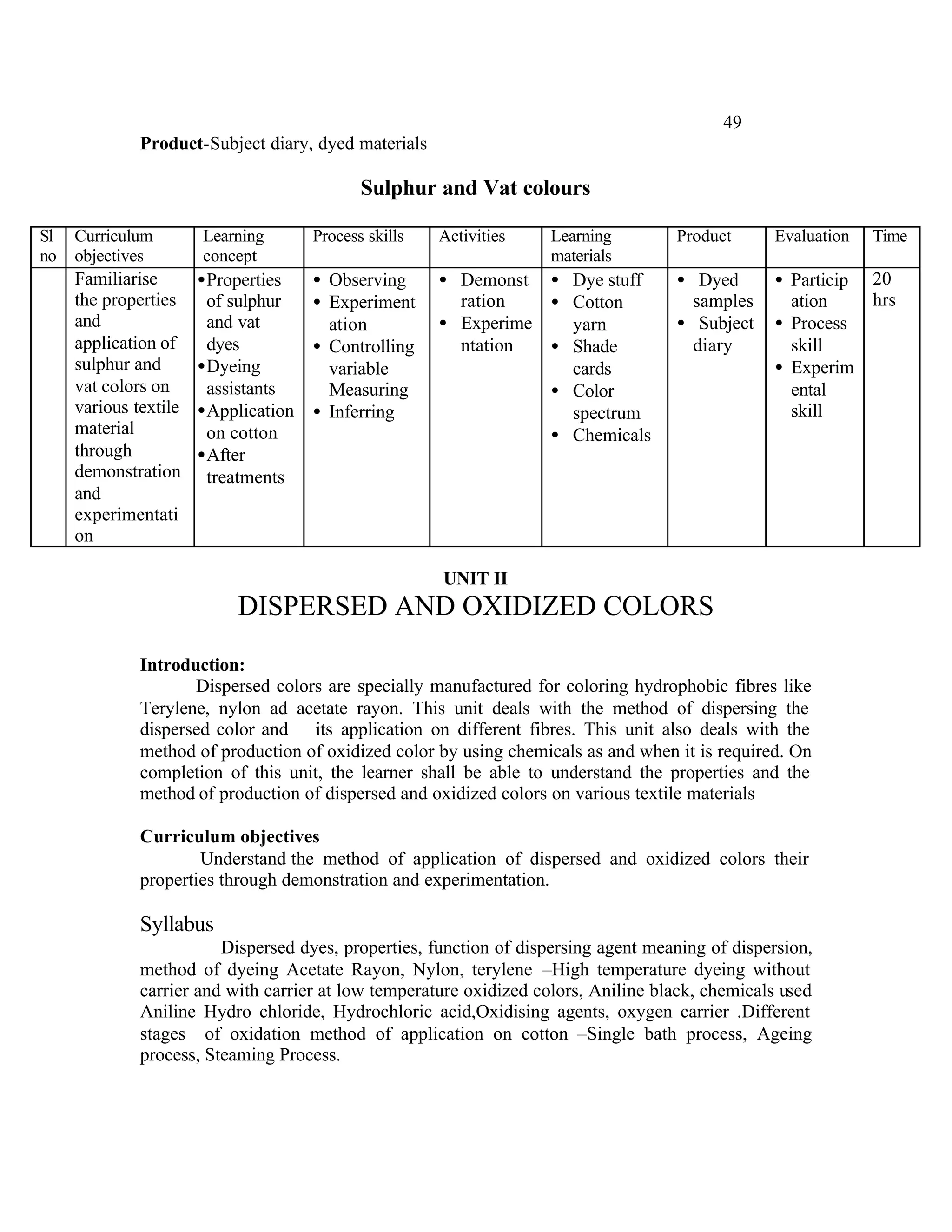
     1.        Sulphur and Vat colours                       46
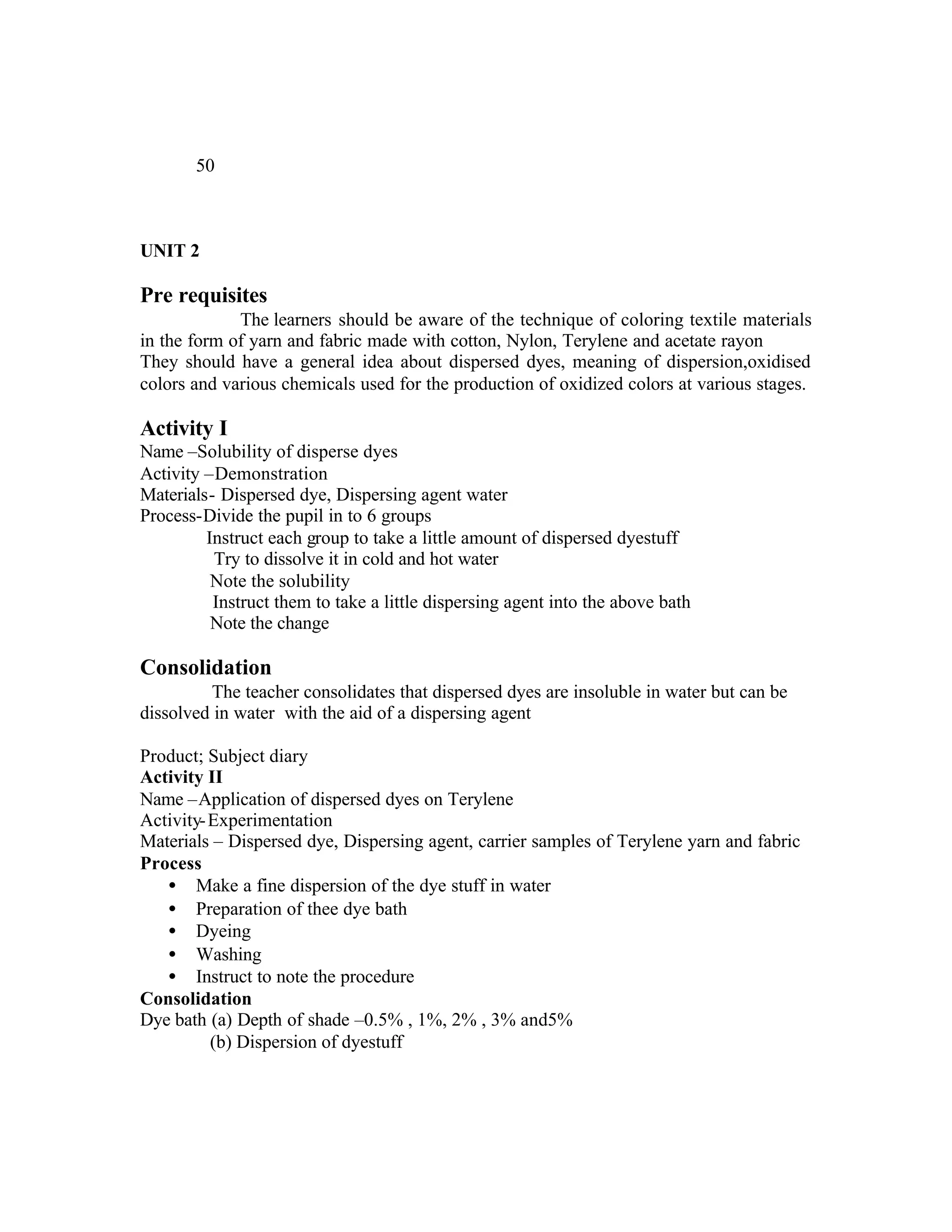
     2.        Dispersed and Oxidised colour                 49
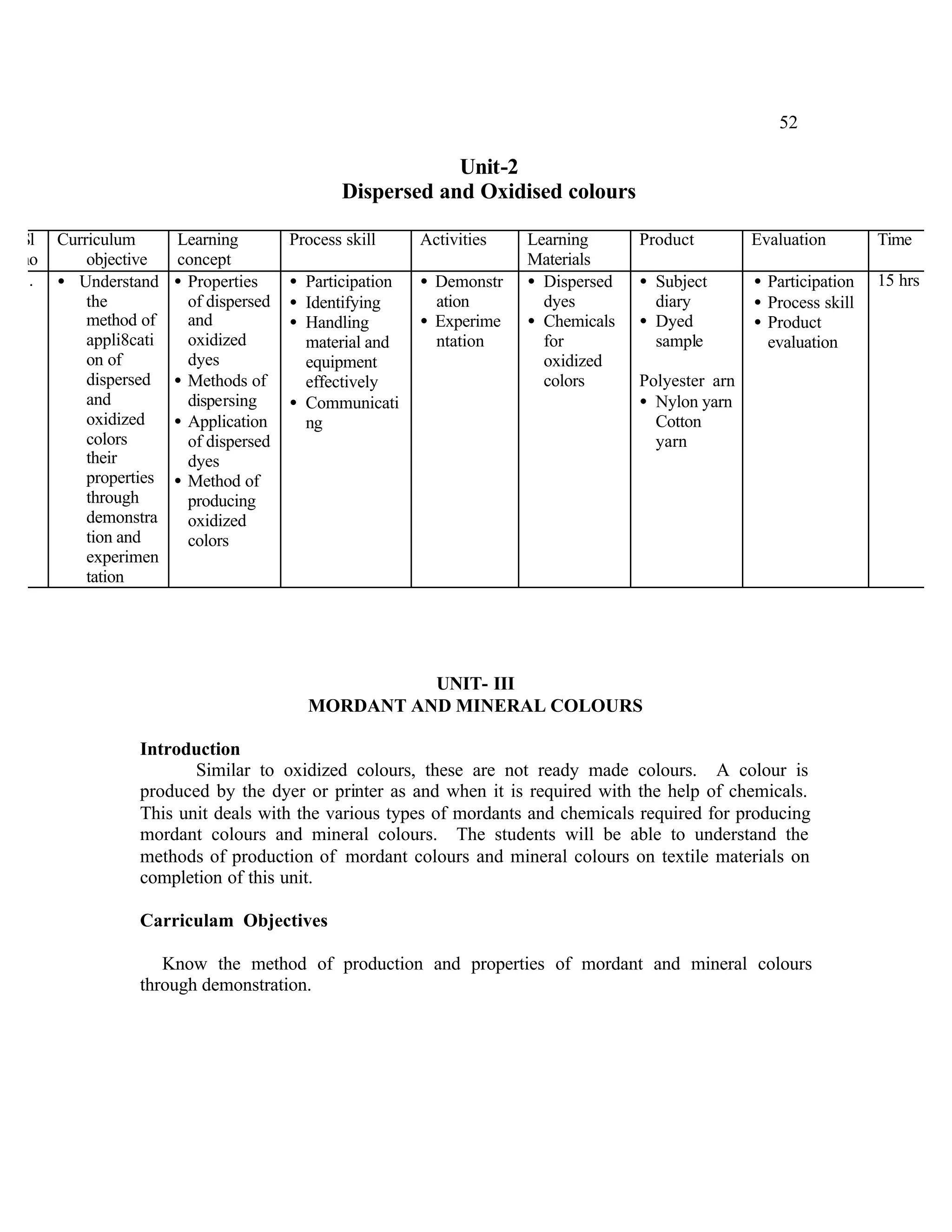
     3.        Mordant and Mineral colours                   52
     4.        Azoic dyes.                                   55
     5.        Introduction to Textile Printing              58
     6.        Methods of Printing                           61
     7.        Styles of Printing                            62
     8.        Recipes for printing and After treatments     66
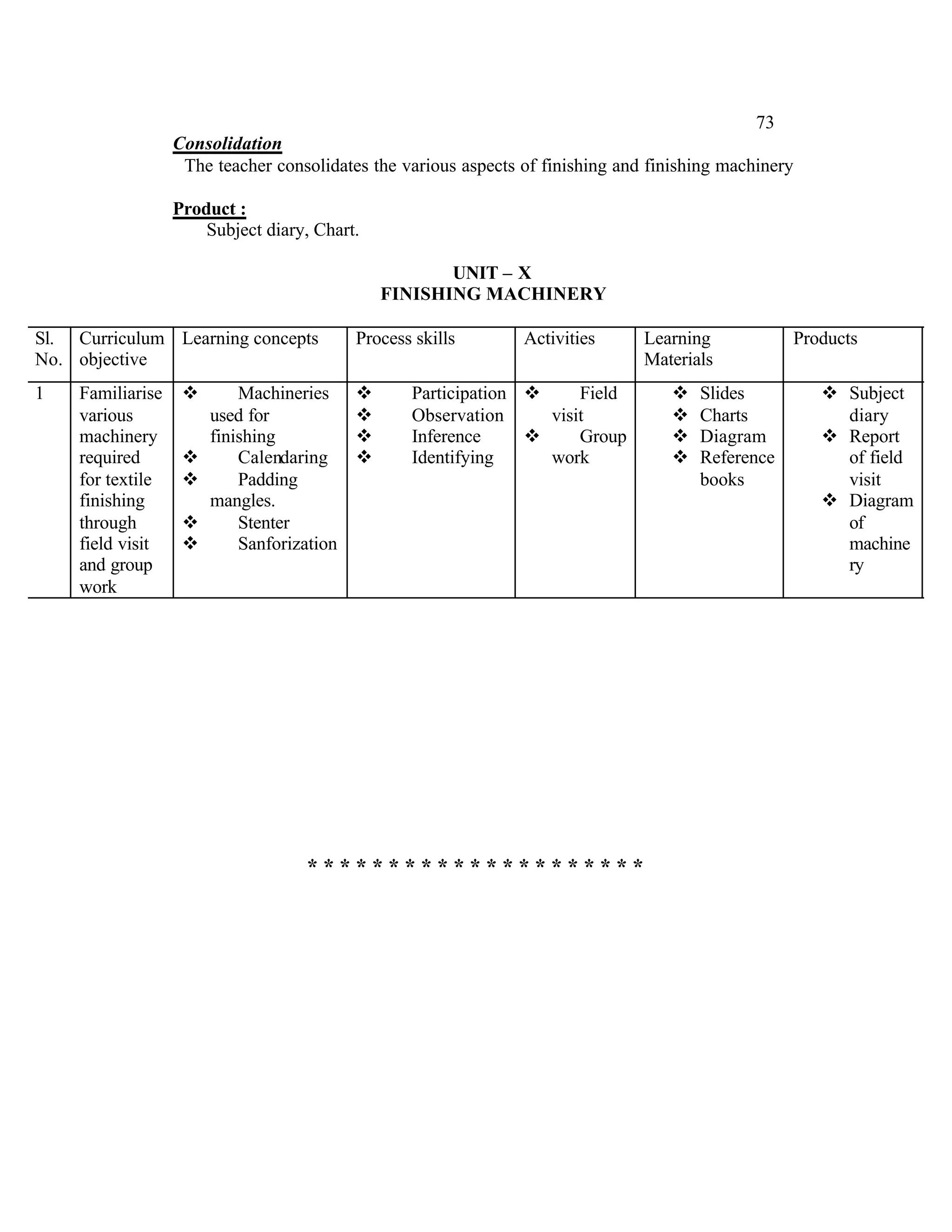
     9.        Introduction to Textile Finishing             69
    10.        Finishing Machinery                           71
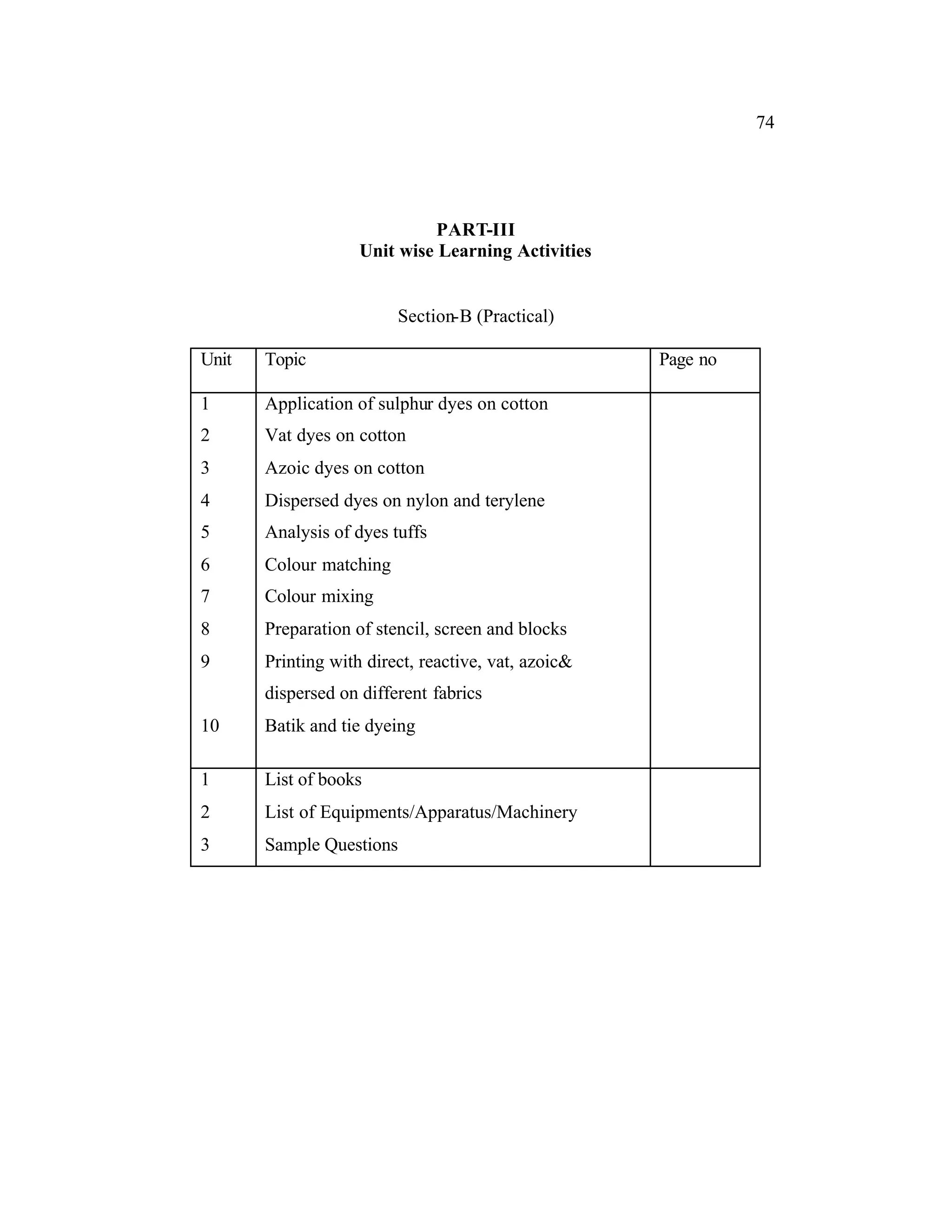
 PART III
(Practical )
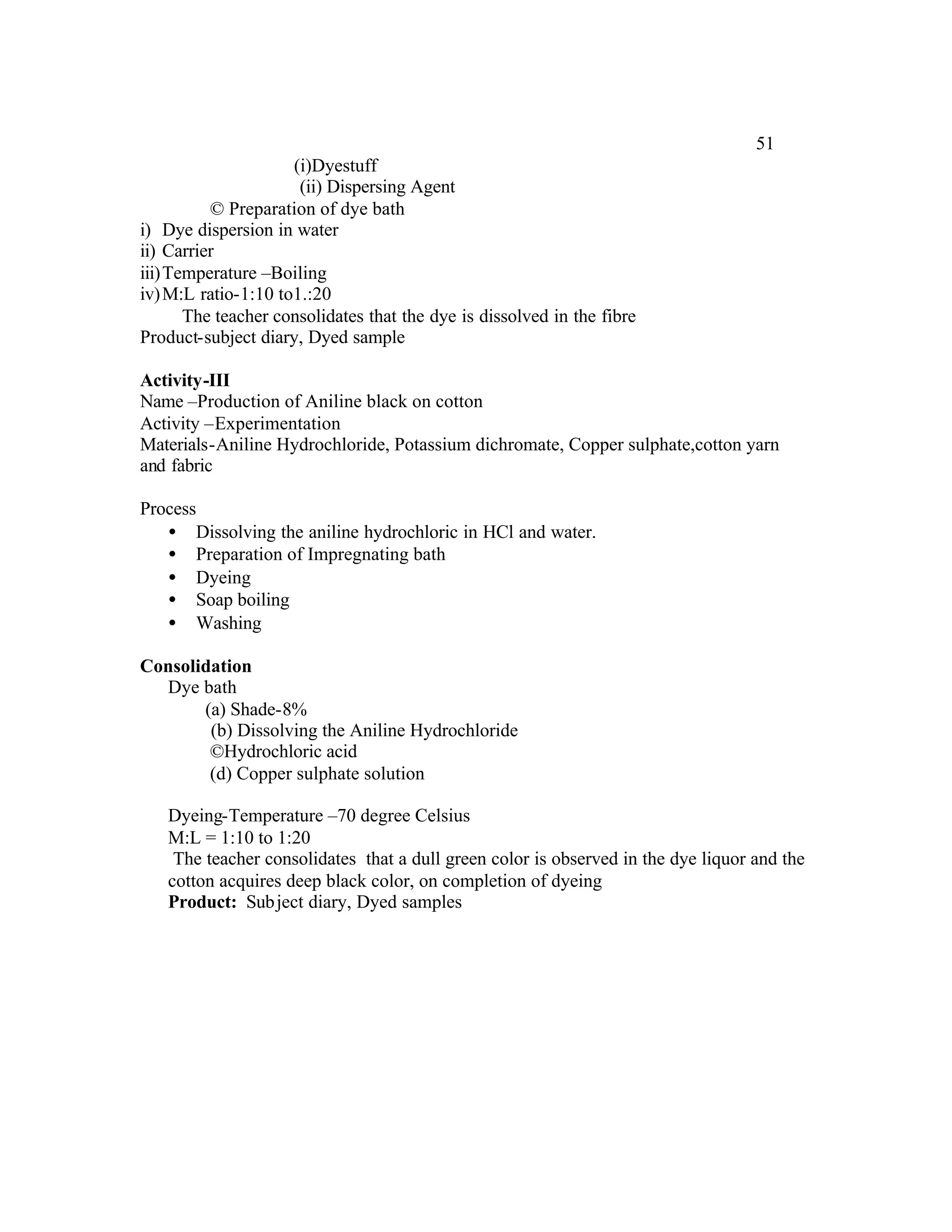
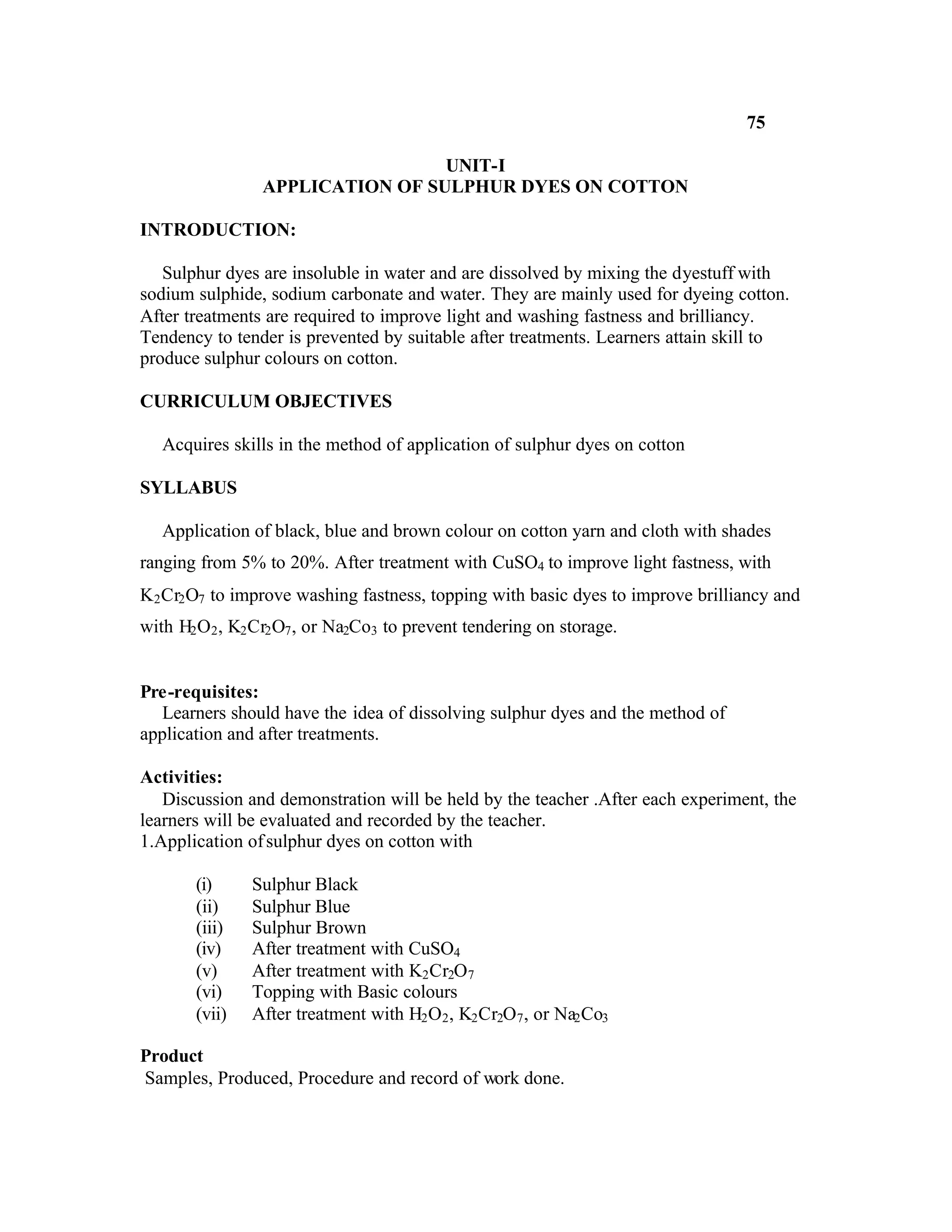
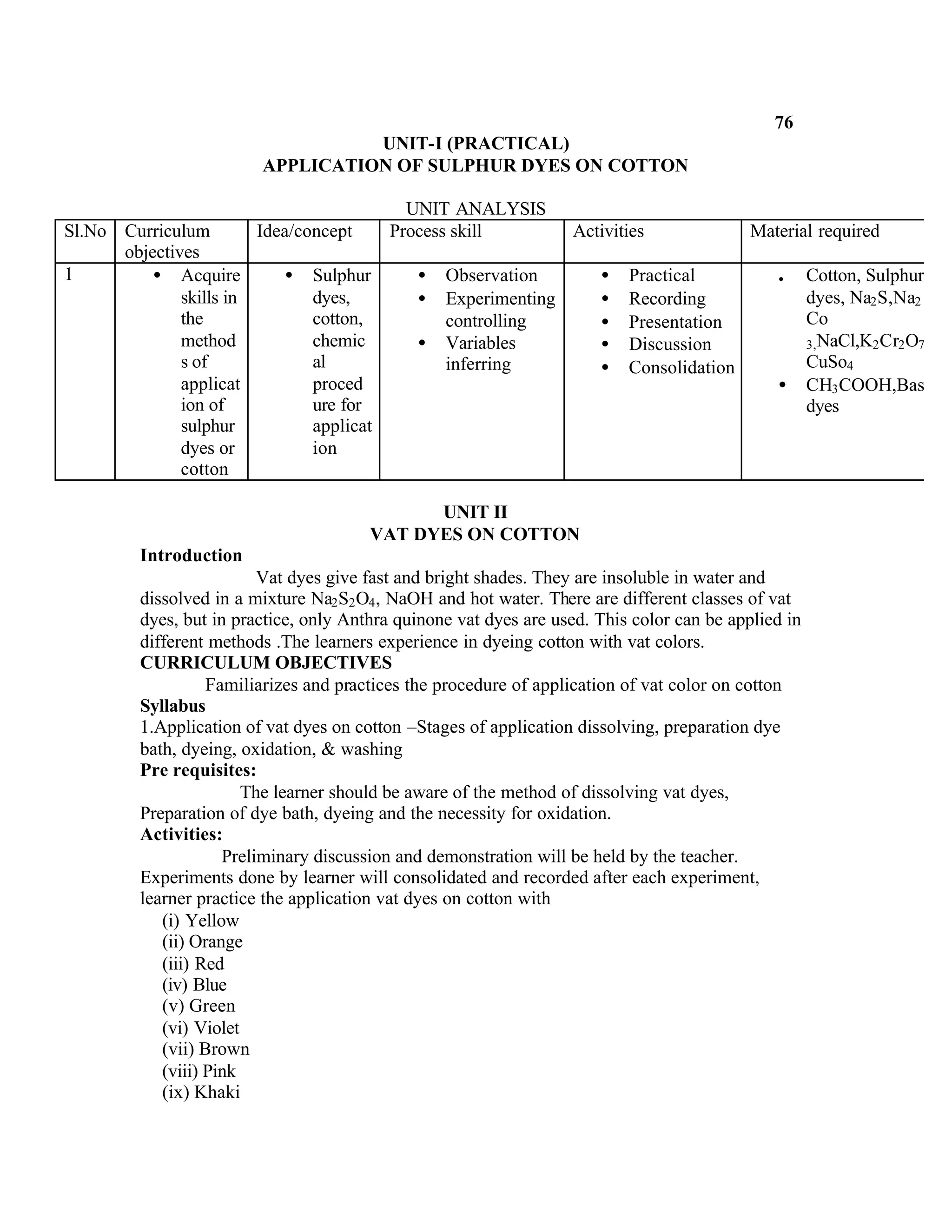
     1.        Application of sulphur dyes on cotton         75
     2.        Vat dyes on cotton                            76
     3.        Azoic dyes on cotton                          77
     4.        Dispersed dyes on nylon and Terylene          78
     5.        Analysis of dyestuffs                         80
     6.        Colour Matching                               83
     7.        Colour Mixing                                 84
     8.        Preparation of stencil, Screen and Blocks     86
     9.        Printing with Direct, Reactive, Vat, azoic    87
               and dispersed dyes
    10.        Batik and Tie dyeing                          89
               List of Equipments/Machinery/ Apparatus       91
               Sample Questions                              91
               List of Books                                 95
Textile Dyeing and Printing


                              General Approach


  Introduction
                                                      Opportunities is a service issue of the
                                                   present society. For overcoming this deep
   The ultimate aim of education is human
                                                   crisis, emergenet techniques have to be sorted
refinement. Education should enable the
                                                   out and appropriate researches have to be
learner to formulate a positive outlook
                                                   seriously carried out. It is in the sence that the
towards life and to accept a stand which suits
                                                   content and methodology of Vocational
the well being of the society and the
                                                   Higher Secondary Education have be
individual as well.
                                                   approached.
   The attitude and potential to 'to work' has
determined the destiny, progress and cultural      The Vocational Higher Secondary course was
development ofthe human race. As we all are        envisaged as a part of the National Policy on
aware, the objective of education to form a        Education with the noble idea of securing a
society and individuals having a positive          job along with education. The relevance of
work culture. The educational process              vocational education is very great in this age
expected in and outside our formal schools         of unemployment. This education system,
should      concentrate    upon      inculcating   which ensures a job along with higher
concepts, abilities, attitudes and values in       education, stands aloof from other systems of
tune with these 'work culture.' Hence              education.
vocationalised education c   annot be isolated
from the main stream of education. In anthor           A learning enviornment which ensures
sence, every educational process should be         vocational aptitude, vocational training, basic
vocationalised. However, due to our inability      life skills, competencies related to different
to utilise the resources wisely, scarcity of job   subjects, appropriate va lues and attitudes and
                                                   existential readiness has to be provided here.
Vocational Higher Secondary School -11 Year (Theory)


                                                            oriented, need based vocational curriculum
    The curriculum should be one which
 recognises the specific personality of the                 What is learning?
 learner and should develop it in a desirable
 way. It should provide opportunity to imbibe
                                                           .       Learning is construction of knowledge and
                                                                   so it is a live and continuous mental process.
 novel ideas to follow a ctritical approach and
 for learning through experiences.                         .       Learning is a process of advancement
                                                                   through adding and correcting in the light of
   The competency to transform ones own
                                                                   comparing the new issue with the previously
   resources for the betterment of the society
                                                                   learned concepts.
   and the individual is to be ensured in each
   individual. Training in the sense of                     .      Learning takes place as a part of the
   equality, democratic sense, enviommental                        effort to solve problems.
   consiousness and devotion to the
   constitution is an inseparable factor of the
                                                           .       Learning takes place by assimilating bits
                                                                   of knowledge into ones own cognitive
   cuniculum.                                                      structure.
                                                           .      Learning is not a linear process. It is a
   The need of a systematic curriculum is                         spiral process growing deeper and
prevailing in vocational subjects. A                              wider.
scientifically     structured     curriculum               .      Learning is an intellectual process rather
incorperating the unique features peculiarity                     than the mere memorisation of facts.
of Kerala ensuring the possibility of higher                      Learning is a conglomeration of a
education and utili sing the national and                         variety activities like problem analysis,
international possibilities of employment is                      elucidation, critical thinking, rational
required.                                                         thinking, finding out co-relations,
    The new curriculum should be capable of                       prediction, arriving at conclusions,
assimilating the life skills, scientific temper,                  applications,     grouping    for    other
attitude of co-existence, leadership qualities                    possibilities and extracting the crux.
and mental health to face the challenges                          When opportunities are proviced for
oflife. It should be capable of strengthening                     intellectual processes learning will
the competencies imbibed by the learners up                       become effective and intellectual ability
to the tenth class.                                               will get strengthend.
                                                           Theoretical foundations of learning

                                                                Education is the best device that can be
4


                                                                       Textile Dyeing and Printing

adopted for creation of a new society. It
                                                         It is high time that education was
should be democratic in content and process
                                                      recognised on the basis of the
and should acknowledge the rights of the
                                                      philosophy of human education. The
learner. It should also provide opportunity
                                                      human approach to education has to
for better citizenship training. The concept
                                                      reflect in its content, learning process
of equality at all areas should             get
                                                      and outlook. The perspective of 'learning
recognition in theory and practice.
                                                      to be' and learning to live together as
   There should be consious programme of              expressed by the UNESCO and the
action to develop nationality, humaness and           concepts of existentialist intelligence
love and against the enchroachment of the             intrapersonal     and       interpersonal
sectarianism of caste and religion.                   intelligence.

                                                          The basis of new approaches on
   The learner should be able to take finn            curriculum, teaching-learning process are
steps and deferred against the social crisis          derived from the developments place in the
like      privatisation,      liberalisation,         east and west of the world.
globalisation etc and against all kinds of               When we begin to see the learner at the
dominations.                                          centre of the learning process, the teaching
   They should develop a discrimination to            process has to be changed timely. It is the
use the acquired learning as a liberative             result ofthe rapid growth and development
weapon.                                               of Science and Technology and Pedagogy. If
                                                      we want to undergo the changing process,
They should get opportunity to recognise              we have to imbibe the modem hypothesis
that co-operation is better than competition          regarding learner, they have;
and that co-operation is the key to social life
and culture
                                                      •       Great curiosity
   A basic awareness of all the subj ects
                                                      •       Good Imagination
needed for life essential for all students.
                                                      •       Numerous other qualities and
   The remnants of perspectives formed
                                                              interest
in us during the colonial period still
                                                      •       Independent individuality
influence our educational philosophy.
                                                      •       Interest in free thinking and
The solution to the present day
                                                              working in a fearless atmosphere.
perplexities of the society which
                                                      •       Have interest in enquiring and
approaches education on the basis of
                                                              questioning
competitions and marketisation is only a
                                                      •       Ability to reach conclusions after
comprehensive view of life.
                                                              logical thinking.
5


Vocational Higher Secondary School -II Year Theory)


•    ability for manifest and establish                   •   To classify
     freely the conclusions arrived at.                   •   To measure and prepare charts
•    Interest for recognition in the society.             •   To experiment
•    Determination to face the interference
                                                          •   To predict
     of society and make components which
                                                          •   To recognize and cont6rol the
     is a part of social life.
                                                              variables
When we consider the learning system,
                                                          •   To raise questions
the domains to be stressed in education
                                                          •   To generalize
according to the modem development
                                                          •   To form a hypothesis and check.
becomes relevant.
The knowledge domain consists                             •   To conclude
                                                          •   To communicate
•    Facts
                                                          •   To predict and infer
•    Ideas
                                                          •   To use tools
•    Laws
                                                          •   Observation         is the process of
•    The temporary conclusions and
                                                              acquiring knowledge through the
     principles used presently by
                                                              senses.      It      ispurely     objective
     scientists.
                                                              oriented.         Learning      experiences
   The learning is a process. The                             which provide the opportunity to use
continuous procedures we undergo to                           all the senses may be used.
reach a particular goal is process. The
                                                              The process of grouping is known
skills which are parts of the process to
                                                              as classifying. Starting from simple
analyse the collected ideas and proofs
                                                              groupings of data, it can extend to
and come to a conclusion is called
                                                              the level of classification into
process skills. Some important process
                                                              minute subgroups.
skills are,
The skills;                                               In addition to this, consider the skills
• To observe                                              related to creative domain also, they are
•    To collect data and record                           skills:
                                                          • To visualize
                                                                 To connect facts and ideas in new
                                                                                              ways
6


                                                            Textile Dyeing and printing


•   To findout new and uncommon uses               •   Take the help of scientific process
                                                       to solve the problems of daily life
    of objects                                     •   Choose a scientific life style
•   To fantasize                                   •   Connect the ideas acquired with
•   To dream                                           other subjects
•   To     develop     creative    isolated        •   Integrate the subjects with other
    thoughts                                           subjects
Creativity is involved in finding out                  Some basic stands have to be taken
problems, formation of hypothesis,                     on the new scientific knowledge
finding' solutions' to problems etc.                   about intelligence learning and
Through activity oriented learning                     teaching. When such basic concepts
experiences, opportunities to express                  are accepted changes are required in
again, the following factors consisting in             the following factors
the Attitudinal domain                             •   The vision, approach, structure and
•   Self confidence                                    content of the curric ulum.
•   Love for scientific knowledge                  •   The vision, approach, structure and
•   Attitude to know and value history                 content of the textbooks.
•   Respect human emotions                         •   Role of the teacher and the learner
•   Decide     with   reasonable     present       •   Learner      atmosphere,      learning
    problems                                           materials and learning techniques.
•   Take logical decisions regarding               Some scientific pespectives accepted by
    personal values                                modern world in educational psychology
   'Hypothesis'    is    a    temporary            are given below.
conclusion drawn using insight. Based              Constructivism This approach puts
on knowledge and experiences relating              forward the concept that the learner
to the problems the causes and solutions           constructs knowledge. New knowledge
can be guessed                                     is constructed when ideas are examined
As regards the application domain the              and practiced in new situations relating
important factors are the ability to :             them with the previously acquired
                                                   knowledge and experience. That is
                                                   assimilated into the congnitive structure
•   Observe in daily life examples of              of one's knowledge. This method which
    ideas acquired
,
              7


Vocational Higher Secondary School-II Year (Theory)


                  gives priority to critical thinking and proble solving   probing for other possibilities, extracting the crux
                  provides opportunity for self motivated learning.        and other processes are of critical importance in
                  Social Constructivism                                    learning.

                                                                               Constructivism          gives         greater
                     Social constructivism is a sub section of
                                                                  predominance                to co-operative learning.
                  constructivism. Knowledge is formed, spread and
                                                                           Social and cultural factors influence learning.
                  imbibed and it becomes relevant in a social
                                                                           Sharing of knowledge and experience among
                  enviomment. Interactive learning, group learning,
                                                                           learners, collective enquiry, assessment and
                  co-operative participatory learning, all these are
                                                                           improvement,         group      activity     and
                  concepts put forward by social constructivism.
                                                                           collaborative       learning,     by     sharing
                     The main propounders of constructivism are            responsibilities with the objective of public
                  piaget, vygotsky and Bruner.                             activity, provide opportunity for effective
                      Discovery learning and interactive                   learning.
                  learning have prime importance. Learning                      In learning internal motivation is more
                  takes place as a part of the attempt for                   important than external motivation. The
                  problem solving. The activities of a learner               learner should have interest and initiative in
                  who confronts cognitive disequilibrium in a                learning. Learning situation should be
                  learning situation when he tries                           capable of forming a sense of ownership in
                  to overcome it is leades to the renewal of                 of the learner regarding the learning process.
                  cognitive structure. It is through this process               Learning is not a linear process. It
                  construction of new knowledge and the                      progresses in a spiralled way advancing
                  assimilation of them that learning take                    deeper and wider.
                  place. Observation and enquiry are                         Learner-his nature and features
                  unavoidable factors.                                        The learners in standard XI has undergone
                  The learner advances towards new areas of                a learner centered and process oriented
                  acquisition of ~owledge where he tries to                learning experience up to X standard. He is
                  compare his new findings with the existing               adequately competent to select vocational
                  conceptions.                                             subjects according to his aptitude and interest
                     Learning is a live mental process. Rather             and to acquire higher education and
                  than the ability for memorisation of facts               profession as he wishes. The aspirations
                                                                            .
                  cognitive process has to be given emphasis.              about future life is framed in this particular
                  The process of problem analysis, elucidation,            age foreseeing national and international job
                  critical thinking, rational thinking, finding            oppurtunities. Some of the peculiarities of
                  out co-relation, prediction, hypothesis                  the learner at this stage are:
                  formation, application,
8
                                                      •   Sharer of information.

    •   Physical, intellectual and emotional          •   Share of responsibilities
        planes are intensive changes during
        this age and their reflections can be         •   Collects information
        observed.
                                                      •   Takes leadership
    •   Ability to enquire, discover and
        establish cause-effected relationship         •   Involves in group work.
        between phenomena.
                                                      •   Acts as co-participant
    •   Readiness to undertake challenges.
                                                      •   Observes his environment
    •   Capacity to shoulder leadership roles.
                                                      •   Experiments and realises
    •   Attempt to interpret oneself.
                                                      •   Makes interpretations and draws
    •   Susceptibility to different pressecures.          inferences.

    •   Doubts, anxities and eagerness about       Role of the Teacher
        sex.
                                                   The teacher should :
    •   Lounging for social recognition
                                                      •   Consider the ‘Stress and Strain’ of the
Needs of the learner                                      teenagers

    •   To make acquaintance with a job               •   Understand the socio-economic and
        through vocational education                      cultural background of the students.

    •   To acquire more knowledge in the              •   Promote and motivate the students to
        concerned area through higher                     construct knowledge.
        education
                                                      •   Arrange proper situatio n to interact in
    •   To recognize and encourage the                    an outside of the classroom
        peculiar personality of the later
        adolescent period.                            •   Guide the students by explanations,
                                                          demonstrations etc.
    •   To enable him to defend against the
        unfavourable circumstances without            •   Promote opportunity for co-operative
        any help.                                         learning and collaborative learning.

    •   Role of the learner                           •   Facilitate the interpersonal and intra-
                                                          personal interactions
    •   Active participation in the learning
        process.                                      •   Acts as a democratic leader

    •   Acts as a researcher                          •   Acts as a problem solver
9


                                      -
    Vocational Higher Secondary School 11 Year (Theory)


    .   effectively guide the students for the
                                                      .       he a good organiser, guide, friend,
        selection and conduct of various                      philosopher and co- learner:
        continuous evaluation elements.               .
    .    continuously evaluate the progress of
                                                              have an inter disciplinary approach in
                                                              learning activities.
         the learners.                                .
    .    gives scaffolding/support        wherever
                                                              be able to guide the learner in his/her career
                                                              prospects based on his interest aptitude and
         necessary.                                           ability.
    .                                                     .   be     impartial           and
    .    motivate for learning
         promote divergent
                                                          .   democratic.

    .    thinking.democratic group leader.
                                                              provide ample experiences to attain the

    .    act as a                                             basic values and objectives of the
                                                              curriculum.
    .    act as a co-learner
         gives        variety       oflearning        New Concepts of Learning
    .                                                     1. Discovery Learning
    .    experiences. be a constant student
         facilitate     for     reference/data          The teacher has to create a motivating
    .    collection
         have a clear under standing about the      atmosphere for the learner to discover
         age, needs, peculiarities, abilities,      concepts and facts, instead of listening
         nature, aptitude etc. ofthe learner.       always. Creating occasion to progress
    .    have the ability to motivate the learner
                                                    towards discovery is preferred. Instead of
                                                    telling everything before and compelling to
         in order to acquire and enrich their initiate the models, situations are to be
    .    knowledge.                                 created to help the children act models as
         be a guide to the learner in developing themselves.
         insights and creating responses on 2. Learning by discussion
    .    current affairs.
                                                      That discussion leads to learning is
    •    be capable to lead the learner into a
                                                  Burner's theory. Here discussion is not
         variety oflearning methods and process
                                                  opposing each other. It is a sharing on the
    .    based on curricular objectives.
    •    be a link between school and             plane of ideas. New ideas are arrived at by
         community.                               seeking explanations, by mutual giving and
                                                  taking of ideas and by problem solving.
10                                                                               Textile Dyeing and Printing


     3. Problem solving and learning
                                                            a plane of social system in learning also. As
        Only when the learner feels that some thing is      there are no high ups and low ones according
     a problem to be solved that he takes the               to status among the learners they can ask the
     responsibility of learning it. It is an inborn         fellow students doubts and for helps without
     tendency to act to solve a problem that causes         any hesitation or in hesitation Care should be
     cognitive disequilibrium in a particular area. It is   taken not to lead this seeking of help to
     also needed to have confidence that one is             mechanical copying. It should be on the basis
     capable of doing it. The problems are to be            of actual needs. So even while encouraging
     presented in consideration of the ability and level    this exchange of ideas among the members
     of attainment of the learner.                          of the group cautions acceptance is to be
                                                            observed as a convention. There should be an
     4. Collaborative learning
                                                            understanding that satisfactory responses
         This is the learning in which the                  should come from each member and that the
     responsibilities are distributed among the             achievement of the group will be assessed on
     members of the group keeping common                    the basis of the achievement of all the
     learning      objectives.   The      common            members
     responsibility of the group will be successful
     only if each member discharges his duties.             6 Zone of Proximal Development
     All the members will reach a stage of sharing
                                                               Vygotsky observes that these is a stage of
     the result oflearning, equally through the
                                                            achievement where a learner can reach by
     activity with mutual understanding. The
                                                            himself
     teachers who arrange collaborative learning
                                                            and another higher zone where he can reach
     will have to make clear the responsibilites to
                                                            with the help of his teachers and peers and
     be discharged. This is possible through the
                                                            elders. Even though some can fulfil the
     discussion with the learners. Collaborative
                                                            learning activity by themselves there is the
     learning will help to avoid the situations of
                                                            possibility of a higher excellence. If
     one person working for the whole group.
                                                            appropriate help is forth covering every
     5. Co-operative learning                               learner can better himself.

        This is the learning in which the learners          7 Scaffolding
     help one another. Those who have more
                                                               It is natural that the learner may not be
     knowledge, experience and competency, will
                                                            able to complete his work ifhe does not get
     help others. By this exchange of resources
                                                            support at the proper time. The learner may
     the learners develop
                                                            require the help of the teacher in several
                                                            learning activities. Here helping means to
                                                            make the learner complete
11

      Vocational Higher Secondary School-11 Year (Theory)


     the activity taking responsibility by himself The        .   Epitomising      in    one
     teacher has to keep in mind the objective of
                                                                  word.
     enabling the learner to take the responsibility and
     to make it successful.                                  .    Giving titles and so on.

                                                             .    Symbols, performance of characters
     8 Learning: a live mental process
                                                                  indications, lines of a poem, tables, pictures,
        Learning is a cognitive process, only a                   concepts, actions, body language and such
     teacher who has an awareness as to what the                  things can be given for interpretation.
     cognitive process is alone can arrange                       Process based language given for
     learning situations to the learner to involve                interpretation. Process based language
     in it. Learning can be made effectively and                  learning has to give prime importance to the
     intellectual sharpness can be improved by                    cognitive process.
     giving opportunity for the cognitive                     9 Internal motivation
     processes like reminding, recognising
                                                                Internal motivation is given more
     compromising, co- relating, comparing,
                                                             importance than external motivation. The
     guessing, summarising and so on. How is
                                                             teacher has to arouse the internal motivation
     cognitive process considered in language
                                                             of the learner, A person internally motivated
     learning? Take guessing and prediction for
                                                             like this alone can immerse in learning and
     example.
                                                             own its responsibility. How motivating is
       .    Guessing the meaning ITom the context.
                                                             each of the activities is to be assessed.

       .    Guessing the content ITom the heading.           10 Multiple intelligence
       .    Predicting the end of the story.                    The Theory of Multiple Intelligence put
       .    Guessing the incident, story from the            forward by Howard Gardener has created a
                                                             turning point in the field of education. The
            picture                                          National     cmriculum      document      has
       .   Guessing the facts from medications.              recommended that the curriculum is to be
       . and other such activities can be                    designed taking into consideration of this
           given the following activities can
                                                             theory.
           be given for the cognitive
           process of summarisation.                         Main factors         of    the
       . Preparation of blue print.                          intellect:

       . Preparation of list.                              1. Verbal/linguistic Intelligence

      . Preparation of flow chart.                            Ability to read and write, making
                                                           linguistic creations, ability to lecture
                                                           competence effective
12


                                                                               Textile Dyeing and Printing


      a communication, all these come under this.         initiating the songs of musicians, listening
      This can be developed by engaging in                silently to the rhythms and activities like this
      language games and by teaching others.              are capable of developing this area of
                                                          intelligence.
      2. Logical/mathematical Intelligence
                                                          6 Interpersonal Intelligence
         Thinking rationally with causes and effect
      relation and finding out patterns and                  Those in whom this area of intelligence is
      relations come under this area, finding out         developed show qualities of leadership and
      relations and explaining things sequential          behave with others in a noble manner. They
      and arithmetical calculations are capable of        are capable of understanding the thought of
      developing this area of intelligence.               others and carrying on activities like
                                                          discussion successfully.
     3. Visual/spatial Intelligence

        In those who are able to visualise models and     7 Intrapersonal Intelligence
     bringing what is in the imagination into visual
                                                             This is the ability to understand oneself.
     form and in philosophers, designers and
                                                          These people can recognise their own
     sculptors this area of intelligence is developed.
                                                          abilities and disabilities. Writing diaries
     The activities like modelling using clay and pulp,
                                                          truthfully and in an analysing way and
     making of art equipments, sculpture, and giving
                                                          assessing the ideas and activities of others
     illustrations to stories can help the development
                                                          will help developing this areas of intelligence
     of this ability.
                                                          8 Naturalistic Intelligence
     4 Bodily Kinaesthetic Intelligence
                                                             A great interest in the flora and fauna of
        The activities using body language come
                                                          the nature, love towards fellow beings
     under this. This area of intelligence is more
                                                          interest in spiritual and natural factors will be
     developed in dancers and actors who are able
                                                          capable of developing this area.
     to express ideas through body movements
     and in experts in sports, gymnastics etc.            9. Existential Intelligence

     5 Musical Intelligence                                           The ability to see and distinguish
                                                          ours own existence as a part of the universe,
          This is an area of intelligence which is
                                                          ability to distinguish the meaning and
     highly developed in those who are able to
                                                          meaninglessness of life, the ability to realise
     recognise the different elements of music in
                                                          the ultimate nature of mental and physical
     musicians and in those who can here and
                                                          existences, all these are the
     enjoy songs. Playing musical instruments,
13


     Vocational Higher Secondary School   -11Year (Theory)

     Peculiarities of this faculty of intelligence.            .       Training in finding reasons for problems.
     Emotional Intelligence                                    .       Suggesting solutions through individual or
        The concept of emotional intelligence put                      group efforts.
     forward by Daniel Golman was used in framing              .       Discussing social
     the new curriculum. The fact that one's                           problems.
     Emotional Quotient (E.Q) is the greatest factor           .       Analyzing the shortcomings in methods
                                                                       to Solve problems.
     affecting success in life is now widely accepted.
     The teacher who aims to focus on improving the
                                                                      Whether plastic can be banned within school
     emotional intelligence of students need to
                                                                   premises can be given as a problem. Group
     concentrate on the following.
                                                                   discussion will provide reasons and solutions.
     i) Ability to take decisions                                  Problems which can influence classroom
                                                                   learning and for which the learner can actively
        Rather than imposing decision on
                                                                   contribute solutions need to be posed.
     students while planning and executing
     activities, the students may be allowed to
                                                               .     Self criticism, evaluation
     take part in the decision making process.                       Ability to face problem-situation in life
     Taking decisions through open discussion in
     the class, inviting students suggestions on
                                                               .     Thinking what one would do if placed in
                                                                     the situation of others, how one would
     common problems etc. are habits to be
                                                                     respond to certain experiences of others
     cultivated.
                                                                     All these foster the growth of emotional
     ii) Ability to reach consensus
                                                                     intelligence.
       . When        different    opinions,      ideas   and       iv) Life skills
           positions arise the students may be given
           the responsibility to reach a consensus.                   Life skills need to be given a prominent place

       . Imaging what would be the course of action                in education. W.H.O. has listed ten skills
                                                                   required for success in life.
           in some situtations, allowing to intervene in
           a healthy way in problems between                   .      Self-awareness
           individuals.                                        .      Empathy
     iii) Problem solving                                      .     Inter personal relations
       .    Developing the idea that there is reason and       .      Communication
            solution to any problem.
14                                                            T extile   Dyeing and Printing


•        Critical thinking                             •    To develop the learner to identify and
•        Creative thinking                                  develop his own competencies.
                                                       •    To develop vocational aptitude, work
•        Decision making                                    culture and attitude in the learner so
                                                            as to provide useful products and
•        Problem SOlving
                                                            services to the society.

•        Copying with emotion                          •    To create an awarenss about mental
                                                            and physical health.
•        Copying with stress
                                                       •    To acquire awareness about
The new curriculum addresses these areas.                   different job areas and to provide
                                                            backgrounds for acquiring higher
             Knowing the characteristics of the
                                                            level training in subjects of interest.
learner, role of the teacher and how to use
                                                       •    To develop possibilities of higher
the teachers handbook help the teacher to
                                                            education by creating awareness
plan and effectively implement learning                     about      common         entrance
activities                                                  examinations.

Objectives ofthe Vocational Higher                     •    To provide situation for the
                                                            encouragement of creative thinking
    Secondary Curriculum.                                   and organising training programmes
    • To facilitate higher education                        in each area, creative abilities and
             while   giving opportunity to enter            to develop artistic talents.
             in the field of employment.               Nature of Approach
    •        To develop environmental awareness,          The learning device is to be organized in
             sense of national integration,
                                                       the selected vocational subjects in such a way
             tolerance and human values so as to
             ensure social and cultural                that adequate practical experience should be
        improvement.                                   given, making use of the modem technology.
    • To enable the learner to find on his             The development in each area on the basis of
                                                   •
        own employment                                 information technology is to be brought to
    •

                                                   •
        To inculcate mental courage in the
                                                       the leaner. The work experience in the
        learner to face unfavourable
        situations .                                   respective      fields(OJT,       Field    trip,
    • To make human resource                           Production/Service ..... training, Survey,
        development possible                       •
                                                       Workshop, Exhibition, Youth festival,
      • To enable the learner to understand            Physical fitness etc.) are to be adjusted
         social problems and to react              •
         appropriately.
15


      Vocational Higher Secondary School-II Year (Theory)


     suitable to the learning and evolution process. The    should also be given due weightage. In tune with
     participation and leadership of the students in        the changes in the Vocational Higher Secondary
     planning and execution is to be ensured through        Education changes should be ensured in the field
     this kind of activities. Social service is to be       of higher education.
     made a part of the course.                                The teachers have to take special care in
                                                            arranging learning activities for the
     Approach towards Vocational Higher
                                                            development of all the faculties of
       Secondary Education
                                                            intelligence.
        The learning methodology has to be
     organized so as the learning provide adequate              Learning activities and learning
     practical thinking on the opted vocational                 atmosphere.
     subject utilizing the new technology. The                 A proper learning atmosphere is essential for
     development of information technology                  the betterment of learning activities.
     should be made available in each sector.
     Work experience, OJT, Field trip production,           .They are: physical environment
                                                                Proper
     Service cum training centre, Survey,                   . Healthy mental atmosphere
     Workshops, Exhibitions, Youth festivals,
     Physical fitness etc should be systematised
                                                            .     Suitable social atmosphere

     well appropriate to learning and evaluation.           .     Active participation of PTA, Local bodies
                                                                  and SRG
     Leaner participation should be ensured in the
     planning and implementation of these                   .     Reference materials and visual media
     activities. Social service should be a part of               equipments.
     the course. If a learner has to change his             .     Academic monitoring
     school, he should be provided an opportunity
     to continue his studies in the new school.             .     School Resource Group
     While considering criteria for admission to                  (SRG)
     higher courses, grades of vocational subjects


                            ********************
16


                                        PART-1
                                 Subject wise Approach

  In the first year course of study. coluring of textile materials with soluble group of
dyes were covered. During the second year, dyeing with insoluble colours, Printing and
Textile finishing are to be completed.

   The attractiveness & service ability of the textile materials are improved by dyeing,
printing and finishing. By dyeing, a uniform colour is produced while by printing, it is
possible to produce different coloured patterns on a textile material. Finishing is done in
accordance with the final requirement of the fabric.

    This hand out covers the method of dyeing, printing and finishing of Textile materials,
list of reference books, equipments, apparatus & machinery required.

   The “Textile Dyeing and Printing” courses will help the students to acquire sufficient
skill and practice in the colouring of Textiles. At present, there are a number of vacancies
for textile technicians in the fields of knitting, garment making, fashion designing, dyeing
and printing units. It is hoped that the students completing this course of study will get
gainful employment without any delay in the Textile industries.

                              TEACHING STRATEGIES
LEARNING APPROACH

Learning is the construction of knowledge, and the learning approach of this course is
based on learning to know, learning together and learning to deal.

   Following are the different methods used for the construction of knowledge.
    (1) Discovery learning
    (2) Enquiry learning
    (3) Collaborative learning
    (4) Co- operative learning
    (5) Social Culture learning
    The learning approach should stimulate the multiple intelligence and E:Q of students.
    Learning should be learner centered and problem related. The role of teacher is to
    facilitate the learning process, by orating knowledge in the learner.

   Need of New approach

      Students can develop knowledge to select Textile materials for Dyeing Printing and
   finishing develop skills to handle equipments machinery, tools, testing
17
   instruments etc which are required for colouring. Technical aptitude, discovery
   learning and group working skills of students will be enhanced as detailed below.

       i)       Improve the ability to analyse
       ii)      Enhance the curiosity
       iii)     Familiarize to use the tools, equipments, machinery and testing
                instruments
       iv)      Provide skills to face technical problems related to the subject
       v)       Improve the skills for communication and convey the knowledge to the
                society.

   Role of Teachers

     Teacher is the person to give motivation to the students. For this, the teachers
   should be

       i)       A good communicator
       ii)      A facilitator for learning
       iii)     A good evaluator
       iv)      A good organizer
       v)        Able to understand the limitation of students
       vi)      A good guide
       vii)     Able to raise the leadership abilities of students
       viii)    An authority in the subject
       ix)      A good observer
       x)       A resource manager
       xi)      A systematic record keeper
       xii)     A good counselor
       xiii)    Practically competent
       xiv)     A self evaluator
       xv)      Able to create awareness in social problems
       xvi)     A professional and philosopher
       xvii)    Able to keep up moral values
       xviii)   Impartial
       xix)     Optimistic

Role of students

       i)       Data collection from Textile Industries, Research Industries, selling outlets
       ii)      Express their views related to the data collected
       iii)     Hold discussions, seminars and Industrial visits with the active
                participation of faculty members and Research Institutions.
       iv)      Prepare project reports on selected topic with an aim to start a small scale
                industry in Textile dyeing , printing and Finishing

Teaching aids
18
       i)      Text books, Reference books, Source books.
       ii)     Charts, slides, Diagrams
       iii)    Teaching notes, observation notes, Seminar and Project report.
       iv)     Laboratories and workshops
       v)      Textile Industries, Research institutes, Polytechnics
       vi)     Study tours, exhibitions
       vii)    Journals
       viii)   Library and Internet
       ix)     Discussion, Seminars

Learning strategies

   Important learning strategies are experiments, discussions, debates, seminars,
Drawings, Model Preparation, Specimen Collection, quiz, exhibition and field visit. The
overall performance of students are improved which include the skills, leadership,
research mentality etc.

Experiments

   It is an important learning strategy. teacher has to give the guide lines regarding the
experiments and demonstrate the required instruments.
18

 Students can be either permitted individually or in groups. Most of the topics in Textile
Dyeing, Printing and Finishing require experiments, which will be conducted
simultaneously with the engagement of theory of related topics.

Discussions, Debates, Seminars

   Particular topics for the above are selected and are held under the guidance of the
faculty members and subject experts from out side. Learner centered seminars guided by
experts in Textile Field have to be conducted.

Drawings, Model Preparations, Specimen Collection

  Preparation of drawings and models required for the curriculum are to be prepared.
Collection of specimens from selling outlets, industries and research institutions are to be
made and the quality particulars are to be noted.

Exhibition, quiz

   Exhibition of the products manufactured by dyeing, Printing and finishing has to be
done, the manufacturing details to be noted in detail. Individual/group quiz will help to
update knowledge on selected topics under the guidance of faculty members or subject
experts.
19
Field visits

   It is necessary to conduct a number of local visits to industries related to Textile,
dyeing, Printing and Finishing. One or two study tours are to be conducted to cover the
major industries outside the state. Field visits help the students to acquaint with the most
modern techniques adopted in Textile Industries for Textile Dyeing, Printing and
Finishing.

Project work

   Project work help to develop interest in learning and ensure the active participation of
the students. Each student should be assigned with a project work, either alone or as a
group guided by the teacher and the report of work done should be submitted at the end
of the year.
   The structure of the project report should contain.

               1. Project title
               2. Name of student/students
               3. Branch/School
               4. Certificate
               5. Preface
               6. Introduction
               7. Survey
               8. Need for the Project
               9. Existing market Potentiality
               10. Site for the Project
               11. Plan and layout
               12. Product Manufacture
               13. Equipments/tools/machinery required
               14. Consumables required
               15. Staff and labour pattern
               16. manufacturing Process
               17. Marketing
               18. Profit and loss account
               19. Conclusion

        Some of the project work which can be assigned to the Textile Dyeing and
Printing Students are:

               1.   Setting up a small scale dyeing unit
               2.   Dye a minimum of 1 meter of fabric with each class of dyestuff.
               3.   Prepare a chart of different combinations of naphthols and bases.
               4.   Produce fancy designs on a sari fabric by way of tie and dye method.
               5.   Produce fancy design on a sari fabric using the batik method of
                    printing
19

            6. Produce fancy design on a bed sheet fabric using Azoic style.
            7. Produce a fancy design on a curtain fabric using different methods of
               direct style of application
            8. Set up a small scale printing unit.
            9. Prepare the lay out for processing a fine dhothi from a suitable grey
               cotton cloth .

                          CURRICULUM OBJECTIVES
                                (THEORY)

1. Familiarize the properties and application of sulphur and vat colours on various
    textile materials through discussion, experimentation and observation.
2. Understand the method of application of dispersed and oxidised colours, there
    properties through demonstration and experimentation.
3. Know the method of production and properties of mordant and mineral colours
    through demonstration.
4. Familiarize the production of different azoic colours by using suitable napthol
    and diazotised bases through demonstration and experimentation.
5. Differentiate Dyeing and Printing, preparation of various textile materials for
    printing and developing an idea about the ingredients required for the preparation
    of printing paste by discussion and observation.
6. Understand various methods of printing and machines used for printing. Through
    discussion and field visits.
7. Know the various styles for the application of printing paste by discussion, and
    experimentation
8. Understand the preparation of various recipes for different colours and materials
    and the object of after- treatments through demonstration and group work.
9. Identify and classify the different types of finishes required for different classes
    of textile materials by discussion and field visit.
10. Familiarise various machinery required for textile finishing through field visit and
    group work.

                         CURRICULUM OBJECTIVES
                              (PRACTICAL)

1.   Acquires skills in the methods of application of sulphur dyes on cotton.
2.   Familiarises and practises the procedure of application of vat colours on cotton.
3.   Knowledge and skills are acquired for the production of azoic colours on cotton.
4.   Practises the procedures for the application of dispersed dyes on nylon and
     Terylene.
5.   Analyses and identifies the soluble/ insoluble group of dyes.
6.   Skills are achieved by matching different coloured samples.
7.   Identifies different colours produced by mixing different dyes.
8.   Acquires skill and practise to make stencil, screen and blocks.
20

   9. Practises to print designs with Direct, Reactive, vat, azoic and dispersed colours
       on cotton, wool, silk, nylon and treylene.
   10. finding out the various patterns produced by batik and Tie dyeing.

                            TEXTILE DYEING & PRINTING
                                     (II YEAR)
                                 TIME SCHEDULE

Theory: 160 Hours
           Unit no    Name of unit                                 Hours
           1          Sulphur and vat colours                      20
           2          Dispersed and oxidised colours               15
           3          Mordent and mineral colours                  10
           4          Azoic dyes                                   20
           5          Introduction to textile printing             10
           6          Methods of printing                          20
           7          Styles of printing                           10
           8          Recipes of printing and after treatment      15
           9          Introduction to textile finishing            20
           10         Finishing machinery                          20
                                TOTAL                              160 hours

                       TERM WISE DISTRIBUTION OF UNITS
                                  Second Year
                                    Theory

                     TERM    UNITS                          HOURS
                     I       1,2,3,4                        60
                     II      4,5,6,7,8,9                    70
                     III     9,10                           30
                                                TOTAL       160
21


SYLLABUS

UNIT – 1
SULPHUR AND VAT COLOURS

  SULPHUR DYES – Properties, solubility, fastness, affinity towards textile fibers,
exhaustion, tinctorial power, assistant for dissolving and functions. Application on
cotton, assistants, functions standing bath and feeding baths. After treatments –
objects – After treatment to improve fastness to light and washing. Topping with
basic dyes. Tendering- reason for tendering, after treatments to prevent tendering and
bronziness.

  VAT DYES – Properties, Method of dissolving Classification – Indigoid,
Anthraqnione, sulphide. General method of application of the above colours and
their properties, suitability for dyeing vegetable and animal fibers Assistants and
their functions, different methods of application of Anthraquinone Vat dyes – IN
method, IK method, I W method and IN special method for Vat black.
  Solubilized Vat dyes, Properties, advantages, me thod of application on cotton –
Nitrite Process, Dichromate Process and Ferric salt process.

UNIT 2
Dispersed and Oxidized Colours

  Dispersed dyes, Properties, function of dispersing agent, meaning of dispersion,
Method of dyeing Acetate Rayon, Nylon, Terylene – High Temperature dyeing
without carrier and with carrier at low temperature Oxidized colour, Aniline black,
Chemicals used – Aniline hydrochloric acid, oxidizing agent, oxygen carrier.
Different stages of oxidation. Method of application on cotton- Single bath Process,
Ageing Process, Steaming Process.

UNIT-3
Mordant and Mineral colours

     Mordant dyes, function of mordant, importance of mordanting, Methods of
mordanting with salts of Aluminum and chromium Natural mordant colours –
Logwood black application on wool. Production of Turkey Red colour on cotton
using Alizarine.

  Mineral colour – Chrome Yellow, Prussian blue, Iron Buff, Chrome green and
Mineral Khaki, Chemicals used for producing the above colours and the method of
production of mineral Khaki colour on cotton.
22
UNIT 4
Insoluble Azoic dyes

  Properties, method of application on cotton, Selection of Combinations of
naphtholes and bases for different colours, dissolving naphthol, diazotizing base,
Padding, developing, after treatment.

UNIT – 5
Introduction to textile Printing

   Textile printing, differentiate dyeing and Printing, Preparation of cloth for printing
–singeing, desizing, scouring and bleaching. Ingredients used for printing their
functions – thickeners, dissolving agents. Classification and properties of thickeners
like your Arabic, gum tragacanth and starches.

UNIT – 6
Methods of Printing

  Methods of printing – Hand block Printing – Preparation of block, Printing
table,printing pad. Stencil printing – cutting the stencil, aerograph printing. Screen
printing different methods for the preparation of the screen – direct painting method –
method of printing. Roller printing – single colour, multi colour and duplex printing
machines. Transfer printing – Principle, method of printing a Transfer-printing
machine .

UNIT – 7
STYLES OF PRINTING

  Styles of printing – Direct style, dyed style discharge style, Resist style, Batik
printing, tie and dye, Azoic style, crepon style, metal printing style.

UNIT – 8
Recipes for printing and after treatments

  Recipe for printing with Direct, Basic, Acid, Reactive, Sulphur, Vat, Solibilized
Vat on cotton wool and silk Azoic colour, Pigments. Printing with dispersed colours
on Terylene, Nylon and Acetate Rayon. Discharge Pattern on Direct dyed ground.
Batik printing with Reactive and Azoic colours. Tie and dyeing with all colours on
cotton, wool, silk, Nylon, Terylene and Acetate Rayon.
  After treatment – Steaming, Batch wise Ageing, continuous ageing, Soaping,
Washing, Clearing by passing through bleaching powder solution, washing.
23
UNIT – 9
Introduction to Textile Finishing

   Objects- Classification – Physical and chemical, Temporary and permanent. Types
of finishes – Pure finish, Assisted finish, Stiffened finish. Ingredients used in
finishing – filling materials, adhesives, softeners, deliquescent substance, antiseptics,
whitening agents. Starches wheat starch, rice starch, Potato starch, Tapioca starch,
Soluble starches – Properties. Preparation of finishing mixture, detailed study of
water proofing, water repellency, Fire proofing and moth proofing.


UNIT – 10

Finishing machineries

  Padding Magles – Objects , 2 bowl mangle – 3 bowl mangle, Water mangle,
Washing Mangle, Calendering – Objects , 5 bowl calender , 7 bowl calender,
embossing calender , Schriener calender , Swizzing calender , Chasing calender,
Stenter, sanforization - principle, objects and process.

                       TEXTILE DYEING AND PRINTING
                               SECOND YEAR
PRACTICAL

                                    Time schedule

     UNIT         Name of unit                                 Periods (Hours)
     1.           Application of sulphur dyes on cotton        20
     2.           Vat dyes on cotton                           60
     3.           Azoic dyes on cotton                         80
     4.           Dispersed dyes on nylon and Terylene         50
     5.           Anaalysis of Dyestuffs                       40
     6.           Colour Matching                              50
     7.           Colour mixing                                40
     8.           Preparation of stencil, screen and block     20
     9.           Printing with Direct, Reactive, vat, azoic   60
                  & dispersed dyes on different fibers
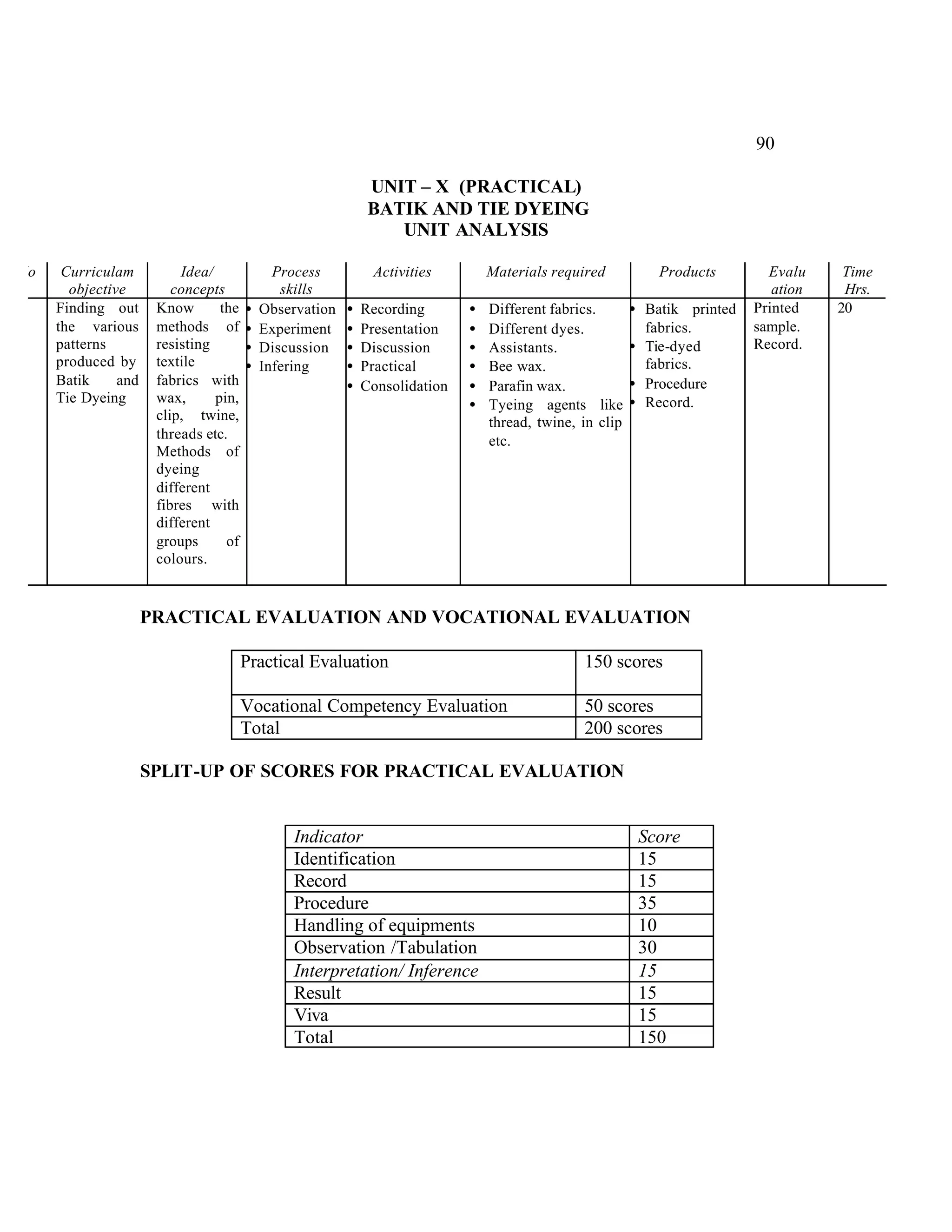
     10           Batik and Tie dyeing                         20
                  Total                                        440
24
                      TERM WISE DISTRIBUTION OF UNITS
                                   Practical
                                 Second Year


                                    TERM      UNITS        HOURS
                                    I         1,2,3        130
                                    II        3,4,5,6,     170
                                    III       7,8,9,10     140
                                              TOTAL        440

                              YEAR PLAN (PRACTICAL)
                           TEXTILE DYEING AND PRINTING
                                  SECOND YEAR


       Month        Unit    Hours     Other Activities
       June         1,2     40        Industry visit
       July         2,3     50        Assignment
       August       3       50        Assignment test
       September    3,4     40        Industry visit
       October      5       60        Study Tour
       November     6,7     60
       December     7,8     40        Assignment
       January      9       60        Seminar
       February,    10      40        Assignment, Revision,
       March                          Test
       Total                440
                            hors.

LIST OF EXPERIMENTS TO BE DONE
   UNIT – 1

     Application of sulphur dyes on cotton
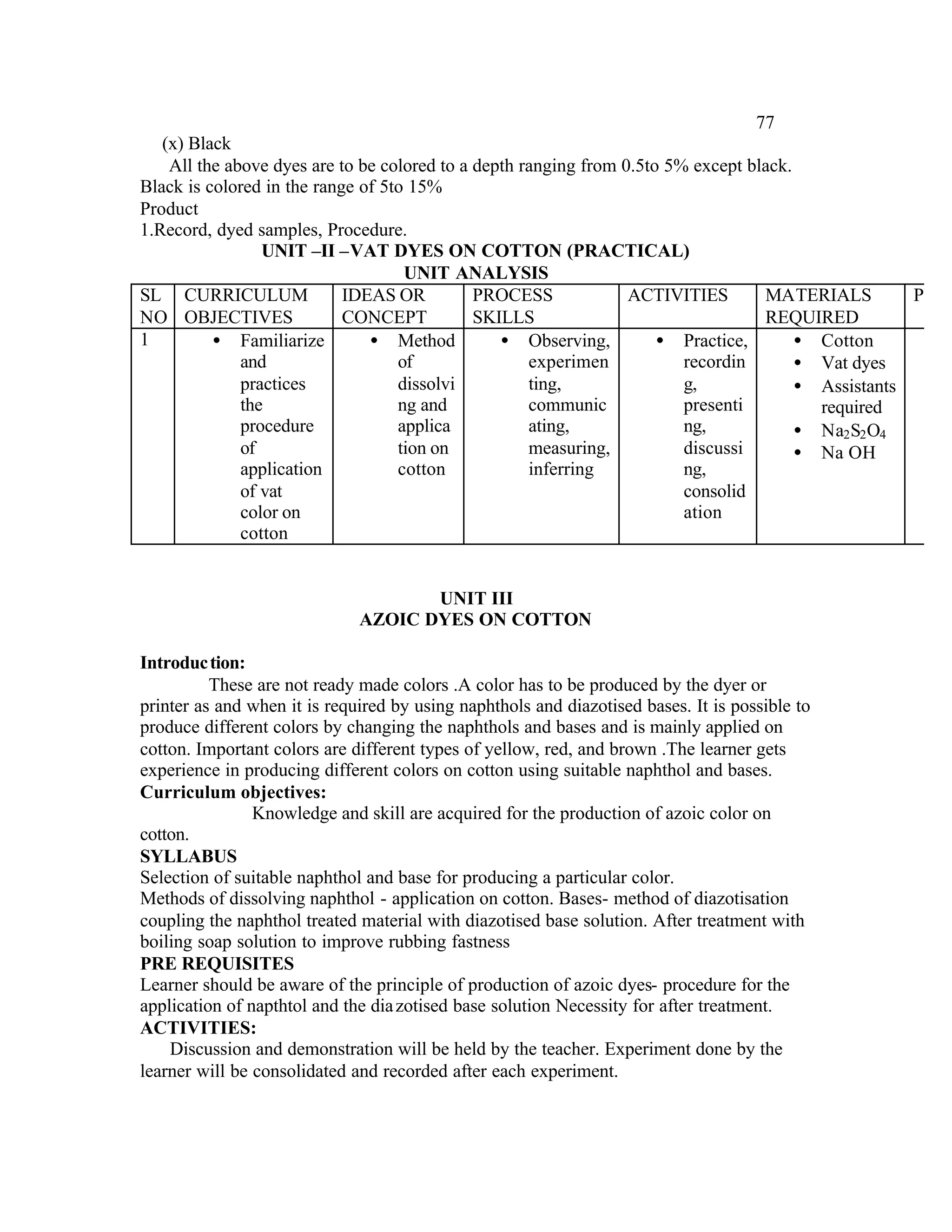
      1.1 Application of Sulphur black, blue, brown colour on cotton
      1.2 After Treatment with copper sulphate
      1.3 After Treatment with Potassium dichromate
      1.4 Topping with Basic colours
      1.5 After treatment with H2 O2 , K2 ,Cr2 O7 and Na2 Co3

UNIT – 2
  Application of Vat dyes on cotton
  2.1 Application of following Vat colours on Cotton
25
               i)      Yellow
               ii)     Orange
               iii)    Red
               iv)     Blue
               v)      Green
               vi)     Violet
               vii)    Brown
               viii)   Pink
               ix)     Khaki
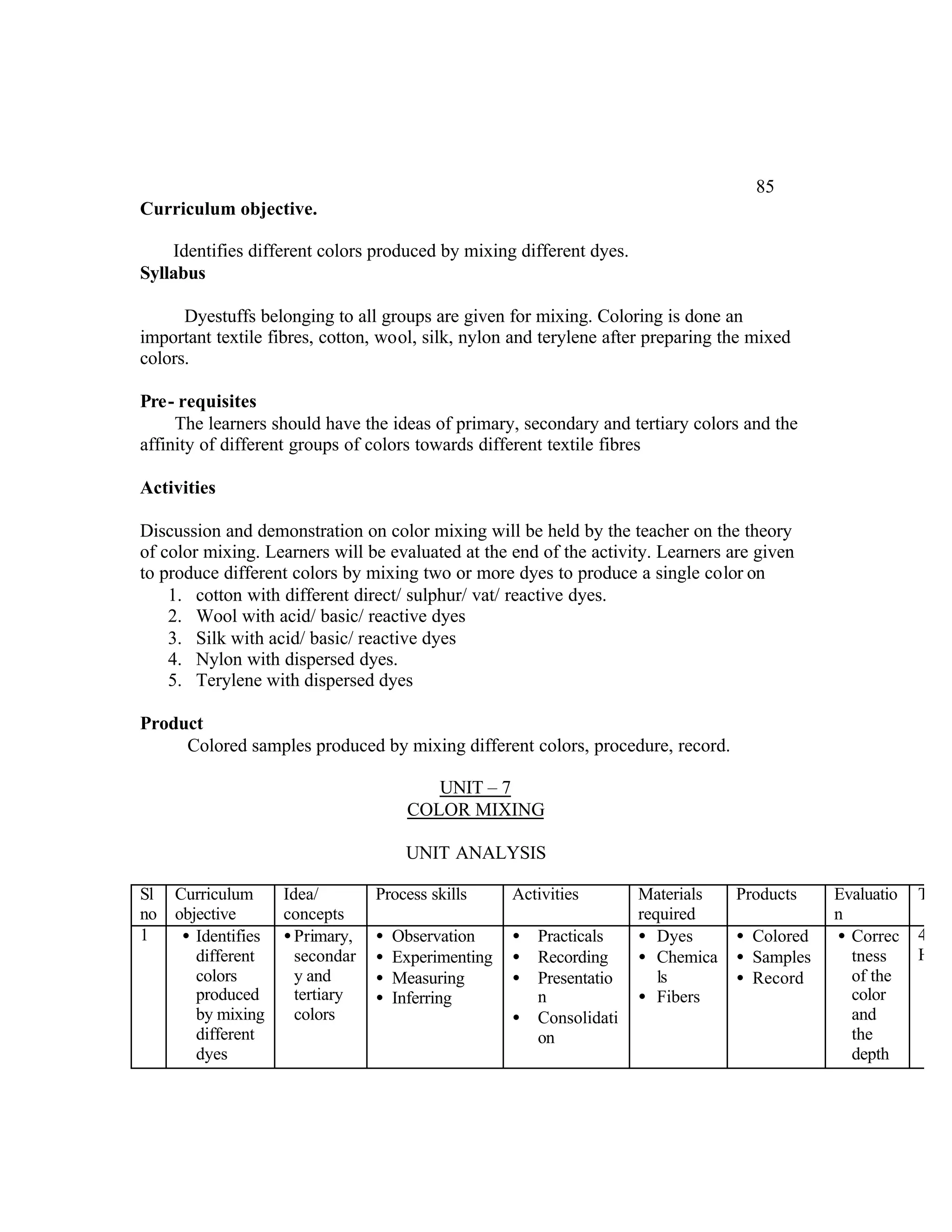
               x)      Black

UNIT – 3

  Application of Azoic dyes on cotton
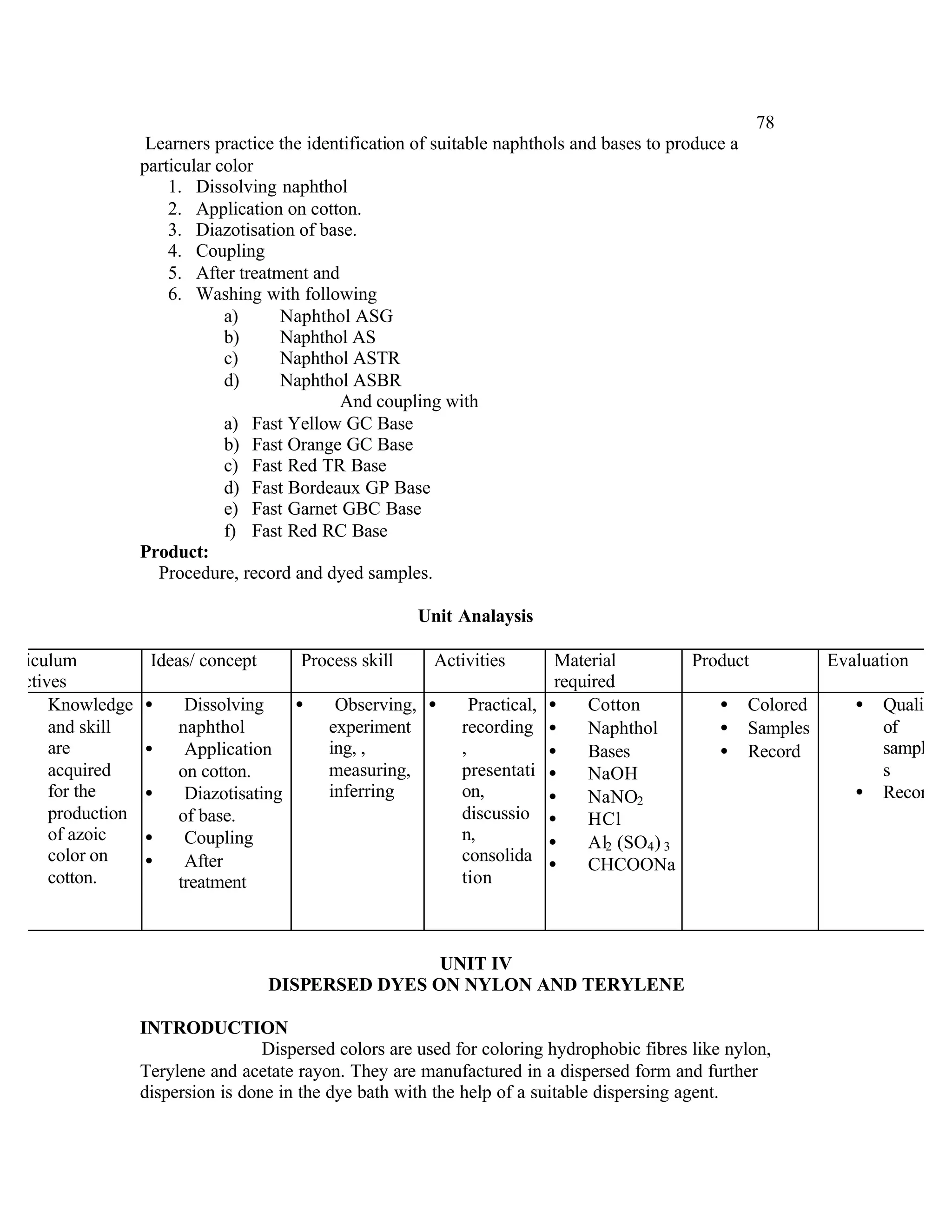
      3.1 Application of the following napthols cotton.
          i)        Naphthol A S G
          ii)       Naphthol A S
          iii)      Naphthol ASTR
      And coupling with the following bases
               i)     Fast Yellow G C base
               ii)    Fast Orange G C base
               iii)   Fast Red T R base
               iv)    Bordeaux G P base
               v)     Garnet G B C base
               vi)    Red R C base.
UNIT – 4

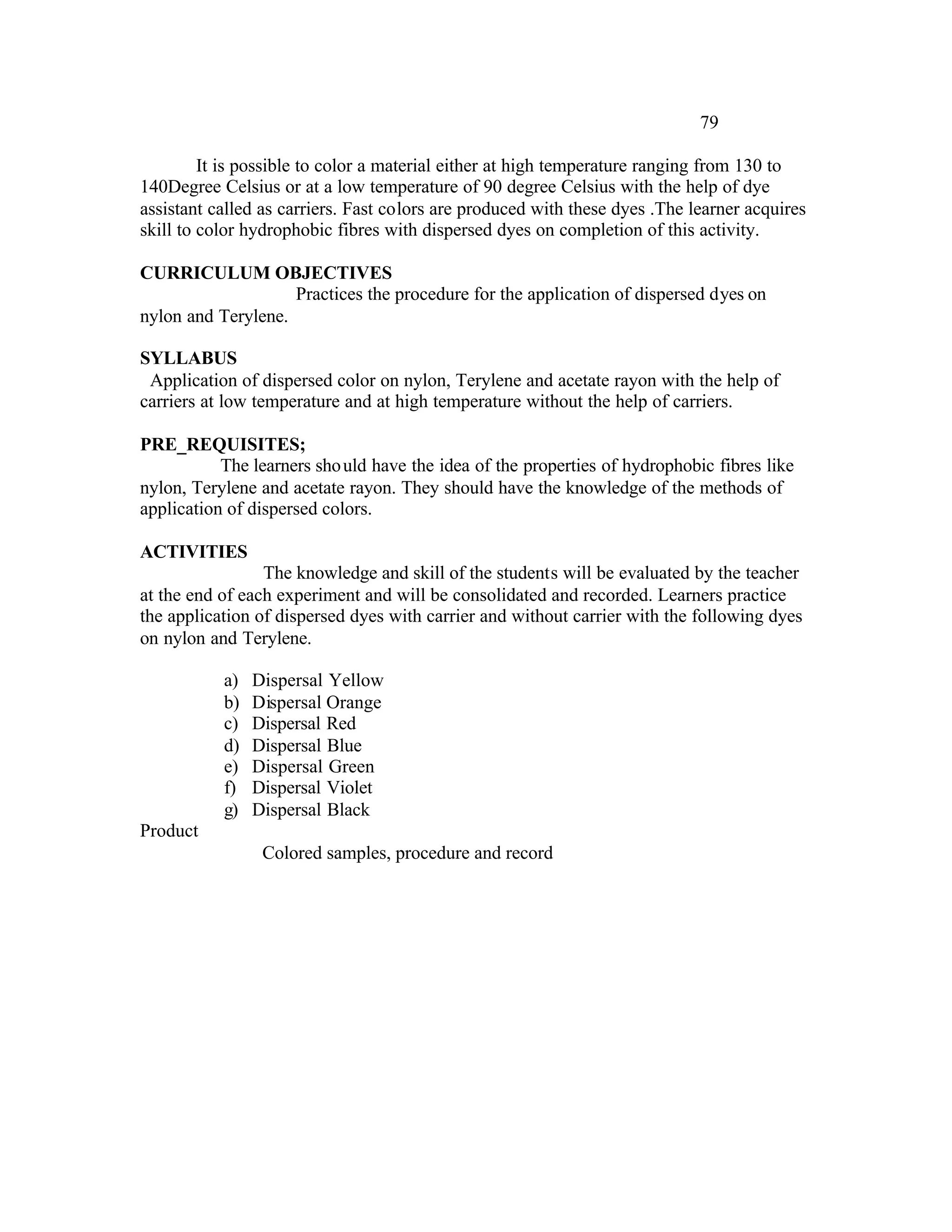
   Application of Dispersed dyes on Terylene and Nylon.
4.1 Application of dispersed dyes with carrier and without carrier with the following
    dyes on Nylon and Terylene
    i)      Dispersol Yellow
    ii)     Dispersol Orange
    iii)    Dispersol Red
    iv)     Dispersol Blue
    v)      Dispersol Green
    vi)     Dispersol Violet, Black

UNIT – 5

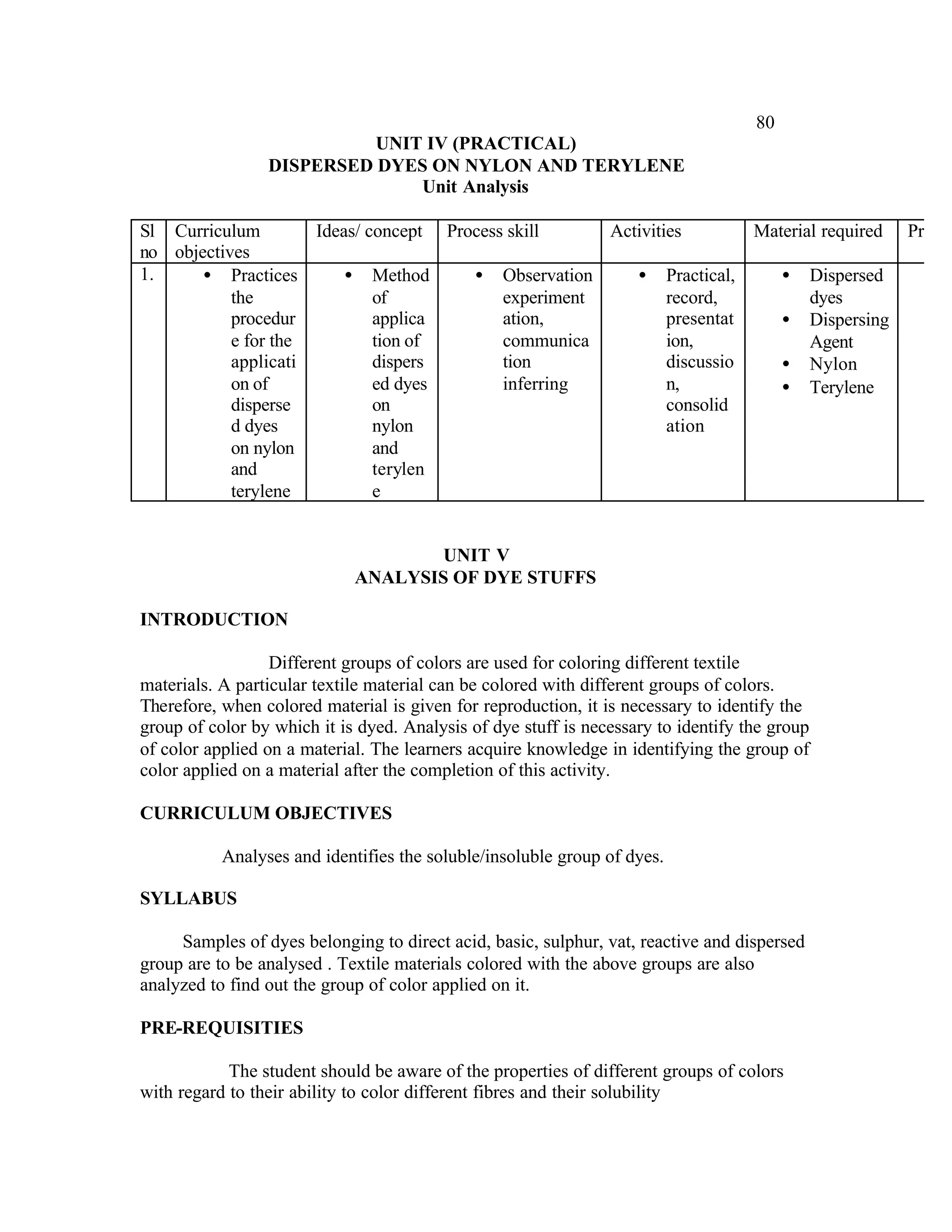
   Analysis of dyestuffs
5.1 Analyse the following colours in powder form
       i)      Dircet
       ii)     Acid
       iii)    Basic
       iv)     Vat
26
      v)      Sulphur
      vi)     Dispersed
      vii)    Reactive
5.2 Analyse the following dyed material
      i)      Cotton dyed with direct dye stuffs
      ii)     Wool dyed with direct dye stuffs
      iii)    Silk dyed with direct dye stuffs
      iv)     Cotton dyed with reactive dye stuffs
      v)      Wool dyed with reactive dye stuffs
      vi)     Silk dyed with reactive dye stuffs
      vii)    Cotton dyed with vat dye stuffs
      viii) Cotton dyed with sulphur dye stuffs
      ix)     Wool dyed with acid dye stuffs
      x)      Silk dyed with acid dye stuffs
      xi)     Wool dyed with basic dye stuffs
      xii)    Silk dyed with basic dye stuffs
      xiii) Nylon and Terylene dyed with dispersed dye stuffs

UNIT – 6
COLOUR MATCHING

6.1   Match the colour of the following dyed materials

      i)     Cotton coloured with direct, sulphus, Vatt reactive, Azoic dyes with
             varying percentage of shades.
      ii)    Silk coloured with Dircet, Acid, Basic and Reactive
      iii)   Wool couloured with, Direct, Acid, Basic and Reactive dyes
      iv)    Nylon and Terylene coloured with dispersed dyes

UNIT – 7
COLOUR MIXING

7.1   Mix two or more dyes to produce a single colour on
      i)    Cotton with different Direct/Suplhur/Vat /Reactive dyes.
      ii)   Wool with Acid/Basic/Reactive dyes.
      iii)  Silk with Acid/Basic/Reactive dyes
      iv)   Nylon with Disperse dyes
      v)    Terylene with Disperse dyes

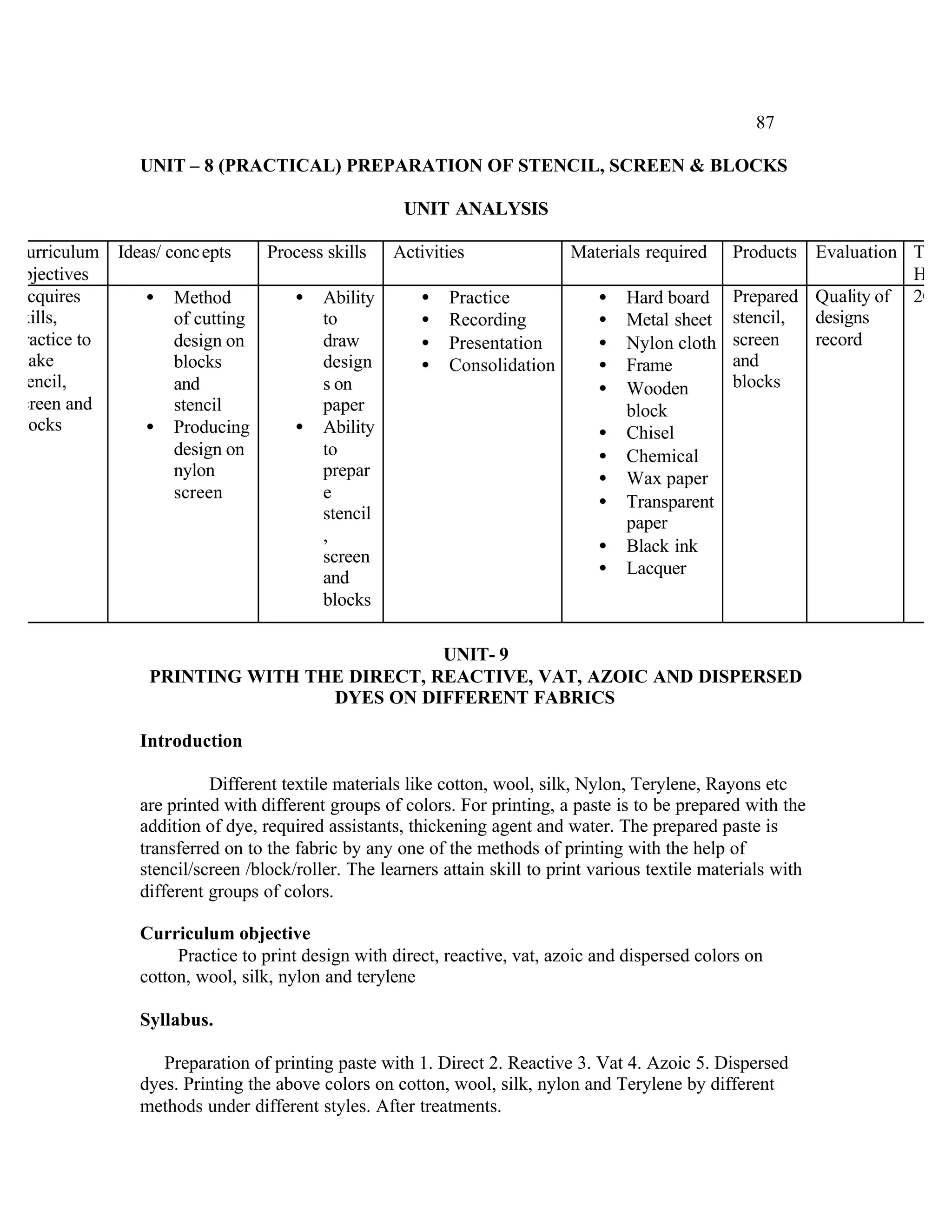
UNIT –8
PREPARATION OF STENCIL, SCREEN AND BLOCKS

8.1   Prepare stencil patterns on Hard boards and metallic sheets.
8.2   Prepare screen with suitable designs by wax paper and photo chemical process.
8.3   Produce Raised patterns on wooden blocks.
27

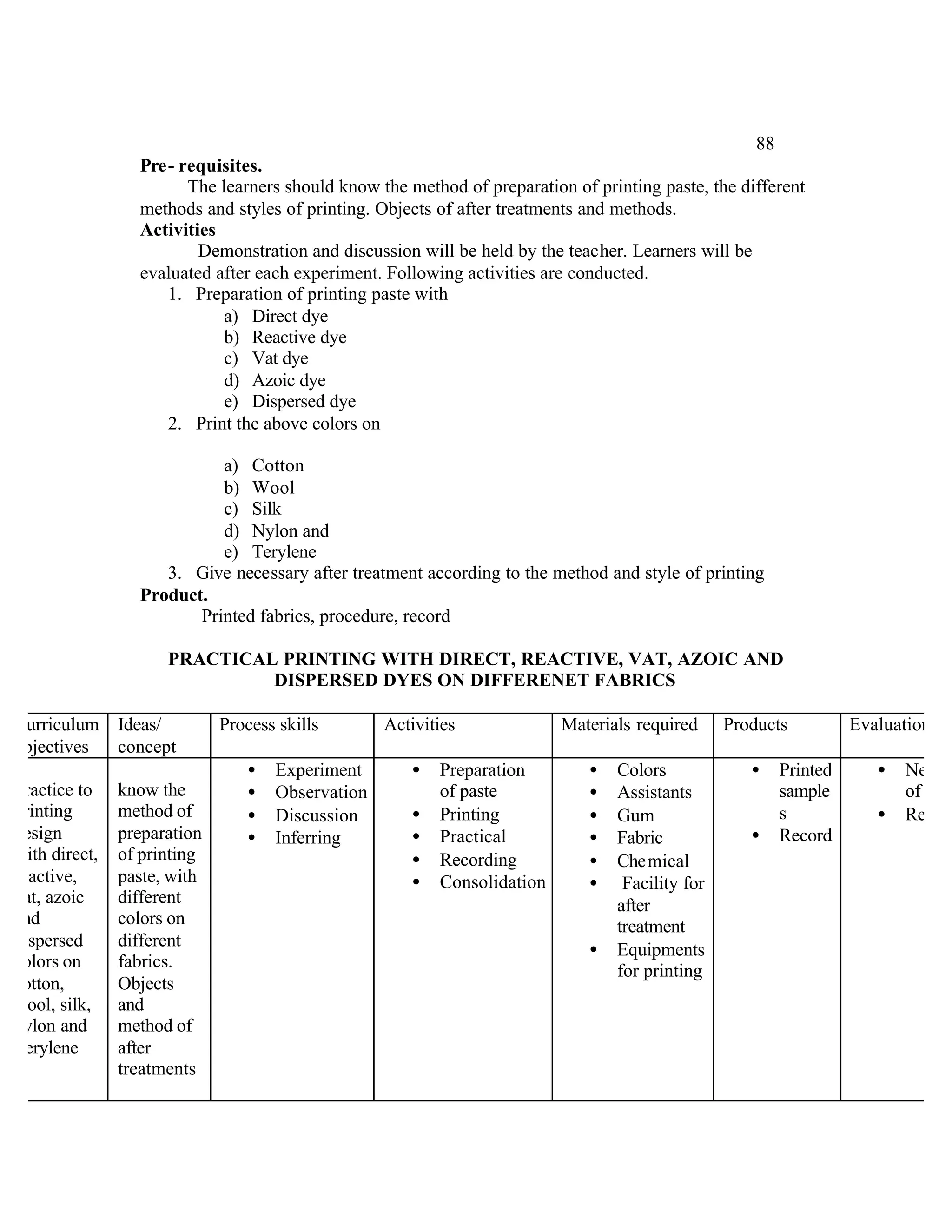
UNIT – 9
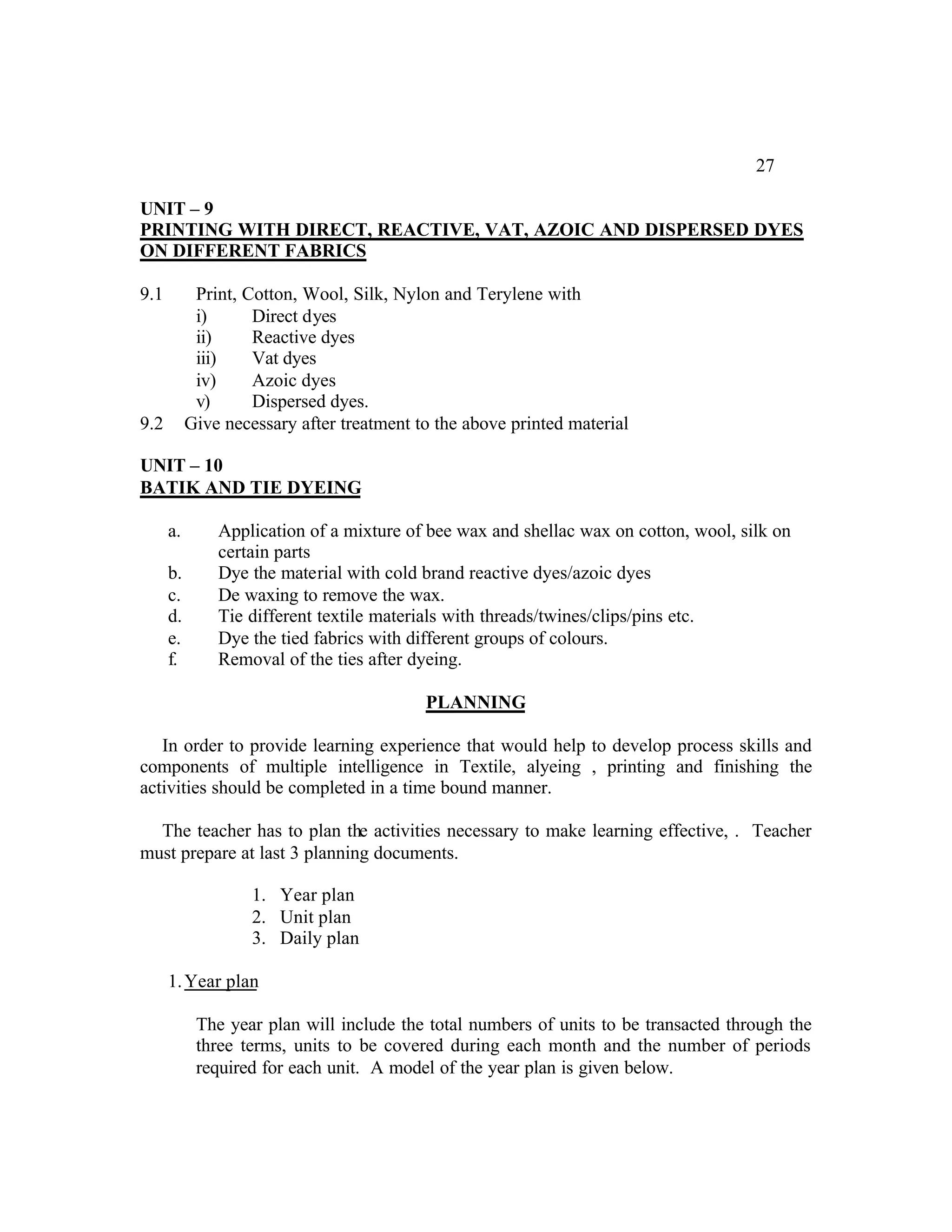
PRINTING WITH DIRECT, REACTIVE, VAT, AZOIC AND DISPERSED DYES
ON DIFFERENT FABRICS

9.1         Print, Cotton, Wool, Silk, Nylon and Terylene with
            i)      Direct dyes
            ii)     Reactive dyes
            iii)    Vat dyes
            iv)     Azoic dyes
            v)      Dispersed dyes.
9.2        Give necessary after treatment to the above printed material

UNIT – 10
BATIK AND TIE DYEING

      a.       Application of a mixture of bee wax and shellac wax on cotton, wool, silk on
               certain parts
      b.       Dye the material with cold brand reactive dyes/azoic dyes
      c.       De waxing to remove the wax.
      d.       Tie different textile materials with threads/twines/clips/pins etc.
      e.       Dye the tied fabrics with different groups of colours.
      f.       Removal of the ties after dyeing.

                                           PLANNING

   In order to provide learning experience that would help to develop process skills and
components of multiple intelligence in Textile, alyeing , printing and finishing the
activities should be completed in a time bound manner.

  The teacher has to plan the activities necessary to make learning effective, . Teacher
must prepare at last 3 planning documents.

                    1. Year plan
                    2. Unit plan
                    3. Daily plan

      1. Year plan

            The year plan will include the total numbers of units to be transacted through the
            three terms, units to be covered during each month and the number of periods
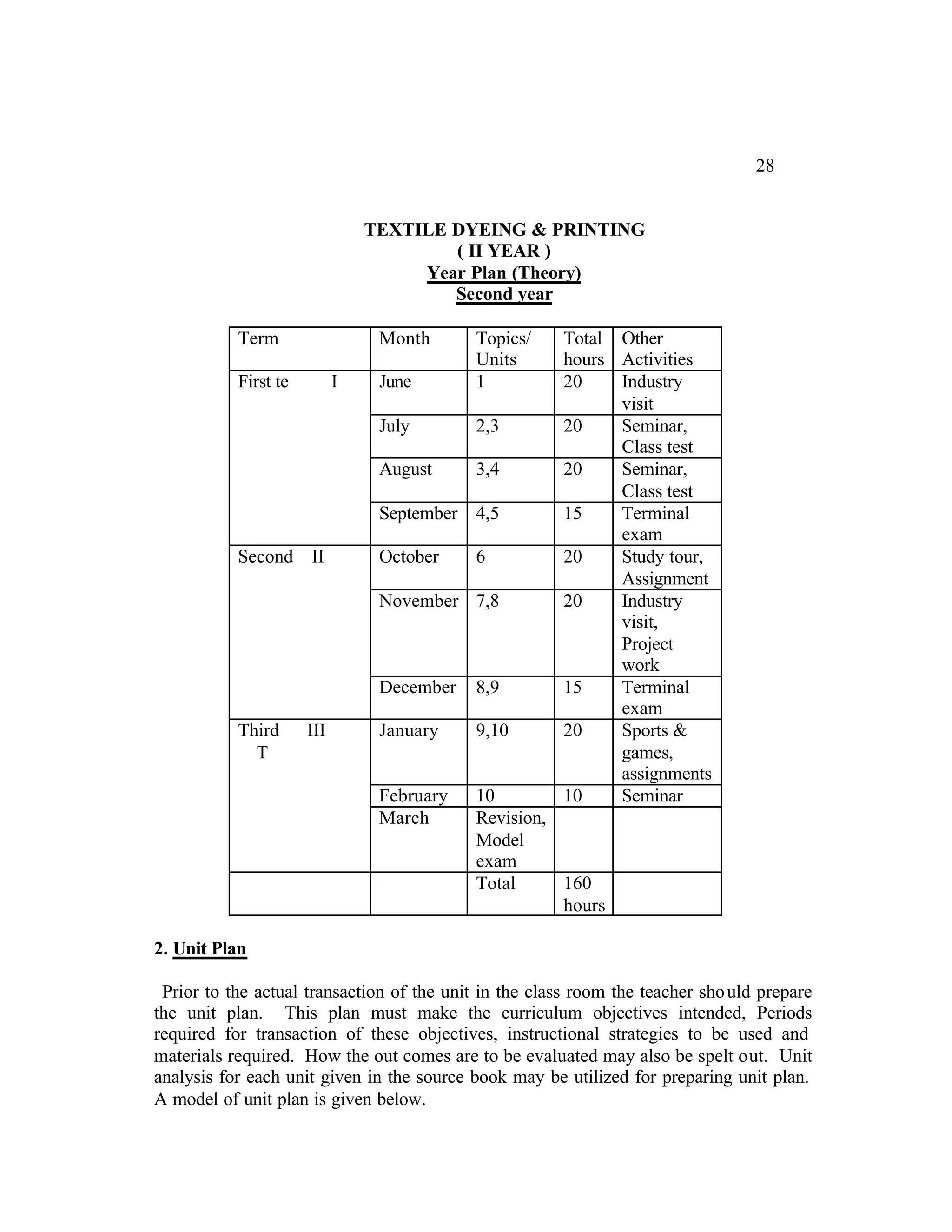
            required for each unit. A model of the year plan is given below.
28


                                TEXTILE DYEING & PRINTING
                                        ( II YEAR )
                                     Year Plan (Theory)
                                        Second year

           Term                  Month      Topics/    Total Other
                                            Units      hours Activities
           First te         I    June       1          20    Industry
                                                             visit
                                 July       2,3        20    Seminar,
                                                             Class test
                                 August     3,4        20    Seminar,
                                                             Class test
                                 September 4,5         15    Terminal
                                                             exam
           Second     II         October    6          20    Study tour,
                                                             Assignment
                                 November 7,8          20    Industry
                                                             visit,
                                                             Project
                                                             work
                                 December   8,9        15    Terminal
                                                             exam
           Third      III        January    9,10       20    Sports &
             T                                               games,
                                                             assignments
                                 February   10         10    Seminar
                                 March      Revision,
                                            Model
                                            exam
                                            Total     160
                                                      hours

2. Unit Plan

 Prior to the actual transaction of the unit in the class room the teacher sho uld prepare
the unit plan. This plan must make the curriculum objectives intended, Periods
required for transaction of these objectives, instructional strategies to be used and
materials required. How the out comes are to be evaluated may also be spelt out. Unit
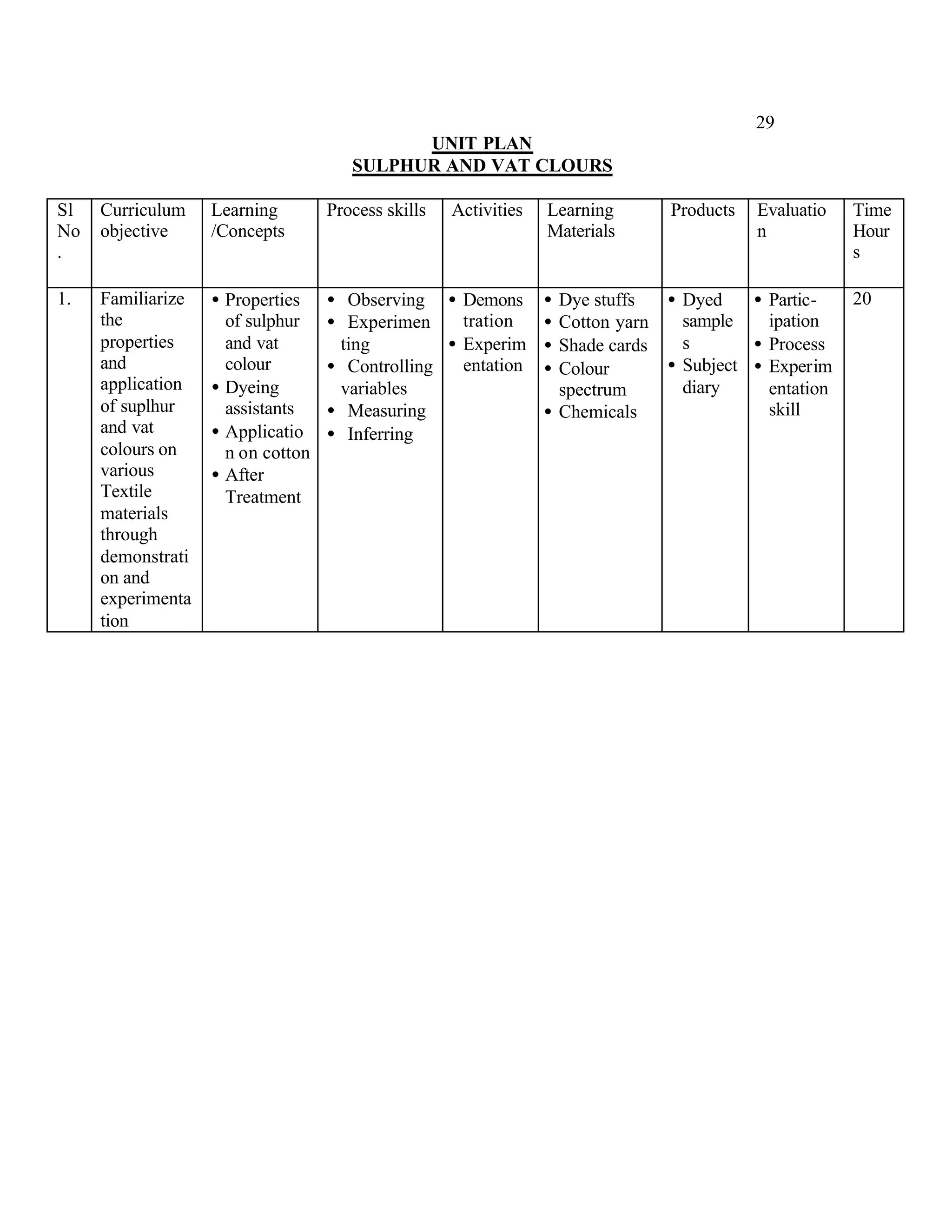
analysis for each unit given in the source book may be utilized for preparing unit plan.
A model of unit plan is given below.
29
                                            UNIT PLAN
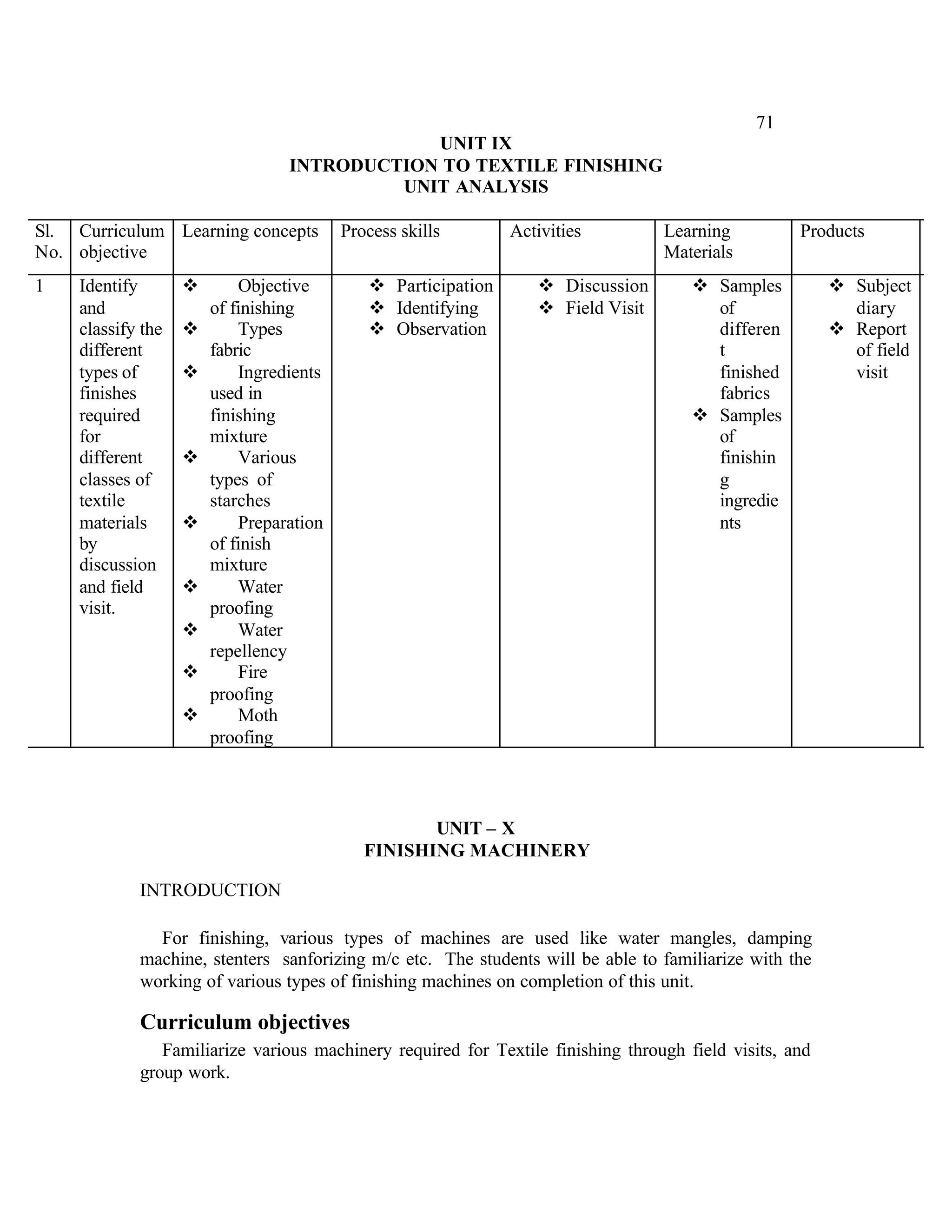
                                      SULPHUR AND VAT CLOURS

Sl   Curriculum    Learning        Process skills   Activities   Learning        Products   Evaluatio   Time
No   objective     /Concepts                                     Materials                  n           Hour
.                                                                                                       s

1.   Familiarize   • Properties    • Observing • Demons          • Dye stuffs    • Dyed    • Partic-    20
     the             of sulphur    • Experimen     tration       • Cotton yarn     sample    ipation
     properties      and vat        ting         • Experim       • Shade cards     s       • Process
     and             colour        • Controlling   entation      • Colour        • Subject • Experim
     application   • Dyeing         variables                      spectrum        diary     entation
     of suplhur      assistants    • Measuring                   • Chemicals                 skill
     and vat       • Applicatio    • Inferring
     colours on      n on cotton
     various       • After
     Textile         Treatment
     materials
     through
     demonstrati
     on and
     experimenta
     tion
30
                           Daily Lesson Plan for suplhur and vat colours

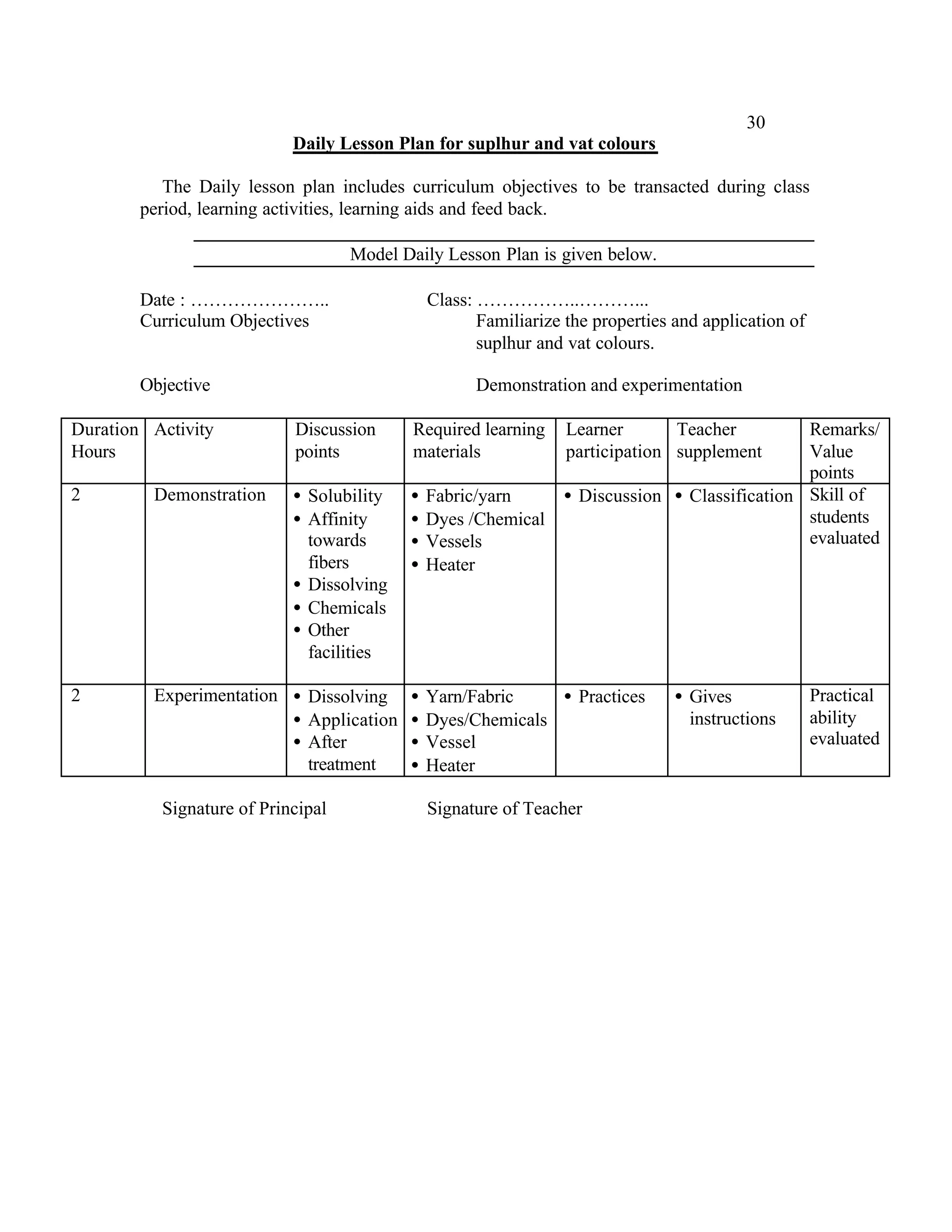
           The Daily lesson plan includes curriculum objectives to be transacted during class
        period, learning activities, learning aids and feed back.

                                   Model Daily Lesson Plan is given below.

        Date : …………………..                      Class: ……………..………...
        Curriculum Objectives                        Familiarize the properties and application of
                                                     suplhur and vat colours.

        Objective                                   Demonstration and experimentation

Duration Activity          Discussion      Required learning     Learner       Teacher     Remarks/
Hours                      points          materials             participation supplement  Value
                                                                                           points
2        Demonstration     • Solubility   •   Fabric/yarn    • Discussion • Classification Skill of
                           • Affinity     •   Dyes /Chemical                               students
                             towards      •   Vessels                                      evaluated
                             fibers       •   Heater
                           • Dissolving
                           • Chemicals
                           • Other
                             facilities

2        Experimentation • Dissolving     •   Yarn/Fabric    • Practices        • Gives              Practical
                         • Application    •   Dyes/Chemicals                      instructions       ability
                         • After          •   Vessel                                                 evaluated
                           treatment      •   Heater

          Signature of Principal              Signature of Teacher
31


 Vocational Higher Secondary School-II Year (Theory)


                                     Evaluation


  It   is the process of scientific assessment            (i) ContinuQ us evaluation
of achievements by the students in relation to
                                                             The multi dimensional competencies of
the curriculum objectives. Learning being a
                                                          the students can be evaluated through
continuous process, evaluation should also
be continuous. It should be comprehensive
and students should be graded on the basis of                1. Seminar          2. Project
their knowledge and skills. Evaluations can                                      4. Lab
                                                             3. Assignment
                                                                                 work
be done in many ways like.
                                                                                 6. Class
                                                             5. Collections
                                                                                 test

                                                          How to evaluate CE items?
                                                            The table showing the CE items, their
                                                         indicators, weightage and score.

                                                                                Score         Total
      CE Items                      Evaluation Indicators                       4/3/2/1       Score
      Seminar       1. Ability to plan and organise (time, topic, sources       4/3/2/1
                       of data, method of presentation etc.)
                    2.          Skill in the collections of data (relevance,    4/3/2/1
                       authenticity, variety of sources etc.)
                    3.      Awareness of the content (presentation of the       4/3/2/1
                               paper, participation in discussion, ability to
                       substantiate his own ideas and views)                                   20
                    4.       Ability to prepare the report (sequence in the     4/3/2/1
                             presentation of the concepts, authenticity and
                                                                      clarity
                       of ideas/views/concepts)
                               Skill in communication (presentation of the
                    5.                                                          4/3/2/1
                                                                      paper,
                       participation in discussion)
  ~
32
                                                                             Score     Total
                                                                             4/3/2/1   Score
     CE Items                      Evaluation Indicators
     Project    1 Ability to plan
                          •     ability to select suitable learning
                                method for
                          •     solving the problem
                          •     ability to develop suitable tools
                          •     ability to plan the duration of study,
                                and the various activities to be carried
                                out in each stage
                   2. Ability to collect data                                4/3/2/1
                          •     ability to collect sufficient and relevant
                                data
                        •          Ability to classify and arrange data
                                   for analysis
                          •     reliability and authenticity of the
                                collected data (this can be assessed
                                based on their recording in the project
                                diary)
                          •     3 Ability to analyse the data and            4/3/2/1
                                arrive at conel usions/inference
                          •     ability to analyse the data
                          •     ability to draw inference based on the
                                analysis of data

                   •     Ability to give suitable suggestions based
                         on the inferences.
                       4 Ability to prepare the project report               4/3/2/1
                         • ability to prepare the project report
                             reflecting the process skills involved.
                         • communicability of the report
                          •     authenticity of the report                              20

                          •     relation with the project diary
                          •     time bound completion
                5. Viva       - Voce (Knowledge of the content and           4/3/2/1
                processes)
                       • Ability to analysis the data
                       • Ability to justify the inference
                       • Ability to explain the strategies and
                           methods adopted and communicate the
                           findings
33


Vocational Higher Secondary School VY ear (Theory)


  CE Items                      Evaluation Indicators                          Score            Total
                                                                              4/3/2/1           Score
 Assignment      1.   Awareness of the content                                4/3/2/1
                 2.   Comprehensiveness of the content (coverage              4/3/2/1
                   of content)
                 3. Systematic and sequential arrangement (clarity,           4/3/2/1            20
                   structure, language)
                 4. Own observations/suggestions/views/judgementl             4/3/2/1
                   evaluation
                 5. Timely submission                                         4/3/2/1
 Lab Work         I.Preparation for the work (procedure, apparatus            4/3/2/1
                  needed, knowledge of the concepts or principles)
               2. Skill in handling the apparatus                             4/3/2/1
                        3.Accuracy and specificity in carrying out the        4/3/2/1            20
                      experiment (controlling variables, measurement,
                 recording.)
               4.Analysis of data and arriving at conclusion                  4/3/2/1
               5.Recording of the work and timely -submission                 4/3/2/1
 Collections     1    Relevance                                               4/3/2/1
                 2    Variety                                                 4/3/2/1
                 3    Uniqueness                                              4/3/2/1
                                                                                                 20
                                                                              4/3/2/1
                 4    Systematic recording
                 5    Neatness ad timely submission                           4/3/2/1

 Class Test      For the year end evaluation the best score out of two class test should
                 be considered for the continuous evaluation. But with in a term, class
                 tests may be conducted after the completion of each unit. Therefore
                 within a term various class tests may be conducted for diagnostic               20
                 purpose
                 and the average score of them should be taken and recorded in the
                 evaluation profile. The features of a class test for diagnostic purpose

                 are as follows:-
34

Vocational Higher Secondary School-II Year


CE Items                         Evaluation Indicators                                     Score


Class Test      . It is a tool used to find out and to solve the learning problems faced
                    by pupils.

                . It may beprocess. a tool to collect feedback from pupils during the
                  learning
                            used as


                . Class test needtest. be a written test. It can also be organised as
                  a performance
                                  not


                .After completing a unit, it can be in the form of a unit test.
                .It may not be a test including more than one unit.
                .Attendance of all pupils may be ensured during class test.
                .Class test may be carried out by the teacher handling the
                 subject.

                .Questions may be prepared in schoo I by following the directions of
                    school examination board.

                . Class test should be informal. No time table or printed question
                    paper is required. No need of blue print.

                .      Questions should be suitable for subject approach.

                .      Should be completed in one period.

                       Arrange more remedial activities to solve the problems
                .      identified
                    through the class test after discussing it with pupils.

                .    Discussion of value points with pupils and peer evaluation and self

                    evaluation may be used.

                    (Average marks of all tests is convernted in to 20.)

    Out of the above 6 CE items class test is compulsory. Consider any other two CE items for
                                                                                                ~
 evaluation and recording.
35


 Vocational Higher Secondary School-II Year (Theory)


 Summary of Methods
                                                       Distribution of scores for year end
                        Feeling the problem            evaluation

                        F onnulating                      For year end evaluation both theory and
                                                       practical test will be conducted
                        Hypothesis
                        Data collection                                                    Score
      2. Project        Analysis                        Theory-written test (external)       80
                        Drawing                         Continous evalution (internal)       20
                        conclusion
                                                        Total                               100
                        Report Writing
                        Presentation
                                                       Grading

                                                           Continuous evaluating is necessary for
                        Planning
                                                       activity based learning process. But the skills
                        Data Collection                achieved by the students cannot be
 3. Seminar
                                                       completely measures in tenns of Marking
                       Presentation of paper           system. Marking System failed in recording
                       Completion                      the growth and development of individual
                                                       students both in scholastic and co-scholastic
                          Planning                     learning outcomes. Classification of students
                                                       in tenns of marks were both unjust and
 4. Lab work
                          Execution                    indefensive. It also creates mental stress and
                                                       strain among the students. To overcome this
                          Completion
                                                       limitation, a popular mode of evaluating
 4. Assignment            Sharing Phase                students' perfonnance known as grading
                          Completion phase             system has been evolved. It is quite
                                                       extensively used allover the world. In the
                                                       Higher Secondary stage, it is desirable to use
                    Sharing in the class room          a 9 point scale absolute grading to
5. Collection
                    Interim evaluation                 consolidate and record the evaluation. After
 6. Class test                                         giving the score, they are changed into
                     Completion phase
                                                       percentages and appropriate letter grades are
                                                       awarded corresponding to each percentage.
                                                       This system is tenned as absolute grading.
36
                                                                           Textile Dyeing and Printing


  The Score percentage and Corresponding                   •     Allow chances for pupils to
Grade is given below
                                                                 attempt multilevel questions
     Score in percentage                Grade      Selection of COs
            90-100                       A+                •     Care should be given to select
             80-89                           A                   items from areas where more
                                                                 activities are possible
             70- 79                      B+
                                                   •       Stress should be given for the higher level
             60-69                       B
                                                           thinking/mental process of pupils.
             50-59                        C+       •       Learning by heart and knowledge not
             40-49                       C                 relating to real life need not be
                                                           encouraged.
             30-39                       D+
                                                   •       Cluster of more than on CO can be used.
             20-29                       D
            Below 20                     E       Question Text

                                                       •       Questions should be in tune with the
   Test items of Termed                                        approach to technological learning.
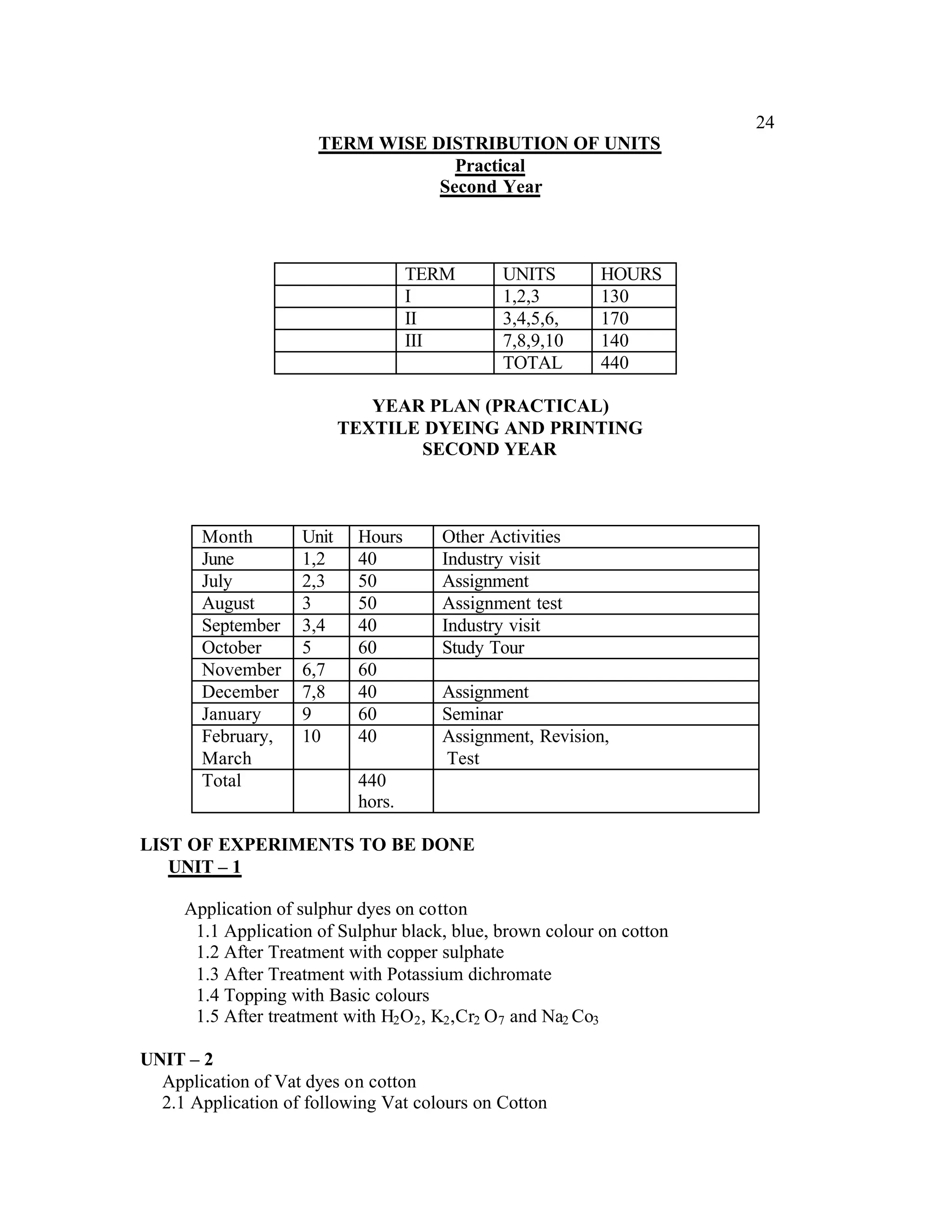
   Evaluation (TE) and year end
                                                       •       Stress should be given to apply the
   evaluation
                                                               innate thinking/mental abilities of
        • Class tests, term end
           evaluation and year end                             pupils
           evaluation should be                        •       Importance may be given to both the
           justifiable to new                                  process as well as product.
           approach
                                                       •       More than one possible answers to the
        • Questions should not lead                            same question need not be
          to mugging up of content.                            discouraged.
                                                       •       Questions should be clear and hints
        •    Questions should
             consider the learning                             may be given wherever needed.
             process and subject                       •       Life related questions should be
             approach
                                                               included.
        • It should help to analyse                    •       Language ofthe questions must be
          the result with a research                           simple and direct.
             mind.

        •    Test items for different                  •       When formulating questions and fixing
             cognitive levels may be                           scores, time required to read, think,
             provided.
                                                               understand and write answers may be
                                                               taken into consideration
37

Vocational Higher Secondary School-II Year (Theory)


   •   To avoid blind guessing, multiple                               •    The questions may be of such type
       choice and supply type questions may                                 that make it possible for students of
       be mixed.                                                            different ability levels to interact.


                                        Consolidated Statement of C.E.


         Sl. No.           Name             Seminar     Assignment            Class             Total          Score
                                                                               Test             Score         reduced
                                              20             20                 20               60             to 20
                                                                                                            Score     20
                                                                                                            obtained X 60


            1.            Vinitha             10             8                   14                32          10.75

            2.            Rema                12             13                  15                40          13

            3.            Nitha               14             9                   10                33          11


                                  Consolidated Statement of T.E. and C.E.

                   Sl. No.          Name              T.E.           C.E.             Total         Grade
                                                                                      Score
                                                      80             20               100

                     1.             Vmitha            55          10.75                66               B

                     2.             Rema              68             13                81               A

                     3.             Nitha             42             11                53            C+
38


                                                                       Textile Dyeing and Printing


Vocational Subject Evaluation                       Practical Evaluation (PE)
   Vocational subject evaluation is used to            In practical evaluation, the leamer's
evaluate the skills of the leamer in the            capability on basic workshop skills and
concerned subject.The facilitator has to make       proficiency in operating machines and
learning in print production techniques             equipment for print production skills are to
activity based, product based, student              be examined. Questions are framed in such a
centered and society bound.                         way that it should evaluate working skills
Part II Vocational Subject                          and knowledge in print production.

Evaluation of Second year


          CE      TE         PE     IE     Total Minimum

  VT       20      80        -      -      100           30%

  VP       -       -       150      -      150           40%
 VCE       -       -         -      50          -        30%


  No minimum for CE
40
                                                                                    Textile Dyeing and Printing


                                               Rating Scale

        81. No.                      I               2               3                 4               5

          1.      Regularity       Never          Often           Usually       Most of the         Always
                                  Regular        Regular          Regular       time Regular        Regular
          2.      Punctuality      Never          Often           Usually       Most of the         Always
                                 Punctual        Punctual         Punctual     time Punctual       Punctual


        Regularity and punctuality can be amassed by
using attendance of the student and time bound             .    Capacity for observation, analysis and
completion of tasks.                                            innovation.
II. Indicators for field visit

    Attitude and readiness towards the task.               .    Documentation, recording and display.
    Capacity for observation.
                                                           Performance - clinic/Camp/exhibition
    Data collection.                                       .
    Application of ideas.
                                                           .    Ability       for      planning       and


    Documentation/Recording.
                                                           .    organisation. Mastery of subject

                                                           .    Ability:ITO   communication.

    Survey                                                 .    Innovation.
                                                               Involvement/social
                                                               commitment.
    .     Planning
                                                           Performance - Production/Service cum
 .        Data collection                                    Training Centre (PSCT)

 .        Consolidation of data and analysis                .   Mastery ofVoc. skills.


 .        Drawing inference                                 .   Managerial capacity.

                                                                Promoting self
 .        Reporting                                         .   confidence.


III. Simulated Experiment/OJT                               .   Innovative approach.

   • Evolvement/participation
          Skills in doing work/communicates
                                                            .   Promoting self-reliance.


          skill
•        Time bound action
41
"

Vocational Higher Secondary School II Year (Theory)


     Note: VC
                                                               A minimum of80% attendance is required
          Items                                Score       for promotion to the second year. Those who
     .                                                     have shortage of attendance should repeat
     .    Regularity and
          Punctuality Field
                                                      10   first year. Those who have 80% attendance
                                                           but failed to achieve 30% of internship
     .    visit/survey (anyone)
                                                      20
                                                           valuatin will be promoted to the second year.
                                                           He has to improve the component in which
    Simulated experiment/OJT                          20   he perfonned poor. He has to attain the
    Perfonnance -                                          minimum by improving the particular
    c1inic/caup/exhibition Perfonnance -                   component to get eligible for appearing
    PSCT (Anyone)                                          second year public examination.

           Total                           50 Scores
42


                                                           Textile Dyeing and Printing


Detailed format for Vocational Competency Evaluation (VCE)


    VCE Item                 Evaluation            Score         Total Score
                              Indicators
 1. Regularity and   1. Attendance
                                                    5                10
    Punctuality
                     2. Discipline and
                        Obedience                   5
 2. Value addition   Field Visit
                     1. Attitude and readiness   4/3/2/1
                        towards the task.
                     2. Capacity for             4/3/2/1
                         observation.
                     3. Data collection.         4/3/2/1
                     4. Application of ideas.    4/3/2/1
                     5. Documentation/           4/3/2/1
                        recording.
                                  OR
                     Survey                                          20
                     1. Planning.                4/3/2/1
                     2. Data collection.         4/3/2/1
                     3. Consolidation of data    4/3/2/1
                        and analysis.
                     4. Drawing inference.       4/3/2/1
                     5. Reporting.               4/3/2/1
  3. Capacity        OJT/ Simulated
     building        Experiment
                     1. Involvement/
                                                 4/3/2/1
                        Participation.
                      2. Skills in doing work/
                                                 4/3/2/1
                         Communication skill.
                     3. Time bound action.       4/3/2/1
                     4. Capacity for
                                                 4/3/2/1
                        observation, analysis
                        and innovation.
                     5. Documentation,                               20
                                                 4/3/2/1
                        Recording and display.
43


Vocational Higher Secondary School1-II Y ear (Theory)


            VCE Item                                    Evaluation     Score   Total Score
                                                        Indicators
                                              OR
                               Performance in campi
                               Exhibition
                               1. Abili or planning and              4/3/2/1
                                  orgamsmg.
                               2. Mastery of subject.                4/3/2/1
                               3. Ability for
                                                                     4/3/2/1
                                  communication.
                               4. Innovation.                        4/3/2/1
                               5. Involvement/Social                 4/3/2/1
                                  commitment.
                                            OR
                               Performace in
                               production! service cum
                               training centre (PSCTC)
                               1. Mastery of vocational
                                                                     4/3/2/1
                                   skills.
                               2. Managerial capacity.               4/3/2/1
                               3. Promoting self
                                                                     4/3/2/1
                                  confidence.
                               4. Innovative approach.               4/3/2/1
                               5. Promoting self -
                                                                     4/3/2/1
                                    reliance.
IL

                                                                                                                                         44

                                                                                                                                                                          ')

                            FORMAT FOR EVALUATION OF VOCATIONAL SUBJECT
                                    CE          TE     Total   Grade                 PE                                Vocational Competency Evaluation
                1     2     3                   (80)   (100)                                                               Value
                                   To-                                                                     Regularit)                Capacity
Sino:   Name                             Tota                                                                                                   Total     Grade
                                                                                                   Grad.
               CIas (20)   (20)   tal    out                           12 34   567        8 Tota              and         Addition   building    (50)

               Test         t     (60)   of                                                                Punctual
                                                                                                                  -         (20)       (20)

               (20)                      20                                                                 ity (10)


                                                                                                                                                                  I r--
45


                                   Government of Kerala
      Board of Vocational Higher Secondary Examinations
                                                                                            Thiruvananthapuram
   Reg: No.
                                                                                            Dated:- - - - - -
                                     Evaluation Sheet
   Sri./Smt. ------------------------------------------------------------- is awarded Scores/
grade as detailed below in the First Year Vocational Higher Secondary Examination held
------------------
in

   Name of School                       '-------                                     Admission No . - - - -
   Name of Vocational Course: -                   ------
                 Subject                               Score Obtained                    Positional      Grade in words
                                        CE20           1E       PE      IE       Total     Grade
                                                       80       150     50
     Part- I
    English                                                 -           -
    Genernl Foundation Colll"re                             -           -

    Part- II Vocational Subjects

    Vocational Theol)'                                                - -
    Vocational Practical                 -         -                    -
    Vocational                           -         -        -

     Part- III Optional Subjects

                                             20        60        20

    Physics                                                                  -

    CkmislIy                                                                 -

                                             20        80

    Mafuematics                                                   -          -

   CE- Continuous Evaluation, TE- Term End Evaluation, PE- Practical Evaluation, IE-
Internship Evaluation.
  Grades A + 90% and Above Outstanding           A      80- 89%      Excellent.
            B+ 70 -79% Very Good                 B      60- 69%      Good
            C+ 50 - 59% Above Average            C      40- 49%      Average
                 D+ 30 - 39% Marginal                                       D      20- 29%            Need improvement
                 E  Below 20% Need improvement
                                  --------
                                  --------
                                  --------
  Marks Entered by
  Marks checked by                                                                              SECRETARY
  S updt/ T. 0
46
                         TEXTILE DYEING AND PRINTING


                               SECOND YEAR

                                         PART-II

                                          UNIT-I

                           SULPHUR AND VAT COLOURS

INTRODUCTION

   These colours are extensively used for colouring cotton textiles. Sulphur colours are
very cheap and produce colours, which are fast to washing. Fastest colours are produced
with vat dyes, but they are very costly and hence applied only on superior varieties of
cotton materials. Completing this unit, the students will be able to under stand the
properties and the method of application of sulphur and vat colours.

Curriculum Objective

  Familiarize the properties and applications of sulphur and vat on various textile
materials through demonstration.

Syllabus

   SULPHUR DYES- Properties, solubility, fastness, affinity towards textile fibers,
exhaustion, tinctorial power, assistants for dissolving and their function. Application on
cotton, dyeing assistants and their functions, standing and feeding baths. After
treatments-objects, after-treatments to improve fastness to light and washing, Topping
with basic dyes. Tendering – reasons for tendering-after treatment for tendering and
bronziness

VAT DYES- Properties, method of dissolving. Classification- Indigoid, Anthraquinone,
sulphide. General method of application of the above vat dyes and their properties,
suitability for dyeing vegetable and animal fibers, assistants and their functions. Different
methods of applications of Anthraquinone Vat dyes-IN method, IK method, IW method
and IN. Special method for Vat Black.

SOLUBILISED VAT DYES- Properties, advantages, method of application on cotton-
Nitrite process, Dichromate process and Ferric salt process.
47
Pre-requisites.
    v Learners should be aware of the colouring technique of textile materials like
       fabrics and yarns of various forms.

   v They should have a ge neral idea about insoluble group of dyes and various
     chemicals used in dyeing of Vat and Sulphur dyes.

Activity -I

Name       : Solubility of Vat and Sulphur Dyes.
Activity : Demonstration.
Materials: Vat and Sulphur dye stuffs, Hot and cold water and solutions of NaOH,
Na2 So4 , Na2 Co3

   Process: Divide the pupil into 5 groups
         o Instruct each group to take a little amount of Vat and sulphur dyes
                 separately using a glass rod.
              o Try to dissolve them in cold and hot water.
              o Note the solubility.
              o Instruct them to add little NaOH Solution to Vat dye, then add Na2 S2 O4
                 solution and heat the whole solution well.
              o Note the solubility of Vat dyes.
              o Instruct again to add little Na2 Co3 solution to Sulphur dye, then add Na2 S
                 solution and heat the whole solution well.
              o Note the solubility of Sulphur dyes.
Consolidation:
         Teacher consolidates that Vat and sulphur dyes are insoluble in Water.
         To dissolve Vat dyes NaOH and Na2 S2O4 are used and for Sulphur dyes Na2 Co3
and Na2 S are used (An alkali and a reducing agent are required to dissolve).

Activity II
Name: Application of Vat dyes on Cotton
Activity: Experimentation.
Materials: Vat dye stuff, Cotton yarn, solutions of NaOH andNa2 SO4
Process: Dissolving of dyestuff.
         Preparation of dye bath.
         Shades to be dyed.
         Dyeing
         Oxidation
         Washing
48
         Instruct to note the procedure

Consolidation

Dye bath: a) Depth of shade (0.5%, 1%, 2%, 3% , 4% )
          b) Dissolving of dyestuffs
               I)        NaOH
               II)       Na2 SO4
            c) Preparation of dye bath
                I)          Dye solution
                II)         NaOH
                III)        Na2 S2 O4
                IV)         Water
                V)          Levelling agent if required.
          d) Temperature – Different for different classes of dyes and different methods
of dyeing.
          e) M.L.Ration- 1:10 to 20.
           f) Developing after dyeing by exposure to air.
Product: Subject diary, Dyed materials.
Activity- III
Name: Application of sulphur dyes on cotton.
Activity: Experimentation
Materials: Sulphur dyes stuff, cotton yarn, and solution of Na2 CO3 and Na2 S
    • Process: Dissolving of dyestuffs
    •                Preparation of dye bath
    •                Shades to be dyed
    •                Dyeing
    •                Washing
    •                Instruct to note the procedure
   Consolidation:
      Dye bath: a) Depth of shade (0.5%,1%, 2%, 4%)
                   b) Dissolving of dyestuffs
                         i)       Na2 CO3
                         ii)      Na2 S
                  c) Preparation dye bath
                        i)       Dye solution
                        ii)      Na2 CO3
                        iii)     Water
                        iv)      Levelling agent if required
                  d)        Temperature – boiling
                  e) M.L.Ratio – 1:10 to 1: 20
                  After washing the dyed materials are treated with
    a. Copper sulphate and acetic acid to improve light fastness
    b. Potassium di chromate and acetic acid to- improve washing fastness
    c. Topping with basic dyes to improve brilliancy.
49
              Product-Subject diary, dyed materials

                                              Sulphur and Vat colours

Sl   Curriculum        Learning        Process skills   Activities   Learning        Product      Evaluation   Time
no   objectives        concept                                       materials
     Familiarise       • Properties    • Observing      • Demonst • Dye stuff        • Dyed       • Particip 20
     the properties      of sulphur    • Experiment       ration   • Cotton            samples      ation    hrs
     and                 and vat         ation          • Experime   yarn            • Subject    • Process
     application of      dyes          • Controlling      ntation  • Shade             diary        skill
     sulphur and       • Dyeing          variable                    cards                        • Experim
     vat colors on       assistants      Measuring                 • Color                          ental
     various textile   • Application   • Inferring                   spectrum                       skill
     material            on cotton                                 • Chemicals
     through           • After
     demonstration       treatments
     and
     experimentati
     on

                                                        UNIT II
                            DISPERSED AND OXIDIZED COLORS

              Introduction:
                     Dispersed colors are specially manufactured for coloring hydrophobic fibres like
              Terylene, nylon ad acetate rayon. This unit deals with the method of dispersing the
              dispersed color and its application on different fibres. This unit also deals with the
              method of production of oxidized color by using chemicals as and when it is required. On
              completion of this unit, the learner shall be able to understand the properties and the
              method of production of dispersed and oxidized colors on various textile materials

              Curriculum objectives
                      Understand the method of application of dispersed and oxidized colors their
              properties through demonstration and experimentation.

              Syllabus
                         Dispersed dyes, properties, function of dispersing agent meaning of dispersion,
              method of dyeing Acetate Rayon, Nylon, terylene –High temperature dyeing without
              carrier and with carrier at low temperature oxidized colors, Aniline black, chemicals used
              Aniline Hydro chloride, Hydrochloric acid,Oxidising agents, oxygen carrier .Different
              stages of oxidation method of application on cotton –Single bath process, Ageing
              process, Steaming Process.
50


UNIT 2

Pre requisites
             The learners should be aware of the technique of coloring textile materials
in the form of yarn and fabric made with cotton, Nylon, Terylene and acetate rayon
They should have a general idea about dispersed dyes, meaning of dispersion,oxidised
colors and various chemicals used for the production of oxidized colors at various stages.

Activity I
Name –Solubility of disperse dyes
Activity –Demonstration
Materials- Dispersed dye, Dispersing agent water
Process-Divide the pupil in to 6 groups
         Instruct each group to take a little amount of dispersed dyestuff
          Try to dissolve it in cold and hot water
          Note the solubility
          Instruct them to take a little dispersing agent into the above bath
          Note the change

Consolidation
         The teacher consolidates that dispersed dyes are insoluble in water but can be
dissolved in water with the aid of a dispersing agent

Product; Subject diary
Activity II
Name –Application of dispersed dyes on Terylene
Activity- Experimentation
Materials – Dispersed dye, Dispersing agent, carrier samples of Terylene yarn and fabric
Process
   • Make a fine dispersion of the dye stuff in water
   • Preparation of thee dye bath
   • Dyeing
   • Washing
   • Instruct to note the procedure
Consolidation
Dye bath (a) Depth of shade –0.5% , 1%, 2% , 3% and5%
          (b) Dispersion of dyestuff
51
                     (i)Dyestuff
                      (ii) Dispersing Agent
          © Preparation of dye bath
i) Dye dispersion in water
ii) Carrier
iii)Temperature –Boiling
iv) M:L ratio-1:10 to1.:20
      The teacher consolidates that the dye is dissolved in the fibre
Product-subject diary, Dyed sample

Activity-III
Name –Production of Aniline black on cotton
Activity –Experimentation
Materials-Aniline Hydrochloride, Potassium dichromate, Copper sulphate,cotton yarn
and fabric

Process
   • Dissolving the aniline hydrochloric in HCl and water.
   • Preparation of Impregnating bath
   • Dyeing
   • Soap boiling
   • Washing

Consolidation
  Dye bath
       (a) Shade-8%
        (b) Dissolving the Aniline Hydrochloride
        ©Hydrochloric acid
        (d) Copper sulphate solution

   Dyeing-Temperature –70 degree Celsius
   M:L = 1:10 to 1:20
    The teacher consolidates that a dull green color is observed in the dye liquor and the
   cotton acquires deep black color, on completion of dyeing
   Product: Sub ject diary, Dyed samples
52

                                                          Unit-2
                                              Dispersed and Oxidised colours

Sl   Curriculum       Learning         Process skill     Activities   Learning      Product         Evaluation        Time
no       objective    concept                                         Materials
1.   • Understand     • Properties     • Participation   • Demonstr   • Dispersed   • Subject       • Participation   15 hrs
         the            of dispersed   • Identifying       ation        dyes          diary         • Process skill
         method of      and            • Handling        • Experime   • Chemicals   • Dyed          • Product
         appli8cati     oxidized         material and      ntation      for           sample          evaluation
         on of          dyes             equipment                      oxidized
         dispersed    • Methods of       effectively                    colors      Polyester arn
         and            dispersing     • Communicati                                • Nylon yarn
         oxidized     • Application      ng                                           Cotton
         colors         of dispersed                                                  yarn
         their          dyes
         properties   • Method of
         through        producing
         demonstra      oxidized
         tion and       colors
         experimen
         tation


                                                   UNIT- III
                                         MORDANT AND MINERAL COLOURS

                Introduction
                       Similar to oxidized colours, these are not ready made colours. A colour is
                produced by the dyer or printer as and when it is required with the help of chemicals.
                This unit deals with the various types of mordants and chemicals required for producing
                mordant colours and mineral colours. The students will be able to understand the
                methods of production of mordant colours and mineral colours on textile materials on
                completion of this unit.

                Carriculam Objectives

                   Know the method of production and properties of mordant and mineral colours
                through demonstration.
53
syllabus

Mordant dyes/ function of mordant,importance of mordanting ,methods of mord
anting with salts of Aluminium and Chromium. Natural mordant colours- Log wood
block, application on wool. Production of Turkey red colour on cotton using Alizarine.

       Mineral colours- Chrome yellow, Prussian blue, Iron buff, Chrome green and
mineral Khaki, chemicals used for producing the above colours and the methods of
production of mineral Khaki colour on cotton.

                                            UNIT-3
Pre-requisites
           v The learn should have a basic idea about metallic salts such as ferrous
               sulphate, Chromium salt, Aluminium sulphate, Turkey red oil.
           v They should have an idea about oiling, mordanting, natural mordant
               colours like log wood block and Alizarin Red .
Activity-I
       Name       Mordanting
       Activity Demonstration
       Materials Turkey Red oil, woollen yarn and fabric,water.
       Process Divide the pupil into six groups.
                      Instruct each group to take some turkey red oil into a bath and add
                      water.
                      Treat the sample of woolen yarn and fibre in turkey red oil
                      solution.
                      Squeeze the sample to have an even oiling.
Consolidation
  The teacher consolidates that the oil is present on the sample uniformly.

Activity-II
       Name        Mordanting
       Activity    Demonstration
       Materials     Aluminium sulphate, Acetic acid, previously oiled samples of yarn
                     and fabric.
       Process       Divide the pupil into six groups
                     Instruct each group to take some Aluminium sulphate.
                     Dissolve Aluminium sulphate in cold water.
                     Treat the sample of yarn and fabric in the above solution in cold.
                     Note the change.
       Consolidation
                     The teacher consolidates that the Aluminium salt is taken up by the
                     yarn and fabric.
       Product :-    Subject diary
Activity-III
       Name     Dyeing with Alizarine
54
       Activity Demonstration
       Materials      Alizarine powder, Acetic acid , mordanted samples of yarn and
                      fabric.
       Process Divide the pupil into six groups.
                      Instruct each group to take some Alizarine powder.
                      Dissolve the Alizarine powder in water
                       Prepare the dye bath with the addition of water, acetic acid and
                      Alizarine solution.
                      Treat the sample of woolen yarn and fabric in the dye bath.
                      Wash the specimen.
                      Note the change.
Consolidation
   The teacher consolidates that the woollen yarn and fabric aquire a red colour.
Product
   Subject diary, dyed sample.
Activity-IV
       Name       Mineral Khaki
       Activity Demonstration
       Materials      Cotton ya rn and fabric, Ferric salt, Chromium salt, Sodium
                      hydroxide.
       Process Divide the pupil into six groups.
                      Instruct each group to take a little of chromium salt and iron salt.
                      Dissolve the Chromium and iron salt separately and added to dye
                      bath.
                      Treat the samp les of yarn and fabric separately in warm dye bath.
                      Squeeze the treated samples.
                      Prepare the developing bath with water and sodium hydroxide.
                      Treat the squeezed sample in the developing bath in cold.
                      Soap boil to remove surface colour.
                      Washing.
Consolidation
   The teacher consolidates that the samples of fabric acquire a khaki colour.
Product
   Subject diary,samples of dyed fabric and yarn.
55
                                             UNIT-III
                                   MORDANT AND MINERAL COLOURS
                                          UNIT ANALYSIS

Sl. Curriculam        Learning             Process                   Activities               Learning            Product
No Objectives         Concepts             Skills                                             Materials
.
1 • Know the              •   Properties       •   Participation         •   Demonstration       •    Mordant
     method of                of               •   Identifying                                        dye
     production and           mordant          •   Handling of                                   •    Chemicals
     properties of            colours              minerals and                                       for
     mordant and          •   Properties           equipments                                         mineral
     mineral                  of mineral           effectively                                        colours
     colours                  colours          •   Communicating                                 •    Woollen
     through              •   Production                                                              yarn
     demonstration            of                                                                 •    Cotton
                              mordant                                                                 yarn
                              colours
                          •   Production
                              of mineral
                              colours.


                                                     UNIT – IV

                                                   AZOIC DYES


             INTRODUCATION

                Production of these colours involve two stages of application,namely, naptholation
             and coupling with diazotised base. Different fast and bright colours are produced mainly
             on cotton with these dyes. The learners acquire the idea of application of napthol and
             base on cotton to produce different colours.


             Curriculum objectives

                Familiarize the production of different Azoic colour by using suitable napthols and
             diazolized bases through Demonstration and Experimentation.
56
Syllabus

   Properties, method of application on cotton, selection of combinations of naphthols
and base for different colours, dissolving naphthol, diazolizing base, padding,
developing, after treatments .


Pre – requisites

   The learners should be aware of the colouring technique of cotton fabric and yarn.
   They should have a general idea about the naphthols and bases.

Activity- I

   Name       : Solubility of Naphthols
   Activity : Demonstration
   Materials : Naphthols, Na OH + water
Process :
     v                       Divide the students into 6 groups
     v                       Instruct each group to take a small quantity of naphthol and
         add water.
     v                       Try to dissolve
     v                       Heat the solution
     v                       Instruct to add Na OH
     v                       Note the solubility of Naphthol
Consolidation

   Teacher consolidates that the Naphthols are insoluble in water but their sodium salts
are soluble in water.
Product :- Subject diary

Activity II
  Name       : Solubility of Bases
  Activity : Demonstration
  Materials : Base, Na No2 , Hcl

Process

                   v   Divide the students into 6 groups
                   v   Instruct each group to take a little quanity of base.
                   v   Try to dissolve the base in water
                   v   Note the solubility
                   v   Instruct them to diazotise the base with Hcl + Na No2
                   v    Note the solubility of base.
57
Consolidation

   Teacher consolidates that the bases are insoluble in water.
   To dissolved add Na NO2 + Hcl.
Product :- Subject diary

Activity III

  Name       : Application of azoic dyes on cotton
  Activity : Experimentation
  Materials : Naphthols, Na OH water
           Bases, Na NO2 , Hcl, sod: acetat
           Alu: Sulphate
           Cotton yarn

  Process: Dissolving Naphthols
        Dissolving Bases
        Shade –deep
        Padding
        Developing
        Washing
        Instruct to note the procedure
Consolidations
   -      Shade – Deep
   -      Dissolving the Naphthol
   a.         Naphthols
   b.         Na OH
   c.         Water
   2. Dissolving the base.
   a. Base
   b. NaNo2
   c. Hcl
   3. Preparation of the padding bath
          1. Naphthol solution
   d. Temperature cold bath- preparation of the developing bath
          1. Base solution
          2. Sod. Acetate
          3. Al Sulphate- Alkali binding agent- Temperature cold bath
          4. Padding with Naphthol solution
          5. Developing the padded yarn in the diazotised base solution
          6. After treatment – soap solution- to give brightness of the colour
Product : Subject diary, Dyed sample
58

                            UNIT-V
INTRODUCTION TO TEXTILE PRINTING

Introduction

   On completion of this unit, the students will be able to understand the difference
between dyeing and printing, various ingredients used for the preparation of printing
paste and the pre-treatments required for textile materials

Curriculum objectives

   Differentiate dyeing and printing, preparation of various textile materials for printing
and developing an idea about the ingredients required for the preparation of the printing
paste by discussion and observations

Syllabus

   Textile printing, difference between dyeing and printing, preparation of cloth for
printing- singeing, desizing, scouring and bleaching. Ingredients used for printing, their
functions thickners, dissolving agents. Classification and properties of thickners like
gum Arabic, gum tragacanth and starches.

Pre-requisites

   A clear understanding of various types printing like letter printing practised by news
papers, computer printing, type writing, stamping, tattoos etc.

Activity-I

Name       : Printing
Activity : Discussion
Materials     : New papers, photos-colour and black and white type
                written documents, computer print, out printed fabrics etc.
Process       :
                  v Give a brief introduction to various types of printing including
                      textile printing
                  v Distribute the materials to the students
                  v Ask the students to identify the type of prints in the distributed the
                      material
                  v Allow about 5 minutes for this exercise
                  v Discuss the following
                      Letter printing
                      Photo printing
                      Type writing
59
                       Banner writing and printing
                       Computer printing
                       Fabric painting
                       Fabric printing / textile printing
                   v Students to discuss similarities and dissimilarities of the above
                       types of printing and note the points
                   v Students are asked to differentiate textile printing from other types
                       of printing and note the points.
   Consolidation: The teacher differentiates dyeing and textile printing

   Activity-II

  Name        : Textile Printing
  Activity : Observation
  Materials      : Fabrics of cotton, silk,. Polyster, rayons etc. various
                   groups of dyestuffs, starches, oils, hygroscopic agents,
                   antiseptics, thickening agent etc
  process        :
                     v Exhibit the various types of fabries
                     v Ask the students to identify the improving present in each types of
                         fabrics
                     v Ask them to prepare a chart showing various types of impurities
                         present in each type of materials and suggest various pre-
                         treatments required to remove the impurities already studied in the
                         1st year classes
                     v Then exhibit the various ingredients required to prepare printing
                         paste
                     v Familiarize with the various ingredients
                     v Classify and name the ingredients
                     v Make the students be aware of properties of ingredients
                     v Developing an understanding of method of preparation of printing
                         paste for various groups of dyestuffs
Consolidation    : The teacher consolidates the impurities presents in various textile fabrics
                     and the treatments required for each material before printing various
                     ingredients used for the preparation of printing paste are

                      I Dyes and assistants
                      II Adhesive
                      III Softeners
                      IV Hygroscopic substance
                      V Dissolving agents
60


                        UNIT-V        INTRODUCTION TO TEXTILE PRINTING

                                             UNIT ANALYSIS

Sl. Curriculum objectives              Learning           Process skills   ActivitiesLearning         Products
No                                     concepts                                      materials
1   Differentiate between dyeing       *definition of     *observing    *discussion *samples       of *subject diary
    and printing preparation of        printing           *identifying  *observation clothes
    various textile materials for      *pretreatments     *experiencing              *ingredients
    printing and developing an         required                                      *news paper
    idea about the ingredients         *ingredients                                  *photos
    required for the preparation of    for printing                                  *type written
    printing paste by discussion       *properties of                                documents
    and observation                    ingredients                                   *computer
                                       *preparation                                  printers
                                       of      printing                              *printed fabrics
                                       paste                                         *banners etc.
                                       *recipes

       UNIT-VI
       METHODS OF PRINTING

       Introduction
                 The unit covers the different methods of printing like hand block, stencil, screen,
         roller and transfer printing. The students will get a clear idea of transferring designs on
         textile materials using different types of printing machines

         Curriculum objectives

                 Understand various methods of printing machines used for printing through
         discussion, and field visits

         Syllabus

                 Methods of printing hand block printing preparation of blocks, printing table,
         printing pad, printing method. Stencil printing-cutting the stencil. Aerograph printing.
         Screen printing different methods for the preparation of screens direct painting methods,
         pro film method, resist method photographic method, m   ethod of printing- roller printing-
         single colour, multi colour and duplex printing machines. Transfer printing principles,
         method of printing
61
 UNIT-VI
 Pre-requisites

         The learner should have a clear idea of textile printing, equipments, ingredients and
 repairs
 Activity-I

   Name        : Methods of printing
   Activity : discussion
   Materials      : Hand block, stencil, spray gun, screen , squeegees, materials for
                    preparation of screens, provision to setup dark room, pre-treated fabrics
                    and various types of printed fabrics
   Process        :
                      v Give a brief introduction to various methods of printing
                      v Display the materials
                      v Students are asked to discuss the various methods of printing based
                           on the printed samples
                      v Try to identify the various type of prints
                      v Students are asked to differentiate the students of designing in
                           different samples and note the points
Consolidation     : The teacher consolidates the various methods of printing like
                      I Hand block printing
                      II stencil printing
                      III screen printing
                      IV machines printing
                         !. Single colour, multi colour, duplex colour
Product           : Subject diary

Activity-II

   Name        : Method of printing
   Activity : Field visit
   process        :
                      v Planning
                      v Data collection
                      v Consolidation of data and analysis
                      v Drawing
                      v As a part of the field visit the students are asked to prepare a brief
                          report consisting of the details of machinery and equipments
                          required for textile printing unit, especially in the field of block,
                          stencil and screen printing
Consolidation     : The teacher consolidates various aspects of printing
Product           : Report of field visit
62

                                               UNIT-VI
                                         METHODS OF PRINTING
                                            UNIT ANALYSIS


Sl. Curriculum objectives               Learning          Process skills    Activities      Learning            Products
No                                      concepts                                            materials
1   Understand methods various          *methods of       *participation *discussion        *charts             *subject diary
    printing and machines used          printing          *identification *field visit      *drawings           *report of f
    printing through discussion and     *hand block       *comparison                       *text books         visit
    field visits                        printing          *discussion                       *equipments
                                        *stencil          *chart                            related        to
                                        printing          forming                           textile printing
                                        *screen
                                        printing
                                        *machine
                                        printing
                                        *preparation
                                        of screens
                                        *setting    of
                                        dark room


                                                UNIT-VII
                                           STYLES OF PRINTING
       Introduction:

                Styles denote for the manner by which a particular colour is applied. The learners
       will be able to understand the various styles of printing like direct, dyed, discharge, resist,
       crepons, azoic and metal printing styles

       Curriculum objectives

               Know the various of printing for the application of printing paste by discussion and
       experimentation

       Syllabus

                 Styles of printing-direct style, dyed style, discharge style, resist style, batik printing,
       tie and dye, azoic style, crepon style, metal printing style
63
UNIT-VII
PRE REQUISITES
          v           The learner should have a basic idea about various methods of
             printing
  Activity-I

   Name        : Styles of printing
   Activity : discussion
   Materials      : Samples of fabrics printed in different styles
   process        :
                      v Give a brief out line on the various styles of printing
                      v Display the sample fabric printed using various styles
                      v Ask the students to identify the style employed in printing each of
                          the above samples
                      v Try to identify the various type of prints
                      v The students to discuss the similarities and differences between
                          various styles of printing
                      v The students to discuss the merits and demerits of each style of
                          printing
Consolidation     : The teacher differentiates different styles of printing

Product           : Report

Activity-II

   Name        : Direct styles of printing
   Activity : Experimentation
   Materials      : Water soluble dye stuff and other ingredients for the printing paste, pre
                    treated cloth, hand blocks
   process        :
                      v Divide the students into 6 groups
                      v Ask each group to prepare the printing paste using dye stuff and
                          other ingredients
                      v Prepare the hand block, printing table
                      v Spread the fabric on the printing table
                      v Make impression of the printing block on the fabric with the aid of
                          printing paste
                      v The colour to be fixed on the fabric by suitable after treatments
                      v Washing
                      v drying
Consolidation     : The teacher consolidates the methods of producing patterns on the fabric
                      using direct style

Product           : Report, samples
64
Activity-III

   Name        : Dyed style
   Activity : Experiments
   Materials      : Basic dye, mordant, fixing agent and ther ingredients, pre-treated fabric
   Process        :
                      v Divide the students into 6 groups
                      v Ask each group to prepare a paste of mordant gum and water
                      v Print the mordant on the fabric by using hand block
                      v Fix the mordant by treating in a solution of the fixing agent
                      v Prepare a solution of the basic dye using suitable solvent and
                          assistants
                      v Dye the above sample of fabric in the dye bath
                      v Washing
                      v Drying
Consolidation     : The teacher consolidates the method of printing using dyed style
Product           : Report, samples of printed fabric

Activity-IV


   Name        : Discharge style
   Activity : Experimentation
   Materials      : Direct dyed sample of fabric discharging agent and other ingredients,
                    hand block
   process        :
                      v Divide the students into 6 groups
                      v Ask each group to prepare the printing paste using discharging
                          agent and other ingredients
                      v Prepare the hand block, printing table and the printing pad
                      v Spread the direct dyed fabric on the printing table
                      v Print the discharging agent on the direct dyed fabric using hand
                          block
                      v Washing
                      v drying
Consolidation     : The teacher consolidates that the pattern is produced on the dyed fabric
                      by removing the dye from the dyed ground by printing with the
                      discharging agent. The colur is removed only from portion where the
                      discharging agent is applied

Product           : Report, samples of printed fabrics

Activity-V

   Name        : Resist style of printing
65
   Activity : Experimentation
   Materials     : pretreated fabrics, direct dyestuff and assistants, wax coated thread
   process       :
                     v Divide the students into 6 groups
                     v Ask the students to prepare a solution of the direct dye using
                         necessary assistants
                     v Prepare the dye solution by adding suitable amount of water and
                         other assistanrs to the dye solution
                     v Tie the fabric sample with waxed thread at different places tightly
                         so as to prevent the dye solution entering into the fabric where the
                         dye is applied
                     v Dye the ticd fabric in the dye bath, in hot condition
                     v Wash the dyed sample
                     v Remove the wax from the fabric
                     v Drying
Consolidation    : The teacher consolidates that pattern are produced on the fabric by the
                     absence of dye at places where the dyeing is resisted by tyeing with
                     waxed thread

Product           : Report, samples of resist printed fabrics

Activi ty-VI

   Name        : Azoic style of printing
   Activity : Experimentation
   Materials      : Naphthol, base, assistants for naphthol and base. Pre treated fabric,
                    printing block
   process        :
                      v Divide the students into 6 groups
                      v Prepare a paste of the naphthol for printing
                      v Prepare the diazolised solution of the base using necessary
                          assistants
                      v Prepare the developing bath
                      v Print the naphthol on the pre treated fabric using a hand block
                      v Dry the fabric in shade
                      v Develop the naphthol printed fabric in the developing bath
                      v Washing
                      v Soap boiling
                      v Washing
                      v drying
Consolidation     : The teacher consolidates that the pattern is obtained by the presence of
                      colour only in regions where the fabric was printed with naphthol

Product           : Report, samples of fabrics
66
                                              UNIT-VII
                                         STYLES OF PRINTING


                                             UNIT ANALYSIS


Sl. Curriculum objectives              Learning         Process skills   Activities Learning      Products
No                                     concepts                                     materials
1   Know the various styles for the    *Styles     of   *observing     *discussion *Printed cloth *Subject diary
    application of printing paste by   printing         *Participation *observation samples       *Printed sampl
    discussion and experimentation     definition       *Inference                  *Hand block
                                       *Different                                   *Screens
                                       styles      of                               *Stencil
                                       printing                                     *Spray gun
                                       *Production                                  *Printing
                                       of designers                                 pastes
                                       using various                                *Chemicals
                                       styles


                                         UNIT – VIII
                         RECIPES FOR PRINING AND AFTERTREATMENTS

           INTRODUCTION

              This unit deals with the printing paste preparation using different groups of colours
           and various ingredients. Fixation of colour after printing requires various after
           treatments. The students will be able to prepare different printing paste and fix the colour
           after printing by suitable after treatments on comp letion of this unit.


           Curriculum objectives

              Understand the preparation of various recipes for different colour and materials and
           the object of after treatments through demonstration and group work.
67


Syllabus

   Recipe for printing with Direct, Basic, Acid, Reactive, Sulphur, Vat, Solubilized Vat
on Cotton, Wool and silk. Azoic colour, Pigments. Printing with dispersed colours on
Terylene , Nylon and Acetate Rayon. Discharge Pattern on Direct dyed ground, Vat dyed
group, Naphthol dyed ground. Batik priting with Reactive and Azoic colours. Tie and
Dyeing with all colours on cotton, wool, silk, Nylon, Terylene and Acetate Rayon. After
treatment- steaming, batch wise ageing, Continuous ageing, Soaping, washing, clearing
by passing through bleaching powder solution washing.


Pre – requesites

   A clear understanding of Textile printing, methods of printing, styles of printing,
Ingredients for printing paste, printing machinery and chemicals required for after
treatment .


Activity – I

  Name        : Recipes for printing
  Activity : Demonstration
  Materials : Various ingredients for printing paste.
  Process
      •          Through reference students are asked to find out suitable recipes to
            prepare printing paste for various types of fabrics using different group of
            dyestuffs.
      •          Students are asked to prepare sample printing pates using suitable
            ingredients for various types of fabrics as per the recipe.
      •          Group assignment: make a booklet of recipes of printing paste for
            various styles, methods and group of dyestuffs.
      •          Field trips to printing industries to observe and understand more about
            the preparation of printing paste and method and styles of printing.

Consolidation
        Sample Recipe
                             1. Direct dye printing
                             a)         Dyestuff – 5 parts
                             b)         Urea or Glycerin – 5 parts
                             c)         Nacl – 5 parts
                             d)         Na2 Co3 – 2 parts
                             e)         Thickening agent – 40
                                parts
                             f)         Hot water – 43 parts
68


           Product : Booklet


           Activity- II

              Name        : After treatment given to printed materials.
              Activity : Group work
              Process
                    v        Group work - A group of students are given an assignment of
                        preparing a chart of after treatments given to materials printed with different
                        group of dyestuffs
                    v        Field trips to printing industries are cond ucted to observe and
                        understand more about after treatments

           Consolidation -                 Fabric printed with different group of dyes required
                                           different after treatments like steaming, curing,
                                           developing with chemicals, ALL printed fabric require
                                           steaming for the fixation of colour.
           Product – Assignment

                                                   UNIT VIII

                          RECIPES FOR PRINTING AND AFTER TREATMENTS
                                         UNIT ANALYSIS

Sl. Curriculum     Learning            Process skills          Activities               Learning          Products
No. objective      concepts                                                             Materials
1   Understand     v     Meaning          v Observation           v Demonstration           v Various        v Booklet
    the              of recipe            v Participation         v Group work                ingredi        v Assignm
    preparation of v     Objects          v Identification                                    ents to
    various          of after                                                                 prepare
    recipes for      treatments                                                               printing
    different      v     Different                                                            paste
    colours and      after
    materials and    treatments
    the objects of
    after
    treatments
    through
    demonstration
    and group
    work.
69


                                UNIT – IX
                    INTRODUCTION TO TEXTILE FINISHING


INTRODUCTION

   Finishing is the last stage of Textile processing which gives the required attractiveness
and other desirable properties to a textile material according to the requirement and
include water proofing, water repellency, fire proofing, moth proofing, calendering,
sanforising, anticreasing etc. The learners will acquire sufficient knowledge about the
objects of various types of finishes.


Curriculum objectives

  Identify and classify the different of finishes required for different classes of Textile
materials by discussion and field visit.
Syllabus

    Objects , Classification – physical and Chemical- Temporary and permanent. Types
of finishes- pure finish, assisted finish, stiffened finish, Ingredients used in finishing-
filling materials, adhesives, softeners, deliquescent substances, antiseptics, whitening
agents. Starches – wheat starch, Rice starch, potato starch, Tapioca starch, soluble
starches – properties. Preparation of finishing mixture, detailed study of water proofing,
water repellency, fire proofing and moth proofing
UNIT – 9

Pre- requisites

           v The students should have a general idea about the objects finishing, types
             of finishes.


Activity – I

   Name       : Textile finishing
   Activity : Discussion
                     Materials : Different samples of finished fabrics and finishing
              ingredients
70
       Process
          v Give a brief out line on the various types of finishes given to textile fabrics
          v Display the different samples of finished fabrics
          v Students to discuss various types of finishes applied in the fabric
          v Try to identify the various finishes applied to the fabrics
          v Students are asked to differentiate various finishes applied on the sample
              and note the points.


Consolidation

  The teacher consolidates the various types of finishes as
              (i)    Pure finish
              (ii)   Assisted finish
              (iii)  Stiffened finish
Product : Report


Activity- II

  Name         : Methods of Finishing
  Activity :   Field Visit
  Process :
          v    Planning
          v    Data collection
          v    Consolidation of data and analysis.
          v    Reporting
          v    As the part of the field visit the students are asked to prepare a brief report
               consisting the details of machinery, equipments s and finishing ingredients
               required for textile finishing

Consolidation
  The Teacher consolidation various aspects of Textile finishing

Product :Report field visit.
71
                                              UNIT IX
                                  INTRODUCTION TO TEXTILE FINISHING
                                           UNIT ANALYSIS

Sl. Curriculum Learning concepts          Process skills       Activities         Learning          Products
No. objective                                                                     Materials
1    Identify       v       Objective        v Participation      v Discussion        v Samples          v Subject
     and                of finishing         v Identifying        v Field Visit         of                 diary
     classify the   v       Types            v Observation                              differen         v Report
     different          fabric                                                          t                  of field
     types of       v       Ingredients                                                 finished           visit
     finishes           used in                                                         fabrics
     required           finishing                                                     v Samples
     for                mixture                                                         of
     different      v       Various                                                     finishin
     classes of         types of                                                        g
     textile            starches                                                        ingredie
     materials      v       Preparation                                                 nts
     by                 of finish
     discussion         mixture
     and field      v       Water
     visit.             proofing
                    v       Water
                        repellency
                    v       Fire
                        proofing
                    v       Moth
                        proofing


                                                    UNIT – X
                                             FINISHING MACHINERY

             INTRODUCTION

               For finishing, various types of machines are used like water mangles, damping
             machine, stenters sanforizing m/c etc. The students will be able to familiarize with the
             working of various types of finishing machines on completion of this unit.

             Curriculum objectives
                Familiarize various machinery required for Textile finishing through field visits, and
             group work.
72

Syllabus

   Padding mangles – objects, 2 bowl mangle, 3 bowl mangle, water mangle, washing
mangle. Calendaring – objects, 5 bowl calendar, 7 bowl calendar , schreiner calendar,
chasing calendar, stenter, sanforization principle, objects and process.
Pre-requisites :
   Learners should have a clear idea about the various types of finishing machines.


Activity – I
      Name        : Finishing machinery
      Activity : Field visit
Process:
    v Planning
    v Data Collection
    v Consolidation of data and analysis
    v Drawing inference
    v Reporting
    v As a part of the field visit, the students are asked to prepare a brief report
        consisting of the details of Textile Finishing machinery.

Consolidation

  The teacher consolidates various aspects of Textile finishing and working of finishing
machinery.
                                       Product

   Subject diary, report of field visit and Diagram of machinery

Activity – II

   Name       : Finishing machinery
   Activity : Group work
   Materials : Samples of finished fabrics
                                         Process
           v Divide the students into six groups
           v Instruct each group to observe the samples
           v Instruct the students to list the kind of finish applied to each sample
           v The students discuss the finishing applied on each sample, their objects
              and how it affects the end use of the fabric and the ingredients required for
              each finish. The students should also discuss various machinery and
              equipments required in obtaining the particular finish.
           v The students are asked to list and prepare a chart containing all the
           aspects concerned with finishing, their objects and advantages.
73
                   Consolidation
                    The teacher consolidates the various aspects of finishing and finishing machinery

                   Product :
                       Subject diary, Chart.

                                                       UNIT – X
                                                FINISHING MACHINERY

Sl. Curriculum Learning concepts            Process skills       Activities      Learning            Products
No. objective                                                                    Materials
1    Familiarise    v       Machineries     v      Participation v     Field        v   Slides          v Subject
     various            used for            v      Observation     visit            v   Charts            diary
     machinery          finishing           v      Inference     v     Group        v   Diagram         v Report
     required       v       Calendaring     v      Identifying     work             v   Reference         of field
     for textile    v       Padding                                                     books             visit
     finishing          mangles.                                                                        v Diagram
     through        v       Stenter                                                                       of
     field visit    v       Sanforization                                                                 machine
     and group                                                                                            ry
     work


                                    *********************
74


                              PART-III
                    Unit wise Learning Activities


                         Section-B (Practical)

Unit   Topic                                         Page no

1      Application of sulphur dyes on cotton
2      Vat dyes on cotton
3      Azoic dyes on cotton
4      Dispersed dyes on nylon and terylene
5      Analysis of dyes tuffs
6      Colour matching
7      Colour mixing
8      Preparation of stencil, screen and blocks
9      Printing with direct, reactive, vat, azoic&
       dispersed on different fabrics
10     Batik and tie dyeing

1      List of books
2      List of Equipments/Apparatus/Machinery
3      Sample Questions
75

                                  UNIT-I
                 APPLICATION OF SULPHUR DYES ON COTTON

INTRODUCTION:

   Sulphur dyes are insoluble in water and are dissolved by mixing the dyestuff with
sodium sulphide, sodium carbonate and water. They are mainly used for dyeing cotton.
After treatments are required to improve light and washing fastness and brilliancy.
Tendency to tender is prevented by suitable after treatments. Learners attain skill to
produce sulphur colours on cotton.

CURRICULUM OBJECTIVES

   Acquires skills in the method of application of sulphur dyes on cotton

SYLLABUS

   Application of black, blue and brown colour on cotton yarn and cloth with shades
ranging from 5% to 20%. After treatment with CuSO4 to improve light fastness, with
K2 Cr2 O7 to improve washing fastness, topping with basic dyes to improve brilliancy and
with H2 O2 , K2 Cr2 O7 , or Na2Co3 to prevent tendering on storage.


Pre-requisites:
  Learners should have the idea of dissolving sulphur dyes and the method of
application and after treatments.

Activities:
   Discussion and demonstration will be held by the teacher .After each experiment, the
learners will be evaluated and recorded by the teacher.
1.Application of sulphur dyes on cotton with

       (i)     Sulphur Black
       (ii)    Sulphur Blue
       (iii)   Sulphur Brown
       (iv)    After treatment with CuSO4
       (v)     After treatment with K2 Cr2O7
       (vi)    Topping with Basic colours
       (vii)   After treatment with H2 O2 , K2 Cr2O7 , or Na2 Co3

Product
Samples, Produced, Procedure and record of work done.
76
                                   UNIT-I (PRACTICAL)
                         APPLICATION OF SULPHUR DYES ON COTTON

                                            UNIT ANALYSIS
Sl.No Curriculum        Idea/concept      Process skill            Activities               Material required
      objectives
1         • Acquire        • Sulphur          •   Observation          •   Practical           •      Cotton, Sulphur
              skills in        dyes,          •   Experimenting        •   Recording                  dyes, Na2 S,Na2
              the              cotton,            controlling          •   Presentation               Co
              method           chemic         •   Variables            •   Discussion                 3, NaCl,K2 Cr2 O7
              s of             al                 inferring            •   Consolidation              CuSo4
              applicat         proced                                                          •      CH3 COOH,Basi
              ion of           ure for                                                                dyes
              sulphur          applicat
              dyes or          ion
              cotton

                                              UNIT II
                                        VAT DYES ON COTTON
         Introduction
                          Vat dyes give fast and bright shades. They are insoluble in water and
         dissolved in a mixture Na2 S2 O4 , NaOH and hot water. There are different classes of vat
         dyes, but in practice, only Anthra quinone vat dyes are used. This color can be applied in
         different methods .The learners experience in dyeing cotton with vat colors.
         CURRICULUM OBJECTIVES
                   Familiarizes and practices the procedure of application of vat color on cotton
         Syllabus
         1.Application of vat dyes on cotton –Stages of application dissolving, preparation dye
         bath, dyeing, oxidation, & washing
         Pre requisites:
                        The learner should be aware of the method of dissolving vat dyes,
         Preparation of dye bath, dyeing and the necessity for oxidation.
         Activities:
                     Preliminary discussion and demonstration will be held by the teacher.
         Experiments done by learner will consolidated and recorded after each experiment,
         learner practice the application vat dyes on cotton with
            (i) Yellow
            (ii) Orange
            (iii) Red
            (iv) Blue
            (v) Green
            (vi) Violet
            (vii) Brown
            (viii) Pink
            (ix) Khaki
77
   (x) Black
    All the above dyes are to be colored to a depth ranging from 0.5to 5% except black.
Black is colored in the range of 5to 15%
Product
1.Record, dyed samples, Procedure.
                 UNIT –II –VAT DYES ON COTTON (PRACTICAL)
                                    UNIT ANALYSIS
SL CURRICULUM               IDEAS OR          PROCESS             ACTIVITIES       MATERIALS         PROD
NO OBJECTIVES               CONCEPT           SKILLS                               REQUIRED
1         • Familiarize        • Method          • Observing,         • Practice,       • Cotton
              and                  of                experimen           recordin       • Vat dyes
              practices            dissolvi          ting,               g,             • Assistants
              the                  ng and            communic            presenti         required
              procedure            applica           ating,              ng,            • Na2 S2 O4
              of                   tion on           measuring,          discussi       • Na OH
              application          cotton            inferring           ng,
              of vat                                                     consolid
              color on                                                   ation
              cotton


                                     UNIT III
                              AZOIC DYES ON COTTON

Introduc tion:
          These are not ready made colors .A color has to be produced by the dyer or
printer as and when it is required by using naphthols and diazotised bases. It is possible to
produce different colors by changing the naphthols and bases and is mainly applied on
cotton. Important colors are different types of yellow, red, and brown .The learner gets
experience in producing different colors on cotton using suitable naphthol and bases.
Curriculum objectives:
                Knowledge and skill are acquired for the production of azoic color on
cotton.
SYLLABUS
Selection of suitable naphthol and base for producing a particular color.
Methods of dissolving naphthol - application on cotton. Bases- method of diazotisation
coupling the naphthol treated material with diazotised base solution. After treatment with
boiling soap solution to improve rubbing fastness
PRE REQUISITES
Learner should be aware of the principle of production of azoic dyes- procedure for the
application of napthtol and the dia zotised base solution Necessity for after treatment.
ACTIVITIES:
    Discussion and demonstration will be held by the teacher. Experiment done by the
learner will be consolidated and recorded after each experiment.
78
                      Learners practice the identification of suitable naphthols and bases to produce a
                     particular color
                         1. Dissolving naphthol
                         2. Application on cotton.
                         3. Diazotisation of base.
                         4. Coupling
                         5. After treatment and
                         6. Washing with following
                                 a)     Naphthol ASG
                                 b)     Naphthol AS
                                 c)     Naphthol ASTR
                                 d)     Naphthol ASBR
                                                And coupling with
                                 a) Fast Yellow GC Base
                                 b) Fast Orange GC Base
                                 c) Fast Red TR Base
                                 d) Fast Bordeaux GP Base
                                 e) Fast Garnet GBC Base
                                 f) Fast Red RC Base
                     Product:
                       Procedure, record and dyed samples.

                                                           Unit Analaysis

Curriculum            Ideas/ concept       Process skill     Activities          Material         Product      Evaluation
objectives                                                                       required
        Knowledge    •     Dissolving    •     Observing, •        Practical,   •    Cotton          • Colored    • Quality
        and skill         naphthol            experiment         recording      •    Naphthol        • Samples        of
        are          •     Application        ing, ,             ,              •    Bases           • Record         sample
        acquired          on cotton.          measuring,         presentati     •    NaOH                             s
        for the      •     Diazotisating      inferring          on,            •    NaNO2                        • Record
        production        of base.                               discussio      •    HCl
        of azoic     •     Coupling                              n,             •    Al2 (SO4 ) 3
        color on     •     After                                 consolida      •    CHCOONa
        cotton.           treatment                              tion


                                                       UNIT IV
                                       DISPERSED DYES ON NYLON AND TERYLENE

                     INTRODUCTION
                                      Dispersed colors are used for coloring hydrophobic fibres like nylon,
                     Terylene and acetate rayon. They are manufactured in a dispersed form and further
                     dispersion is done in the dye bath with the help of a suitable dispersing agent.
79

         It is possible to color a material either at high temperature ranging from 130 to
140Degree Celsius or at a low temperature of 90 degree Celsius with the help of dye
assistant called as carriers. Fast colors are produced with these dyes .The learner acquires
skill to color hydrophobic fibres with dispersed dyes on completion of this activity.

CURRICULUM OBJECTIVES
                    Practices the procedure for the application of dispersed dyes on
nylon and Terylene.

SYLLABUS
 Application of dispersed color on nylon, Terylene and acetate rayon with the help of
carriers at low temperature and at high temperature without the help of carriers.

PRE_REQUISITES;
           The learners sho uld have the idea of the properties of hydrophobic fibres like
nylon, Terylene and acetate rayon. They should have the knowledge of the methods of
application of dispersed colors.

ACTIVITIES
                 The knowledge and skill of the students will be evaluated by the teacher
at the end of each experiment and will be consolidated and recorded. Learners practice
the application of dispersed dyes with carrier and without carrier with the following dyes
on nylon and Terylene.

           a)   Dispersal Yellow
           b)   Dispersal Orange
           c)   Dispersal Red
           d)   Dispersal Blue
           e)   Dispersal Green
           f)   Dispersal Violet
           g)   Dispersal Black
Product
                 Colored samples, procedure and record
80
                           UNIT IV (PRACTICAL)
                 DISPERSED DYES ON NYLON AND TERYLENE
                               Unit Analysis

Sl Curriculum        Ideas/ concept Process skill     Activities        Material required Produc
no objectives
1.     • Practices       • Method      • Observation     • Practical,      • Dispersed
           the               of            experiment         record,          dyes
           procedur          applica       ation,             presentat    • Dispersing
           e for the         tion of       communica          ion,             Agent
           applicati         dispers       tion               discussio    • Nylon
           on of             ed dyes       inferring          n,           • Terylene
           disperse          on                               consolid
           d dyes            nylon                            ation
           on nylon          and
           and               terylen
           terylene          e


                                     UNIT V
                             ANALYSIS OF DYE STUFFS

INTRODUCTION

                  Different groups of colors are used for coloring different textile
materials. A particular textile material can be colored with different groups of colors.
Therefore, when colored material is given for reproduction, it is necessary to identify the
group of color by which it is dyed. Analysis of dye stuff is necessary to identify the group
of color applied on a material. The learners acquire knowledge in identifying the group of
color applied on a material after the completion of this activity.

CURRICULUM OBJECTIVES

           Analyses and identifies the soluble/insoluble group of dyes.

SYLLABUS

     Samples of dyes belonging to direct acid, basic, sulphur, vat, reactive and dispersed
group are to be analysed . Textile materials colored with the above groups are also
analyzed to find out the group of color applied on it.

PRE-REQUISITIES

            The student should be aware of the properties of different groups of colors
with regard to their ability to color different fibres and their solubility
81

ACTIVITES

               The learner should analyze the following colors in powder form
                     1 Direct
                     2 Acid
                     3 Basic
                     4 Vat
                     5 Sulphur
                     6 Dispersed
                     7 Reactive

Colored samples of different textile materials dyed with different groups of color as
mentioned below should be given for the analysis of dyes.

                          1. Cotton dyed with direct dyestuff
                          2. Wool dyed with direct dyestuff
                          3. Silk dyed with direct dyestuff
                          4. Cotton dyed with reactive dyestuff
                          5. Wool dyed with reactive dyestuff
                          6. Silk dyed with reactive dyestuff
                          7. Cotton dyed with vat dyestuff
                          8. Cotton dyed sulphur dyestuff
                          9. Wool dyed with acid dyestuff
                          10. Silk dyed with acid dyestuff
                          11. Wool dyed with basic dyestuff
                          12. Silk dyed with basic dyestuff
                          13. Nylon and Terylene dyed with dispersed dyes.
Product
Analyzed samples, procedure and record
82
                                      UNIT V (PRACTICAL)
                                    ANALYSIS OF DYESTUFFS
                                          Unit Analysis

Sl Curriculum            Ideas/ concept      Process skill        Activities        Material       Prod
no objectives                                                                       required
1.     • Analysis           •   Properties      •   Observation      •   Practical,     • Cotton,
           and                  of                  experiment           procedur          wool,
           identifies           different           ation,               e, record,        silk,
           the                  groups of           measuring,           discussio         nylon,
           soluable/in          colors,             inferring            n,                terylen
           soluable             direct,                                  consolid          e,
           group of             acid,                                    ation             direct
           dyes                 basic,                                                     dye,
                                sulphur,                                                   acid
                                vat,                                                       dye,
                                reactive,                                                  basic
                                dispersed                                                  dye,
                                dyes                                                       reactiv
                                                                                           e dye,
                                                                                           sulphu
                                                                                           r dye,
                                                                                           vat
                                                                                           dye,
                                                                                           dispers
                                                                                           ed dye
83


                                     UNIT- 6
                                COLOUR MATCHING

Introduction.

       When it is required to reproduce a color given from a coloured sample, it is
necessary to identify the group of color present on the material. The group/ groups of
color and the percentage of shade a found out by coloring identical samples with
                                      re
suitable groups of color to the same depth of shade. The learners acquire skill to match a
given colored sample with the suitable group of dyes stuff to the correct depth of shade
on completion of this activity.

Curriculum objectives.

    Skill is achieved by matching different colored sample.
Syllabus

    Colored samples of different textile materials with different groups of colors are
given for matching.

Pre- requisites.

       Students should have the knowledge of the properties of different groups of colors
including their affinity towards different textile fibers.
Activities
   The teacher will hold demonstration and discussion on matching colored samples of
different origins dyed with different groups of colors. At the end of the activity, the
learners will be evaluated by the exactness of matching and the record of work done.
Learners are given the following samples, dyed with different groups of colors like.

     I. Cotton colored with direct, sulphur, vat, reactive and azoic dyes with varying
        percentage of shades.
    II. Silk colored with direct, acid, basic and reactive dyes.
   III. Wool colored with direct, acid, basic and reactive dyes.
   IV. Nylon and terylene colored with dispersed dyes

Products:
     Procedure, record and matched samples
84
                                                     UNIT- 6
                                          (PRACTICAL) COLOR MATCHING

                                                       UNIT ANALYSIS

Sl. Curriculum    Idea/        Process skills     Activities          Materials required       Products       Evaluation
    objective     concepts
    Skill is      Properties   • Skill to          •    Practice      • Colored samples of     • Matched      •   Exactness
    achieved      of             observe           •    Record          cotton, wool, Silk,      sample           of
    by            different    • Experimentin      •    Presentatio     Nylon and              • Record           matching
    matching      fibres and     g                      n               Terylene                              •   Record
    different     dyes stuff   • Communicati       •    Discussion    • Dye stuffs of
    colored                      on                •    Consolidati     direct, acid, basic,
    samples                    • Controlling            on              sulphur, vat, azoic
                                 variables                              dispersed
                               • Recording                            • Assisting
                               • Inferring                              chemicals for the
                                                                        above groups.


                                                          UNIT- 7
                                                       COLOR MIXING

                 Introduction:

                        It is possible to produce any color on a textile material by mixing two or three
                 primary colors in suitable proportions. eg. If orange dyestuff is not available, it can be
                 produced by mixing red and yellow primary colors. By varying the proportion in mixing,
                 different depths of colors can be produced.
85
Curriculum objective.

    Identifies different colors produced by mixing different dyes.
Syllabus

      Dyestuffs belonging to all groups are given for mixing. Coloring is done an
important textile fibres, cotton, wool, silk, nylon and terylene after preparing the mixed
colors.

Pre- requisites
     The learners should have the ideas of primary, secondary and tertiary colors and the
affinity of different groups of colors towards different textile fibres

Activities

Discussion and demonstration on color mixing will be held by the teacher on the theory
of color mixing. Learners will be evaluated at the end of the activity. Learners are given
to produce different colors by mixing two or more dyes to produce a single color on
    1. cotton with different direct/ sulphur/ vat/ reactive dyes.
    2. Wool with acid/ basic/ reactive dyes
    3. Silk with acid/ basic/ reactive dyes
    4. Nylon with dispersed dyes.
    5. Terylene with dispersed dyes

Product
     Colored samples produced by mixing different colors, procedure, record.

                                          UNIT – 7
                                       COLOR MIXING

                                       UNIT ANALYSIS

Sl   Curriculum      Idea/        Process skills      Activities        Materials   Products    Evaluatio   Time
no   objective       concepts                                           required                n
1     • Identifies   • Primary,   •   Observation     •   Practicals    • Dyes      • Colored   • Correc    40
        different      secondar   •   Experimenting   •   Recording     • Chemica   • Samples     tness     Hrs
        colors         y and      •   Measuring       •   Presentatio      ls       • Record      of the
        produced       tertiary   •   Inferring           n             • Fibers                  color
        by mixing      colors                         •   Consolidati                             and
        different                                         on                                      the
        dyes                                                                                      depth
86
                                UNIT- 8
               PREPARATION OF STENCIL, SCREEN AND BLOCKS

Introduction

    Textile printing is done with stencil, screen and blocks. This unit deals with the
method of preparation of screen, stencil and blocks required for printing. The color paste
is applied through the cut outs of stencil and screen. For producing color with blocks it is
charged with the printing paste on the raised surface which is further transferred to the
fabric.

Curriculum objectives

           Acquires skills and practice to make stencil, screen and blocks.
Syllabus

     Preparation of stencil from hard board or metallic sheet, preparation of screen with
nylon cloth by wax paper method and photo chemical method. Desigining and cutting out
designs on wooden blocks.

Pre- requisites

 Students should ha ve the ability to sketch the designs on paper and cutting out the
designs on stencil and block. They should know the method of preparation of screen by
wax paper method and photochemical process.

Activities

     Demonstration and discussion will be held by the teacher for the preparation of
stencils, screen and blocks. The ability of learners will be evaluated and recorded. The
learners will

    1. Prepare stencil patterns on hard boards and metallic sheets.
    2. Prepare screens with suitable designs by wax paper and photo chemical process
    3. Produce raised patterns on wooden blocks.

Product

  Stencil, screen and blocks with desired designs.
87

              UNIT – 8 (PRACTICAL) PREPARATION OF STENCIL, SCREEN & BLOCKS

                                                   UNIT ANALYSIS

Curriculum Ideas/ conc epts   Process skills Activities         Materials required                Products Evaluation Time
objectives                                                                                                            Hrs
Acquires       • Method          • Ability      • Practice         • Hard board                   Prepared Quality of 20Hrs
skills,            of cutting        to         • Recording        • Metal sheet                  stencil, designs
practice to        design on         draw       • Presentation     • Nylon cloth                  screen   record
make               blocks            design     • Consolidation    • Frame                        and
stencil,           and               s on                          • Wooden                       blocks
screen and         stencil           paper                             block
blocks         • Producing       • Ability                         • Chisel
                   design on         to                            • Chemical
                   nylon             prepar                        • Wax paper
                   screen            e                             • Transparent
                                     stencil                           paper
                                     ,
                                                                   • Black ink
                                     screen
                                                                   • Lacquer
                                     and
                                     blocks

                                          UNIT- 9
               PRINTING WITH THE DIRECT, REACTIVE, VAT, AZOIC AND DISPERSED
                               DYES ON DIFFERENT FABRICS

              Introduction

                        Different textile materials like cotton, wool, silk, Nylon, Terylene, Rayons etc
              are printed with different groups of colors. For printing, a paste is to be prepared with the
              addition of dye, required assistants, thickening agent and water. The prepared paste is
              transferred on to the fabric by any one of the methods of printing with the help of
              stencil/screen /block/roller. The learners attain skill to print various textile materials with
              different groups of colors.

              Curriculum objective
                   Practice to print design with direct, reactive, vat, azoic and dispersed colors on
              cotton, wool, silk, nylon and terylene

              Syllabus.

                 Preparation of printing paste with 1. Direct 2. Reactive 3. Vat 4. Azoic 5. Dispersed
              dyes. Printing the above colors on cotton, wool, silk, nylon and Terylene by different
              methods under different styles. After treatments.
88
                 Pre- requisites.
                       The learners should know the method of preparation of printing paste, the different
                 methods and styles of printing. Objects of after treatments and methods.
                 Activities
                         Demonstration and discussion will be held by the teacher. Learners will be
                 evaluated after each experiment. Following activities are conducted.
                    1. Preparation of printing paste with
                            a) Direct dye
                            b) Reactive dye
                            c) Vat dye
                            d) Azoic dye
                            e) Dispersed dye
                    2. Print the above colors on

                           a) Cotton
                           b) Wool
                           c) Silk
                           d) Nylon and
                           e) Terylene
                    3. Give necessary after treatment according to the method and style of printing
                 Product.
                        Printed fabrics, procedure, record

                     PRACTICAL PRINTING WITH DIRECT, REACTIVE, VAT, AZOIC AND
                              DISPERSED DYES ON DIFFERENET FABRICS

Curriculum Ideas/            Process skills       Activities             Materials required      Products         Evaluation
objectives concept
                                •   Experiment       •   Preparation         •   Colors             •   Printed      •   Neatne
Practice to    know the         •   Observation          of paste            •   Assistants             sample           of prin
printing       method of        •   Discussion       •   Printing            •   Gum                    s            •   Record
design         preparation      •   Inferring        •   Practical           •   Fabric             •   Record
with direct,   of printing                           •   Recording           •   Chemical
reactive,      paste, with                           •   Consolidation       •    Facility for
vat, azoic     different                                                         after
and            colors on                                                         treatment
dispersed      different                                                     •   Equipments
colors on      fabrics.                                                          for printing
cotton,        Objects
wool, silk,    and
nylon and      method of
Terylene       after
               treatments
89
                                      UNIT - X
                                BATIK AND TIE DYING

Introduction
        Patterns resembling prints are produced on textile materials by dyeing it with a
suitable colours, provided that the textile materials are given some resists where colour is
not required. The resists used is bee wax and paraffin wax for Batiks while threads,
twine, clip etc. are used for producing tie dyed fabrics. Give suitable ties or resist by wax
application and dye it. Further, the ties are removed, the fabrics gets a printed effect.
Learners attain skill to produce batik and tie dyed fabrics.

curriculum objective.

       Finding out the various patterns produced by batik and tie dying.

Syllabus
        Textile materials made with different fibres in the form of yarn or fabric are
resisted by wax / threads / pins/ clips/ twines etc. Prepare dyebath with different group
of colours according to the fibre to be printed. Dyeing – removal of resists or ties- after
treatment.

Pre-requisites
       The students should have the idea of producing printed effects by resisting either
with wax or mechanical resisting agents. They should also know the methods of
application of different colours on different fibres.

Activities
        Demonstration will be held by the teacher and the learners will be evaluated after
each experiment. Activities to be done are
   i)      Application of a mixture of Bee wax and shellac wax on cotton / wool / silk
           on certain parts.
   ii)     Dye the material with cold brand reactive dyes / Azoic dyes.
   iii)    De-waxing to remove the wax.
   iv)     Tie different textile materials with threads / twines / clips / pins etc.
   v)      Dye the tied fabrics with different groups of colours.
   vi)     Removal of ties after dyeing.

   Product :

           •   Batik and tie dyed samples.
           •   Record, procedure.
90

                                                                 UNIT – X (PRACTICAL)
                                                                 BATIK AND TIE DYEING
                                                                    UNIT ANALYSIS

Sl No    Curriculam          Idea/              Process          Activities         Materials required           Products        Evalu     Time
          objective         concepts             skills                                                                           ation    Hrs.
        Finding out      Know       the   •   Observation   •   Recording       •   Different fabrics.       • Batik printed   Printed    20
        the various      methods of       •   Experiment    •   Presentation    •   Different dyes.            fabrics.        sample.
        patterns         resisting        •   Discussion    •   Discussion      •   Assistants.              • Tie-dyed        Record.
        produced by      textile          •   Infering      •   Practical       •   Bee wax.                   fabrics.
        Batik     and    fabrics with                       •   Consolidation   •   Parafin wax.             • Procedure
        Tie Dyeing       wax,      pin,                                         •   Tyeing agents like       • Record.
                         clip, twine,                                               thread, twine, in clip
                         threads etc.                                               etc.
                         Methods of
                         dyeing
                         different
                         fibres with
                         different
                         groups      of
                         colours.


                        PRACTICAL EVALUATION AND VOCATIONAL EVALUATION

                                          Practical Evaluation                                     150 scores

                                          Vocational Competency Evaluation                         50 scores
                                          Total                                                    200 scores

                        SPLIT-UP OF SCORES FOR PRACTICAL EVALUATION


                                                   Indicator                                                  Score
                                                   Identification                                             15
                                                   Record                                                     15
                                                   Procedure                                                  35
                                                   Handling of equipments                                     10
                                                   Observation /Tabulation                                    30
                                                   Interpretation/ Inference                                  15
                                                   Result                                                     15
                                                   Viva                                                       15
                                                   Total                                                      150
91
SPLIT UP OF SCORE FOR VOCATIONAL EVALUATION


            Indicators                           Score
            Regulating and punctuality           10
            Field visit / survey report (anyone) 20
            experiment                           20
            Performance- /camp/exhibition
            Performance –production cum training
            center(anyone)
            Total                                50


LIST OF APPARATUS /EQUIPMENTS/MACHINERY REQUIRED

 Sl    Name of equipment/Apparatus/Machinery                   Quantity
 No.                                                           Required
                                                               Nos.
 1     Laboratory model multi colour roller printing machine   1
 2     Laboratory model screen printing machine                1
 3     Laboratory model Transfer printing machine              1
 4     Laboratory model Calendering machine                    1
 5     Laboratory model Padding mangle                         1
 6     Laboratory model Dyeing range                           1
 7     Laboratory model Stenter                                1
 8     Laboratory model Sanforising machine                    1
 9     Laboratory model Jet dyeing machine                     1
 10    Laboratory model Duplex printing machine                1
 11    Laboratory model Boiler                                 1

                          TERMINAL EVALUATION
                             Sample questions

                                     UNIT-I
  1.   Sulphur coloured materials are tendering on storage. Give reasons and
       remedial measures.
  2.   Washing and light fastness of Sulphur coloured materials are i proved by
                                                                         m
       after treatments. Suggest the chemicals required and procedure.
  3.   Brilliancy of Sulphur colours are improved by topping. Name the dye used
       for topping and the method of topping.
  4.   Application of any colour involves different stages. What are the stagesfor
       dyeing Sulphur colours? Give a brief account.
  5.   Sulphur dyes are insoluble in water. It is dissolved by mixing with a reducing
       agent and alkali. Name these chemicals.
92

6.    Dissolving of vat dye is known as vatting. It is done with help of a strong
      reducing agent and alkali. What are the chemicals used for this purpose and
      and give the procedure.
7.    After dyeing with any vat colour, it is essential to oxidize the coloured
      material. Mention the necessity for oxidation.
8.    There are three groups of vat colours of which one group is mainly used for
      producing fast colours. Name the group.
9.    Vat dyes can be applied in four different ways. Name the method by which
      vat dye can be dyed at room temperature.
10.   Black dyes of vat group require chemical oxidation after air oxidation suggest
      the chemicals suitable for this purpose.
11.   Give the sequence of operations involved in the application of vat colours on
      cottons. Write the procedure.
12.   Solubilised vat dyes are leuco esters of vat dyes which are soluble in water.
      Give the different methods to develop this colour.
      UNIT-II
13.   Dispersed dyes are insoluble in water. They are dispersed in the dyebath with
      a dispersing agent. Name the dispersing agent commonly used for this
      purpose.
14.   There are two methods by which a dispersed dye can be applied on
      hydrophobic fibers of which one method is by using carriers. What is the
      function of carriers.
15.   Name three hydrophobic fibres.
16.   With dispersed dyes, the dyestuff dissolves in fibre. What is the theory of
      dyeing.
17.   Give the procedure for colouring a hydrophobic fibre with dispersed dye.
18.   Aniline black is the only oxidized colour produced by oxidation of a chemical.
      Which is the chemical used for this purpose.
19.   Oxidising agents and oxygen carriers are required for the production of
      oxidized dyes. Give the names of these agents.
20.   Oxidised colours can be produced on textile materials in three different
      methods. Give the procedure for application in these methods.
21.   In older dyes cotton umbrella cloth were mainly coloured with an oxidized
      colour. What was it.
      UNIT-III
22.    Mordant is used when there is no affinity between a fibre and a colour. The
      function of mordant is to make affinity . Name the dyes and fibres which
      require mordanting before dyeing.
23.   Mordants make affinity between a fibre and colour where there is no affinity.
      Suggest some mordants.
24.   Most of the mordant colours are polygenetic in nature. Give its meaning.
25.   The most important colour produced in mordant group is Turkey Red shade.
      How is it produced . Write the procedure.
93

26.      Logwood black is a mordant colour produced on wool . Give the combination
         of mordant and mordant colour.
27.      Mineral khaki is the most popular colour produced on cotton. It is a
         combination of two minerals. What are they.
28.      Give the method of production of mineral khaki on cotton with a chart.
29.      Name the important mineral colours produced in Textile Industries.
30.   Chromium yellow colours can be changed to orange by developing. Name the
      chemical used.
      UNIT-IV
31.   The production of azoic colour involves the application of two separate
      chemicals. Give the principle of production.
32.   Naphthols are insoluble in water. How is it dissolved in water.
33.   Bases are required for producing a colour with azoic dyes. These are diazotised
      before application. Give the conditions required for diazotisation.
34.   Aluminium sulphate is added in the diazotising bath as an alkali binding agent.
      Give reason for this addition.
35.   Neutralisation of excess acid is possible with the addition of a neutralizing agent
      in the diazotizing bath. Which chemical is used for this purpose.
      UNIT-V
36.   Give the procedure for the application of Nephthol colour on cotton textiles.
37.   Differentiate dyeing and printing.
38.   Impurities present on textile materials are removed prior to printing. Give the
      objects of the same and the different treatments.
39.   Thickners are added in the printing paste. What is the function of the thickening
      agent.
40.   Give the properties of important thickners used in Textile Printing.
      UNIT-VI
41.   Hand blocks for printing are made from wood. Give the procedure for cutting
      the design on blocks.
42.   For making banners and large patterns, stencils are made. How aerograph
      printing is done to make designs with stencils.
43.   Screens for printing can be prepared in different ways. Write the procedure for
      making screen by any one of the methods.
44.   There are single, multi and duplex printing machines used for printing textile
      materials. Sketch and explain the working of any one of them.
45.   Transfer printing is done on hydrophobic fibre with dispersed dyes. Sketch
      amachine suitable for the same and discuss the merits of the same over other
      types of printing machine.
46.   Note the merits and demerits of screen printing machine.
      UNIT-VII
47.   The term style denots for a particular performance in textile printing. What is
      it?
48.   You are given a dyed fabric. How is it possible to produce a discharge pattern
      on it.
94

49.   Apply a fancy pattern on a given cloth by Batik method of printing.
50.   Tie and dye a cotton fabric to produce a design on the given fabric with reactive
      dye.
51.   Compare the process of Batik with Tie and dye.
52.   Discuss the merits and demerits of different styles of printing.
      UNIT-VIII
53.   Prepare a printing recipe for vat dye on cotton.
54.   Silk is usually printed with reactive and basic colours. Name the ingredients
      required for these colours.
55.   Terylene and nylon are printed with dispersed colours. Give the recipe for the
      same.
56.   Make a printing paste with acid dyestuff to print on a woollen cloth.
57.   Discuss the objects of after treatments of the printed fabrics.
58.   Mention the importance of steaming after printing.
      UNIT-IX
59.   Discuss the importance of textile finishing.
60.   Several ingredients are required for finishing textile materials. Give the
      functions of each ingredient and the method of preparation.
61.   Write the procedure for waterproofing and water repellency.
62.   Certain fabrics require fire proofing. Give the procedure for the same.
63.   Moth proofing is done on textile fabrics to prevent the formation of moth on
      storage. How is it done?
64.   Compare the properties of different types of starches used in Textile finishing.
      UNIT-X
65.   Padding mangle is an important part in textile finishing. Mention its
      importance.
66.   Sketch a water mangle and explain the working.
67.   Calenders are of different types to impart different types of finishes. Compare
      the properties achieved by schreiner and swizzing calenders.
68.   Embossed effect is formed with embossing calenders. Show the passage of
      cloth through the machine.
69.   Give some important properties achieved by calendaring.
70.   Sanforization is based on a particular principle. Show it with a diagram.
71.   Differentiate anticrease and antishrink finishes.
72.   Show the passage of cloth through a sanforising range. Give a brief description
      of working.
95

                 LISTS OF BOOKS


Sl.No.               Title of the Book        Author
  1      Technology of Dyeing            V.A. Shenai
  2      Technology of Dyeing            Trotman
  3      Technology of Printing          V.A. Shenai
  4      Technology of Finishing         V.A. Shenai
  5      Textile Printing                R.S. Prayag
  6      Textile Dyeing                  R.S. Prayag
  7      Textile Finishing               R.S. Prayag

Textile dyeing and printing ii

  • 1.
    VOCATIONAL HIGHER SECONDARY TEXTILEDYEING AND PRINTING TEACHER’SSOURCEBOOK CLASSXII GOVERNMENT OF KERALA Department of Education SCERT -- 2006 STATE COUNCIL OF EDUCATIONAL RESEARCH & TRAINING (SCERT) VIDYABHAVAN, POOJAPPURA, THIRUVANANTHAPURAM -12 KERALA
  • 2.
    SOURCEBOOK VocationalHigherSecondaryCourse TEXTILE DYEING AND PRINTING ClassXII Preparedby: StateCouncilofEducationalResearch&Training (SCERT),Vidyabhavan,Poojappura, Thiruvananthapuram-12,Kerala E-mail:scertkerala@asianetindia.com Typesettingby: SCERTComputerLab. Published on June, 2006 © GovernmentofKerala DepartmentofEducation SCERT--2006
  • 3.
    Pea e rfc Dear Teacher, The children promoted to the second year course of study are having a basis idea regarding Textile Dyeing and Printing. They were evaluated continuously during the first year class in a learner centred and process oriented pedagogy. The paradigm applied to those children in their secondary classes is to be continued in Higher Secondary level also, but we know that most of the present higher secondary teachers are not familiar with this paradigm. Hence for the first time we are introducing Sourcebooks for all the subjects included in the Higher Secondary curriculum. The sourcebook for “Textile Dyeing and Printing” will be helpful to prepare yourself to be competent in the activity oriented pedagogy. It is complementary to the training you have undergone in the beginning of the academic year. The sourcebook has three parts. Part I gives you the general approach to the teaching learning process of “Textile Dyeing and Printing”. It also covers the curricular objectives and syllabus of the subject. The term-wise distribution and time schedule of the syllabus will be helpful for proper planning to complete the syllabus in a time bound, but efficient and effective manner. Towards the end of this part, the learning activities that can be applied and narrated and some of them are taken for continuous evaluation as per the directions of Higher Secondary curriculum committee. Evaluation indicators and guidelines for setting questions for written examination are also indicated in this part. Part II of this book deals with the activities that can be carries out to attain the curricular objectives and are described chapter-wise. The activities specified are tried out and found apt and time bound. Being the teachers in different school situations, you have the freedom to choose alternate activities, but should ensure the feasibility, students involvement and time limit while selecting activities or strategies. Part III contains the activities to be performed, sample questions, list of equipments/apparatus/machinery/ required and the list of books. Suggestions are invited to improve the quality of the book as well as the teaching learning process to attain the objectives of the new pedagogy. With regards, Dr. E. Valsala Kumar Thiruvananthapuram Director June -- 2006 SCERT, Kerala
  • 4.
    TEXTILE DYEING ANDPRINTING CONTENTS Sl. No. Topic Page PART I 1. General Approach 1 2. Subject wise Approach 16 3. Teaching strategies 16 4. Learning Strategies 18 5. Curriculum Objectives 19 6. Syllabus 21 7. Planning 27 8. Evaluation 31 PART II (Theory) 1. Sulphur and Vat colours 46 2. Dispersed and Oxidised colour 49 3. Mordant and Mineral colours 52 4. Azoic dyes. 55 5. Introduction to Textile Printing 58 6. Methods of Printing 61 7. Styles of Printing 62 8. Recipes for printing and After treatments 66 9. Introduction to Textile Finishing 69 10. Finishing Machinery 71 PART III (Practical ) 1. Application of sulphur dyes on cotton 75 2. Vat dyes on cotton 76 3. Azoic dyes on cotton 77 4. Dispersed dyes on nylon and Terylene 78 5. Analysis of dyestuffs 80 6. Colour Matching 83 7. Colour Mixing 84 8. Preparation of stencil, Screen and Blocks 86 9. Printing with Direct, Reactive, Vat, azoic 87 and dispersed dyes 10. Batik and Tie dyeing 89 List of Equipments/Machinery/ Apparatus 91 Sample Questions 91 List of Books 95
  • 5.
    Textile Dyeing andPrinting General Approach Introduction Opportunities is a service issue of the present society. For overcoming this deep The ultimate aim of education is human crisis, emergenet techniques have to be sorted refinement. Education should enable the out and appropriate researches have to be learner to formulate a positive outlook seriously carried out. It is in the sence that the towards life and to accept a stand which suits content and methodology of Vocational the well being of the society and the Higher Secondary Education have be individual as well. approached. The attitude and potential to 'to work' has determined the destiny, progress and cultural The Vocational Higher Secondary course was development ofthe human race. As we all are envisaged as a part of the National Policy on aware, the objective of education to form a Education with the noble idea of securing a society and individuals having a positive job along with education. The relevance of work culture. The educational process vocational education is very great in this age expected in and outside our formal schools of unemployment. This education system, should concentrate upon inculcating which ensures a job along with higher concepts, abilities, attitudes and values in education, stands aloof from other systems of tune with these 'work culture.' Hence education. vocationalised education c annot be isolated from the main stream of education. In anthor A learning enviornment which ensures sence, every educational process should be vocational aptitude, vocational training, basic vocationalised. However, due to our inability life skills, competencies related to different to utilise the resources wisely, scarcity of job subjects, appropriate va lues and attitudes and existential readiness has to be provided here.
  • 6.
    Vocational Higher SecondarySchool -11 Year (Theory) oriented, need based vocational curriculum The curriculum should be one which recognises the specific personality of the What is learning? learner and should develop it in a desirable way. It should provide opportunity to imbibe . Learning is construction of knowledge and so it is a live and continuous mental process. novel ideas to follow a ctritical approach and for learning through experiences. . Learning is a process of advancement through adding and correcting in the light of The competency to transform ones own comparing the new issue with the previously resources for the betterment of the society learned concepts. and the individual is to be ensured in each individual. Training in the sense of . Learning takes place as a part of the equality, democratic sense, enviommental effort to solve problems. consiousness and devotion to the constitution is an inseparable factor of the . Learning takes place by assimilating bits of knowledge into ones own cognitive cuniculum. structure. . Learning is not a linear process. It is a The need of a systematic curriculum is spiral process growing deeper and prevailing in vocational subjects. A wider. scientifically structured curriculum . Learning is an intellectual process rather incorperating the unique features peculiarity than the mere memorisation of facts. of Kerala ensuring the possibility of higher Learning is a conglomeration of a education and utili sing the national and variety activities like problem analysis, international possibilities of employment is elucidation, critical thinking, rational required. thinking, finding out co-relations, The new curriculum should be capable of prediction, arriving at conclusions, assimilating the life skills, scientific temper, applications, grouping for other attitude of co-existence, leadership qualities possibilities and extracting the crux. and mental health to face the challenges When opportunities are proviced for oflife. It should be capable of strengthening intellectual processes learning will the competencies imbibed by the learners up become effective and intellectual ability to the tenth class. will get strengthend. Theoretical foundations of learning Education is the best device that can be
  • 7.
    4 Textile Dyeing and Printing adopted for creation of a new society. It It is high time that education was should be democratic in content and process recognised on the basis of the and should acknowledge the rights of the philosophy of human education. The learner. It should also provide opportunity human approach to education has to for better citizenship training. The concept reflect in its content, learning process of equality at all areas should get and outlook. The perspective of 'learning recognition in theory and practice. to be' and learning to live together as There should be consious programme of expressed by the UNESCO and the action to develop nationality, humaness and concepts of existentialist intelligence love and against the enchroachment of the intrapersonal and interpersonal sectarianism of caste and religion. intelligence. The basis of new approaches on The learner should be able to take finn curriculum, teaching-learning process are steps and deferred against the social crisis derived from the developments place in the like privatisation, liberalisation, east and west of the world. globalisation etc and against all kinds of When we begin to see the learner at the dominations. centre of the learning process, the teaching They should develop a discrimination to process has to be changed timely. It is the use the acquired learning as a liberative result ofthe rapid growth and development weapon. of Science and Technology and Pedagogy. If we want to undergo the changing process, They should get opportunity to recognise we have to imbibe the modem hypothesis that co-operation is better than competition regarding learner, they have; and that co-operation is the key to social life and culture • Great curiosity A basic awareness of all the subj ects • Good Imagination needed for life essential for all students. • Numerous other qualities and The remnants of perspectives formed interest in us during the colonial period still • Independent individuality influence our educational philosophy. • Interest in free thinking and The solution to the present day working in a fearless atmosphere. perplexities of the society which • Have interest in enquiring and approaches education on the basis of questioning competitions and marketisation is only a • Ability to reach conclusions after comprehensive view of life. logical thinking.
  • 8.
    5 Vocational Higher SecondarySchool -II Year Theory) • ability for manifest and establish • To classify freely the conclusions arrived at. • To measure and prepare charts • Interest for recognition in the society. • To experiment • Determination to face the interference • To predict of society and make components which • To recognize and cont6rol the is a part of social life. variables When we consider the learning system, • To raise questions the domains to be stressed in education • To generalize according to the modem development • To form a hypothesis and check. becomes relevant. The knowledge domain consists • To conclude • To communicate • Facts • To predict and infer • Ideas • To use tools • Laws • Observation is the process of • The temporary conclusions and acquiring knowledge through the principles used presently by senses. It ispurely objective scientists. oriented. Learning experiences The learning is a process. The which provide the opportunity to use continuous procedures we undergo to all the senses may be used. reach a particular goal is process. The The process of grouping is known skills which are parts of the process to as classifying. Starting from simple analyse the collected ideas and proofs groupings of data, it can extend to and come to a conclusion is called the level of classification into process skills. Some important process minute subgroups. skills are, The skills; In addition to this, consider the skills • To observe related to creative domain also, they are • To collect data and record skills: • To visualize To connect facts and ideas in new ways
  • 9.
    6 Textile Dyeing and printing • To findout new and uncommon uses • Take the help of scientific process to solve the problems of daily life of objects • Choose a scientific life style • To fantasize • Connect the ideas acquired with • To dream other subjects • To develop creative isolated • Integrate the subjects with other thoughts subjects Creativity is involved in finding out Some basic stands have to be taken problems, formation of hypothesis, on the new scientific knowledge finding' solutions' to problems etc. about intelligence learning and Through activity oriented learning teaching. When such basic concepts experiences, opportunities to express are accepted changes are required in again, the following factors consisting in the following factors the Attitudinal domain • The vision, approach, structure and • Self confidence content of the curric ulum. • Love for scientific knowledge • The vision, approach, structure and • Attitude to know and value history content of the textbooks. • Respect human emotions • Role of the teacher and the learner • Decide with reasonable present • Learner atmosphere, learning problems materials and learning techniques. • Take logical decisions regarding Some scientific pespectives accepted by personal values modern world in educational psychology 'Hypothesis' is a temporary are given below. conclusion drawn using insight. Based Constructivism This approach puts on knowledge and experiences relating forward the concept that the learner to the problems the causes and solutions constructs knowledge. New knowledge can be guessed is constructed when ideas are examined As regards the application domain the and practiced in new situations relating important factors are the ability to : them with the previously acquired knowledge and experience. That is assimilated into the congnitive structure • Observe in daily life examples of of one's knowledge. This method which ideas acquired
  • 10.
    , 7 Vocational Higher Secondary School-II Year (Theory) gives priority to critical thinking and proble solving probing for other possibilities, extracting the crux provides opportunity for self motivated learning. and other processes are of critical importance in Social Constructivism learning. Constructivism gives greater Social constructivism is a sub section of predominance to co-operative learning. constructivism. Knowledge is formed, spread and Social and cultural factors influence learning. imbibed and it becomes relevant in a social Sharing of knowledge and experience among enviomment. Interactive learning, group learning, learners, collective enquiry, assessment and co-operative participatory learning, all these are improvement, group activity and concepts put forward by social constructivism. collaborative learning, by sharing The main propounders of constructivism are responsibilities with the objective of public piaget, vygotsky and Bruner. activity, provide opportunity for effective Discovery learning and interactive learning. learning have prime importance. Learning In learning internal motivation is more takes place as a part of the attempt for important than external motivation. The problem solving. The activities of a learner learner should have interest and initiative in who confronts cognitive disequilibrium in a learning. Learning situation should be learning situation when he tries capable of forming a sense of ownership in to overcome it is leades to the renewal of of the learner regarding the learning process. cognitive structure. It is through this process Learning is not a linear process. It construction of new knowledge and the progresses in a spiralled way advancing assimilation of them that learning take deeper and wider. place. Observation and enquiry are Learner-his nature and features unavoidable factors. The learners in standard XI has undergone The learner advances towards new areas of a learner centered and process oriented acquisition of ~owledge where he tries to learning experience up to X standard. He is compare his new findings with the existing adequately competent to select vocational conceptions. subjects according to his aptitude and interest Learning is a live mental process. Rather and to acquire higher education and than the ability for memorisation of facts profession as he wishes. The aspirations . cognitive process has to be given emphasis. about future life is framed in this particular The process of problem analysis, elucidation, age foreseeing national and international job critical thinking, rational thinking, finding oppurtunities. Some of the peculiarities of out co-relation, prediction, hypothesis the learner at this stage are: formation, application,
  • 11.
    8 • Sharer of information. • Physical, intellectual and emotional • Share of responsibilities planes are intensive changes during this age and their reflections can be • Collects information observed. • Takes leadership • Ability to enquire, discover and establish cause-effected relationship • Involves in group work. between phenomena. • Acts as co-participant • Readiness to undertake challenges. • Observes his environment • Capacity to shoulder leadership roles. • Experiments and realises • Attempt to interpret oneself. • Makes interpretations and draws • Susceptibility to different pressecures. inferences. • Doubts, anxities and eagerness about Role of the Teacher sex. The teacher should : • Lounging for social recognition • Consider the ‘Stress and Strain’ of the Needs of the learner teenagers • To make acquaintance with a job • Understand the socio-economic and through vocational education cultural background of the students. • To acquire more knowledge in the • Promote and motivate the students to concerned area through higher construct knowledge. education • Arrange proper situatio n to interact in • To recognize and encourage the an outside of the classroom peculiar personality of the later adolescent period. • Guide the students by explanations, demonstrations etc. • To enable him to defend against the unfavourable circumstances without • Promote opportunity for co-operative any help. learning and collaborative learning. • Role of the learner • Facilitate the interpersonal and intra- personal interactions • Active participation in the learning process. • Acts as a democratic leader • Acts as a researcher • Acts as a problem solver
  • 12.
    9 - Vocational Higher Secondary School 11 Year (Theory) . effectively guide the students for the . he a good organiser, guide, friend, selection and conduct of various philosopher and co- learner: continuous evaluation elements. . . continuously evaluate the progress of have an inter disciplinary approach in learning activities. the learners. . . gives scaffolding/support wherever be able to guide the learner in his/her career prospects based on his interest aptitude and necessary. ability. . . be impartial and . motivate for learning promote divergent . democratic. . thinking.democratic group leader. provide ample experiences to attain the . act as a basic values and objectives of the curriculum. . act as a co-learner gives variety oflearning New Concepts of Learning . 1. Discovery Learning . experiences. be a constant student facilitate for reference/data The teacher has to create a motivating . collection have a clear under standing about the atmosphere for the learner to discover age, needs, peculiarities, abilities, concepts and facts, instead of listening nature, aptitude etc. ofthe learner. always. Creating occasion to progress . have the ability to motivate the learner towards discovery is preferred. Instead of telling everything before and compelling to in order to acquire and enrich their initiate the models, situations are to be . knowledge. created to help the children act models as be a guide to the learner in developing themselves. insights and creating responses on 2. Learning by discussion . current affairs. That discussion leads to learning is • be capable to lead the learner into a Burner's theory. Here discussion is not variety oflearning methods and process opposing each other. It is a sharing on the . based on curricular objectives. • be a link between school and plane of ideas. New ideas are arrived at by community. seeking explanations, by mutual giving and taking of ideas and by problem solving.
  • 13.
    10 Textile Dyeing and Printing 3. Problem solving and learning a plane of social system in learning also. As Only when the learner feels that some thing is there are no high ups and low ones according a problem to be solved that he takes the to status among the learners they can ask the responsibility of learning it. It is an inborn fellow students doubts and for helps without tendency to act to solve a problem that causes any hesitation or in hesitation Care should be cognitive disequilibrium in a particular area. It is taken not to lead this seeking of help to also needed to have confidence that one is mechanical copying. It should be on the basis capable of doing it. The problems are to be of actual needs. So even while encouraging presented in consideration of the ability and level this exchange of ideas among the members of attainment of the learner. of the group cautions acceptance is to be observed as a convention. There should be an 4. Collaborative learning understanding that satisfactory responses This is the learning in which the should come from each member and that the responsibilities are distributed among the achievement of the group will be assessed on members of the group keeping common the basis of the achievement of all the learning objectives. The common members responsibility of the group will be successful only if each member discharges his duties. 6 Zone of Proximal Development All the members will reach a stage of sharing Vygotsky observes that these is a stage of the result oflearning, equally through the achievement where a learner can reach by activity with mutual understanding. The himself teachers who arrange collaborative learning and another higher zone where he can reach will have to make clear the responsibilites to with the help of his teachers and peers and be discharged. This is possible through the elders. Even though some can fulfil the discussion with the learners. Collaborative learning activity by themselves there is the learning will help to avoid the situations of possibility of a higher excellence. If one person working for the whole group. appropriate help is forth covering every 5. Co-operative learning learner can better himself. This is the learning in which the learners 7 Scaffolding help one another. Those who have more It is natural that the learner may not be knowledge, experience and competency, will able to complete his work ifhe does not get help others. By this exchange of resources support at the proper time. The learner may the learners develop require the help of the teacher in several learning activities. Here helping means to make the learner complete
  • 14.
    11 Vocational Higher Secondary School-11 Year (Theory) the activity taking responsibility by himself The . Epitomising in one teacher has to keep in mind the objective of word. enabling the learner to take the responsibility and to make it successful. . Giving titles and so on. . Symbols, performance of characters 8 Learning: a live mental process indications, lines of a poem, tables, pictures, Learning is a cognitive process, only a concepts, actions, body language and such teacher who has an awareness as to what the things can be given for interpretation. cognitive process is alone can arrange Process based language given for learning situations to the learner to involve interpretation. Process based language in it. Learning can be made effectively and learning has to give prime importance to the intellectual sharpness can be improved by cognitive process. giving opportunity for the cognitive 9 Internal motivation processes like reminding, recognising Internal motivation is given more compromising, co- relating, comparing, importance than external motivation. The guessing, summarising and so on. How is teacher has to arouse the internal motivation cognitive process considered in language of the learner, A person internally motivated learning? Take guessing and prediction for like this alone can immerse in learning and example. own its responsibility. How motivating is . Guessing the meaning ITom the context. each of the activities is to be assessed. . Guessing the content ITom the heading. 10 Multiple intelligence . Predicting the end of the story. The Theory of Multiple Intelligence put . Guessing the incident, story from the forward by Howard Gardener has created a turning point in the field of education. The picture National cmriculum document has . Guessing the facts from medications. recommended that the curriculum is to be . and other such activities can be designed taking into consideration of this given the following activities can theory. be given for the cognitive process of summarisation. Main factors of the . Preparation of blue print. intellect: . Preparation of list. 1. Verbal/linguistic Intelligence . Preparation of flow chart. Ability to read and write, making linguistic creations, ability to lecture competence effective
  • 15.
    12 Textile Dyeing and Printing a communication, all these come under this. initiating the songs of musicians, listening This can be developed by engaging in silently to the rhythms and activities like this language games and by teaching others. are capable of developing this area of intelligence. 2. Logical/mathematical Intelligence 6 Interpersonal Intelligence Thinking rationally with causes and effect relation and finding out patterns and Those in whom this area of intelligence is relations come under this area, finding out developed show qualities of leadership and relations and explaining things sequential behave with others in a noble manner. They and arithmetical calculations are capable of are capable of understanding the thought of developing this area of intelligence. others and carrying on activities like discussion successfully. 3. Visual/spatial Intelligence In those who are able to visualise models and 7 Intrapersonal Intelligence bringing what is in the imagination into visual This is the ability to understand oneself. form and in philosophers, designers and These people can recognise their own sculptors this area of intelligence is developed. abilities and disabilities. Writing diaries The activities like modelling using clay and pulp, truthfully and in an analysing way and making of art equipments, sculpture, and giving assessing the ideas and activities of others illustrations to stories can help the development will help developing this areas of intelligence of this ability. 8 Naturalistic Intelligence 4 Bodily Kinaesthetic Intelligence A great interest in the flora and fauna of The activities using body language come the nature, love towards fellow beings under this. This area of intelligence is more interest in spiritual and natural factors will be developed in dancers and actors who are able capable of developing this area. to express ideas through body movements and in experts in sports, gymnastics etc. 9. Existential Intelligence 5 Musical Intelligence The ability to see and distinguish ours own existence as a part of the universe, This is an area of intelligence which is ability to distinguish the meaning and highly developed in those who are able to meaninglessness of life, the ability to realise recognise the different elements of music in the ultimate nature of mental and physical musicians and in those who can here and existences, all these are the enjoy songs. Playing musical instruments,
  • 16.
    13 Vocational Higher Secondary School -11Year (Theory) Peculiarities of this faculty of intelligence. . Training in finding reasons for problems. Emotional Intelligence . Suggesting solutions through individual or The concept of emotional intelligence put group efforts. forward by Daniel Golman was used in framing . Discussing social the new curriculum. The fact that one's problems. Emotional Quotient (E.Q) is the greatest factor . Analyzing the shortcomings in methods to Solve problems. affecting success in life is now widely accepted. The teacher who aims to focus on improving the Whether plastic can be banned within school emotional intelligence of students need to premises can be given as a problem. Group concentrate on the following. discussion will provide reasons and solutions. i) Ability to take decisions Problems which can influence classroom learning and for which the learner can actively Rather than imposing decision on contribute solutions need to be posed. students while planning and executing activities, the students may be allowed to . Self criticism, evaluation take part in the decision making process. Ability to face problem-situation in life Taking decisions through open discussion in the class, inviting students suggestions on . Thinking what one would do if placed in the situation of others, how one would common problems etc. are habits to be respond to certain experiences of others cultivated. All these foster the growth of emotional ii) Ability to reach consensus intelligence. . When different opinions, ideas and iv) Life skills positions arise the students may be given the responsibility to reach a consensus. Life skills need to be given a prominent place . Imaging what would be the course of action in education. W.H.O. has listed ten skills required for success in life. in some situtations, allowing to intervene in a healthy way in problems between . Self-awareness individuals. . Empathy iii) Problem solving . Inter personal relations . Developing the idea that there is reason and . Communication solution to any problem.
  • 17.
    14 T extile Dyeing and Printing • Critical thinking • To develop the learner to identify and • Creative thinking develop his own competencies. • To develop vocational aptitude, work • Decision making culture and attitude in the learner so as to provide useful products and • Problem SOlving services to the society. • Copying with emotion • To create an awarenss about mental and physical health. • Copying with stress • To acquire awareness about The new curriculum addresses these areas. different job areas and to provide backgrounds for acquiring higher Knowing the characteristics of the level training in subjects of interest. learner, role of the teacher and how to use • To develop possibilities of higher the teachers handbook help the teacher to education by creating awareness plan and effectively implement learning about common entrance activities examinations. Objectives ofthe Vocational Higher • To provide situation for the encouragement of creative thinking Secondary Curriculum. and organising training programmes • To facilitate higher education in each area, creative abilities and while giving opportunity to enter to develop artistic talents. in the field of employment. Nature of Approach • To develop environmental awareness, The learning device is to be organized in sense of national integration, the selected vocational subjects in such a way tolerance and human values so as to ensure social and cultural that adequate practical experience should be improvement. given, making use of the modem technology. • To enable the learner to find on his The development in each area on the basis of • own employment information technology is to be brought to • • To inculcate mental courage in the the leaner. The work experience in the learner to face unfavourable situations . respective fields(OJT, Field trip, • To make human resource Production/Service ..... training, Survey, development possible • Workshop, Exhibition, Youth festival, • To enable the learner to understand Physical fitness etc.) are to be adjusted social problems and to react • appropriately.
  • 18.
    15 Vocational Higher Secondary School-II Year (Theory) suitable to the learning and evolution process. The should also be given due weightage. In tune with participation and leadership of the students in the changes in the Vocational Higher Secondary planning and execution is to be ensured through Education changes should be ensured in the field this kind of activities. Social service is to be of higher education. made a part of the course. The teachers have to take special care in arranging learning activities for the Approach towards Vocational Higher development of all the faculties of Secondary Education intelligence. The learning methodology has to be organized so as the learning provide adequate Learning activities and learning practical thinking on the opted vocational atmosphere. subject utilizing the new technology. The A proper learning atmosphere is essential for development of information technology the betterment of learning activities. should be made available in each sector. Work experience, OJT, Field trip production, .They are: physical environment Proper Service cum training centre, Survey, . Healthy mental atmosphere Workshops, Exhibitions, Youth festivals, Physical fitness etc should be systematised . Suitable social atmosphere well appropriate to learning and evaluation. . Active participation of PTA, Local bodies and SRG Leaner participation should be ensured in the planning and implementation of these . Reference materials and visual media activities. Social service should be a part of equipments. the course. If a learner has to change his . Academic monitoring school, he should be provided an opportunity to continue his studies in the new school. . School Resource Group While considering criteria for admission to (SRG) higher courses, grades of vocational subjects ********************
  • 19.
    16 PART-1 Subject wise Approach In the first year course of study. coluring of textile materials with soluble group of dyes were covered. During the second year, dyeing with insoluble colours, Printing and Textile finishing are to be completed. The attractiveness & service ability of the textile materials are improved by dyeing, printing and finishing. By dyeing, a uniform colour is produced while by printing, it is possible to produce different coloured patterns on a textile material. Finishing is done in accordance with the final requirement of the fabric. This hand out covers the method of dyeing, printing and finishing of Textile materials, list of reference books, equipments, apparatus & machinery required. The “Textile Dyeing and Printing” courses will help the students to acquire sufficient skill and practice in the colouring of Textiles. At present, there are a number of vacancies for textile technicians in the fields of knitting, garment making, fashion designing, dyeing and printing units. It is hoped that the students completing this course of study will get gainful employment without any delay in the Textile industries. TEACHING STRATEGIES LEARNING APPROACH Learning is the construction of knowledge, and the learning approach of this course is based on learning to know, learning together and learning to deal. Following are the different methods used for the construction of knowledge. (1) Discovery learning (2) Enquiry learning (3) Collaborative learning (4) Co- operative learning (5) Social Culture learning The learning approach should stimulate the multiple intelligence and E:Q of students. Learning should be learner centered and problem related. The role of teacher is to facilitate the learning process, by orating knowledge in the learner. Need of New approach Students can develop knowledge to select Textile materials for Dyeing Printing and finishing develop skills to handle equipments machinery, tools, testing
  • 20.
    17 instruments etc which are required for colouring. Technical aptitude, discovery learning and group working skills of students will be enhanced as detailed below. i) Improve the ability to analyse ii) Enhance the curiosity iii) Familiarize to use the tools, equipments, machinery and testing instruments iv) Provide skills to face technical problems related to the subject v) Improve the skills for communication and convey the knowledge to the society. Role of Teachers Teacher is the person to give motivation to the students. For this, the teachers should be i) A good communicator ii) A facilitator for learning iii) A good evaluator iv) A good organizer v) Able to understand the limitation of students vi) A good guide vii) Able to raise the leadership abilities of students viii) An authority in the subject ix) A good observer x) A resource manager xi) A systematic record keeper xii) A good counselor xiii) Practically competent xiv) A self evaluator xv) Able to create awareness in social problems xvi) A professional and philosopher xvii) Able to keep up moral values xviii) Impartial xix) Optimistic Role of students i) Data collection from Textile Industries, Research Industries, selling outlets ii) Express their views related to the data collected iii) Hold discussions, seminars and Industrial visits with the active participation of faculty members and Research Institutions. iv) Prepare project reports on selected topic with an aim to start a small scale industry in Textile dyeing , printing and Finishing Teaching aids
  • 21.
    18 i) Text books, Reference books, Source books. ii) Charts, slides, Diagrams iii) Teaching notes, observation notes, Seminar and Project report. iv) Laboratories and workshops v) Textile Industries, Research institutes, Polytechnics vi) Study tours, exhibitions vii) Journals viii) Library and Internet ix) Discussion, Seminars Learning strategies Important learning strategies are experiments, discussions, debates, seminars, Drawings, Model Preparation, Specimen Collection, quiz, exhibition and field visit. The overall performance of students are improved which include the skills, leadership, research mentality etc. Experiments It is an important learning strategy. teacher has to give the guide lines regarding the experiments and demonstrate the required instruments. 18 Students can be either permitted individually or in groups. Most of the topics in Textile Dyeing, Printing and Finishing require experiments, which will be conducted simultaneously with the engagement of theory of related topics. Discussions, Debates, Seminars Particular topics for the above are selected and are held under the guidance of the faculty members and subject experts from out side. Learner centered seminars guided by experts in Textile Field have to be conducted. Drawings, Model Preparations, Specimen Collection Preparation of drawings and models required for the curriculum are to be prepared. Collection of specimens from selling outlets, industries and research institutions are to be made and the quality particulars are to be noted. Exhibition, quiz Exhibition of the products manufactured by dyeing, Printing and finishing has to be done, the manufacturing details to be noted in detail. Individual/group quiz will help to update knowledge on selected topics under the guidance of faculty members or subject experts.
  • 22.
    19 Field visits It is necessary to conduct a number of local visits to industries related to Textile, dyeing, Printing and Finishing. One or two study tours are to be conducted to cover the major industries outside the state. Field visits help the students to acquaint with the most modern techniques adopted in Textile Industries for Textile Dyeing, Printing and Finishing. Project work Project work help to develop interest in learning and ensure the active participation of the students. Each student should be assigned with a project work, either alone or as a group guided by the teacher and the report of work done should be submitted at the end of the year. The structure of the project report should contain. 1. Project title 2. Name of student/students 3. Branch/School 4. Certificate 5. Preface 6. Introduction 7. Survey 8. Need for the Project 9. Existing market Potentiality 10. Site for the Project 11. Plan and layout 12. Product Manufacture 13. Equipments/tools/machinery required 14. Consumables required 15. Staff and labour pattern 16. manufacturing Process 17. Marketing 18. Profit and loss account 19. Conclusion Some of the project work which can be assigned to the Textile Dyeing and Printing Students are: 1. Setting up a small scale dyeing unit 2. Dye a minimum of 1 meter of fabric with each class of dyestuff. 3. Prepare a chart of different combinations of naphthols and bases. 4. Produce fancy designs on a sari fabric by way of tie and dye method. 5. Produce fancy design on a sari fabric using the batik method of printing
  • 23.
    19 6. Produce fancy design on a bed sheet fabric using Azoic style. 7. Produce a fancy design on a curtain fabric using different methods of direct style of application 8. Set up a small scale printing unit. 9. Prepare the lay out for processing a fine dhothi from a suitable grey cotton cloth . CURRICULUM OBJECTIVES (THEORY) 1. Familiarize the properties and application of sulphur and vat colours on various textile materials through discussion, experimentation and observation. 2. Understand the method of application of dispersed and oxidised colours, there properties through demonstration and experimentation. 3. Know the method of production and properties of mordant and mineral colours through demonstration. 4. Familiarize the production of different azoic colours by using suitable napthol and diazotised bases through demonstration and experimentation. 5. Differentiate Dyeing and Printing, preparation of various textile materials for printing and developing an idea about the ingredients required for the preparation of printing paste by discussion and observation. 6. Understand various methods of printing and machines used for printing. Through discussion and field visits. 7. Know the various styles for the application of printing paste by discussion, and experimentation 8. Understand the preparation of various recipes for different colours and materials and the object of after- treatments through demonstration and group work. 9. Identify and classify the different types of finishes required for different classes of textile materials by discussion and field visit. 10. Familiarise various machinery required for textile finishing through field visit and group work. CURRICULUM OBJECTIVES (PRACTICAL) 1. Acquires skills in the methods of application of sulphur dyes on cotton. 2. Familiarises and practises the procedure of application of vat colours on cotton. 3. Knowledge and skills are acquired for the production of azoic colours on cotton. 4. Practises the procedures for the application of dispersed dyes on nylon and Terylene. 5. Analyses and identifies the soluble/ insoluble group of dyes. 6. Skills are achieved by matching different coloured samples. 7. Identifies different colours produced by mixing different dyes. 8. Acquires skill and practise to make stencil, screen and blocks.
  • 24.
    20 9. Practises to print designs with Direct, Reactive, vat, azoic and dispersed colours on cotton, wool, silk, nylon and treylene. 10. finding out the various patterns produced by batik and Tie dyeing. TEXTILE DYEING & PRINTING (II YEAR) TIME SCHEDULE Theory: 160 Hours Unit no Name of unit Hours 1 Sulphur and vat colours 20 2 Dispersed and oxidised colours 15 3 Mordent and mineral colours 10 4 Azoic dyes 20 5 Introduction to textile printing 10 6 Methods of printing 20 7 Styles of printing 10 8 Recipes of printing and after treatment 15 9 Introduction to textile finishing 20 10 Finishing machinery 20 TOTAL 160 hours TERM WISE DISTRIBUTION OF UNITS Second Year Theory TERM UNITS HOURS I 1,2,3,4 60 II 4,5,6,7,8,9 70 III 9,10 30 TOTAL 160
  • 25.
    21 SYLLABUS UNIT – 1 SULPHURAND VAT COLOURS SULPHUR DYES – Properties, solubility, fastness, affinity towards textile fibers, exhaustion, tinctorial power, assistant for dissolving and functions. Application on cotton, assistants, functions standing bath and feeding baths. After treatments – objects – After treatment to improve fastness to light and washing. Topping with basic dyes. Tendering- reason for tendering, after treatments to prevent tendering and bronziness. VAT DYES – Properties, Method of dissolving Classification – Indigoid, Anthraqnione, sulphide. General method of application of the above colours and their properties, suitability for dyeing vegetable and animal fibers Assistants and their functions, different methods of application of Anthraquinone Vat dyes – IN method, IK method, I W method and IN special method for Vat black. Solubilized Vat dyes, Properties, advantages, me thod of application on cotton – Nitrite Process, Dichromate Process and Ferric salt process. UNIT 2 Dispersed and Oxidized Colours Dispersed dyes, Properties, function of dispersing agent, meaning of dispersion, Method of dyeing Acetate Rayon, Nylon, Terylene – High Temperature dyeing without carrier and with carrier at low temperature Oxidized colour, Aniline black, Chemicals used – Aniline hydrochloric acid, oxidizing agent, oxygen carrier. Different stages of oxidation. Method of application on cotton- Single bath Process, Ageing Process, Steaming Process. UNIT-3 Mordant and Mineral colours Mordant dyes, function of mordant, importance of mordanting, Methods of mordanting with salts of Aluminum and chromium Natural mordant colours – Logwood black application on wool. Production of Turkey Red colour on cotton using Alizarine. Mineral colour – Chrome Yellow, Prussian blue, Iron Buff, Chrome green and Mineral Khaki, Chemicals used for producing the above colours and the method of production of mineral Khaki colour on cotton.
  • 26.
    22 UNIT 4 Insoluble Azoicdyes Properties, method of application on cotton, Selection of Combinations of naphtholes and bases for different colours, dissolving naphthol, diazotizing base, Padding, developing, after treatment. UNIT – 5 Introduction to textile Printing Textile printing, differentiate dyeing and Printing, Preparation of cloth for printing –singeing, desizing, scouring and bleaching. Ingredients used for printing their functions – thickeners, dissolving agents. Classification and properties of thickeners like your Arabic, gum tragacanth and starches. UNIT – 6 Methods of Printing Methods of printing – Hand block Printing – Preparation of block, Printing table,printing pad. Stencil printing – cutting the stencil, aerograph printing. Screen printing different methods for the preparation of the screen – direct painting method – method of printing. Roller printing – single colour, multi colour and duplex printing machines. Transfer printing – Principle, method of printing a Transfer-printing machine . UNIT – 7 STYLES OF PRINTING Styles of printing – Direct style, dyed style discharge style, Resist style, Batik printing, tie and dye, Azoic style, crepon style, metal printing style. UNIT – 8 Recipes for printing and after treatments Recipe for printing with Direct, Basic, Acid, Reactive, Sulphur, Vat, Solibilized Vat on cotton wool and silk Azoic colour, Pigments. Printing with dispersed colours on Terylene, Nylon and Acetate Rayon. Discharge Pattern on Direct dyed ground. Batik printing with Reactive and Azoic colours. Tie and dyeing with all colours on cotton, wool, silk, Nylon, Terylene and Acetate Rayon. After treatment – Steaming, Batch wise Ageing, continuous ageing, Soaping, Washing, Clearing by passing through bleaching powder solution, washing.
  • 27.
    23 UNIT – 9 Introductionto Textile Finishing Objects- Classification – Physical and chemical, Temporary and permanent. Types of finishes – Pure finish, Assisted finish, Stiffened finish. Ingredients used in finishing – filling materials, adhesives, softeners, deliquescent substance, antiseptics, whitening agents. Starches wheat starch, rice starch, Potato starch, Tapioca starch, Soluble starches – Properties. Preparation of finishing mixture, detailed study of water proofing, water repellency, Fire proofing and moth proofing. UNIT – 10 Finishing machineries Padding Magles – Objects , 2 bowl mangle – 3 bowl mangle, Water mangle, Washing Mangle, Calendering – Objects , 5 bowl calender , 7 bowl calender, embossing calender , Schriener calender , Swizzing calender , Chasing calender, Stenter, sanforization - principle, objects and process. TEXTILE DYEING AND PRINTING SECOND YEAR PRACTICAL Time schedule UNIT Name of unit Periods (Hours) 1. Application of sulphur dyes on cotton 20 2. Vat dyes on cotton 60 3. Azoic dyes on cotton 80 4. Dispersed dyes on nylon and Terylene 50 5. Anaalysis of Dyestuffs 40 6. Colour Matching 50 7. Colour mixing 40 8. Preparation of stencil, screen and block 20 9. Printing with Direct, Reactive, vat, azoic 60 & dispersed dyes on different fibers 10 Batik and Tie dyeing 20 Total 440
  • 28.
    24 TERM WISE DISTRIBUTION OF UNITS Practical Second Year TERM UNITS HOURS I 1,2,3 130 II 3,4,5,6, 170 III 7,8,9,10 140 TOTAL 440 YEAR PLAN (PRACTICAL) TEXTILE DYEING AND PRINTING SECOND YEAR Month Unit Hours Other Activities June 1,2 40 Industry visit July 2,3 50 Assignment August 3 50 Assignment test September 3,4 40 Industry visit October 5 60 Study Tour November 6,7 60 December 7,8 40 Assignment January 9 60 Seminar February, 10 40 Assignment, Revision, March Test Total 440 hors. LIST OF EXPERIMENTS TO BE DONE UNIT – 1 Application of sulphur dyes on cotton 1.1 Application of Sulphur black, blue, brown colour on cotton 1.2 After Treatment with copper sulphate 1.3 After Treatment with Potassium dichromate 1.4 Topping with Basic colours 1.5 After treatment with H2 O2 , K2 ,Cr2 O7 and Na2 Co3 UNIT – 2 Application of Vat dyes on cotton 2.1 Application of following Vat colours on Cotton
  • 29.
    25 i) Yellow ii) Orange iii) Red iv) Blue v) Green vi) Violet vii) Brown viii) Pink ix) Khaki x) Black UNIT – 3 Application of Azoic dyes on cotton 3.1 Application of the following napthols cotton. i) Naphthol A S G ii) Naphthol A S iii) Naphthol ASTR And coupling with the following bases i) Fast Yellow G C base ii) Fast Orange G C base iii) Fast Red T R base iv) Bordeaux G P base v) Garnet G B C base vi) Red R C base. UNIT – 4 Application of Dispersed dyes on Terylene and Nylon. 4.1 Application of dispersed dyes with carrier and without carrier with the following dyes on Nylon and Terylene i) Dispersol Yellow ii) Dispersol Orange iii) Dispersol Red iv) Dispersol Blue v) Dispersol Green vi) Dispersol Violet, Black UNIT – 5 Analysis of dyestuffs 5.1 Analyse the following colours in powder form i) Dircet ii) Acid iii) Basic iv) Vat
  • 30.
    26 v) Sulphur vi) Dispersed vii) Reactive 5.2 Analyse the following dyed material i) Cotton dyed with direct dye stuffs ii) Wool dyed with direct dye stuffs iii) Silk dyed with direct dye stuffs iv) Cotton dyed with reactive dye stuffs v) Wool dyed with reactive dye stuffs vi) Silk dyed with reactive dye stuffs vii) Cotton dyed with vat dye stuffs viii) Cotton dyed with sulphur dye stuffs ix) Wool dyed with acid dye stuffs x) Silk dyed with acid dye stuffs xi) Wool dyed with basic dye stuffs xii) Silk dyed with basic dye stuffs xiii) Nylon and Terylene dyed with dispersed dye stuffs UNIT – 6 COLOUR MATCHING 6.1 Match the colour of the following dyed materials i) Cotton coloured with direct, sulphus, Vatt reactive, Azoic dyes with varying percentage of shades. ii) Silk coloured with Dircet, Acid, Basic and Reactive iii) Wool couloured with, Direct, Acid, Basic and Reactive dyes iv) Nylon and Terylene coloured with dispersed dyes UNIT – 7 COLOUR MIXING 7.1 Mix two or more dyes to produce a single colour on i) Cotton with different Direct/Suplhur/Vat /Reactive dyes. ii) Wool with Acid/Basic/Reactive dyes. iii) Silk with Acid/Basic/Reactive dyes iv) Nylon with Disperse dyes v) Terylene with Disperse dyes UNIT –8 PREPARATION OF STENCIL, SCREEN AND BLOCKS 8.1 Prepare stencil patterns on Hard boards and metallic sheets. 8.2 Prepare screen with suitable designs by wax paper and photo chemical process. 8.3 Produce Raised patterns on wooden blocks.
  • 31.
    27 UNIT – 9 PRINTINGWITH DIRECT, REACTIVE, VAT, AZOIC AND DISPERSED DYES ON DIFFERENT FABRICS 9.1 Print, Cotton, Wool, Silk, Nylon and Terylene with i) Direct dyes ii) Reactive dyes iii) Vat dyes iv) Azoic dyes v) Dispersed dyes. 9.2 Give necessary after treatment to the above printed material UNIT – 10 BATIK AND TIE DYEING a. Application of a mixture of bee wax and shellac wax on cotton, wool, silk on certain parts b. Dye the material with cold brand reactive dyes/azoic dyes c. De waxing to remove the wax. d. Tie different textile materials with threads/twines/clips/pins etc. e. Dye the tied fabrics with different groups of colours. f. Removal of the ties after dyeing. PLANNING In order to provide learning experience that would help to develop process skills and components of multiple intelligence in Textile, alyeing , printing and finishing the activities should be completed in a time bound manner. The teacher has to plan the activities necessary to make learning effective, . Teacher must prepare at last 3 planning documents. 1. Year plan 2. Unit plan 3. Daily plan 1. Year plan The year plan will include the total numbers of units to be transacted through the three terms, units to be covered during each month and the number of periods required for each unit. A model of the year plan is given below.
  • 32.
    28 TEXTILE DYEING & PRINTING ( II YEAR ) Year Plan (Theory) Second year Term Month Topics/ Total Other Units hours Activities First te I June 1 20 Industry visit July 2,3 20 Seminar, Class test August 3,4 20 Seminar, Class test September 4,5 15 Terminal exam Second II October 6 20 Study tour, Assignment November 7,8 20 Industry visit, Project work December 8,9 15 Terminal exam Third III January 9,10 20 Sports & T games, assignments February 10 10 Seminar March Revision, Model exam Total 160 hours 2. Unit Plan Prior to the actual transaction of the unit in the class room the teacher sho uld prepare the unit plan. This plan must make the curriculum objectives intended, Periods required for transaction of these objectives, instructional strategies to be used and materials required. How the out comes are to be evaluated may also be spelt out. Unit analysis for each unit given in the source book may be utilized for preparing unit plan. A model of unit plan is given below.
  • 33.
    29 UNIT PLAN SULPHUR AND VAT CLOURS Sl Curriculum Learning Process skills Activities Learning Products Evaluatio Time No objective /Concepts Materials n Hour . s 1. Familiarize • Properties • Observing • Demons • Dye stuffs • Dyed • Partic- 20 the of sulphur • Experimen tration • Cotton yarn sample ipation properties and vat ting • Experim • Shade cards s • Process and colour • Controlling entation • Colour • Subject • Experim application • Dyeing variables spectrum diary entation of suplhur assistants • Measuring • Chemicals skill and vat • Applicatio • Inferring colours on n on cotton various • After Textile Treatment materials through demonstrati on and experimenta tion
  • 34.
    30 Daily Lesson Plan for suplhur and vat colours The Daily lesson plan includes curriculum objectives to be transacted during class period, learning activities, learning aids and feed back. Model Daily Lesson Plan is given below. Date : ………………….. Class: ……………..………... Curriculum Objectives Familiarize the properties and application of suplhur and vat colours. Objective Demonstration and experimentation Duration Activity Discussion Required learning Learner Teacher Remarks/ Hours points materials participation supplement Value points 2 Demonstration • Solubility • Fabric/yarn • Discussion • Classification Skill of • Affinity • Dyes /Chemical students towards • Vessels evaluated fibers • Heater • Dissolving • Chemicals • Other facilities 2 Experimentation • Dissolving • Yarn/Fabric • Practices • Gives Practical • Application • Dyes/Chemicals instructions ability • After • Vessel evaluated treatment • Heater Signature of Principal Signature of Teacher
  • 35.
    31 Vocational HigherSecondary School-II Year (Theory) Evaluation It is the process of scientific assessment (i) ContinuQ us evaluation of achievements by the students in relation to The multi dimensional competencies of the curriculum objectives. Learning being a the students can be evaluated through continuous process, evaluation should also be continuous. It should be comprehensive and students should be graded on the basis of 1. Seminar 2. Project their knowledge and skills. Evaluations can 4. Lab 3. Assignment work be done in many ways like. 6. Class 5. Collections test How to evaluate CE items? The table showing the CE items, their indicators, weightage and score. Score Total CE Items Evaluation Indicators 4/3/2/1 Score Seminar 1. Ability to plan and organise (time, topic, sources 4/3/2/1 of data, method of presentation etc.) 2. Skill in the collections of data (relevance, 4/3/2/1 authenticity, variety of sources etc.) 3. Awareness of the content (presentation of the 4/3/2/1 paper, participation in discussion, ability to substantiate his own ideas and views) 20 4. Ability to prepare the report (sequence in the 4/3/2/1 presentation of the concepts, authenticity and clarity of ideas/views/concepts) Skill in communication (presentation of the 5. 4/3/2/1 paper, participation in discussion) ~
  • 36.
    32 Score Total 4/3/2/1 Score CE Items Evaluation Indicators Project 1 Ability to plan • ability to select suitable learning method for • solving the problem • ability to develop suitable tools • ability to plan the duration of study, and the various activities to be carried out in each stage 2. Ability to collect data 4/3/2/1 • ability to collect sufficient and relevant data • Ability to classify and arrange data for analysis • reliability and authenticity of the collected data (this can be assessed based on their recording in the project diary) • 3 Ability to analyse the data and 4/3/2/1 arrive at conel usions/inference • ability to analyse the data • ability to draw inference based on the analysis of data • Ability to give suitable suggestions based on the inferences. 4 Ability to prepare the project report 4/3/2/1 • ability to prepare the project report reflecting the process skills involved. • communicability of the report • authenticity of the report 20 • relation with the project diary • time bound completion 5. Viva - Voce (Knowledge of the content and 4/3/2/1 processes) • Ability to analysis the data • Ability to justify the inference • Ability to explain the strategies and methods adopted and communicate the findings
  • 37.
    33 Vocational Higher SecondarySchool VY ear (Theory) CE Items Evaluation Indicators Score Total 4/3/2/1 Score Assignment 1. Awareness of the content 4/3/2/1 2. Comprehensiveness of the content (coverage 4/3/2/1 of content) 3. Systematic and sequential arrangement (clarity, 4/3/2/1 20 structure, language) 4. Own observations/suggestions/views/judgementl 4/3/2/1 evaluation 5. Timely submission 4/3/2/1 Lab Work I.Preparation for the work (procedure, apparatus 4/3/2/1 needed, knowledge of the concepts or principles) 2. Skill in handling the apparatus 4/3/2/1 3.Accuracy and specificity in carrying out the 4/3/2/1 20 experiment (controlling variables, measurement, recording.) 4.Analysis of data and arriving at conclusion 4/3/2/1 5.Recording of the work and timely -submission 4/3/2/1 Collections 1 Relevance 4/3/2/1 2 Variety 4/3/2/1 3 Uniqueness 4/3/2/1 20 4/3/2/1 4 Systematic recording 5 Neatness ad timely submission 4/3/2/1 Class Test For the year end evaluation the best score out of two class test should be considered for the continuous evaluation. But with in a term, class tests may be conducted after the completion of each unit. Therefore within a term various class tests may be conducted for diagnostic 20 purpose and the average score of them should be taken and recorded in the evaluation profile. The features of a class test for diagnostic purpose are as follows:-
  • 38.
    34 Vocational Higher SecondarySchool-II Year CE Items Evaluation Indicators Score Class Test . It is a tool used to find out and to solve the learning problems faced by pupils. . It may beprocess. a tool to collect feedback from pupils during the learning used as . Class test needtest. be a written test. It can also be organised as a performance not .After completing a unit, it can be in the form of a unit test. .It may not be a test including more than one unit. .Attendance of all pupils may be ensured during class test. .Class test may be carried out by the teacher handling the subject. .Questions may be prepared in schoo I by following the directions of school examination board. . Class test should be informal. No time table or printed question paper is required. No need of blue print. . Questions should be suitable for subject approach. . Should be completed in one period. Arrange more remedial activities to solve the problems . identified through the class test after discussing it with pupils. . Discussion of value points with pupils and peer evaluation and self evaluation may be used. (Average marks of all tests is convernted in to 20.) Out of the above 6 CE items class test is compulsory. Consider any other two CE items for ~ evaluation and recording.
  • 39.
    35 Vocational HigherSecondary School-II Year (Theory) Summary of Methods Distribution of scores for year end Feeling the problem evaluation F onnulating For year end evaluation both theory and practical test will be conducted Hypothesis Data collection Score 2. Project Analysis Theory-written test (external) 80 Drawing Continous evalution (internal) 20 conclusion Total 100 Report Writing Presentation Grading Continuous evaluating is necessary for Planning activity based learning process. But the skills Data Collection achieved by the students cannot be 3. Seminar completely measures in tenns of Marking Presentation of paper system. Marking System failed in recording Completion the growth and development of individual students both in scholastic and co-scholastic Planning learning outcomes. Classification of students in tenns of marks were both unjust and 4. Lab work Execution indefensive. It also creates mental stress and strain among the students. To overcome this Completion limitation, a popular mode of evaluating 4. Assignment Sharing Phase students' perfonnance known as grading Completion phase system has been evolved. It is quite extensively used allover the world. In the Higher Secondary stage, it is desirable to use Sharing in the class room a 9 point scale absolute grading to 5. Collection Interim evaluation consolidate and record the evaluation. After 6. Class test giving the score, they are changed into Completion phase percentages and appropriate letter grades are awarded corresponding to each percentage. This system is tenned as absolute grading.
  • 40.
    36 Textile Dyeing and Printing The Score percentage and Corresponding • Allow chances for pupils to Grade is given below attempt multilevel questions Score in percentage Grade Selection of COs 90-100 A+ • Care should be given to select 80-89 A items from areas where more activities are possible 70- 79 B+ • Stress should be given for the higher level 60-69 B thinking/mental process of pupils. 50-59 C+ • Learning by heart and knowledge not 40-49 C relating to real life need not be encouraged. 30-39 D+ • Cluster of more than on CO can be used. 20-29 D Below 20 E Question Text • Questions should be in tune with the Test items of Termed approach to technological learning. Evaluation (TE) and year end • Stress should be given to apply the evaluation innate thinking/mental abilities of • Class tests, term end evaluation and year end pupils evaluation should be • Importance may be given to both the justifiable to new process as well as product. approach • More than one possible answers to the • Questions should not lead same question need not be to mugging up of content. discouraged. • Questions should be clear and hints • Questions should consider the learning may be given wherever needed. process and subject • Life related questions should be approach included. • It should help to analyse • Language ofthe questions must be the result with a research simple and direct. mind. • Test items for different • When formulating questions and fixing cognitive levels may be scores, time required to read, think, provided. understand and write answers may be taken into consideration
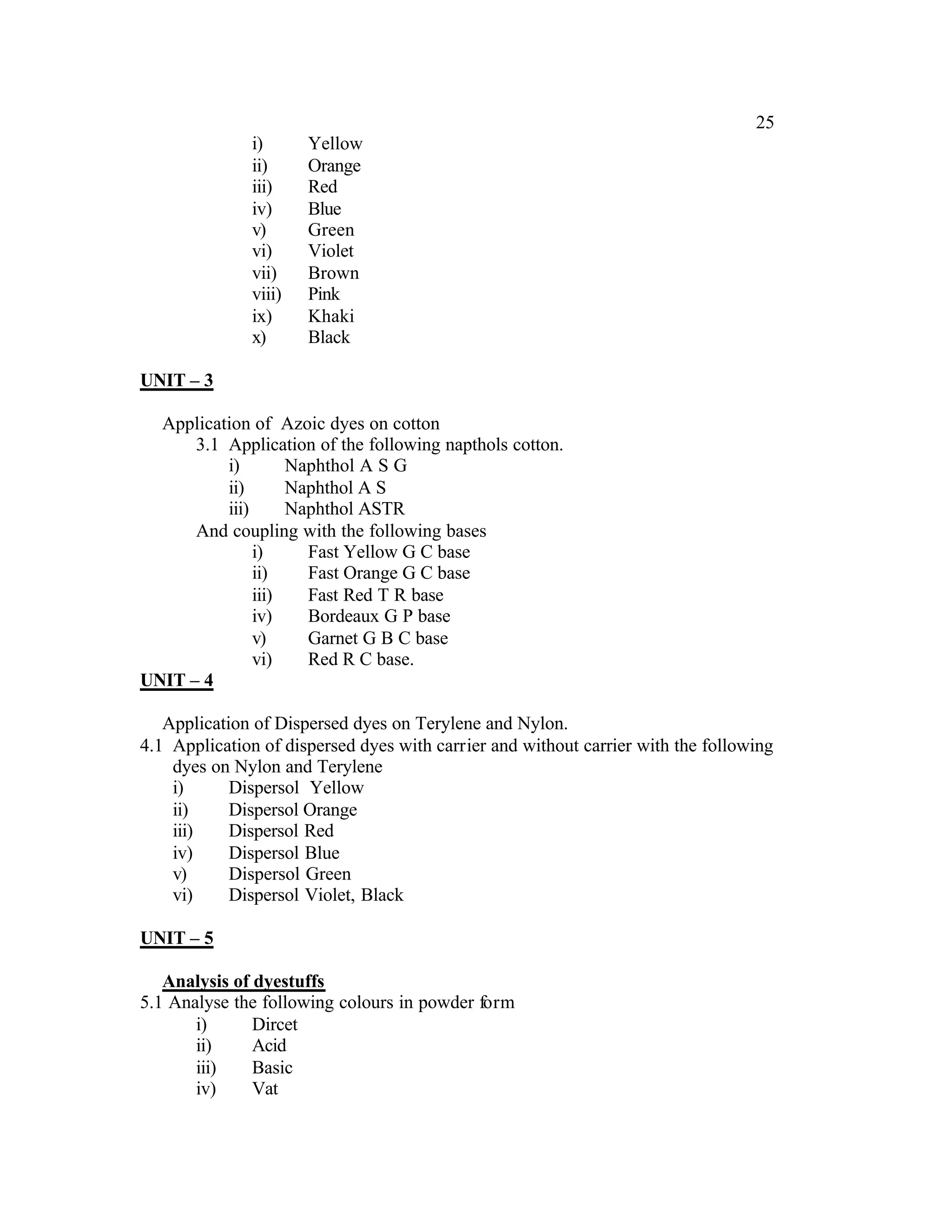
  • 41.
    37 Vocational Higher SecondarySchool-II Year (Theory) • To avoid blind guessing, multiple • The questions may be of such type choice and supply type questions may that make it possible for students of be mixed. different ability levels to interact. Consolidated Statement of C.E. Sl. No. Name Seminar Assignment Class Total Score Test Score reduced 20 20 20 60 to 20 Score 20 obtained X 60 1. Vinitha 10 8 14 32 10.75 2. Rema 12 13 15 40 13 3. Nitha 14 9 10 33 11 Consolidated Statement of T.E. and C.E. Sl. No. Name T.E. C.E. Total Grade Score 80 20 100 1. Vmitha 55 10.75 66 B 2. Rema 68 13 81 A 3. Nitha 42 11 53 C+
  • 42.
    38 Textile Dyeing and Printing Vocational Subject Evaluation Practical Evaluation (PE) Vocational subject evaluation is used to In practical evaluation, the leamer's evaluate the skills of the leamer in the capability on basic workshop skills and concerned subject.The facilitator has to make proficiency in operating machines and learning in print production techniques equipment for print production skills are to activity based, product based, student be examined. Questions are framed in such a centered and society bound. way that it should evaluate working skills Part II Vocational Subject and knowledge in print production. Evaluation of Second year CE TE PE IE Total Minimum VT 20 80 - - 100 30% VP - - 150 - 150 40% VCE - - - 50 - 30% No minimum for CE
  • 43.
    40 Textile Dyeing and Printing Rating Scale 81. No. I 2 3 4 5 1. Regularity Never Often Usually Most of the Always Regular Regular Regular time Regular Regular 2. Punctuality Never Often Usually Most of the Always Punctual Punctual Punctual time Punctual Punctual Regularity and punctuality can be amassed by using attendance of the student and time bound . Capacity for observation, analysis and completion of tasks. innovation. II. Indicators for field visit Attitude and readiness towards the task. . Documentation, recording and display. Capacity for observation. Performance - clinic/Camp/exhibition Data collection. . Application of ideas. . Ability for planning and Documentation/Recording. . organisation. Mastery of subject . Ability:ITO communication. Survey . Innovation. Involvement/social commitment. . Planning Performance - Production/Service cum . Data collection Training Centre (PSCT) . Consolidation of data and analysis . Mastery ofVoc. skills. . Drawing inference . Managerial capacity. Promoting self . Reporting . confidence. III. Simulated Experiment/OJT . Innovative approach. • Evolvement/participation Skills in doing work/communicates . Promoting self-reliance. skill • Time bound action
  • 44.
    41 " Vocational Higher SecondarySchool II Year (Theory) Note: VC A minimum of80% attendance is required Items Score for promotion to the second year. Those who . have shortage of attendance should repeat . Regularity and Punctuality Field 10 first year. Those who have 80% attendance but failed to achieve 30% of internship . visit/survey (anyone) 20 valuatin will be promoted to the second year. He has to improve the component in which Simulated experiment/OJT 20 he perfonned poor. He has to attain the Perfonnance - minimum by improving the particular c1inic/caup/exhibition Perfonnance - component to get eligible for appearing PSCT (Anyone) second year public examination. Total 50 Scores
  • 45.
    42 Textile Dyeing and Printing Detailed format for Vocational Competency Evaluation (VCE) VCE Item Evaluation Score Total Score Indicators 1. Regularity and 1. Attendance 5 10 Punctuality 2. Discipline and Obedience 5 2. Value addition Field Visit 1. Attitude and readiness 4/3/2/1 towards the task. 2. Capacity for 4/3/2/1 observation. 3. Data collection. 4/3/2/1 4. Application of ideas. 4/3/2/1 5. Documentation/ 4/3/2/1 recording. OR Survey 20 1. Planning. 4/3/2/1 2. Data collection. 4/3/2/1 3. Consolidation of data 4/3/2/1 and analysis. 4. Drawing inference. 4/3/2/1 5. Reporting. 4/3/2/1 3. Capacity OJT/ Simulated building Experiment 1. Involvement/ 4/3/2/1 Participation. 2. Skills in doing work/ 4/3/2/1 Communication skill. 3. Time bound action. 4/3/2/1 4. Capacity for 4/3/2/1 observation, analysis and innovation. 5. Documentation, 20 4/3/2/1 Recording and display.
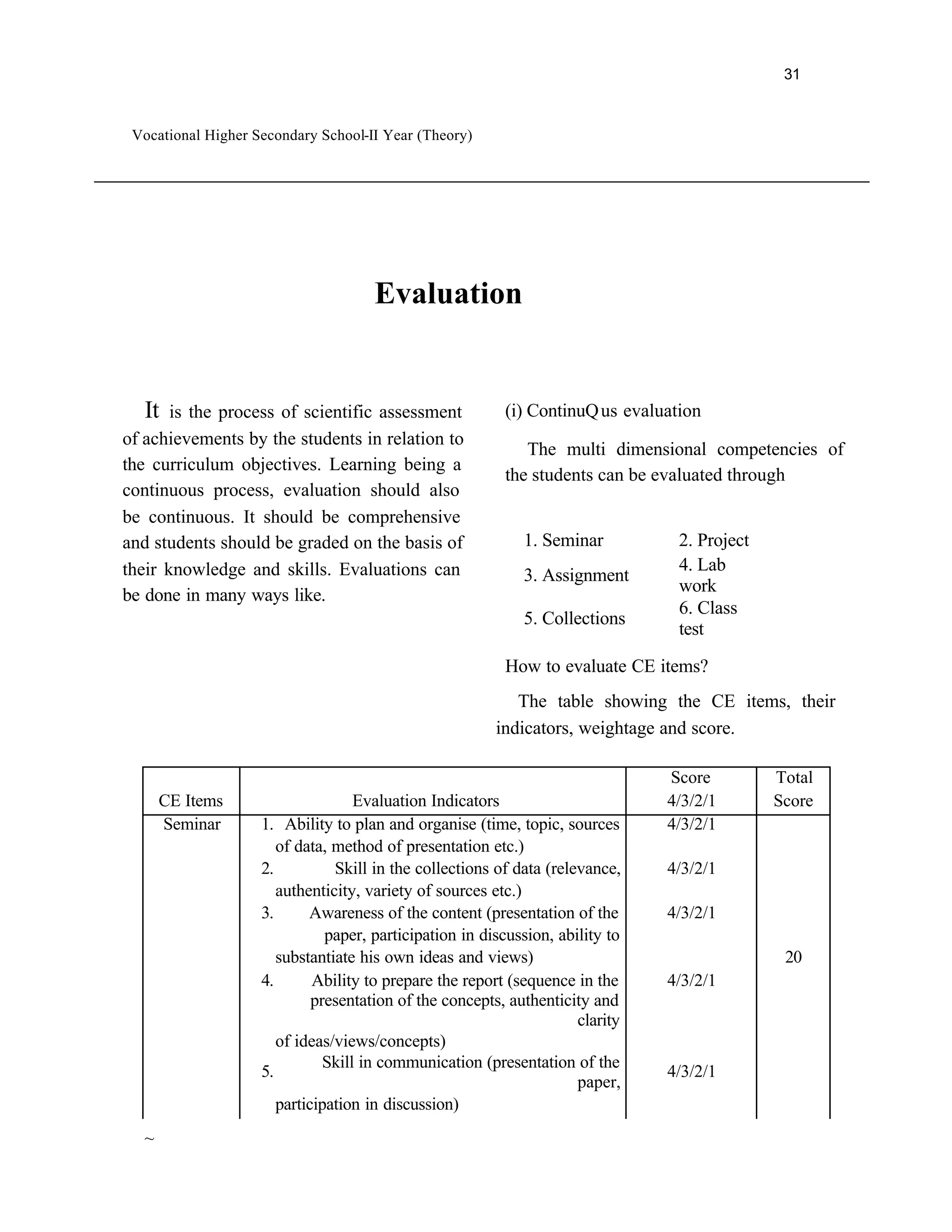
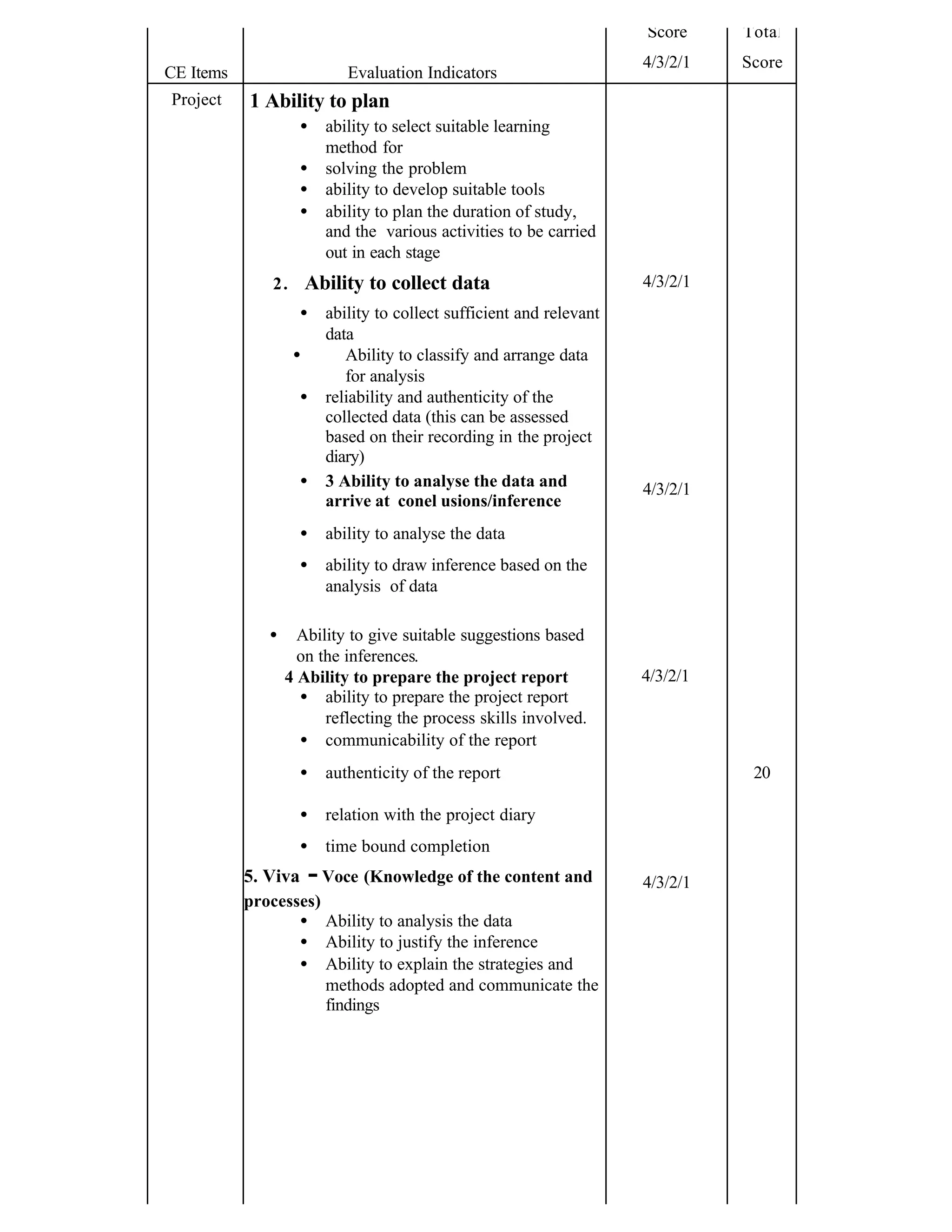
  • 47.
    43 Vocational Higher SecondarySchool1-II Y ear (Theory) VCE Item Evaluation Score Total Score Indicators OR Performance in campi Exhibition 1. Abili or planning and 4/3/2/1 orgamsmg. 2. Mastery of subject. 4/3/2/1 3. Ability for 4/3/2/1 communication. 4. Innovation. 4/3/2/1 5. Involvement/Social 4/3/2/1 commitment. OR Performace in production! service cum training centre (PSCTC) 1. Mastery of vocational 4/3/2/1 skills. 2. Managerial capacity. 4/3/2/1 3. Promoting self 4/3/2/1 confidence. 4. Innovative approach. 4/3/2/1 5. Promoting self - 4/3/2/1 reliance.
  • 48.
    IL 44 ') FORMAT FOR EVALUATION OF VOCATIONAL SUBJECT CE TE Total Grade PE Vocational Competency Evaluation 1 2 3 (80) (100) Value To- Regularit) Capacity Sino: Name Tota Total Grade Grad. CIas (20) (20) tal out 12 34 567 8 Tota and Addition building (50) Test t (60) of Punctual - (20) (20) (20) 20 ity (10) I r--
  • 49.
    45 Government of Kerala Board of Vocational Higher Secondary Examinations Thiruvananthapuram Reg: No. Dated:- - - - - - Evaluation Sheet Sri./Smt. ------------------------------------------------------------- is awarded Scores/ grade as detailed below in the First Year Vocational Higher Secondary Examination held ------------------ in Name of School '------- Admission No . - - - - Name of Vocational Course: - ------ Subject Score Obtained Positional Grade in words CE20 1E PE IE Total Grade 80 150 50 Part- I English - - Genernl Foundation Colll"re - - Part- II Vocational Subjects Vocational Theol)' - - Vocational Practical - - - Vocational - - - Part- III Optional Subjects 20 60 20 Physics - CkmislIy - 20 80 Mafuematics - - CE- Continuous Evaluation, TE- Term End Evaluation, PE- Practical Evaluation, IE- Internship Evaluation. Grades A + 90% and Above Outstanding A 80- 89% Excellent. B+ 70 -79% Very Good B 60- 69% Good C+ 50 - 59% Above Average C 40- 49% Average D+ 30 - 39% Marginal D 20- 29% Need improvement E Below 20% Need improvement -------- -------- -------- Marks Entered by Marks checked by SECRETARY S updt/ T. 0
  • 50.
    46 TEXTILE DYEING AND PRINTING SECOND YEAR PART-II UNIT-I SULPHUR AND VAT COLOURS INTRODUCTION These colours are extensively used for colouring cotton textiles. Sulphur colours are very cheap and produce colours, which are fast to washing. Fastest colours are produced with vat dyes, but they are very costly and hence applied only on superior varieties of cotton materials. Completing this unit, the students will be able to under stand the properties and the method of application of sulphur and vat colours. Curriculum Objective Familiarize the properties and applications of sulphur and vat on various textile materials through demonstration. Syllabus SULPHUR DYES- Properties, solubility, fastness, affinity towards textile fibers, exhaustion, tinctorial power, assistants for dissolving and their function. Application on cotton, dyeing assistants and their functions, standing and feeding baths. After treatments-objects, after-treatments to improve fastness to light and washing, Topping with basic dyes. Tendering – reasons for tendering-after treatment for tendering and bronziness VAT DYES- Properties, method of dissolving. Classification- Indigoid, Anthraquinone, sulphide. General method of application of the above vat dyes and their properties, suitability for dyeing vegetable and animal fibers, assistants and their functions. Different methods of applications of Anthraquinone Vat dyes-IN method, IK method, IW method and IN. Special method for Vat Black. SOLUBILISED VAT DYES- Properties, advantages, method of application on cotton- Nitrite process, Dichromate process and Ferric salt process.
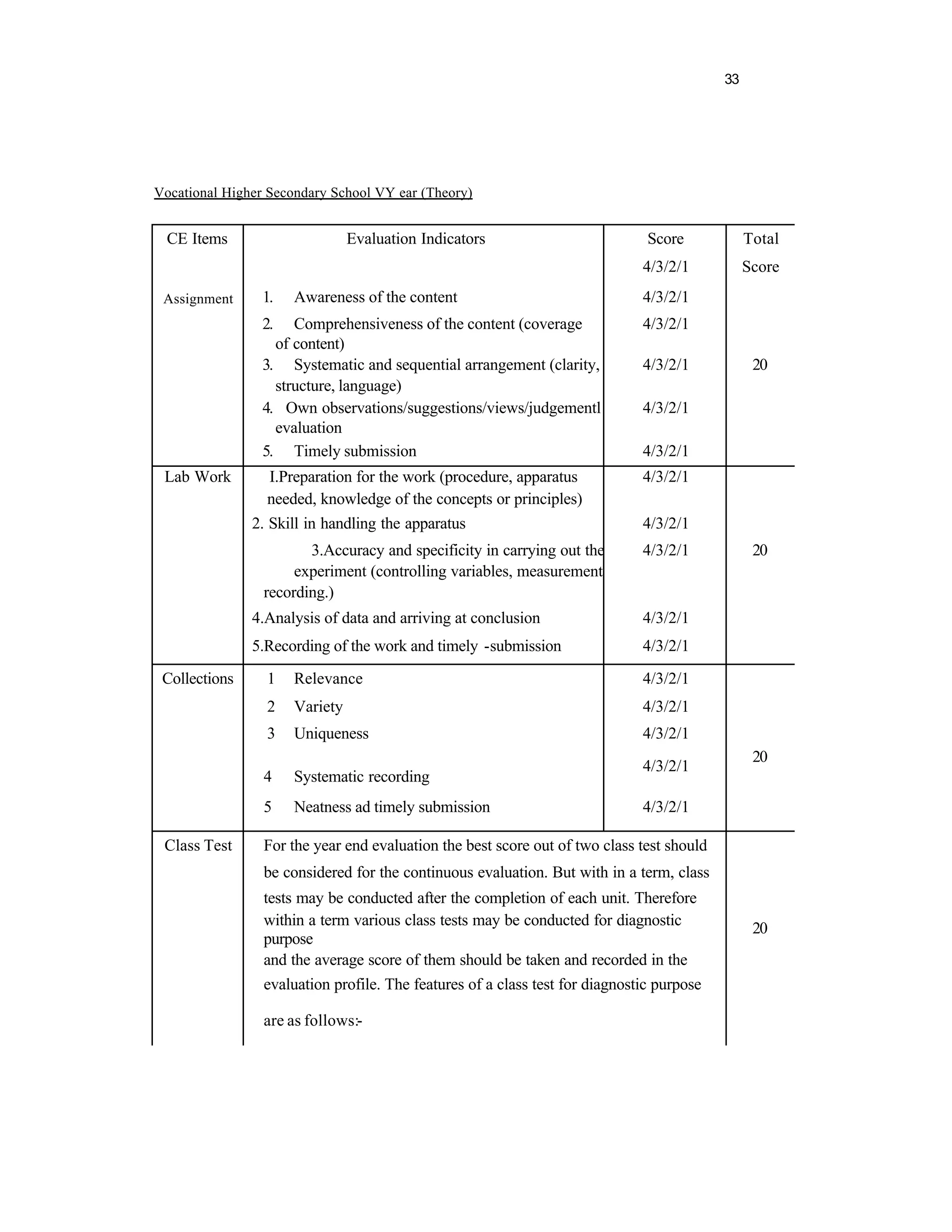
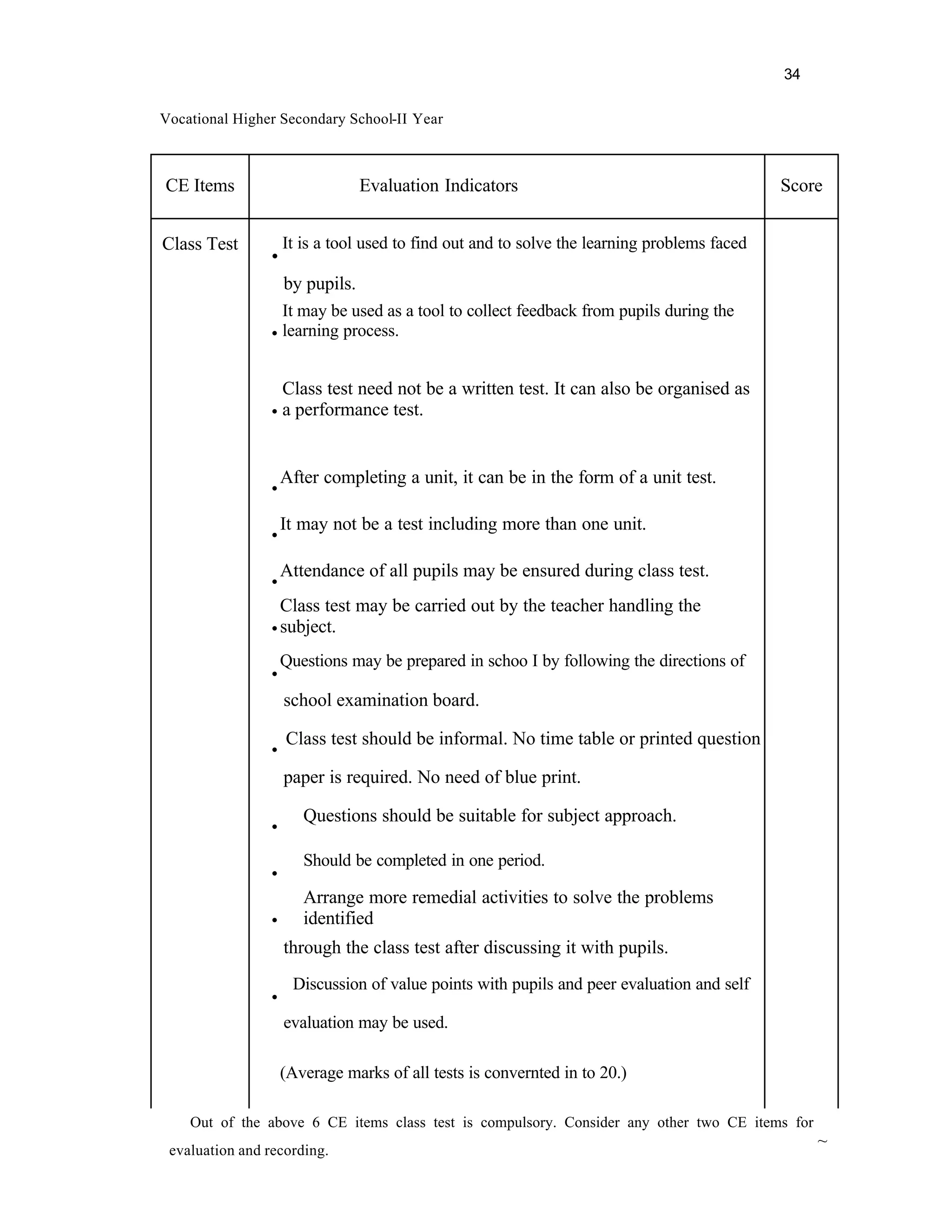
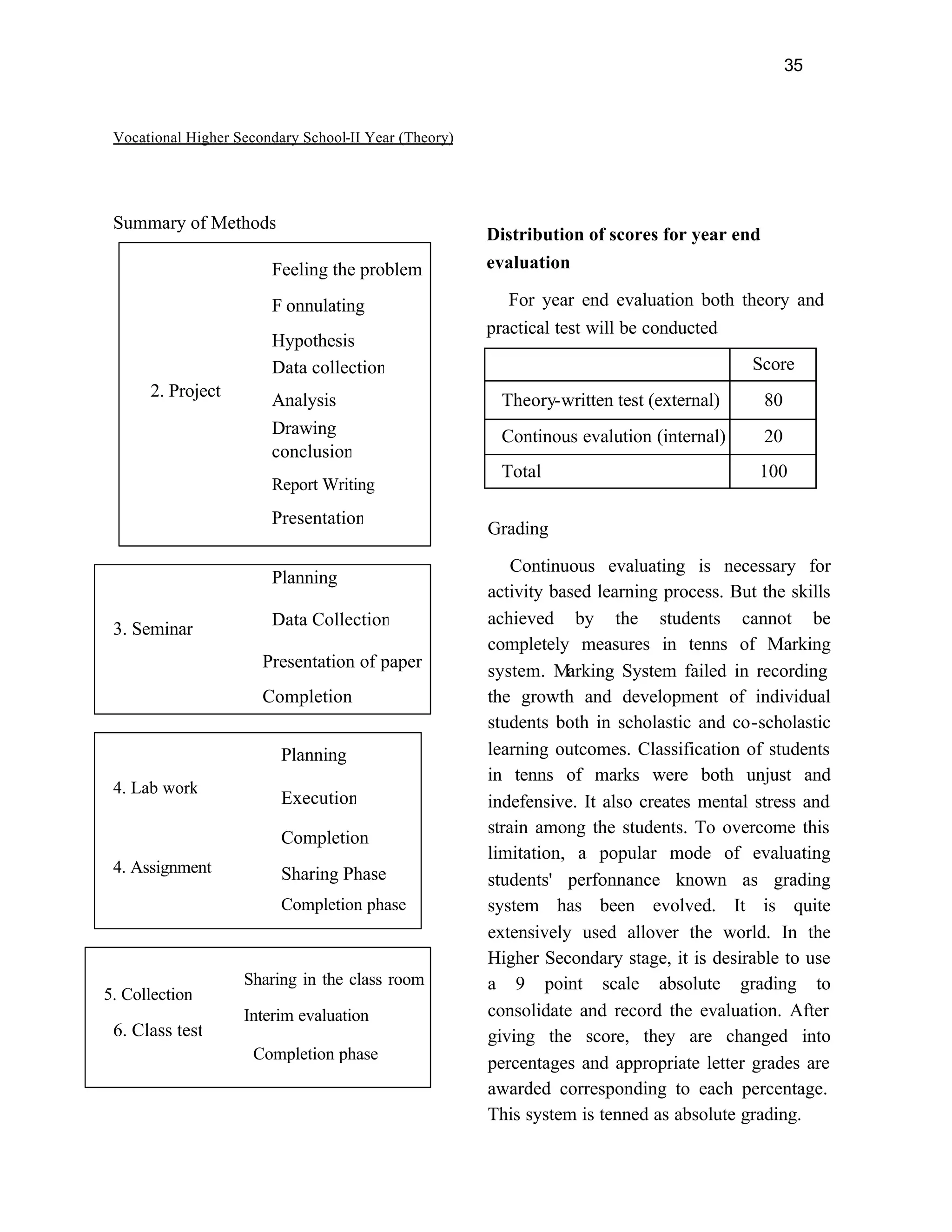
  • 51.
    47 Pre-requisites. v Learners should be aware of the colouring technique of textile materials like fabrics and yarns of various forms. v They should have a ge neral idea about insoluble group of dyes and various chemicals used in dyeing of Vat and Sulphur dyes. Activity -I Name : Solubility of Vat and Sulphur Dyes. Activity : Demonstration. Materials: Vat and Sulphur dye stuffs, Hot and cold water and solutions of NaOH, Na2 So4 , Na2 Co3 Process: Divide the pupil into 5 groups o Instruct each group to take a little amount of Vat and sulphur dyes separately using a glass rod. o Try to dissolve them in cold and hot water. o Note the solubility. o Instruct them to add little NaOH Solution to Vat dye, then add Na2 S2 O4 solution and heat the whole solution well. o Note the solubility of Vat dyes. o Instruct again to add little Na2 Co3 solution to Sulphur dye, then add Na2 S solution and heat the whole solution well. o Note the solubility of Sulphur dyes. Consolidation: Teacher consolidates that Vat and sulphur dyes are insoluble in Water. To dissolve Vat dyes NaOH and Na2 S2O4 are used and for Sulphur dyes Na2 Co3 and Na2 S are used (An alkali and a reducing agent are required to dissolve). Activity II Name: Application of Vat dyes on Cotton Activity: Experimentation. Materials: Vat dye stuff, Cotton yarn, solutions of NaOH andNa2 SO4 Process: Dissolving of dyestuff. Preparation of dye bath. Shades to be dyed. Dyeing Oxidation Washing
  • 52.
    48 Instruct to note the procedure Consolidation Dye bath: a) Depth of shade (0.5%, 1%, 2%, 3% , 4% ) b) Dissolving of dyestuffs I) NaOH II) Na2 SO4 c) Preparation of dye bath I) Dye solution II) NaOH III) Na2 S2 O4 IV) Water V) Levelling agent if required. d) Temperature – Different for different classes of dyes and different methods of dyeing. e) M.L.Ration- 1:10 to 20. f) Developing after dyeing by exposure to air. Product: Subject diary, Dyed materials. Activity- III Name: Application of sulphur dyes on cotton. Activity: Experimentation Materials: Sulphur dyes stuff, cotton yarn, and solution of Na2 CO3 and Na2 S • Process: Dissolving of dyestuffs • Preparation of dye bath • Shades to be dyed • Dyeing • Washing • Instruct to note the procedure Consolidation: Dye bath: a) Depth of shade (0.5%,1%, 2%, 4%) b) Dissolving of dyestuffs i) Na2 CO3 ii) Na2 S c) Preparation dye bath i) Dye solution ii) Na2 CO3 iii) Water iv) Levelling agent if required d) Temperature – boiling e) M.L.Ratio – 1:10 to 1: 20 After washing the dyed materials are treated with a. Copper sulphate and acetic acid to improve light fastness b. Potassium di chromate and acetic acid to- improve washing fastness c. Topping with basic dyes to improve brilliancy.
  • 53.
    49 Product-Subject diary, dyed materials Sulphur and Vat colours Sl Curriculum Learning Process skills Activities Learning Product Evaluation Time no objectives concept materials Familiarise • Properties • Observing • Demonst • Dye stuff • Dyed • Particip 20 the properties of sulphur • Experiment ration • Cotton samples ation hrs and and vat ation • Experime yarn • Subject • Process application of dyes • Controlling ntation • Shade diary skill sulphur and • Dyeing variable cards • Experim vat colors on assistants Measuring • Color ental various textile • Application • Inferring spectrum skill material on cotton • Chemicals through • After demonstration treatments and experimentati on UNIT II DISPERSED AND OXIDIZED COLORS Introduction: Dispersed colors are specially manufactured for coloring hydrophobic fibres like Terylene, nylon ad acetate rayon. This unit deals with the method of dispersing the dispersed color and its application on different fibres. This unit also deals with the method of production of oxidized color by using chemicals as and when it is required. On completion of this unit, the learner shall be able to understand the properties and the method of production of dispersed and oxidized colors on various textile materials Curriculum objectives Understand the method of application of dispersed and oxidized colors their properties through demonstration and experimentation. Syllabus Dispersed dyes, properties, function of dispersing agent meaning of dispersion, method of dyeing Acetate Rayon, Nylon, terylene –High temperature dyeing without carrier and with carrier at low temperature oxidized colors, Aniline black, chemicals used Aniline Hydro chloride, Hydrochloric acid,Oxidising agents, oxygen carrier .Different stages of oxidation method of application on cotton –Single bath process, Ageing process, Steaming Process.
  • 54.
    50 UNIT 2 Pre requisites The learners should be aware of the technique of coloring textile materials in the form of yarn and fabric made with cotton, Nylon, Terylene and acetate rayon They should have a general idea about dispersed dyes, meaning of dispersion,oxidised colors and various chemicals used for the production of oxidized colors at various stages. Activity I Name –Solubility of disperse dyes Activity –Demonstration Materials- Dispersed dye, Dispersing agent water Process-Divide the pupil in to 6 groups Instruct each group to take a little amount of dispersed dyestuff Try to dissolve it in cold and hot water Note the solubility Instruct them to take a little dispersing agent into the above bath Note the change Consolidation The teacher consolidates that dispersed dyes are insoluble in water but can be dissolved in water with the aid of a dispersing agent Product; Subject diary Activity II Name –Application of dispersed dyes on Terylene Activity- Experimentation Materials – Dispersed dye, Dispersing agent, carrier samples of Terylene yarn and fabric Process • Make a fine dispersion of the dye stuff in water • Preparation of thee dye bath • Dyeing • Washing • Instruct to note the procedure Consolidation Dye bath (a) Depth of shade –0.5% , 1%, 2% , 3% and5% (b) Dispersion of dyestuff
  • 55.
    51 (i)Dyestuff (ii) Dispersing Agent © Preparation of dye bath i) Dye dispersion in water ii) Carrier iii)Temperature –Boiling iv) M:L ratio-1:10 to1.:20 The teacher consolidates that the dye is dissolved in the fibre Product-subject diary, Dyed sample Activity-III Name –Production of Aniline black on cotton Activity –Experimentation Materials-Aniline Hydrochloride, Potassium dichromate, Copper sulphate,cotton yarn and fabric Process • Dissolving the aniline hydrochloric in HCl and water. • Preparation of Impregnating bath • Dyeing • Soap boiling • Washing Consolidation Dye bath (a) Shade-8% (b) Dissolving the Aniline Hydrochloride ©Hydrochloric acid (d) Copper sulphate solution Dyeing-Temperature –70 degree Celsius M:L = 1:10 to 1:20 The teacher consolidates that a dull green color is observed in the dye liquor and the cotton acquires deep black color, on completion of dyeing Product: Sub ject diary, Dyed samples
  • 56.
    52 Unit-2 Dispersed and Oxidised colours Sl Curriculum Learning Process skill Activities Learning Product Evaluation Time no objective concept Materials 1. • Understand • Properties • Participation • Demonstr • Dispersed • Subject • Participation 15 hrs the of dispersed • Identifying ation dyes diary • Process skill method of and • Handling • Experime • Chemicals • Dyed • Product appli8cati oxidized material and ntation for sample evaluation on of dyes equipment oxidized dispersed • Methods of effectively colors Polyester arn and dispersing • Communicati • Nylon yarn oxidized • Application ng Cotton colors of dispersed yarn their dyes properties • Method of through producing demonstra oxidized tion and colors experimen tation UNIT- III MORDANT AND MINERAL COLOURS Introduction Similar to oxidized colours, these are not ready made colours. A colour is produced by the dyer or printer as and when it is required with the help of chemicals. This unit deals with the various types of mordants and chemicals required for producing mordant colours and mineral colours. The students will be able to understand the methods of production of mordant colours and mineral colours on textile materials on completion of this unit. Carriculam Objectives Know the method of production and properties of mordant and mineral colours through demonstration.
  • 57.
    53 syllabus Mordant dyes/ functionof mordant,importance of mordanting ,methods of mord anting with salts of Aluminium and Chromium. Natural mordant colours- Log wood block, application on wool. Production of Turkey red colour on cotton using Alizarine. Mineral colours- Chrome yellow, Prussian blue, Iron buff, Chrome green and mineral Khaki, chemicals used for producing the above colours and the methods of production of mineral Khaki colour on cotton. UNIT-3 Pre-requisites v The learn should have a basic idea about metallic salts such as ferrous sulphate, Chromium salt, Aluminium sulphate, Turkey red oil. v They should have an idea about oiling, mordanting, natural mordant colours like log wood block and Alizarin Red . Activity-I Name Mordanting Activity Demonstration Materials Turkey Red oil, woollen yarn and fabric,water. Process Divide the pupil into six groups. Instruct each group to take some turkey red oil into a bath and add water. Treat the sample of woolen yarn and fibre in turkey red oil solution. Squeeze the sample to have an even oiling. Consolidation The teacher consolidates that the oil is present on the sample uniformly. Activity-II Name Mordanting Activity Demonstration Materials Aluminium sulphate, Acetic acid, previously oiled samples of yarn and fabric. Process Divide the pupil into six groups Instruct each group to take some Aluminium sulphate. Dissolve Aluminium sulphate in cold water. Treat the sample of yarn and fabric in the above solution in cold. Note the change. Consolidation The teacher consolidates that the Aluminium salt is taken up by the yarn and fabric. Product :- Subject diary Activity-III Name Dyeing with Alizarine
  • 58.
    54 Activity Demonstration Materials Alizarine powder, Acetic acid , mordanted samples of yarn and fabric. Process Divide the pupil into six groups. Instruct each group to take some Alizarine powder. Dissolve the Alizarine powder in water Prepare the dye bath with the addition of water, acetic acid and Alizarine solution. Treat the sample of woolen yarn and fabric in the dye bath. Wash the specimen. Note the change. Consolidation The teacher consolidates that the woollen yarn and fabric aquire a red colour. Product Subject diary, dyed sample. Activity-IV Name Mineral Khaki Activity Demonstration Materials Cotton ya rn and fabric, Ferric salt, Chromium salt, Sodium hydroxide. Process Divide the pupil into six groups. Instruct each group to take a little of chromium salt and iron salt. Dissolve the Chromium and iron salt separately and added to dye bath. Treat the samp les of yarn and fabric separately in warm dye bath. Squeeze the treated samples. Prepare the developing bath with water and sodium hydroxide. Treat the squeezed sample in the developing bath in cold. Soap boil to remove surface colour. Washing. Consolidation The teacher consolidates that the samples of fabric acquire a khaki colour. Product Subject diary,samples of dyed fabric and yarn.
  • 59.
    55 UNIT-III MORDANT AND MINERAL COLOURS UNIT ANALYSIS Sl. Curriculam Learning Process Activities Learning Product No Objectives Concepts Skills Materials . 1 • Know the • Properties • Participation • Demonstration • Mordant method of of • Identifying dye production and mordant • Handling of • Chemicals properties of colours minerals and for mordant and • Properties equipments mineral mineral of mineral effectively colours colours colours • Communicating • Woollen through • Production yarn demonstration of • Cotton mordant yarn colours • Production of mineral colours. UNIT – IV AZOIC DYES INTRODUCATION Production of these colours involve two stages of application,namely, naptholation and coupling with diazotised base. Different fast and bright colours are produced mainly on cotton with these dyes. The learners acquire the idea of application of napthol and base on cotton to produce different colours. Curriculum objectives Familiarize the production of different Azoic colour by using suitable napthols and diazolized bases through Demonstration and Experimentation.
  • 60.
    56 Syllabus Properties, method of application on cotton, selection of combinations of naphthols and base for different colours, dissolving naphthol, diazolizing base, padding, developing, after treatments . Pre – requisites The learners should be aware of the colouring technique of cotton fabric and yarn. They should have a general idea about the naphthols and bases. Activity- I Name : Solubility of Naphthols Activity : Demonstration Materials : Naphthols, Na OH + water Process : v Divide the students into 6 groups v Instruct each group to take a small quantity of naphthol and add water. v Try to dissolve v Heat the solution v Instruct to add Na OH v Note the solubility of Naphthol Consolidation Teacher consolidates that the Naphthols are insoluble in water but their sodium salts are soluble in water. Product :- Subject diary Activity II Name : Solubility of Bases Activity : Demonstration Materials : Base, Na No2 , Hcl Process v Divide the students into 6 groups v Instruct each group to take a little quanity of base. v Try to dissolve the base in water v Note the solubility v Instruct them to diazotise the base with Hcl + Na No2 v Note the solubility of base.
  • 61.
    57 Consolidation Teacher consolidates that the bases are insoluble in water. To dissolved add Na NO2 + Hcl. Product :- Subject diary Activity III Name : Application of azoic dyes on cotton Activity : Experimentation Materials : Naphthols, Na OH water Bases, Na NO2 , Hcl, sod: acetat Alu: Sulphate Cotton yarn Process: Dissolving Naphthols Dissolving Bases Shade –deep Padding Developing Washing Instruct to note the procedure Consolidations - Shade – Deep - Dissolving the Naphthol a. Naphthols b. Na OH c. Water 2. Dissolving the base. a. Base b. NaNo2 c. Hcl 3. Preparation of the padding bath 1. Naphthol solution d. Temperature cold bath- preparation of the developing bath 1. Base solution 2. Sod. Acetate 3. Al Sulphate- Alkali binding agent- Temperature cold bath 4. Padding with Naphthol solution 5. Developing the padded yarn in the diazotised base solution 6. After treatment – soap solution- to give brightness of the colour Product : Subject diary, Dyed sample
  • 62.
    58 UNIT-V INTRODUCTION TO TEXTILE PRINTING Introduction On completion of this unit, the students will be able to understand the difference between dyeing and printing, various ingredients used for the preparation of printing paste and the pre-treatments required for textile materials Curriculum objectives Differentiate dyeing and printing, preparation of various textile materials for printing and developing an idea about the ingredients required for the preparation of the printing paste by discussion and observations Syllabus Textile printing, difference between dyeing and printing, preparation of cloth for printing- singeing, desizing, scouring and bleaching. Ingredients used for printing, their functions thickners, dissolving agents. Classification and properties of thickners like gum Arabic, gum tragacanth and starches. Pre-requisites A clear understanding of various types printing like letter printing practised by news papers, computer printing, type writing, stamping, tattoos etc. Activity-I Name : Printing Activity : Discussion Materials : New papers, photos-colour and black and white type written documents, computer print, out printed fabrics etc. Process : v Give a brief introduction to various types of printing including textile printing v Distribute the materials to the students v Ask the students to identify the type of prints in the distributed the material v Allow about 5 minutes for this exercise v Discuss the following Letter printing Photo printing Type writing
  • 63.
    59 Banner writing and printing Computer printing Fabric painting Fabric printing / textile printing v Students to discuss similarities and dissimilarities of the above types of printing and note the points v Students are asked to differentiate textile printing from other types of printing and note the points. Consolidation: The teacher differentiates dyeing and textile printing Activity-II Name : Textile Printing Activity : Observation Materials : Fabrics of cotton, silk,. Polyster, rayons etc. various groups of dyestuffs, starches, oils, hygroscopic agents, antiseptics, thickening agent etc process : v Exhibit the various types of fabries v Ask the students to identify the improving present in each types of fabrics v Ask them to prepare a chart showing various types of impurities present in each type of materials and suggest various pre- treatments required to remove the impurities already studied in the 1st year classes v Then exhibit the various ingredients required to prepare printing paste v Familiarize with the various ingredients v Classify and name the ingredients v Make the students be aware of properties of ingredients v Developing an understanding of method of preparation of printing paste for various groups of dyestuffs Consolidation : The teacher consolidates the impurities presents in various textile fabrics and the treatments required for each material before printing various ingredients used for the preparation of printing paste are I Dyes and assistants II Adhesive III Softeners IV Hygroscopic substance V Dissolving agents
  • 64.
    60 UNIT-V INTRODUCTION TO TEXTILE PRINTING UNIT ANALYSIS Sl. Curriculum objectives Learning Process skills ActivitiesLearning Products No concepts materials 1 Differentiate between dyeing *definition of *observing *discussion *samples of *subject diary and printing preparation of printing *identifying *observation clothes various textile materials for *pretreatments *experiencing *ingredients printing and developing an required *news paper idea about the ingredients *ingredients *photos required for the preparation of for printing *type written printing paste by discussion *properties of documents and observation ingredients *computer *preparation printers of printing *printed fabrics paste *banners etc. *recipes UNIT-VI METHODS OF PRINTING Introduction The unit covers the different methods of printing like hand block, stencil, screen, roller and transfer printing. The students will get a clear idea of transferring designs on textile materials using different types of printing machines Curriculum objectives Understand various methods of printing machines used for printing through discussion, and field visits Syllabus Methods of printing hand block printing preparation of blocks, printing table, printing pad, printing method. Stencil printing-cutting the stencil. Aerograph printing. Screen printing different methods for the preparation of screens direct painting methods, pro film method, resist method photographic method, m ethod of printing- roller printing- single colour, multi colour and duplex printing machines. Transfer printing principles, method of printing
  • 65.
    61 UNIT-VI Pre-requisites The learner should have a clear idea of textile printing, equipments, ingredients and repairs Activity-I Name : Methods of printing Activity : discussion Materials : Hand block, stencil, spray gun, screen , squeegees, materials for preparation of screens, provision to setup dark room, pre-treated fabrics and various types of printed fabrics Process : v Give a brief introduction to various methods of printing v Display the materials v Students are asked to discuss the various methods of printing based on the printed samples v Try to identify the various type of prints v Students are asked to differentiate the students of designing in different samples and note the points Consolidation : The teacher consolidates the various methods of printing like I Hand block printing II stencil printing III screen printing IV machines printing !. Single colour, multi colour, duplex colour Product : Subject diary Activity-II Name : Method of printing Activity : Field visit process : v Planning v Data collection v Consolidation of data and analysis v Drawing v As a part of the field visit the students are asked to prepare a brief report consisting of the details of machinery and equipments required for textile printing unit, especially in the field of block, stencil and screen printing Consolidation : The teacher consolidates various aspects of printing Product : Report of field visit
  • 66.
    62 UNIT-VI METHODS OF PRINTING UNIT ANALYSIS Sl. Curriculum objectives Learning Process skills Activities Learning Products No concepts materials 1 Understand methods various *methods of *participation *discussion *charts *subject diary printing and machines used printing *identification *field visit *drawings *report of f printing through discussion and *hand block *comparison *text books visit field visits printing *discussion *equipments *stencil *chart related to printing forming textile printing *screen printing *machine printing *preparation of screens *setting of dark room UNIT-VII STYLES OF PRINTING Introduction: Styles denote for the manner by which a particular colour is applied. The learners will be able to understand the various styles of printing like direct, dyed, discharge, resist, crepons, azoic and metal printing styles Curriculum objectives Know the various of printing for the application of printing paste by discussion and experimentation Syllabus Styles of printing-direct style, dyed style, discharge style, resist style, batik printing, tie and dye, azoic style, crepon style, metal printing style
  • 67.
    63 UNIT-VII PRE REQUISITES v The learner should have a basic idea about various methods of printing Activity-I Name : Styles of printing Activity : discussion Materials : Samples of fabrics printed in different styles process : v Give a brief out line on the various styles of printing v Display the sample fabric printed using various styles v Ask the students to identify the style employed in printing each of the above samples v Try to identify the various type of prints v The students to discuss the similarities and differences between various styles of printing v The students to discuss the merits and demerits of each style of printing Consolidation : The teacher differentiates different styles of printing Product : Report Activity-II Name : Direct styles of printing Activity : Experimentation Materials : Water soluble dye stuff and other ingredients for the printing paste, pre treated cloth, hand blocks process : v Divide the students into 6 groups v Ask each group to prepare the printing paste using dye stuff and other ingredients v Prepare the hand block, printing table v Spread the fabric on the printing table v Make impression of the printing block on the fabric with the aid of printing paste v The colour to be fixed on the fabric by suitable after treatments v Washing v drying Consolidation : The teacher consolidates the methods of producing patterns on the fabric using direct style Product : Report, samples
  • 68.
    64 Activity-III Name : Dyed style Activity : Experiments Materials : Basic dye, mordant, fixing agent and ther ingredients, pre-treated fabric Process : v Divide the students into 6 groups v Ask each group to prepare a paste of mordant gum and water v Print the mordant on the fabric by using hand block v Fix the mordant by treating in a solution of the fixing agent v Prepare a solution of the basic dye using suitable solvent and assistants v Dye the above sample of fabric in the dye bath v Washing v Drying Consolidation : The teacher consolidates the method of printing using dyed style Product : Report, samples of printed fabric Activity-IV Name : Discharge style Activity : Experimentation Materials : Direct dyed sample of fabric discharging agent and other ingredients, hand block process : v Divide the students into 6 groups v Ask each group to prepare the printing paste using discharging agent and other ingredients v Prepare the hand block, printing table and the printing pad v Spread the direct dyed fabric on the printing table v Print the discharging agent on the direct dyed fabric using hand block v Washing v drying Consolidation : The teacher consolidates that the pattern is produced on the dyed fabric by removing the dye from the dyed ground by printing with the discharging agent. The colur is removed only from portion where the discharging agent is applied Product : Report, samples of printed fabrics Activity-V Name : Resist style of printing
  • 69.
    65 Activity : Experimentation Materials : pretreated fabrics, direct dyestuff and assistants, wax coated thread process : v Divide the students into 6 groups v Ask the students to prepare a solution of the direct dye using necessary assistants v Prepare the dye solution by adding suitable amount of water and other assistanrs to the dye solution v Tie the fabric sample with waxed thread at different places tightly so as to prevent the dye solution entering into the fabric where the dye is applied v Dye the ticd fabric in the dye bath, in hot condition v Wash the dyed sample v Remove the wax from the fabric v Drying Consolidation : The teacher consolidates that pattern are produced on the fabric by the absence of dye at places where the dyeing is resisted by tyeing with waxed thread Product : Report, samples of resist printed fabrics Activi ty-VI Name : Azoic style of printing Activity : Experimentation Materials : Naphthol, base, assistants for naphthol and base. Pre treated fabric, printing block process : v Divide the students into 6 groups v Prepare a paste of the naphthol for printing v Prepare the diazolised solution of the base using necessary assistants v Prepare the developing bath v Print the naphthol on the pre treated fabric using a hand block v Dry the fabric in shade v Develop the naphthol printed fabric in the developing bath v Washing v Soap boiling v Washing v drying Consolidation : The teacher consolidates that the pattern is obtained by the presence of colour only in regions where the fabric was printed with naphthol Product : Report, samples of fabrics
  • 70.
    66 UNIT-VII STYLES OF PRINTING UNIT ANALYSIS Sl. Curriculum objectives Learning Process skills Activities Learning Products No concepts materials 1 Know the various styles for the *Styles of *observing *discussion *Printed cloth *Subject diary application of printing paste by printing *Participation *observation samples *Printed sampl discussion and experimentation definition *Inference *Hand block *Different *Screens styles of *Stencil printing *Spray gun *Production *Printing of designers pastes using various *Chemicals styles UNIT – VIII RECIPES FOR PRINING AND AFTERTREATMENTS INTRODUCTION This unit deals with the printing paste preparation using different groups of colours and various ingredients. Fixation of colour after printing requires various after treatments. The students will be able to prepare different printing paste and fix the colour after printing by suitable after treatments on comp letion of this unit. Curriculum objectives Understand the preparation of various recipes for different colour and materials and the object of after treatments through demonstration and group work.
  • 71.
    67 Syllabus Recipe for printing with Direct, Basic, Acid, Reactive, Sulphur, Vat, Solubilized Vat on Cotton, Wool and silk. Azoic colour, Pigments. Printing with dispersed colours on Terylene , Nylon and Acetate Rayon. Discharge Pattern on Direct dyed ground, Vat dyed group, Naphthol dyed ground. Batik priting with Reactive and Azoic colours. Tie and Dyeing with all colours on cotton, wool, silk, Nylon, Terylene and Acetate Rayon. After treatment- steaming, batch wise ageing, Continuous ageing, Soaping, washing, clearing by passing through bleaching powder solution washing. Pre – requesites A clear understanding of Textile printing, methods of printing, styles of printing, Ingredients for printing paste, printing machinery and chemicals required for after treatment . Activity – I Name : Recipes for printing Activity : Demonstration Materials : Various ingredients for printing paste. Process • Through reference students are asked to find out suitable recipes to prepare printing paste for various types of fabrics using different group of dyestuffs. • Students are asked to prepare sample printing pates using suitable ingredients for various types of fabrics as per the recipe. • Group assignment: make a booklet of recipes of printing paste for various styles, methods and group of dyestuffs. • Field trips to printing industries to observe and understand more about the preparation of printing paste and method and styles of printing. Consolidation Sample Recipe 1. Direct dye printing a) Dyestuff – 5 parts b) Urea or Glycerin – 5 parts c) Nacl – 5 parts d) Na2 Co3 – 2 parts e) Thickening agent – 40 parts f) Hot water – 43 parts
  • 72.
    68 Product : Booklet Activity- II Name : After treatment given to printed materials. Activity : Group work Process v Group work - A group of students are given an assignment of preparing a chart of after treatments given to materials printed with different group of dyestuffs v Field trips to printing industries are cond ucted to observe and understand more about after treatments Consolidation - Fabric printed with different group of dyes required different after treatments like steaming, curing, developing with chemicals, ALL printed fabric require steaming for the fixation of colour. Product – Assignment UNIT VIII RECIPES FOR PRINTING AND AFTER TREATMENTS UNIT ANALYSIS Sl. Curriculum Learning Process skills Activities Learning Products No. objective concepts Materials 1 Understand v Meaning v Observation v Demonstration v Various v Booklet the of recipe v Participation v Group work ingredi v Assignm preparation of v Objects v Identification ents to various of after prepare recipes for treatments printing different v Different paste colours and after materials and treatments the objects of after treatments through demonstration and group work.
  • 73.
    69 UNIT – IX INTRODUCTION TO TEXTILE FINISHING INTRODUCTION Finishing is the last stage of Textile processing which gives the required attractiveness and other desirable properties to a textile material according to the requirement and include water proofing, water repellency, fire proofing, moth proofing, calendering, sanforising, anticreasing etc. The learners will acquire sufficient knowledge about the objects of various types of finishes. Curriculum objectives Identify and classify the different of finishes required for different classes of Textile materials by discussion and field visit. Syllabus Objects , Classification – physical and Chemical- Temporary and permanent. Types of finishes- pure finish, assisted finish, stiffened finish, Ingredients used in finishing- filling materials, adhesives, softeners, deliquescent substances, antiseptics, whitening agents. Starches – wheat starch, Rice starch, potato starch, Tapioca starch, soluble starches – properties. Preparation of finishing mixture, detailed study of water proofing, water repellency, fire proofing and moth proofing UNIT – 9 Pre- requisites v The students should have a general idea about the objects finishing, types of finishes. Activity – I Name : Textile finishing Activity : Discussion Materials : Different samples of finished fabrics and finishing ingredients
  • 74.
    70 Process v Give a brief out line on the various types of finishes given to textile fabrics v Display the different samples of finished fabrics v Students to discuss various types of finishes applied in the fabric v Try to identify the various finishes applied to the fabrics v Students are asked to differentiate various finishes applied on the sample and note the points. Consolidation The teacher consolidates the various types of finishes as (i) Pure finish (ii) Assisted finish (iii) Stiffened finish Product : Report Activity- II Name : Methods of Finishing Activity : Field Visit Process : v Planning v Data collection v Consolidation of data and analysis. v Reporting v As the part of the field visit the students are asked to prepare a brief report consisting the details of machinery, equipments s and finishing ingredients required for textile finishing Consolidation The Teacher consolidation various aspects of Textile finishing Product :Report field visit.
  • 75.
    71 UNIT IX INTRODUCTION TO TEXTILE FINISHING UNIT ANALYSIS Sl. Curriculum Learning concepts Process skills Activities Learning Products No. objective Materials 1 Identify v Objective v Participation v Discussion v Samples v Subject and of finishing v Identifying v Field Visit of diary classify the v Types v Observation differen v Report different fabric t of field types of v Ingredients finished visit finishes used in fabrics required finishing v Samples for mixture of different v Various finishin classes of types of g textile starches ingredie materials v Preparation nts by of finish discussion mixture and field v Water visit. proofing v Water repellency v Fire proofing v Moth proofing UNIT – X FINISHING MACHINERY INTRODUCTION For finishing, various types of machines are used like water mangles, damping machine, stenters sanforizing m/c etc. The students will be able to familiarize with the working of various types of finishing machines on completion of this unit. Curriculum objectives Familiarize various machinery required for Textile finishing through field visits, and group work.
  • 76.
    72 Syllabus Padding mangles – objects, 2 bowl mangle, 3 bowl mangle, water mangle, washing mangle. Calendaring – objects, 5 bowl calendar, 7 bowl calendar , schreiner calendar, chasing calendar, stenter, sanforization principle, objects and process. Pre-requisites : Learners should have a clear idea about the various types of finishing machines. Activity – I Name : Finishing machinery Activity : Field visit Process: v Planning v Data Collection v Consolidation of data and analysis v Drawing inference v Reporting v As a part of the field visit, the students are asked to prepare a brief report consisting of the details of Textile Finishing machinery. Consolidation The teacher consolidates various aspects of Textile finishing and working of finishing machinery. Product Subject diary, report of field visit and Diagram of machinery Activity – II Name : Finishing machinery Activity : Group work Materials : Samples of finished fabrics Process v Divide the students into six groups v Instruct each group to observe the samples v Instruct the students to list the kind of finish applied to each sample v The students discuss the finishing applied on each sample, their objects and how it affects the end use of the fabric and the ingredients required for each finish. The students should also discuss various machinery and equipments required in obtaining the particular finish. v The students are asked to list and prepare a chart containing all the aspects concerned with finishing, their objects and advantages.
  • 77.
    73 Consolidation The teacher consolidates the various aspects of finishing and finishing machinery Product : Subject diary, Chart. UNIT – X FINISHING MACHINERY Sl. Curriculum Learning concepts Process skills Activities Learning Products No. objective Materials 1 Familiarise v Machineries v Participation v Field v Slides v Subject various used for v Observation visit v Charts diary machinery finishing v Inference v Group v Diagram v Report required v Calendaring v Identifying work v Reference of field for textile v Padding books visit finishing mangles. v Diagram through v Stenter of field visit v Sanforization machine and group ry work *********************
  • 78.
    74 PART-III Unit wise Learning Activities Section-B (Practical) Unit Topic Page no 1 Application of sulphur dyes on cotton 2 Vat dyes on cotton 3 Azoic dyes on cotton 4 Dispersed dyes on nylon and terylene 5 Analysis of dyes tuffs 6 Colour matching 7 Colour mixing 8 Preparation of stencil, screen and blocks 9 Printing with direct, reactive, vat, azoic& dispersed on different fabrics 10 Batik and tie dyeing 1 List of books 2 List of Equipments/Apparatus/Machinery 3 Sample Questions
  • 79.
    75 UNIT-I APPLICATION OF SULPHUR DYES ON COTTON INTRODUCTION: Sulphur dyes are insoluble in water and are dissolved by mixing the dyestuff with sodium sulphide, sodium carbonate and water. They are mainly used for dyeing cotton. After treatments are required to improve light and washing fastness and brilliancy. Tendency to tender is prevented by suitable after treatments. Learners attain skill to produce sulphur colours on cotton. CURRICULUM OBJECTIVES Acquires skills in the method of application of sulphur dyes on cotton SYLLABUS Application of black, blue and brown colour on cotton yarn and cloth with shades ranging from 5% to 20%. After treatment with CuSO4 to improve light fastness, with K2 Cr2 O7 to improve washing fastness, topping with basic dyes to improve brilliancy and with H2 O2 , K2 Cr2 O7 , or Na2Co3 to prevent tendering on storage. Pre-requisites: Learners should have the idea of dissolving sulphur dyes and the method of application and after treatments. Activities: Discussion and demonstration will be held by the teacher .After each experiment, the learners will be evaluated and recorded by the teacher. 1.Application of sulphur dyes on cotton with (i) Sulphur Black (ii) Sulphur Blue (iii) Sulphur Brown (iv) After treatment with CuSO4 (v) After treatment with K2 Cr2O7 (vi) Topping with Basic colours (vii) After treatment with H2 O2 , K2 Cr2O7 , or Na2 Co3 Product Samples, Produced, Procedure and record of work done.
  • 80.
    76 UNIT-I (PRACTICAL) APPLICATION OF SULPHUR DYES ON COTTON UNIT ANALYSIS Sl.No Curriculum Idea/concept Process skill Activities Material required objectives 1 • Acquire • Sulphur • Observation • Practical • Cotton, Sulphur skills in dyes, • Experimenting • Recording dyes, Na2 S,Na2 the cotton, controlling • Presentation Co method chemic • Variables • Discussion 3, NaCl,K2 Cr2 O7 s of al inferring • Consolidation CuSo4 applicat proced • CH3 COOH,Basi ion of ure for dyes sulphur applicat dyes or ion cotton UNIT II VAT DYES ON COTTON Introduction Vat dyes give fast and bright shades. They are insoluble in water and dissolved in a mixture Na2 S2 O4 , NaOH and hot water. There are different classes of vat dyes, but in practice, only Anthra quinone vat dyes are used. This color can be applied in different methods .The learners experience in dyeing cotton with vat colors. CURRICULUM OBJECTIVES Familiarizes and practices the procedure of application of vat color on cotton Syllabus 1.Application of vat dyes on cotton –Stages of application dissolving, preparation dye bath, dyeing, oxidation, & washing Pre requisites: The learner should be aware of the method of dissolving vat dyes, Preparation of dye bath, dyeing and the necessity for oxidation. Activities: Preliminary discussion and demonstration will be held by the teacher. Experiments done by learner will consolidated and recorded after each experiment, learner practice the application vat dyes on cotton with (i) Yellow (ii) Orange (iii) Red (iv) Blue (v) Green (vi) Violet (vii) Brown (viii) Pink (ix) Khaki
  • 81.
    77 (x) Black All the above dyes are to be colored to a depth ranging from 0.5to 5% except black. Black is colored in the range of 5to 15% Product 1.Record, dyed samples, Procedure. UNIT –II –VAT DYES ON COTTON (PRACTICAL) UNIT ANALYSIS SL CURRICULUM IDEAS OR PROCESS ACTIVITIES MATERIALS PROD NO OBJECTIVES CONCEPT SKILLS REQUIRED 1 • Familiarize • Method • Observing, • Practice, • Cotton and of experimen recordin • Vat dyes practices dissolvi ting, g, • Assistants the ng and communic presenti required procedure applica ating, ng, • Na2 S2 O4 of tion on measuring, discussi • Na OH application cotton inferring ng, of vat consolid color on ation cotton UNIT III AZOIC DYES ON COTTON Introduc tion: These are not ready made colors .A color has to be produced by the dyer or printer as and when it is required by using naphthols and diazotised bases. It is possible to produce different colors by changing the naphthols and bases and is mainly applied on cotton. Important colors are different types of yellow, red, and brown .The learner gets experience in producing different colors on cotton using suitable naphthol and bases. Curriculum objectives: Knowledge and skill are acquired for the production of azoic color on cotton. SYLLABUS Selection of suitable naphthol and base for producing a particular color. Methods of dissolving naphthol - application on cotton. Bases- method of diazotisation coupling the naphthol treated material with diazotised base solution. After treatment with boiling soap solution to improve rubbing fastness PRE REQUISITES Learner should be aware of the principle of production of azoic dyes- procedure for the application of napthtol and the dia zotised base solution Necessity for after treatment. ACTIVITIES: Discussion and demonstration will be held by the teacher. Experiment done by the learner will be consolidated and recorded after each experiment.
  • 82.
    78 Learners practice the identification of suitable naphthols and bases to produce a particular color 1. Dissolving naphthol 2. Application on cotton. 3. Diazotisation of base. 4. Coupling 5. After treatment and 6. Washing with following a) Naphthol ASG b) Naphthol AS c) Naphthol ASTR d) Naphthol ASBR And coupling with a) Fast Yellow GC Base b) Fast Orange GC Base c) Fast Red TR Base d) Fast Bordeaux GP Base e) Fast Garnet GBC Base f) Fast Red RC Base Product: Procedure, record and dyed samples. Unit Analaysis Curriculum Ideas/ concept Process skill Activities Material Product Evaluation objectives required Knowledge • Dissolving • Observing, • Practical, • Cotton • Colored • Quality and skill naphthol experiment recording • Naphthol • Samples of are • Application ing, , , • Bases • Record sample acquired on cotton. measuring, presentati • NaOH s for the • Diazotisating inferring on, • NaNO2 • Record production of base. discussio • HCl of azoic • Coupling n, • Al2 (SO4 ) 3 color on • After consolida • CHCOONa cotton. treatment tion UNIT IV DISPERSED DYES ON NYLON AND TERYLENE INTRODUCTION Dispersed colors are used for coloring hydrophobic fibres like nylon, Terylene and acetate rayon. They are manufactured in a dispersed form and further dispersion is done in the dye bath with the help of a suitable dispersing agent.
  • 83.
    79 It is possible to color a material either at high temperature ranging from 130 to 140Degree Celsius or at a low temperature of 90 degree Celsius with the help of dye assistant called as carriers. Fast colors are produced with these dyes .The learner acquires skill to color hydrophobic fibres with dispersed dyes on completion of this activity. CURRICULUM OBJECTIVES Practices the procedure for the application of dispersed dyes on nylon and Terylene. SYLLABUS Application of dispersed color on nylon, Terylene and acetate rayon with the help of carriers at low temperature and at high temperature without the help of carriers. PRE_REQUISITES; The learners sho uld have the idea of the properties of hydrophobic fibres like nylon, Terylene and acetate rayon. They should have the knowledge of the methods of application of dispersed colors. ACTIVITIES The knowledge and skill of the students will be evaluated by the teacher at the end of each experiment and will be consolidated and recorded. Learners practice the application of dispersed dyes with carrier and without carrier with the following dyes on nylon and Terylene. a) Dispersal Yellow b) Dispersal Orange c) Dispersal Red d) Dispersal Blue e) Dispersal Green f) Dispersal Violet g) Dispersal Black Product Colored samples, procedure and record
  • 84.
    80 UNIT IV (PRACTICAL) DISPERSED DYES ON NYLON AND TERYLENE Unit Analysis Sl Curriculum Ideas/ concept Process skill Activities Material required Produc no objectives 1. • Practices • Method • Observation • Practical, • Dispersed the of experiment record, dyes procedur applica ation, presentat • Dispersing e for the tion of communica ion, Agent applicati dispers tion discussio • Nylon on of ed dyes inferring n, • Terylene disperse on consolid d dyes nylon ation on nylon and and terylen terylene e UNIT V ANALYSIS OF DYE STUFFS INTRODUCTION Different groups of colors are used for coloring different textile materials. A particular textile material can be colored with different groups of colors. Therefore, when colored material is given for reproduction, it is necessary to identify the group of color by which it is dyed. Analysis of dye stuff is necessary to identify the group of color applied on a material. The learners acquire knowledge in identifying the group of color applied on a material after the completion of this activity. CURRICULUM OBJECTIVES Analyses and identifies the soluble/insoluble group of dyes. SYLLABUS Samples of dyes belonging to direct acid, basic, sulphur, vat, reactive and dispersed group are to be analysed . Textile materials colored with the above groups are also analyzed to find out the group of color applied on it. PRE-REQUISITIES The student should be aware of the properties of different groups of colors with regard to their ability to color different fibres and their solubility
  • 85.
    81 ACTIVITES The learner should analyze the following colors in powder form 1 Direct 2 Acid 3 Basic 4 Vat 5 Sulphur 6 Dispersed 7 Reactive Colored samples of different textile materials dyed with different groups of color as mentioned below should be given for the analysis of dyes. 1. Cotton dyed with direct dyestuff 2. Wool dyed with direct dyestuff 3. Silk dyed with direct dyestuff 4. Cotton dyed with reactive dyestuff 5. Wool dyed with reactive dyestuff 6. Silk dyed with reactive dyestuff 7. Cotton dyed with vat dyestuff 8. Cotton dyed sulphur dyestuff 9. Wool dyed with acid dyestuff 10. Silk dyed with acid dyestuff 11. Wool dyed with basic dyestuff 12. Silk dyed with basic dyestuff 13. Nylon and Terylene dyed with dispersed dyes. Product Analyzed samples, procedure and record
  • 86.
    82 UNIT V (PRACTICAL) ANALYSIS OF DYESTUFFS Unit Analysis Sl Curriculum Ideas/ concept Process skill Activities Material Prod no objectives required 1. • Analysis • Properties • Observation • Practical, • Cotton, and of experiment procedur wool, identifies different ation, e, record, silk, the groups of measuring, discussio nylon, soluable/in colors, inferring n, terylen soluable direct, consolid e, group of acid, ation direct dyes basic, dye, sulphur, acid vat, dye, reactive, basic dispersed dye, dyes reactiv e dye, sulphu r dye, vat dye, dispers ed dye
  • 87.
    83 UNIT- 6 COLOUR MATCHING Introduction. When it is required to reproduce a color given from a coloured sample, it is necessary to identify the group of color present on the material. The group/ groups of color and the percentage of shade a found out by coloring identical samples with re suitable groups of color to the same depth of shade. The learners acquire skill to match a given colored sample with the suitable group of dyes stuff to the correct depth of shade on completion of this activity. Curriculum objectives. Skill is achieved by matching different colored sample. Syllabus Colored samples of different textile materials with different groups of colors are given for matching. Pre- requisites. Students should have the knowledge of the properties of different groups of colors including their affinity towards different textile fibers. Activities The teacher will hold demonstration and discussion on matching colored samples of different origins dyed with different groups of colors. At the end of the activity, the learners will be evaluated by the exactness of matching and the record of work done. Learners are given the following samples, dyed with different groups of colors like. I. Cotton colored with direct, sulphur, vat, reactive and azoic dyes with varying percentage of shades. II. Silk colored with direct, acid, basic and reactive dyes. III. Wool colored with direct, acid, basic and reactive dyes. IV. Nylon and terylene colored with dispersed dyes Products: Procedure, record and matched samples
  • 88.
    84 UNIT- 6 (PRACTICAL) COLOR MATCHING UNIT ANALYSIS Sl. Curriculum Idea/ Process skills Activities Materials required Products Evaluation objective concepts Skill is Properties • Skill to • Practice • Colored samples of • Matched • Exactness achieved of observe • Record cotton, wool, Silk, sample of by different • Experimentin • Presentatio Nylon and • Record matching matching fibres and g n Terylene • Record different dyes stuff • Communicati • Discussion • Dye stuffs of colored on • Consolidati direct, acid, basic, samples • Controlling on sulphur, vat, azoic variables dispersed • Recording • Assisting • Inferring chemicals for the above groups. UNIT- 7 COLOR MIXING Introduction: It is possible to produce any color on a textile material by mixing two or three primary colors in suitable proportions. eg. If orange dyestuff is not available, it can be produced by mixing red and yellow primary colors. By varying the proportion in mixing, different depths of colors can be produced.
  • 89.
    85 Curriculum objective. Identifies different colors produced by mixing different dyes. Syllabus Dyestuffs belonging to all groups are given for mixing. Coloring is done an important textile fibres, cotton, wool, silk, nylon and terylene after preparing the mixed colors. Pre- requisites The learners should have the ideas of primary, secondary and tertiary colors and the affinity of different groups of colors towards different textile fibres Activities Discussion and demonstration on color mixing will be held by the teacher on the theory of color mixing. Learners will be evaluated at the end of the activity. Learners are given to produce different colors by mixing two or more dyes to produce a single color on 1. cotton with different direct/ sulphur/ vat/ reactive dyes. 2. Wool with acid/ basic/ reactive dyes 3. Silk with acid/ basic/ reactive dyes 4. Nylon with dispersed dyes. 5. Terylene with dispersed dyes Product Colored samples produced by mixing different colors, procedure, record. UNIT – 7 COLOR MIXING UNIT ANALYSIS Sl Curriculum Idea/ Process skills Activities Materials Products Evaluatio Time no objective concepts required n 1 • Identifies • Primary, • Observation • Practicals • Dyes • Colored • Correc 40 different secondar • Experimenting • Recording • Chemica • Samples tness Hrs colors y and • Measuring • Presentatio ls • Record of the produced tertiary • Inferring n • Fibers color by mixing colors • Consolidati and different on the dyes depth
  • 90.
    86 UNIT- 8 PREPARATION OF STENCIL, SCREEN AND BLOCKS Introduction Textile printing is done with stencil, screen and blocks. This unit deals with the method of preparation of screen, stencil and blocks required for printing. The color paste is applied through the cut outs of stencil and screen. For producing color with blocks it is charged with the printing paste on the raised surface which is further transferred to the fabric. Curriculum objectives Acquires skills and practice to make stencil, screen and blocks. Syllabus Preparation of stencil from hard board or metallic sheet, preparation of screen with nylon cloth by wax paper method and photo chemical method. Desigining and cutting out designs on wooden blocks. Pre- requisites Students should ha ve the ability to sketch the designs on paper and cutting out the designs on stencil and block. They should know the method of preparation of screen by wax paper method and photochemical process. Activities Demonstration and discussion will be held by the teacher for the preparation of stencils, screen and blocks. The ability of learners will be evaluated and recorded. The learners will 1. Prepare stencil patterns on hard boards and metallic sheets. 2. Prepare screens with suitable designs by wax paper and photo chemical process 3. Produce raised patterns on wooden blocks. Product Stencil, screen and blocks with desired designs.
  • 91.
    87 UNIT – 8 (PRACTICAL) PREPARATION OF STENCIL, SCREEN & BLOCKS UNIT ANALYSIS Curriculum Ideas/ conc epts Process skills Activities Materials required Products Evaluation Time objectives Hrs Acquires • Method • Ability • Practice • Hard board Prepared Quality of 20Hrs skills, of cutting to • Recording • Metal sheet stencil, designs practice to design on draw • Presentation • Nylon cloth screen record make blocks design • Consolidation • Frame and stencil, and s on • Wooden blocks screen and stencil paper block blocks • Producing • Ability • Chisel design on to • Chemical nylon prepar • Wax paper screen e • Transparent stencil paper , • Black ink screen • Lacquer and blocks UNIT- 9 PRINTING WITH THE DIRECT, REACTIVE, VAT, AZOIC AND DISPERSED DYES ON DIFFERENT FABRICS Introduction Different textile materials like cotton, wool, silk, Nylon, Terylene, Rayons etc are printed with different groups of colors. For printing, a paste is to be prepared with the addition of dye, required assistants, thickening agent and water. The prepared paste is transferred on to the fabric by any one of the methods of printing with the help of stencil/screen /block/roller. The learners attain skill to print various textile materials with different groups of colors. Curriculum objective Practice to print design with direct, reactive, vat, azoic and dispersed colors on cotton, wool, silk, nylon and terylene Syllabus. Preparation of printing paste with 1. Direct 2. Reactive 3. Vat 4. Azoic 5. Dispersed dyes. Printing the above colors on cotton, wool, silk, nylon and Terylene by different methods under different styles. After treatments.
  • 92.
    88 Pre- requisites. The learners should know the method of preparation of printing paste, the different methods and styles of printing. Objects of after treatments and methods. Activities Demonstration and discussion will be held by the teacher. Learners will be evaluated after each experiment. Following activities are conducted. 1. Preparation of printing paste with a) Direct dye b) Reactive dye c) Vat dye d) Azoic dye e) Dispersed dye 2. Print the above colors on a) Cotton b) Wool c) Silk d) Nylon and e) Terylene 3. Give necessary after treatment according to the method and style of printing Product. Printed fabrics, procedure, record PRACTICAL PRINTING WITH DIRECT, REACTIVE, VAT, AZOIC AND DISPERSED DYES ON DIFFERENET FABRICS Curriculum Ideas/ Process skills Activities Materials required Products Evaluation objectives concept • Experiment • Preparation • Colors • Printed • Neatne Practice to know the • Observation of paste • Assistants sample of prin printing method of • Discussion • Printing • Gum s • Record design preparation • Inferring • Practical • Fabric • Record with direct, of printing • Recording • Chemical reactive, paste, with • Consolidation • Facility for vat, azoic different after and colors on treatment dispersed different • Equipments colors on fabrics. for printing cotton, Objects wool, silk, and nylon and method of Terylene after treatments
  • 93.
    89 UNIT - X BATIK AND TIE DYING Introduction Patterns resembling prints are produced on textile materials by dyeing it with a suitable colours, provided that the textile materials are given some resists where colour is not required. The resists used is bee wax and paraffin wax for Batiks while threads, twine, clip etc. are used for producing tie dyed fabrics. Give suitable ties or resist by wax application and dye it. Further, the ties are removed, the fabrics gets a printed effect. Learners attain skill to produce batik and tie dyed fabrics. curriculum objective. Finding out the various patterns produced by batik and tie dying. Syllabus Textile materials made with different fibres in the form of yarn or fabric are resisted by wax / threads / pins/ clips/ twines etc. Prepare dyebath with different group of colours according to the fibre to be printed. Dyeing – removal of resists or ties- after treatment. Pre-requisites The students should have the idea of producing printed effects by resisting either with wax or mechanical resisting agents. They should also know the methods of application of different colours on different fibres. Activities Demonstration will be held by the teacher and the learners will be evaluated after each experiment. Activities to be done are i) Application of a mixture of Bee wax and shellac wax on cotton / wool / silk on certain parts. ii) Dye the material with cold brand reactive dyes / Azoic dyes. iii) De-waxing to remove the wax. iv) Tie different textile materials with threads / twines / clips / pins etc. v) Dye the tied fabrics with different groups of colours. vi) Removal of ties after dyeing. Product : • Batik and tie dyed samples. • Record, procedure.
  • 94.
    90 UNIT – X (PRACTICAL) BATIK AND TIE DYEING UNIT ANALYSIS Sl No Curriculam Idea/ Process Activities Materials required Products Evalu Time objective concepts skills ation Hrs. Finding out Know the • Observation • Recording • Different fabrics. • Batik printed Printed 20 the various methods of • Experiment • Presentation • Different dyes. fabrics. sample. patterns resisting • Discussion • Discussion • Assistants. • Tie-dyed Record. produced by textile • Infering • Practical • Bee wax. fabrics. Batik and fabrics with • Consolidation • Parafin wax. • Procedure Tie Dyeing wax, pin, • Tyeing agents like • Record. clip, twine, thread, twine, in clip threads etc. etc. Methods of dyeing different fibres with different groups of colours. PRACTICAL EVALUATION AND VOCATIONAL EVALUATION Practical Evaluation 150 scores Vocational Competency Evaluation 50 scores Total 200 scores SPLIT-UP OF SCORES FOR PRACTICAL EVALUATION Indicator Score Identification 15 Record 15 Procedure 35 Handling of equipments 10 Observation /Tabulation 30 Interpretation/ Inference 15 Result 15 Viva 15 Total 150
  • 95.
    91 SPLIT UP OFSCORE FOR VOCATIONAL EVALUATION Indicators Score Regulating and punctuality 10 Field visit / survey report (anyone) 20 experiment 20 Performance- /camp/exhibition Performance –production cum training center(anyone) Total 50 LIST OF APPARATUS /EQUIPMENTS/MACHINERY REQUIRED Sl Name of equipment/Apparatus/Machinery Quantity No. Required Nos. 1 Laboratory model multi colour roller printing machine 1 2 Laboratory model screen printing machine 1 3 Laboratory model Transfer printing machine 1 4 Laboratory model Calendering machine 1 5 Laboratory model Padding mangle 1 6 Laboratory model Dyeing range 1 7 Laboratory model Stenter 1 8 Laboratory model Sanforising machine 1 9 Laboratory model Jet dyeing machine 1 10 Laboratory model Duplex printing machine 1 11 Laboratory model Boiler 1 TERMINAL EVALUATION Sample questions UNIT-I 1. Sulphur coloured materials are tendering on storage. Give reasons and remedial measures. 2. Washing and light fastness of Sulphur coloured materials are i proved by m after treatments. Suggest the chemicals required and procedure. 3. Brilliancy of Sulphur colours are improved by topping. Name the dye used for topping and the method of topping. 4. Application of any colour involves different stages. What are the stagesfor dyeing Sulphur colours? Give a brief account. 5. Sulphur dyes are insoluble in water. It is dissolved by mixing with a reducing agent and alkali. Name these chemicals.
  • 96.
    92 6. Dissolving of vat dye is known as vatting. It is done with help of a strong reducing agent and alkali. What are the chemicals used for this purpose and and give the procedure. 7. After dyeing with any vat colour, it is essential to oxidize the coloured material. Mention the necessity for oxidation. 8. There are three groups of vat colours of which one group is mainly used for producing fast colours. Name the group. 9. Vat dyes can be applied in four different ways. Name the method by which vat dye can be dyed at room temperature. 10. Black dyes of vat group require chemical oxidation after air oxidation suggest the chemicals suitable for this purpose. 11. Give the sequence of operations involved in the application of vat colours on cottons. Write the procedure. 12. Solubilised vat dyes are leuco esters of vat dyes which are soluble in water. Give the different methods to develop this colour. UNIT-II 13. Dispersed dyes are insoluble in water. They are dispersed in the dyebath with a dispersing agent. Name the dispersing agent commonly used for this purpose. 14. There are two methods by which a dispersed dye can be applied on hydrophobic fibers of which one method is by using carriers. What is the function of carriers. 15. Name three hydrophobic fibres. 16. With dispersed dyes, the dyestuff dissolves in fibre. What is the theory of dyeing. 17. Give the procedure for colouring a hydrophobic fibre with dispersed dye. 18. Aniline black is the only oxidized colour produced by oxidation of a chemical. Which is the chemical used for this purpose. 19. Oxidising agents and oxygen carriers are required for the production of oxidized dyes. Give the names of these agents. 20. Oxidised colours can be produced on textile materials in three different methods. Give the procedure for application in these methods. 21. In older dyes cotton umbrella cloth were mainly coloured with an oxidized colour. What was it. UNIT-III 22. Mordant is used when there is no affinity between a fibre and a colour. The function of mordant is to make affinity . Name the dyes and fibres which require mordanting before dyeing. 23. Mordants make affinity between a fibre and colour where there is no affinity. Suggest some mordants. 24. Most of the mordant colours are polygenetic in nature. Give its meaning. 25. The most important colour produced in mordant group is Turkey Red shade. How is it produced . Write the procedure.
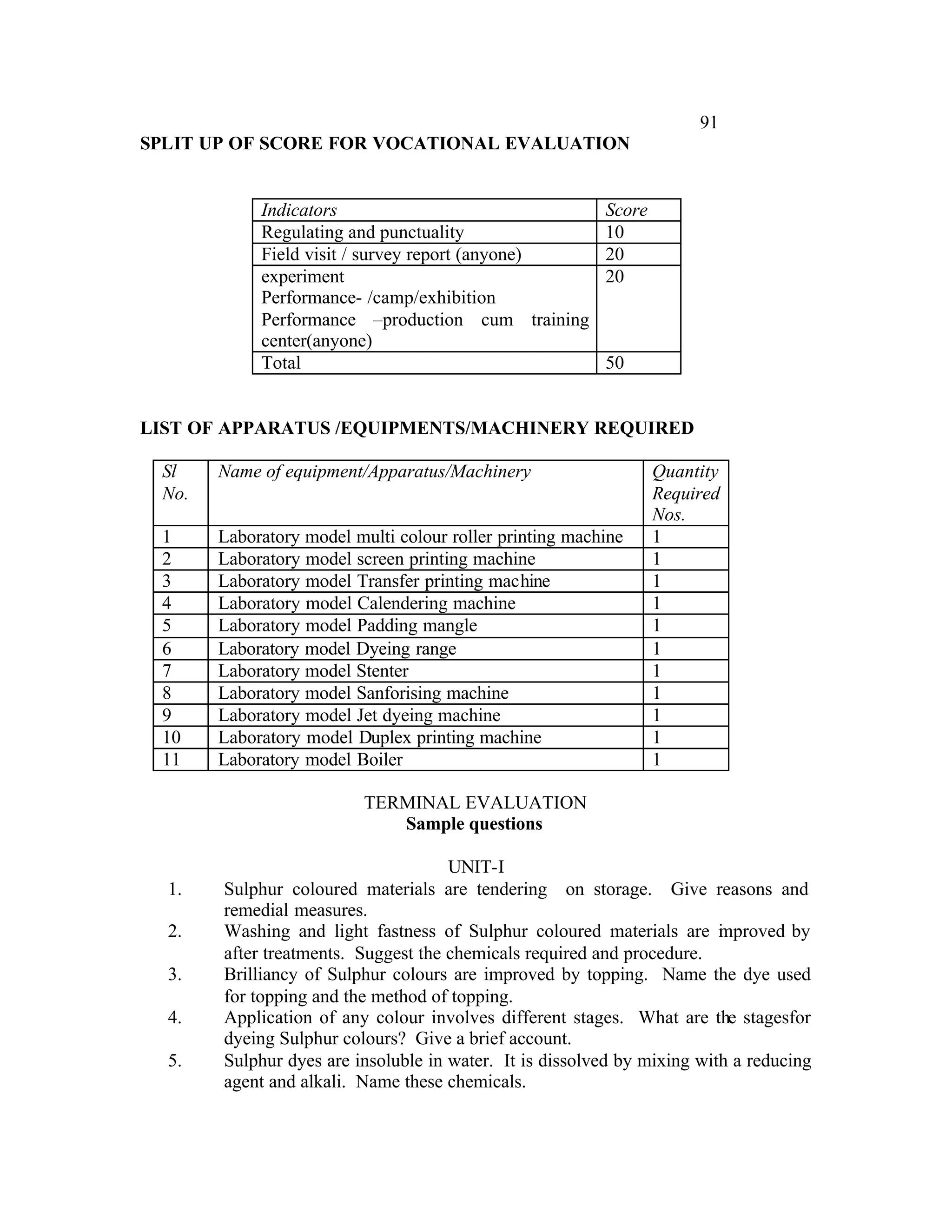
  • 97.
    93 26. Logwood black is a mordant colour produced on wool . Give the combination of mordant and mordant colour. 27. Mineral khaki is the most popular colour produced on cotton. It is a combination of two minerals. What are they. 28. Give the method of production of mineral khaki on cotton with a chart. 29. Name the important mineral colours produced in Textile Industries. 30. Chromium yellow colours can be changed to orange by developing. Name the chemical used. UNIT-IV 31. The production of azoic colour involves the application of two separate chemicals. Give the principle of production. 32. Naphthols are insoluble in water. How is it dissolved in water. 33. Bases are required for producing a colour with azoic dyes. These are diazotised before application. Give the conditions required for diazotisation. 34. Aluminium sulphate is added in the diazotising bath as an alkali binding agent. Give reason for this addition. 35. Neutralisation of excess acid is possible with the addition of a neutralizing agent in the diazotizing bath. Which chemical is used for this purpose. UNIT-V 36. Give the procedure for the application of Nephthol colour on cotton textiles. 37. Differentiate dyeing and printing. 38. Impurities present on textile materials are removed prior to printing. Give the objects of the same and the different treatments. 39. Thickners are added in the printing paste. What is the function of the thickening agent. 40. Give the properties of important thickners used in Textile Printing. UNIT-VI 41. Hand blocks for printing are made from wood. Give the procedure for cutting the design on blocks. 42. For making banners and large patterns, stencils are made. How aerograph printing is done to make designs with stencils. 43. Screens for printing can be prepared in different ways. Write the procedure for making screen by any one of the methods. 44. There are single, multi and duplex printing machines used for printing textile materials. Sketch and explain the working of any one of them. 45. Transfer printing is done on hydrophobic fibre with dispersed dyes. Sketch amachine suitable for the same and discuss the merits of the same over other types of printing machine. 46. Note the merits and demerits of screen printing machine. UNIT-VII 47. The term style denots for a particular performance in textile printing. What is it? 48. You are given a dyed fabric. How is it possible to produce a discharge pattern on it.
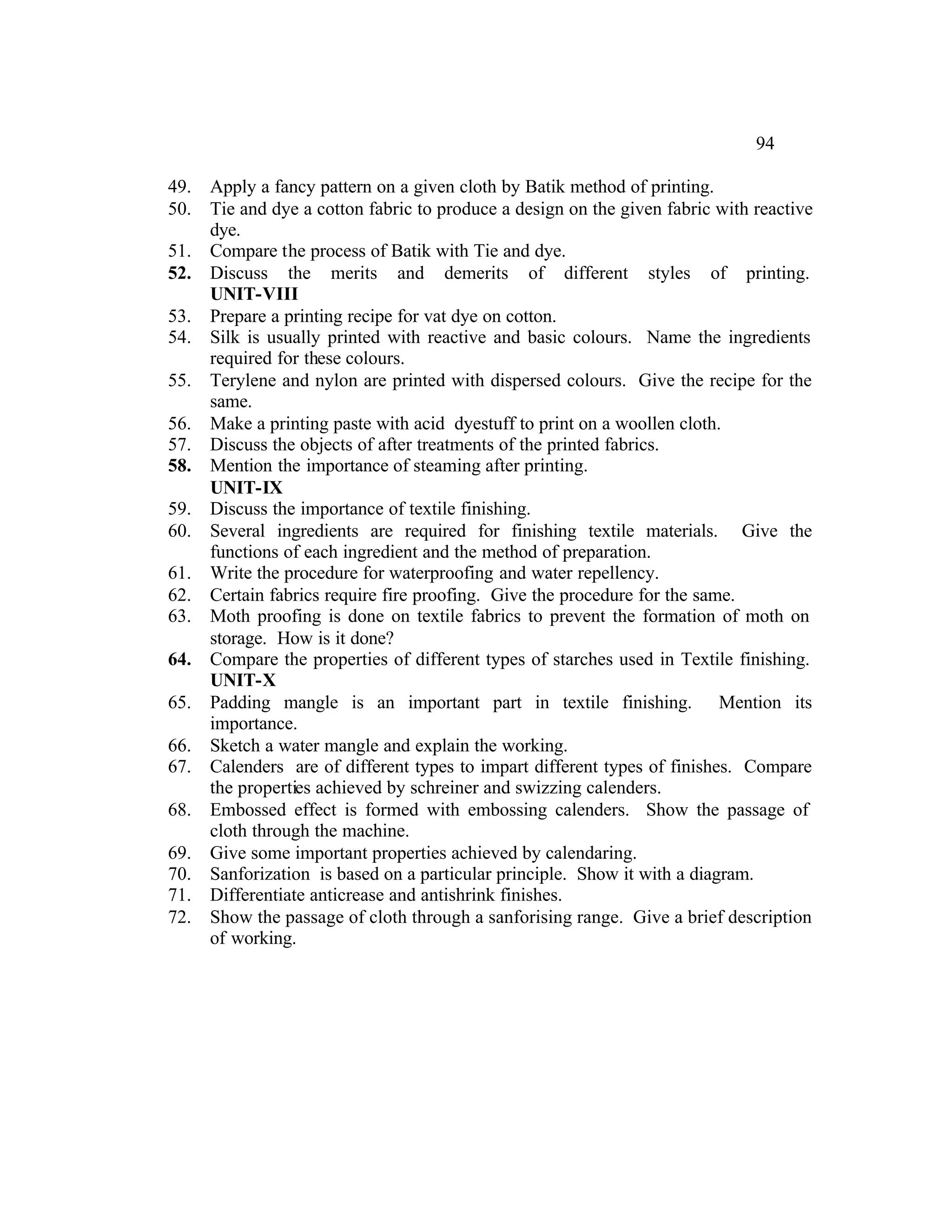
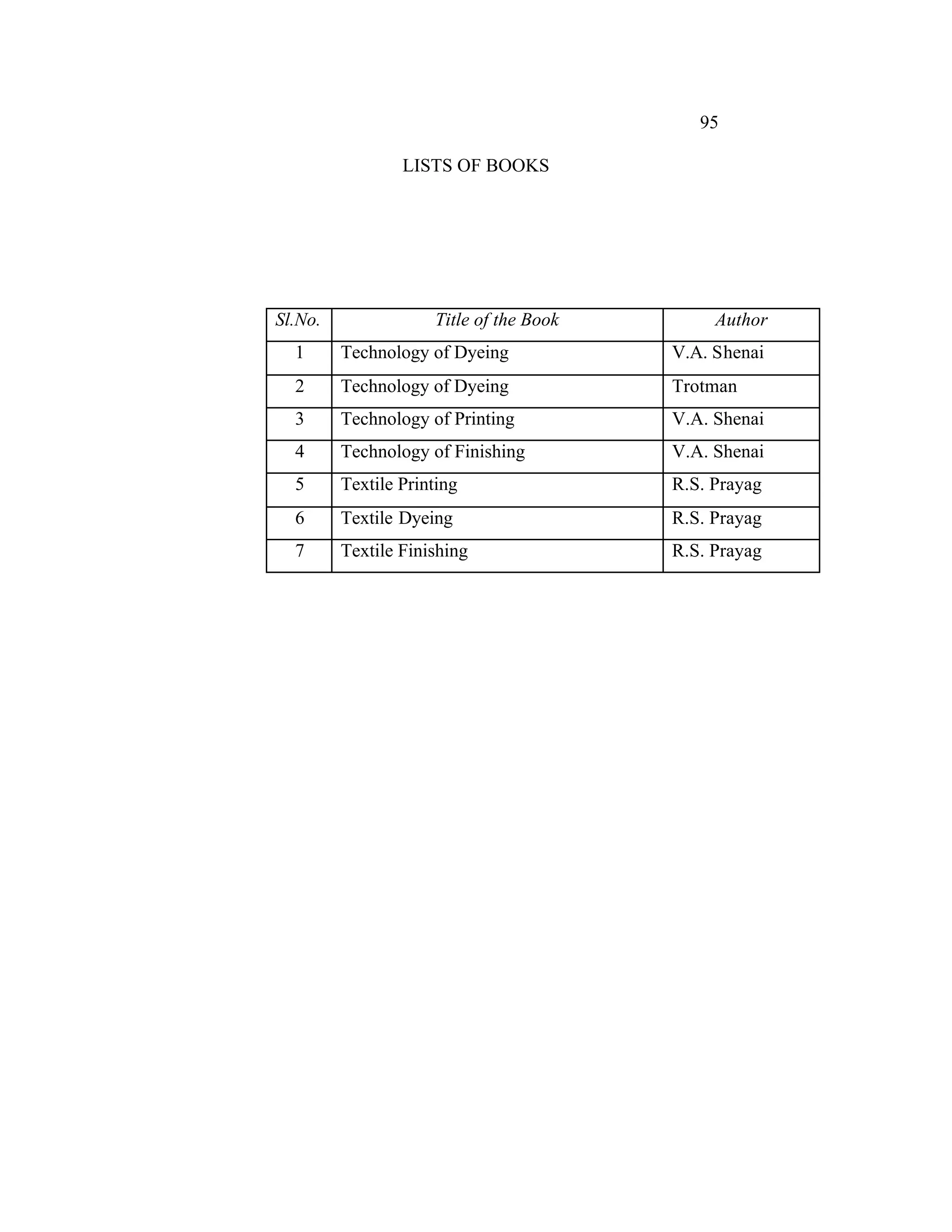
  • 98.
    94 49. Apply a fancy pattern on a given cloth by Batik method of printing. 50. Tie and dye a cotton fabric to produce a design on the given fabric with reactive dye. 51. Compare the process of Batik with Tie and dye. 52. Discuss the merits and demerits of different styles of printing. UNIT-VIII 53. Prepare a printing recipe for vat dye on cotton. 54. Silk is usually printed with reactive and basic colours. Name the ingredients required for these colours. 55. Terylene and nylon are printed with dispersed colours. Give the recipe for the same. 56. Make a printing paste with acid dyestuff to print on a woollen cloth. 57. Discuss the objects of after treatments of the printed fabrics. 58. Mention the importance of steaming after printing. UNIT-IX 59. Discuss the importance of textile finishing. 60. Several ingredients are required for finishing textile materials. Give the functions of each ingredient and the method of preparation. 61. Write the procedure for waterproofing and water repellency. 62. Certain fabrics require fire proofing. Give the procedure for the same. 63. Moth proofing is done on textile fabrics to prevent the formation of moth on storage. How is it done? 64. Compare the properties of different types of starches used in Textile finishing. UNIT-X 65. Padding mangle is an important part in textile finishing. Mention its importance. 66. Sketch a water mangle and explain the working. 67. Calenders are of different types to impart different types of finishes. Compare the properties achieved by schreiner and swizzing calenders. 68. Embossed effect is formed with embossing calenders. Show the passage of cloth through the machine. 69. Give some important properties achieved by calendaring. 70. Sanforization is based on a particular principle. Show it with a diagram. 71. Differentiate anticrease and antishrink finishes. 72. Show the passage of cloth through a sanforising range. Give a brief description of working.
  • 99.
    95 LISTS OF BOOKS Sl.No. Title of the Book Author 1 Technology of Dyeing V.A. Shenai 2 Technology of Dyeing Trotman 3 Technology of Printing V.A. Shenai 4 Technology of Finishing V.A. Shenai 5 Textile Printing R.S. Prayag 6 Textile Dyeing R.S. Prayag 7 Textile Finishing R.S. Prayag