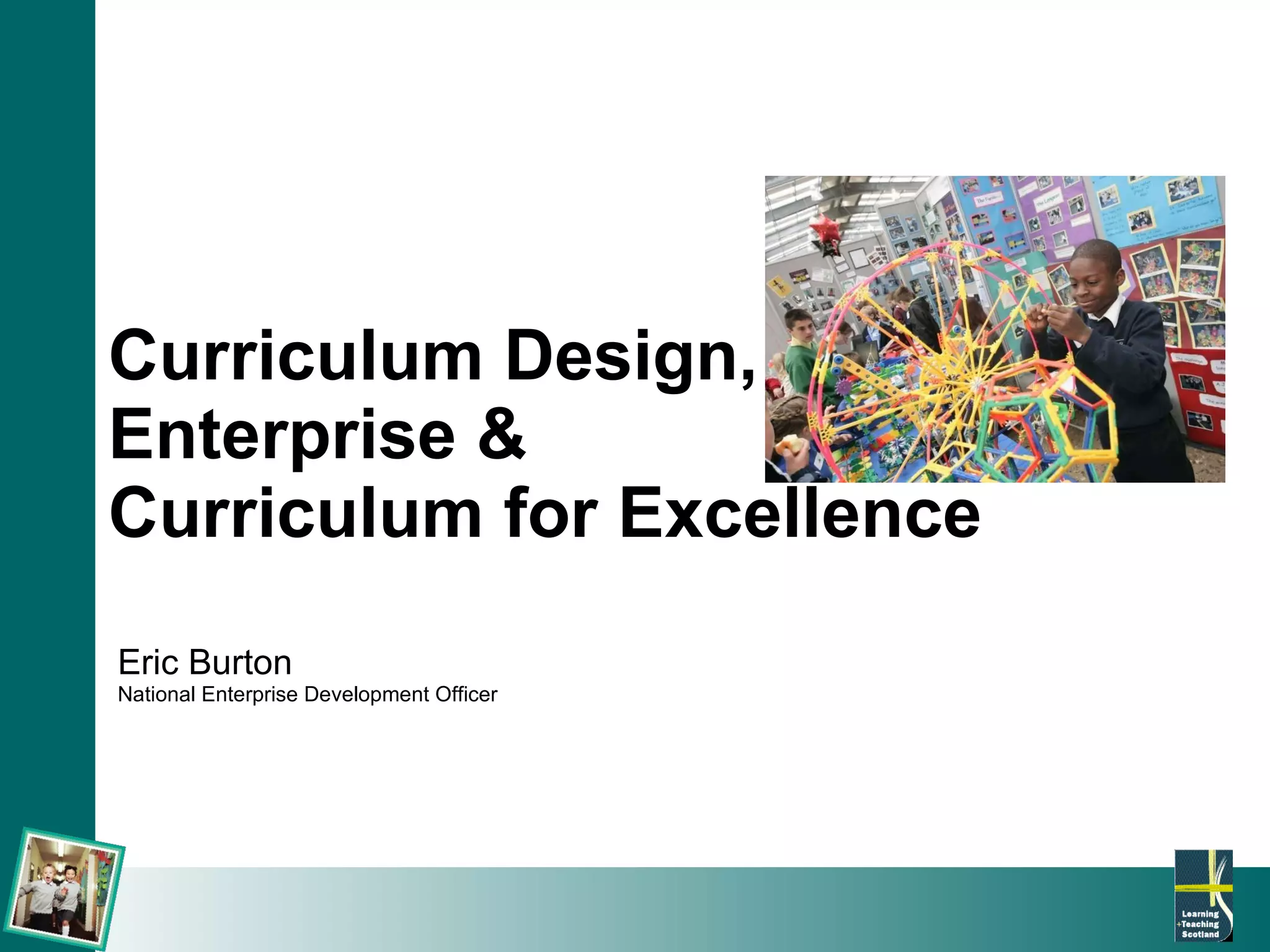

Curriculum Design,  Enterprise &  Curriculum for Excellence Eric Burton National Enterprise Development Officer
Presentation Outcomes By the end of this presentation you will have ; An insight into the underpinning that enterprise in education can give to  Principles of Curriculum design An overview of some of the ideas and support that have been developed at present. A personal reflection on the signposting to improvement in curriculum and teaching for learning. An opportunity for learning.
To get what we’ve never had….  we must do……  … ..what we have never done. Anon.  212 ° The Extra Degree
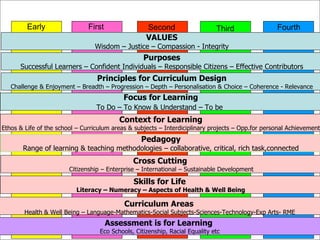
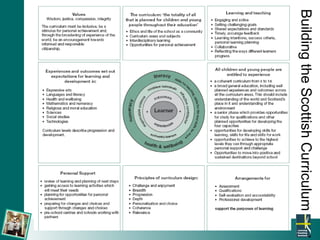
VALUES Wisdom – Justice – Compassion - Integrity Purposes Successful Learners – Confident Individuals – Responsible Citizens – Effective Contributors Principles for Curriculum Design Challenge & Enjoyment – Breadth – Progression – Depth – Personalisation & Choice – Coherence - Relevance Focus for Learning To Do – To Know & Understand – To be   Assessment is for Learning  Eco Schools, Citizenship, Racial Equality etc Context for Learning Ethos & Life of the school – Curriculum areas & subjects – Interdiciplinary projects – Opp.for personal Achievement Early First Second Third  Fourth Pedagogy Range of learning & teaching methodologies – collaborative, critical, rich task,connected Cross Cutting  Citizenship – Enterprise – International – Sustainable Development Skills for Life  Literacy – Numeracy – Aspects of Health & Well Being Curriculum Areas   Health & Well Being – Language-Mathematics-Social Subjects-Sciences-Technology-Exp Arts- RME
The Scottish Executive’s vision for children and young people is “A Scotland in which every child matters, where every child, regardless of his or her family background, has the best possible start in life.” The Curriculum Review Group
“ The curriculum needs to include space for learning beyond subject boundaries, so that learners can make connections between different areas of learning. Through interdisciplinary activities of this kind, young people can develop their organisational skills, creativity, teamwork and the ability to apply their learning in new and challenging contexts.” A Curriculum for Excellence: Progress and Proposals
5 to 14 process of  learning
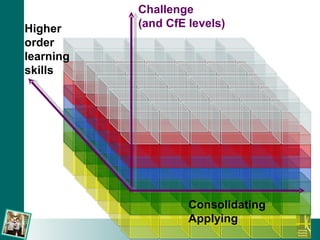
Challenge  (and CfE levels) Higher order learning  skills Consolidating Applying
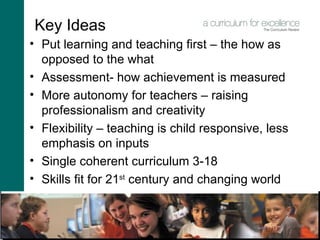
Key Ideas Put learning and teaching first – the how as opposed to the what Assessment- how achievement is measured More autonomy for teachers – raising professionalism and creativity Flexibility – teaching is child responsive, less emphasis on inputs  Single coherent curriculum 3-18 Skills fit for 21 st  century and changing world
Building the Scottish Curriculum
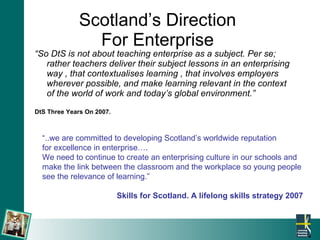
Scotland’s Direction  For Enterprise  “ So DtS is not about teaching enterprise as a subject. Per se; rather teachers deliver their subject lessons in an enterprising way , that contextualises learning , that involves employers wherever possible, and make learning relevant in the context of the world of work and today’s global environment.” DtS Three Years On 2007. “ ..we are committed to developing Scotland’s worldwide reputation  for excellence in enterprise…. We need to continue to create an enterprising culture in our schools and make the link between the classroom and the workplace so young people see the relevance of learning.” Skills for Scotland. A lifelong skills strategy 2007
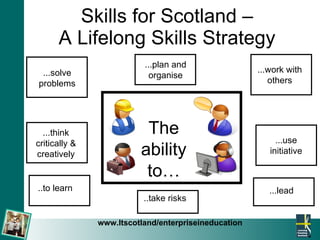
Skills for Scotland –  A Lifelong Skills Strategy  www.ltscotland/enterpriseineducation ...solve problems ...plan and organise ...work with others ...think critically & creatively ...use initiative ...lead  ..to learn ..take risks The  ability  to…
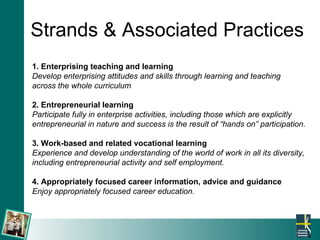
Strands & Associated Practices 1. Enterprising teaching and learning Develop enterprising attitudes and skills through learning and teaching  across the whole curriculum 2. Entrepreneurial learning Participate fully in enterprise activities, including those which are explicitly  entrepreneurial in nature and success is the result of “hands on” participation. 3. Work-based and related vocational learning Experience and develop understanding of the world of work in all its diversity,  including entrepreneurial activity and self employment. 4. Appropriately focused career information, advice and guidance Enjoy appropriately focused career education.
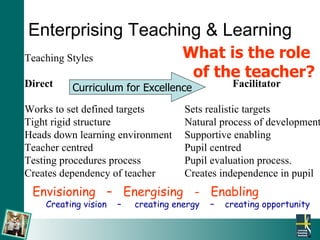
Enterprising Teaching & Learning Teaching Styles Direct    Facilitator Works to set defined targets Sets realistic targets  Tight rigid structure Natural process of development Heads down learning environment Supportive enabling  Teacher centred  Pupil centred Testing procedures process Pupil evaluation process. Creates dependency of teacher Creates independence in pupil   What is the role  of the teacher? Envisioning  –  Energising  -  Enabling Creating vision  –  creating energy  –  creating opportunity Curriculum for Excellence
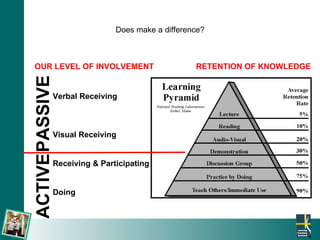
Does make a difference? Verbal Receiving Visual Receiving Receiving & Participating Doing PASSIVE ACTIVE OUR LEVEL OF INVOLVEMENT RETENTION OF KNOWLEDGE
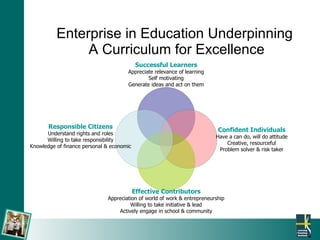
Enterprise in Education Underpinning  A Curriculum for Excellence Successful Learners Appreciate relevance of learning Self motivating Generate ideas and act on them Confident Individuals Have a can do, will do attitude Creative, resourceful Problem solver & risk taker Effective Contributors Appreciation of world of work & entrepreneurship Willing to take initiative & lead Actively engage in school & community Responsible Citizens Understand rights and roles Willing to take responsibility Knowledge of finance personal & economic
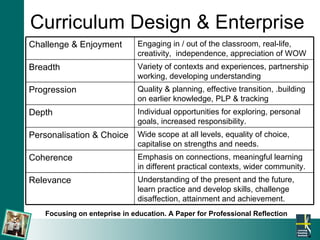
Curriculum Design & Enterprise Focusing on enteprise in education. A Paper for Professional Reflection Challenge & Enjoyment Engaging in / out of the classroom, real-life, creativity,  independence, appreciation of WOW Breadth Variety of contexts and experiences, partnership working, developing understanding Progression Quality & planning, effective transition, .building on earlier knowledge, PLP & tracking Depth Individual opportunities for exploring, personal goals, increased responsibility. Personalisation & Choice Wide scope at all levels, equality of choice, capitalise on strengths and needs. Coherence Emphasis on connections, meaningful learning in different practical contexts, wider community. Relevance Understanding of the present and the future, learn practice and develop skills, challenge disaffection, attainment and achievement.
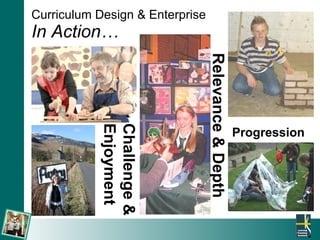
Curriculum Design & Enterprise In Action… Progression  Relevance & Depth   Challenge & Enjoyment
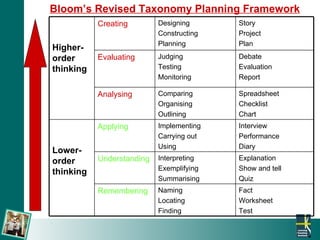
Bloom’s Revised Taxonomy Planning Framework   Higher-order thinking   Creating Designing Constructing Planning Story Project Plan Evaluating Judging Testing Monitoring Debate Evaluation Report Analysing Comparing Organising Outlining Spreadsheet Checklist Chart Lower-order thinking   Applying Implementing Carrying out Using Interview Performance Diary Understanding Interpreting Exemplifying Summarising Explanation Show and tell Quiz Remembering Naming Locating Finding Fact Worksheet Test
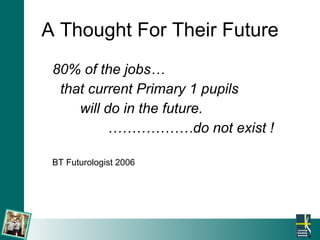
A Thought For Their Future 80% of the jobs… that current Primary 1 pupils  will do in the future. ……………… do not exist ! BT Futurologist 2006
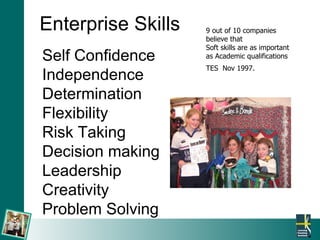
Enterprise Skills Self Confidence Independence Determination Flexibility Risk Taking Decision making Leadership Creativity Problem Solving 9 out of 10 companies believe that Soft skills are as important as Academic qualifications TES  Nov 1997.
LTS & DtS Support CPD Business Engagement Day by Day Enterprise Matters Planner Support for Staff Glow communities Continuing Professional Development ; METRO Route.
Contact Us Eric Burton Learning and Teaching Scotland The Optima, 58 Robertson Street, Glasgow G2 8DU [email_address] www.LTScotland.org.uk

Unesco Visit Lts Feb 2010

  • 1.
    Curriculum Design, Enterprise & Curriculum for Excellence Eric Burton National Enterprise Development Officer
  • 2.
    Presentation Outcomes Bythe end of this presentation you will have ; An insight into the underpinning that enterprise in education can give to Principles of Curriculum design An overview of some of the ideas and support that have been developed at present. A personal reflection on the signposting to improvement in curriculum and teaching for learning. An opportunity for learning.
  • 3.
    To get whatwe’ve never had…. we must do…… … ..what we have never done. Anon. 212 ° The Extra Degree
  • 4.
    VALUES Wisdom –Justice – Compassion - Integrity Purposes Successful Learners – Confident Individuals – Responsible Citizens – Effective Contributors Principles for Curriculum Design Challenge & Enjoyment – Breadth – Progression – Depth – Personalisation & Choice – Coherence - Relevance Focus for Learning To Do – To Know & Understand – To be Assessment is for Learning Eco Schools, Citizenship, Racial Equality etc Context for Learning Ethos & Life of the school – Curriculum areas & subjects – Interdiciplinary projects – Opp.for personal Achievement Early First Second Third Fourth Pedagogy Range of learning & teaching methodologies – collaborative, critical, rich task,connected Cross Cutting Citizenship – Enterprise – International – Sustainable Development Skills for Life Literacy – Numeracy – Aspects of Health & Well Being Curriculum Areas Health & Well Being – Language-Mathematics-Social Subjects-Sciences-Technology-Exp Arts- RME
  • 5.
    The Scottish Executive’svision for children and young people is “A Scotland in which every child matters, where every child, regardless of his or her family background, has the best possible start in life.” The Curriculum Review Group
  • 6.
    “ The curriculumneeds to include space for learning beyond subject boundaries, so that learners can make connections between different areas of learning. Through interdisciplinary activities of this kind, young people can develop their organisational skills, creativity, teamwork and the ability to apply their learning in new and challenging contexts.” A Curriculum for Excellence: Progress and Proposals
  • 7.
    5 to 14process of learning
  • 8.
    Challenge (andCfE levels) Higher order learning skills Consolidating Applying
  • 9.
    Key Ideas Putlearning and teaching first – the how as opposed to the what Assessment- how achievement is measured More autonomy for teachers – raising professionalism and creativity Flexibility – teaching is child responsive, less emphasis on inputs Single coherent curriculum 3-18 Skills fit for 21 st century and changing world
  • 10.
  • 11.
    Scotland’s Direction For Enterprise “ So DtS is not about teaching enterprise as a subject. Per se; rather teachers deliver their subject lessons in an enterprising way , that contextualises learning , that involves employers wherever possible, and make learning relevant in the context of the world of work and today’s global environment.” DtS Three Years On 2007. “ ..we are committed to developing Scotland’s worldwide reputation for excellence in enterprise…. We need to continue to create an enterprising culture in our schools and make the link between the classroom and the workplace so young people see the relevance of learning.” Skills for Scotland. A lifelong skills strategy 2007
  • 12.
    Skills for Scotland– A Lifelong Skills Strategy www.ltscotland/enterpriseineducation ...solve problems ...plan and organise ...work with others ...think critically & creatively ...use initiative ...lead ..to learn ..take risks The ability to…
  • 13.
    Strands & AssociatedPractices 1. Enterprising teaching and learning Develop enterprising attitudes and skills through learning and teaching across the whole curriculum 2. Entrepreneurial learning Participate fully in enterprise activities, including those which are explicitly entrepreneurial in nature and success is the result of “hands on” participation. 3. Work-based and related vocational learning Experience and develop understanding of the world of work in all its diversity, including entrepreneurial activity and self employment. 4. Appropriately focused career information, advice and guidance Enjoy appropriately focused career education.
  • 14.
    Enterprising Teaching &Learning Teaching Styles Direct Facilitator Works to set defined targets Sets realistic targets Tight rigid structure Natural process of development Heads down learning environment Supportive enabling Teacher centred Pupil centred Testing procedures process Pupil evaluation process. Creates dependency of teacher Creates independence in pupil What is the role of the teacher? Envisioning – Energising - Enabling Creating vision – creating energy – creating opportunity Curriculum for Excellence
  • 15.
    Does make adifference? Verbal Receiving Visual Receiving Receiving & Participating Doing PASSIVE ACTIVE OUR LEVEL OF INVOLVEMENT RETENTION OF KNOWLEDGE
  • 16.
    Enterprise in EducationUnderpinning A Curriculum for Excellence Successful Learners Appreciate relevance of learning Self motivating Generate ideas and act on them Confident Individuals Have a can do, will do attitude Creative, resourceful Problem solver & risk taker Effective Contributors Appreciation of world of work & entrepreneurship Willing to take initiative & lead Actively engage in school & community Responsible Citizens Understand rights and roles Willing to take responsibility Knowledge of finance personal & economic
  • 17.
    Curriculum Design &Enterprise Focusing on enteprise in education. A Paper for Professional Reflection Challenge & Enjoyment Engaging in / out of the classroom, real-life, creativity, independence, appreciation of WOW Breadth Variety of contexts and experiences, partnership working, developing understanding Progression Quality & planning, effective transition, .building on earlier knowledge, PLP & tracking Depth Individual opportunities for exploring, personal goals, increased responsibility. Personalisation & Choice Wide scope at all levels, equality of choice, capitalise on strengths and needs. Coherence Emphasis on connections, meaningful learning in different practical contexts, wider community. Relevance Understanding of the present and the future, learn practice and develop skills, challenge disaffection, attainment and achievement.
  • 18.
    Curriculum Design &Enterprise In Action… Progression Relevance & Depth Challenge & Enjoyment
  • 19.
    Bloom’s Revised TaxonomyPlanning Framework Higher-order thinking Creating Designing Constructing Planning Story Project Plan Evaluating Judging Testing Monitoring Debate Evaluation Report Analysing Comparing Organising Outlining Spreadsheet Checklist Chart Lower-order thinking Applying Implementing Carrying out Using Interview Performance Diary Understanding Interpreting Exemplifying Summarising Explanation Show and tell Quiz Remembering Naming Locating Finding Fact Worksheet Test
  • 20.
    A Thought ForTheir Future 80% of the jobs… that current Primary 1 pupils will do in the future. ……………… do not exist ! BT Futurologist 2006
  • 21.
    Enterprise Skills SelfConfidence Independence Determination Flexibility Risk Taking Decision making Leadership Creativity Problem Solving 9 out of 10 companies believe that Soft skills are as important as Academic qualifications TES Nov 1997.
  • 22.
    LTS & DtSSupport CPD Business Engagement Day by Day Enterprise Matters Planner Support for Staff Glow communities Continuing Professional Development ; METRO Route.
  • 23.
    Contact Us EricBurton Learning and Teaching Scotland The Optima, 58 Robertson Street, Glasgow G2 8DU [email_address] www.LTScotland.org.uk

Editor's Notes

  • #2 Overwrite the words with the presentation title, subtitle (if any), presenter’s name and date (if required). If you require any help with the use of this corporate PowerPoint then please contact Heidi Idle, Marketing Communications Manager.
  • #3 You may wish to start your presentation here before you use the ‘LT Scotland’s remit’ slides, i.e. presentation programme/overview. Use the black colour font. Alternatively, you may wish to start with a blank slide (see below for copy and instructions to use it) if full screen graphics are required or if any graphics required for this slide make your slide look too busy. The corporate house style is not to use animation schemes or slide transitions.
  • #11 These are the last two bullet points of LT Scotland’s remit. If the audience would like to read more about LT Scotland’s remit then they can download this at the web address provided.
  • #12 Customise the presentation slide to suit your needs. The corporate house style is not to use animation schemes or slide transitions. Copy this blank slide if you require more slides in your presentation. If you require a blank slide use the next slide provided. This is useful for slides that require full screen graphics or where a graphic looks too busy on the corporate design slide.
  • #24 Use this contact us page as the final slide in your presentation. Add your details or delete this line. Keep the LT Scotland Head quarter details in.