AGGREGAT
ES IMPACT
AND
CRUSHING
Aggregates undergo significant
wear and tear throughout their life.
Aggregates must be hard and
tough enough to resist crushing,
degradation and disintegration and
be able to transmit loads from the
pavement surface to the underlying
layers and eventually the subgrade.
Testing the strength of
parent rock alone does not
exactly indicate the
strength of aggregates in
concrete.
INTRODUCT
ION
MECHANICA
L PROPERTY
OF
AGGREGATE
01
02
Satisfactory resistance to
crushing under the roller
during construction
Adequate resistance to
surface abrasion under
traffic
Aggregates used in road
construction should be strong
enough to resist abrasion and
crushing and also the impact
load.
AGGREGAT
ES IMPACT
VALUE
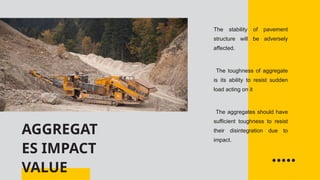
The stability of pavement
structure will be adversely
affected.
The toughness of aggregate
is its ability to resist sudden
load acting on it
The aggregates should have
sufficient toughness to resist
their disintegration due to
impact.
CLASSIFICATION OF
AGGREGATES BASED
ON AGGREGATE
IMPACT VALUE
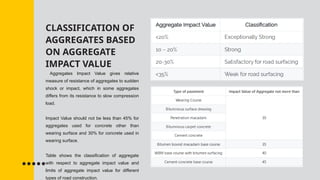
Aggregates Impact Value gives relative
measure of resistance of aggregates to sudden
shock or impact, which in some aggregates
differs from its resistance to slow compression
load.
Impact Value should not be less than 45% for
aggregates used for concrete other than
wearing surface and 30% for concrete used in
wearing surface.
Table shows the classification of aggregate
with respect to aggregate impact value and
limits of aggregate impact value for different
types of road construction.
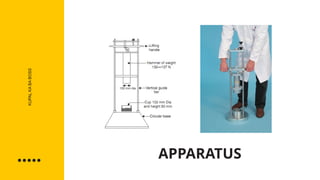
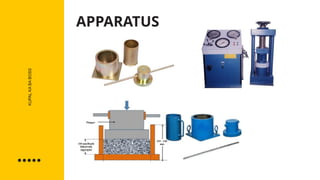
APPARATUS
KUPAL
KA
BA
BOSS
KUPAL
KA
BA
BOSS • Prepare the test sample by selecting aggregates sized between 10.0 mm
and 12.5 mm. Dry the aggregates by heating at 100-110° C for 4 hours
or until constant mass is achieved, and then cool them.
• Sieve the aggregates through 12.5 mm or 14mm and 10.0 mm sieves.
The material passing through the 12.5 mm sieve and retained on the
10.0 mm sieve will be used as the test material.
• Pour the test material into a measuring cylinder, filling it to
approximately 1/3 of its depth.
• Compact the material by giving it 25 gentle blows with the rounded end
of a tamping rod.
• Add two more layers of material to the cylinder, compacting each layer
in the same manner until the cylinder is full.
• Strike off any excess material from the top of the cylinder.
PROCEDU
RE
KUPAL
KA
BA
BOSS
• Set up the impact machine on a rigid, level surface with the hammer
guide columns vertical.
• Fix the cup firmly to the base of the machine and place the entire test
sample in it. Compact the sample by giving it 25 gentle blows with the
tamping rod.
• Raise the hammer to a height of 380 mm above the surface of the
sample and allow it to fall freely on the sample. Repeat this process 15
times, waiting at least one second between each fall.
• Remove the crushed aggregate from the cup and sieve it through a 2.36
mm sieve until no further significant amount passes in one minute.
• Weigh the fraction of the sample passing through the sieve to an
accuracy of 1 gram, as well as the fraction retained in the sieve.
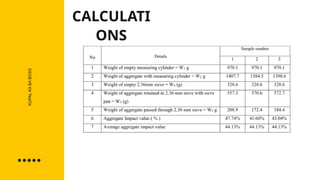
• Calculate the Aggregate Impact Value by dividing the weight of the
fraction passing through the sieve by the total weight of the sample, and
KUPAL
KA
BA
BOSS
CALCULATI
ONS
AGGREGAT
ES
CRUSHING
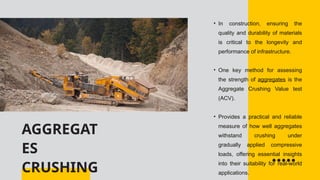
• In construction, ensuring the
quality and durability of materials
is critical to the longevity and
performance of infrastructure.
• One key method for assessing
the strength of aggregates is the
Aggregate Crushing Value test
(ACV).
• Provides a practical and reliable
measure of how well aggregates
withstand crushing under
gradually applied compressive
loads, offering essential insights
into their suitability for real-world
applications.
CLASSIFICATION OF
AGGREGATES BASED
ON AGGREGATE
CRUSHING VALUE
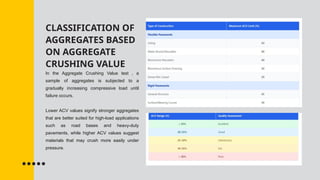
In the Aggregate Crushing Value test , a
sample of aggregates is subjected to a
gradually increasing compressive load until
failure occurs.
Lower ACV values signify stronger aggregates
that are better suited for high-load applications
such as road bases and heavy-duty
pavements, while higher ACV values suggest
materials that may crush more easily under
pressure.
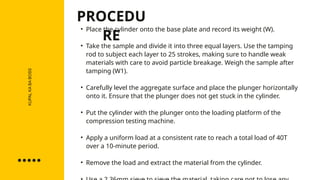
APPARATUS
KUPAL
KA
BA
BOSS
KUPAL
KA
BA
BOSS • Place the cylinder onto the base plate and record its weight (W).
• Take the sample and divide it into three equal layers. Use the tamping
rod to subject each layer to 25 strokes, making sure to handle weak
materials with care to avoid particle breakage. Weigh the sample after
tamping (W1).
• Carefully level the aggregate surface and place the plunger horizontally
onto it. Ensure that the plunger does not get stuck in the cylinder.
• Put the cylinder with the plunger onto the loading platform of the
compression testing machine.
• Apply a uniform load at a consistent rate to reach a total load of 40T
over a 10-minute period.
• Remove the load and extract the material from the cylinder.
PROCEDU
RE
KUPAL
KA
BA
BOSS
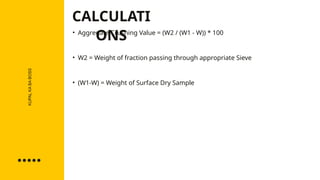
• Aggregate Crushing Value = (W2 / (W1 - W)) * 100
• W2 = Weight of fraction passing through appropriate Sieve
• (W1-W) = Weight of Surface Dry Sample
CALCULATI
ONS
DPWH STANDARD
SPECIFICATIONS FOR
PUBLIC WORKS AND
HIGHWAYS, 2004 EDITION:
VOLUME II, HIGHWAYS,
BRIDGES AND AIRPORTS.
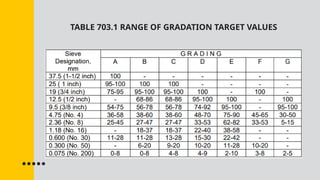
TABLE 703.1 RANGE OF GRADATION TARGET VALUES
703.6 AGGREGATE FOR BITUMINOUS PLANT MIX
SURFACING
No intermediate sizes of aggregate shall be removed for other purposes without
written consent of the Engineer. If crushed gravel is used, not less than 50 mass
percent of the material retained on the 4.75 mm (No. 4) sieve shall be particles
having at least one fractured face. That portion of the composite material passing
a 4.75 mm (No. 4) sieve shall have a sand equivalent of not less than 35, as
determined by AASHTO T 176, Alternate Method No. 2. The aggregate shall
show a durability index not less than 35 (coarse and fine) as determined by
AASHTO T 210. The material shall be free of clay balls and adherent films of
clay or other matter that would prevent thorough coating with the bituminous
material.
703.7 AGGREGATE FOR HOT PLANT-MIX BITUMINOUS
PAVEMENT
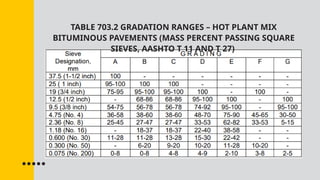
The provisions of Subsections 703.5.1, 703.5.2 and 703.5.3 shall apply.
The several aggregate fraction for the mixture shall be sized, graded
and combined in such proportions that the resulting composite blend
meets one of the grading requirements of Table 703.2 as specified in the
Schedule. The gradings to be used will be shown in the Special
Provisions, adjusted to reflect variations in aggregate densities. The
ranges apply to aggregates with bulk specific gravity values that are
relatively constant throughout a grading band. When such values vary
from sieve to sieve, such as with lightweight aggregates, the ranges for
each sieve size shall be adjusted to reflect the variations.
703.8 AGGREGATE FOR COLD PLANT-MIX
BITUMINOUS PAVEMENT
The provisions of Subsections 703.5.1 and 703.5.2 shall apply.
703.8.1 AGGREGATE FOR PAVEMENT
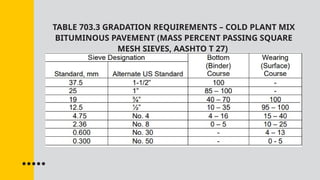
The several aggregate fractions for the mixture shall be sized, graded
and combined in such proportions that the resulting composite blends
meet the respective grading requirements of Table 703.3 adjusted to
reflect variation in aggregate densities.
703.8.2 AGGREGATE FOR TOP DRESSING
The material for the top dressing shall consist of dry sand, stone
screenings or slag screenings so graded that at least 95 mass percent
shall pass the 4.75 mm (No. 4) sieve and not more than 40 percent shall
pass the 0.300 mm (No. 50) sieve.
TABLE 703.2 GRADATION RANGES – HOT PLANT MIX
BITUMINOUS PAVEMENTS (MASS PERCENT PASSING SQUARE
SIEVES, AASHTO T 11 AND T 27)
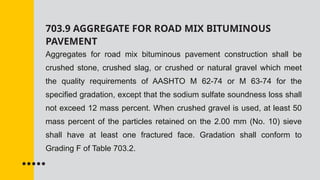
703.9 AGGREGATE FOR ROAD MIX BITUMINOUS
PAVEMENT
Aggregates for road mix bituminous pavement construction shall be
crushed stone, crushed slag, or crushed or natural gravel which meet
the quality requirements of AASHTO M 62-74 or M 63-74 for the
specified gradation, except that the sodium sulfate soundness loss shall
not exceed 12 mass percent. When crushed gravel is used, at least 50
mass percent of the particles retained on the 2.00 mm (No. 10) sieve
shall have at least one fractured face. Gradation shall conform to
Grading F of Table 703.2.
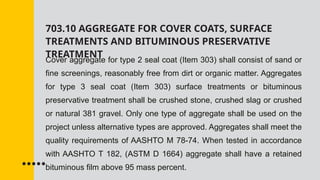
703.10 AGGREGATE FOR COVER COATS, SURFACE
TREATMENTS AND BITUMINOUS PRESERVATIVE
TREATMENT
Cover aggregate for type 2 seal coat (Item 303) shall consist of sand or
fine screenings, reasonably free from dirt or organic matter. Aggregates
for type 3 seal coat (Item 303) surface treatments or bituminous
preservative treatment shall be crushed stone, crushed slag or crushed
or natural 381 gravel. Only one type of aggregate shall be used on the
project unless alternative types are approved. Aggregates shall meet the
quality requirements of AASHTO M 78-74. When tested in accordance
with AASHTO T 182, (ASTM D 1664) aggregate shall have a retained
bituminous film above 95 mass percent.
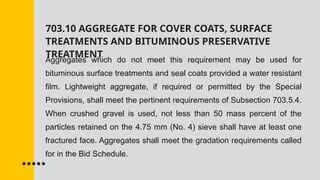
703.10 AGGREGATE FOR COVER COATS, SURFACE
TREATMENTS AND BITUMINOUS PRESERVATIVE
TREATMENT
Aggregates which do not meet this requirement may be used for
bituminous surface treatments and seal coats provided a water resistant
film. Lightweight aggregate, if required or permitted by the Special
Provisions, shall meet the pertinent requirements of Subsection 703.5.4.
When crushed gravel is used, not less than 50 mass percent of the
particles retained on the 4.75 mm (No. 4) sieve shall have at least one
fractured face. Aggregates shall meet the gradation requirements called
for in the Bid Schedule.
TABLE 703.3 GRADATION REQUIREMENTS – COLD PLANT MIX
BITUMINOUS PAVEMENT (MASS PERCENT PASSING SQUARE
MESH SIEVES, AASHTO T 27)
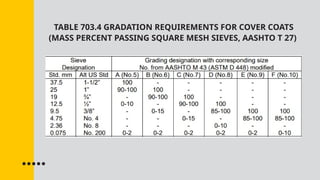
TABLE 703.4 GRADATION REQUIREMENTS FOR COVER COATS
(MASS PERCENT PASSING SQUARE MESH SIEVES, AASHTO T 27)
THANK YOU MGA BOSS!!!

Material Testing - Aggregates Impact Value.pptx

  • 1.
  • 2.
    Aggregates undergo significant wearand tear throughout their life. Aggregates must be hard and tough enough to resist crushing, degradation and disintegration and be able to transmit loads from the pavement surface to the underlying layers and eventually the subgrade. Testing the strength of parent rock alone does not exactly indicate the strength of aggregates in concrete. INTRODUCT ION
  • 4.
    MECHANICA L PROPERTY OF AGGREGATE 01 02 Satisfactory resistanceto crushing under the roller during construction Adequate resistance to surface abrasion under traffic Aggregates used in road construction should be strong enough to resist abrasion and crushing and also the impact load.
  • 5.
    AGGREGAT ES IMPACT VALUE The stabilityof pavement structure will be adversely affected. The toughness of aggregate is its ability to resist sudden load acting on it The aggregates should have sufficient toughness to resist their disintegration due to impact.
  • 6.
    CLASSIFICATION OF AGGREGATES BASED ONAGGREGATE IMPACT VALUE Aggregates Impact Value gives relative measure of resistance of aggregates to sudden shock or impact, which in some aggregates differs from its resistance to slow compression load. Impact Value should not be less than 45% for aggregates used for concrete other than wearing surface and 30% for concrete used in wearing surface. Table shows the classification of aggregate with respect to aggregate impact value and limits of aggregate impact value for different types of road construction.
  • 7.
  • 8.
    KUPAL KA BA BOSS • Preparethe test sample by selecting aggregates sized between 10.0 mm and 12.5 mm. Dry the aggregates by heating at 100-110° C for 4 hours or until constant mass is achieved, and then cool them. • Sieve the aggregates through 12.5 mm or 14mm and 10.0 mm sieves. The material passing through the 12.5 mm sieve and retained on the 10.0 mm sieve will be used as the test material. • Pour the test material into a measuring cylinder, filling it to approximately 1/3 of its depth. • Compact the material by giving it 25 gentle blows with the rounded end of a tamping rod. • Add two more layers of material to the cylinder, compacting each layer in the same manner until the cylinder is full. • Strike off any excess material from the top of the cylinder. PROCEDU RE
  • 9.
    KUPAL KA BA BOSS • Set upthe impact machine on a rigid, level surface with the hammer guide columns vertical. • Fix the cup firmly to the base of the machine and place the entire test sample in it. Compact the sample by giving it 25 gentle blows with the tamping rod. • Raise the hammer to a height of 380 mm above the surface of the sample and allow it to fall freely on the sample. Repeat this process 15 times, waiting at least one second between each fall. • Remove the crushed aggregate from the cup and sieve it through a 2.36 mm sieve until no further significant amount passes in one minute. • Weigh the fraction of the sample passing through the sieve to an accuracy of 1 gram, as well as the fraction retained in the sieve. • Calculate the Aggregate Impact Value by dividing the weight of the fraction passing through the sieve by the total weight of the sample, and
  • 10.
  • 11.
    AGGREGAT ES CRUSHING • In construction,ensuring the quality and durability of materials is critical to the longevity and performance of infrastructure. • One key method for assessing the strength of aggregates is the Aggregate Crushing Value test (ACV). • Provides a practical and reliable measure of how well aggregates withstand crushing under gradually applied compressive loads, offering essential insights into their suitability for real-world applications.
  • 12.
    CLASSIFICATION OF AGGREGATES BASED ONAGGREGATE CRUSHING VALUE In the Aggregate Crushing Value test , a sample of aggregates is subjected to a gradually increasing compressive load until failure occurs. Lower ACV values signify stronger aggregates that are better suited for high-load applications such as road bases and heavy-duty pavements, while higher ACV values suggest materials that may crush more easily under pressure.
  • 13.
  • 14.
    KUPAL KA BA BOSS • Placethe cylinder onto the base plate and record its weight (W). • Take the sample and divide it into three equal layers. Use the tamping rod to subject each layer to 25 strokes, making sure to handle weak materials with care to avoid particle breakage. Weigh the sample after tamping (W1). • Carefully level the aggregate surface and place the plunger horizontally onto it. Ensure that the plunger does not get stuck in the cylinder. • Put the cylinder with the plunger onto the loading platform of the compression testing machine. • Apply a uniform load at a consistent rate to reach a total load of 40T over a 10-minute period. • Remove the load and extract the material from the cylinder. PROCEDU RE
  • 15.
    KUPAL KA BA BOSS • Aggregate CrushingValue = (W2 / (W1 - W)) * 100 • W2 = Weight of fraction passing through appropriate Sieve • (W1-W) = Weight of Surface Dry Sample CALCULATI ONS
  • 16.
    DPWH STANDARD SPECIFICATIONS FOR PUBLICWORKS AND HIGHWAYS, 2004 EDITION: VOLUME II, HIGHWAYS, BRIDGES AND AIRPORTS.
  • 17.
    TABLE 703.1 RANGEOF GRADATION TARGET VALUES
  • 18.
    703.6 AGGREGATE FORBITUMINOUS PLANT MIX SURFACING No intermediate sizes of aggregate shall be removed for other purposes without written consent of the Engineer. If crushed gravel is used, not less than 50 mass percent of the material retained on the 4.75 mm (No. 4) sieve shall be particles having at least one fractured face. That portion of the composite material passing a 4.75 mm (No. 4) sieve shall have a sand equivalent of not less than 35, as determined by AASHTO T 176, Alternate Method No. 2. The aggregate shall show a durability index not less than 35 (coarse and fine) as determined by AASHTO T 210. The material shall be free of clay balls and adherent films of clay or other matter that would prevent thorough coating with the bituminous material.
  • 19.
    703.7 AGGREGATE FORHOT PLANT-MIX BITUMINOUS PAVEMENT The provisions of Subsections 703.5.1, 703.5.2 and 703.5.3 shall apply. The several aggregate fraction for the mixture shall be sized, graded and combined in such proportions that the resulting composite blend meets one of the grading requirements of Table 703.2 as specified in the Schedule. The gradings to be used will be shown in the Special Provisions, adjusted to reflect variations in aggregate densities. The ranges apply to aggregates with bulk specific gravity values that are relatively constant throughout a grading band. When such values vary from sieve to sieve, such as with lightweight aggregates, the ranges for each sieve size shall be adjusted to reflect the variations.
  • 20.
    703.8 AGGREGATE FORCOLD PLANT-MIX BITUMINOUS PAVEMENT The provisions of Subsections 703.5.1 and 703.5.2 shall apply. 703.8.1 AGGREGATE FOR PAVEMENT The several aggregate fractions for the mixture shall be sized, graded and combined in such proportions that the resulting composite blends meet the respective grading requirements of Table 703.3 adjusted to reflect variation in aggregate densities.
  • 21.
    703.8.2 AGGREGATE FORTOP DRESSING The material for the top dressing shall consist of dry sand, stone screenings or slag screenings so graded that at least 95 mass percent shall pass the 4.75 mm (No. 4) sieve and not more than 40 percent shall pass the 0.300 mm (No. 50) sieve.
  • 22.
    TABLE 703.2 GRADATIONRANGES – HOT PLANT MIX BITUMINOUS PAVEMENTS (MASS PERCENT PASSING SQUARE SIEVES, AASHTO T 11 AND T 27)
  • 23.
    703.9 AGGREGATE FORROAD MIX BITUMINOUS PAVEMENT Aggregates for road mix bituminous pavement construction shall be crushed stone, crushed slag, or crushed or natural gravel which meet the quality requirements of AASHTO M 62-74 or M 63-74 for the specified gradation, except that the sodium sulfate soundness loss shall not exceed 12 mass percent. When crushed gravel is used, at least 50 mass percent of the particles retained on the 2.00 mm (No. 10) sieve shall have at least one fractured face. Gradation shall conform to Grading F of Table 703.2.
  • 24.
    703.10 AGGREGATE FORCOVER COATS, SURFACE TREATMENTS AND BITUMINOUS PRESERVATIVE TREATMENT Cover aggregate for type 2 seal coat (Item 303) shall consist of sand or fine screenings, reasonably free from dirt or organic matter. Aggregates for type 3 seal coat (Item 303) surface treatments or bituminous preservative treatment shall be crushed stone, crushed slag or crushed or natural 381 gravel. Only one type of aggregate shall be used on the project unless alternative types are approved. Aggregates shall meet the quality requirements of AASHTO M 78-74. When tested in accordance with AASHTO T 182, (ASTM D 1664) aggregate shall have a retained bituminous film above 95 mass percent.
  • 25.
    703.10 AGGREGATE FORCOVER COATS, SURFACE TREATMENTS AND BITUMINOUS PRESERVATIVE TREATMENT Aggregates which do not meet this requirement may be used for bituminous surface treatments and seal coats provided a water resistant film. Lightweight aggregate, if required or permitted by the Special Provisions, shall meet the pertinent requirements of Subsection 703.5.4. When crushed gravel is used, not less than 50 mass percent of the particles retained on the 4.75 mm (No. 4) sieve shall have at least one fractured face. Aggregates shall meet the gradation requirements called for in the Bid Schedule.

  • 26.
    TABLE 703.3 GRADATIONREQUIREMENTS – COLD PLANT MIX BITUMINOUS PAVEMENT (MASS PERCENT PASSING SQUARE MESH SIEVES, AASHTO T 27)
  • 27.
    TABLE 703.4 GRADATIONREQUIREMENTS FOR COVER COATS (MASS PERCENT PASSING SQUARE MESH SIEVES, AASHTO T 27)
  • 28.