BUILDING
ESTIMATION
Presented by :
Ar. Vivek Painuli
INTRODUCTION
 In various engineering works it is required beforehand to know the probable
cost of construction which is known as the estimated cost. If money available
is less than the estimated cost, then attempts have to be made to reduce the
cost by changing the specification or by reducing the work.
 The subject matter of estimation is simple but knowledge of drawing of
structures requires special skills like AUTOCAD, STAAD PRO, etc. One
who understands the drawing can find out dimensions such as length,
breadth, height, etc.
 Following requirements are necessary for preparing estimate-
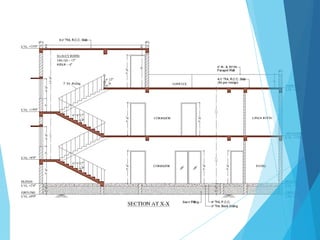
 Drawings like plan, elevation and sections of important points like
beam, staircase, footing, and column.
 Detailed specification of workmanship and properties of materials.
 Standard schedule of rates for the current year.
 The complete work is divided into various items of work such as earthwork
concreting, brickwork, reinforced concrete, plastering etc. The details of
measurements are taken from drawings and entered in respective columns
of prescribed proforma.
 For calculating the cost of the building structure, the rates of materials
are derived from Standard Schedule Rates which comprises of the prices
of list of items in a tabular form.
 Also, LumpSum items in estimate are included in the estimate-
 Water supply and sanitary arrangements.
 Electrical installation like meter, motor, etc.
 Architectural features.
 Contingencies and unforeseen items.
TYPES OF ESTIMATE
 Following are the different types of estimation-
1. Preliminary estimate or Approximate estimate or Abstract
Estimate or Rough Cost Estimate
2. Detailed Estimate or Item Rate Estimate
3. Plinth Area Estimate
4. Cube Rate Estimate or Cubical Content Estimate
5. Approximate Quantity Method Estimate
6. Revised Estimate
7. Supplementary Estimate
8. Supplementary and Revised Estimate
9. Annual Repair or Maintenance Estimate
OBJECTIVE
 Required Quantity of Materials
 Cost of Materials
 Finding cost of various works like Brickwork, RCC, Reinforcement,
etc.
METHODOLOGY
 Mensuration Method- This method of measuring lengths, areas,
volumes using mensuration in its meaning is to measure, is widely
used where geometrical figures are thoughtful and where one has to
determine various physical quantities such as area, volume, length,
etc. In estimation it is a common practice to use mensuration method
to calculate quantities of items.
 Centre Line Method- This method consists to find out total length of
centre line of walls. Brickwork has been found out by this method
in this project.
 Engineering Method- With this technique, the system being costed
is broken down into low level components each of which is costed
separately for direct labour, other costs and direct material.
STATEMENT
To perform Double Storeyed Building Estimation and to calculate the
cost of building structure from a given Plan, Elevation and Cross
section of elements present in the building.
Salient features:
1. Utility of building: Residential
complex
2. No of stories: G+1
3. No of staircases: 5
4. No of lifts: 1
5. Type of construction: R.C.C framed
structure
6. Types of walls: brick wall
7. Height of plinth: 0.76 m
Geometric details:
8. Ground floor: 3.3 m
9. Floor to floor height: 3.3 m.
10. Depth of foundation: 1.68 m.
11. Clear Cover: 40 mm in Column, 50 mm in Footing, 25 mm in
Beam and 15 mm in Slab
Materials:
12. Concrete grade: All Concrete Mix M20 (1:1.5:3) unless
otherwise specified
13. All steel grades: Fe 500 grade
14. Bearing Capacity of soil: 18 M.T./m2
All Dimensions in the Drawings are in Feet and Inches.
PLAN OF
 GROUND FLOOR
 FIRST FLOOR
 TERRACE FLOOR
& ELEVATION
(Rupees Sixty Five Lakh Ninety Two Thousand Three Hundred Fifty One Only)
GENERAL ABSTRACT OF THE
ESTIMATE OF PROPOSED (G+1)
RESIDENTIAL BUILDING
Sl.
No.
Description Unit
SOR
Rate
(Rs.)
Qty Amount
1
Cost of Civil Works for Building as
per CPWD 2013-14 4,365,939.82
2 30% Escalation for current year 5,675,721.77
3
Cost of electrical work - 7.5% of civil
cost 425,679.13
4
Cost of plumbing & sanitary work -
7.5% of civil cost 425,679.13
Total Rs. 6,527,080.04
5
Add 1% contingency for unforseen item
if any 65,270.80
Grand Total Rs. 6,592,350.84
Say Rs. 6,592,351.00
FOOTING
FOOTING F1
Feet Inch Metre Reinforcement details
L = 4 0 1.20 D2(Diameter of bars) T(Spacing)
B = 4 0 1.20 10 mm 0.15 m
D = 0 10 0.25
C = 0 6 0.15
G = 0 6 0.15
L1(Length of
Column)=
0 14 0.36
B1(Breadth of
Column)=
0 9 0.23
D1(Depth for
Excavation)=
5 7 1.68
P1(PCC 0 3 0.08
S1(Sand Filling
Thickness)=
0 4 0.10
W1(Bottom
Wire Mesh
Spacing)=
0 6 0.15
Sl No. Particulars Calculation Quantity
Nos. of
F1
Footing
Total
Quantit
y
1 Earthwork in Excavation ((L+0.3) x (B+0.3) x D1) m3
3.78 m³ 1 3.78 m³
2 1:4:8 PCC ((L+0.15) x (B+0.15) x P1) m3
0.14 m³ 1 0.14 m³
3 Sand Filling ((L+0.15)x(B+0.15)xS1) m3
0.19 m³ 1 0.19 m³
RCC in Footing
a)Upper Rectangular Portion (L1+0.3) x (B1+0.3)xG 0.05 m³
4
b) Bottom Rectangular Portion (L x B x C) m3 0.22 m³
c) Trapezoidal Portion {0.5 (L + (L1+ 0.3 )} x {0.5(B+(B1+0.3)} x (D-C)
m3
0.08 m³
Total 0.35 m³ 1 0.35 m³
5
Reinforcement
10.9 kg 1
10.9 kg
a)Main bar in Foundation
Transverse
direction
No. of bars
(N2)=
(Q/T)+
1
8
L-2 x
Clear
Cover (Q)
1.1 m
Longitudinal
direction
No. of bars
(N1)=
(P/T)+
1
8
B-2 x
Clear
Cover (P)
1.1 m
Length=P x N1+Q x N2
Weight= Lengthx((D2 x D2)/162)
6 Shuttering Area= 4L x C 0.73 1 0.7 m²
TOTAL QUANTITY IN
FOUNDATION
Item
Quantity
Total
Quantity
F1 F2 F3 F4 F5 F6 EF1 EF2 EF3 EF4 EF3" EF4"
E/W in
Excavation
3.78 m³ 4.87 m³ 18.20 m³ 37.00 m³ 17.80
m³
21.00
m³
18.88
m³
4.87
m³
12.13
m³
14.80
m³
6.07
m³
7.40
m³ 166.78 m³
PCC(1:4:8) 0.14 m³ 0.18 m³ 0.70 m³ 1.45 m³
0.71 m³
0.84
m³ 0.65 m³
0.17
m³
0.45
m³ 0.56 m³
0.23
m³
0.29
m³ 6.38 m³
Sand Filling 0.19 m³ 0.25 m³ 0.94 m³ 1.93 m³
0.94 m³
1.12
m³ 0.87 m³
0.23
m³
0.59
m³ 0.74 m³
0.31
m³
0.39
m³ 8.50 m³
RCC (M20) 0.35 m³ 0.51 m³ 2.06 m³ 4.84 m³
2.41 m³
3.41
m³ 1.71 m³
0.48
m³
1.33
m³ 1.85 m³
0.69
m³
0.91
m³ 20.55 m³
Reinforcement 10.86 kg 8.85 kg 72.08 kg 211.56 kg 135.34
kg
164.39
kg
104.86
kg
33.09
kg
84.22
kg
137.85
kg
42.11
kg
68.93
kg 1074.14 kg
Shuttering 0.7 m² 0.9 m² 2.9 m² 5.5 m²
2.4 m² 3.6 m² 6.1 m² 1.7 m² 4.6 m² 5.9 m² 1.0 m² 1.1 m² 36.3 m²
For RCC
Grade of Concrete Ratio Of Cement Ratio of Sand Ratio of Aggregate
M20 1 1.5 3
Total Volume
of
Concrete
Volume of
Cement Volume of Sand
Volume of
Aggregate
No of Bags
20.55 m³ 5.76 m³ 13.29 m³ 26.59 m³ 166
For PCC
Grade of Concrete Ratio Of Cement Ratio of Sand Ratio of Aggregate
M7.5 1 4 8
Total Volume
of
Concrete
Volume of
Cement
Volume of Sand
Volume of
Aggregate
No of Bags
6.38 m³ 0.76 m³ 4.65 m³ 9.30 m³ 22

Building-estimationjsjsjsjsjshhjsjsj.pptx

  • 1.
  • 2.
    INTRODUCTION  In variousengineering works it is required beforehand to know the probable cost of construction which is known as the estimated cost. If money available is less than the estimated cost, then attempts have to be made to reduce the cost by changing the specification or by reducing the work.  The subject matter of estimation is simple but knowledge of drawing of structures requires special skills like AUTOCAD, STAAD PRO, etc. One who understands the drawing can find out dimensions such as length, breadth, height, etc.  Following requirements are necessary for preparing estimate-  Drawings like plan, elevation and sections of important points like beam, staircase, footing, and column.  Detailed specification of workmanship and properties of materials.  Standard schedule of rates for the current year.
  • 3.
     The completework is divided into various items of work such as earthwork concreting, brickwork, reinforced concrete, plastering etc. The details of measurements are taken from drawings and entered in respective columns of prescribed proforma.  For calculating the cost of the building structure, the rates of materials are derived from Standard Schedule Rates which comprises of the prices of list of items in a tabular form.  Also, LumpSum items in estimate are included in the estimate-  Water supply and sanitary arrangements.  Electrical installation like meter, motor, etc.  Architectural features.  Contingencies and unforeseen items.
  • 4.
    TYPES OF ESTIMATE Following are the different types of estimation- 1. Preliminary estimate or Approximate estimate or Abstract Estimate or Rough Cost Estimate 2. Detailed Estimate or Item Rate Estimate 3. Plinth Area Estimate 4. Cube Rate Estimate or Cubical Content Estimate 5. Approximate Quantity Method Estimate 6. Revised Estimate 7. Supplementary Estimate 8. Supplementary and Revised Estimate 9. Annual Repair or Maintenance Estimate
  • 5.
    OBJECTIVE  Required Quantityof Materials  Cost of Materials  Finding cost of various works like Brickwork, RCC, Reinforcement, etc.
  • 6.
    METHODOLOGY  Mensuration Method-This method of measuring lengths, areas, volumes using mensuration in its meaning is to measure, is widely used where geometrical figures are thoughtful and where one has to determine various physical quantities such as area, volume, length, etc. In estimation it is a common practice to use mensuration method to calculate quantities of items.  Centre Line Method- This method consists to find out total length of centre line of walls. Brickwork has been found out by this method in this project.  Engineering Method- With this technique, the system being costed is broken down into low level components each of which is costed separately for direct labour, other costs and direct material.
  • 7.
    STATEMENT To perform DoubleStoreyed Building Estimation and to calculate the cost of building structure from a given Plan, Elevation and Cross section of elements present in the building. Salient features: 1. Utility of building: Residential complex 2. No of stories: G+1 3. No of staircases: 5 4. No of lifts: 1 5. Type of construction: R.C.C framed structure 6. Types of walls: brick wall 7. Height of plinth: 0.76 m
  • 8.
    Geometric details: 8. Groundfloor: 3.3 m 9. Floor to floor height: 3.3 m. 10. Depth of foundation: 1.68 m. 11. Clear Cover: 40 mm in Column, 50 mm in Footing, 25 mm in Beam and 15 mm in Slab Materials: 12. Concrete grade: All Concrete Mix M20 (1:1.5:3) unless otherwise specified 13. All steel grades: Fe 500 grade 14. Bearing Capacity of soil: 18 M.T./m2 All Dimensions in the Drawings are in Feet and Inches.
  • 9.
    PLAN OF  GROUNDFLOOR  FIRST FLOOR  TERRACE FLOOR & ELEVATION
  • 14.
    (Rupees Sixty FiveLakh Ninety Two Thousand Three Hundred Fifty One Only) GENERAL ABSTRACT OF THE ESTIMATE OF PROPOSED (G+1) RESIDENTIAL BUILDING Sl. No. Description Unit SOR Rate (Rs.) Qty Amount 1 Cost of Civil Works for Building as per CPWD 2013-14 4,365,939.82 2 30% Escalation for current year 5,675,721.77 3 Cost of electrical work - 7.5% of civil cost 425,679.13 4 Cost of plumbing & sanitary work - 7.5% of civil cost 425,679.13 Total Rs. 6,527,080.04 5 Add 1% contingency for unforseen item if any 65,270.80 Grand Total Rs. 6,592,350.84 Say Rs. 6,592,351.00
  • 15.
  • 16.
    FOOTING F1 Feet InchMetre Reinforcement details L = 4 0 1.20 D2(Diameter of bars) T(Spacing) B = 4 0 1.20 10 mm 0.15 m D = 0 10 0.25 C = 0 6 0.15 G = 0 6 0.15 L1(Length of Column)= 0 14 0.36 B1(Breadth of Column)= 0 9 0.23 D1(Depth for Excavation)= 5 7 1.68 P1(PCC 0 3 0.08 S1(Sand Filling Thickness)= 0 4 0.10 W1(Bottom Wire Mesh Spacing)= 0 6 0.15 Sl No. Particulars Calculation Quantity Nos. of F1 Footing Total Quantit y 1 Earthwork in Excavation ((L+0.3) x (B+0.3) x D1) m3 3.78 m³ 1 3.78 m³ 2 1:4:8 PCC ((L+0.15) x (B+0.15) x P1) m3 0.14 m³ 1 0.14 m³ 3 Sand Filling ((L+0.15)x(B+0.15)xS1) m3 0.19 m³ 1 0.19 m³ RCC in Footing a)Upper Rectangular Portion (L1+0.3) x (B1+0.3)xG 0.05 m³
  • 17.
    4 b) Bottom RectangularPortion (L x B x C) m3 0.22 m³ c) Trapezoidal Portion {0.5 (L + (L1+ 0.3 )} x {0.5(B+(B1+0.3)} x (D-C) m3 0.08 m³ Total 0.35 m³ 1 0.35 m³ 5 Reinforcement 10.9 kg 1 10.9 kg a)Main bar in Foundation Transverse direction No. of bars (N2)= (Q/T)+ 1 8 L-2 x Clear Cover (Q) 1.1 m Longitudinal direction No. of bars (N1)= (P/T)+ 1 8 B-2 x Clear Cover (P) 1.1 m Length=P x N1+Q x N2 Weight= Lengthx((D2 x D2)/162) 6 Shuttering Area= 4L x C 0.73 1 0.7 m²
  • 18.
    TOTAL QUANTITY IN FOUNDATION Item Quantity Total Quantity F1F2 F3 F4 F5 F6 EF1 EF2 EF3 EF4 EF3" EF4" E/W in Excavation 3.78 m³ 4.87 m³ 18.20 m³ 37.00 m³ 17.80 m³ 21.00 m³ 18.88 m³ 4.87 m³ 12.13 m³ 14.80 m³ 6.07 m³ 7.40 m³ 166.78 m³ PCC(1:4:8) 0.14 m³ 0.18 m³ 0.70 m³ 1.45 m³ 0.71 m³ 0.84 m³ 0.65 m³ 0.17 m³ 0.45 m³ 0.56 m³ 0.23 m³ 0.29 m³ 6.38 m³ Sand Filling 0.19 m³ 0.25 m³ 0.94 m³ 1.93 m³ 0.94 m³ 1.12 m³ 0.87 m³ 0.23 m³ 0.59 m³ 0.74 m³ 0.31 m³ 0.39 m³ 8.50 m³ RCC (M20) 0.35 m³ 0.51 m³ 2.06 m³ 4.84 m³ 2.41 m³ 3.41 m³ 1.71 m³ 0.48 m³ 1.33 m³ 1.85 m³ 0.69 m³ 0.91 m³ 20.55 m³ Reinforcement 10.86 kg 8.85 kg 72.08 kg 211.56 kg 135.34 kg 164.39 kg 104.86 kg 33.09 kg 84.22 kg 137.85 kg 42.11 kg 68.93 kg 1074.14 kg Shuttering 0.7 m² 0.9 m² 2.9 m² 5.5 m² 2.4 m² 3.6 m² 6.1 m² 1.7 m² 4.6 m² 5.9 m² 1.0 m² 1.1 m² 36.3 m² For RCC Grade of Concrete Ratio Of Cement Ratio of Sand Ratio of Aggregate M20 1 1.5 3 Total Volume of Concrete Volume of Cement Volume of Sand Volume of Aggregate No of Bags 20.55 m³ 5.76 m³ 13.29 m³ 26.59 m³ 166 For PCC Grade of Concrete Ratio Of Cement Ratio of Sand Ratio of Aggregate M7.5 1 4 8 Total Volume of Concrete Volume of Cement Volume of Sand Volume of Aggregate No of Bags 6.38 m³ 0.76 m³ 4.65 m³ 9.30 m³ 22