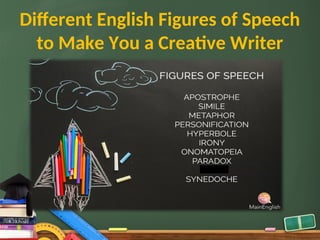
Different English Figures of Speech
to Make You a Creative Writer
• English figures of speech enhance the writer’s
outputs. It adds another layer and taste to the
words being used.
1. Apostrophe
•Apostrophe is calling out a nonexistent person or an inanimate object
as though it were a living object.
Example: Oh, Mother Earth! Sorry for spoiling your beauty.
2. Hyperbole
•The hyperbole is an extravagant statement or the use of exaggerated
terms for the purpose of emphasis.
Example: Just wash it, it is now a mountain of dirty clothes.
3. Onomatopoeia
This figure of speech uses the words that imitate the sounds associate
with the objects or actions they refer to.
Example: Quack, quack went the ducks as we threw them our
stale bread.
4. Irony
•This is the use of words to convey the opposite of
their literal meaning.
Example: A police station gets robbed.
5. Metaphor- A metaphor is an implied comparison
between two dissimilar things that have something in
common.
Example: The wind is a blanket of ice.
7. Paradox- A paradox is a statement that appears to contradict itself.
Example: Every new beginning comes from someone else’s
beginnings end.
8. Personification- A figure of speech in which an inanimate object or
abstraction is endowed with human qualities or abilities.
Example: The river swallowed the earth as the water continued to
rise higher and higher.
9. Simile- Similar to metaphor, a simile states a comparison between two
fundamentally dissimilar things that have certain qualities in common. They
only differ in one thing, a simile uses words usually formed with “like” or
“as”.
Example: Roberto was white as a sheet after he walked out of the horror
movie.
10. Synecdoche- refers to a part which is represented as a
whole.
Example: Man shall not live by bread alone, but by every word
that proceeded out of the mouth of God.
*bread represents all kinds of food.
11. Metonymy- is the opposite of synecdoche. These are words
used that is closely associated with the subject.
Example: The pen is mightier than the sword.
*pen refers to writers, while sword refers to soldiers.
• All of these figures of speech add flavors to writing and make us
readers be more engrossed in reading.
Among all the 11 Figures of
Speech, choose at least 5
then give atleast 1 example
of each. Use it in a sentence.
Writing as a Language Macro Skill
• Teaching writing includes the mastery of micro and
macro skills.
• Micro skills are those that the students need to
comprehend in order that they are able to produce
an acceptable writing like acceptable grammar,
correct cohesive devices, and also the ability to
express a meaning in different grammatical forms.
• Macro skills in the other hand are further skills and
strategies that are required in order that the
students being able to convey the meaning they
want to communicate in their writing.
• Brown (2004) distinguishes micro- and macro-skills of
writing as follows:
Micro- skills
• 1. Produce graphemes and orthographic patterns of
English.
• 2. Produce writing at an efficient rate of speed to suit the
purpose.
• 3. Produce an acceptable core of words and use
appropriate word order patterns.
• 4. Use grammatical system e.g., tense, agreement,
pluralization, patterns, and rules.
• 5. Express a particular meaning in different grammatical
forms.
• 6. Use cohesive devices in written discourse.
Macro- skills
•7. Use the rhetorical forms and conventions of written discourse.
• 8. Accomplish appropriately the communicative functions of
written text according to form and purpose.
•9. Convey links and connections between events and communicate
such relations as main idea, supporting idea, new information, given
information, generalization, and exemplification.
•10. Distinguish between literal and implied meanings when writing.
•11. Correctly convey culturally specific references in the context of
the written text.
•12. Develop and use a battery of writing strategies, such as
accurately assessing the audience‘s interpretation, using prewriting
devices, writing with fluency in the first drafts, using paraphrases
and synonyms, soliciting peer and instructor feedback, and using
feedback for revising and editing.
• From the macro- and micro-skills mentioned above, it can be
concluded that the main point of micro-skills are about
grammar mastery and the macro-skills are about larger
elements like the process of generating ideas, and the use of
writing organization.
• Therefore, it is necessary for English teachers to improve their
students ‘ writing ability, especially those that are related to those
aspects.
• It is mentioned that mastery of grammar is also emphasized at
the micro skill requirements of writing. Grammar as linguistic
aspects of writing mentioned above includes tense, agreement,
and pluralization are still considered as a difficult aspect to
master in this research.
• Therefore, the researcher includes grammar as one of the
aspects being improved in order that the learners being studied
can be able to improve their writing.
Writing as a Discourse & as an Output
• Writing as a discourse means writing in a formal conversation
where one expresses one’s ideas in a logical flow and
progression. ‘Written discourse skills are represented in the
structure of a written text: entailing its internal coherence,
logical development and the range of linguistic resources used
to express meaning precisely.
• Writing as an output is the physical result of your work. It’s the
number of meetings, the number of people served, the number
of meals delivered, and the number of trainings your
organization will provide with the grant you’re applying for.
Outputs do not measure the change in behavior or knowledge
as a result of a grant’s activities
Sub- skills in Writing
• It is a skill that is part of and necessary to another more
complex skill. Objective tests of writing sub-skills do not
measure the ability to compose.
Writing sub-skills are as follows;
• * Know Orthography (the way words of a language are
spelled)
• *Know the system of the second language
• *Word order
• *Use good standard grammar
• *Know how to express a particular meaning using different
grammatical forms
• *Use of synonyms and antonyms
• *Writing strategies
• *Be able to structure a text into paragraphs
The 6 Steps of the Writing Process
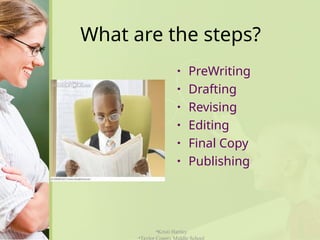
What are the steps?
• PreWriting
• Drafting
• Revising
• Editing
• Final Copy
• Publishing
•Kristi Hartley
•Taylor County Middle School
Step 1: PreWriting
• Find your
Inspiration!
• Determine
your most
useful form to
PreWrite
•Kristi Hartley
•Taylor County Middle School
Steps
Step 2: Drafting
• Select your writing ideas
from your Pre-Writing
Exercise.
• Form a main idea
• Develop topic sentences
• Give details to support
your main idea and
topic sentences
• Use textual evidence
• Have you completed
your thoughts through
your writing?
•Kristi Hartley
•Taylor County Middle School
Steps
Step 3: Revising
•Kristi Hartley
• A.R.M.S.
 Adding
Remove
Move
Substitute
Adding: Is there any other information
that the reader needs to know?
Removing: Are there any unnecessary
details?
Moving: Is the information presented
in the most logical order?
Substituting: Could I change anything
to make my expressions stronger?
Steps
Step 4: Editing
•
•Kristi Hartley
• Self Editing
• Peer Editing
Spelling
Capitalization
Punctuation
Grammar
Sentence Structure
Subject/Verb
Agreement
Word Usage
Steps
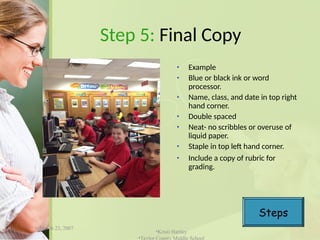
Step 5: Final Copy
• Example
• Blue or black ink or word
processor.
• Name, class, and date in top right
hand corner.
• Double spaced
• Neat- no scribbles or overuse of
liquid paper.
• Staple in top left hand corner.
• Include a copy of rubric for
grading.
• March 23, 2007
•Kristi Hartley
•Taylor County Middle School
Steps
Step 6: Publication
• Share your work
with others.
• March 23, 2007
•Kristi Hartley
•Taylor County Middle School
Thank you….

Lesson2-Week---------------------- 2.ppt

  • 2.
    Different English Figuresof Speech to Make You a Creative Writer
  • 3.
    • English figuresof speech enhance the writer’s outputs. It adds another layer and taste to the words being used.
  • 4.
    1. Apostrophe •Apostrophe iscalling out a nonexistent person or an inanimate object as though it were a living object. Example: Oh, Mother Earth! Sorry for spoiling your beauty. 2. Hyperbole •The hyperbole is an extravagant statement or the use of exaggerated terms for the purpose of emphasis. Example: Just wash it, it is now a mountain of dirty clothes. 3. Onomatopoeia This figure of speech uses the words that imitate the sounds associate with the objects or actions they refer to. Example: Quack, quack went the ducks as we threw them our stale bread.
  • 5.
    4. Irony •This isthe use of words to convey the opposite of their literal meaning. Example: A police station gets robbed. 5. Metaphor- A metaphor is an implied comparison between two dissimilar things that have something in common. Example: The wind is a blanket of ice.
  • 6.
    7. Paradox- Aparadox is a statement that appears to contradict itself. Example: Every new beginning comes from someone else’s beginnings end. 8. Personification- A figure of speech in which an inanimate object or abstraction is endowed with human qualities or abilities. Example: The river swallowed the earth as the water continued to rise higher and higher. 9. Simile- Similar to metaphor, a simile states a comparison between two fundamentally dissimilar things that have certain qualities in common. They only differ in one thing, a simile uses words usually formed with “like” or “as”. Example: Roberto was white as a sheet after he walked out of the horror movie.
  • 7.
    10. Synecdoche- refersto a part which is represented as a whole. Example: Man shall not live by bread alone, but by every word that proceeded out of the mouth of God. *bread represents all kinds of food. 11. Metonymy- is the opposite of synecdoche. These are words used that is closely associated with the subject. Example: The pen is mightier than the sword. *pen refers to writers, while sword refers to soldiers. • All of these figures of speech add flavors to writing and make us readers be more engrossed in reading.
  • 8.
    Among all the11 Figures of Speech, choose at least 5 then give atleast 1 example of each. Use it in a sentence.
  • 9.
    Writing as aLanguage Macro Skill • Teaching writing includes the mastery of micro and macro skills. • Micro skills are those that the students need to comprehend in order that they are able to produce an acceptable writing like acceptable grammar, correct cohesive devices, and also the ability to express a meaning in different grammatical forms. • Macro skills in the other hand are further skills and strategies that are required in order that the students being able to convey the meaning they want to communicate in their writing.
  • 10.
    • Brown (2004)distinguishes micro- and macro-skills of writing as follows: Micro- skills • 1. Produce graphemes and orthographic patterns of English. • 2. Produce writing at an efficient rate of speed to suit the purpose. • 3. Produce an acceptable core of words and use appropriate word order patterns. • 4. Use grammatical system e.g., tense, agreement, pluralization, patterns, and rules. • 5. Express a particular meaning in different grammatical forms. • 6. Use cohesive devices in written discourse.
  • 11.
    Macro- skills •7. Usethe rhetorical forms and conventions of written discourse. • 8. Accomplish appropriately the communicative functions of written text according to form and purpose. •9. Convey links and connections between events and communicate such relations as main idea, supporting idea, new information, given information, generalization, and exemplification. •10. Distinguish between literal and implied meanings when writing. •11. Correctly convey culturally specific references in the context of the written text. •12. Develop and use a battery of writing strategies, such as accurately assessing the audience‘s interpretation, using prewriting devices, writing with fluency in the first drafts, using paraphrases and synonyms, soliciting peer and instructor feedback, and using feedback for revising and editing.
  • 12.
    • From themacro- and micro-skills mentioned above, it can be concluded that the main point of micro-skills are about grammar mastery and the macro-skills are about larger elements like the process of generating ideas, and the use of writing organization. • Therefore, it is necessary for English teachers to improve their students ‘ writing ability, especially those that are related to those aspects. • It is mentioned that mastery of grammar is also emphasized at the micro skill requirements of writing. Grammar as linguistic aspects of writing mentioned above includes tense, agreement, and pluralization are still considered as a difficult aspect to master in this research. • Therefore, the researcher includes grammar as one of the aspects being improved in order that the learners being studied can be able to improve their writing.
  • 13.
    Writing as aDiscourse & as an Output • Writing as a discourse means writing in a formal conversation where one expresses one’s ideas in a logical flow and progression. ‘Written discourse skills are represented in the structure of a written text: entailing its internal coherence, logical development and the range of linguistic resources used to express meaning precisely. • Writing as an output is the physical result of your work. It’s the number of meetings, the number of people served, the number of meals delivered, and the number of trainings your organization will provide with the grant you’re applying for. Outputs do not measure the change in behavior or knowledge as a result of a grant’s activities
  • 14.
    Sub- skills inWriting • It is a skill that is part of and necessary to another more complex skill. Objective tests of writing sub-skills do not measure the ability to compose. Writing sub-skills are as follows; • * Know Orthography (the way words of a language are spelled) • *Know the system of the second language • *Word order • *Use good standard grammar • *Know how to express a particular meaning using different grammatical forms • *Use of synonyms and antonyms • *Writing strategies • *Be able to structure a text into paragraphs
  • 15.
    The 6 Stepsof the Writing Process
  • 16.
    What are thesteps? • PreWriting • Drafting • Revising • Editing • Final Copy • Publishing •Kristi Hartley •Taylor County Middle School
  • 17.
    Step 1: PreWriting •Find your Inspiration! • Determine your most useful form to PreWrite •Kristi Hartley •Taylor County Middle School Steps
  • 18.
    Step 2: Drafting •Select your writing ideas from your Pre-Writing Exercise. • Form a main idea • Develop topic sentences • Give details to support your main idea and topic sentences • Use textual evidence • Have you completed your thoughts through your writing? •Kristi Hartley •Taylor County Middle School Steps
  • 19.
    Step 3: Revising •KristiHartley • A.R.M.S.  Adding Remove Move Substitute Adding: Is there any other information that the reader needs to know? Removing: Are there any unnecessary details? Moving: Is the information presented in the most logical order? Substituting: Could I change anything to make my expressions stronger? Steps
  • 20.
    Step 4: Editing • •KristiHartley • Self Editing • Peer Editing Spelling Capitalization Punctuation Grammar Sentence Structure Subject/Verb Agreement Word Usage Steps
  • 21.
    Step 5: FinalCopy • Example • Blue or black ink or word processor. • Name, class, and date in top right hand corner. • Double spaced • Neat- no scribbles or overuse of liquid paper. • Staple in top left hand corner. • Include a copy of rubric for grading. • March 23, 2007 •Kristi Hartley •Taylor County Middle School Steps
  • 22.
    Step 6: Publication •Share your work with others. • March 23, 2007 •Kristi Hartley •Taylor County Middle School
  • 23.

Editor's Notes

  • #3 The effective use of figures of speech brings life to mere words, phrases, or paragraphs. Here are the most common English figures of speech used in creative writing to learn and to apply.
  • #4 Meaning: Speaking to someone who is absent, dead, or to an object as if it could hear or respond. O sun, why do you hide behind the clouds today?” (You are talking to the sun as if it were a person.) 2. Meaning: An exaggeration used to show strong emotion or emphasis. Example: “I’m so hungry I could eat a whole horse!” (You can't really eat a whole horse—it's just an exaggeration.) 3. Meaning: A word that imitates a sound. Example: “The bees buzzed around the garden.”
  • #5 Meaning: Saying or showing the opposite of what is expected or of what the words literally mean. Example: “A fire station burned down.” (You expect a fire station to be the safest from fire, so the situation is ironic.) Meaning: A direct comparison between two unlike things without using “like” or “as.” Example: “Her smile is sunshine.” (This compares her smile to sunshine, meaning it is bright and warm.)
  • #6 Meaning: A statement that seems contradictory or impossible but actually reveals a truth. Example: “Less is more.” (It sounds contradictory, but it means simplicity can be more effective.) 8. Personification Meaning: Giving human qualities to animals, objects, or ideas. Example: “The wind whispered through the trees.” (The wind is described as if it can whisper like a person.) 9. Simile Meaning: A comparison between two unlike things using “like” or “as.” Example: “Her voice is like music to my ears.” (It compares her voice to music using like.)
  • #7 Meaning: A figure of speech where a part represents the whole or the whole represents a part. Here, bread does not only mean actual bread—it stands for all kinds of food. So a part (bread) is used to represent the whole (all food). Example: “All hands on deck!” (“Hands” refers to the sailors or crew—not just their hands.) 11. Metonymy Meaning: Using a related word to stand for something else; the word is closely connected to the idea or thing. Example: “The White House announced a new policy today.” (“The White House” represents the U.S. president or government.) Final Note All of these figures of speech add flavor, emotion, and creativity to writing, making stories and ideas more interesting and engaging for readers.
  • #9 Micro Skills (Small-scale Writing Skills) Micro skills are the basic, technical skills students need to write correctly. They focus on the details of language. Examples of micro skills: Using correct grammar Using cohesive devices (and, but, because, however) Forming clear sentences Expressing meaning using correct word forms In short: Micro skills help students write accurately. Macro Skills (Large-scale Writing Skills) Macro skills deal with the overall meaning and organization of writing. These skills help students communicate ideas clearly and effectively. Examples of macro skills: Organizing ideas logically Writing with a clear purpose and message Using the proper style, tone, and structure Connecting ideas into a coherent paragraph or essay In short: Macro skills help students write meaningfully and effectively.
  • #10 Micro-Skills of Writing These are the basic, technical skills needed to write correctly in English. Produce graphemes and orthographic patterns Write letters, spelling, and word forms correctly. Example: Knowing how to spell “receive” or “thought.” Produce writing at an efficient rate Write fast enough to express ideas clearly for the intended purpose. Use an acceptable core of words and proper word order Use the right vocabulary and arrange words correctly in sentences. Example: “She eats an apple” is correct; “Eats apple she an” is not. Use the grammatical system Apply tense, subject-verb agreement, plurals, and other grammar rules. Express meaning in different grammatical forms Convey the same idea using different structures. Example: “He is happy” → “Happiness fills him.” Use cohesive devices Connect sentences and ideas logically using words like and, but, therefore, however. In short: Micro-skills focus on accuracy, grammar, vocabulary, and sentence-level writing.
  • #11 Macro-Skills of Writing Macro-skills focus on the overall meaning, organization, and effectiveness of writing, helping students communicate ideas clearly. Use rhetorical forms and conventions Follow the typical structures of different types of writing (narrative, argumentative, descriptive, etc.). Accomplish communicative functions Write appropriately for the purpose, such as to inform, persuade, entertain, or explain. Convey links and connections between events Show relationships between ideas, such as main vs. supporting ideas, examples, generalizations, or new vs. known information. Distinguish literal and implied meanings Understand and express both the obvious and deeper meanings in writing. Convey culturally specific references correctly Use cultural norms, idioms, and references appropriately so readers understand the context. Develop and use writing strategies Plan and revise writing effectively: Assess audience understanding Use prewriting tools (outlines, brainstorming) Write first drafts fluently Use paraphrases and synonyms Get and apply feedback from peers or teachers In short: Macro-skills help students write meaningfully, effectively, and appropriately for the audience and purpose, going beyond grammar to actual communication.
  • #17 (lists, mapping, webbing, graphic organizers, etc.)