US- Retail Market Analysis
US- Retail Market Analysis and Its Key Players-
What Should Costco Do To Better Utilize Its Loyalty Program
By Kaushik Biswas
Key Topics
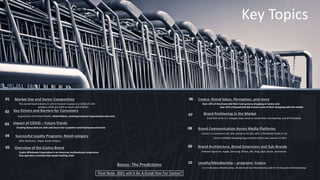
The overall retail industry in USA is forecast to grow at a CAGR of 3.5%
between 2020 and 2025 to reach USD 4,767bn
Market Size and Sector Composition
01
Augmented and Virtual Reality, Retail Robots, Evolving Customer Expectations and more
Key Drivers and Barriers for Consumers
02
Creating Stores that are Safe and Secure for Customers and Employees and more
Impact of COVID – Future Trends
03
IKEA, Starbucks, Target, Buskin Robins,
Successful Loyalty Programs- Retail category
04
Costco Wholesale Corporation is an American multinational corporation
that operates a membership-based retailing chain
Overview of the Costco Brand
05
A full 91% of its U.S. shopper base chose to renew their membership, and 87% Globally
Brand Positioning in the Market
07
Costco’s e-commerce net sales stands at $4.2bn, with 1.2% Market Share in US,
Costco’s Mobile Shopping App monthly visitors was around 13.34m
Brand Communication Across Media Platforms
08
Kirkland Signature, Apple, Samsung, Philips, Silk, Ring, Agio, Dyson, Sensodyne
Brand Architecture, Brand Extensions and Sub-Brands
09
11.3 m Business Memberships, 46.8m Gold Star Membership and 47.4m Executive Memberships
Loyalty/Membership – programs- Costco
10
Final Note- 2021 will It Be A Great Year For Costco?
Over 10% of Americans did their main grocery shopping at Costco and
over 22% of households did at least some of their shopping with the retailer
Costco- Brand Value, Perception..and more
06
Bonus- The Predictions
Market Size
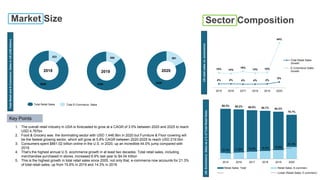
1. The overall retail industry in USA is forecasted to grow at a CAGR of 3.5% between 2020 and 2025 to reach
USD 4,767bn
2. Food & Grocery was the dominating sector with USD 1,446.9bn in 2020 but Furniture & Floor covering will
be the fastest growing sector, which will grow at 5.8% CAGR between 2020-2025 to reach USD 219.0bn
3. Consumers spent $861.02 billion online in the U.S. in 2020, up an incredible 44.0% jump compared with
2019.
4. That’s the highest annual U.S. ecommerce growth in at least two decades. Total retail sales, including
merchandise purchased in stores, increased 6.9% last year to $4.04 trillion
5. This is the highest growth in total retail sales since 2005, not only that, e-commerce now accounts for 21.3%
of total retail sales, up from 15.8% in 2019 and 14.3% in 2018
Sector Composition
Total
Retail
and
E-Commerce
Sales
In
US
(US$
billion)
523
3626
US
retail
sales
vs.
ecommerce
10.7% 11.8% 13.2% 14.3% 15.8%
21.3%
10.7% 11.8% 13.2% 14.3% 15.8%
21.3%
89.3% 88.2% 86.8% 85.7% 84.2%
78.7%
2015 2016 2017 2018 2019 2020
Retail Sales: Total Retail Sales: E-commerc
Linear (Retail Sales: E-commerc)
US-
Ecommerce
Sales
as
a
%
of
Total
Retail
Sales
Key Points
598
3780
2018 2019 2020
Total Retail Sales Total E-Commerce Sales
4% 4% 4% 4% 4%
6%
15% 14%
16%
14% 15%
44%
2015 2016 2017 2018 2019 2020
Total Retail Sales
Growth
E-Commerce Sales
Growth
861
4040
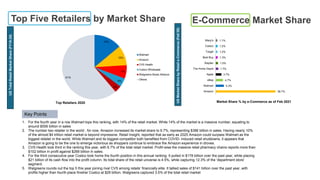
Top Five Retailers by Market Share
1. For the fourth year in a row Walmart tops this ranking, with 14% of the retail market. While 14% of the market is a massive number, equating to
around $556 billion in sales
2. The number two retailer in the world , for now, Amazon increased its market share to 9.7%, representing $386 billion in sales. Having nearly 10%
of the almost $4 trillion retail market is beyond impressive. Retail Insight, reported that as early as 2025 Amazon could surpass Walmart as the
biggest retailer in the world. While Walmart and its biggest competitor both benefited from COVID- induced retail shutdowns, it appears that
Amazon is going to be the one to emerge victorious as shoppers continue to embrace the Amazon experience in droves.
3. CVS Health took third in the ranking this year, with 6.7% of the total retail market. Profit-wise the massive retail pharmacy chains reports more than
$102 billion in profit against $268 billion in sales.
4. For the third consecutive year Costco took home the fourth position in this annual ranking. It pulled in $178 billion over the past year, while placing
$21 billion of its cash flow into the profit column. Its total share of the retail universe is 4.5%, while capturing 12.3% of the ‘department store’
segment.
5. Walgreens rounds out the top 5 this year joining rival CVS among retails’ financially elite. It tallied sales of $141 billion over the past year, with
profits higher than fourth-place finisher Costco at $29 billion. Walgreens captured 3.5% of the total retail market
Key Points
US
Total
Retail
Market
Share
(FY19-20)
14%
10%
7%
5%
4%
61%
Top Retailers 2020
Walmart
Amazon
CVS Health
Costco Wholesale
Walgreens Boots Alliance
Others
38.7%
5.3%
4.7%
3.7%
1.7%
1.5%
1.3%
1.2%
1.2%
1.1%
Amazon
Walmart
eBay
Apple
The Home Depot
Wayfair
Best Buy
Target
Costco
Macy's
Market Share % by e-Commerce as of Feb 2021
E-Commerce Market Share
US
Market
Share
by
Retail
e-Commerce
(Feb’20)
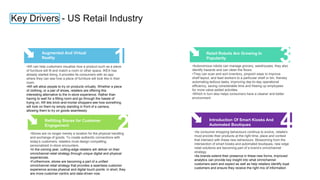
Key Drivers - US Retail Industry
1
Augmented And Virtual
Reality
•AR can help customers visualize how a product such as a piece
of furniture will fit and match a room or other space. IKEA has
already started doing, it provides its consumers with an app
where they can see how a piece of furniture will look like in their
room.
•AR will allow people to try on products virtually. Whether a piece
of clothing, or a pair of shoes, retailers are offering this
interesting alternative to the in-store experience. Rather than
having to wait for a fitting room and go through the hassle of
trying on, AR lets brick-and-mortar shoppers see how something
will look on them by simply standing in front of a camera,
allowing them to try on goods seamlessly
2
Refitting Stores for Customer
Engagement
•Stores are no longer merely a location for the physical handling
and exchange of goods. To create authentic connections with
today’s customers, retailers must design compelling,
personalized in-store encounters.
•In the coming year, cutting-edge retailers will deliver on their
omnichannel retail strategy through unique digital and physical
experiences.
•Furthermore, stores are becoming a part of a unified
omnichannel retail strategy that provides a seamless customer
experience across physical and digital touch points: in short, they
are more customer-centric and data-driven now.
3
Retail Robots Are Growing In
Popularity
•Autonomous robots can manage grocery, warehouses, they also
identify hazards and can clean the floors.
•They can scan and sort inventory, pinpoint ways to improve
shelf layout, and lead workers to a particular shelf or bin, thereby
automating tedious tasks, improving day-to-day operational
efficiency, saving considerable time and freeing up employees
for more value-added activities.
•Which in turn also helps consumers have a cleaner and better
environment
4
Introduction Of Smart Kiosks And
Automated Boutiques
•As consumer shopping behaviours continue to evolve, retailers
must provide their products at the right time, place and context
that intersect with these new behaviours. Blossoming from the
intersection of smart kiosks and automated boutiques, new edge
retail solutions are becoming part of a brand’s omnichannel
strategy.
•As brands extend their presence in these new forms, improved
analytics can provide key insight into what omnichannel
customers want and expect as well as help retailers identify loyal
customers and ensure they receive the right mix of information
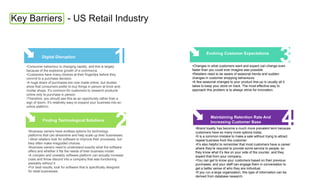
Key Barriers - US Retail Industry
1
Digital Disruption
•Consumer behaviour is changing rapidly, and this is largely
because of the explosive growth of e-commerce.
•Customers have many choices at their fingertips before they
commit to a purchase decision.
•A huge share of purchases are now made online, but studies
show that consumers prefer to buy things in person at brick-and-
mortar shops. It’s common for customers to research products
online only to purchase in person.
•Therefore, you should see this as an opportunity rather than a
sign of doom. It’s relatively easy to expand your business into an
online platform.
2
Finding Technological Solutions
•Business owners have endless options for technology
platforms that can streamline and help scale up their businesses.
• Most retailers look for software to improve their processes, but
they often make misguided choices.
•Business owners need to understand exactly what the software
offers and whether it fits the needs of their business model.
•A complex and unwieldy software platform can actually increase
costs and throw discord into a company that was functioning
passably without it.
•For best results, look for software that is specifically designed
for retail businesses.
3
Evolving Customer Expectations
•Changes in what customers want and expect can change even
faster than you could ever imagine was possible.
•Retailers need to be aware of seasonal trends and sudden
changes in customer shopping behaviours.
•A few seasonal changes to your product line-up is usually all it
takes to keep your store on track. The most effective way to
approach this problem is to always strive for innovation.
4
Maintaining Retention Rate And
Increasing Customer Base
•Brand loyalty has become a much more prevalent term because
customers have so many more options today.
•It is a common mistake to make a sale without trying to attract
repeat business from the customer.
•It’s also helpful to remember that most customers have a career
where they’re required to provide some service to people, so
they know what it’s like on your side of the counter, and they
expect that from your company.
•You can get to know your customers based on their previous
purchases, and your staff can engage them in conversation to
get a better sense of who they are individual.
•If you run a large organization, this type of information can be
derived from database research.
Impact On
Retail Sector
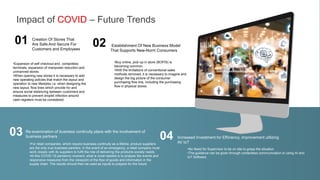
Impact of COVID – Future Trends
01
•Expansion of self checkout and contactless
terminals, expansion of manpower reduction and
unmanned stores.
•When opening new stores it is necessary to add
new operating policies that match the layout and
operation to new lifestyles i.e. when designing the
new layout, flow lines which provide for and
ensure social distancing between customers and
measures to prevent droplet infection around
cash registers must be considered.
02
•Buy online, pick-up in store (BOPIS) is
becoming common.
•With the limitations of conventional sales
methods removed, it is necessary to imagine and
design the big picture of the consumer
purchasing flow line, including the purchasing
flow in physical stores
03
•For retail companies, which require business continuity as a lifeline, product suppliers
are the only true business partners. In the event of an emergency, a retail company must
work closely with its suppliers to fulfil the role of delivering the products society needs.
•At this COVID-19 pandemic moment, what is most needed is to analyze the events and
responsive measures from the viewpoint of the flow of goods and information in the
supply chain. The results should then be used as inputs to prepare for the future.
04
•No Need for Supervisor to be on site to grasp the situation.
•The guidance can be given through contactless communication or using AI and
IoT Software
Creation Of Stores That
Are Safe And Secure For
Customers and Employees
Establishment Of New Business Model
That Supports New-Norm Consumers
Re-examination of business continuity plans with the involvement of
business partners Increased Investment for Efficiency, improvement utilizing
AI/ IoT
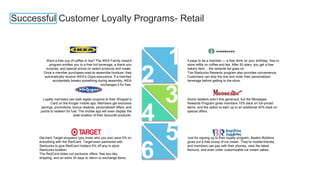
Successful Customer Loyalty Programs- Retail
1
2
3
4
5
6
Die-hard Target shoppers (you know who you are) save 5% on
everything with the RedCard. Target even partnered with
Starbucks to give RedCard holders 5% off any in-store
Starbucks location.
The RedCard doles out exclusive offers, free two-day
shipping, and an extra 30 days to return or exchange items.
Loyalty members can load digital coupons to their Shopper’s
Card on the Kroger mobile app. Members get exclusive
savings, promotions, bonus rewards, personalized offers, and
points to redeem for fuel. The mobile app will even display the
aisle location of their favourite products.
Want a free cup of coffee or tea? The IKEA Family reward
program entitles you to a free hot beverage, a thank-you
surprise, and special prices on select products and meals.
Once a member purchases read-to-assemble furniture, they
automatically receive IKEA’s Oops-assurance. If a member
accidentally breaks something during assembly, IKEA
exchanges it for free.
It pays to be a member — a free drink on your birthday, free in-
store refills on coffee and tea. After 50 stars, you get a free
bakery item… the rewards list goes on.
The Starbucks Rewards program also provides convenience.
Customers can skip the line and order their personalized
beverage before getting to the store.
Some retailers aren’t this generous, but the Moosejaw
Rewards Program gives members 10% back on full-priced
items, and the option to earn up to an additional 40% back on
special offers.
Just for signing up to their loyalty program, Baskin-Robbins
gives out a free scoop of ice cream. They’re mobile-friendly
and members can pay with their phones, view the latest
flavours, and even order customizable ice cream cakes.
WHAT ABOUT……….
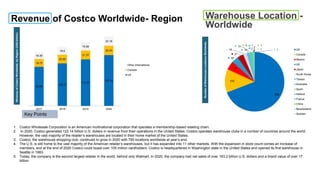
Revenue of Costco Worldwide- Region
1. Costco Wholesale Corporation is an American multinational corporation that operates a membership-based retailing chain.
2. In 2020, Costco generated 122.14 billion U.S. dollars in revenue from their operations in the United States. Costco operates warehouse clubs in a number of countries around the world.
However, the vast majority of the retailer’s warehouses are located in their home market of the United States.
3. Costco, the warehouse shopping club, continued to grow in 2020 with 795 locations worldwide at year’s end.
4. The U.S. is still home to the vast majority of the American retailer’s warehouses, but it has expanded into 11 other markets. With the expansion in store count comes an increase of
members, and at the end of 2020 Costco could boast over 105 million cardholders. Costco is headquartered in Washington state in the United States and opened its first warehouse in
Seattle in 1983.
5. Today, the company is the second largest retailer in the world, behind only Walmart. In 2020, the company had net sales of over 163.2 billion U.S. dollars and a brand value of over 17
billion.
Warehouse Location -
Worldwide
Number
of
Warehouse
Locations
Worldwide
Revenue
of
Costco
Worldwide-
by
Region
(US$
billion)
93.89
102.27
111.75
122.14
18.75
20.69
21.37
22.43
16.36
18.6
19.58
22.18
2017 2018 2019 2020
Other International
Canada
US
558
103
39
29
27
16 14
13 3
1
1 1
1 1 US
Canada
Mexico
UK
Japan
South Korea
Taiwan
Austrialia
Spain
Iceland
France
China
NewZealand
Sweden
Key Points
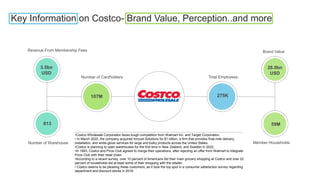
Key Information on Costco- Brand Value, Perception..and more
Total Employees
Brand Value
Member Households
Number of Cardholders
Revenue From Membership Fees
Number of Warehouse
•Costco Wholesale Corporation faces tough competition from Walmart Inc. and Target Corporation.
• In March 2020, the company acquired Innovel Solutions for $1 billion, a firm that provides final-mile delivery,
installation, and white-glove services for large and bulky products across the United States.
•Costco is planning to open warehouses for the first time in New Zealand, and Sweden in 2022.
•In 1993, Costco and Price Club agreed to merge their operations, after rejecting an offer from Walmart to integrate
Price Club with their retail chain.
•According to a recent survey, over 10 percent of Americans did their main grocery shopping at Costco and over 22
percent of households did at least some of their shopping with the retailer.
• Costco seems to be pleasing these customers, as it took the top spot in a consumer satisfaction survey regarding
department and discount stores in 2018.
3.5bn
USD
107M
59M
275K
28.9bn
USD
813
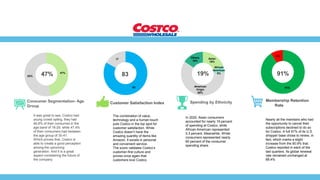
It was great to see, Costco had
young crowd opting, they had
46.8% of their consumes in the
age band of 18-29, while 47.4%
of their consumers had between
the age group of 30-41.
Which proves that, Costco is
able to create a good perception
among the upcoming
generation. And it is a great
aspect considering the future of
the company
Customer Satisfaction Index
Membership Retention
Rate
The combination of value,
technology and a human touch
puts Costco in the top spot for
customer satisfaction. While
Costco doesn’t have the
amazing quantity of items like
Amazon, it excels in personal
and convenient service.
The score validates Costco’s
customer-first culture and
proves once again that
customers love Costco.
Nearly all the members who had
the opportunity to cancel their
subscriptions declined to do so
for Costco. A full 91% of its U.S.
shopper base chose to renew, in
fact, which marks a slight
increase from the 90.9% that
Costco reported in each of the
last quarters. Its global renewal
rate remained unchanged at
88.4%
In 2020, Asian consumers
accounted for nearly 19 percent
of spending at Costco, while
African American represented
5.3 percent. Meanwhile, White
consumers represented nearly
60 percent of the consumer
spending share.
Consumer Segmentation- Age
Group
Spending by Ethnicity
47%
53%
83
17 Asian
19%
African
American
5%
American
Origin
60%
Others
16%
91%
9%
47% 83 19% 91%
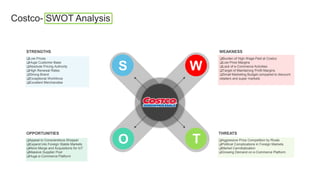
Costco- SWOT Analysis
Appeal to Conscientious Shopper
Expand into Foreign Stable Markets
More Merge and Acquisitions for IoT
Massive Supplier Pool
Huge e-Commerce Platform
OPPORTUNITIES
Low Prices
Huge Customer Base
Absolute Pricing Authority
High Renewal Rates
Strong Brand
Exceptional Workforce
Excellent Merchandise
STRENGTHS
Aggressive Price Competition by Rivals
Political Complications in Foreign Markets
Market Cannibalization
Growing Demand on e-Commerce Platform
THREATS
Burden of High Wage Paid at Costco
Low Price Margins
Lack of e-Commerce Activities
Target of Maintaining Profit Margins
Small Marketing Budget compared to discount
retailers and super markets
WEAKNESS
S W
O T
Buyers Substitutes Suppliers Competitive Rivalry
Potential New
Entry
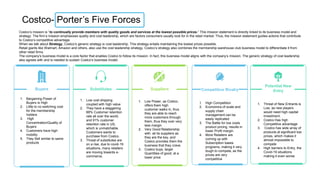
Costco- Porter’s Five Forces
1. Bargaining Power of
Buyers is High
2. Little to no switching cost
for the membership
holders
3. High
Concentration/Quality of
Buyers
4. Customers have high
mobility
5. They Sell similar to same
products
1. Low cost shipping
coupled with high value
2. They have a staggering
88% Customer retention
rate all over the world,
and 91% customer
retention rate in US,
which is unmatchable.
Customers wants to
purchase from Costco.
3. Threat of substitutes are
on a rise, due to covid-19
situations, many retailers
are moving towards e-
commerce,
1. Low Power, as Costco,
offers them high
customer walks in, thus
they are able to reach
more customers through
them, thus they over very
less margin
2. Very Good Relationship
with all its suppliers as
they are the key, and
Costco provides them the
business that they crave.
3. Costco buys, larger
Quantities of good, at a
lower price
1. High Competition
2. Economics of scale and
supply chain
management can be
easily replicated
3. The Battle for low costs
product pricing, results in
lower Profit margin.
4. More Retailers are
coming up with
Subscription bases
programs, making it very
tough to compete, as the
prices are very
competitive
1. Threat of New Entrants is
Low, as new players
would need high capital
investment.
2. Costco Has high
Competitive advantage
3. Costco has wide array of
products at significant low
prices, which makes it
almost impossible to
compete
4. High barriers to Entry, the
Covid-19 situations
making it even worse
Costco’s mission is “to continually provide members with quality goods and services at the lowest possible prices.” This mission statement is directly linked to its business model and
strategy. The firm’s mission emphasizes quality and cost leadership, which are factors consumers usually look for in the retail market. Thus, the mission statement guides actions that contribute
to Costco’s competitive advantage.
When we talk about Strategy, Costco’s generic strategy is cost leadership. This strategy entails maintaining the lowest prices possible.
Retail giants like Walmart, Amazon and others, also use the cost leadership strategy. Costco’s strategy also combines the membership warehouse club business model to differentiate it from
other retail firms.
The company’s business model is a core factor that enables Costco to follow its mission. In fact, this business model aligns with the company’s mission. The generic strategy of cost leadership
also agrees with and is needed to sustain Costco’s business model.
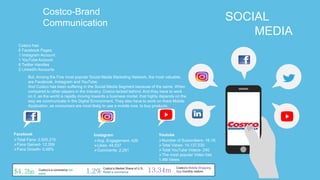
Costco-Brand
Communication
SOCIAL
MEDIA
Costco has:
6 Facebook Pages
1 Instagram Account
1 YouTube Account
6 Twitter Handles
2 LinkedIn Accounts
Total Fans- 2,505,215
Fans Gained- 12,359
Fans Growth- 0.49%
Facebook
Avg. Engagement- 426
Likes- 44,537
Comments- 2,291
Instagram
But, Among the Five most popular Social Media Marketing Network, the most valuable,
are Facebook, Instagram and YouTube.
And Costco has been suffering in the Social Media Segment because of the same. When
compared to other players in the Industry, Costco lacked behind. And they have to work
on it, as the world is rapidly moving towards a business model, that highly depends on the
way we communicate in the Digital Environment. They also have to work on there Mobile
Application, as consumers are most likely to use a mobile now, to buy products.
Number of Subscribers- 16.1K
Total Views- 14,137,530
Total YouTube Videos- 240
The most popular Video has
1.4M Views
Youtube
$4.2bn 1.2% 13.34m
Costco’s e-commerce net
sales
Costco’s Market Share of U.S,
Retail e-commerce
Costco’s Mobile Shopping
App monthly visitors
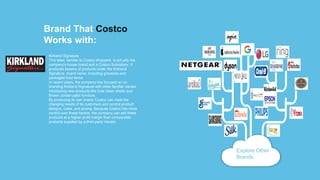
Brand That Costco
Works with:
Kirkland Signature
This label, familiar to Costco shoppers, is actually the
company's house brand and a Costco Subsidiary. It
produces dozens of products under the Kirkland
Signature brand name, including groceries and
packaged food items.
In recent years, the company has focused on co-
branding Kirkland Signature with other familiar names,
introducing new products like Cole Haan shoes and
Brown Jordan patio furniture.
By producing its own brand, Costco can meet the
changing needs of its customers and control product
designs, costs, and pricing. Because Costco has more
control over these factors, the company can sell these
products at a higher profit margin than comparable
products supplied by a third-party Vendor.
Explore Other
Brands
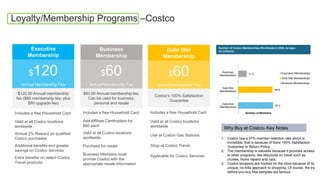
Loyalty/Membership Programs –Costco
Executive
Membership
$120
Annual Membership Fee
$120.00 Annual membership
fee ($60 membership fee, plus
$60 upgrade fee)
Includes a free Household Card
Valid at all Costco locations
worldwide
Annual 2% Reward on qualified
Costco purchases
Additional benefits and greater
savings on Costco Services
Extra benefits on select Costco
Travel products
Business
Membership
$60
Annual Membership Fee
$60.00 Annual membership fee,
Can be used for business,
personal and resale
Includes a free Household Card
Add Affiliate Cardholders for
$60 each
Valid at all Costco locations
worldwide
Purchase for resale
Business Members must
provide Costco with the
appropriate resale information
Gold Star
Membership
$60
Annual Membership Fee
Costco’s 100% Satisfaction
Guarantee
Includes a free Household Card
Valid at all Costco locations
worldwide
Use at Costco Gas Stations
Shop at Costco Travel
Applicable for Costco Services
47.4
46.8
11.3
Executive
Memberships
Gold Star
Memberships
Business
Memberships
Number of Members
Executive Memberships
Gold Star Memberships
Business Memberships
Number of Costco Memberships Worldwide in 2020, by type:
(in millions)
Why Buy at Costco- Key Notes
1. Costco has a 91% member retention rate which is
incredible, that is because of there 100% Satisfaction
Guarantee or Return Policy.
2. The membership is valuable because it provides access
to other programs, like discounts on travel such as
cruises, home repairs and cars.
3. Costco shoppers are hooked on the store because of its
unique, no-frills approach to shopping. Of course, the try-
before-you-buy free samples are famous
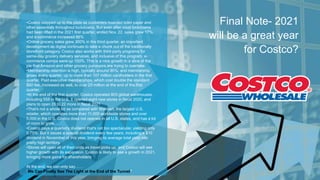
•Costco stepped up to the plate as customers hoarded toilet paper and
other essentials throughout lockdowns. But even after most lockdowns
had been lifted in the 2021 first quarter, ended Nov. 22, sales grew 17%,
and e-commerce increased 86%
•Online grocery sales grew 300% in the third quarter, an important
development as digital continues to take a chunk out of the traditionally
storefront category. Costco also works with third-party programs for
same-day grocery delivery services, and inclusive of this program, e-
commerce comps were up 100%. This is a nice growth in a slice of the
pie that Amazon and other grocery purveyors are trying to overtake.
•Membership retention is high, typically around 90%, and membership
grows every quarter, up to more than 107 million cardholders in the first
quarter. Paid executive memberships, which cost double the standard
$60 fee, increased as well, to over 23 million at the end of the first
quarter.
•At the end of the first quarter, Costco operated 803 global warehouses,
including 558 in the U.S. It opened eight new stores in fiscal 2020, and
plans to open 20 to 22 more in fiscal 2021
•That's not a whole lot as compared with Walmart, the largest U.S.
retailer, which operates more than 11,000 worldwide stores and over
5,000 in the U.S. Costco does not operate in all U.S. states, and has a lot
of room to grow.
•Costco pays a quarterly dividend that's not too spectacular, yielding only
0.75%. But it issues a special dividend every few years, including a $10
dividend in November of this year, bringing its average total yield into
pretty high territory.
•Stores will open all of their units as travel picks up, and Costco will see
higher growth with its expansion. Costco is likely to see a growth in 2021,
bringing more gains for shareholders
At the end, we can only say……
“We Can Finally See The Light at the End of the Tunnel”
Final Note- 2021
will be a great year
for Costco?
THANK YOU
US- Retail Market Analysis and Its Key Players-
What Should Costco Do To Better Utilize Its Loyalty Program

US Retail Market Analysis

  • 1.
    US- Retail MarketAnalysis US- Retail Market Analysis and Its Key Players- What Should Costco Do To Better Utilize Its Loyalty Program By Kaushik Biswas
  • 2.
    Key Topics The overallretail industry in USA is forecast to grow at a CAGR of 3.5% between 2020 and 2025 to reach USD 4,767bn Market Size and Sector Composition 01 Augmented and Virtual Reality, Retail Robots, Evolving Customer Expectations and more Key Drivers and Barriers for Consumers 02 Creating Stores that are Safe and Secure for Customers and Employees and more Impact of COVID – Future Trends 03 IKEA, Starbucks, Target, Buskin Robins, Successful Loyalty Programs- Retail category 04 Costco Wholesale Corporation is an American multinational corporation that operates a membership-based retailing chain Overview of the Costco Brand 05 A full 91% of its U.S. shopper base chose to renew their membership, and 87% Globally Brand Positioning in the Market 07 Costco’s e-commerce net sales stands at $4.2bn, with 1.2% Market Share in US, Costco’s Mobile Shopping App monthly visitors was around 13.34m Brand Communication Across Media Platforms 08 Kirkland Signature, Apple, Samsung, Philips, Silk, Ring, Agio, Dyson, Sensodyne Brand Architecture, Brand Extensions and Sub-Brands 09 11.3 m Business Memberships, 46.8m Gold Star Membership and 47.4m Executive Memberships Loyalty/Membership – programs- Costco 10 Final Note- 2021 will It Be A Great Year For Costco? Over 10% of Americans did their main grocery shopping at Costco and over 22% of households did at least some of their shopping with the retailer Costco- Brand Value, Perception..and more 06 Bonus- The Predictions
  • 3.
    Market Size 1. Theoverall retail industry in USA is forecasted to grow at a CAGR of 3.5% between 2020 and 2025 to reach USD 4,767bn 2. Food & Grocery was the dominating sector with USD 1,446.9bn in 2020 but Furniture & Floor covering will be the fastest growing sector, which will grow at 5.8% CAGR between 2020-2025 to reach USD 219.0bn 3. Consumers spent $861.02 billion online in the U.S. in 2020, up an incredible 44.0% jump compared with 2019. 4. That’s the highest annual U.S. ecommerce growth in at least two decades. Total retail sales, including merchandise purchased in stores, increased 6.9% last year to $4.04 trillion 5. This is the highest growth in total retail sales since 2005, not only that, e-commerce now accounts for 21.3% of total retail sales, up from 15.8% in 2019 and 14.3% in 2018 Sector Composition Total Retail and E-Commerce Sales In US (US$ billion) 523 3626 US retail sales vs. ecommerce 10.7% 11.8% 13.2% 14.3% 15.8% 21.3% 10.7% 11.8% 13.2% 14.3% 15.8% 21.3% 89.3% 88.2% 86.8% 85.7% 84.2% 78.7% 2015 2016 2017 2018 2019 2020 Retail Sales: Total Retail Sales: E-commerc Linear (Retail Sales: E-commerc) US- Ecommerce Sales as a % of Total Retail Sales Key Points 598 3780 2018 2019 2020 Total Retail Sales Total E-Commerce Sales 4% 4% 4% 4% 4% 6% 15% 14% 16% 14% 15% 44% 2015 2016 2017 2018 2019 2020 Total Retail Sales Growth E-Commerce Sales Growth 861 4040
  • 4.
    Top Five Retailersby Market Share 1. For the fourth year in a row Walmart tops this ranking, with 14% of the retail market. While 14% of the market is a massive number, equating to around $556 billion in sales 2. The number two retailer in the world , for now, Amazon increased its market share to 9.7%, representing $386 billion in sales. Having nearly 10% of the almost $4 trillion retail market is beyond impressive. Retail Insight, reported that as early as 2025 Amazon could surpass Walmart as the biggest retailer in the world. While Walmart and its biggest competitor both benefited from COVID- induced retail shutdowns, it appears that Amazon is going to be the one to emerge victorious as shoppers continue to embrace the Amazon experience in droves. 3. CVS Health took third in the ranking this year, with 6.7% of the total retail market. Profit-wise the massive retail pharmacy chains reports more than $102 billion in profit against $268 billion in sales. 4. For the third consecutive year Costco took home the fourth position in this annual ranking. It pulled in $178 billion over the past year, while placing $21 billion of its cash flow into the profit column. Its total share of the retail universe is 4.5%, while capturing 12.3% of the ‘department store’ segment. 5. Walgreens rounds out the top 5 this year joining rival CVS among retails’ financially elite. It tallied sales of $141 billion over the past year, with profits higher than fourth-place finisher Costco at $29 billion. Walgreens captured 3.5% of the total retail market Key Points US Total Retail Market Share (FY19-20) 14% 10% 7% 5% 4% 61% Top Retailers 2020 Walmart Amazon CVS Health Costco Wholesale Walgreens Boots Alliance Others 38.7% 5.3% 4.7% 3.7% 1.7% 1.5% 1.3% 1.2% 1.2% 1.1% Amazon Walmart eBay Apple The Home Depot Wayfair Best Buy Target Costco Macy's Market Share % by e-Commerce as of Feb 2021 E-Commerce Market Share US Market Share by Retail e-Commerce (Feb’20)
  • 5.
    Key Drivers -US Retail Industry 1 Augmented And Virtual Reality •AR can help customers visualize how a product such as a piece of furniture will fit and match a room or other space. IKEA has already started doing, it provides its consumers with an app where they can see how a piece of furniture will look like in their room. •AR will allow people to try on products virtually. Whether a piece of clothing, or a pair of shoes, retailers are offering this interesting alternative to the in-store experience. Rather than having to wait for a fitting room and go through the hassle of trying on, AR lets brick-and-mortar shoppers see how something will look on them by simply standing in front of a camera, allowing them to try on goods seamlessly 2 Refitting Stores for Customer Engagement •Stores are no longer merely a location for the physical handling and exchange of goods. To create authentic connections with today’s customers, retailers must design compelling, personalized in-store encounters. •In the coming year, cutting-edge retailers will deliver on their omnichannel retail strategy through unique digital and physical experiences. •Furthermore, stores are becoming a part of a unified omnichannel retail strategy that provides a seamless customer experience across physical and digital touch points: in short, they are more customer-centric and data-driven now. 3 Retail Robots Are Growing In Popularity •Autonomous robots can manage grocery, warehouses, they also identify hazards and can clean the floors. •They can scan and sort inventory, pinpoint ways to improve shelf layout, and lead workers to a particular shelf or bin, thereby automating tedious tasks, improving day-to-day operational efficiency, saving considerable time and freeing up employees for more value-added activities. •Which in turn also helps consumers have a cleaner and better environment 4 Introduction Of Smart Kiosks And Automated Boutiques •As consumer shopping behaviours continue to evolve, retailers must provide their products at the right time, place and context that intersect with these new behaviours. Blossoming from the intersection of smart kiosks and automated boutiques, new edge retail solutions are becoming part of a brand’s omnichannel strategy. •As brands extend their presence in these new forms, improved analytics can provide key insight into what omnichannel customers want and expect as well as help retailers identify loyal customers and ensure they receive the right mix of information
  • 6.
    Key Barriers -US Retail Industry 1 Digital Disruption •Consumer behaviour is changing rapidly, and this is largely because of the explosive growth of e-commerce. •Customers have many choices at their fingertips before they commit to a purchase decision. •A huge share of purchases are now made online, but studies show that consumers prefer to buy things in person at brick-and- mortar shops. It’s common for customers to research products online only to purchase in person. •Therefore, you should see this as an opportunity rather than a sign of doom. It’s relatively easy to expand your business into an online platform. 2 Finding Technological Solutions •Business owners have endless options for technology platforms that can streamline and help scale up their businesses. • Most retailers look for software to improve their processes, but they often make misguided choices. •Business owners need to understand exactly what the software offers and whether it fits the needs of their business model. •A complex and unwieldy software platform can actually increase costs and throw discord into a company that was functioning passably without it. •For best results, look for software that is specifically designed for retail businesses. 3 Evolving Customer Expectations •Changes in what customers want and expect can change even faster than you could ever imagine was possible. •Retailers need to be aware of seasonal trends and sudden changes in customer shopping behaviours. •A few seasonal changes to your product line-up is usually all it takes to keep your store on track. The most effective way to approach this problem is to always strive for innovation. 4 Maintaining Retention Rate And Increasing Customer Base •Brand loyalty has become a much more prevalent term because customers have so many more options today. •It is a common mistake to make a sale without trying to attract repeat business from the customer. •It’s also helpful to remember that most customers have a career where they’re required to provide some service to people, so they know what it’s like on your side of the counter, and they expect that from your company. •You can get to know your customers based on their previous purchases, and your staff can engage them in conversation to get a better sense of who they are individual. •If you run a large organization, this type of information can be derived from database research.
  • 7.
  • 8.
    Impact of COVID– Future Trends 01 •Expansion of self checkout and contactless terminals, expansion of manpower reduction and unmanned stores. •When opening new stores it is necessary to add new operating policies that match the layout and operation to new lifestyles i.e. when designing the new layout, flow lines which provide for and ensure social distancing between customers and measures to prevent droplet infection around cash registers must be considered. 02 •Buy online, pick-up in store (BOPIS) is becoming common. •With the limitations of conventional sales methods removed, it is necessary to imagine and design the big picture of the consumer purchasing flow line, including the purchasing flow in physical stores 03 •For retail companies, which require business continuity as a lifeline, product suppliers are the only true business partners. In the event of an emergency, a retail company must work closely with its suppliers to fulfil the role of delivering the products society needs. •At this COVID-19 pandemic moment, what is most needed is to analyze the events and responsive measures from the viewpoint of the flow of goods and information in the supply chain. The results should then be used as inputs to prepare for the future. 04 •No Need for Supervisor to be on site to grasp the situation. •The guidance can be given through contactless communication or using AI and IoT Software Creation Of Stores That Are Safe And Secure For Customers and Employees Establishment Of New Business Model That Supports New-Norm Consumers Re-examination of business continuity plans with the involvement of business partners Increased Investment for Efficiency, improvement utilizing AI/ IoT
  • 9.
    Successful Customer LoyaltyPrograms- Retail 1 2 3 4 5 6 Die-hard Target shoppers (you know who you are) save 5% on everything with the RedCard. Target even partnered with Starbucks to give RedCard holders 5% off any in-store Starbucks location. The RedCard doles out exclusive offers, free two-day shipping, and an extra 30 days to return or exchange items. Loyalty members can load digital coupons to their Shopper’s Card on the Kroger mobile app. Members get exclusive savings, promotions, bonus rewards, personalized offers, and points to redeem for fuel. The mobile app will even display the aisle location of their favourite products. Want a free cup of coffee or tea? The IKEA Family reward program entitles you to a free hot beverage, a thank-you surprise, and special prices on select products and meals. Once a member purchases read-to-assemble furniture, they automatically receive IKEA’s Oops-assurance. If a member accidentally breaks something during assembly, IKEA exchanges it for free. It pays to be a member — a free drink on your birthday, free in- store refills on coffee and tea. After 50 stars, you get a free bakery item… the rewards list goes on. The Starbucks Rewards program also provides convenience. Customers can skip the line and order their personalized beverage before getting to the store. Some retailers aren’t this generous, but the Moosejaw Rewards Program gives members 10% back on full-priced items, and the option to earn up to an additional 40% back on special offers. Just for signing up to their loyalty program, Baskin-Robbins gives out a free scoop of ice cream. They’re mobile-friendly and members can pay with their phones, view the latest flavours, and even order customizable ice cream cakes.
  • 10.
  • 11.
    Revenue of CostcoWorldwide- Region 1. Costco Wholesale Corporation is an American multinational corporation that operates a membership-based retailing chain. 2. In 2020, Costco generated 122.14 billion U.S. dollars in revenue from their operations in the United States. Costco operates warehouse clubs in a number of countries around the world. However, the vast majority of the retailer’s warehouses are located in their home market of the United States. 3. Costco, the warehouse shopping club, continued to grow in 2020 with 795 locations worldwide at year’s end. 4. The U.S. is still home to the vast majority of the American retailer’s warehouses, but it has expanded into 11 other markets. With the expansion in store count comes an increase of members, and at the end of 2020 Costco could boast over 105 million cardholders. Costco is headquartered in Washington state in the United States and opened its first warehouse in Seattle in 1983. 5. Today, the company is the second largest retailer in the world, behind only Walmart. In 2020, the company had net sales of over 163.2 billion U.S. dollars and a brand value of over 17 billion. Warehouse Location - Worldwide Number of Warehouse Locations Worldwide Revenue of Costco Worldwide- by Region (US$ billion) 93.89 102.27 111.75 122.14 18.75 20.69 21.37 22.43 16.36 18.6 19.58 22.18 2017 2018 2019 2020 Other International Canada US 558 103 39 29 27 16 14 13 3 1 1 1 1 1 US Canada Mexico UK Japan South Korea Taiwan Austrialia Spain Iceland France China NewZealand Sweden Key Points
  • 12.
    Key Information onCostco- Brand Value, Perception..and more Total Employees Brand Value Member Households Number of Cardholders Revenue From Membership Fees Number of Warehouse •Costco Wholesale Corporation faces tough competition from Walmart Inc. and Target Corporation. • In March 2020, the company acquired Innovel Solutions for $1 billion, a firm that provides final-mile delivery, installation, and white-glove services for large and bulky products across the United States. •Costco is planning to open warehouses for the first time in New Zealand, and Sweden in 2022. •In 1993, Costco and Price Club agreed to merge their operations, after rejecting an offer from Walmart to integrate Price Club with their retail chain. •According to a recent survey, over 10 percent of Americans did their main grocery shopping at Costco and over 22 percent of households did at least some of their shopping with the retailer. • Costco seems to be pleasing these customers, as it took the top spot in a consumer satisfaction survey regarding department and discount stores in 2018. 3.5bn USD 107M 59M 275K 28.9bn USD 813
  • 13.
    It was greatto see, Costco had young crowd opting, they had 46.8% of their consumes in the age band of 18-29, while 47.4% of their consumers had between the age group of 30-41. Which proves that, Costco is able to create a good perception among the upcoming generation. And it is a great aspect considering the future of the company Customer Satisfaction Index Membership Retention Rate The combination of value, technology and a human touch puts Costco in the top spot for customer satisfaction. While Costco doesn’t have the amazing quantity of items like Amazon, it excels in personal and convenient service. The score validates Costco’s customer-first culture and proves once again that customers love Costco. Nearly all the members who had the opportunity to cancel their subscriptions declined to do so for Costco. A full 91% of its U.S. shopper base chose to renew, in fact, which marks a slight increase from the 90.9% that Costco reported in each of the last quarters. Its global renewal rate remained unchanged at 88.4% In 2020, Asian consumers accounted for nearly 19 percent of spending at Costco, while African American represented 5.3 percent. Meanwhile, White consumers represented nearly 60 percent of the consumer spending share. Consumer Segmentation- Age Group Spending by Ethnicity 47% 53% 83 17 Asian 19% African American 5% American Origin 60% Others 16% 91% 9% 47% 83 19% 91%
  • 14.
    Costco- SWOT Analysis Appealto Conscientious Shopper Expand into Foreign Stable Markets More Merge and Acquisitions for IoT Massive Supplier Pool Huge e-Commerce Platform OPPORTUNITIES Low Prices Huge Customer Base Absolute Pricing Authority High Renewal Rates Strong Brand Exceptional Workforce Excellent Merchandise STRENGTHS Aggressive Price Competition by Rivals Political Complications in Foreign Markets Market Cannibalization Growing Demand on e-Commerce Platform THREATS Burden of High Wage Paid at Costco Low Price Margins Lack of e-Commerce Activities Target of Maintaining Profit Margins Small Marketing Budget compared to discount retailers and super markets WEAKNESS S W O T
  • 15.
    Buyers Substitutes SuppliersCompetitive Rivalry Potential New Entry Costco- Porter’s Five Forces 1. Bargaining Power of Buyers is High 2. Little to no switching cost for the membership holders 3. High Concentration/Quality of Buyers 4. Customers have high mobility 5. They Sell similar to same products 1. Low cost shipping coupled with high value 2. They have a staggering 88% Customer retention rate all over the world, and 91% customer retention rate in US, which is unmatchable. Customers wants to purchase from Costco. 3. Threat of substitutes are on a rise, due to covid-19 situations, many retailers are moving towards e- commerce, 1. Low Power, as Costco, offers them high customer walks in, thus they are able to reach more customers through them, thus they over very less margin 2. Very Good Relationship with all its suppliers as they are the key, and Costco provides them the business that they crave. 3. Costco buys, larger Quantities of good, at a lower price 1. High Competition 2. Economics of scale and supply chain management can be easily replicated 3. The Battle for low costs product pricing, results in lower Profit margin. 4. More Retailers are coming up with Subscription bases programs, making it very tough to compete, as the prices are very competitive 1. Threat of New Entrants is Low, as new players would need high capital investment. 2. Costco Has high Competitive advantage 3. Costco has wide array of products at significant low prices, which makes it almost impossible to compete 4. High barriers to Entry, the Covid-19 situations making it even worse Costco’s mission is “to continually provide members with quality goods and services at the lowest possible prices.” This mission statement is directly linked to its business model and strategy. The firm’s mission emphasizes quality and cost leadership, which are factors consumers usually look for in the retail market. Thus, the mission statement guides actions that contribute to Costco’s competitive advantage. When we talk about Strategy, Costco’s generic strategy is cost leadership. This strategy entails maintaining the lowest prices possible. Retail giants like Walmart, Amazon and others, also use the cost leadership strategy. Costco’s strategy also combines the membership warehouse club business model to differentiate it from other retail firms. The company’s business model is a core factor that enables Costco to follow its mission. In fact, this business model aligns with the company’s mission. The generic strategy of cost leadership also agrees with and is needed to sustain Costco’s business model.
  • 16.
    Costco-Brand Communication SOCIAL MEDIA Costco has: 6 FacebookPages 1 Instagram Account 1 YouTube Account 6 Twitter Handles 2 LinkedIn Accounts Total Fans- 2,505,215 Fans Gained- 12,359 Fans Growth- 0.49% Facebook Avg. Engagement- 426 Likes- 44,537 Comments- 2,291 Instagram But, Among the Five most popular Social Media Marketing Network, the most valuable, are Facebook, Instagram and YouTube. And Costco has been suffering in the Social Media Segment because of the same. When compared to other players in the Industry, Costco lacked behind. And they have to work on it, as the world is rapidly moving towards a business model, that highly depends on the way we communicate in the Digital Environment. They also have to work on there Mobile Application, as consumers are most likely to use a mobile now, to buy products. Number of Subscribers- 16.1K Total Views- 14,137,530 Total YouTube Videos- 240 The most popular Video has 1.4M Views Youtube $4.2bn 1.2% 13.34m Costco’s e-commerce net sales Costco’s Market Share of U.S, Retail e-commerce Costco’s Mobile Shopping App monthly visitors
  • 17.
    Brand That Costco Workswith: Kirkland Signature This label, familiar to Costco shoppers, is actually the company's house brand and a Costco Subsidiary. It produces dozens of products under the Kirkland Signature brand name, including groceries and packaged food items. In recent years, the company has focused on co- branding Kirkland Signature with other familiar names, introducing new products like Cole Haan shoes and Brown Jordan patio furniture. By producing its own brand, Costco can meet the changing needs of its customers and control product designs, costs, and pricing. Because Costco has more control over these factors, the company can sell these products at a higher profit margin than comparable products supplied by a third-party Vendor. Explore Other Brands
  • 18.
    Loyalty/Membership Programs –Costco Executive Membership $120 AnnualMembership Fee $120.00 Annual membership fee ($60 membership fee, plus $60 upgrade fee) Includes a free Household Card Valid at all Costco locations worldwide Annual 2% Reward on qualified Costco purchases Additional benefits and greater savings on Costco Services Extra benefits on select Costco Travel products Business Membership $60 Annual Membership Fee $60.00 Annual membership fee, Can be used for business, personal and resale Includes a free Household Card Add Affiliate Cardholders for $60 each Valid at all Costco locations worldwide Purchase for resale Business Members must provide Costco with the appropriate resale information Gold Star Membership $60 Annual Membership Fee Costco’s 100% Satisfaction Guarantee Includes a free Household Card Valid at all Costco locations worldwide Use at Costco Gas Stations Shop at Costco Travel Applicable for Costco Services 47.4 46.8 11.3 Executive Memberships Gold Star Memberships Business Memberships Number of Members Executive Memberships Gold Star Memberships Business Memberships Number of Costco Memberships Worldwide in 2020, by type: (in millions) Why Buy at Costco- Key Notes 1. Costco has a 91% member retention rate which is incredible, that is because of there 100% Satisfaction Guarantee or Return Policy. 2. The membership is valuable because it provides access to other programs, like discounts on travel such as cruises, home repairs and cars. 3. Costco shoppers are hooked on the store because of its unique, no-frills approach to shopping. Of course, the try- before-you-buy free samples are famous
  • 19.
    •Costco stepped upto the plate as customers hoarded toilet paper and other essentials throughout lockdowns. But even after most lockdowns had been lifted in the 2021 first quarter, ended Nov. 22, sales grew 17%, and e-commerce increased 86% •Online grocery sales grew 300% in the third quarter, an important development as digital continues to take a chunk out of the traditionally storefront category. Costco also works with third-party programs for same-day grocery delivery services, and inclusive of this program, e- commerce comps were up 100%. This is a nice growth in a slice of the pie that Amazon and other grocery purveyors are trying to overtake. •Membership retention is high, typically around 90%, and membership grows every quarter, up to more than 107 million cardholders in the first quarter. Paid executive memberships, which cost double the standard $60 fee, increased as well, to over 23 million at the end of the first quarter. •At the end of the first quarter, Costco operated 803 global warehouses, including 558 in the U.S. It opened eight new stores in fiscal 2020, and plans to open 20 to 22 more in fiscal 2021 •That's not a whole lot as compared with Walmart, the largest U.S. retailer, which operates more than 11,000 worldwide stores and over 5,000 in the U.S. Costco does not operate in all U.S. states, and has a lot of room to grow. •Costco pays a quarterly dividend that's not too spectacular, yielding only 0.75%. But it issues a special dividend every few years, including a $10 dividend in November of this year, bringing its average total yield into pretty high territory. •Stores will open all of their units as travel picks up, and Costco will see higher growth with its expansion. Costco is likely to see a growth in 2021, bringing more gains for shareholders At the end, we can only say…… “We Can Finally See The Light at the End of the Tunnel” Final Note- 2021 will be a great year for Costco?
  • 20.
    THANK YOU US- RetailMarket Analysis and Its Key Players- What Should Costco Do To Better Utilize Its Loyalty Program