Terry Handley Lead Consultant for APP ICT Assessing Pupils Progress (APP) in ICT  NAACE All Members Conference Coventry 4 th  October 2008  Introduction to APP
Some current features of assessment practice   often seen as a ‘separate’ activity from teaching and learning represented by numbers and letters high stakes – school and teacher accountability judgements not always trusted or used within and across schools and phases
QCA key messages about assessment   The learner is at the heart of assessment Assessment needs to provide a view of the whole learner Assessment is integral to teaching and learning Assessment includes reliable judgements about how learners are progressing related, where appropriate, to National standards and expectations
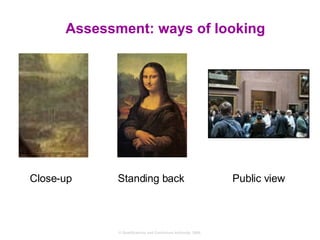
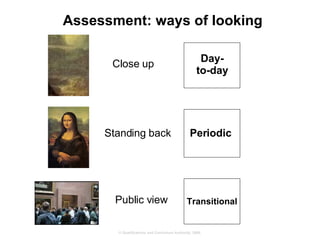
Assessment: ways of looking Close-up Standing back Public view
Assessment: ways of looking Standing back Public view Close up Day-to-day Periodic Transitional
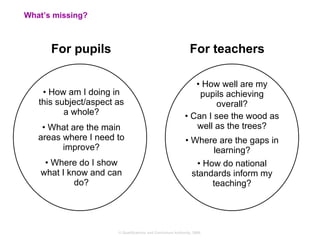
What’s missing? How am I doing in this subject/aspect as a whole? What are the main areas where I need to improve? Where do I show what I know and can do? For pupils For teachers How well are my pupils achieving overall? Can I see the wood as well as the trees? Where are the gaps in learning? How do national standards inform my teaching?
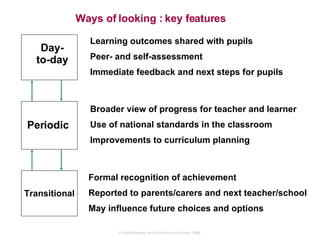
Day-to-day Periodic Transitional Ways of looking : key features Learning outcomes shared with pupils Peer- and self-assessment Immediate feedback and next steps for pupils Broader view of progress for teacher and learner Use of national standards in the classroom Improvements to curriculum planning Formal recognition of achievement Reported to parents/carers and next teacher/school May influence future choices and options
Assessing Pupils’ Progress (APP)   APP is designed to: Demonstrate how assessment is integral to successful teaching and learning Encourage a broadly based curriculum which generates a wide range of evidence of pupils’ achievement Provide a fuller picture of pupils’ strengths and weaknesses (for teachers, pupils and parents/carers) in relation to national standards Offer a secure basis for pupil tracking
APP is designed to: Give insights which directly inform future planning, teaching and learning in the course of a year Help make connections between day-to-day assessment and national standards Engage teachers and learners in all year groups in periodic assessment to raise attainment
What are APP materials? Assessment Guidelines – criteria for making periodic judgements grouped by ‘assessment focus’ Standards Files – annotated collections of evidence from a pupil which represent a particular level Handbook with guidance
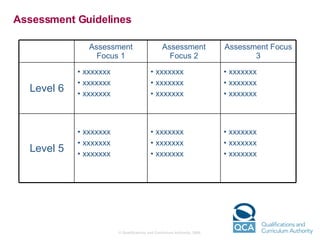
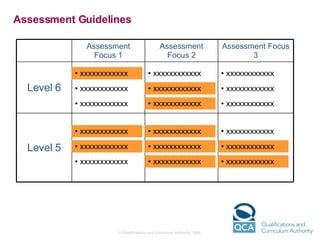
Assessment Guidelines xxxxxxx xxxxxxx xxxxxxx xxxxxxx xxxxxxx xxxxxxx xxxxxxx xxxxxxx xxxxxxx Level 5 xxxxxxx xxxxxxx xxxxxxx xxxxxxx xxxxxxx xxxxxxx xxxxxxx xxxxxxx xxxxxxx Level 6 Assessment Focus 3 Assessment Focus 2 Assessment Focus 1
The APP process Teachers identify pupils (initially a sample) After a suitable period, they review the full range of evidence (written, spoken and observed) for each assessment focus They select the appropriate ‘level boundary’ and arrive at judgements using the  assessment guidelines  sheet They use annotated examples of pupils’ work (standards files) as reference points and benchmarks They undertake moderation with colleagues within and beyond the school
Assessment Guidelines xxxxxxxxxxxx xxxxxxxxxxxx xxxxxxxxxxxx xxxxxxxxxxxx xxxxxxxxxxxx xxxxxxxxxxxx xxxxxxxxxxxx xxxxxxxxxxxx xxxxxxxxxxxx xxxxxxxxxxxx xxxxxxxxxxxx xxxxxxxxxxxx xxxxxxxxxxxx xxxxxxxxxxxx xxxxxxxxxxxx xxxxxxxxxxxx xxxxxxxxxxxx xxxxxxxxxxxx xxxxxxxxxxxx xxxxxxxxxxxx Level 5 Level 6 Assessment Focus 3 Assessment Focus 2 Assessment Focus 1
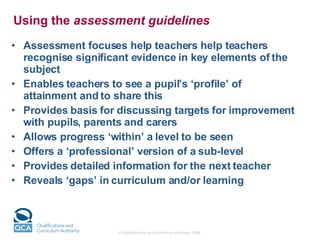
Using the  assessment guidelines Assessment focuses help teachers help teachers recognise significant evidence in key elements of the subject Enables teachers to see a pupil’s ‘profile’ of attainment and to share this Provides basis for discussing targets for improvement with pupils, parents and carers Allows progress ‘within’ a level to be seen Offers a ‘professional’ version of a sub-level Provides detailed information for the next teacher  Reveals ‘gaps’ in curriculum and/or learning
Features of APP assessments Wide range of evidence – can be drawn from work in other subjects Independence and choice – pupils demonstrating what they can do Use of  assessment guidelines  which help ‘unpick’ National Curriculum level descriptions in terms of assessment focuses Opportunities for shared professional discussions (standardisation and moderation) and external support
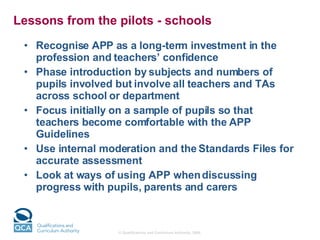
Lessons from the pilots - schools  Recognise APP as a long-term investment in the profession and teachers’ confidence Phase introduction by subjects and numbers of pupils involved but involve all teachers and TAs across school or department Focus initially on a sample of pupils so that teachers become comfortable with the APP Guidelines Use internal moderation and the Standards Files for accurate assessment Look at ways of using APP when discussing progress with pupils, parents and carers
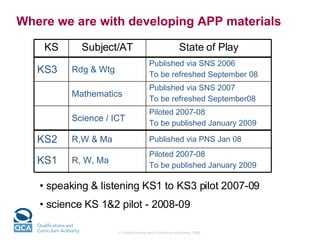
Where we are with developing APP materials speaking & listening KS1 to KS3 pilot 2007-09 science KS 1&2 pilot - 2008-09 Piloted 2007-08 To be published January 2009 R, W, Ma KS1 Published via PNS Jan 08  R,W & Ma KS2 Piloted 2007-08 To be published January 2009 Science / ICT Published via SNS 2007 To be refreshed September08 Mathematics Published via SNS 2006 To be refreshed September 08 Rdg & Wtg KS3 State of Play Subject/AT KS
APP and the wider assessment agenda  Children’s Plan  – December 2007  Additional funding (£50 million for 3 years) for schools to improve assessment  APP as the ‘universal model’ Moderation training developed and rolled out nationally Assessment for Learning Strategy  - May 2008  Strategic support for implementation of APP APP to be developed for foundation subjects at KS3

Terry Handley - Assessing Pupils Progress in ICT

  • 1.
    Terry Handley LeadConsultant for APP ICT Assessing Pupils Progress (APP) in ICT NAACE All Members Conference Coventry 4 th October 2008 Introduction to APP
  • 2.
    Some current featuresof assessment practice often seen as a ‘separate’ activity from teaching and learning represented by numbers and letters high stakes – school and teacher accountability judgements not always trusted or used within and across schools and phases
  • 3.
    QCA key messagesabout assessment The learner is at the heart of assessment Assessment needs to provide a view of the whole learner Assessment is integral to teaching and learning Assessment includes reliable judgements about how learners are progressing related, where appropriate, to National standards and expectations
  • 4.
    Assessment: ways oflooking Close-up Standing back Public view
  • 5.
    Assessment: ways oflooking Standing back Public view Close up Day-to-day Periodic Transitional
  • 6.
    What’s missing? Howam I doing in this subject/aspect as a whole? What are the main areas where I need to improve? Where do I show what I know and can do? For pupils For teachers How well are my pupils achieving overall? Can I see the wood as well as the trees? Where are the gaps in learning? How do national standards inform my teaching?
  • 7.
    Day-to-day Periodic TransitionalWays of looking : key features Learning outcomes shared with pupils Peer- and self-assessment Immediate feedback and next steps for pupils Broader view of progress for teacher and learner Use of national standards in the classroom Improvements to curriculum planning Formal recognition of achievement Reported to parents/carers and next teacher/school May influence future choices and options
  • 8.
    Assessing Pupils’ Progress(APP) APP is designed to: Demonstrate how assessment is integral to successful teaching and learning Encourage a broadly based curriculum which generates a wide range of evidence of pupils’ achievement Provide a fuller picture of pupils’ strengths and weaknesses (for teachers, pupils and parents/carers) in relation to national standards Offer a secure basis for pupil tracking
  • 9.
    APP is designedto: Give insights which directly inform future planning, teaching and learning in the course of a year Help make connections between day-to-day assessment and national standards Engage teachers and learners in all year groups in periodic assessment to raise attainment
  • 10.
    What are APPmaterials? Assessment Guidelines – criteria for making periodic judgements grouped by ‘assessment focus’ Standards Files – annotated collections of evidence from a pupil which represent a particular level Handbook with guidance
  • 11.
    Assessment Guidelines xxxxxxxxxxxxxx xxxxxxx xxxxxxx xxxxxxx xxxxxxx xxxxxxx xxxxxxx xxxxxxx Level 5 xxxxxxx xxxxxxx xxxxxxx xxxxxxx xxxxxxx xxxxxxx xxxxxxx xxxxxxx xxxxxxx Level 6 Assessment Focus 3 Assessment Focus 2 Assessment Focus 1
  • 12.
    The APP processTeachers identify pupils (initially a sample) After a suitable period, they review the full range of evidence (written, spoken and observed) for each assessment focus They select the appropriate ‘level boundary’ and arrive at judgements using the assessment guidelines sheet They use annotated examples of pupils’ work (standards files) as reference points and benchmarks They undertake moderation with colleagues within and beyond the school
  • 13.
    Assessment Guidelines xxxxxxxxxxxxxxxxxxxxxxxx xxxxxxxxxxxx xxxxxxxxxxxx xxxxxxxxxxxx xxxxxxxxxxxx xxxxxxxxxxxx xxxxxxxxxxxx xxxxxxxxxxxx xxxxxxxxxxxx xxxxxxxxxxxx xxxxxxxxxxxx xxxxxxxxxxxx xxxxxxxxxxxx xxxxxxxxxxxx xxxxxxxxxxxx xxxxxxxxxxxx xxxxxxxxxxxx xxxxxxxxxxxx xxxxxxxxxxxx Level 5 Level 6 Assessment Focus 3 Assessment Focus 2 Assessment Focus 1
  • 14.
    Using the assessment guidelines Assessment focuses help teachers help teachers recognise significant evidence in key elements of the subject Enables teachers to see a pupil’s ‘profile’ of attainment and to share this Provides basis for discussing targets for improvement with pupils, parents and carers Allows progress ‘within’ a level to be seen Offers a ‘professional’ version of a sub-level Provides detailed information for the next teacher Reveals ‘gaps’ in curriculum and/or learning
  • 15.
    Features of APPassessments Wide range of evidence – can be drawn from work in other subjects Independence and choice – pupils demonstrating what they can do Use of assessment guidelines which help ‘unpick’ National Curriculum level descriptions in terms of assessment focuses Opportunities for shared professional discussions (standardisation and moderation) and external support
  • 16.
    Lessons from thepilots - schools Recognise APP as a long-term investment in the profession and teachers’ confidence Phase introduction by subjects and numbers of pupils involved but involve all teachers and TAs across school or department Focus initially on a sample of pupils so that teachers become comfortable with the APP Guidelines Use internal moderation and the Standards Files for accurate assessment Look at ways of using APP when discussing progress with pupils, parents and carers
  • 17.
    Where we arewith developing APP materials speaking & listening KS1 to KS3 pilot 2007-09 science KS 1&2 pilot - 2008-09 Piloted 2007-08 To be published January 2009 R, W, Ma KS1 Published via PNS Jan 08 R,W & Ma KS2 Piloted 2007-08 To be published January 2009 Science / ICT Published via SNS 2007 To be refreshed September08 Mathematics Published via SNS 2006 To be refreshed September 08 Rdg & Wtg KS3 State of Play Subject/AT KS
  • 18.
    APP and thewider assessment agenda Children’s Plan – December 2007 Additional funding (£50 million for 3 years) for schools to improve assessment APP as the ‘universal model’ Moderation training developed and rolled out nationally Assessment for Learning Strategy - May 2008 Strategic support for implementation of APP APP to be developed for foundation subjects at KS3

Editor's Notes

  • #2 Main heading - Arial (bold) 32pt Body copy heading 01 – Arial (bold) – 24pt Presenters name- Arial 14 pt Title- Arial 14 pt 09 May 2006- Arial 14 pt