The Results Are In…
Now What?
2015 WASA/AWSP Summer Conference
Annette Burnett & Dr. Glenn E. Malone
A Magic Trick
Essential Questions
1) How might we frame the SBA Results unveiling?
2) How do the SBA Claims and Targets relate to instruction?
3) How might Item Specification, Blueprints, Digital Library &
Interims be used to promote the Instructional Shifts required
to Succeed?
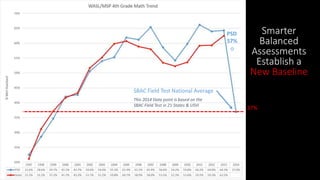
2014 Preliminary
SBA Results in Context
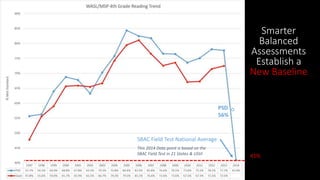
SBAC Field Test National Average
This 2014 Data point is based on the
SBAC Field Test in 21 States & USVI
41%
Smarter
Balanced
Assessments
Establish a
New Baseline
PSD
56%
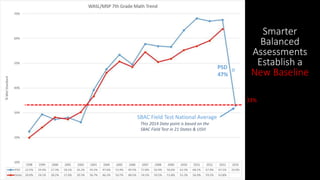
SBAC Field Test National Average
This 2014 Data point is based on the
SBAC Field Test in 21 States & USVI
37%
Smarter
Balanced
Assessments
Establish a
New Baseline
PSD
57%
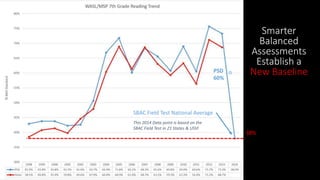
SBAC Field Test National Average
This 2014 Data point is based on the
SBAC Field Test in 21 States & USVI
Smarter
Balanced
Assessments
Establish a
New Baseline
33%
PSD
47%
SBAC Field Test National Average

This 2014 Data point is based on the
SBAC Field Test in 21 States & USVI
Smarter
Balanced
Assessments
Establish a
New Baseline
38%
PSD
60%
I P T UInstructional Performance Through Understanding
Using SBA Results
to Get Better Results
CCSS
Claims & Targets
Content & Item Specs
Interims & Digital Library
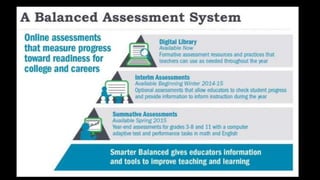
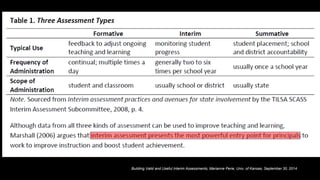
Building Valid and Useful Interim Assessments, Marianne Perie, Univ. of Kansas, September 30, 2014
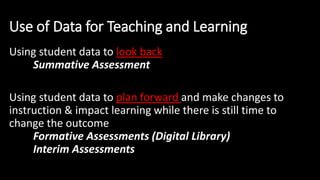
Use of Data for Teaching and Learning
Using student data to look back
Summative Assessment
Using student data to plan forward and make changes to
instruction & impact learning while there is still time to
change the outcome
Formative Assessments (Digital Library)
Interim Assessments
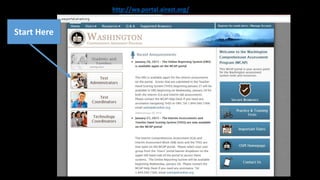
Start Here
http://wa.portal.airast.org/
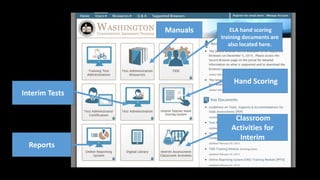
Hand Scoring
Reports
Interim Tests
Manuals ELA hand scoring
training documents are
also located here.
Classroom
Activities for
Interim
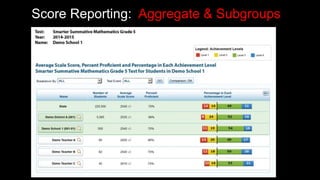
Score Reporting: Aggregate & Subgroups
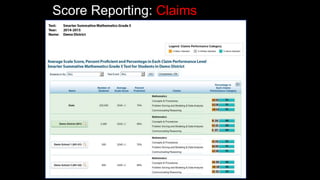
Score Reporting: Claims
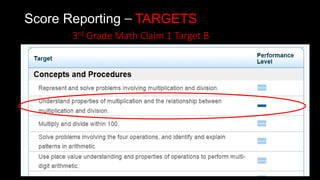
Score Reporting – TARGETS
3rd Grade Math Claim 1 Target B
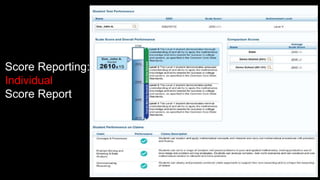
Score Reporting:
Individual
Score Report
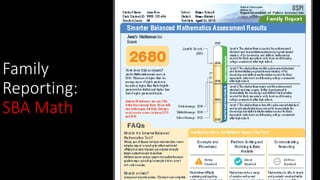
Family
Reporting:
SBA Math
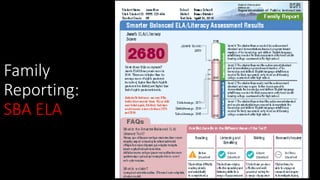
Family
Reporting:
SBA ELA
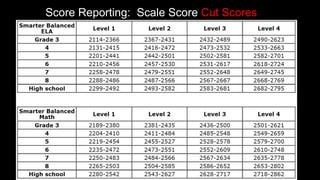
Score Reporting: Scale Score Cut Scores
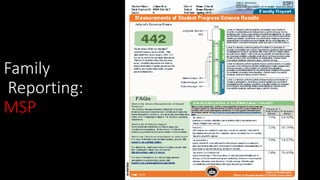
Family
Reporting:
MSP
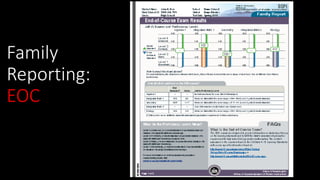
Family
Reporting:
EOC
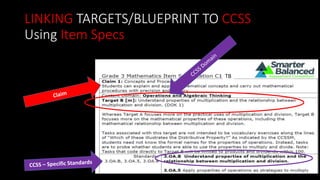
What are CLAIMS &
ASSESSMENT TARGETS?
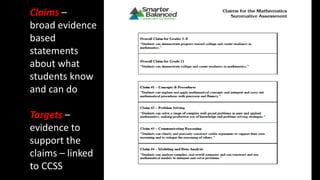
Claims –
broad evidence
based
statements
about what
students know
and can do
Targets –
evidence to
support the
claims – linked
to CCSS
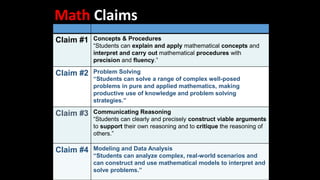
Math Claims
Claim #1 Concepts & Procedures
“Students can explain and apply mathematical concepts and
interpret and carry out mathematical procedures with
precision and fluency.”
Claim #2 Problem Solving
“Students can solve a range of complex well-posed
problems in pure and applied mathematics, making
productive use of knowledge and problem solving
strategies.”
Claim #3 Communicating Reasoning
“Students can clearly and precisely construct viable arguments
to support their own reasoning and to critique the reasoning of
others.”
Claim #4 Modeling and Data Analysis
“Students can analyze complex, real-world scenarios and
can construct and use mathematical models to interpret and
solve problems.”
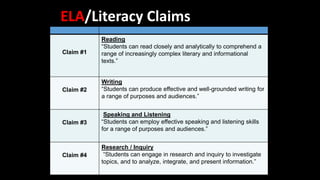
ELA/Literacy Claims
Claim #1
Reading
“Students can read closely and analytically to comprehend a
range of increasingly complex literary and informational
texts.”
Claim #2
Writing
“Students can produce effective and well-grounded writing for
a range of purposes and audiences.”
Claim #3
Speaking and Listening
“Students can employ effective speaking and listening skills
for a range of purposes and audiences.”
Claim #4
Research / Inquiry
“Students can engage in research and inquiry to investigate
topics, and to analyze, integrate, and present information.”
SBAC Claims & Targets
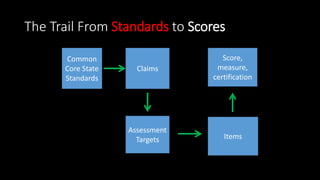
The Trail From Standards to Scores
Common
Core State
Standards
Claims
Assessment
Targets Items
Score,
measure,
certification
The Test Reflects the Standards
•Content Specifications create a bridge between
standards, assessment, and instruction.
•Item Specifications translate the Content Specs
into actual items that provide evidence of
learning.
http://www.smarterbalanced.org/smarter-balanced-assessments
DISCLAIMER
• Data from SBA is limited and confusing – this is a starting point
• This is a shortcut to navigating the system which will lead to instructional
conversations
• This is not a shortcut in making changes to instruction
• The system will change
LINKING TARGETS/BLUEPRINT TO CCSS
Using Item Specs
TB
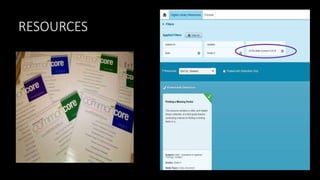
RESOURCES
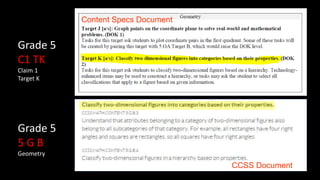
Content Specs Document
CCSS Document
Grade 5
C1 TK
Claim 1
Target K
Grade 5
5 G B
Geometry
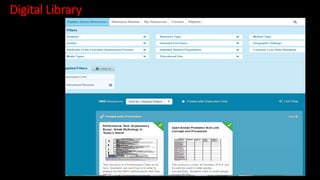
Digital Library
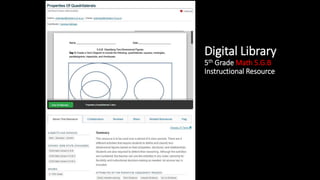
Digital Library
5th Grade Math 5.G.B
Instructional Resource
We can do this!
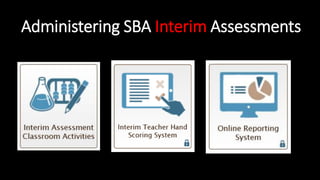
Administering SBA Interim Assessments
Why Use SBA Interim Assessments?
• Create familiarity with online student and teacher interface
• Item Type Quick Sheet
• Create accessibility to tools and accommodations embedded within
the testing portal
• Assess student progress (strengths and limitations) and help teachers
plan and shift instruction towards Common Core
• Use ELA/Math blueprints to gain insight on how to effectively
incorporate the assessment within the current instructional practice
• Better understand reported results
Types of Interims
Interim Assessment Blocks
• Short, focused sets of items
which measure one or more
assessment targets
• See the blueprint for more
details regarding claims,
assessment targets, depth of
Knowledge levels, number of
items and timing.
Interim Comprehensive Assessment
• Mirrors the year-end assessment
• Performance task has students
apply their knowledge and skills to
respond to complex real-world
problems
• Both PT and CAT must be
completed to generate a score
Interim Teacher Hand Scoring System (THSS)
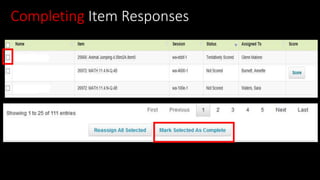
Student responses which require hand scoring are sent to THSS.
Scores are not generated until items are scored and marked as
complete.
Two roles: Scoring Managers will be able to see all scores assigned,
Testing Administrators will only be able to score the items assigned to
them
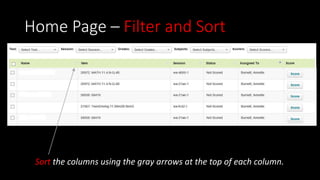
Home Page – Filter and Sort
Sort the columns using the gray arrows at the top of each column.
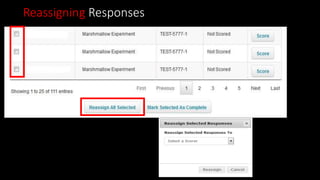
Reassigning Responses
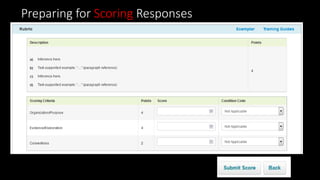
Preparing for Scoring Responses
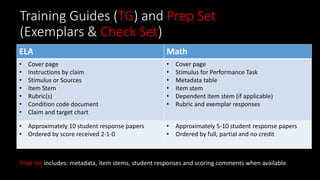
Training Guides (TG) and Prep Set
(Exemplars & Check Set)
ELA Math
• Cover page
• Instructions by claim
• Stimulus or Sources
• Item Stem
• Rubric(s)
• Condition code document
• Claim and target chart
• Cover page
• Stimulus for Performance Task
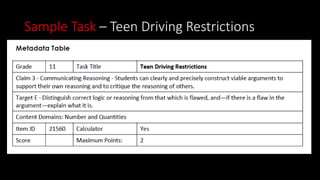
• Metadata table
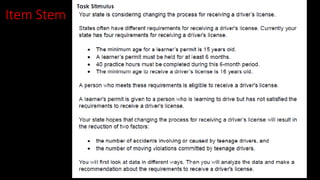
• Item stem
• Dependent item stem (if applicable)
• Rubric and exemplar responses
• Approximately 10 student response papers
• Ordered by score received 2-1-0
• Approximately 5-10 student response papers
• Ordered by full, partial and no credit
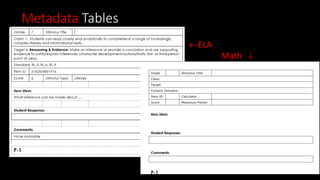
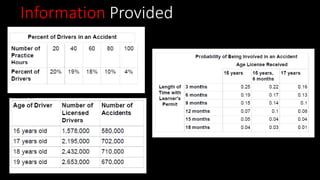
Prep Set includes: metadata, item stems, student responses and scoring comments when available.
Metadata Tables
ELA
Math 
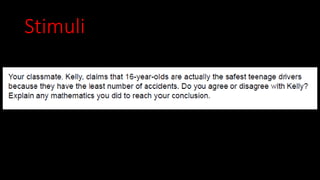
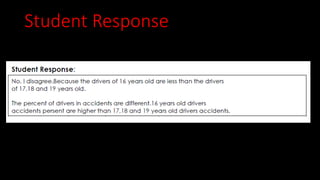
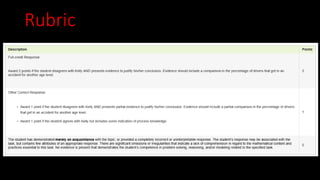
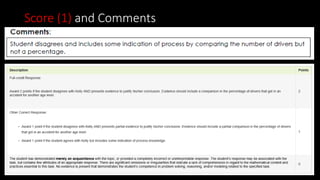
Sample Task – Teen Driving Restrictions
Item Stem
Information Provided
Stimuli
Student Response
Rubric
Score (1) and Comments
Completing Item Responses

WSU new standards mean new baseline

  • 1.
    The Results AreIn… Now What? 2015 WASA/AWSP Summer Conference Annette Burnett & Dr. Glenn E. Malone
  • 2.
  • 3.
    Essential Questions 1) Howmight we frame the SBA Results unveiling? 2) How do the SBA Claims and Targets relate to instruction? 3) How might Item Specification, Blueprints, Digital Library & Interims be used to promote the Instructional Shifts required to Succeed?
  • 4.
  • 5.
    SBAC Field TestNational Average This 2014 Data point is based on the SBAC Field Test in 21 States & USVI 41% Smarter Balanced Assessments Establish a New Baseline PSD 56%
  • 6.
    SBAC Field TestNational Average This 2014 Data point is based on the SBAC Field Test in 21 States & USVI 37% Smarter Balanced Assessments Establish a New Baseline PSD 57%
  • 7.
    SBAC Field TestNational Average This 2014 Data point is based on the SBAC Field Test in 21 States & USVI Smarter Balanced Assessments Establish a New Baseline 33% PSD 47%
  • 8.
    SBAC Field TestNational Average This 2014 Data point is based on the SBAC Field Test in 21 States & USVI Smarter Balanced Assessments Establish a New Baseline 38% PSD 60%
  • 9.
    I P TUInstructional Performance Through Understanding
  • 10.
    Using SBA Results toGet Better Results CCSS Claims & Targets Content & Item Specs Interims & Digital Library
  • 12.
    Building Valid andUseful Interim Assessments, Marianne Perie, Univ. of Kansas, September 30, 2014
  • 13.
    Use of Datafor Teaching and Learning Using student data to look back Summative Assessment Using student data to plan forward and make changes to instruction & impact learning while there is still time to change the outcome Formative Assessments (Digital Library) Interim Assessments
  • 14.
  • 15.
    Hand Scoring Reports Interim Tests ManualsELA hand scoring training documents are also located here. Classroom Activities for Interim
  • 16.
  • 17.
  • 18.
    Score Reporting –TARGETS 3rd Grade Math Claim 1 Target B
  • 19.
  • 20.
  • 21.
  • 22.
    Score Reporting: ScaleScore Cut Scores
  • 23.
  • 24.
  • 25.
    What are CLAIMS& ASSESSMENT TARGETS?
  • 26.
    Claims – broad evidence based statements aboutwhat students know and can do Targets – evidence to support the claims – linked to CCSS
  • 27.
    Math Claims Claim #1Concepts & Procedures “Students can explain and apply mathematical concepts and interpret and carry out mathematical procedures with precision and fluency.” Claim #2 Problem Solving “Students can solve a range of complex well-posed problems in pure and applied mathematics, making productive use of knowledge and problem solving strategies.” Claim #3 Communicating Reasoning “Students can clearly and precisely construct viable arguments to support their own reasoning and to critique the reasoning of others.” Claim #4 Modeling and Data Analysis “Students can analyze complex, real-world scenarios and can construct and use mathematical models to interpret and solve problems.”
  • 28.
    ELA/Literacy Claims Claim #1 Reading “Studentscan read closely and analytically to comprehend a range of increasingly complex literary and informational texts.” Claim #2 Writing “Students can produce effective and well-grounded writing for a range of purposes and audiences.” Claim #3 Speaking and Listening “Students can employ effective speaking and listening skills for a range of purposes and audiences.” Claim #4 Research / Inquiry “Students can engage in research and inquiry to investigate topics, and to analyze, integrate, and present information.”
  • 29.
  • 30.
    The Trail FromStandards to Scores Common Core State Standards Claims Assessment Targets Items Score, measure, certification
  • 31.
    The Test Reflectsthe Standards •Content Specifications create a bridge between standards, assessment, and instruction. •Item Specifications translate the Content Specs into actual items that provide evidence of learning. http://www.smarterbalanced.org/smarter-balanced-assessments
  • 32.
    DISCLAIMER • Data fromSBA is limited and confusing – this is a starting point • This is a shortcut to navigating the system which will lead to instructional conversations • This is not a shortcut in making changes to instruction • The system will change
  • 33.
    LINKING TARGETS/BLUEPRINT TOCCSS Using Item Specs TB
  • 34.
  • 35.
    Content Specs Document CCSSDocument Grade 5 C1 TK Claim 1 Target K Grade 5 5 G B Geometry
  • 36.
  • 37.
    Digital Library 5th GradeMath 5.G.B Instructional Resource
  • 38.
    We can dothis!
  • 39.
  • 40.
    Why Use SBAInterim Assessments? • Create familiarity with online student and teacher interface • Item Type Quick Sheet • Create accessibility to tools and accommodations embedded within the testing portal • Assess student progress (strengths and limitations) and help teachers plan and shift instruction towards Common Core • Use ELA/Math blueprints to gain insight on how to effectively incorporate the assessment within the current instructional practice • Better understand reported results
  • 41.
    Types of Interims InterimAssessment Blocks • Short, focused sets of items which measure one or more assessment targets • See the blueprint for more details regarding claims, assessment targets, depth of Knowledge levels, number of items and timing. Interim Comprehensive Assessment • Mirrors the year-end assessment • Performance task has students apply their knowledge and skills to respond to complex real-world problems • Both PT and CAT must be completed to generate a score
  • 42.
    Interim Teacher HandScoring System (THSS) Student responses which require hand scoring are sent to THSS. Scores are not generated until items are scored and marked as complete. Two roles: Scoring Managers will be able to see all scores assigned, Testing Administrators will only be able to score the items assigned to them
  • 43.
    Home Page –Filter and Sort Sort the columns using the gray arrows at the top of each column.
  • 44.
  • 45.
  • 46.
    Training Guides (TG)and Prep Set (Exemplars & Check Set) ELA Math • Cover page • Instructions by claim • Stimulus or Sources • Item Stem • Rubric(s) • Condition code document • Claim and target chart • Cover page • Stimulus for Performance Task • Metadata table • Item stem • Dependent item stem (if applicable) • Rubric and exemplar responses • Approximately 10 student response papers • Ordered by score received 2-1-0 • Approximately 5-10 student response papers • Ordered by full, partial and no credit Prep Set includes: metadata, item stems, student responses and scoring comments when available.
  • 47.
  • 48.
    Sample Task –Teen Driving Restrictions
  • 49.
  • 50.
  • 51.
  • 52.
  • 53.
  • 54.
    Score (1) andComments
  • 55.

Editor's Notes

  • #12 What separates interim assessment from other types of assessment? Def. of Interim. Def. of summative. Interim assessment fits between summative and formative assessment and is intended to provide periodic evaluations of student knowledge and skills. Interim assessments would generally be considered “medium‐cycle” assessments under the Wiliam and Leahy (2006) typology. They are administered at regular intervals, usually three to four times per year or every 6 to 10 weeks (Goertz, Olah, & Riggan, 2010). However, it is not just the cycle that defines interim assessment. According to Perie, Marion, and Gong (2009), interim assessments are administered during instruction to evaluate students’ knowledge and skills relative to a specific set of academic goals in order to inform s policymaker’s or educator’s decisions at the classroom, school, or district level. The specific interim assessment designs are driven by the purpose and intended uses, but the results of any interim assessment are reported in a manner allowing aggregation across students, occasions, or concepts (Perie et al., 2009). Aggregating the data is a key distinction between interim and formative assessments. Table 1 summarizes the differences among the three assessment types. Goes on to talk about purposes and uses (Instructional, predictive, growth, )
  • #13 Report available upon request. Interim assessment fits between summative and formative assessment and is intended to provide periodic evaluations of student knowledge and skills. Interim assessments would generally be considered “medium‐cycle” assessments under the Wiliam and Leahy (2006) typology. They are administered at regular intervals, usually three to four times per year or every 6 to 10 weeks (Goertz, Olah, & Riggan, 2010). However, it is not just the cycle that defines interim assessment. According to Perie, Marion, and Gong (2009), interim assessments are administered during instruction to evaluate students’ knowledge and skills relative to a specific set of academic goals in order to inform policymaker’s or educator’s decisions at the classroom, school, or district level. The specific interim assessment designs are driven by the purpose and intended uses, but the results of any interim assessment are reported in a manner allowing aggregation across students, occasions, or concepts (Perie et al., 2009). Aggregating the data is a key distinction between interim and formative assessments. Table 1 summarizes the differences among the three assessment types. Marshall argues that interim assessment is the most powerful entry point for principals to lmprove instruction. Common purposes and uses (Instructional, predictive, determine growth, )
  • #15 The first page of the portal will display recent announcements and display tabs to access all support materials. There are four end-user access points: Students and Families, Test Administrators (TA), Test Coordinators and Technology Coordinators. Some of the tabs contain the same materials within the options, but classroom educators will find what they need under the Test Administrators tab.
  • #16 Once you’ve entered the TA interface, more options appear. The Test Administration Resources icon houses all manuals and non-secure resources. The TIDE icon, depending on your role, includes: managing user accounts, managing student information, assessment eligibilities and test settings, managing orders for testing materials, managing rosters of students, and managing appeals. Notice the lock in the bottom right corner indicating access is secure and will need a secure login to access. Secure material related to the assessments are also located here, including the summative Performance Task Classroom Activities and ELA Interim Scoring Training materials. The Test Administration icon is where educators assign, approve and activate assessments their students are taking, both interim and summative. The Interim Assessment Classroom Activities icon houses the Classroom Activity that needs to preface the Interim Performance Tasks. Once students have completed the interim, educators access the Interim Teacher Hand Scoring System (THSS) icon to score student constructed responses and essays. Once all scores have been submitted, educators access the Online Reporting System icon to view scores for their assigned students.
  • #17 Achievement Levels and Claims
  • #20 Claims report : For you to understand this, must get more familiar with claims.
  • #23 Claims report : For you to understand this, must get more familiar with claims.
  • #26 .5
  • #28 1.0 For the purposes of reporting, Smarter Balanced has combined Claims 2 and 4
  • #29 1/0
  • #32 1.0
  • #36 5.G.B.3 and 5.G.B.4
  • #37 .5
  • #38 .5
  • #43 http://wa.portal.airast.org/wp-content/uploads/Item-Type-Quick-Sheet.pdf
  • #59 Note: Some blocks require hand scoring while others will be scored completely by machine. While the summative items are professionally scored, interim hand scoring is done by local educators.
  • #60 These are the specific blocks available for grades 3-5. Note that performance tasks are limited for the 2014-2015 school year. Additional Performance Tasks are also located in each grade level of the ELA Practice Test for student use.
  • #61 These are the specific blocks available for grades 6-8. Note that performance tasks are limited for the 2014-2015 school year. Additional Performance Tasks are also located in each grade level of the ELA Practice Test for student use.
  • #62 These are the specific blocks available for High School. Note that performance tasks are limited for the 2014-2015 school year. Additional Performance Tasks are also located in each grade level of the ELA Practice Test for student use.