Terrorism What is it? Where does it come from? Why is it used? How can we prevent it? What do we fear about Terrorism?
Definition of Terrorism Terrorism actually comes from the Latin Word “Fear” “ The Unlawful Use of Force Against Persons or Property to Intimidate or Coerce a Government, the Civilian Population, or Segment Thereof, in the Furtherance of Political or Social Objectives.”(Source FBI)
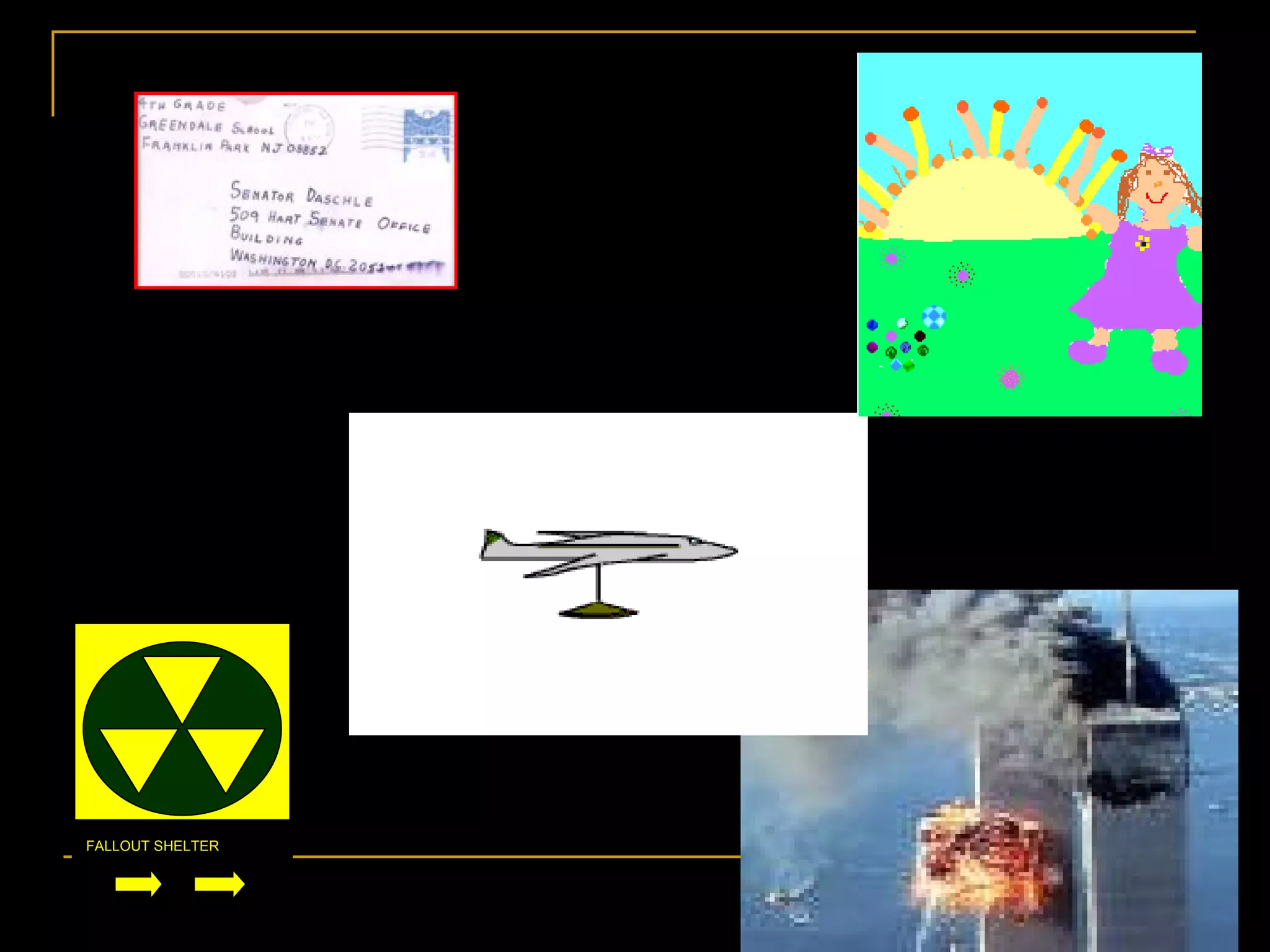
FALLOUT SHELTER
Terrorism Is  an unlawful act of violence Intimidates governments or societies Goal is to achieve political, religious or ideological objectives  Arthur H. Garrison
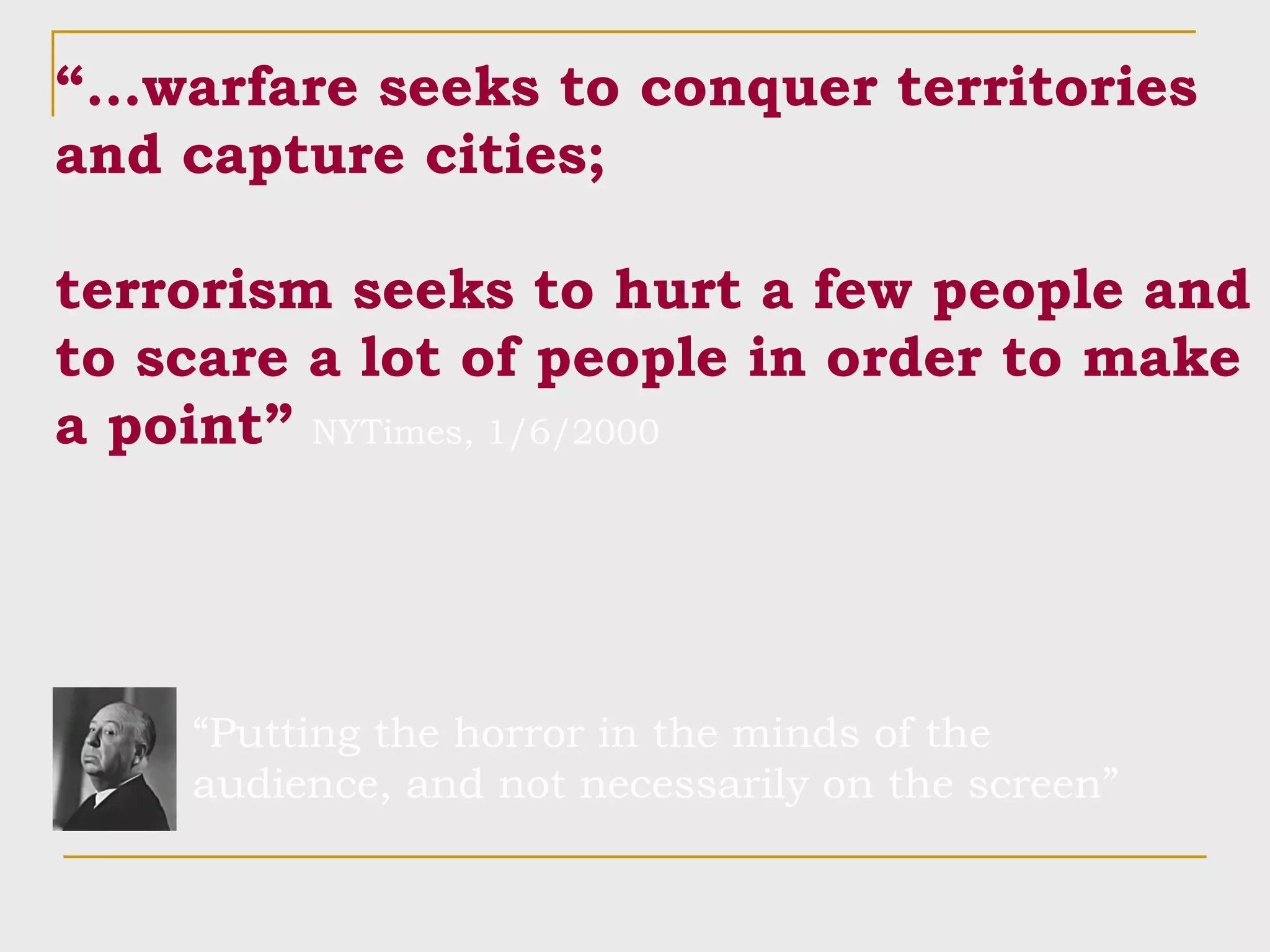
“… warfare seeks to conquer territories and capture cities; terrorism seeks to hurt a few people and to scare a lot of people in order to make a point”   NYTimes, 1/6/2000 “ Putting the horror in the minds of the audience, and not necessarily on the screen”


Terrorism Priorities Today Biological Conventional Weapons Dirty Bombs
Property of Terrorism Terrorism is different from regular crime because of its strong political properties The definition of terrorism can vary from people to people due to the differences in standpoint One person’s terrorist can be another’s fighter
The Terrorist and their Thinking
Educational Deterence Fear always springs from ignorance.   Emerson, 1837
Modern History of Terrorism Terrorism is  Asymmetric Warfare . Asymmetric warfare is the use of apparently random/unpredictable violence by an weak military against a stronger military to gain advantage. (Allen, 1997). The key of Asymmetric warfare is using unexpected,  unconventional tactics in combat (Craig, 1998). Arthur H. Garrison
Terrorism conclusions Terrorism is an  ancient   tactic. Terrorism is a mode of  communication .  Terrorism is a special type of violence and  Asymmetrical warfare . Terrorism is  used in times of peace, conflicts and war . Terrorism is designed to make a point, through psychological means,  fear. Terrorism is a  political act . Arthur H. Garrison
Two Types of Groups Domestic/ National International
Terrorist Motives Ethnic Cleansing Damage Infrastructure Disrupt Normal Life Direct Kill of an Enemy
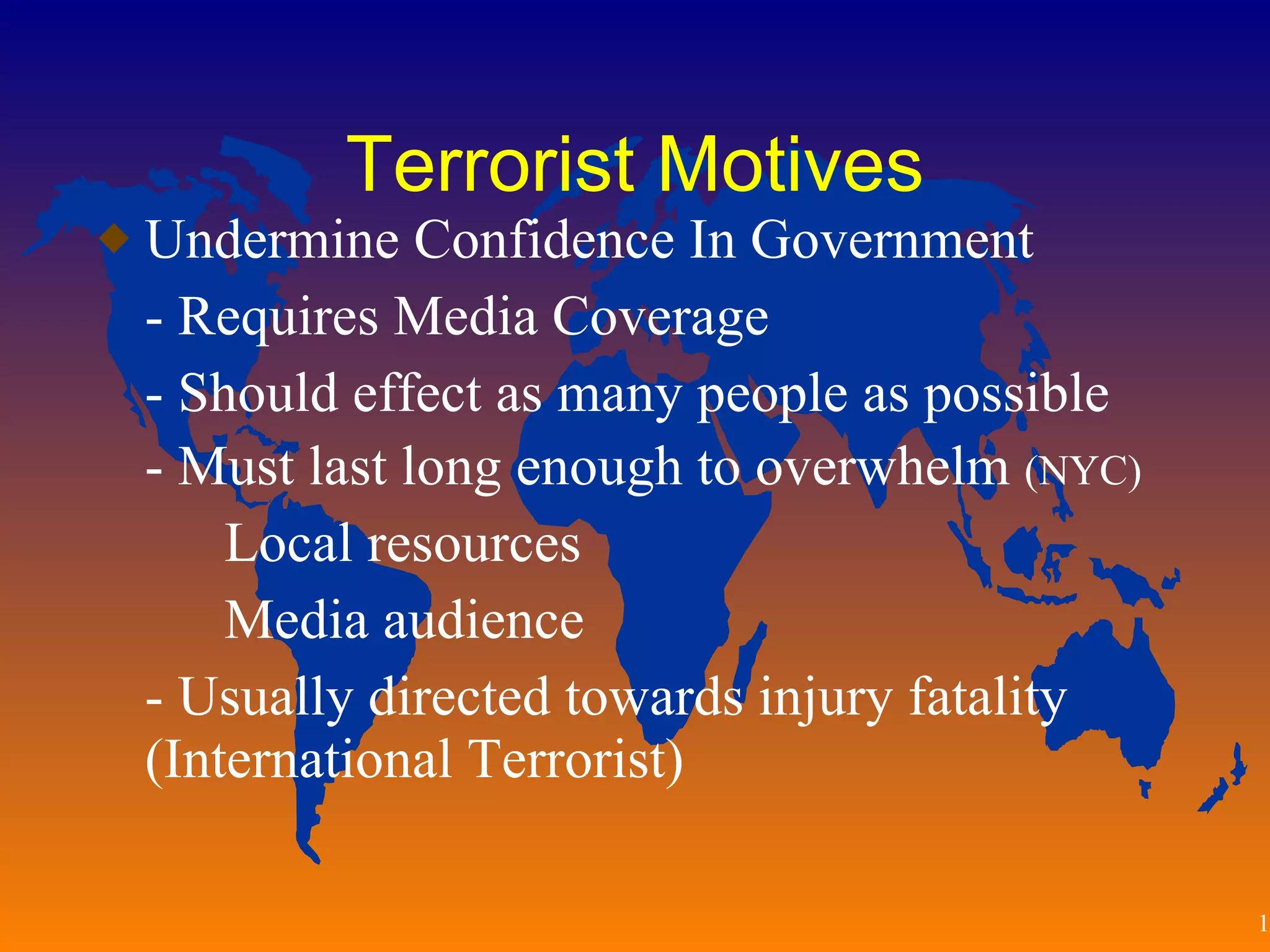
Terrorist Motives Undermine Confidence In Government - Requires Media Coverage - Should effect as many people as possible - Must last long enough to overwhelm  (NYC) Local resources Media audience - Usually directed towards injury fatality (International Terrorist)
Target Selection Based on: Motive Type of Device Available Type of Deployment Method Available
Thinking Outside the Box They ARE!!
Types of Terrorist Incidents Four Primary Types for Emergency Services
Terrorist Incidents Explosives and Arson Nuclear Materials Biological Agents Chemical Agents
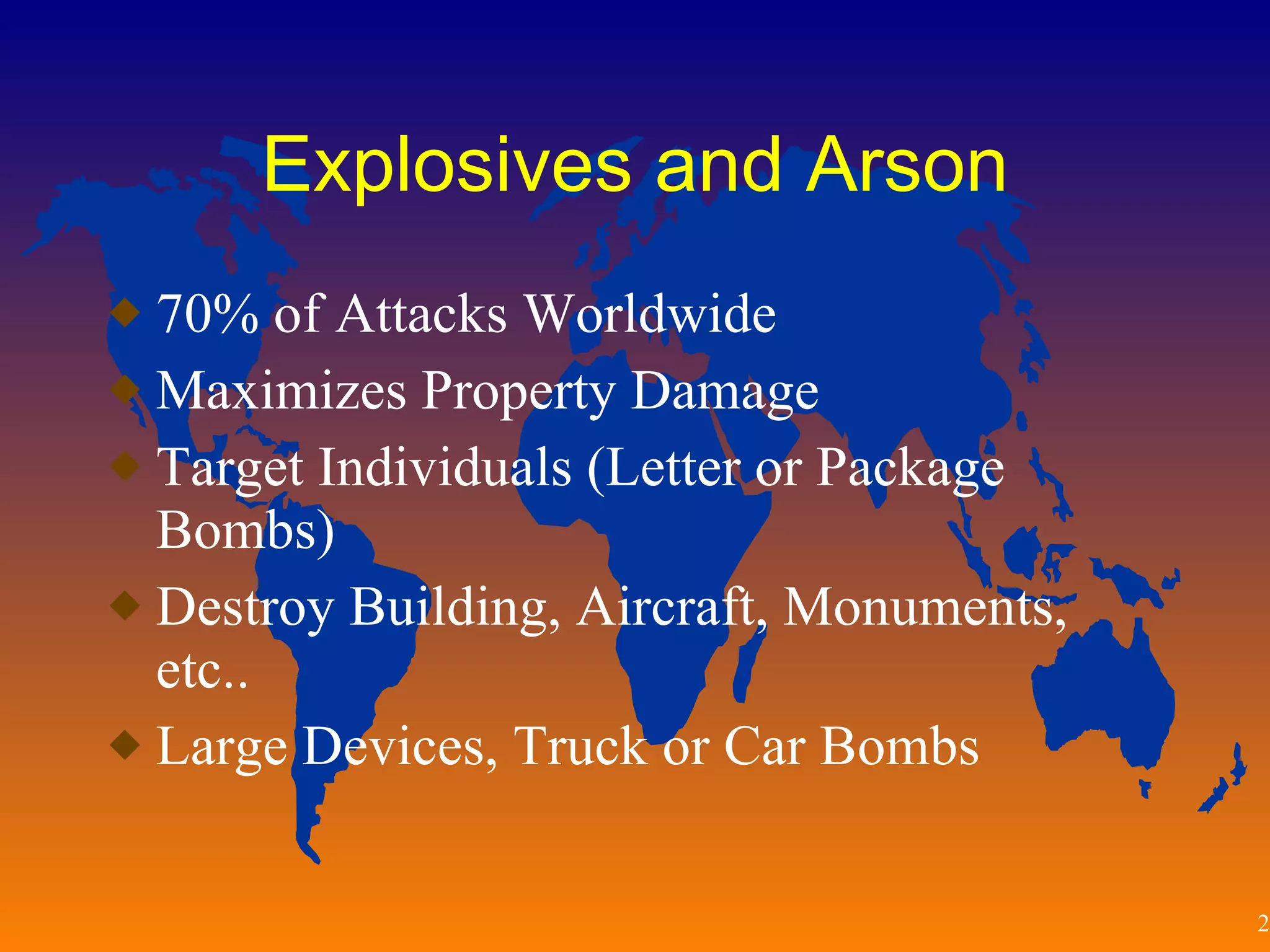
Explosives and Arson 70% of Attacks Worldwide Maximizes Property Damage Target Individuals (Letter or Package Bombs) Destroy Building, Aircraft, Monuments, etc.. Large Devices, Truck or Car Bombs
Suspicious Thing to Look for
Operational Procedures for Terrorist Incidents FACTORS FOR PREPARING Common Weapons Stand-off Weapons Super Terrorism
Operational Changes Emergency Services strategic thinker must be willing to “think the unthinkable” so that appropriate responses may be conceived. Do not overstate the threat.
Terrorist Units and Cells: A Functional Approach Funding Sources:    crime, harvesting Processing and   management,  Nation States Training Recruitment  Instructors Sites Equipment Intelligence Supplied Gathered Internet/other   open source Information   and politics Logistics Equipment &   supplies Other essentials Sources Operations One-man Team Multilateral/   collaborative
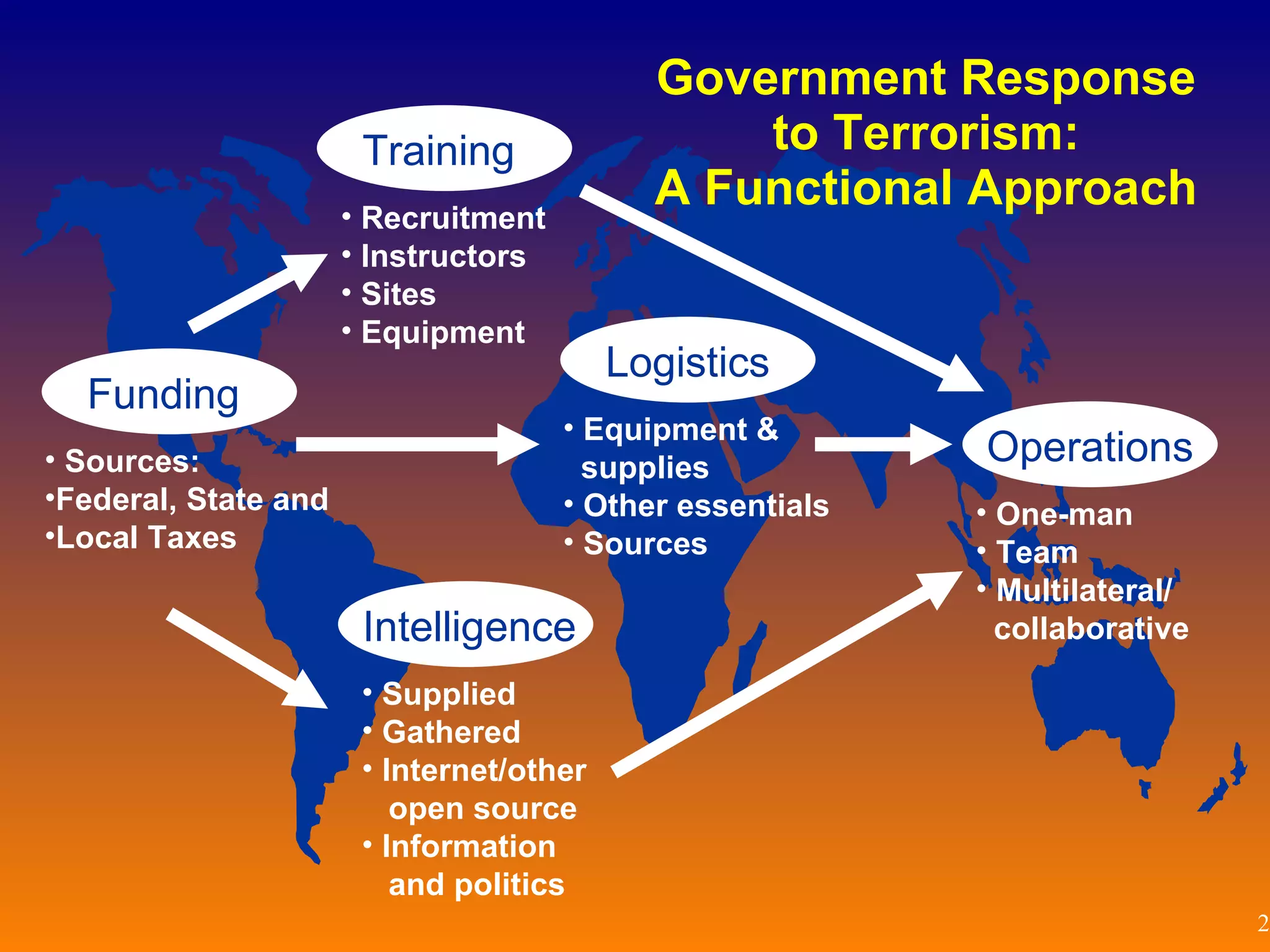
Government Response to Terrorism: A Functional Approach Funding Sources:  Federal, State and  Local Taxes Training Recruitment  Instructors Sites Equipment Intelligence Supplied Gathered Internet/other   open source Information   and politics Logistics Equipment &   supplies Other essentials Sources Operations One-man Team Multilateral/   collaborative
Terrorism and Weapons of Mass Destruction Terrorist Targets and their Weapons
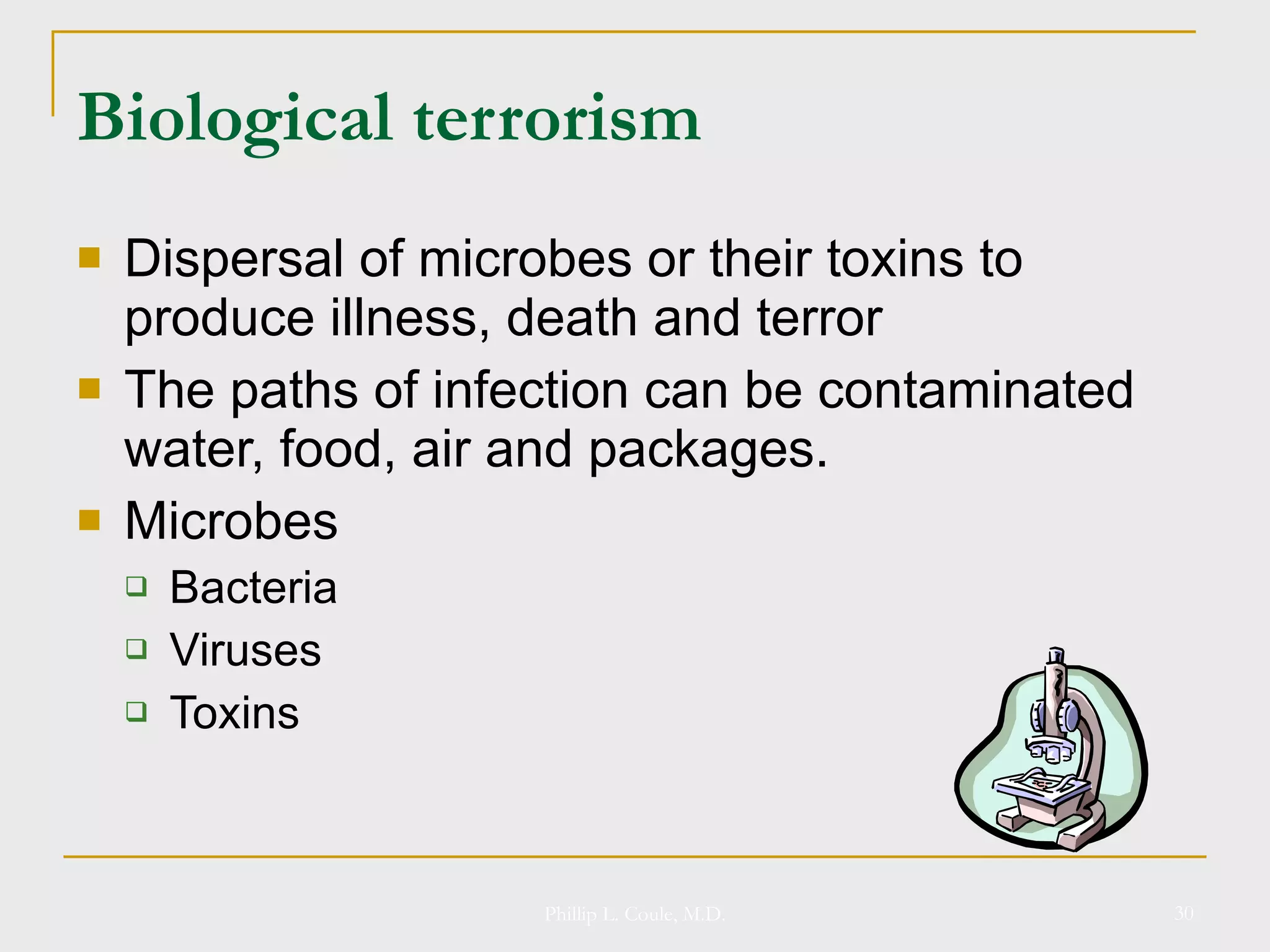
Biological terrorism Dispersal of microbes or their toxins to produce illness, death and terror The paths of infection can be contaminated water, food, air and packages. Microbes Bacteria Viruses Toxins Phillip L. Coule, M.D.
Anatomy of a Bioterrorist Attack Preparation 5 years Execution 1 day Diagnosed case 3 days First Death Multiple deaths Terrorism takes much  Time and planning
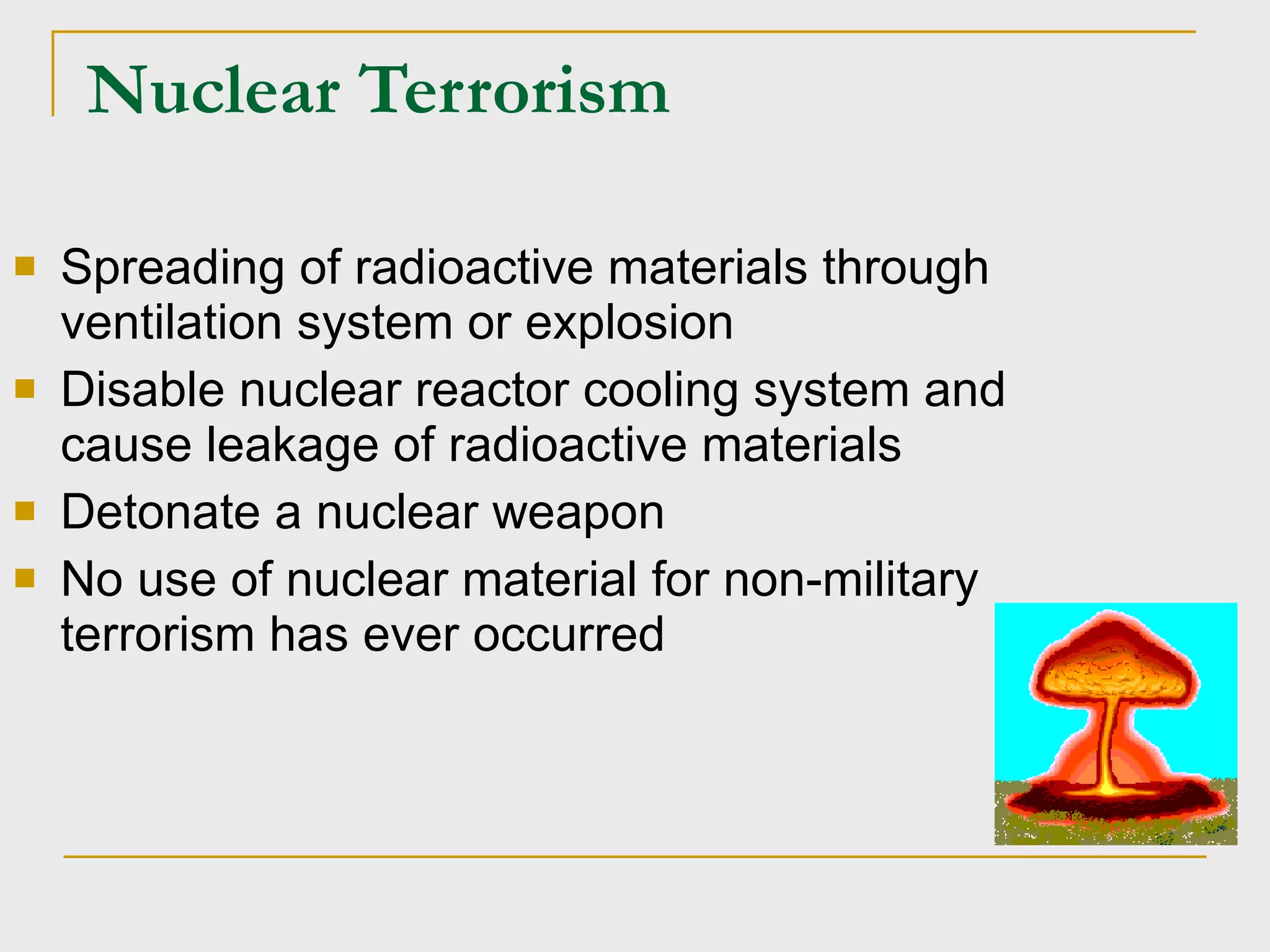
Nuclear Terrorism Spreading of radioactive materials through ventilation system or explosion Disable nuclear reactor cooling system and cause leakage of radioactive materials Detonate a nuclear weapon No use of nuclear material for non-military terrorism has ever occurred
Common Weapons Fertilizer Bombs Dynamite Semtex Automatic and Semi-automatic and Pistols remain the weapons of choice.
Stand-Off Weapons American Stinger Russian SA-7 Hand-Held Anti-Aircraft missiles US Army Light Anti-tank Weapon (LAW) Russian RPG-7 Anti-Tank Weapon And Increasing Bombing Technologies.
Where is Terrorism Going? The CYBER World
HE IS!!!!!!!!!
Prevention of Terrorism Primary prevention: Education!!! Understand the differences in cultures, religions, beliefs and human behaviors Think of the peace, freedom and equality of all human beings, not just “my group of people” Eliminate the root of terrorism
Prevention of Terrorism Secondary prevention: Establish surveillance and monitoring system on terrorism attack Improve protective system for citizens
Prevention of Terrorism Tertiary prevention Early detection of the sources Prevent the extension of impairments Rescue the survivors Console the rest of the population
Conclusion Terrorism is unlawful act Terrorism has a long history of being used to achieve political, religious and ideological objectives Terrorism can be conducted through firearms, explosive devices and biological, chemical, nuclear materials  Even through the events of 2001,the risk of dying from terrorism has remained much lower than that from motor vehicles, smoking, and alcoholic beverage .
The only thing we have to  fear is fear itself.   FDR, 1933 Fears are educated into us & can,  if we wish, be educated out.
 

Terrorism

  • 1.
    Terrorism What isit? Where does it come from? Why is it used? How can we prevent it? What do we fear about Terrorism?
  • 2.
    Definition of TerrorismTerrorism actually comes from the Latin Word “Fear” “ The Unlawful Use of Force Against Persons or Property to Intimidate or Coerce a Government, the Civilian Population, or Segment Thereof, in the Furtherance of Political or Social Objectives.”(Source FBI)
  • 3.
  • 4.
    Terrorism Is an unlawful act of violence Intimidates governments or societies Goal is to achieve political, religious or ideological objectives Arthur H. Garrison
  • 5.
    “… warfare seeksto conquer territories and capture cities; terrorism seeks to hurt a few people and to scare a lot of people in order to make a point” NYTimes, 1/6/2000 “ Putting the horror in the minds of the audience, and not necessarily on the screen”
  • 6.
  • 7.
  • 8.
  • 9.
  • 10.
    Terrorism Priorities TodayBiological Conventional Weapons Dirty Bombs
  • 11.
    Property of TerrorismTerrorism is different from regular crime because of its strong political properties The definition of terrorism can vary from people to people due to the differences in standpoint One person’s terrorist can be another’s fighter
  • 12.
    The Terrorist andtheir Thinking
  • 13.
    Educational Deterence Fearalways springs from ignorance. Emerson, 1837
  • 14.
    Modern History ofTerrorism Terrorism is Asymmetric Warfare . Asymmetric warfare is the use of apparently random/unpredictable violence by an weak military against a stronger military to gain advantage. (Allen, 1997). The key of Asymmetric warfare is using unexpected, unconventional tactics in combat (Craig, 1998). Arthur H. Garrison
  • 15.
    Terrorism conclusions Terrorismis an ancient tactic. Terrorism is a mode of communication . Terrorism is a special type of violence and Asymmetrical warfare . Terrorism is used in times of peace, conflicts and war . Terrorism is designed to make a point, through psychological means, fear. Terrorism is a political act . Arthur H. Garrison
  • 16.
    Two Types ofGroups Domestic/ National International
  • 17.
    Terrorist Motives EthnicCleansing Damage Infrastructure Disrupt Normal Life Direct Kill of an Enemy
  • 18.
    Terrorist Motives UndermineConfidence In Government - Requires Media Coverage - Should effect as many people as possible - Must last long enough to overwhelm (NYC) Local resources Media audience - Usually directed towards injury fatality (International Terrorist)
  • 19.
    Target Selection Basedon: Motive Type of Device Available Type of Deployment Method Available
  • 20.
    Thinking Outside theBox They ARE!!
  • 21.
    Types of TerroristIncidents Four Primary Types for Emergency Services
  • 22.
    Terrorist Incidents Explosivesand Arson Nuclear Materials Biological Agents Chemical Agents
  • 23.
    Explosives and Arson70% of Attacks Worldwide Maximizes Property Damage Target Individuals (Letter or Package Bombs) Destroy Building, Aircraft, Monuments, etc.. Large Devices, Truck or Car Bombs
  • 24.
  • 25.
    Operational Procedures forTerrorist Incidents FACTORS FOR PREPARING Common Weapons Stand-off Weapons Super Terrorism
  • 26.
    Operational Changes EmergencyServices strategic thinker must be willing to “think the unthinkable” so that appropriate responses may be conceived. Do not overstate the threat.
  • 27.
    Terrorist Units andCells: A Functional Approach Funding Sources: crime, harvesting Processing and management, Nation States Training Recruitment Instructors Sites Equipment Intelligence Supplied Gathered Internet/other open source Information and politics Logistics Equipment & supplies Other essentials Sources Operations One-man Team Multilateral/ collaborative
  • 28.
    Government Response toTerrorism: A Functional Approach Funding Sources: Federal, State and Local Taxes Training Recruitment Instructors Sites Equipment Intelligence Supplied Gathered Internet/other open source Information and politics Logistics Equipment & supplies Other essentials Sources Operations One-man Team Multilateral/ collaborative
  • 29.
    Terrorism and Weaponsof Mass Destruction Terrorist Targets and their Weapons
  • 30.
    Biological terrorism Dispersalof microbes or their toxins to produce illness, death and terror The paths of infection can be contaminated water, food, air and packages. Microbes Bacteria Viruses Toxins Phillip L. Coule, M.D.
  • 31.
    Anatomy of aBioterrorist Attack Preparation 5 years Execution 1 day Diagnosed case 3 days First Death Multiple deaths Terrorism takes much Time and planning
  • 32.
    Nuclear Terrorism Spreadingof radioactive materials through ventilation system or explosion Disable nuclear reactor cooling system and cause leakage of radioactive materials Detonate a nuclear weapon No use of nuclear material for non-military terrorism has ever occurred
  • 33.
    Common Weapons FertilizerBombs Dynamite Semtex Automatic and Semi-automatic and Pistols remain the weapons of choice.
  • 34.
    Stand-Off Weapons AmericanStinger Russian SA-7 Hand-Held Anti-Aircraft missiles US Army Light Anti-tank Weapon (LAW) Russian RPG-7 Anti-Tank Weapon And Increasing Bombing Technologies.
  • 35.
    Where is TerrorismGoing? The CYBER World
  • 36.
  • 37.
    Prevention of TerrorismPrimary prevention: Education!!! Understand the differences in cultures, religions, beliefs and human behaviors Think of the peace, freedom and equality of all human beings, not just “my group of people” Eliminate the root of terrorism
  • 38.
    Prevention of TerrorismSecondary prevention: Establish surveillance and monitoring system on terrorism attack Improve protective system for citizens
  • 39.
    Prevention of TerrorismTertiary prevention Early detection of the sources Prevent the extension of impairments Rescue the survivors Console the rest of the population
  • 40.
    Conclusion Terrorism isunlawful act Terrorism has a long history of being used to achieve political, religious and ideological objectives Terrorism can be conducted through firearms, explosive devices and biological, chemical, nuclear materials Even through the events of 2001,the risk of dying from terrorism has remained much lower than that from motor vehicles, smoking, and alcoholic beverage .
  • 41.
    The only thingwe have to fear is fear itself. FDR, 1933 Fears are educated into us & can, if we wish, be educated out.
  • 42.

Editor's Notes

  • #2 The objective of this lecture is to present some scientific facts about terrorism, so that teachers can educate the next generation, to understand terrorism and help to prevent terrorism. This is a template lecture for teachers. Please feel free to add or take out any slides. For example, you might want to include information about terrorism in your country, rather than the examples used in this lecture. The lecture is designed to be apolitical. The objectives are to 1) provide information to students about terrorism in general, 2) to show that terrorism has had a long history, 3) to demonstrate that terrorism has taken place in all areas of the world and 4 to demonstrate that terrorism although scaring many people is very rare. We must be concerned about terrorism, however, we cannot be paralyzed due to fear.
  • #3 2
  • #4 We have all seen pictures of terrorism during the past year since Sept. 11. This has frightened all of us, and lead to major changes in our society. The Homeland of the United States has been invaded, and we want to feel safe again. Terrorism has taken place in many other regions across the world. This is a lecture for Sept. 11, it overviews what we know about terrorism. Little girl image: http://www.corona.bell.k12.ca.us/teach/swa/girl.gif Plane image: http://www.ehr.nsf.gov/ehr/ehr/science_home/images/plane.gif
  • #5 Terrorism is a political act designed by groups to have their message heard. Arthur H. Garrison, How the World Changed: a History of the Development of Terrorism, presented at Delaware criminal Justice Council Annual Retreat, Oct 28-29, 2001 http://www.state.de.us/cjc/history.ppt
  • #6 Often we talk about terrorism, without really defining it. Terrorism is not warfare, the goals are different. Terrorists want to seed a political message into our minds, murder, and violence are secondary. Hitchcock is a perfect spokesperson for terrorism as he is the master of terrorism. Terrorist make us afraid, which makes them heard.
  • #7 On Sept. 11 the Twin Towers received a body blow by a terrorist. Please close your eyes and think about what you felt. Where were you? What type of emotions swept over you? Were your afraid? Most people were.
  • #10 We want to prevent our children, and us from being afraid. Educators, teachers, and mentors need the best possible information quickly to prevent the buildup of fear, and to dissipate fear after it has arisen. In many ways fear, for the survivors, is more disruptive than death.
  • #14 The major destructive force of terrorism is fear. However, we can reduce fear by building up our knowledge of terrorism.
  • #15 There has been much discussion of Asymmetric Warfare. This is where a superior power is confronted with an unconventional, much smaller enemy. However, the enemy has a fervent belief in a cause, but attacks using new, often never used before approaches often to the surprise of the dominant force. Arthur H. Garrison, How the World Changed: a History of the Development of Terrorism, presented at Delaware criminal Justice Council Annual Retreat, Oct 28-29, 2001 http://www.state.de.us/cjc/history.ppt
  • #16 We were surprised on Sept. 11. However, it is very important to recognize that terrorism is not new, and it’s primary goal is not to kill, but to communicate a message. Terrorism is a form of violence, and has been used throughout history. Terrorism most certainly has a psychological impact, and is a very powerful political act. It gets people heard. Arthur H. Garrison, How the World Changed: a History of the Development of Terrorism, presented at Delaware criminal Justice Council Annual Retreat, Oct 28-29, 2001 http://www.state.de.us/cjc/history.ppt
  • #25 http://www.emergency.com/pkgbomb.htm
  • #26 6
  • #27 7
  • #31 Source: Chemical and Biological Terrorism, an overview of the threat. Phillip L. Coule, M.D. http://www.pemba.utk.edu/bt101/Chem%20and%20Biol%20Terrorism-%20Dr.%20Coule.ppt
  • #32 The problem is that few recognize the time course of terrorism. There is a long, protracted time period of planning, followed by a short execution phase and short diagnosis phase. The terrorist on Sept. 11 prepared for almost 5 years before finally attacking. The time between execution and first death is typically small. For example, if a nuclear devise were to be detonated, death would arise within seconds. We want to be able to intervene to prevent children and adults from experiencing a terrorist attack, and death.
  • #33 Picture from: http://www.state.nv.us/nucwaste/graphics/nuclear.gi
  • #34 8
  • #35 9
  • #38 Just because of its uncertainty, it is hard to collect unbiased data on terrorism and it is hard to propose specific prevention measures. Here we present the general approaches of prevention from the epidemiological and public health point of view.
  • #41 Sources: Information on how to help children understand the terrorist attacks: Suggestions for Adults: Talking and Thinking with Children About the Terrorist Attacks http://www.ed.gov/inits/september11/adults.html Suggestions for Educators: Meeting the Needs of Students http://www.ed.gov/inits/september11/educators.html A Letter to Elementary School Students from First Lady Laura Bush http://www.whitehouse.gov/news/releases/2001/09/letter2.html A Letter to Middle and High School Students from First Lady Laura Bush http://www.whitehouse.gov/news/releases/2001/09/letter1.html President Bush Participates in Launch of Friendship Through Education Consortium http://www.friendshipthrougheducation.org/ School Officials Urged to Prevent Harassment of Muslim and Arab-American Students http://www.ed.gov/PressReleases/09-2001/09192001c.html Where you can find additional information and resources: American Academy of Child and Adolescent Psychiatry http://www.aacap.org/ American Counseling Association http://www.counseling.org American Psychological Association Online: Help with Trauma http://www.apa.org/psychnet/coverage.html Emergency Services and Disaster Relief Branch, Center for Mental Health http://www.mentalhealth.org/cmhs/emergencyservices/ Helping Children and Adolescents Cope with Violence and Disasters http://www.nimh.nih.gov/publicat/violence.cfm Helping Children Cope with Disaster, National Parent Information Network http://npin.org/library/2001/n00563/n00563.html High Schools for Heroes http://www.hs4heroes.org National Association of School Psychologists http://www.nasponline.org National Center for Post-Traumatic Stress Disorder http://www.ncptsd.org/what_is_new.html Post-Traumatic Stress Disorder (PTSD), Trauma, Disasters, and Violence http://www.nimh.nih.gov/anxiety/ptsdmenu.cfm Talking with Children When Disaster Strikes http://www.tpt.org/TPTspecial_edition/walsh.html Ten Tips to Help Your Kids Deal with Violence, Parenting Press http://www.parentingpress.com/resp_10_tips.html Terrorism and Children, Purdue University Extension http://www.ces.purdue.edu/terrorism/children/index.html University of Oklahoma, Department of Pediatrics http://peds.ouhsc.edu/ U.S. Government Information and Resources in Response to September 11th Events http://www.firstgov.gov/featured/usgresponse.html