Terrorismo
El 11 de septiembre, enemigos de la libertad cometieron
un acto de guerra contra nuestro país ... O están con
nosotros o están con los terroristas.
~ President George W. Bush, 20 Sep 2001
"... El pueblo estadounidense debe permanecer
vigilante .... Aquellos conspirar contra nosotros
buscamos no sólo para socavar nuestra
seguridad, sino también la sociedad abierta y
los valores que apreciamos como
estadounidenses.
~ President Barack Obama, 28 Dec 2009
• Historia
• definiciones
• Las características, objetivos, y Tácticas
• Política Nacional de Estados Unidos y Política
Militar Futuro del terrorismo
Overview
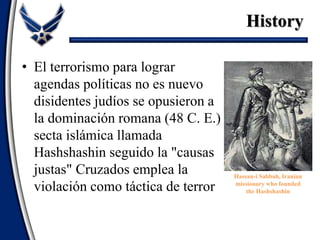
• El terrorismo para lograr
agendas políticas no es nuevo
disidentes judíos se opusieron a
la dominación romana (48 C. E.)
secta islámica llamada
Hashshashin seguido la "causas
justas" Cruzados emplea la
violación como táctica de terror
Hassan-i Sabbah, Iranian
missionary who founded
the Hashshashin
History
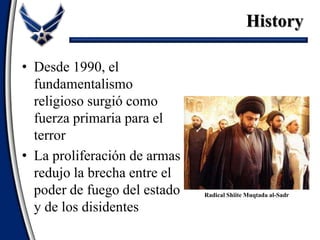
• Desde 1990, el
fundamentalismo
religioso surgió como
fuerza primaria para el
terror
• La proliferación de armas
redujo la brecha entre el
poder de fuego del estado
y de los disidentes
History
Radical Shiite Muqtada al-Sadr
• Walter Laqueur: "El terrorismo constituye el
uso ilegítimo de la fuerza para alcanzar un
objetivo político cuando las personas inocentes
están dirigidos."
• Departamento de Defensa: "El uso ilegal o
amenaza de uso de fuerza o violencia contra
las personas o la propiedad de coaccionar o
intimidar a gobiernos o sociedades, a menudo
para conseguir objetivos políticos, religiosos o
ideológicos."
Definitions
Joint Pub. 3-07.2
El uso ilegal de la violencia o la amenaza de
violencia para infundir miedo y coaccionar a
los gobiernos o sociedades.
El terrorismo es a menudo motivado por
creencias ideológicas religiosas, políticas o de
otro tipo y comprometido en la búsqueda de
objetivos que son generalmente de carácter
político. - Joint Publication 3-07.2, Antiterrorism
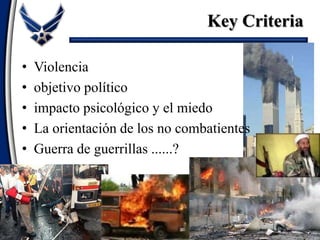
• Violencia
• objetivo político
• impacto psicológico y el miedo
• La orientación de los no combatientes
• Guerra de guerrillas ......?
Key Criteria
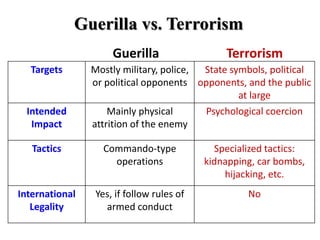
Guerilla vs. Terrorism
Targets Mostly military, police,
or political opponents
State symbols, political
opponents, and the public
at large
Intended
Impact
Mainly physical
attrition of the enemy
Psychological coercion
Tactics Commando-type
operations
Specialized tactics:
kidnapping, car bombs,
hijacking, etc.
International
Legality
Yes, if follow rules of
armed conduct
No
Guerilla Terrorism
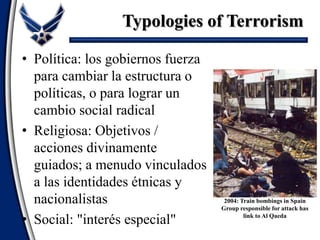
Typologies of Terrorism
• Política: los gobiernos fuerza
para cambiar la estructura o
políticas, o para lograr un
cambio social radical
• Religiosa: Objetivos /
acciones divinamente
guiados; a menudo vinculados
a las identidades étnicas y
nacionalistas
• Social: "interés especial"
2004: Train bombings in Spain
Group responsible for attack has
link to Al Qaeda
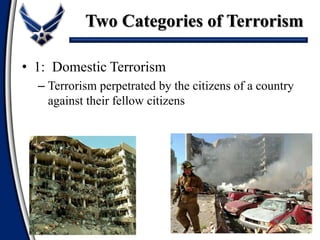
• 1: Domestic Terrorism
– Terrorism perpetrated by the citizens of a country
against their fellow citizens
Two Categories of Terrorism
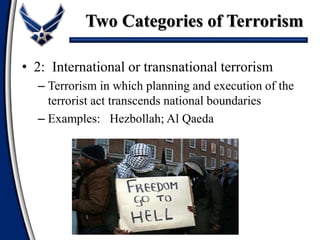
• 2: International or transnational terrorism
– Terrorism in which planning and execution of the
terrorist act transcends national boundaries
– Examples: Hezbollah; Al Qaeda
Two Categories of Terrorism
Characteristics
• Status: Most from middle class backgrounds,
with some from extreme wealth
• Education: Intelligent and literate, with
varying levels of formal education
• Age: Operational members aged between 20-
35, while suicide bombers tend to be younger
• Gender: Most are male but not exclusively
“There’s nothing wrong with being a terrorist, as long as you win.”
(Paul Watson, Sea Shepherd Conservation Society)
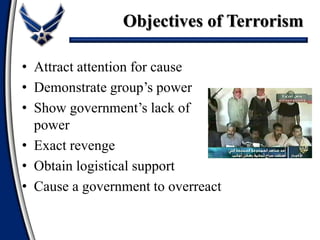
• Attract attention for cause
• Demonstrate group’s power
• Show government’s lack of
power
• Exact revenge
• Obtain logistical support
• Cause a government to overreact
Objectives of Terrorism
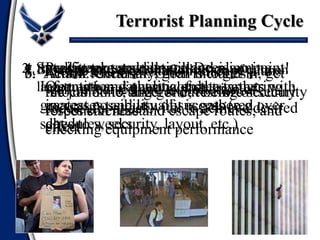
2. Intelligence and surveillance:
Information gathering on the targets with
greatest possibility of success (e.g.,
schedules, security, layout, etc.)
3. Specific target selection: Decision point!6. Action: Generally, goal is to get in, get
the job done, and get out before security
forces can react
1.Broad target selection: Collection of data on
large number of potential targets
7. Escape and exploitation: Escape plans
well rehearsed and exploitation of
successful attack vital to achieve desired
effect
4. Pre-attack surveillance and planning:
Quantity and quality of data gathering
increases, and usually is gathered over
days to weeks
5. Attack rehearsal: Often includes
relocation to target site, testing of security
responsiveness and escape routes, and
checking equipment performance
Terrorist Planning Cycle
Tactics
• Assassination
• Arson
• Bombing
• Hostage taking
• Kidnapping
• Hijacking
• Seizures
• Raids
• Sabotage
• Threat or Hoax
• Use of WMD
“Between now and 2015 terrorist tactics will become increasingly sophisticated and designed
to achieve mass casualties.” (National Intelligence Council)
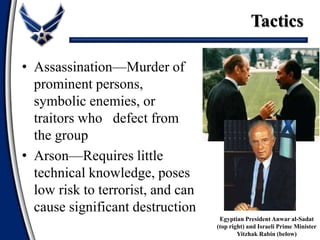
• Assassination—Murder of
prominent persons,
symbolic enemies, or
traitors who defect from
the group
• Arson—Requires little
technical knowledge, poses
low risk to terrorist, and can
cause significant destruction
Tactics
Egyptian President Anwar al-Sadat
(top right) and Israeli Prime Minister
Yitzhak Rabin (below)
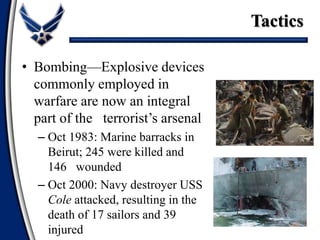
• Bombing—Explosive devices
commonly employed in
warfare are now an integral
part of the terrorist’s arsenal
– Oct 1983: Marine barracks in
Beirut; 245 were killed and
146 wounded
– Oct 2000: Navy destroyer USS
Cole attacked, resulting in the
death of 17 sailors and 39
injured
Tactics
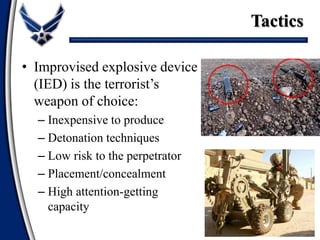
• Improvised explosive device
(IED) is the terrorist’s
weapon of choice:
– Inexpensive to produce
– Detonation techniques
– Low risk to the perpetrator
– Placement/concealment
– High attention-getting
capacity
Tactics
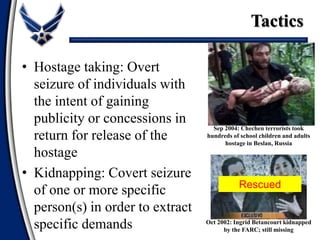
Sep 2004: Chechen terrorists took
hundreds of school children and adults
hostage in Beslan, Russia
Oct 2002: Ingrid Betancourt kidnapped
by the FARC; still missing
• Hostage taking: Overt
seizure of individuals with
the intent of gaining
publicity or concessions in
return for release of the
hostage
• Kidnapping: Covert seizure
of one or more specific
person(s) in order to extract
specific demands
Tactics
Rescued
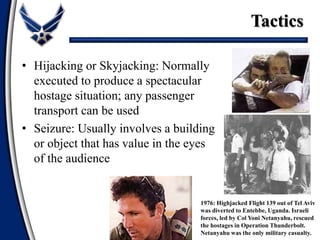
1976: Highjacked Flight 139 out of Tel Aviv
was diverted to Entebbe, Uganda. Israeli
forces, led by Col Yoni Netanyahu, rescued
the hostages in Operation Thunderbolt.
Netanyahu was the only military casualty.
• Hijacking or Skyjacking: Normally
executed to produce a spectacular
hostage situation; any passenger
transport can be used
• Seizure: Usually involves a building
or object that has value in the eyes
of the audience
Tactics
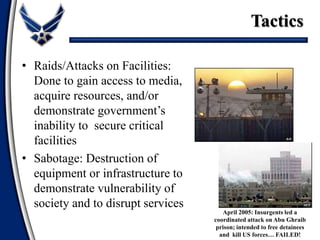
• Raids/Attacks on Facilities:
Done to gain access to media,
acquire resources, and/or
demonstrate government’s
inability to secure critical
facilities
• Sabotage: Destruction of
equipment or infrastructure to
demonstrate vulnerability of
society and to disrupt services
Tactics
April 2005: Insurgents led a
coordinated attack on Abu Ghraib
prison; intended to free detainees
and kill US forces… FAILED!
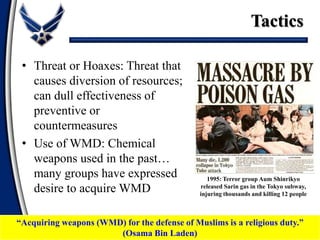
• Threat or Hoaxes: Threat that
causes diversion of resources;
can dull effectiveness of
preventive or
countermeasures
• Use of WMD: Chemical
weapons used in the past…
many groups have expressed
desire to acquire WMD
Tactics
1995: Terror group Aum Shinrikyo
released Sarin gas in the Tokyo subway,
injuring thousands and killing 12 people
“Acquiring weapons (WMD) for the defense of Muslims is a religious duty.”
(Osama Bin Laden)
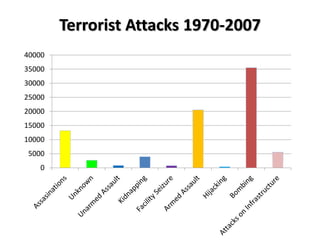
0
5000
10000
15000
20000
25000
30000
35000
40000
Terrorist Attacks 1970-2007
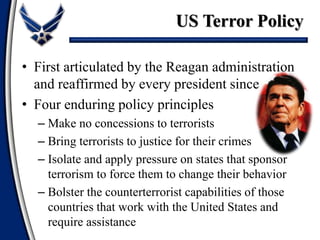
• First articulated by the Reagan administration
and reaffirmed by every president since
• Four enduring policy principles
– Make no concessions to terrorists
– Bring terrorists to justice for their crimes
– Isolate and apply pressure on states that sponsor
terrorism to force them to change their behavior
– Bolster the counterterrorist capabilities of those
countries that work with the United States and
require assistance
US Terror Policy
• Advance effective democracies as the long-term antidote
to the ideology of terrorism;
• Prevent attacks by terrorist networks;
• Deny weapons of mass destruction to rogue states and
terrorist allies who seek to use them;
• Deny terrorists the support and sanctuary of rogue states;
• Deny terrorists control of any nation they would use as a
base and launching pad for terror; and
• Lay the foundations and build the institutions and
structures we need to carry the fight forward against terror
and help ensure our ultimate success.
National Strategy for
Combating Terrorism
• Dept. of Homeland Security established: Third
largest cabinet department after DOD and VA
• Incorporates existing agencies, including US
Coast Guard, Secret Service, and Citizenship
and Immigration Service (CIS)
• Coordinates capabilities of 22+ agencies to:
– Secure borders, transportation, critical
infrastructure
– Synthesize/analyze homeland security intelligence
– Spearheads domestic counter-terrorism efforts
US Policy Post 9/11
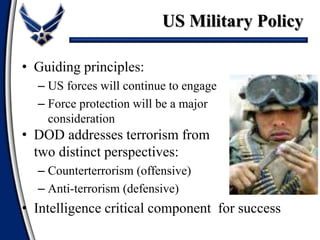
• Guiding principles:
– US forces will continue to engage
– Force protection will be a major
consideration
• DOD addresses terrorism from
two distinct perspectives:
– Counterterrorism (offensive)
– Anti-terrorism (defensive)
• Intelligence critical component for success
US Military Policy
• Counterterrorism
– Offensive measures taken to prevent, deter, and
respond to terrorism include Operation El Dorado
Canyon and the GWOT
• Antiterrorism
– Defensive measures to reduce vulnerability include
facility hardening, setting buildings back from
roads/parking lots, and limiting access to military
posts
US Military Policy
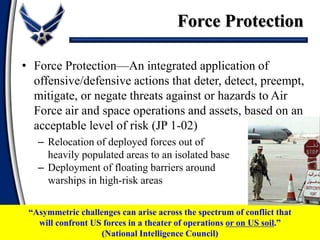
• Force Protection—An integrated application of
offensive/defensive actions that deter, detect, preempt,
mitigate, or negate threats against or hazards to Air
Force air and space operations and assets, based on an
acceptable level of risk (JP 1-02)
– Relocation of deployed forces out of
heavily populated areas to an isolated base
– Deployment of floating barriers around
warships in high-risk areas
Force Protection
“Asymmetric challenges can arise across the spectrum of conflict that
will confront US forces in a theater of operations or on US soil.”
(National Intelligence Council)
• Terrorists are a dynamic enemy…and are
adapting to the challenges posed by developing
societies
• Groups like Al Qaeda and Hezbollah benefit
from and are exploiting globalization, even as
they fight against it
• Terrorist groups are becoming more network
based, encouraging loosely organized, self-
financed organizational structure
Future of Terrorism
• International or transnational cooperation
among terrorist groups is becoming the norm
• WMD proliferation amplifies the danger of
broad, network-based terrorism.
• Terrorists increasingly display a willingness to
use catastrophic violence to cause mass
casualties and destruction
Future of Terrorism
• Other trends:
– Intense motivational extremism
– Flexible organization structure
– Aggressive training to improve operational
capability
– Increasing exploitation of media
– Increasing mass casualties and chaos through use
of more advanced weapons
Future of Terrorism
“States with poor governance; ethnic, cultural, or religious tensions; weak
economies; and porous borders will be prime breeding grounds for terrorism.”
(National Intelligence Council)
• History
• Definitions
• Characteristics, Objectives, & Tactics
• US National Policy and Military Policy
• Future of Terrorism
Summary
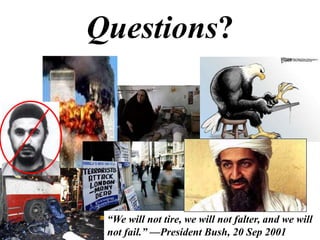
Questions?
“We will not tire, we will not falter, and we will
not fail.” —President Bush, 20 Sep 2001

Terrorismo 12

  • 1.
  • 2.
    El 11 deseptiembre, enemigos de la libertad cometieron un acto de guerra contra nuestro país ... O están con nosotros o están con los terroristas. ~ President George W. Bush, 20 Sep 2001 "... El pueblo estadounidense debe permanecer vigilante .... Aquellos conspirar contra nosotros buscamos no sólo para socavar nuestra seguridad, sino también la sociedad abierta y los valores que apreciamos como estadounidenses. ~ President Barack Obama, 28 Dec 2009
  • 3.
    • Historia • definiciones •Las características, objetivos, y Tácticas • Política Nacional de Estados Unidos y Política Militar Futuro del terrorismo Overview
  • 4.
    • El terrorismopara lograr agendas políticas no es nuevo disidentes judíos se opusieron a la dominación romana (48 C. E.) secta islámica llamada Hashshashin seguido la "causas justas" Cruzados emplea la violación como táctica de terror Hassan-i Sabbah, Iranian missionary who founded the Hashshashin History
  • 5.
    • Desde 1990,el fundamentalismo religioso surgió como fuerza primaria para el terror • La proliferación de armas redujo la brecha entre el poder de fuego del estado y de los disidentes History Radical Shiite Muqtada al-Sadr
  • 6.
    • Walter Laqueur:"El terrorismo constituye el uso ilegítimo de la fuerza para alcanzar un objetivo político cuando las personas inocentes están dirigidos." • Departamento de Defensa: "El uso ilegal o amenaza de uso de fuerza o violencia contra las personas o la propiedad de coaccionar o intimidar a gobiernos o sociedades, a menudo para conseguir objetivos políticos, religiosos o ideológicos." Definitions
  • 7.
    Joint Pub. 3-07.2 Eluso ilegal de la violencia o la amenaza de violencia para infundir miedo y coaccionar a los gobiernos o sociedades. El terrorismo es a menudo motivado por creencias ideológicas religiosas, políticas o de otro tipo y comprometido en la búsqueda de objetivos que son generalmente de carácter político. - Joint Publication 3-07.2, Antiterrorism
  • 8.
    • Violencia • objetivopolítico • impacto psicológico y el miedo • La orientación de los no combatientes • Guerra de guerrillas ......? Key Criteria
  • 9.
    Guerilla vs. Terrorism TargetsMostly military, police, or political opponents State symbols, political opponents, and the public at large Intended Impact Mainly physical attrition of the enemy Psychological coercion Tactics Commando-type operations Specialized tactics: kidnapping, car bombs, hijacking, etc. International Legality Yes, if follow rules of armed conduct No Guerilla Terrorism
  • 10.
    Typologies of Terrorism •Política: los gobiernos fuerza para cambiar la estructura o políticas, o para lograr un cambio social radical • Religiosa: Objetivos / acciones divinamente guiados; a menudo vinculados a las identidades étnicas y nacionalistas • Social: "interés especial" 2004: Train bombings in Spain Group responsible for attack has link to Al Qaeda
  • 11.
    • 1: DomesticTerrorism – Terrorism perpetrated by the citizens of a country against their fellow citizens Two Categories of Terrorism
  • 12.
    • 2: Internationalor transnational terrorism – Terrorism in which planning and execution of the terrorist act transcends national boundaries – Examples: Hezbollah; Al Qaeda Two Categories of Terrorism
  • 13.
    Characteristics • Status: Mostfrom middle class backgrounds, with some from extreme wealth • Education: Intelligent and literate, with varying levels of formal education • Age: Operational members aged between 20- 35, while suicide bombers tend to be younger • Gender: Most are male but not exclusively “There’s nothing wrong with being a terrorist, as long as you win.” (Paul Watson, Sea Shepherd Conservation Society)
  • 14.
    • Attract attentionfor cause • Demonstrate group’s power • Show government’s lack of power • Exact revenge • Obtain logistical support • Cause a government to overreact Objectives of Terrorism
  • 15.
    2. Intelligence andsurveillance: Information gathering on the targets with greatest possibility of success (e.g., schedules, security, layout, etc.) 3. Specific target selection: Decision point!6. Action: Generally, goal is to get in, get the job done, and get out before security forces can react 1.Broad target selection: Collection of data on large number of potential targets 7. Escape and exploitation: Escape plans well rehearsed and exploitation of successful attack vital to achieve desired effect 4. Pre-attack surveillance and planning: Quantity and quality of data gathering increases, and usually is gathered over days to weeks 5. Attack rehearsal: Often includes relocation to target site, testing of security responsiveness and escape routes, and checking equipment performance Terrorist Planning Cycle
  • 16.
    Tactics • Assassination • Arson •Bombing • Hostage taking • Kidnapping • Hijacking • Seizures • Raids • Sabotage • Threat or Hoax • Use of WMD “Between now and 2015 terrorist tactics will become increasingly sophisticated and designed to achieve mass casualties.” (National Intelligence Council)
  • 17.
    • Assassination—Murder of prominentpersons, symbolic enemies, or traitors who defect from the group • Arson—Requires little technical knowledge, poses low risk to terrorist, and can cause significant destruction Tactics Egyptian President Anwar al-Sadat (top right) and Israeli Prime Minister Yitzhak Rabin (below)
  • 18.
    • Bombing—Explosive devices commonlyemployed in warfare are now an integral part of the terrorist’s arsenal – Oct 1983: Marine barracks in Beirut; 245 were killed and 146 wounded – Oct 2000: Navy destroyer USS Cole attacked, resulting in the death of 17 sailors and 39 injured Tactics
  • 19.
    • Improvised explosivedevice (IED) is the terrorist’s weapon of choice: – Inexpensive to produce – Detonation techniques – Low risk to the perpetrator – Placement/concealment – High attention-getting capacity Tactics
  • 20.
    Sep 2004: Chechenterrorists took hundreds of school children and adults hostage in Beslan, Russia Oct 2002: Ingrid Betancourt kidnapped by the FARC; still missing • Hostage taking: Overt seizure of individuals with the intent of gaining publicity or concessions in return for release of the hostage • Kidnapping: Covert seizure of one or more specific person(s) in order to extract specific demands Tactics Rescued
  • 21.
    1976: Highjacked Flight139 out of Tel Aviv was diverted to Entebbe, Uganda. Israeli forces, led by Col Yoni Netanyahu, rescued the hostages in Operation Thunderbolt. Netanyahu was the only military casualty. • Hijacking or Skyjacking: Normally executed to produce a spectacular hostage situation; any passenger transport can be used • Seizure: Usually involves a building or object that has value in the eyes of the audience Tactics
  • 22.
    • Raids/Attacks onFacilities: Done to gain access to media, acquire resources, and/or demonstrate government’s inability to secure critical facilities • Sabotage: Destruction of equipment or infrastructure to demonstrate vulnerability of society and to disrupt services Tactics April 2005: Insurgents led a coordinated attack on Abu Ghraib prison; intended to free detainees and kill US forces… FAILED!
  • 23.
    • Threat orHoaxes: Threat that causes diversion of resources; can dull effectiveness of preventive or countermeasures • Use of WMD: Chemical weapons used in the past… many groups have expressed desire to acquire WMD Tactics 1995: Terror group Aum Shinrikyo released Sarin gas in the Tokyo subway, injuring thousands and killing 12 people “Acquiring weapons (WMD) for the defense of Muslims is a religious duty.” (Osama Bin Laden)
  • 24.
  • 25.
    • First articulatedby the Reagan administration and reaffirmed by every president since • Four enduring policy principles – Make no concessions to terrorists – Bring terrorists to justice for their crimes – Isolate and apply pressure on states that sponsor terrorism to force them to change their behavior – Bolster the counterterrorist capabilities of those countries that work with the United States and require assistance US Terror Policy
  • 26.
    • Advance effectivedemocracies as the long-term antidote to the ideology of terrorism; • Prevent attacks by terrorist networks; • Deny weapons of mass destruction to rogue states and terrorist allies who seek to use them; • Deny terrorists the support and sanctuary of rogue states; • Deny terrorists control of any nation they would use as a base and launching pad for terror; and • Lay the foundations and build the institutions and structures we need to carry the fight forward against terror and help ensure our ultimate success. National Strategy for Combating Terrorism
  • 27.
    • Dept. ofHomeland Security established: Third largest cabinet department after DOD and VA • Incorporates existing agencies, including US Coast Guard, Secret Service, and Citizenship and Immigration Service (CIS) • Coordinates capabilities of 22+ agencies to: – Secure borders, transportation, critical infrastructure – Synthesize/analyze homeland security intelligence – Spearheads domestic counter-terrorism efforts US Policy Post 9/11
  • 28.
    • Guiding principles: –US forces will continue to engage – Force protection will be a major consideration • DOD addresses terrorism from two distinct perspectives: – Counterterrorism (offensive) – Anti-terrorism (defensive) • Intelligence critical component for success US Military Policy
  • 29.
    • Counterterrorism – Offensivemeasures taken to prevent, deter, and respond to terrorism include Operation El Dorado Canyon and the GWOT • Antiterrorism – Defensive measures to reduce vulnerability include facility hardening, setting buildings back from roads/parking lots, and limiting access to military posts US Military Policy
  • 30.
    • Force Protection—Anintegrated application of offensive/defensive actions that deter, detect, preempt, mitigate, or negate threats against or hazards to Air Force air and space operations and assets, based on an acceptable level of risk (JP 1-02) – Relocation of deployed forces out of heavily populated areas to an isolated base – Deployment of floating barriers around warships in high-risk areas Force Protection “Asymmetric challenges can arise across the spectrum of conflict that will confront US forces in a theater of operations or on US soil.” (National Intelligence Council)
  • 31.
    • Terrorists area dynamic enemy…and are adapting to the challenges posed by developing societies • Groups like Al Qaeda and Hezbollah benefit from and are exploiting globalization, even as they fight against it • Terrorist groups are becoming more network based, encouraging loosely organized, self- financed organizational structure Future of Terrorism
  • 32.
    • International ortransnational cooperation among terrorist groups is becoming the norm • WMD proliferation amplifies the danger of broad, network-based terrorism. • Terrorists increasingly display a willingness to use catastrophic violence to cause mass casualties and destruction Future of Terrorism
  • 33.
    • Other trends: –Intense motivational extremism – Flexible organization structure – Aggressive training to improve operational capability – Increasing exploitation of media – Increasing mass casualties and chaos through use of more advanced weapons Future of Terrorism “States with poor governance; ethnic, cultural, or religious tensions; weak economies; and porous borders will be prime breeding grounds for terrorism.” (National Intelligence Council)
  • 34.
    • History • Definitions •Characteristics, Objectives, & Tactics • US National Policy and Military Policy • Future of Terrorism Summary
  • 35.
    Questions? “We will nottire, we will not falter, and we will not fail.” —President Bush, 20 Sep 2001