Sir Michael Angel S. Sajot
Grade VI
Invertebrates are animals that do not have bones. They
comprise of 95% of all animals on Earth having almost 2
million species to date.
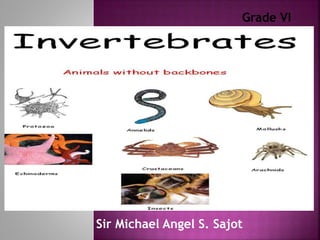
Invertebrates are divided into 6 major groups: Poriferans,
Cnidarians, Echinoderms, Mollusks, Worms and Arthropods.
Some invertebrates have an EXOSKELET ON. It serves as
protection and for muscle support and also prevent water loss.
Soft-bodied invertebrates maintain their body integrity by
maintaining their internal pressure.
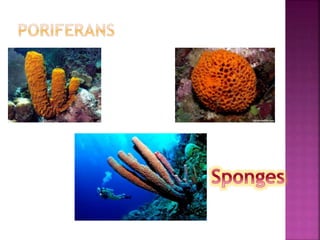
Porifera was derived from a Latin word that means
“pore bearer”. This group of invertebrates has no
definite body symmetry. They can reproduce
sexually and asexually.
Sponges can regenerate lost parts.
Regeneration is the ability to grow missing parts.
Lacking a skeleton, sponges are supported instead
by protein fibers called spongin and by hard
particles made up of calcium carbonate called
spicules.
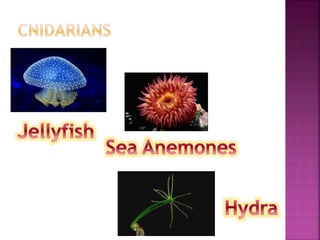
This group is composed of jellyfish, sea anemones,
corals hydras, sea whips, sea fans, and sea
pansies. They are characterized as soft-bodied
animals with hollow central cavity.
The two basic shapes of cnidarians are: Polyp,
which is cylinder-shaped or vase-shaped and
Medusa, umbrella-shaped with stinging tentacles.
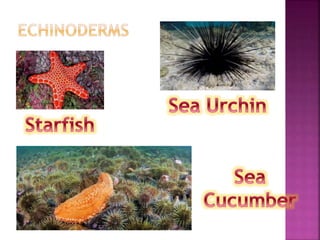
An echinoderm is a marine invertebrate
characterized by spiny skin, an exoskeleton, radial
symmetry and a water vascular system. Its name is
derived from the Greek term for porcupine and
hedgehog.
They have a tube-feet with suction pads located
on their tentacles. The tube-foot is connected to
the ampullae, which is a muscular sac that forces
water into the tube-foot
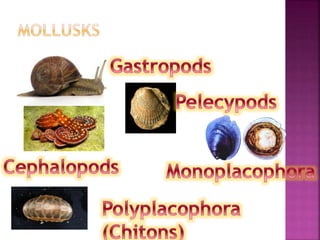
Mollusks are soft-bodied invertebrates that are
often covered or protected by a hard shell. There
are approximately 85 000 known species of
mollusks to date.
It is composed of snails, slugs, clams, scallops,
octopuses, and squids.
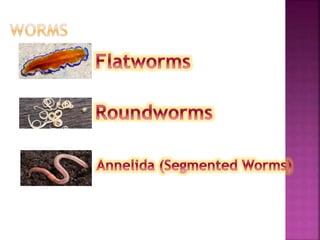
Worms are invertebrates that can be found almost
everywhere. They can be found in marine,
freshwater, and land habitats.
Most worms are scavengers or oftentimes called
decomposers, responsible for breaking down
complex chemical bonds into their original form so
they can be absorbed by plants.
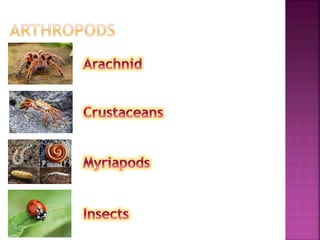
Arthropods are the largest and most diverse
invertebrate group. It is represented by spiders,
crabs, scorpions, lobsters, beetles, bees,
caterpillars, fleas, ticks, mites and lice.
They have segmented bodies covered by an
external skeleton called exoskeleton which is
composed of chitin, a tough material.
Invertebrates

Invertebrates

  • 1.
    Sir Michael AngelS. Sajot Grade VI
  • 2.
    Invertebrates are animalsthat do not have bones. They comprise of 95% of all animals on Earth having almost 2 million species to date. Invertebrates are divided into 6 major groups: Poriferans, Cnidarians, Echinoderms, Mollusks, Worms and Arthropods. Some invertebrates have an EXOSKELET ON. It serves as protection and for muscle support and also prevent water loss. Soft-bodied invertebrates maintain their body integrity by maintaining their internal pressure.
  • 3.
    Porifera was derivedfrom a Latin word that means “pore bearer”. This group of invertebrates has no definite body symmetry. They can reproduce sexually and asexually. Sponges can regenerate lost parts. Regeneration is the ability to grow missing parts. Lacking a skeleton, sponges are supported instead by protein fibers called spongin and by hard particles made up of calcium carbonate called spicules.
  • 5.
    This group iscomposed of jellyfish, sea anemones, corals hydras, sea whips, sea fans, and sea pansies. They are characterized as soft-bodied animals with hollow central cavity. The two basic shapes of cnidarians are: Polyp, which is cylinder-shaped or vase-shaped and Medusa, umbrella-shaped with stinging tentacles.
  • 7.
    An echinoderm isa marine invertebrate characterized by spiny skin, an exoskeleton, radial symmetry and a water vascular system. Its name is derived from the Greek term for porcupine and hedgehog. They have a tube-feet with suction pads located on their tentacles. The tube-foot is connected to the ampullae, which is a muscular sac that forces water into the tube-foot
  • 9.
    Mollusks are soft-bodiedinvertebrates that are often covered or protected by a hard shell. There are approximately 85 000 known species of mollusks to date. It is composed of snails, slugs, clams, scallops, octopuses, and squids.
  • 11.
    Worms are invertebratesthat can be found almost everywhere. They can be found in marine, freshwater, and land habitats. Most worms are scavengers or oftentimes called decomposers, responsible for breaking down complex chemical bonds into their original form so they can be absorbed by plants.
  • 13.
    Arthropods are thelargest and most diverse invertebrate group. It is represented by spiders, crabs, scorpions, lobsters, beetles, bees, caterpillars, fleas, ticks, mites and lice. They have segmented bodies covered by an external skeleton called exoskeleton which is composed of chitin, a tough material.