People from U.S People from Africa
People from Philippines
People from China
As we know that people from different region of
world shows different characteristics such as
physical appearance , language , height etc.
It’s similar with plants as well
Let’s find out
“Plants grow in most places on the earth”
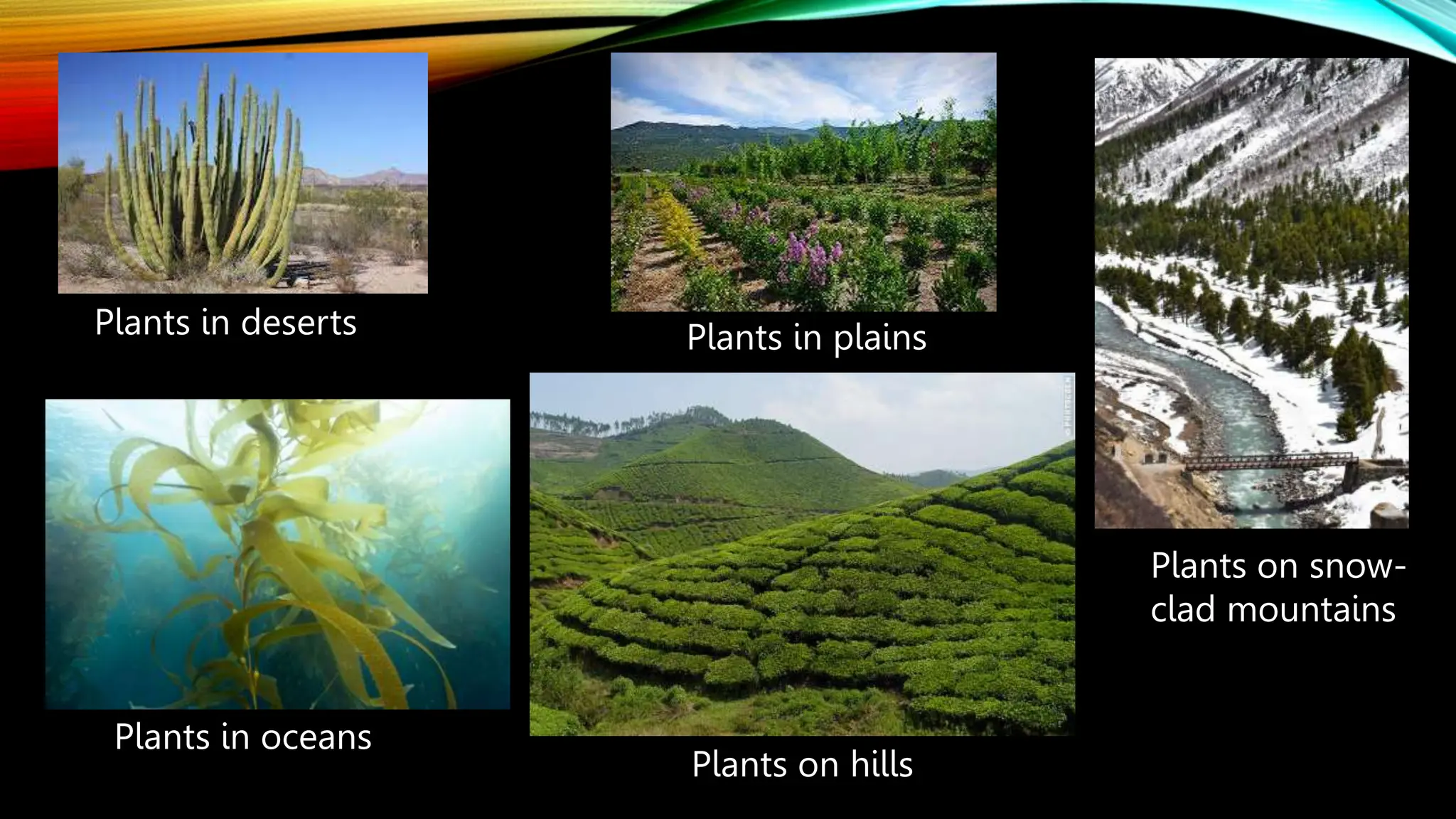
Plants in plains
Plants on hills
Plants on snow-
clad mountains
Plants in oceans
Plants in deserts
Find out what is the difference
between group ‘A’ plants and group
‘B’ plants
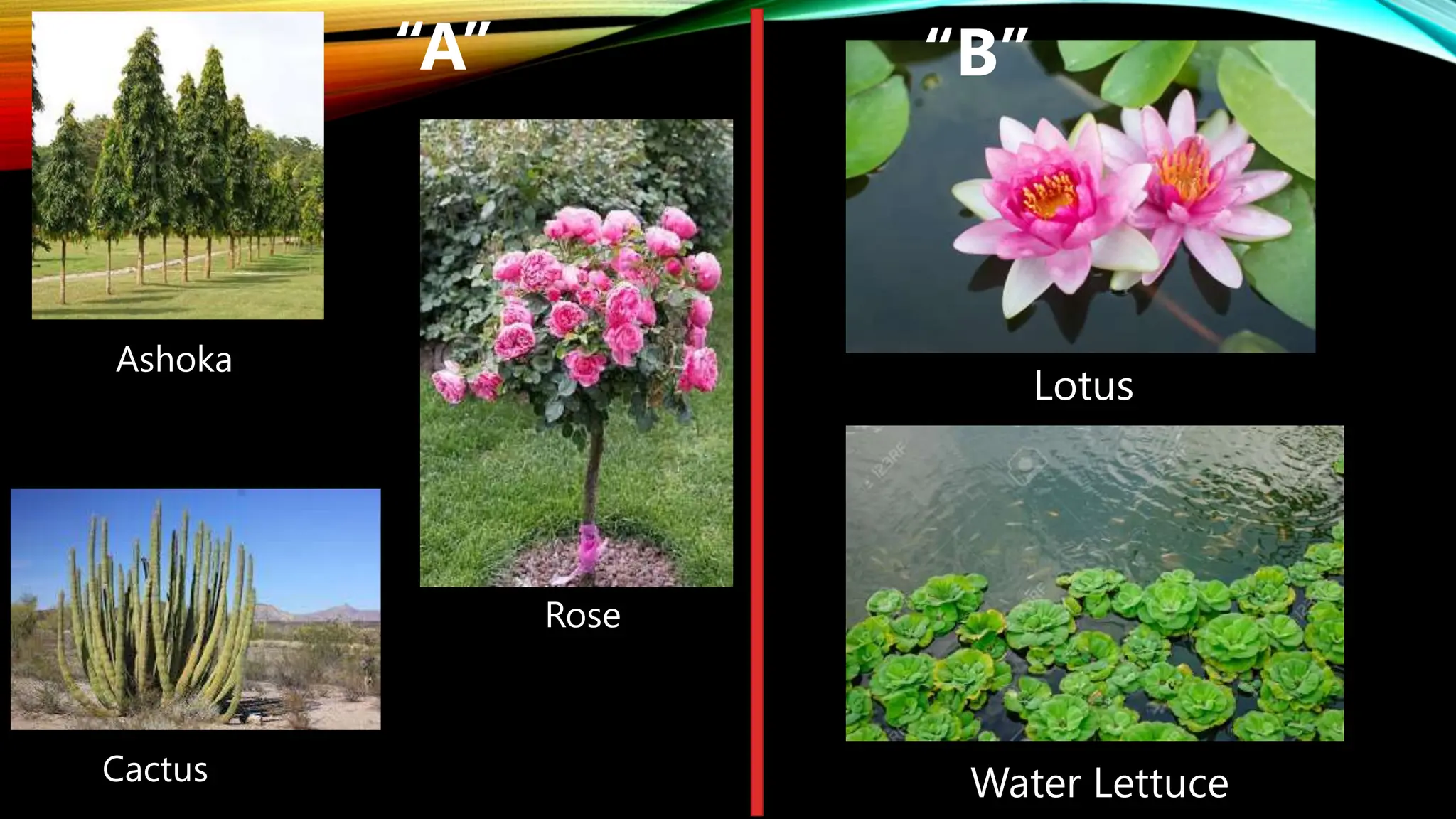
Ashoka
Cactus
Rose
Lotus
Water Lettuce
“B”
“A”
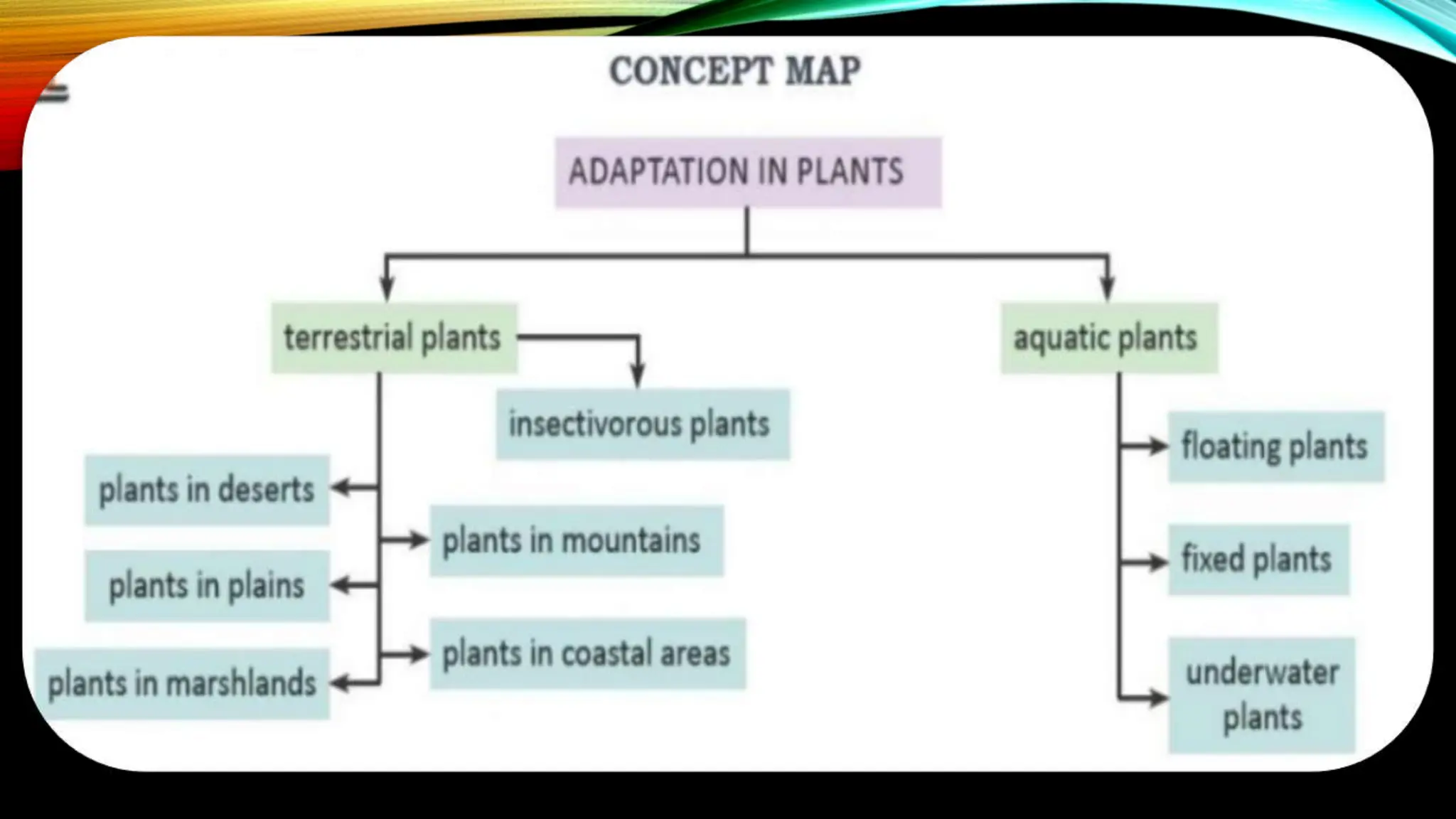
WE CAN BROADLY DIVIDE PLANTS INTO TWO
GROUPS
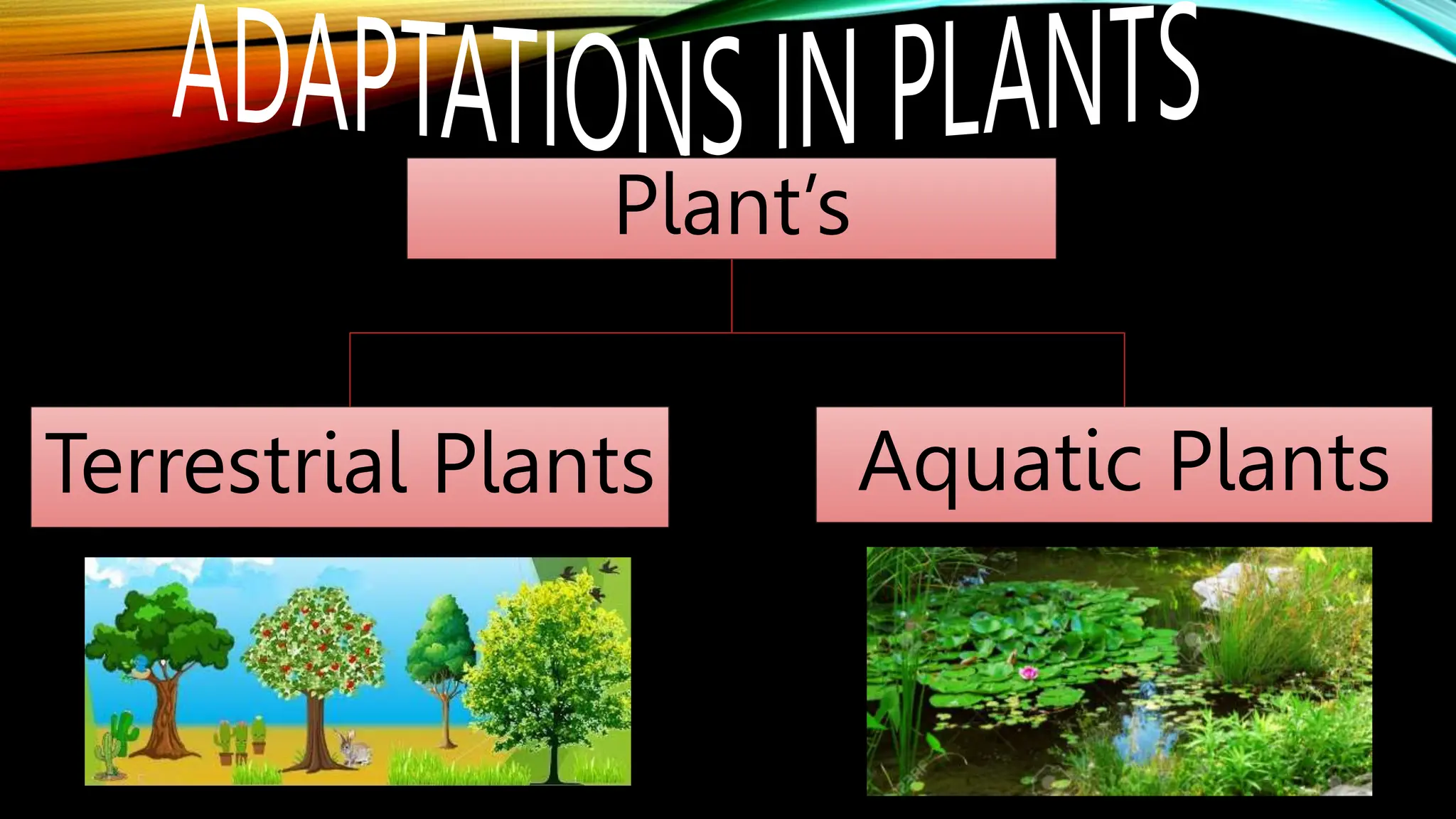
1) TERRESTRIAL PLANTS – PLANTS THAT GROW ON
LAND
2) AQUATIC PLANTS- PLANTS THAT GROW IN
WATER
Lets take an example and understand
“what is Habitat”
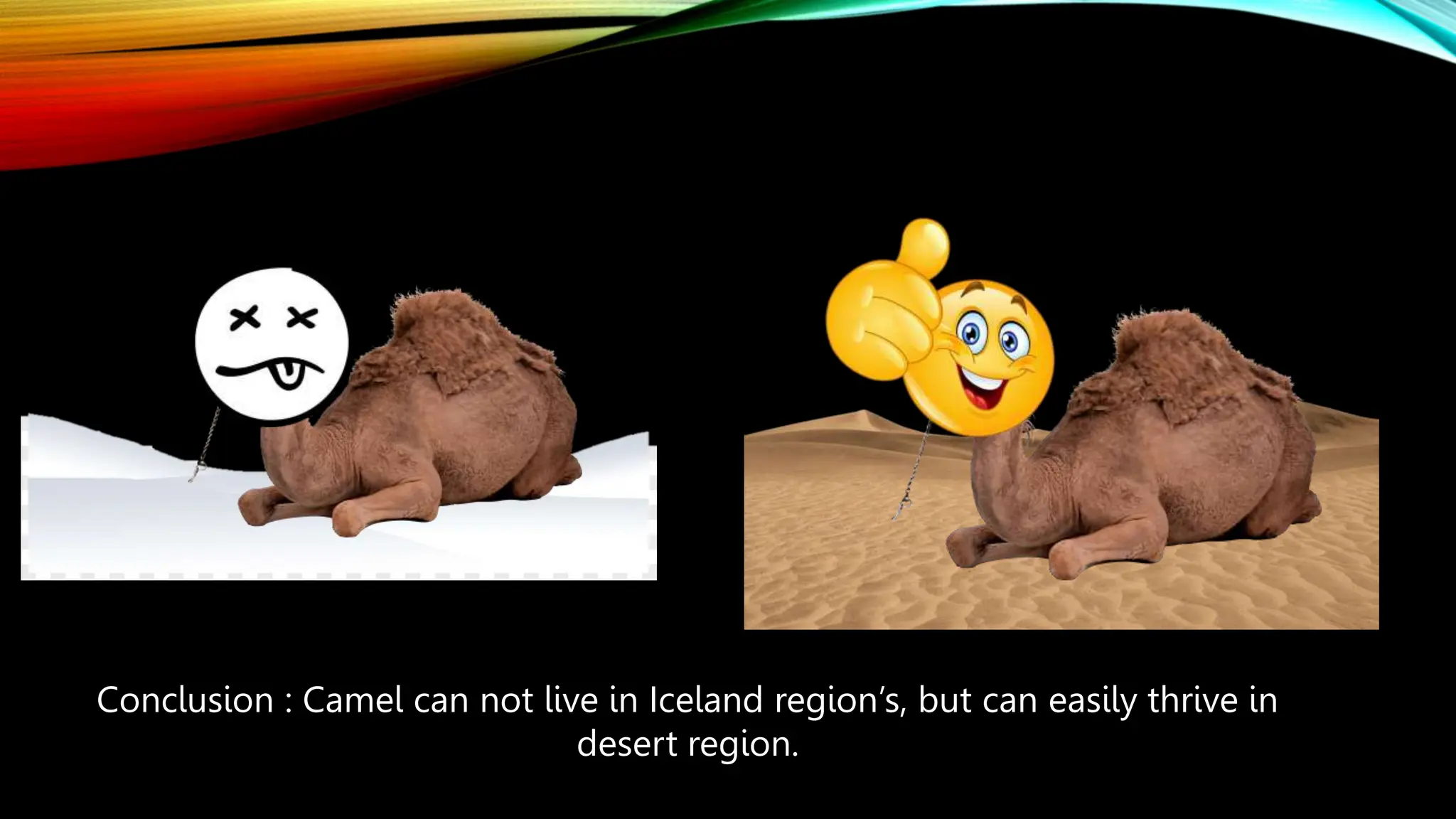
Conclusion : Camel can not live in Iceland region’s, but can easily thrive in
desert region.
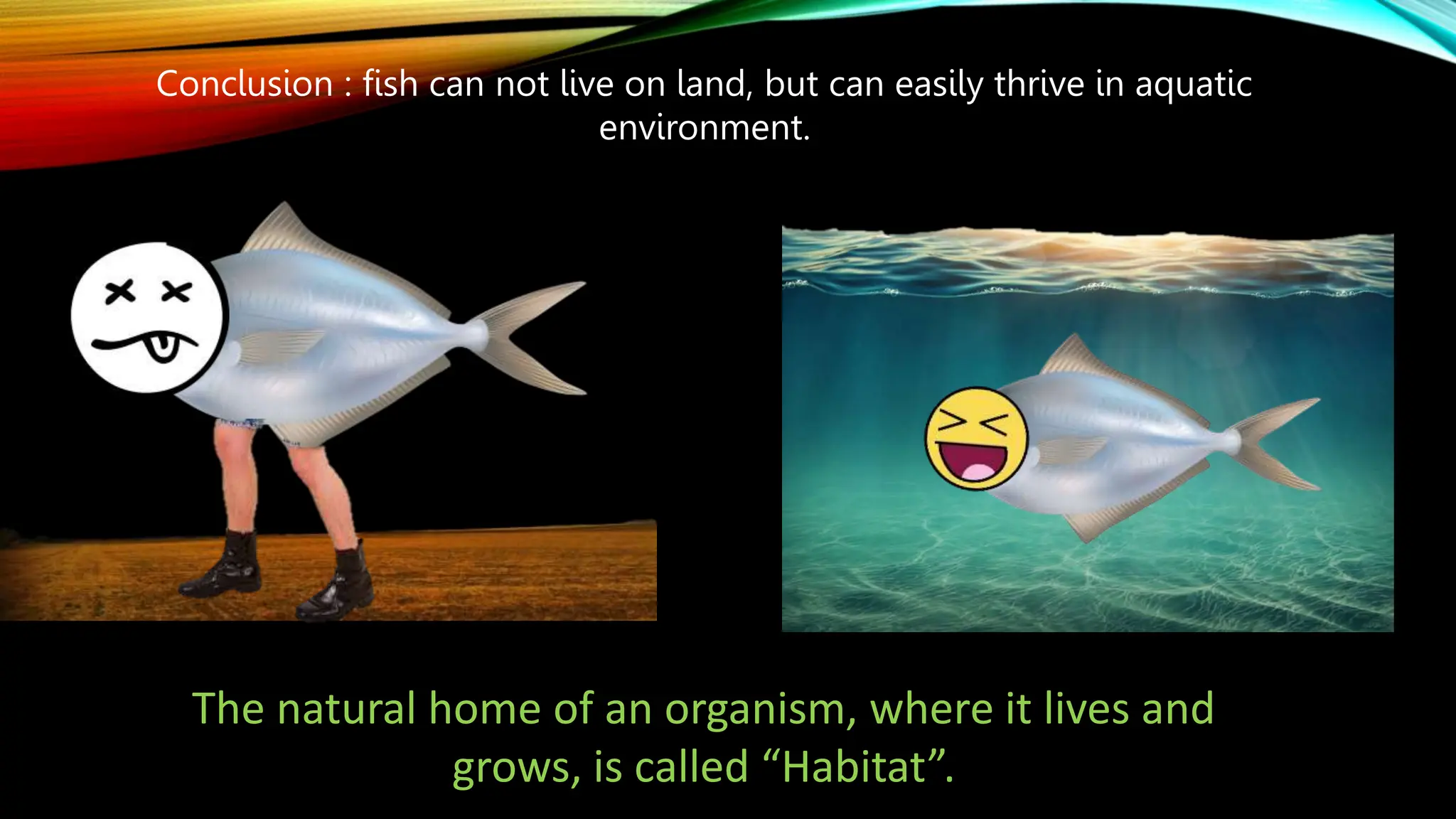
The natural home of an organism, where it lives and
grows, is called “Habitat”.
Conclusion : fish can not live on land, but can easily thrive in aquatic
environment.
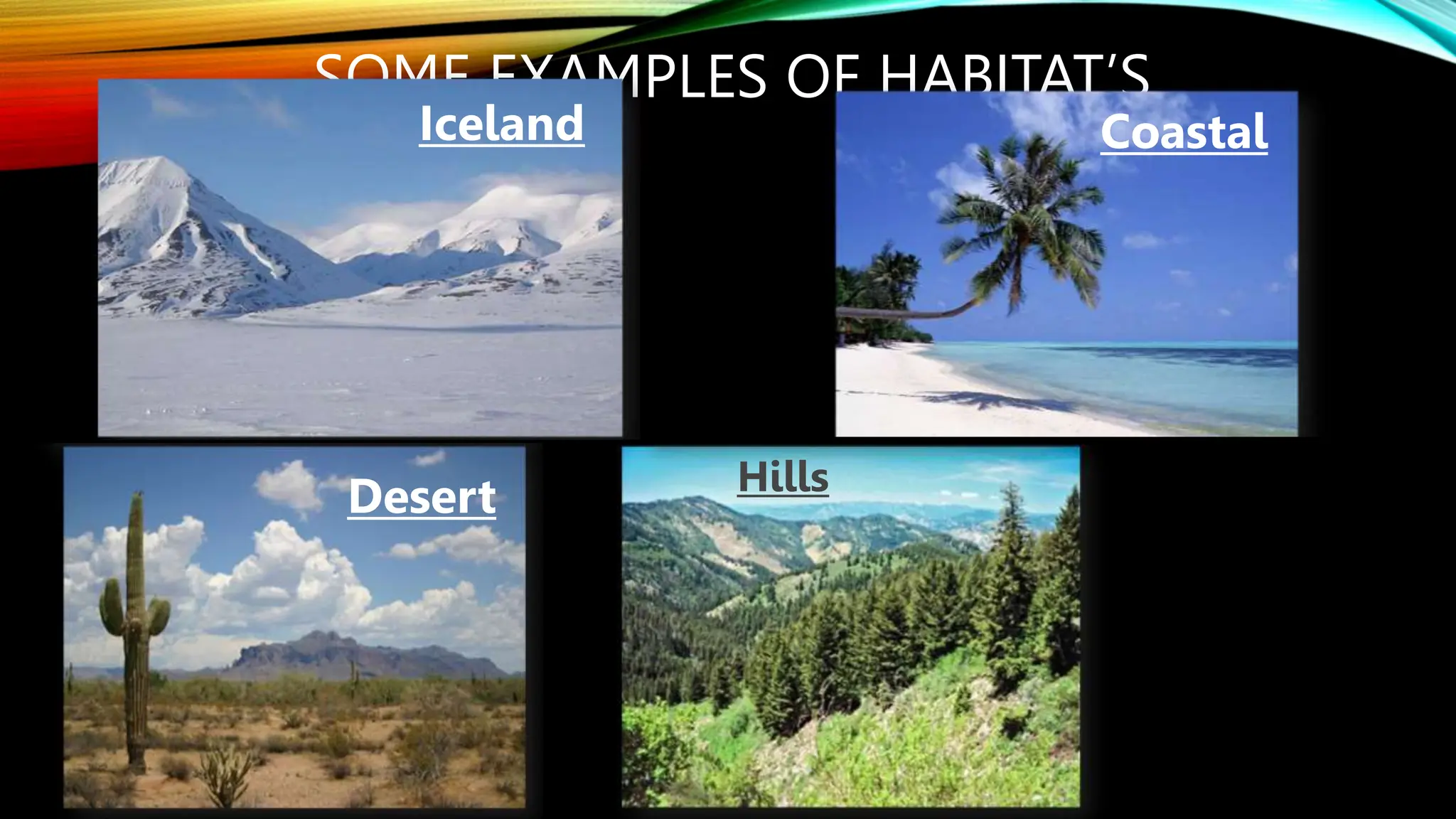
SOME EXAMPLES OF HABITAT’S
Desert
Iceland Coastal
Hills
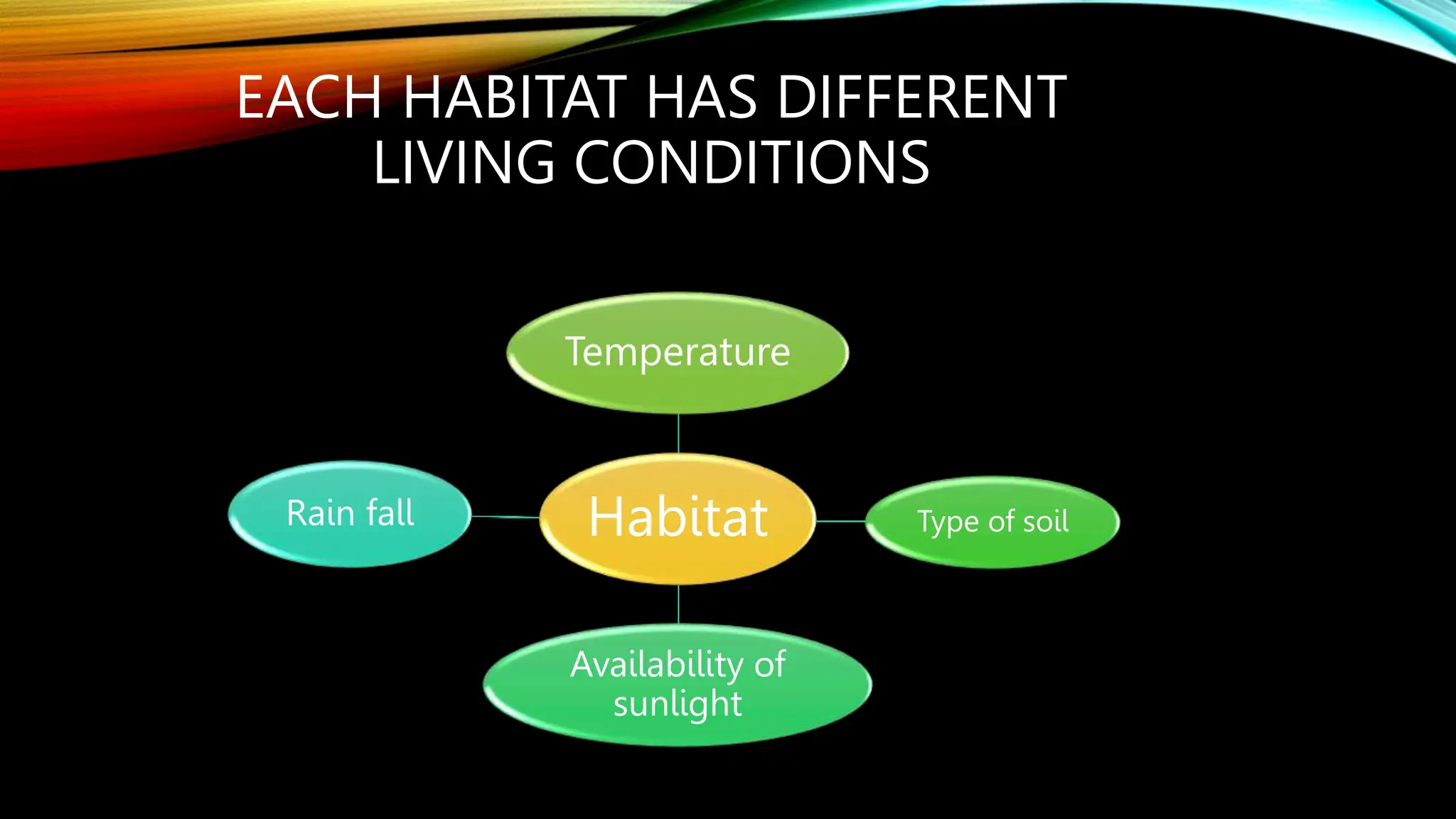
EACH HABITAT HAS DIFFERENT
LIVING CONDITIONS
Habitat
Temperature
Type of soil
Availability of
sunlight
Rain fall
LIVING THINGS HAVE SPECIAL
CHARACTERISTICS OR FEATURES
CALLED “ADAPTATIONS”
ADAPTATION
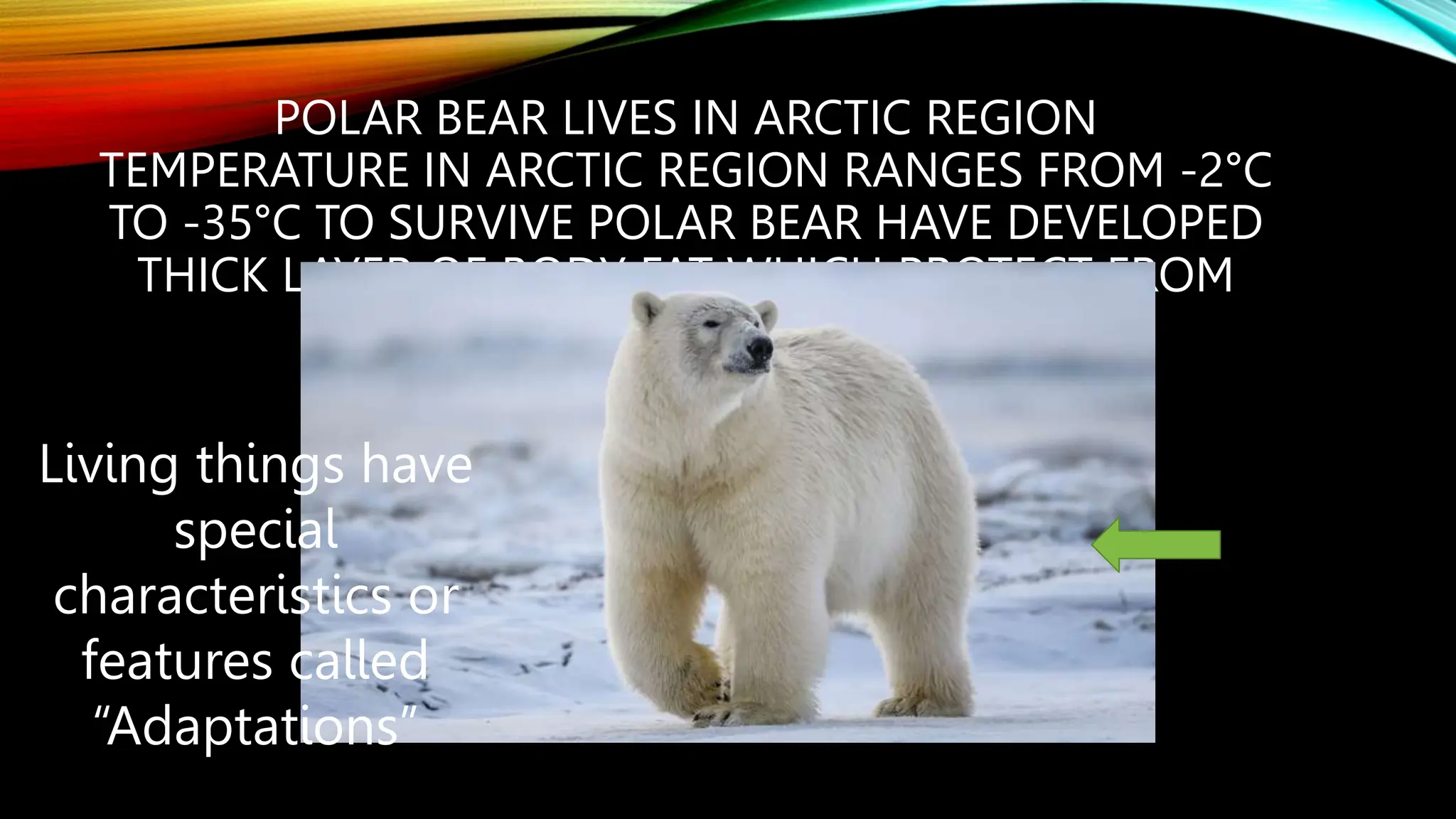
POLAR BEAR LIVES IN ARCTIC REGION
TEMPERATURE IN ARCTIC REGION RANGES FROM -2°C
TO -35°C TO SURVIVE POLAR BEAR HAVE DEVELOPED
THICK LAYER OF BODY FAT WHICH PROTECT FROM
SUCH LOW TEMPERATURES.
Thick layer
of skin
Living things have
special
characteristics or
features called
“Adaptations”
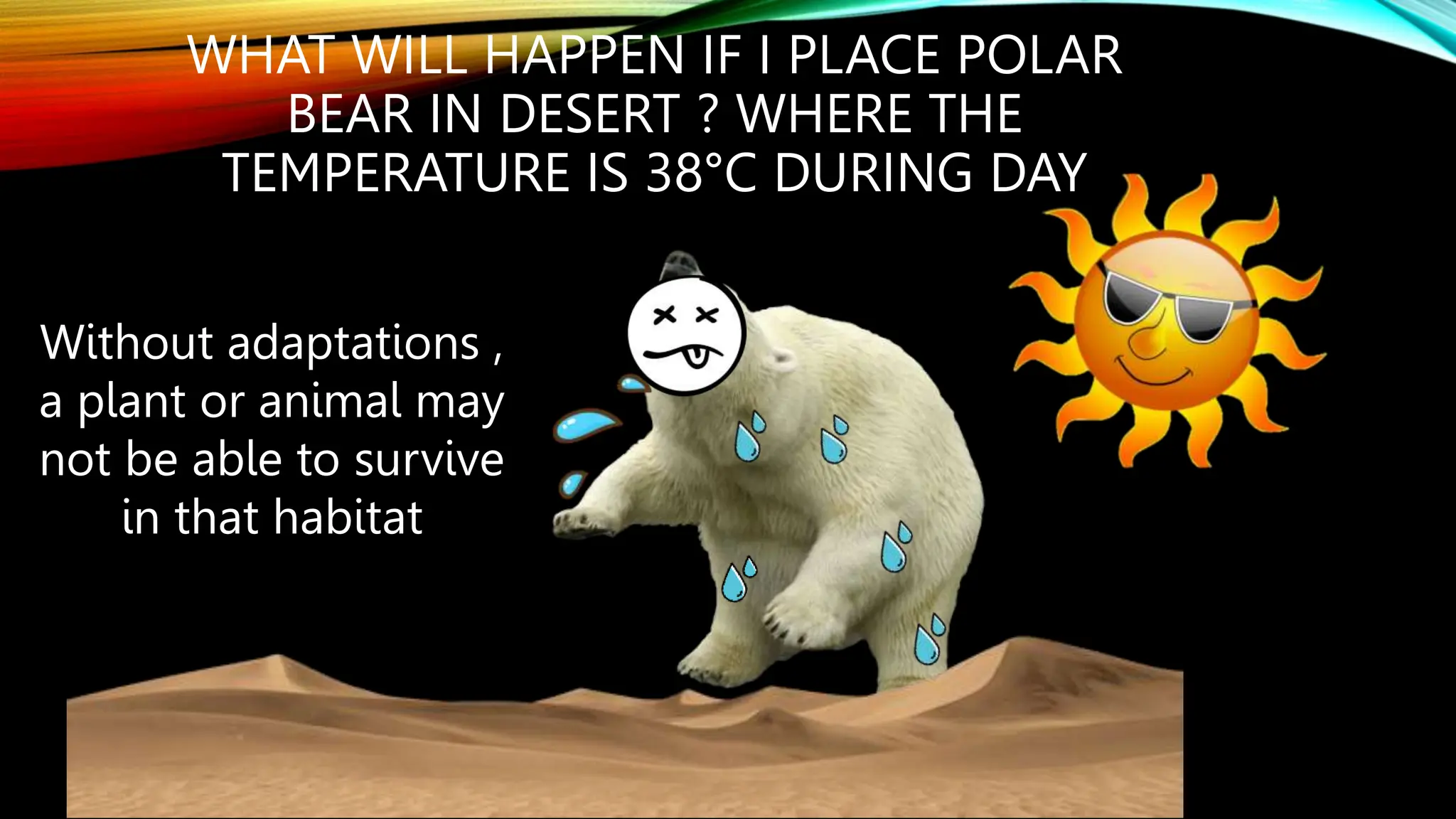
WHAT WILL HAPPEN IF I PLACE POLAR
BEAR IN DESERT ? WHERE THE
TEMPERATURE IS 38°C DURING DAY
Without adaptations ,
a plant or animal may
not be able to survive
in that habitat
Plant’s
Terrestrial Plants Aquatic Plants
ADAPTATION IN TERRESTRIAL PLANTS
( PLANTS ON LAND )
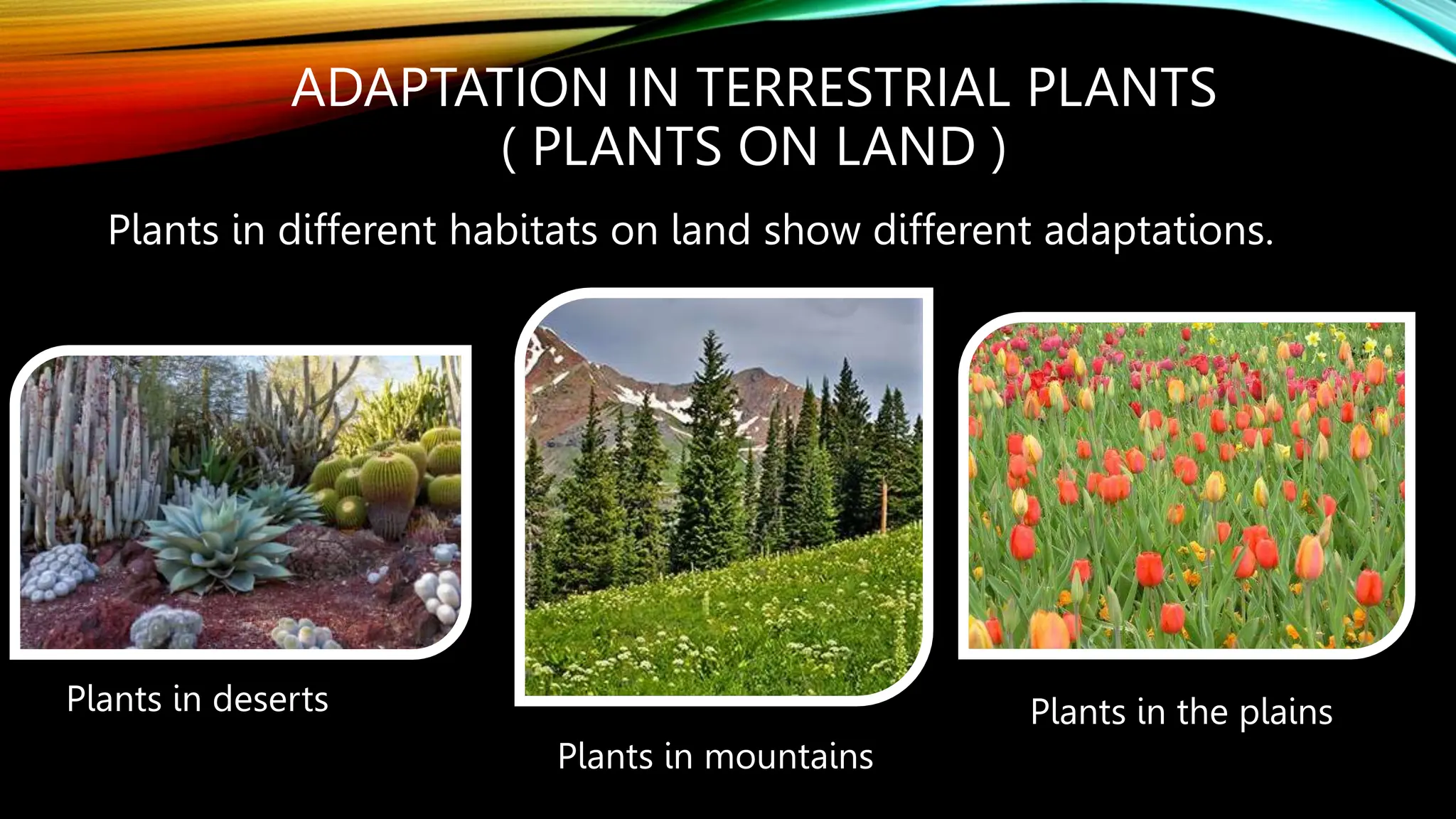
Plants in different habitats on land show different adaptations.
Plants in deserts
Plants in mountains
Plants in the plains
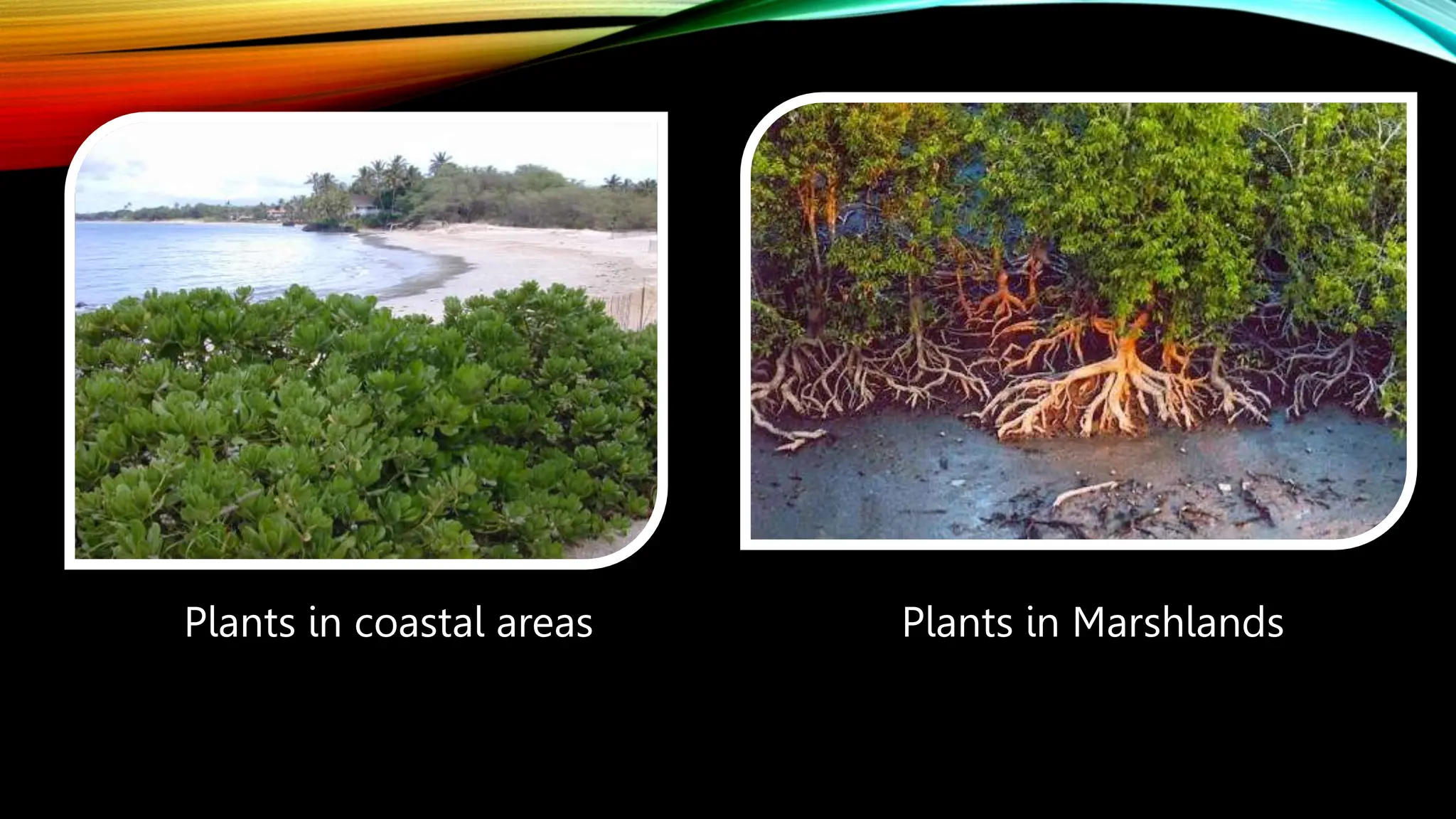
Plants in coastal areas Plants in Marshlands
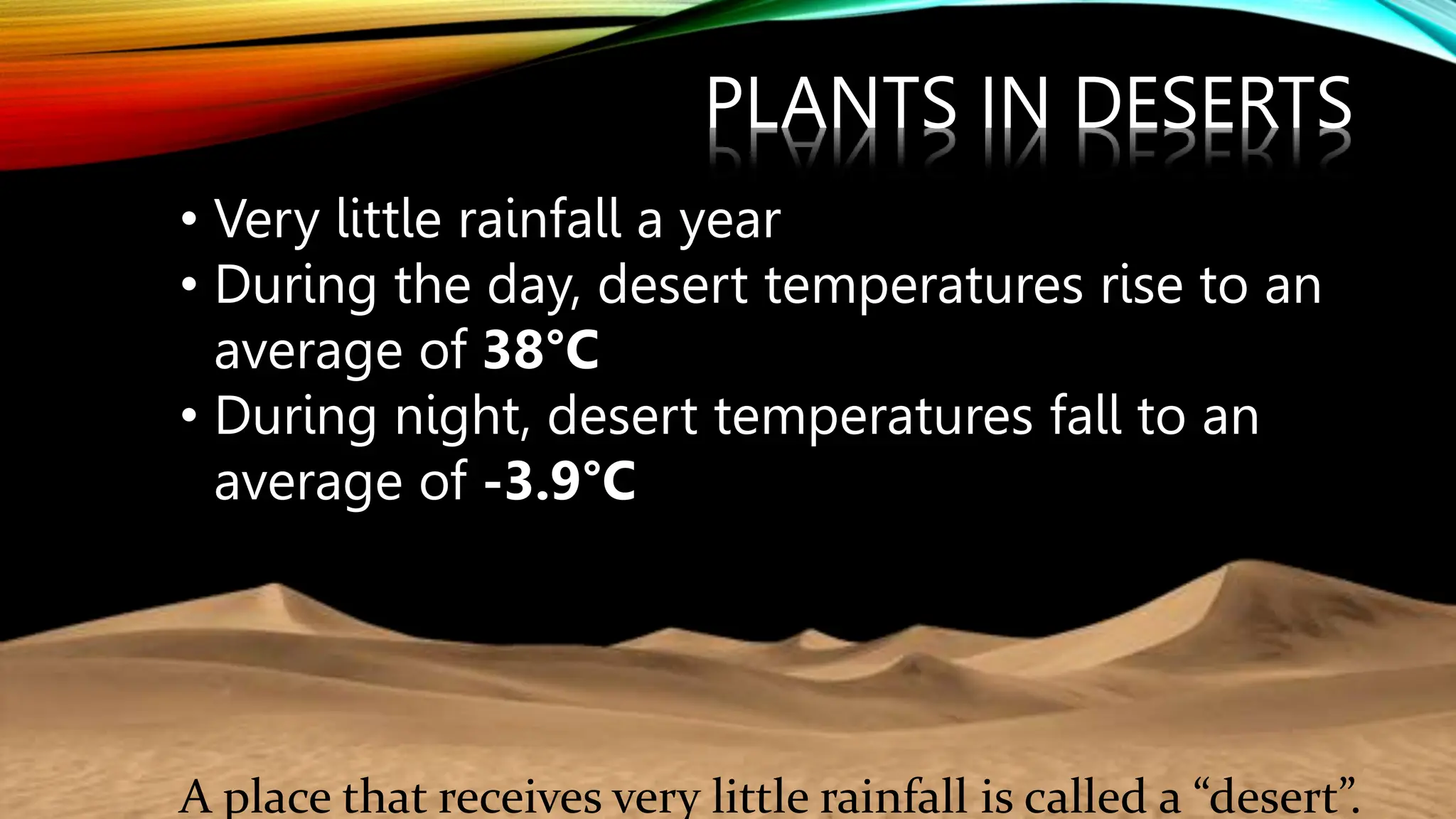
PLANTS IN DESERTS
A place that receives very little rainfall is called a “desert”.
• Very little rainfall a year
• During the day, desert temperatures rise to an
average of 38°C
• During night, desert temperatures fall to an
average of -3.9°C
WHAT FEATURES OR CHARACTERISTICS
PLANTS HAVE DEVELOPED TO LIVE IS SUCH
DRY HABITAT
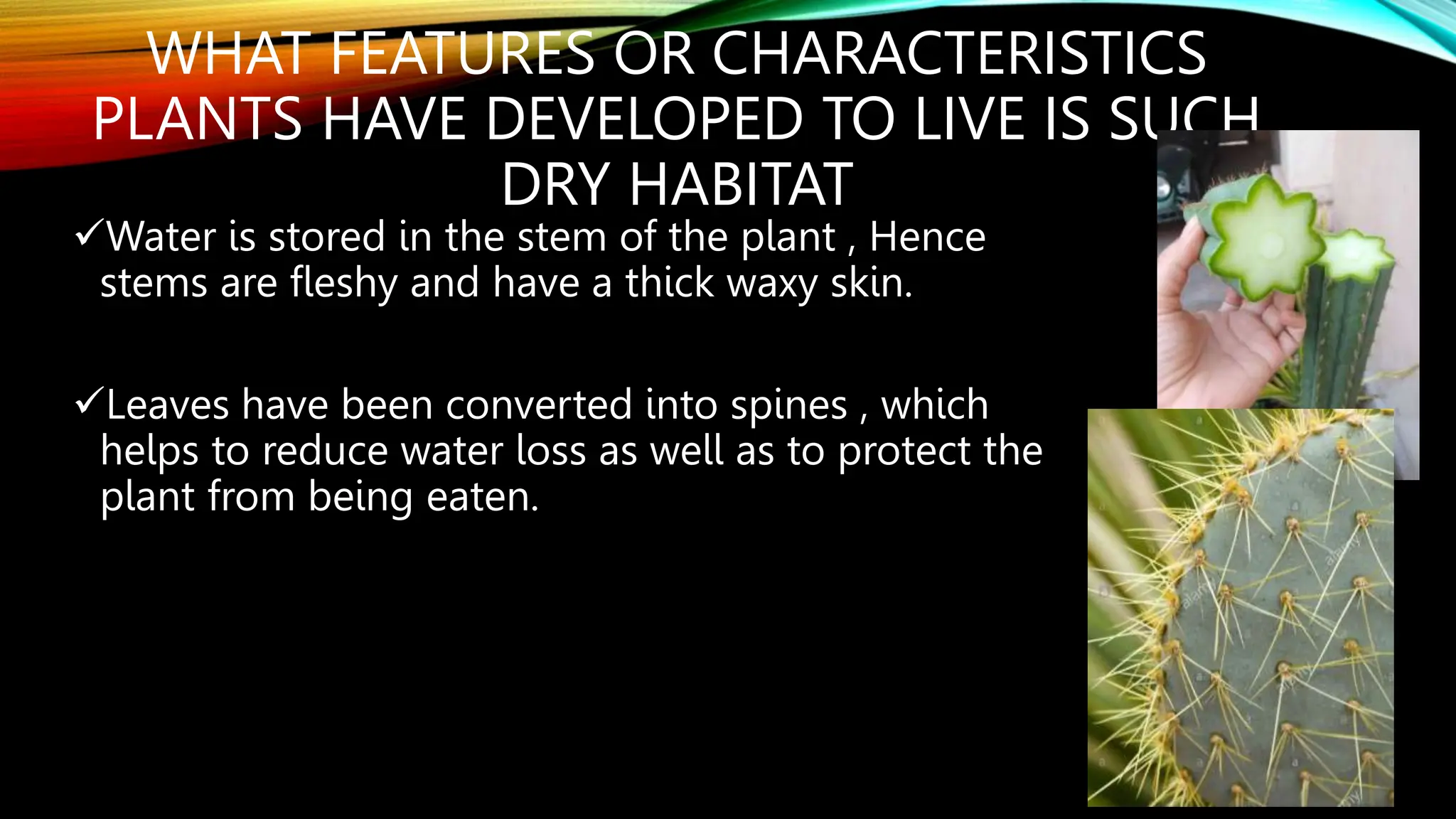
Water is stored in the stem of the plant , Hence
stems are fleshy and have a thick waxy skin.
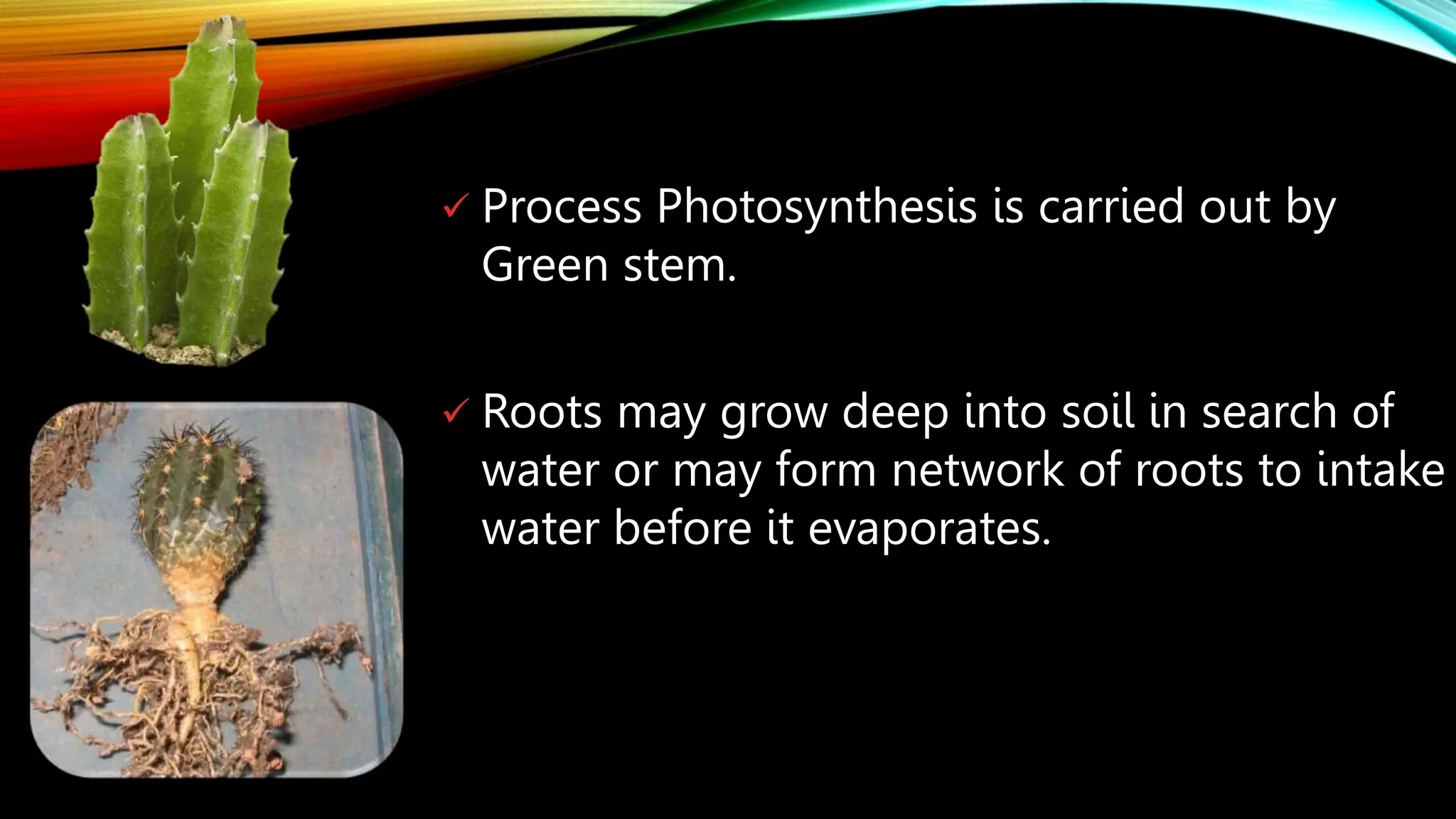
Leaves have been converted into spines , which
helps to reduce water loss as well as to protect the
plant from being eaten.
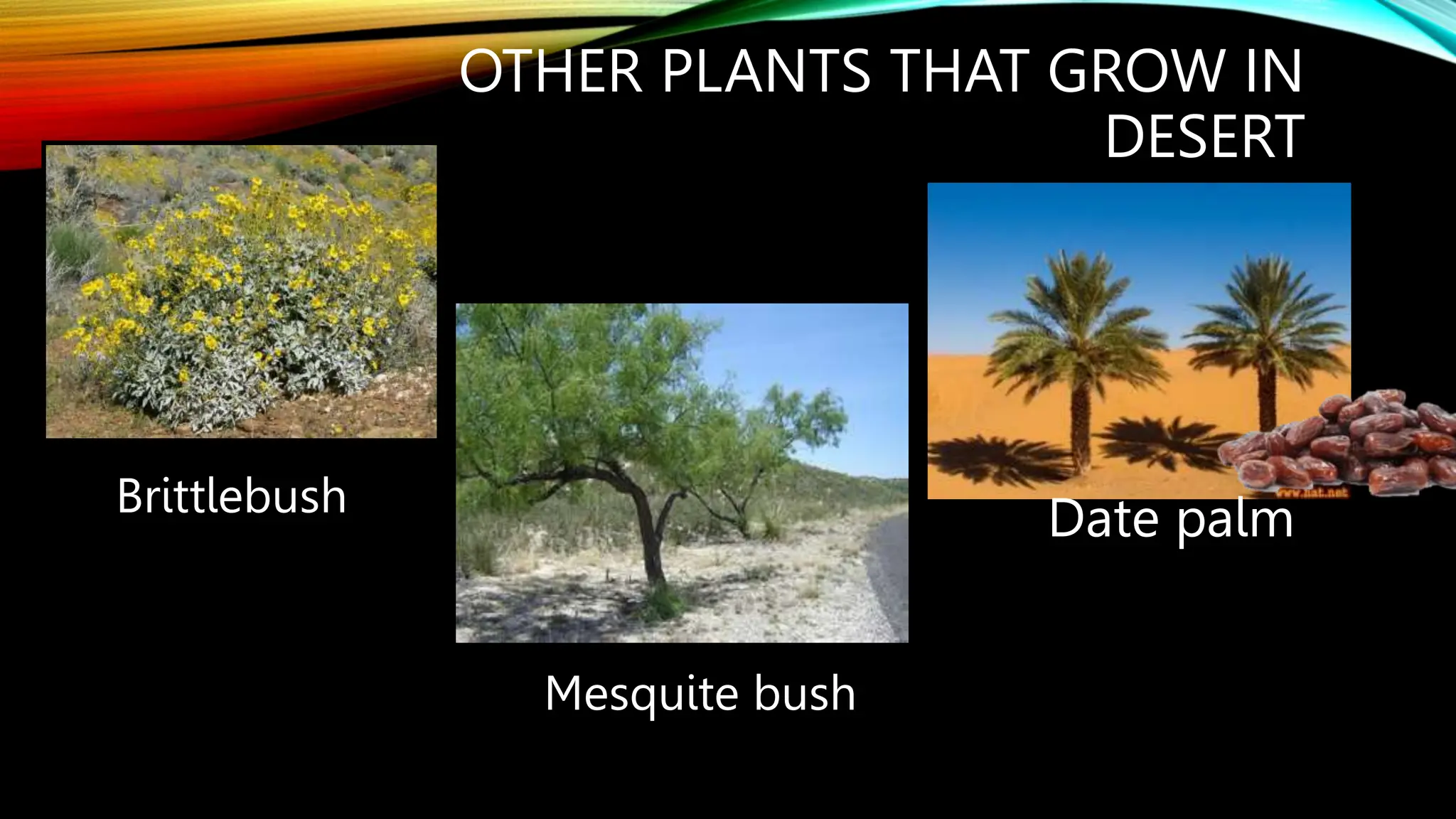
 Process Photosynthesis is carried out by
Green stem.
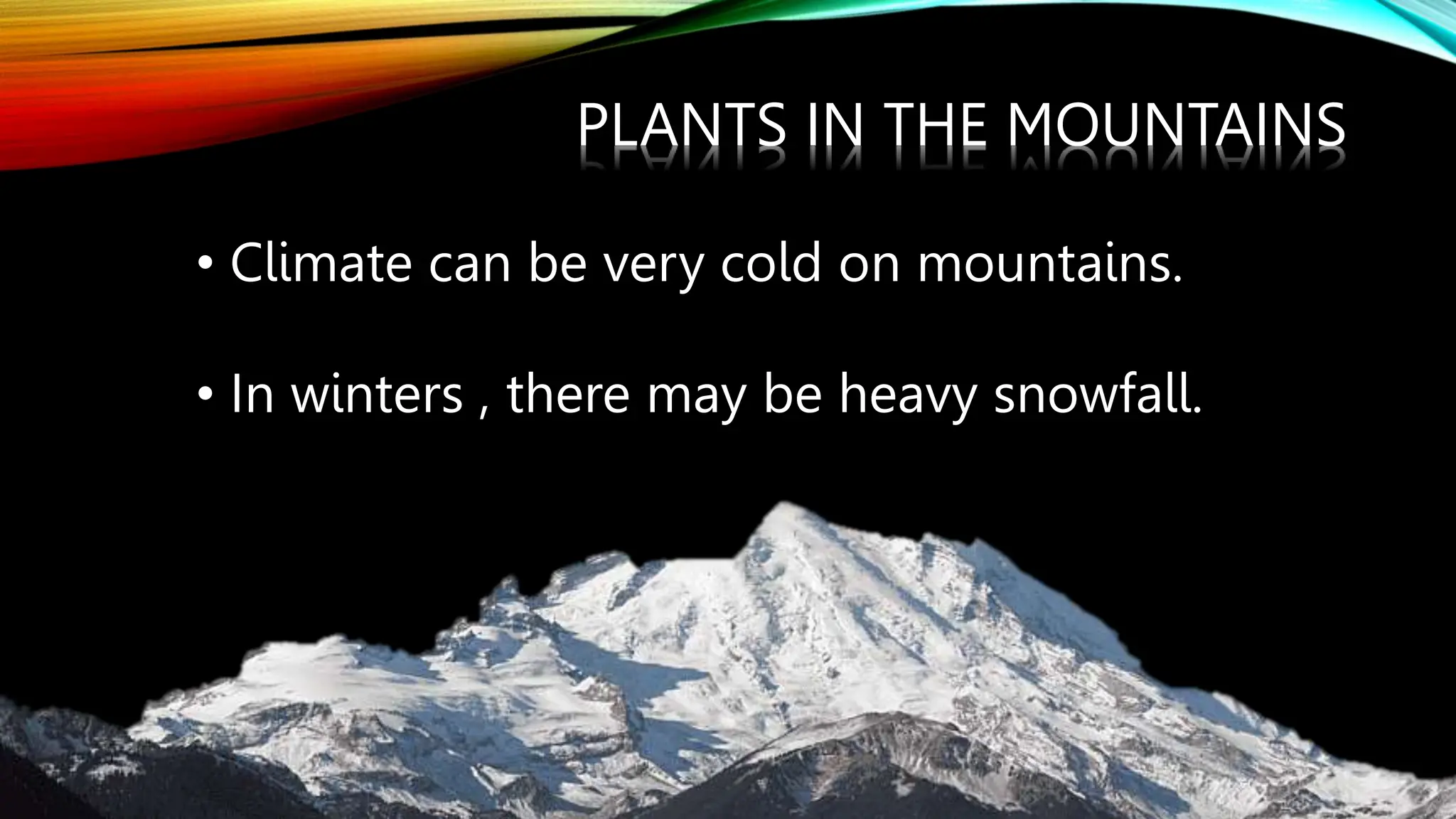
 Roots may grow deep into soil in search of
water or may form network of roots to intake
water before it evaporates.
OTHER PLANTS THAT GROW IN
DESERT
Brittlebush Date palm
Mesquite bush
PLANTS IN THE MOUNTAINS
• Climate can be very cold on mountains.
• In winters , there may be heavy snowfall.
What features or characteristics plants have
developed to live is such cold and snowy habitat
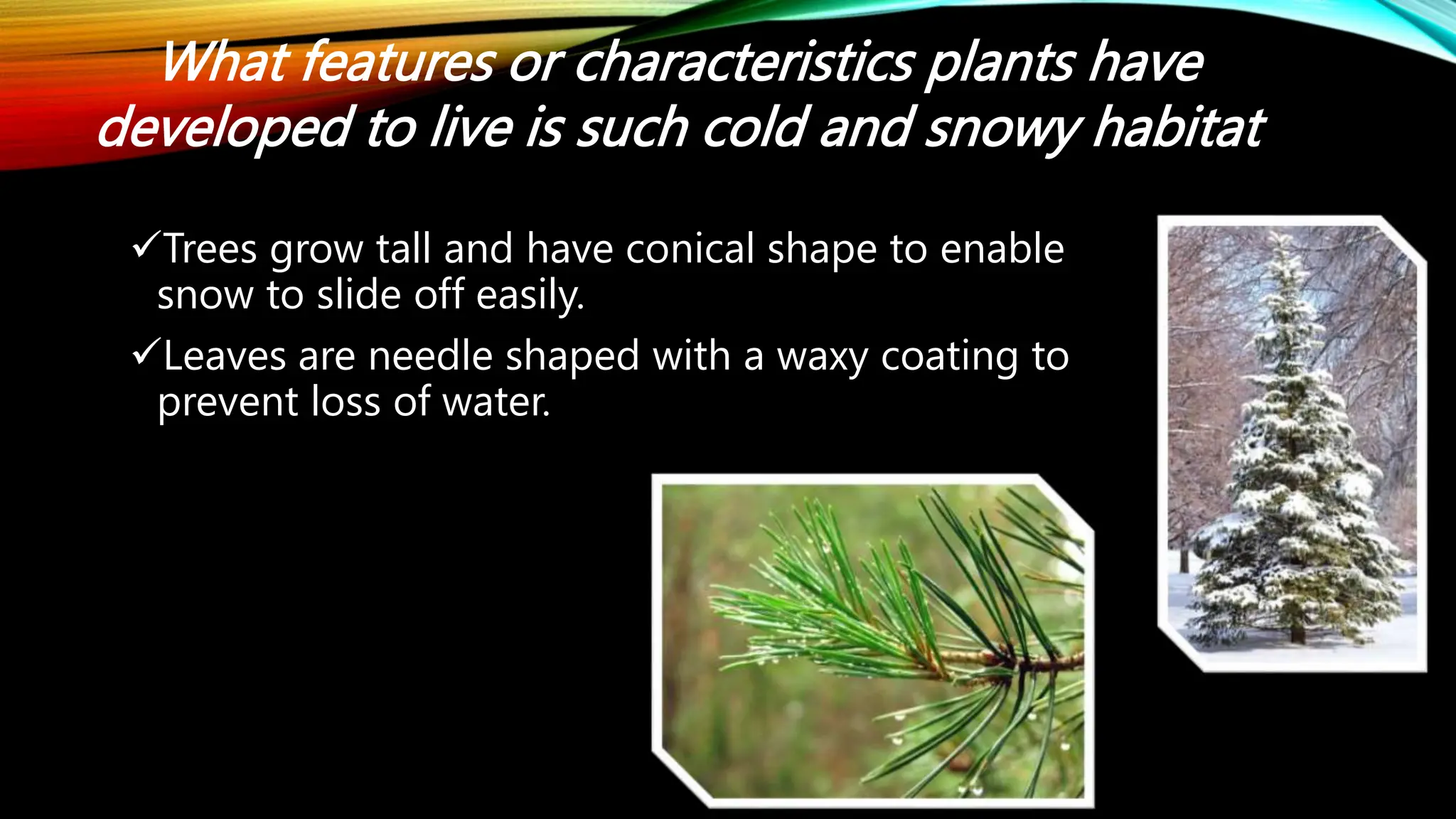
Trees grow tall and have conical shape to enable
snow to slide off easily.
Leaves are needle shaped with a waxy coating to
prevent loss of water.
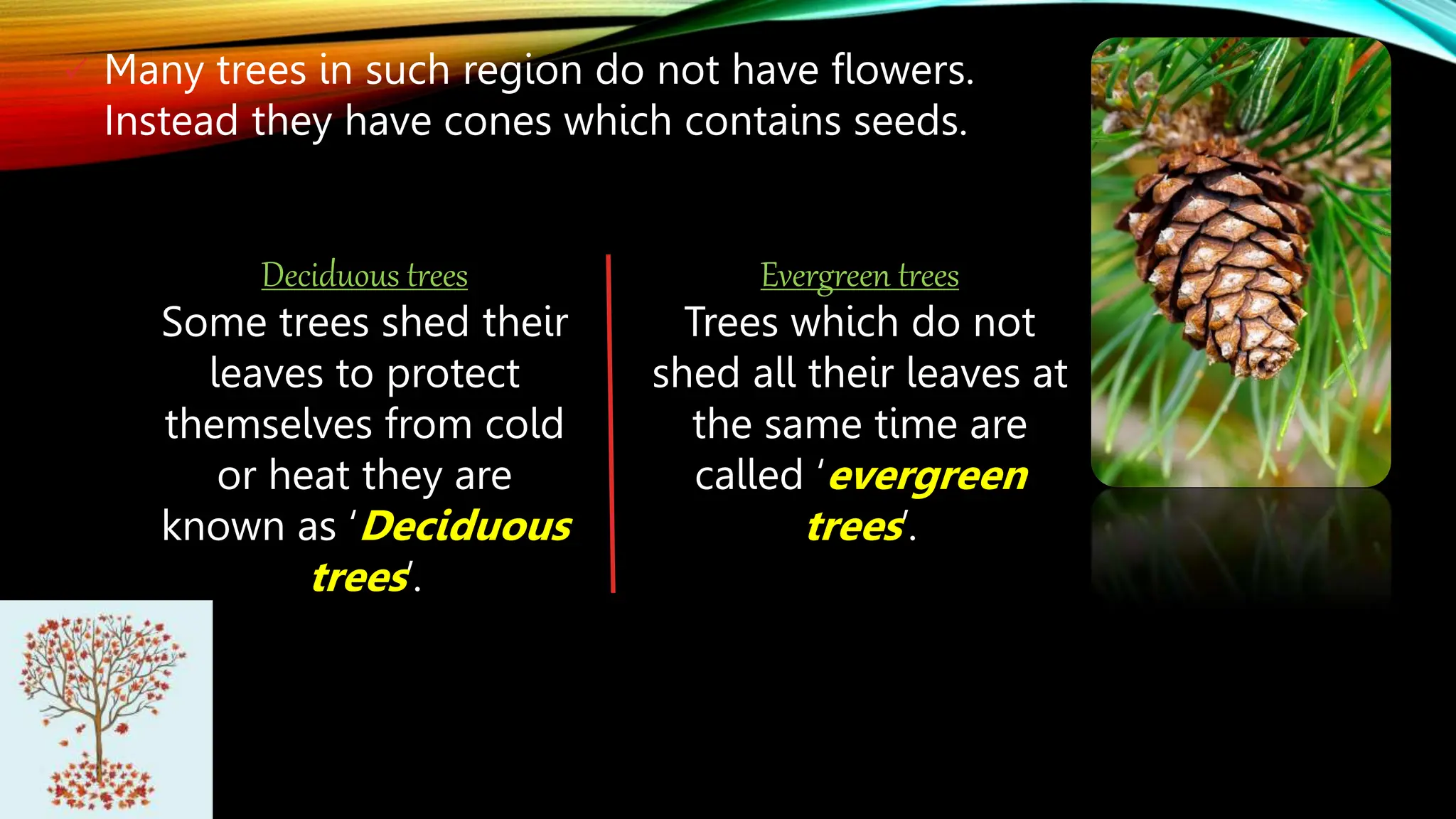
 Many trees in such region do not have flowers.
Instead they have cones which contains seeds.
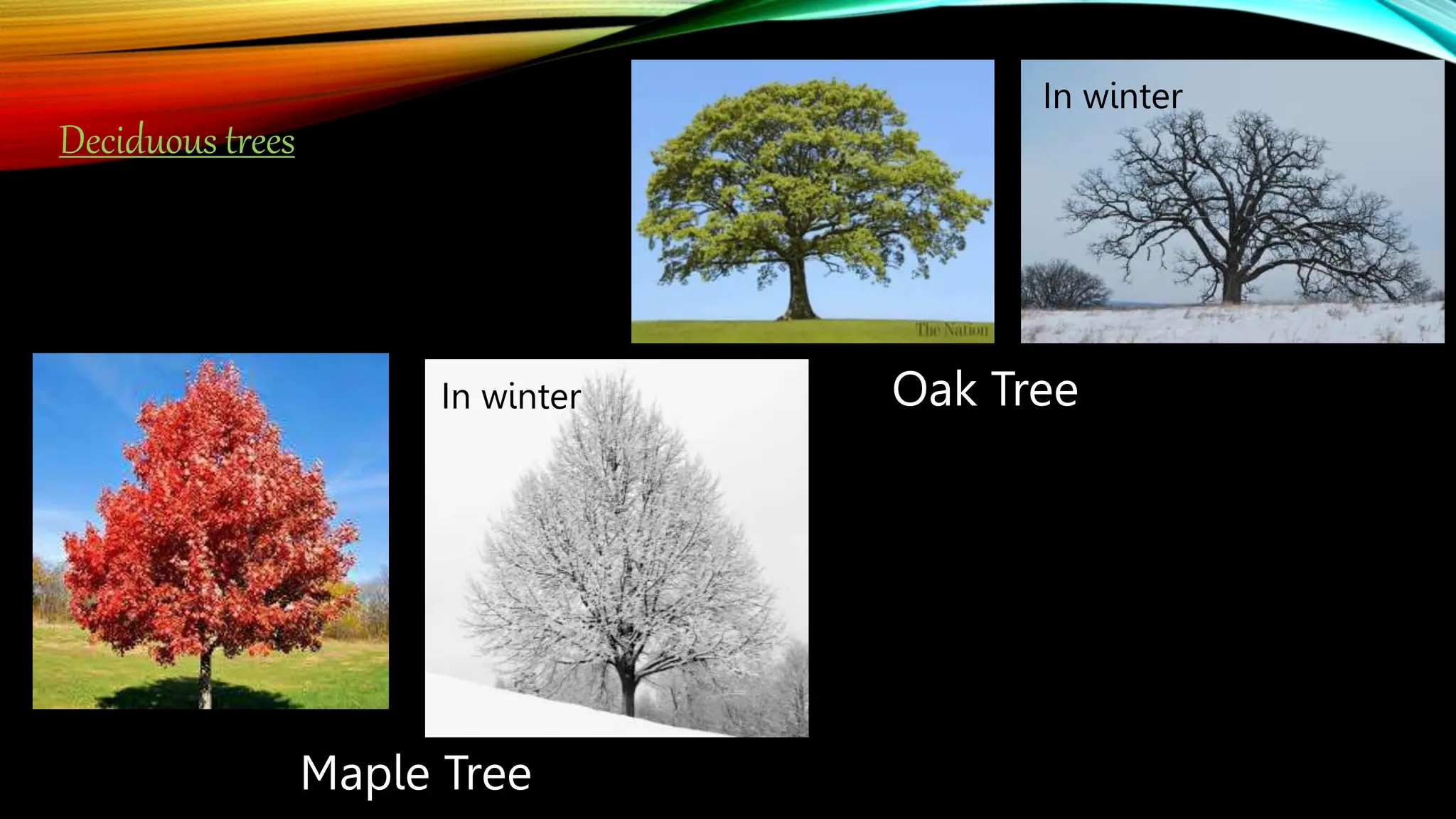
Deciduous trees
Some trees shed their
leaves to protect
themselves from cold
or heat they are
known as ‘Deciduous
trees’.
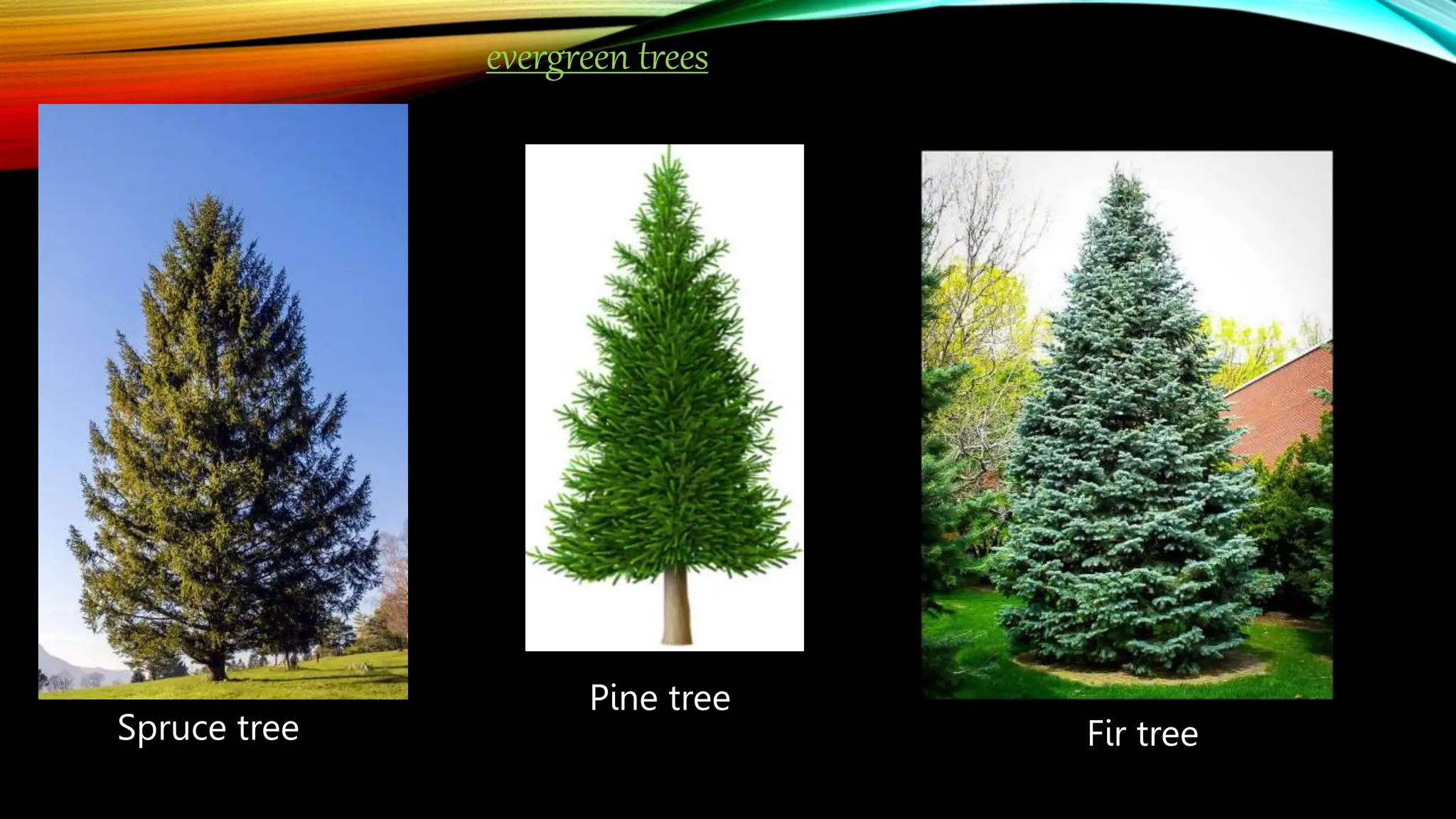
Evergreen trees
Trees which do not
shed all their leaves at
the same time are
called ‘evergreen
trees’.
Deciduous trees
Oak Tree
In winter
In winter
Maple Tree
evergreen trees
Spruce tree
Pine tree
Fir tree
Plants in the plains
Areas on the earth which are flat and which are warmer than
the mountains such regions are known as plains.
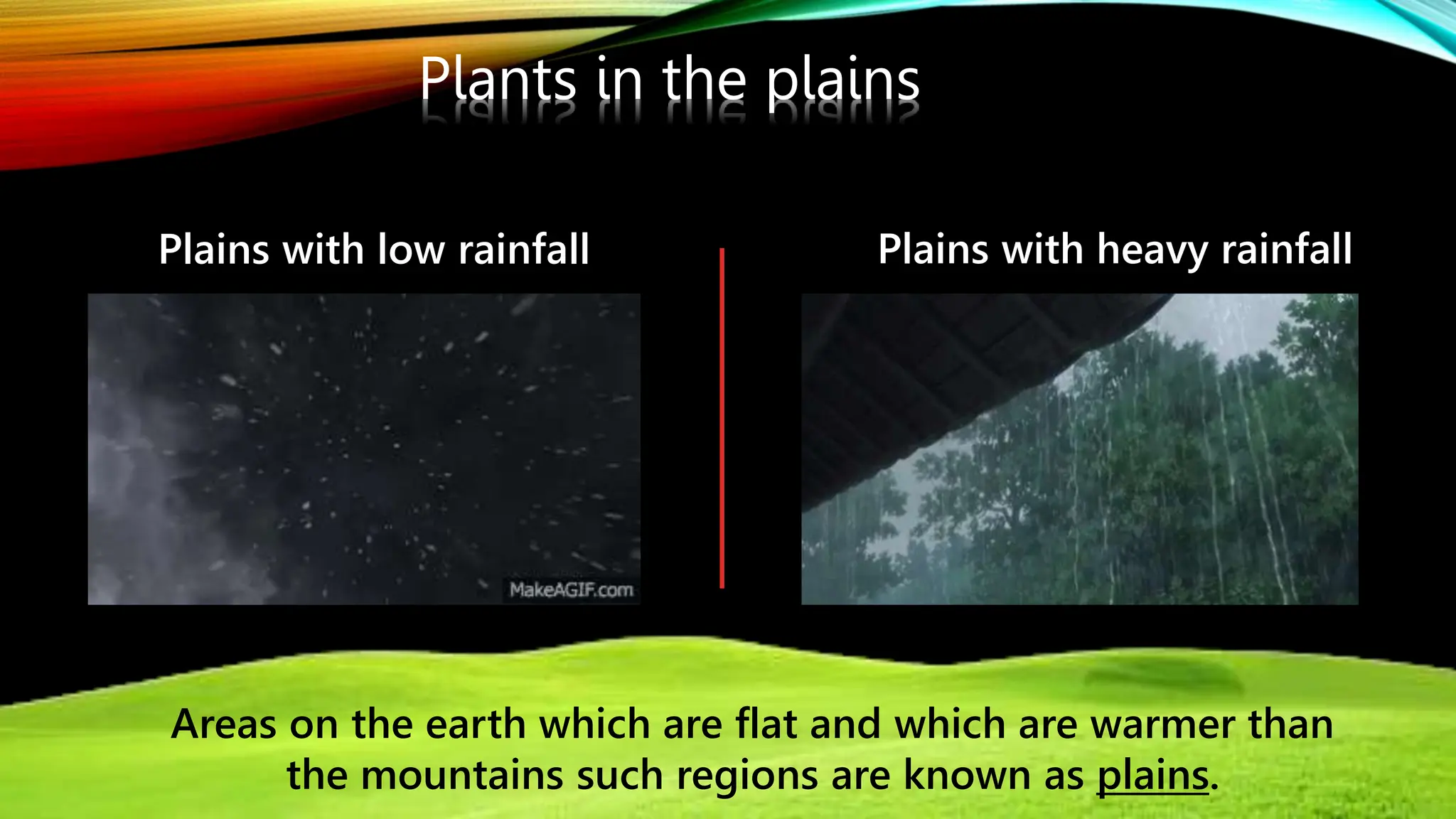
Plains with low rainfall Plains with heavy rainfall
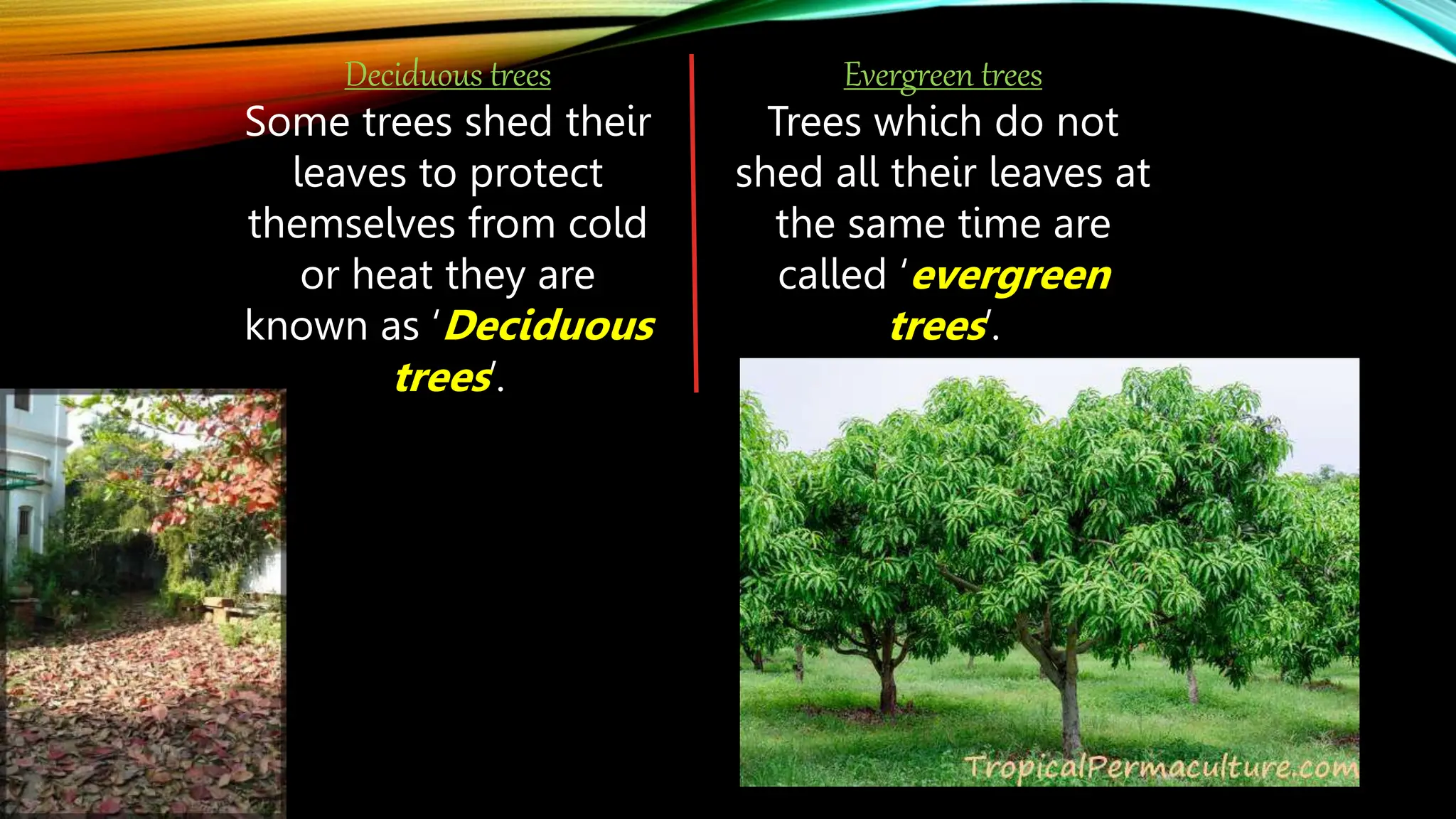
Deciduous trees
Some trees shed their
leaves to protect
themselves from cold
or heat they are
known as ‘Deciduous
trees’.
Evergreen trees
Trees which do not
shed all their leaves at
the same time are
called ‘evergreen
trees’.
ADAPTATIONS IN PLANTS THAT GROW
IN THE PLAINS WITH LOW RAINFALL
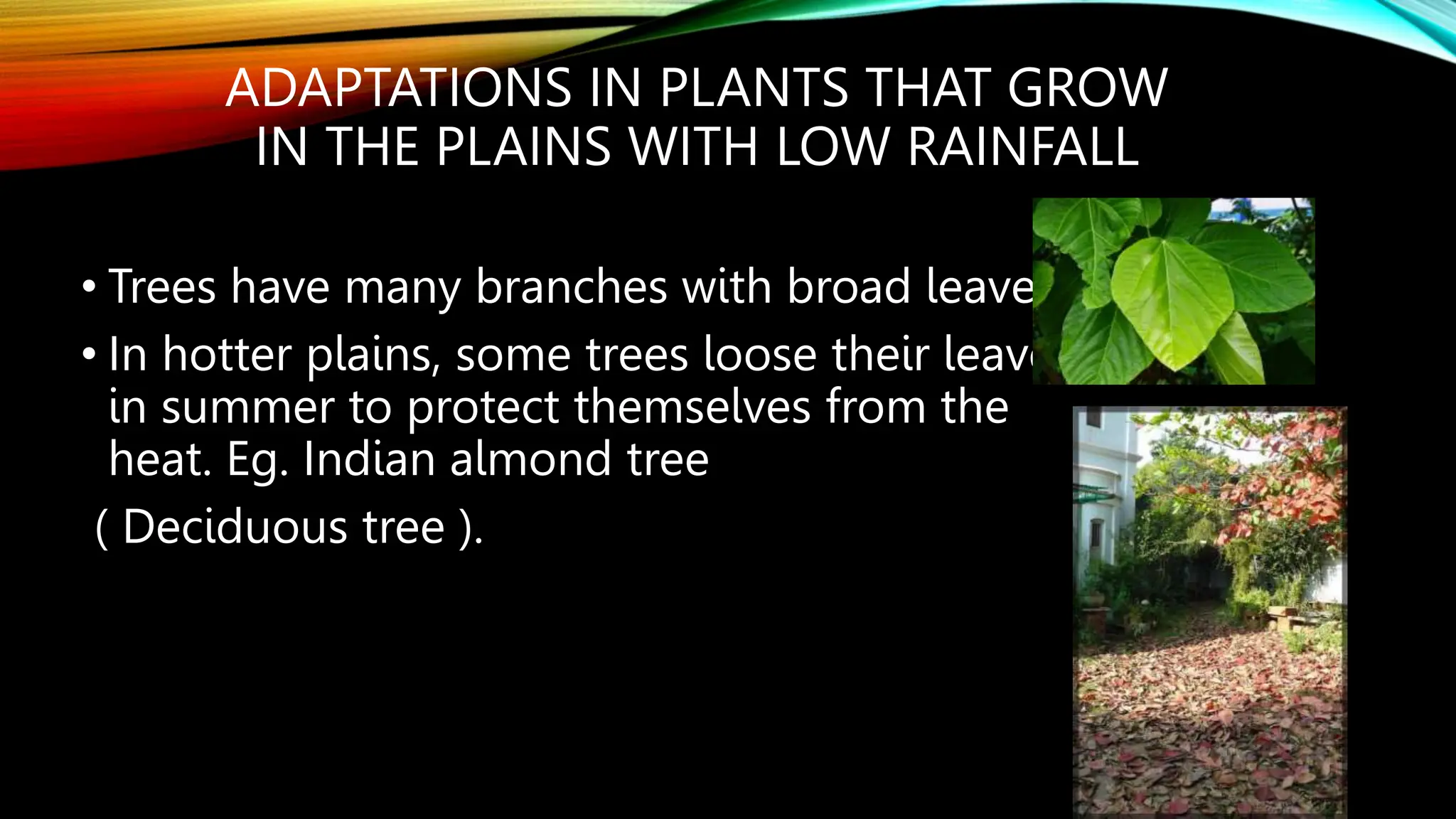
• Trees have many branches with broad leaves.
• In hotter plains, some trees loose their leaves
in summer to protect themselves from the
heat. Eg. Indian almond tree
( Deciduous tree ).
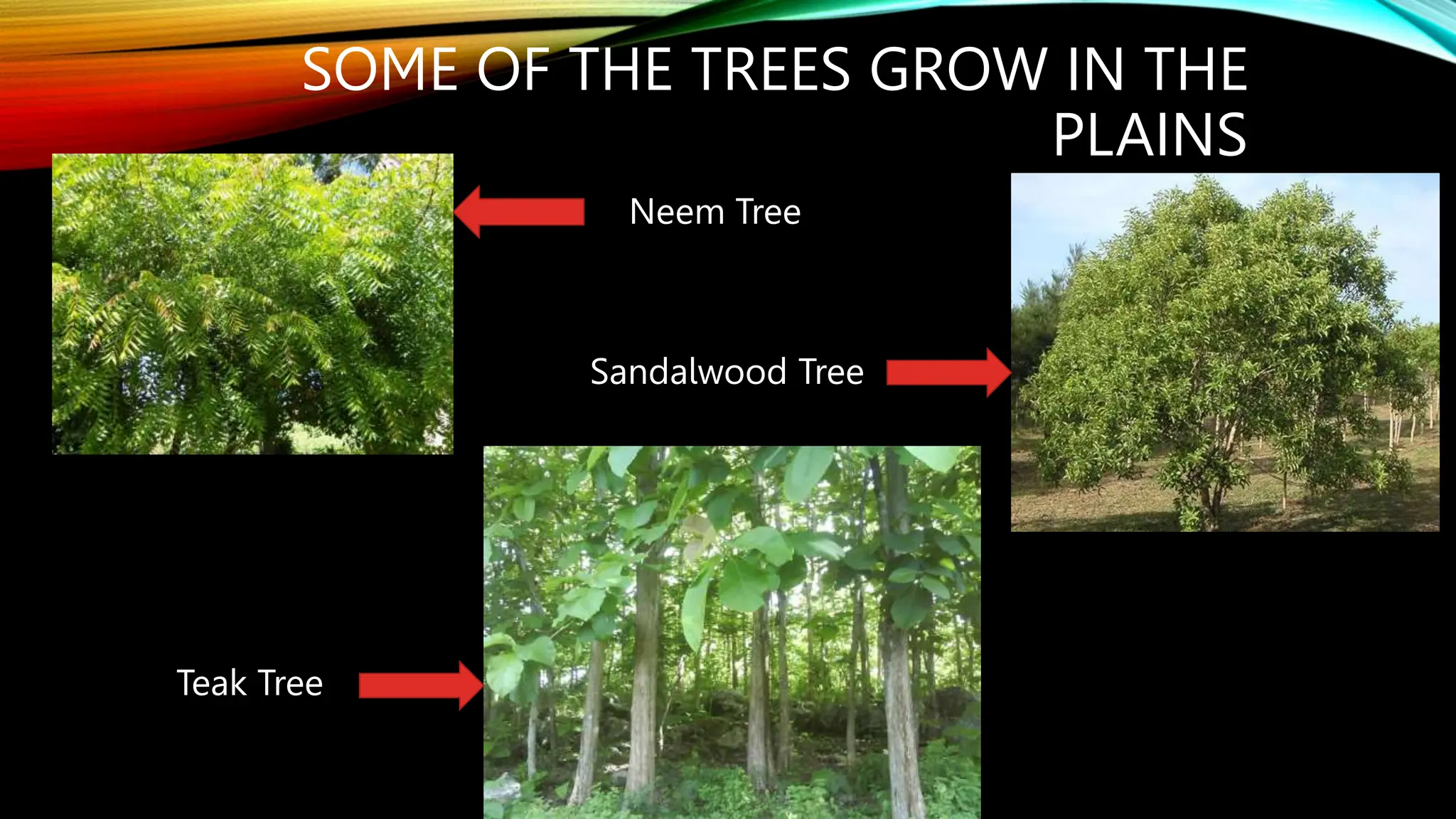
SOME OF THE TREES GROW IN THE
PLAINS
Neem Tree
Sandalwood Tree
Teak Tree
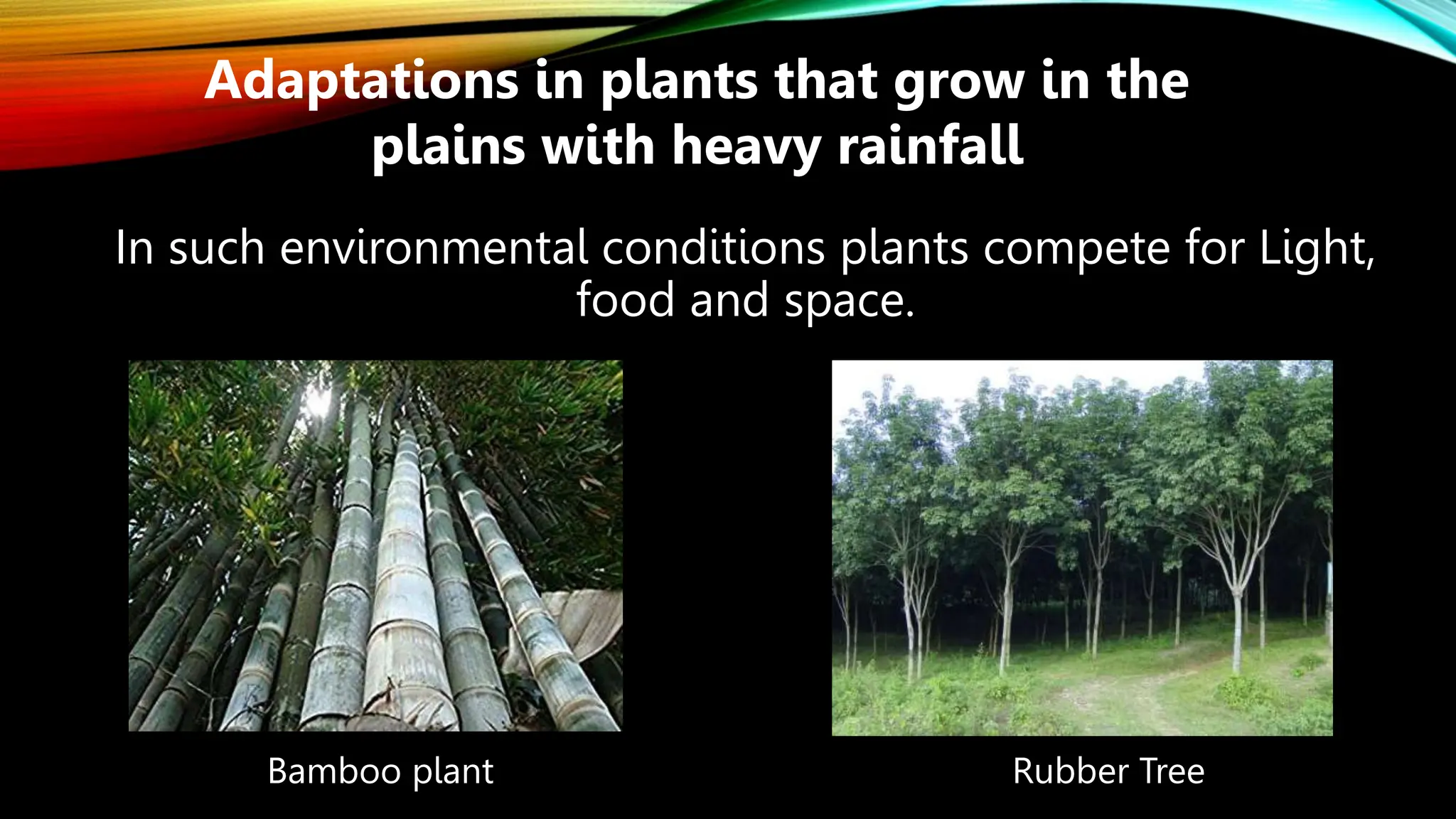
In such environmental conditions plants compete for Light,
food and space.
Adaptations in plants that grow in the
plains with heavy rainfall
Bamboo plant Rubber Tree
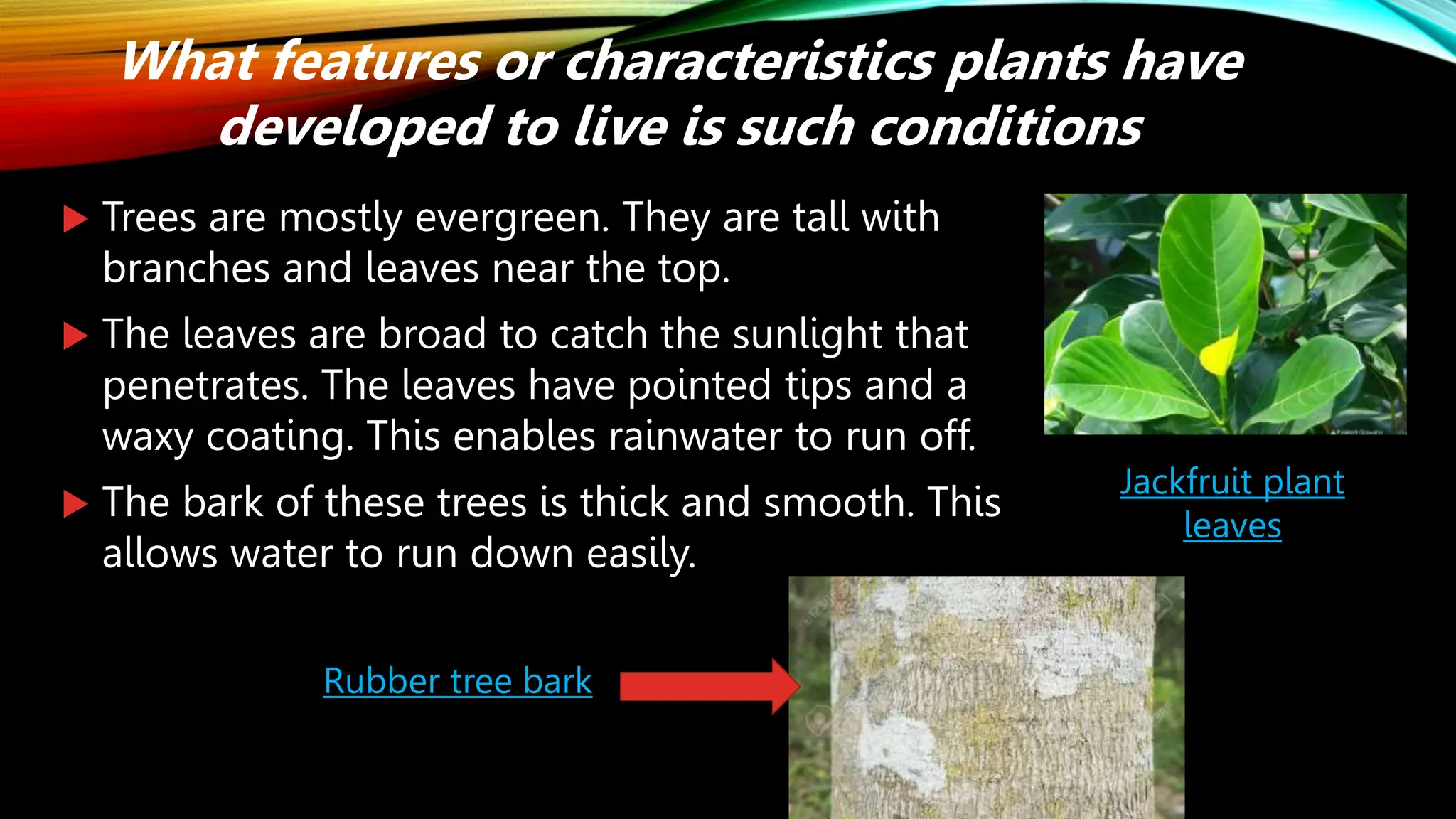
 Trees are mostly evergreen. They are tall with
branches and leaves near the top.
 The leaves are broad to catch the sunlight that
penetrates. The leaves have pointed tips and a
waxy coating. This enables rainwater to run off.
 The bark of these trees is thick and smooth. This
allows water to run down easily.
What features or characteristics plants have
developed to live is such conditions
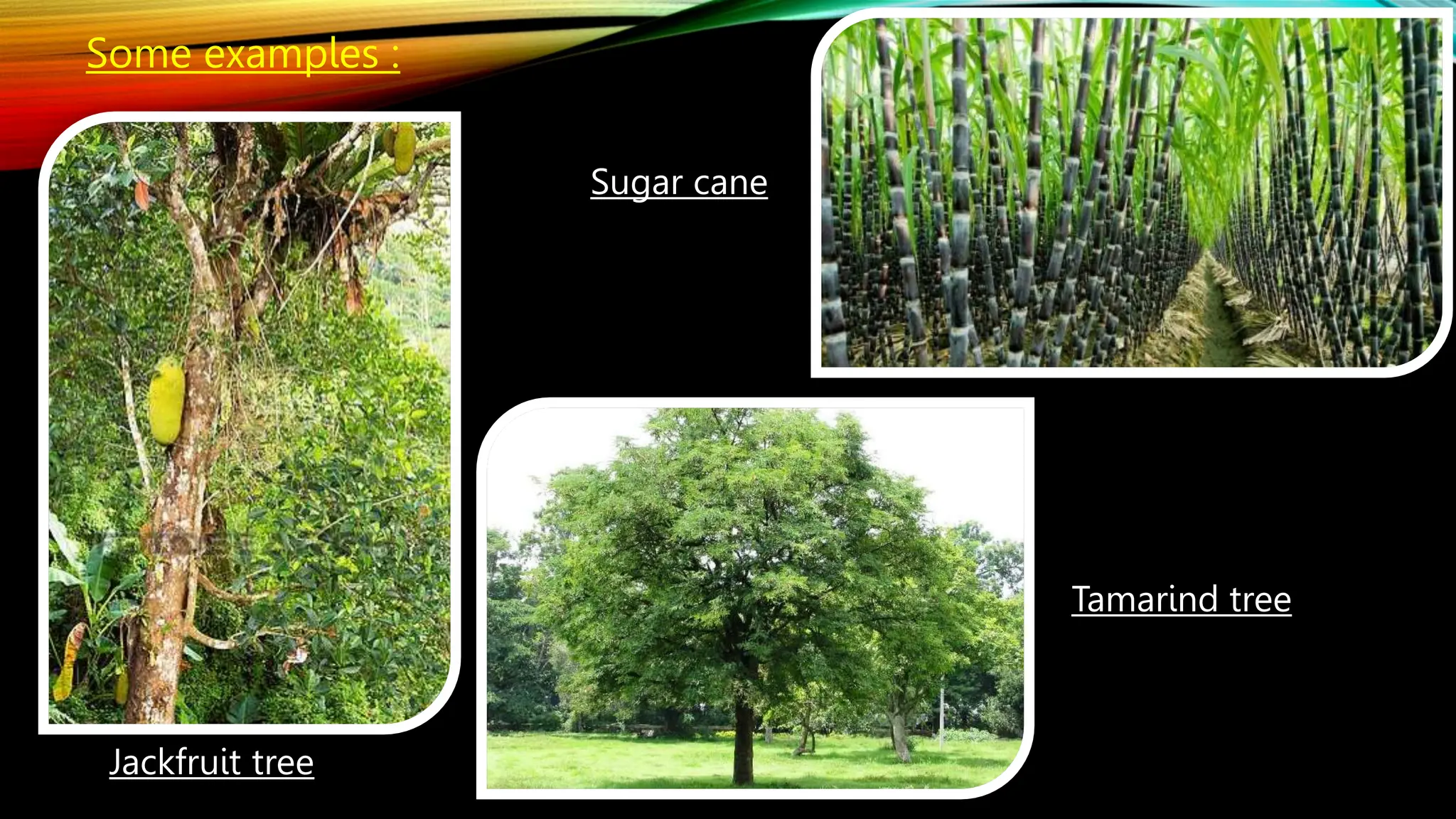
Jackfruit plant
leaves
Rubber tree bark
Jackfruit tree
Tamarind tree
Sugar cane
Some examples :
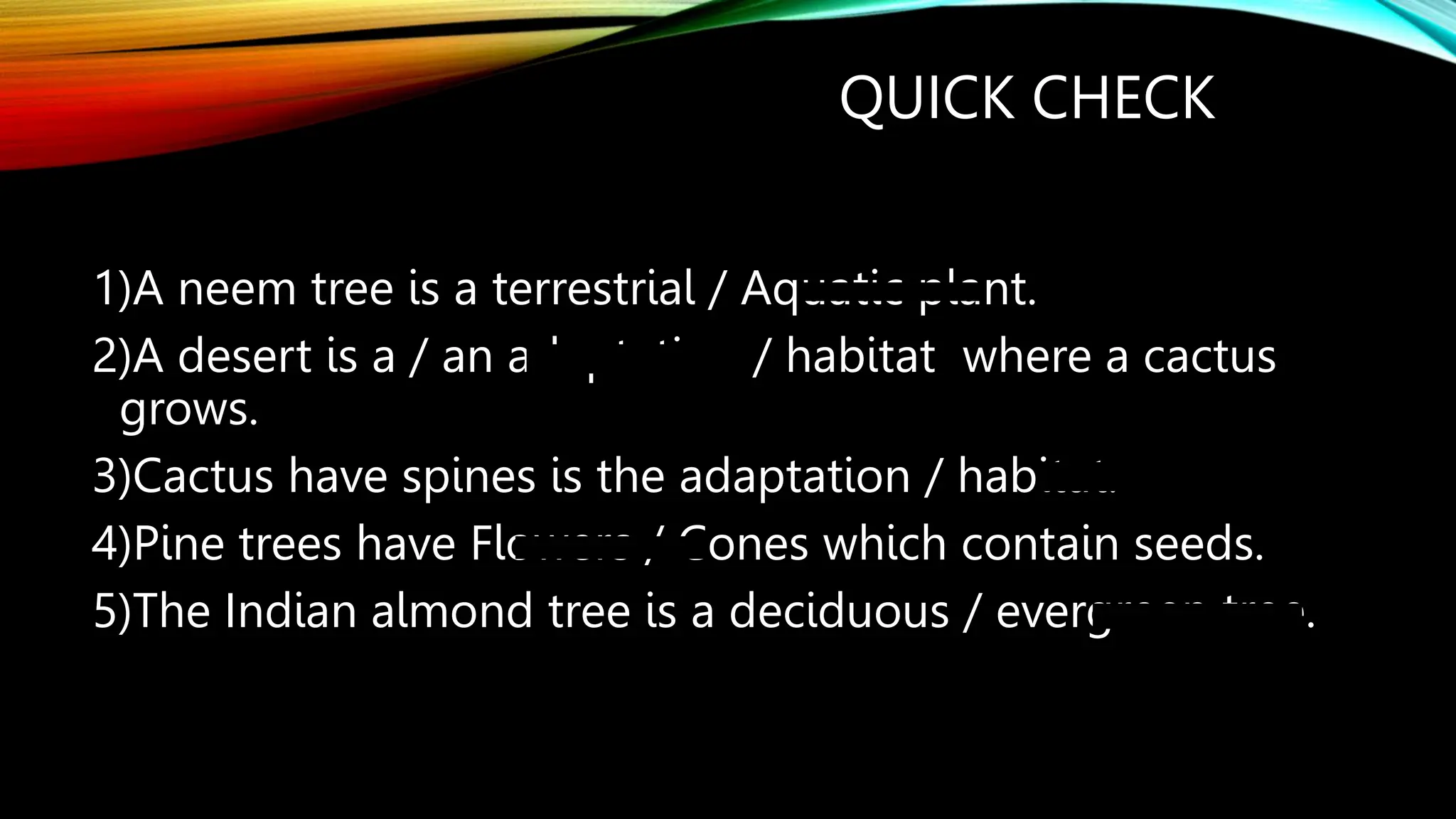
QUICK CHECK
1)A neem tree is a terrestrial / Aquatic plant.
2)A desert is a / an adaptation / habitat where a cactus
grows.
3)Cactus have spines is the adaptation / habitat.
4)Pine trees have Flowers / Cones which contain seeds.
5)The Indian almond tree is a deciduous / evergreen tree.
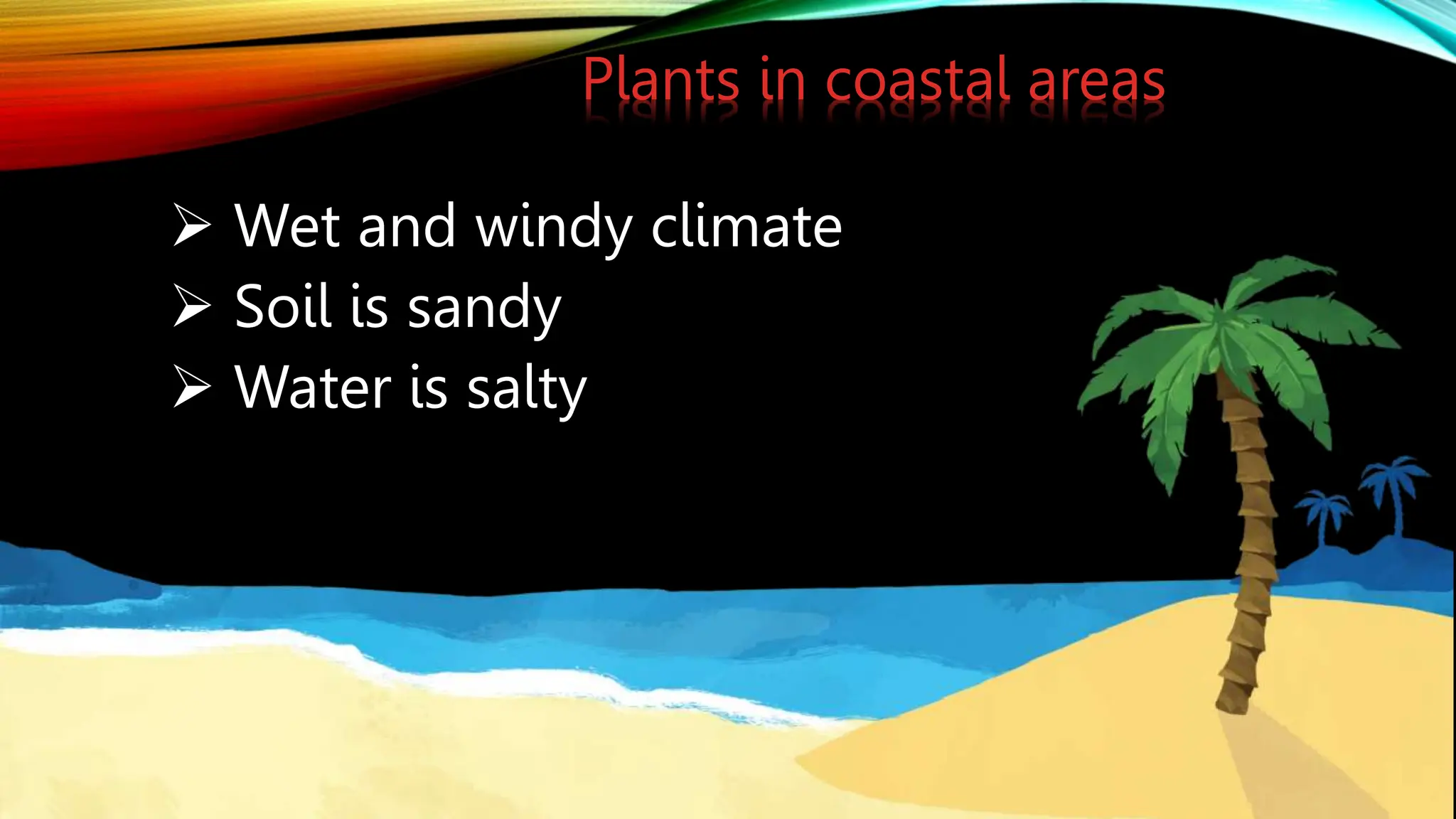
 Wet and windy climate
 Soil is sandy
 Water is salty
Plants in coastal areas
What features or characteristics plants have
developed to live is such conditions
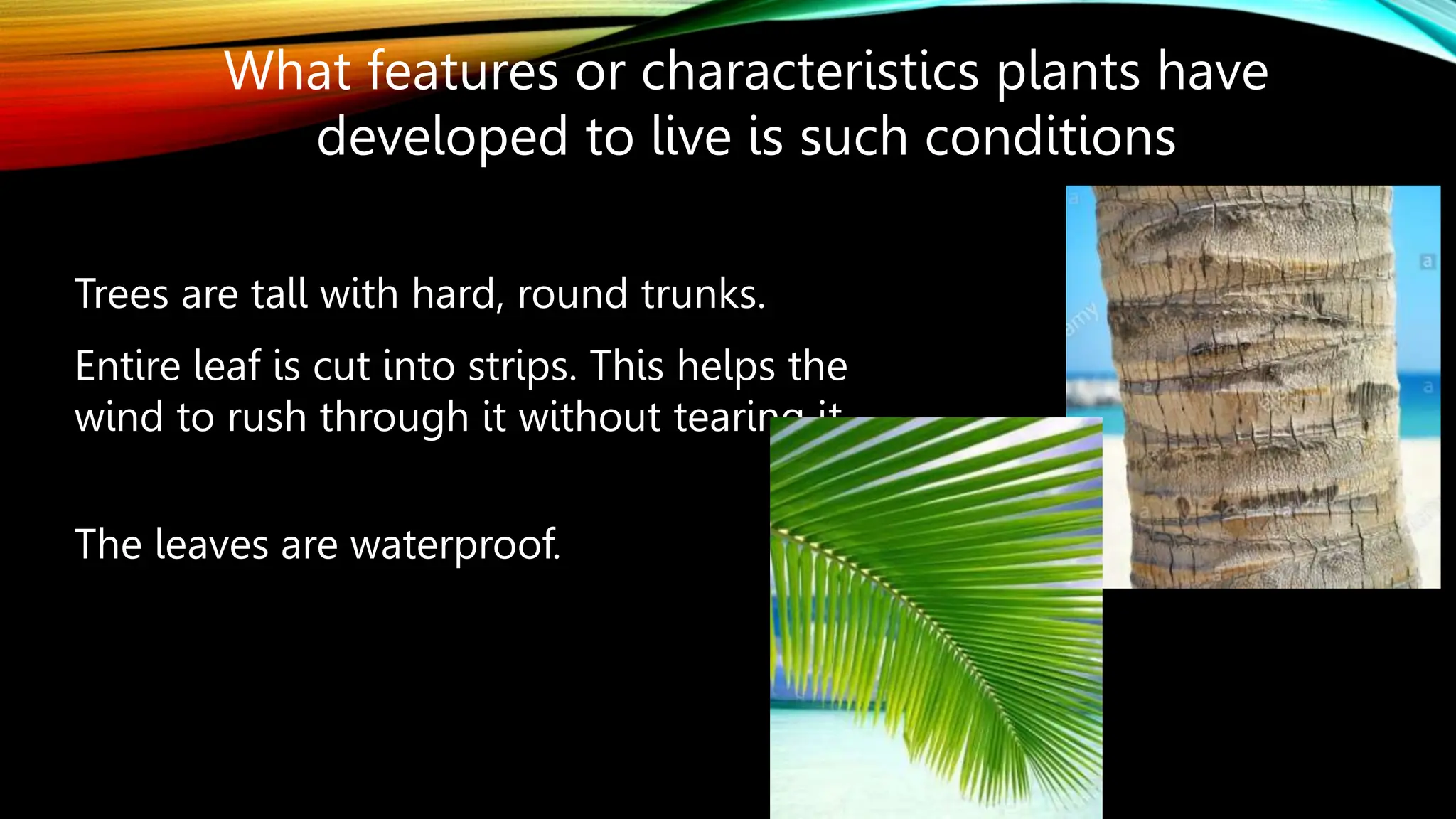
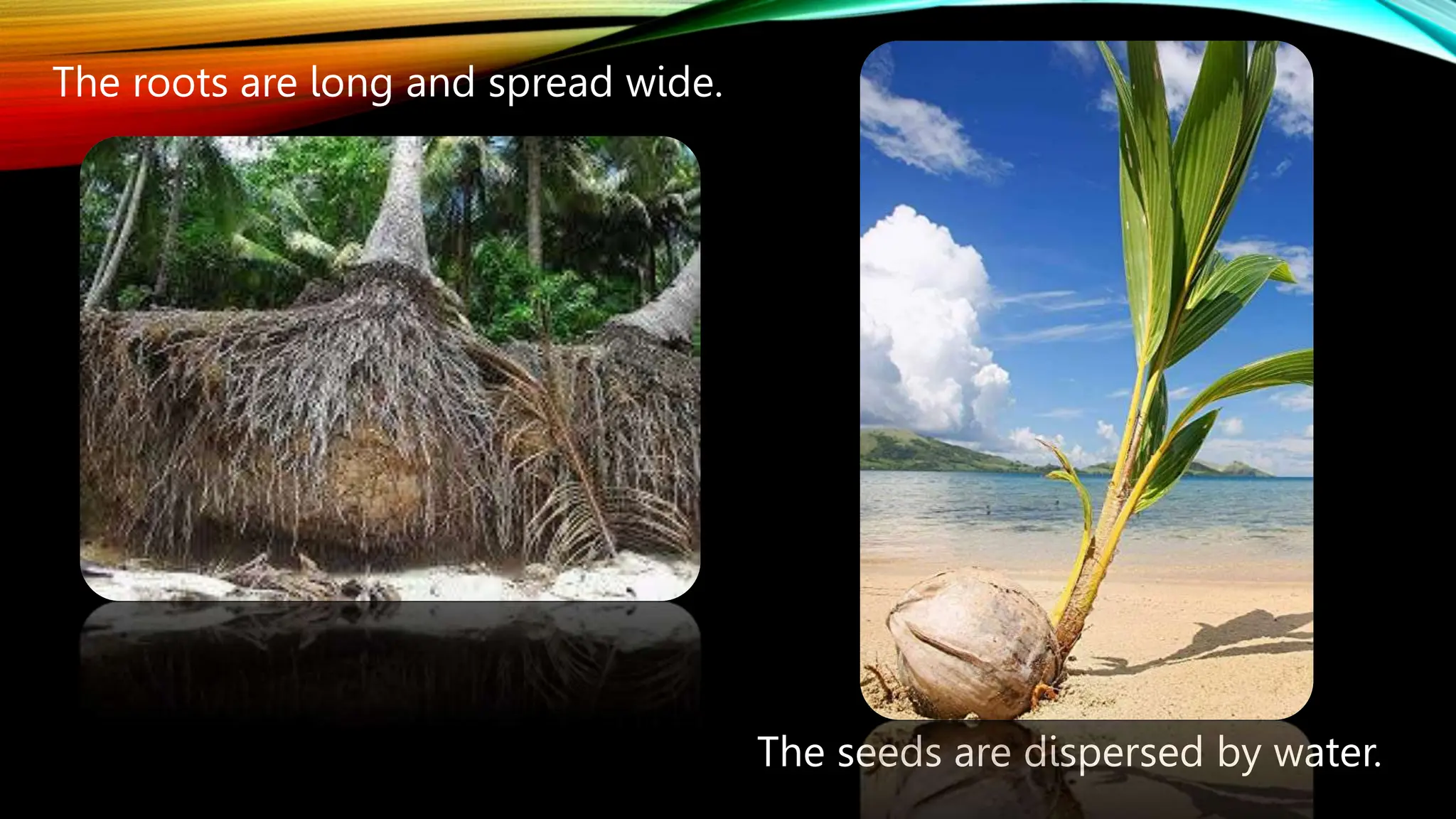
Trees are tall with hard, round trunks.
Entire leaf is cut into strips. This helps the
wind to rush through it without tearing it.
The leaves are waterproof.
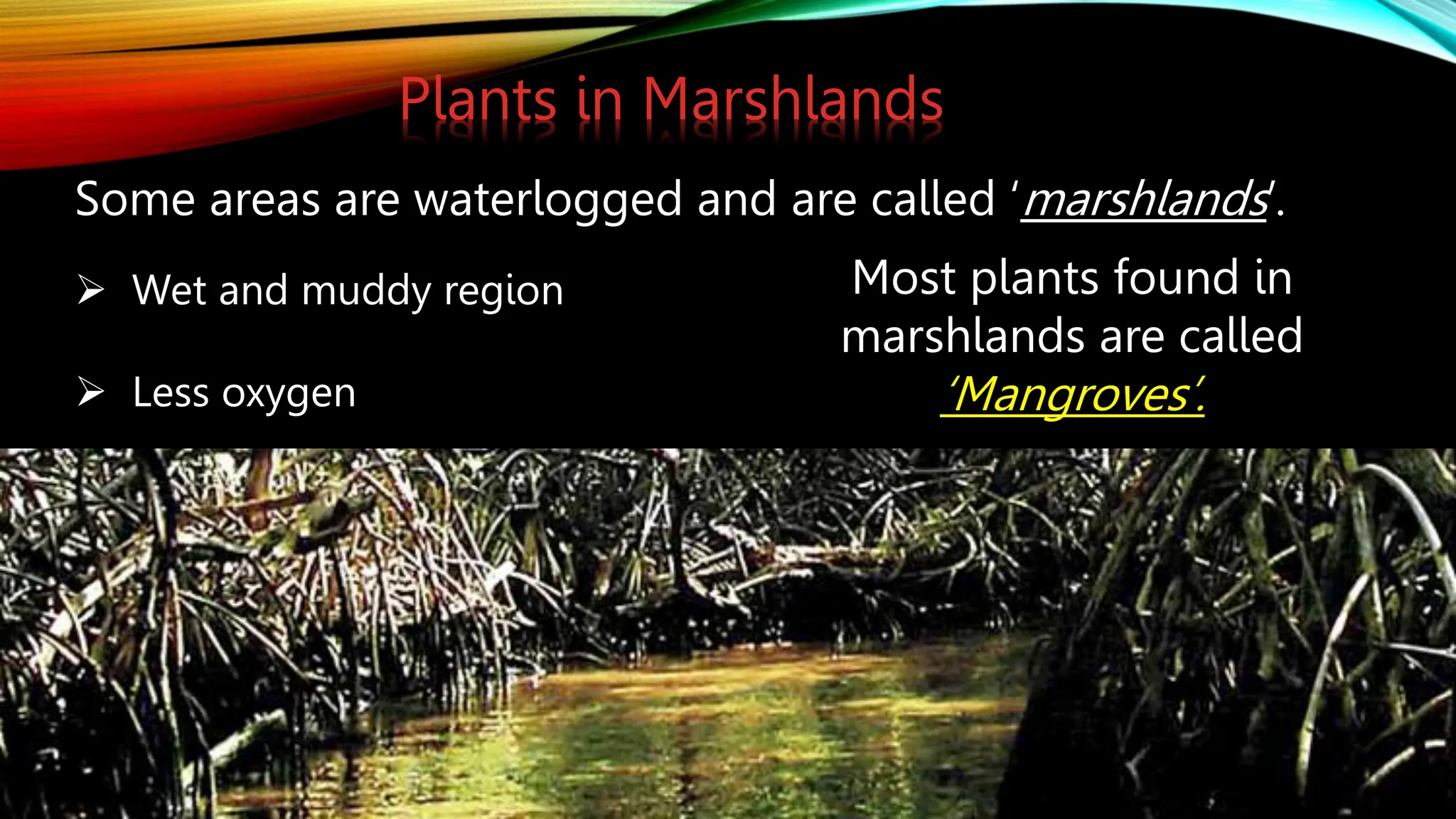
The roots are long and spread wide.
The seeds are dispersed by water.
Plants in Marshlands
Some areas are waterlogged and are called ‘marshlands’.
 Wet and muddy region
 Less oxygen
Most plants found in
marshlands are called
‘Mangroves’.
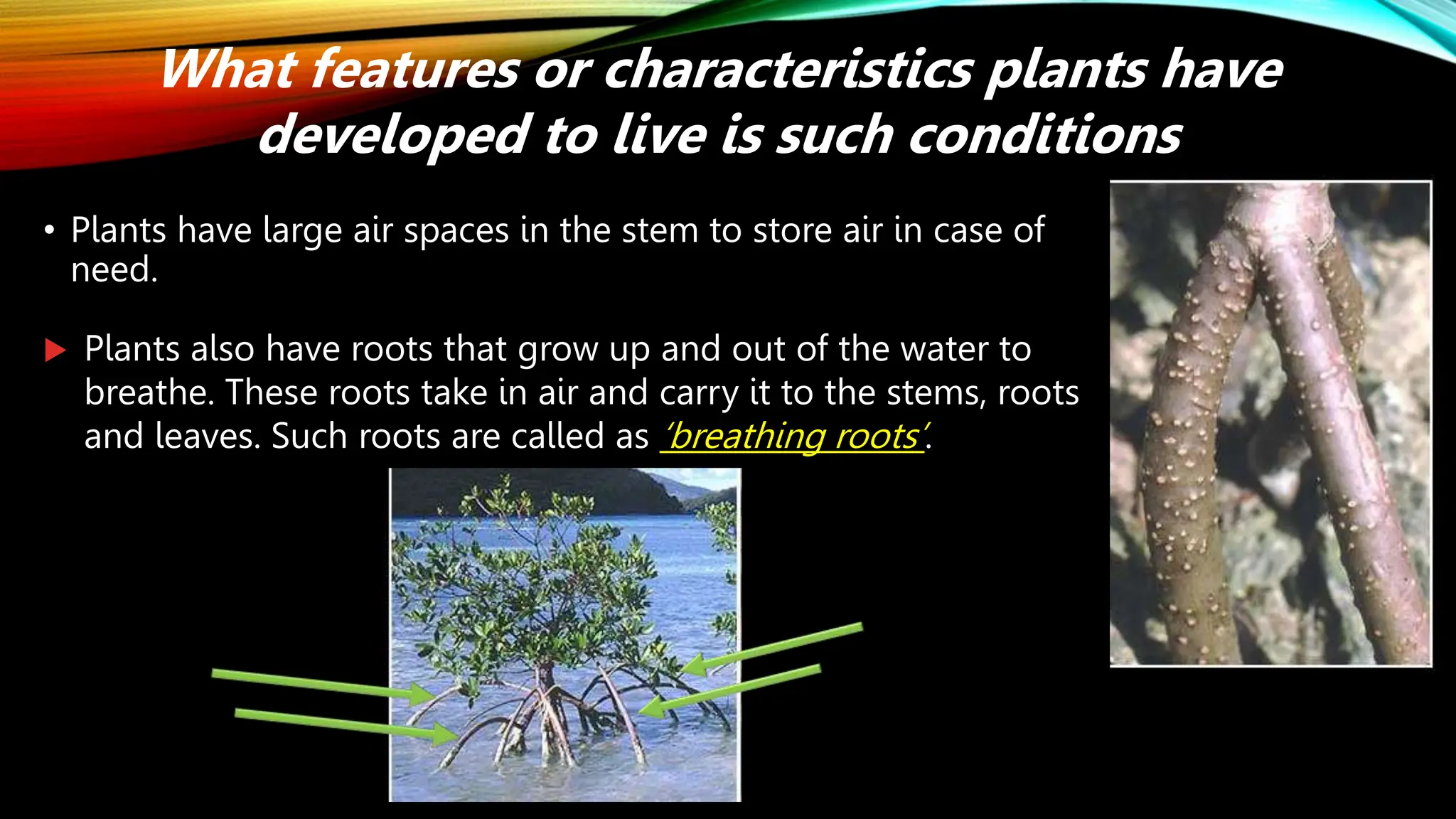
• Plants have large air spaces in the stem to store air in case of
need.
What features or characteristics plants have
developed to live is such conditions
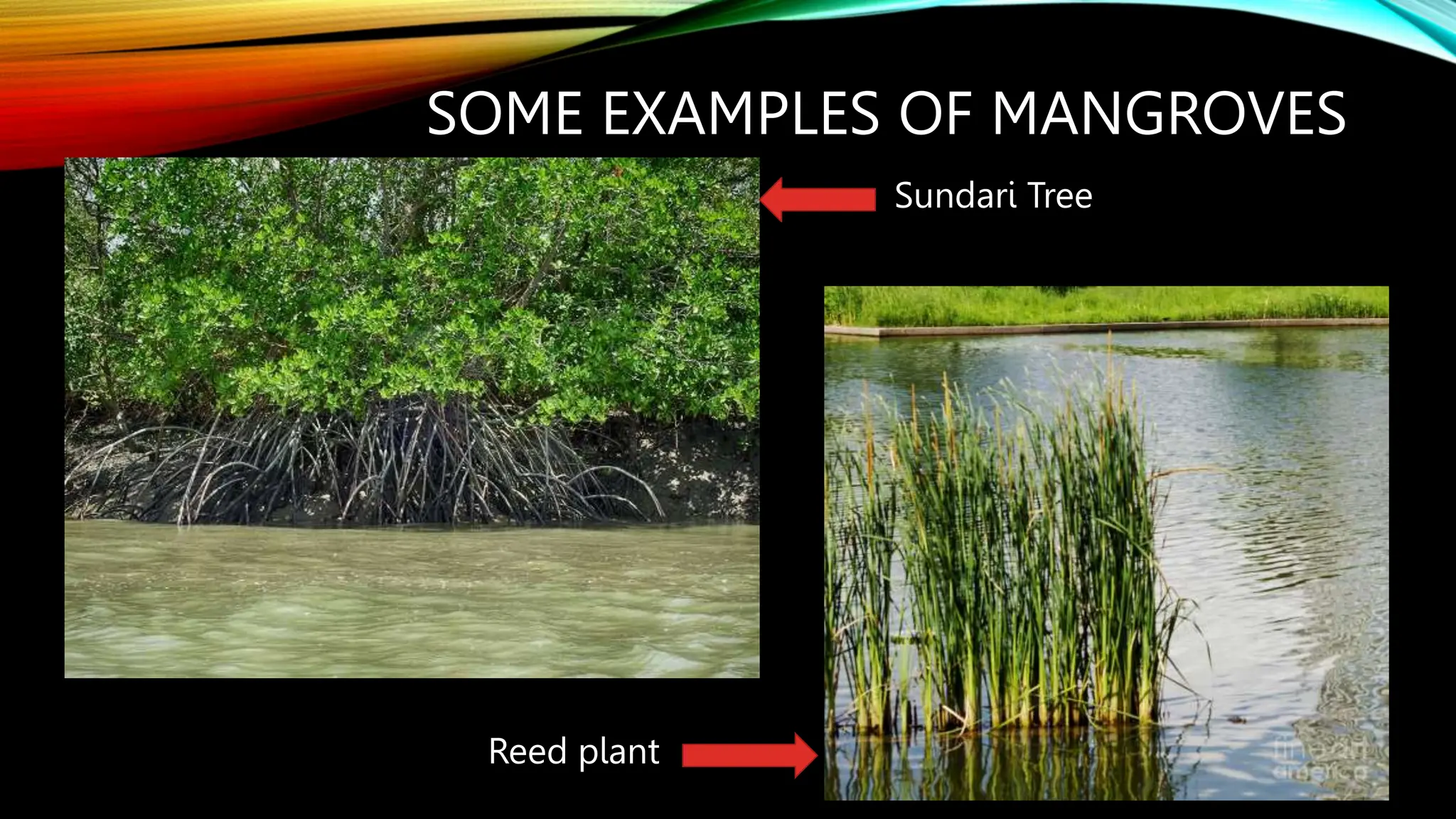
 Plants also have roots that grow up and out of the water to
breathe. These roots take in air and carry it to the stems, roots
and leaves. Such roots are called as ‘breathing roots’.
SOME EXAMPLES OF MANGROVES
Sundari Tree
Reed plant
1) Which habitat do coconut trees grow in ?
2) In which habitat does a sundari tree grows ?
3) What are breathing roots ?
Coastal areas
Marshlands
Exposed part of the roots that grows above the water filled soil and
allows exchanges of gases are called breathing roots.
INTERESTING ADAPTATIONS OF
INSECTIVOROUS PLANTS
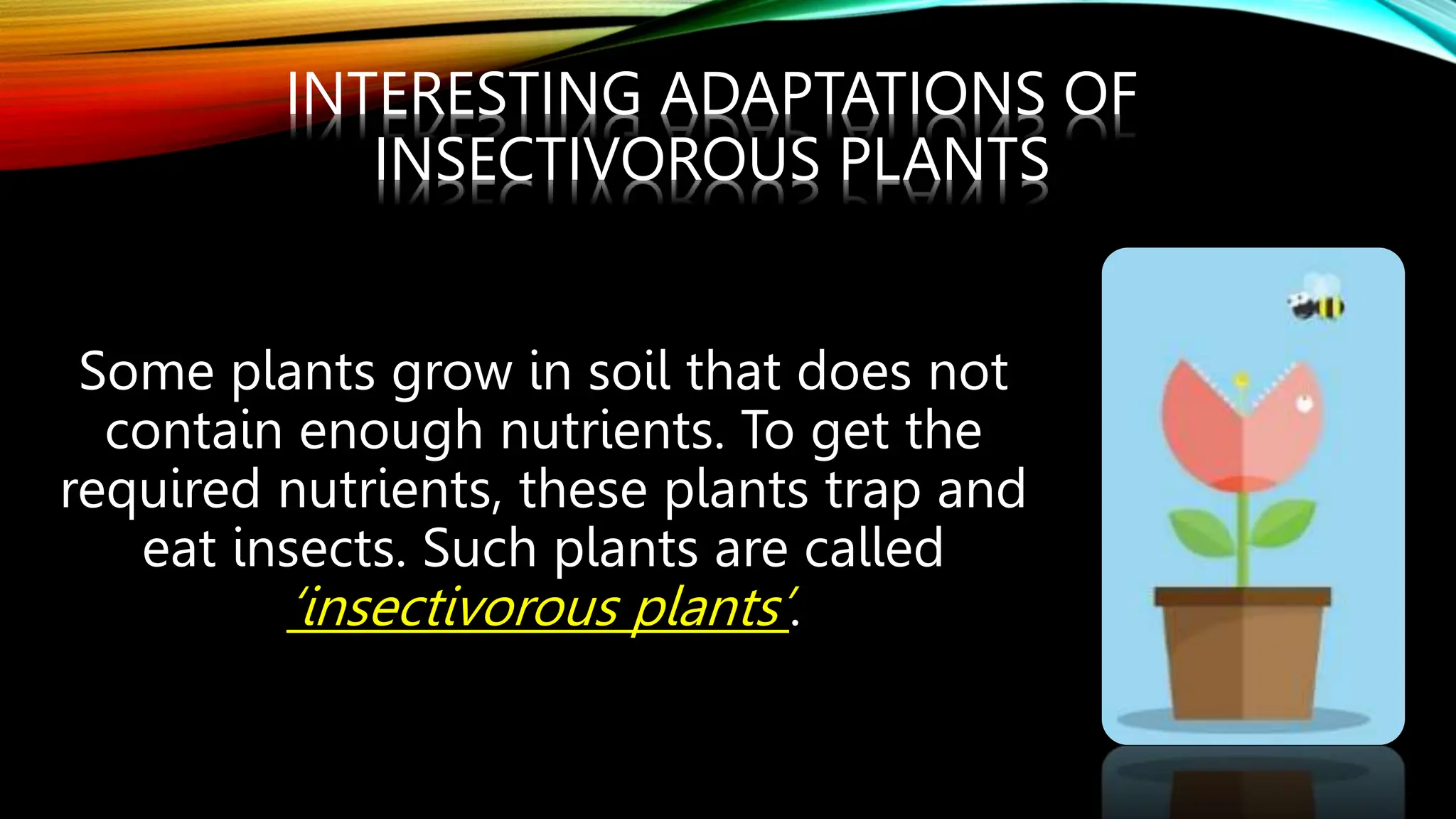
Some plants grow in soil that does not
contain enough nutrients. To get the
required nutrients, these plants trap and
eat insects. Such plants are called
‘insectivorous plants’.
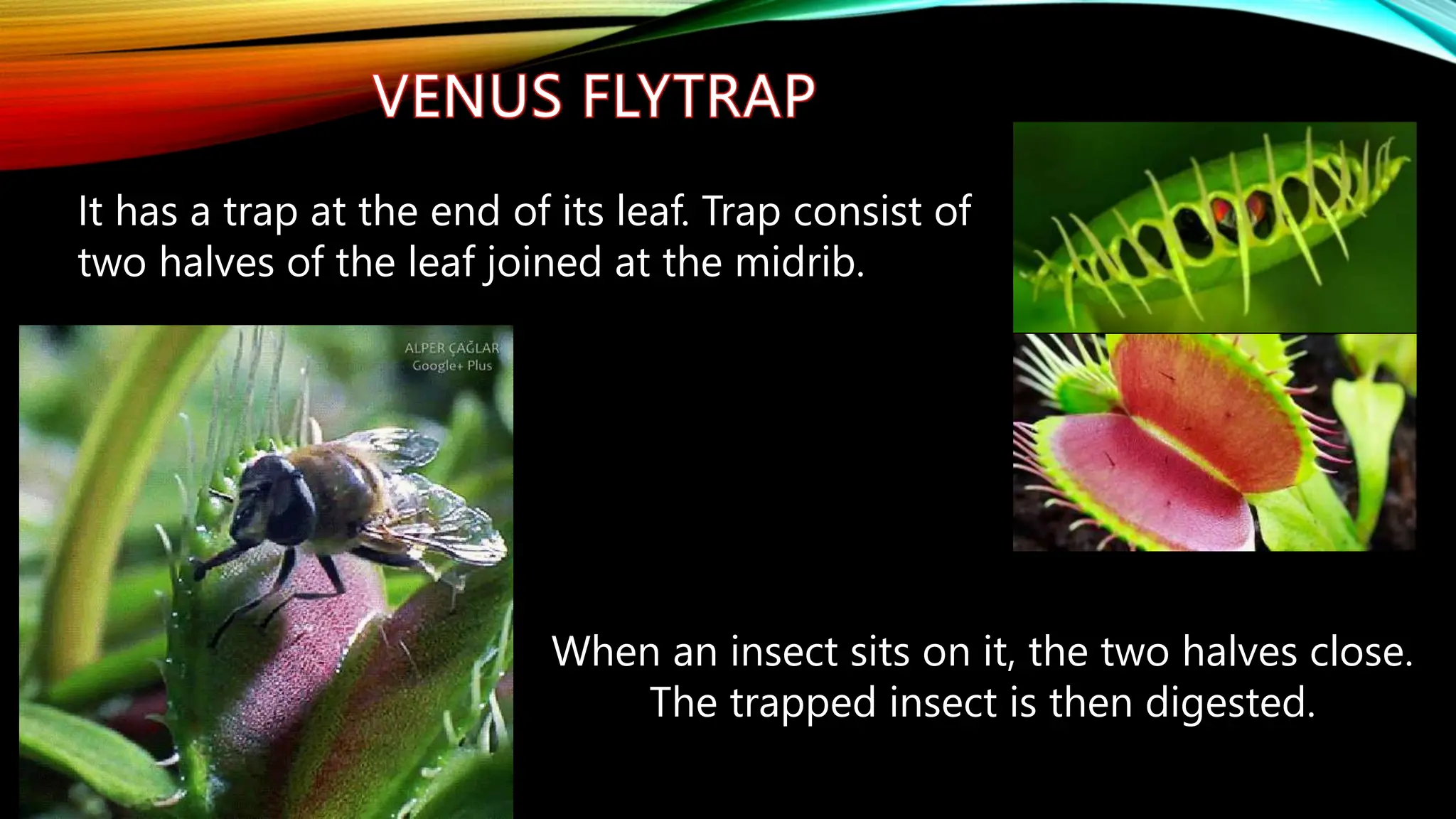
It has a trap at the end of its leaf. Trap consist of
two halves of the leaf joined at the midrib.
When an insect sits on it, the two halves close.
The trapped insect is then digested.
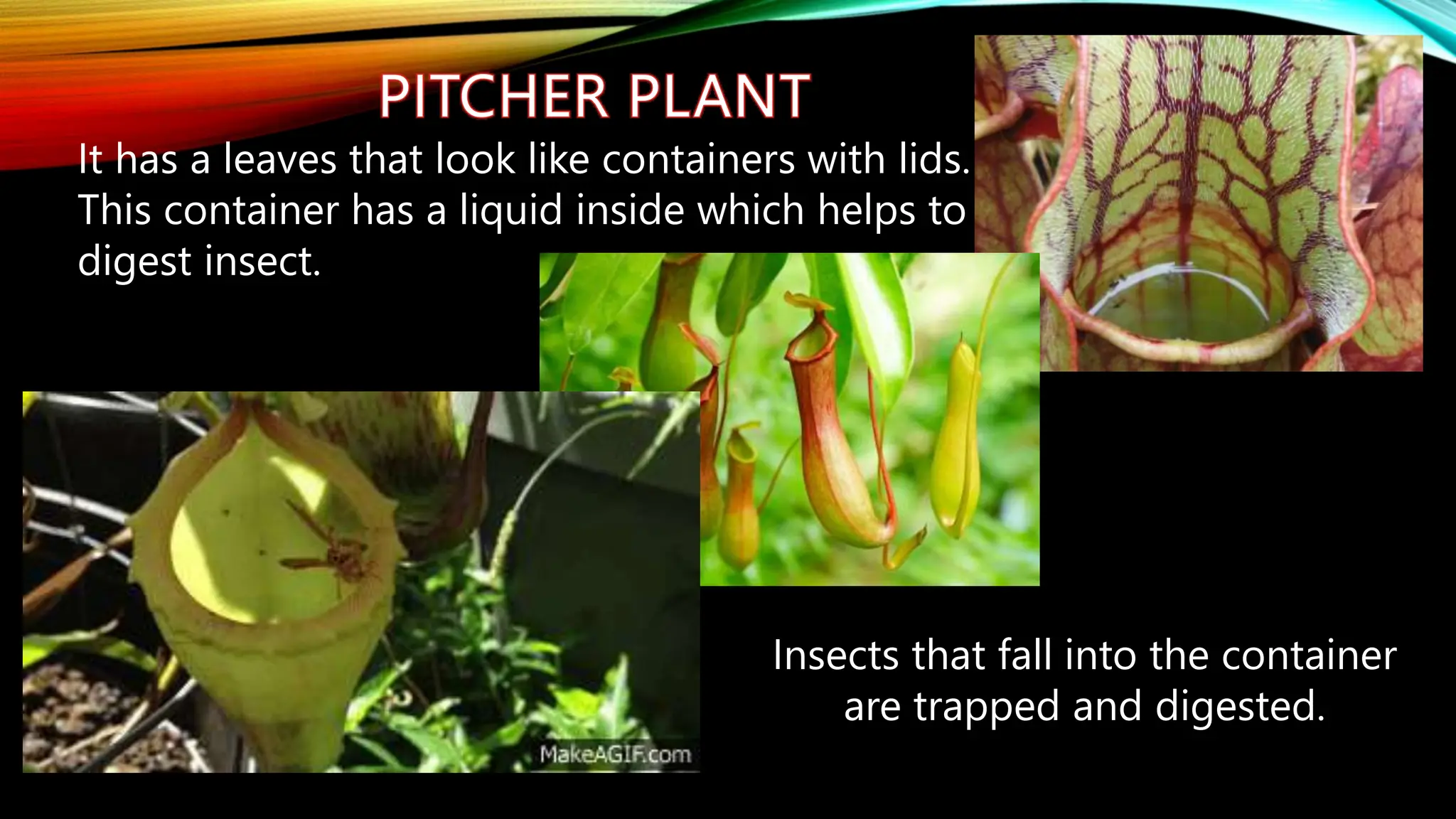
It has a leaves that look like containers with lids.
This container has a liquid inside which helps to
digest insect.
Insects that fall into the container
are trapped and digested.
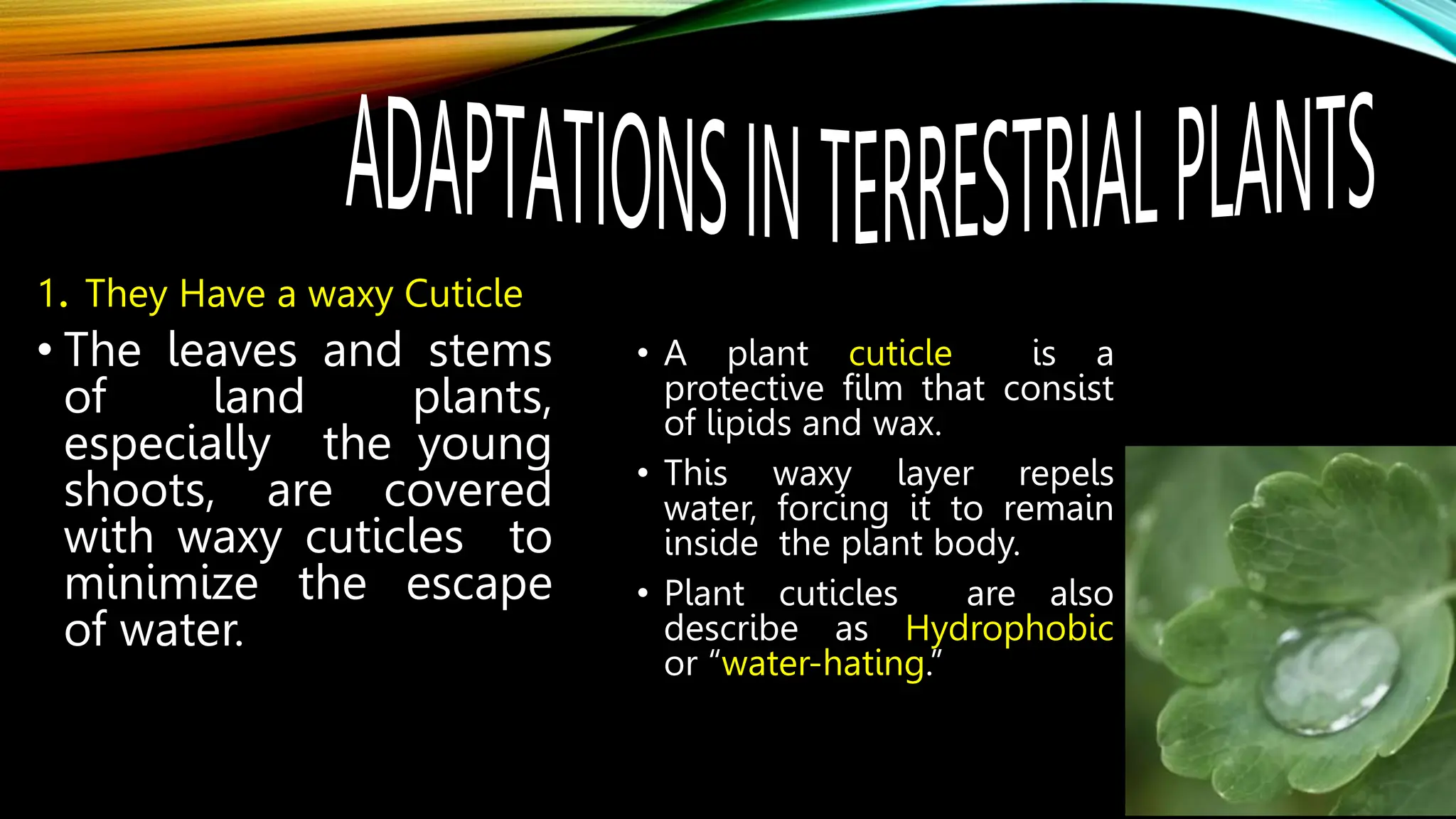
1. They Have a waxy Cuticle
• The leaves and stems
of land plants,
especially the young
shoots, are covered
with waxy cuticles to
minimize the escape
of water.
• A plant cuticle is a
protective film that consist
of lipids and wax.
• This waxy layer repels
water, forcing it to remain
inside the plant body.
• Plant cuticles are also
describe as Hydrophobic
or “water-hating.”
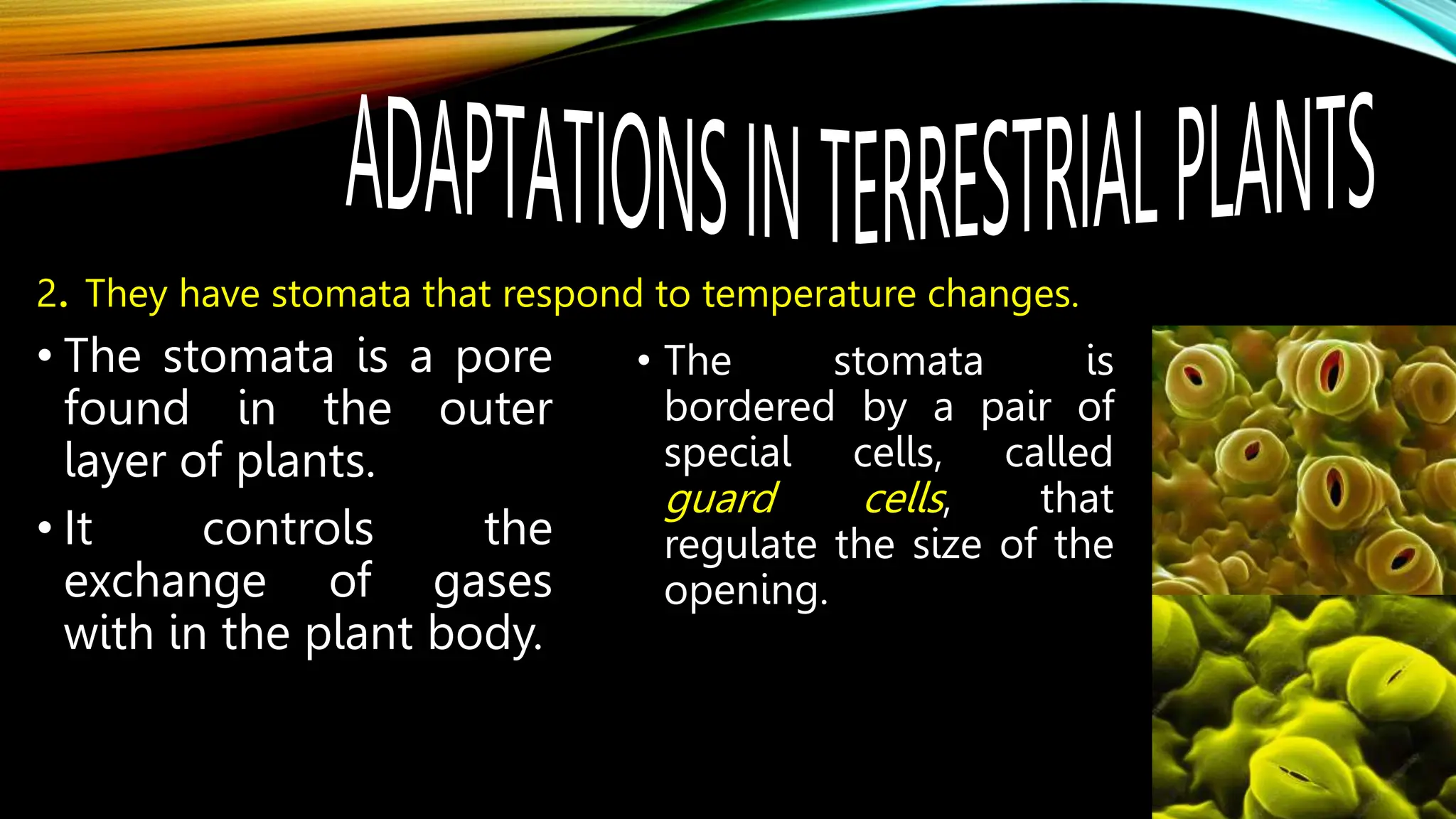
2. They have stomata that respond to temperature changes.
• The stomata is a pore
found in the outer
layer of plants.
• It controls the
exchange of gases
with in the plant body.
• The stomata is
bordered by a pair of
special cells, called
guard cells, that
regulate the size of the
opening.
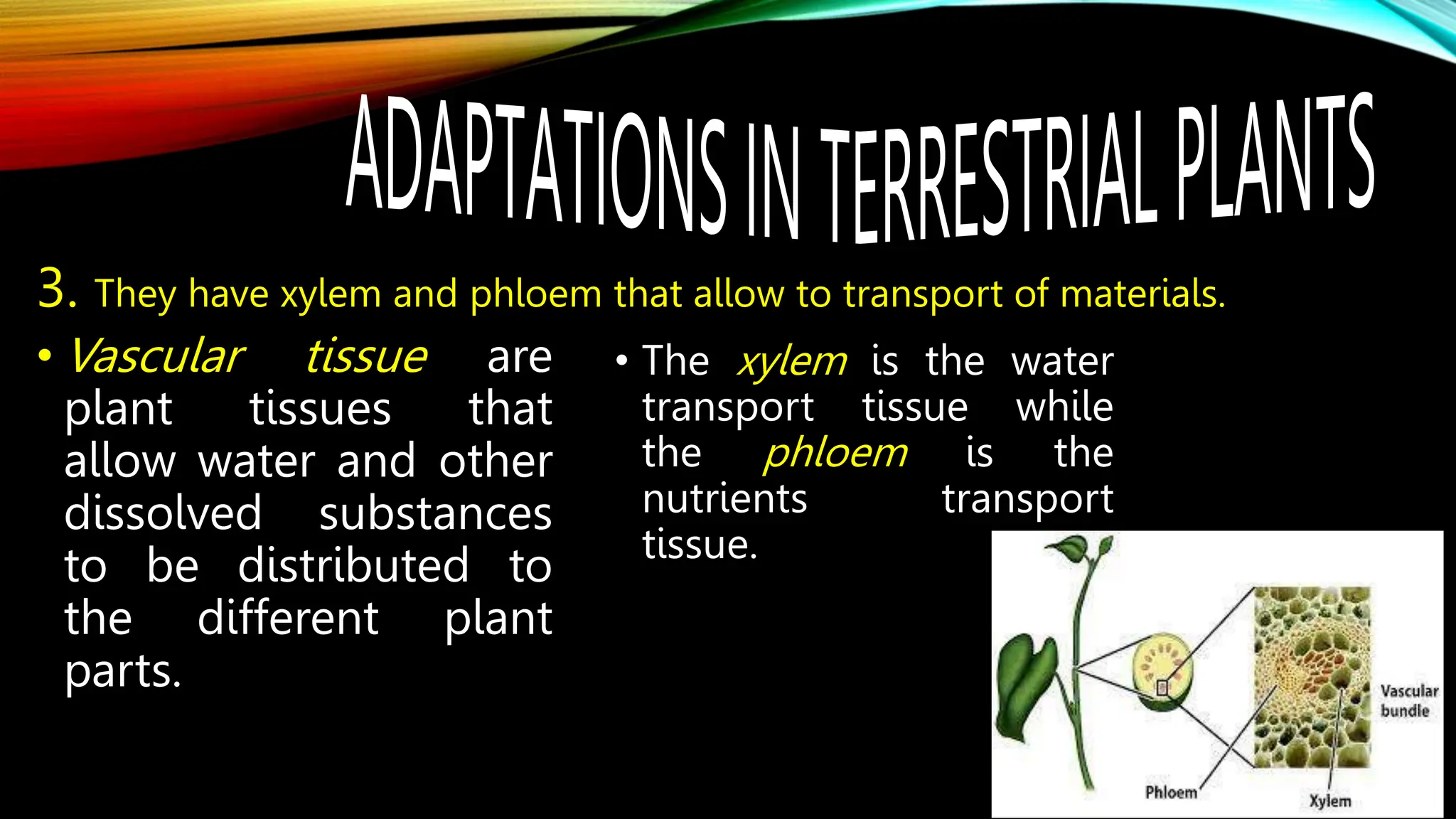
3. They have xylem and phloem that allow to transport of materials.
• Vascular tissue are
plant tissues that
allow water and other
dissolved substances
to be distributed to
the different plant
parts.
• The xylem is the water
transport tissue while
the phloem is the
nutrients transport
tissue.
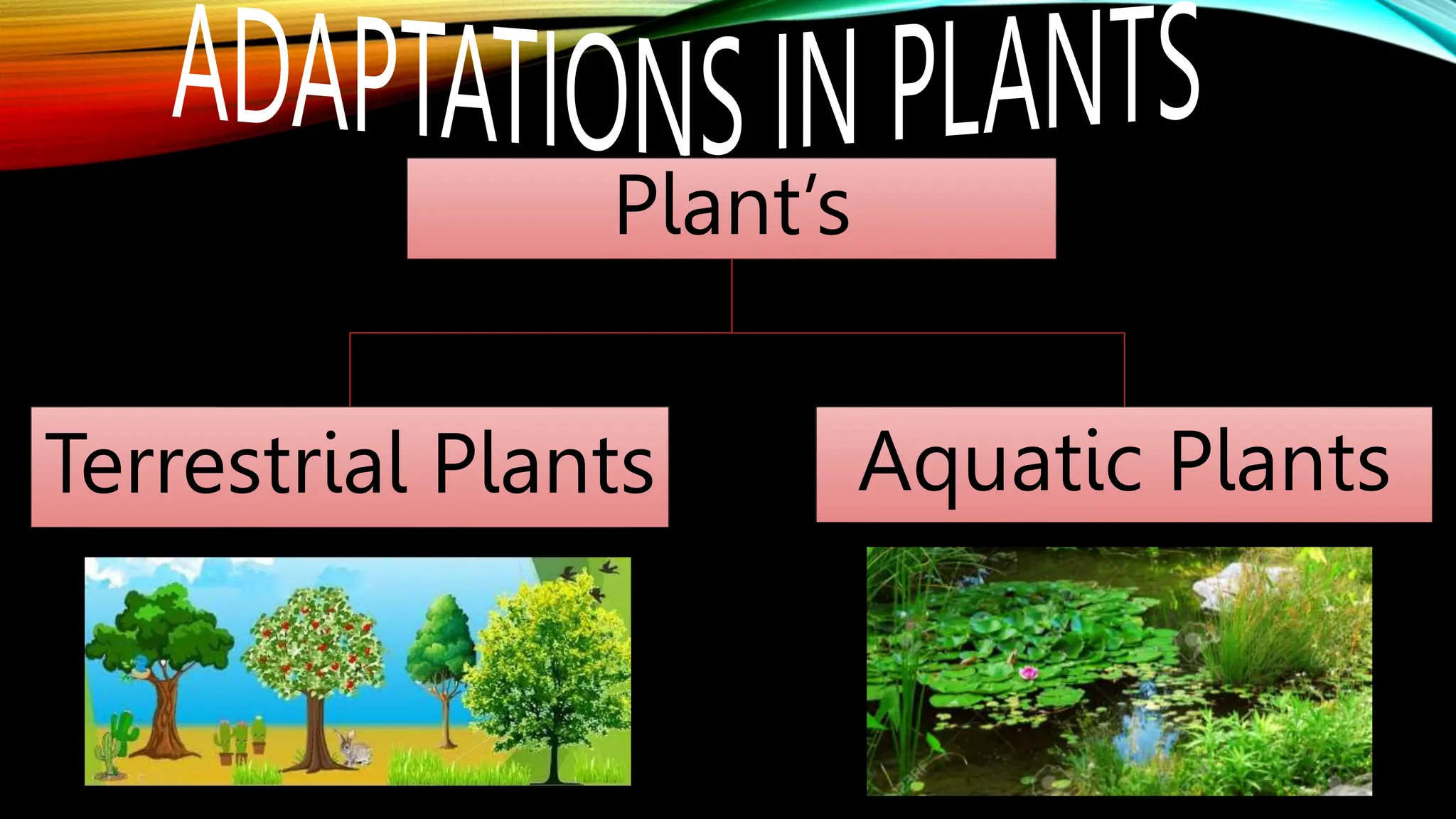
Plant’s
Terrestrial Plants Aquatic Plants
AQUATIC PLANTS
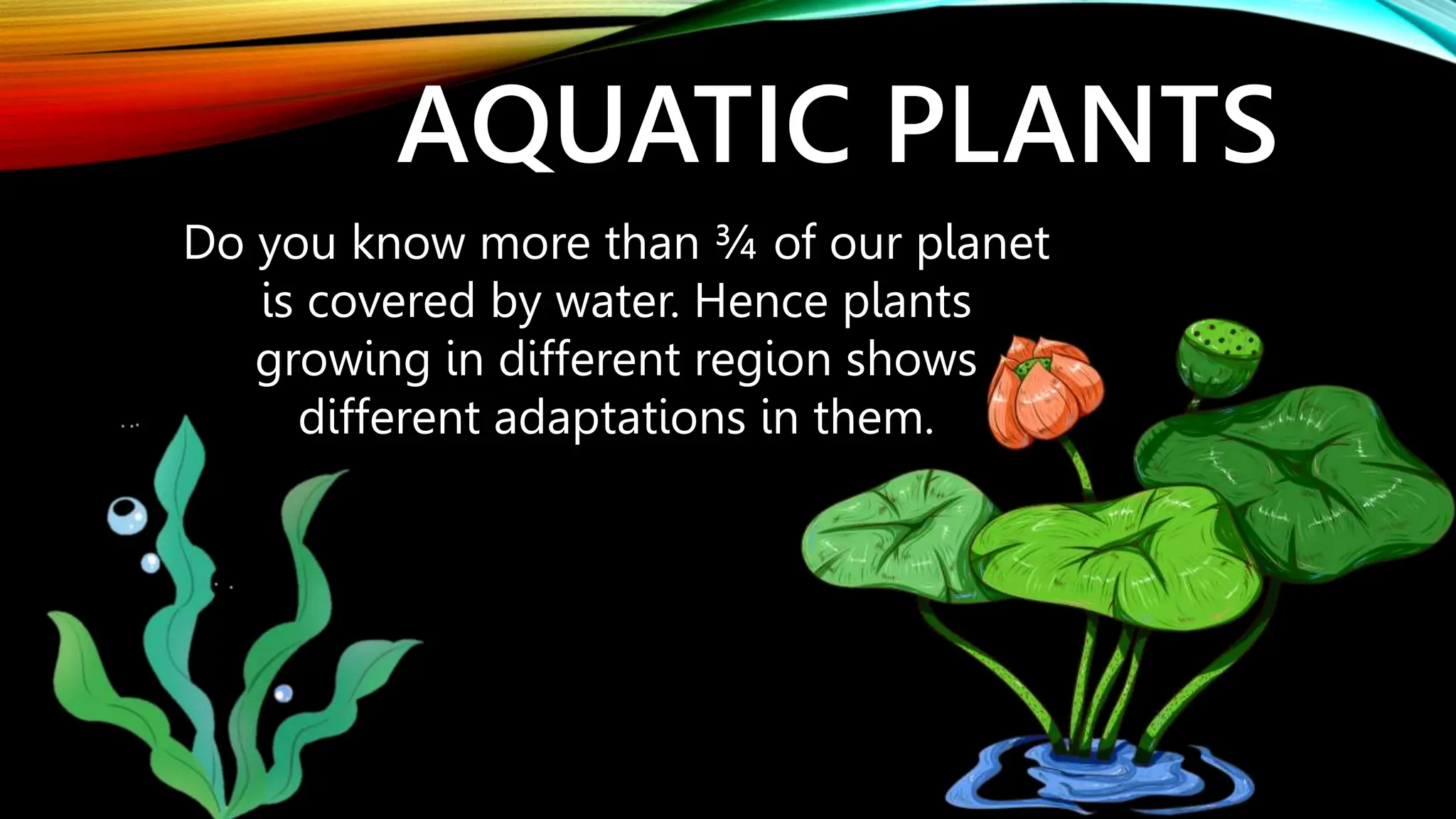
Do you know more than ¾ of our planet
is covered by water. Hence plants
growing in different region shows
different adaptations in them.
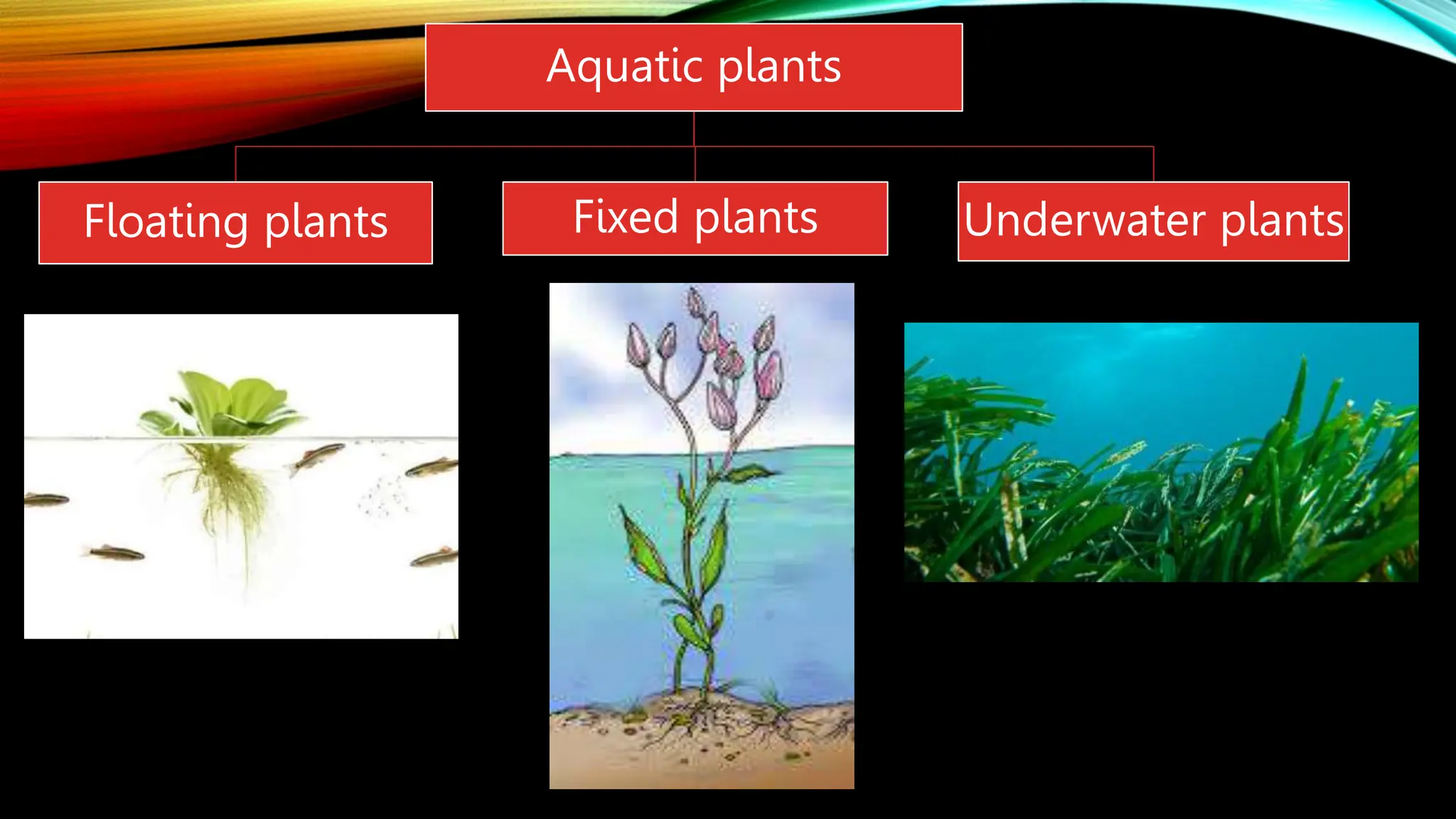
Aquatic plants
Floating plants Fixed plants Underwater plants
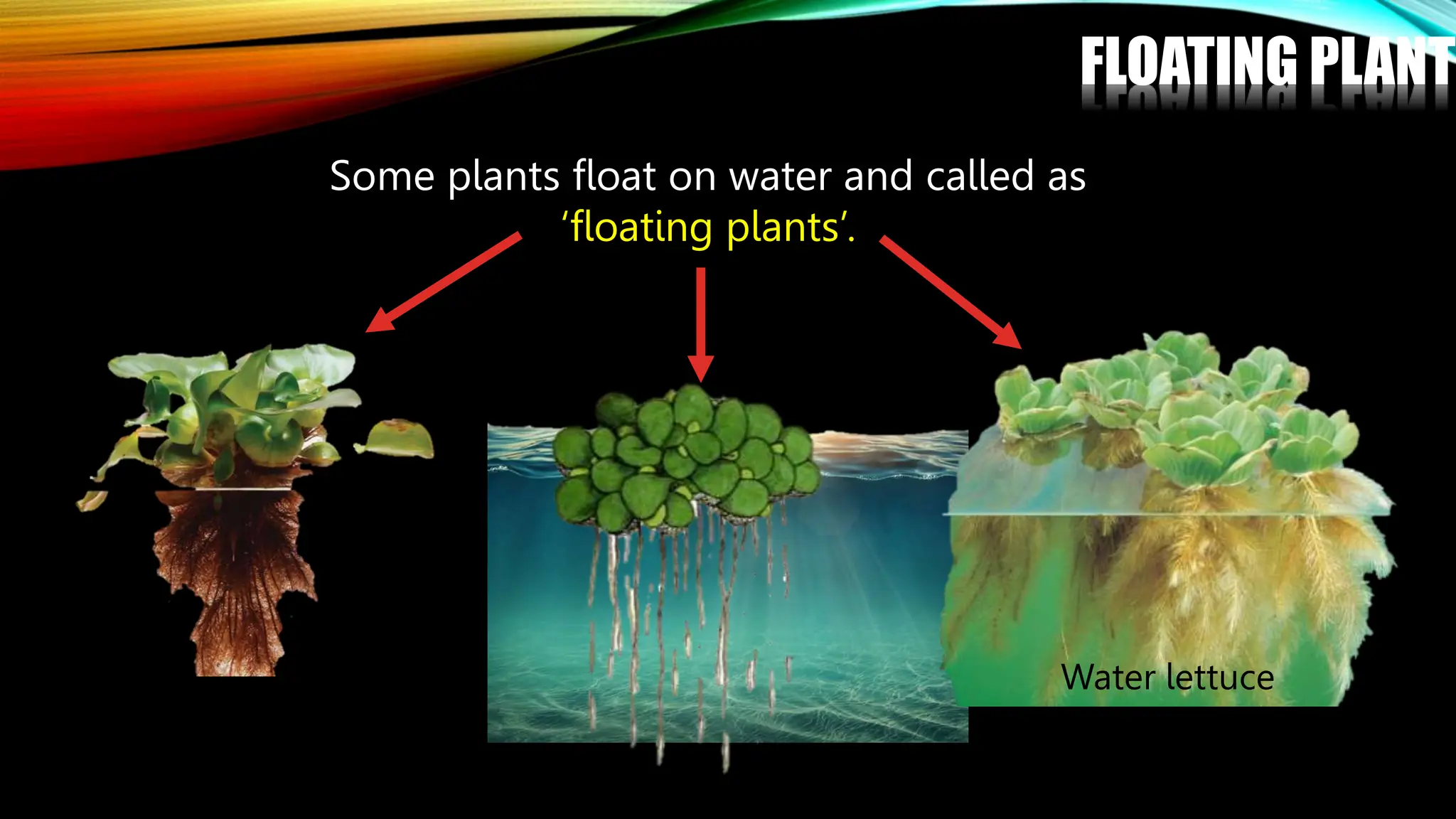
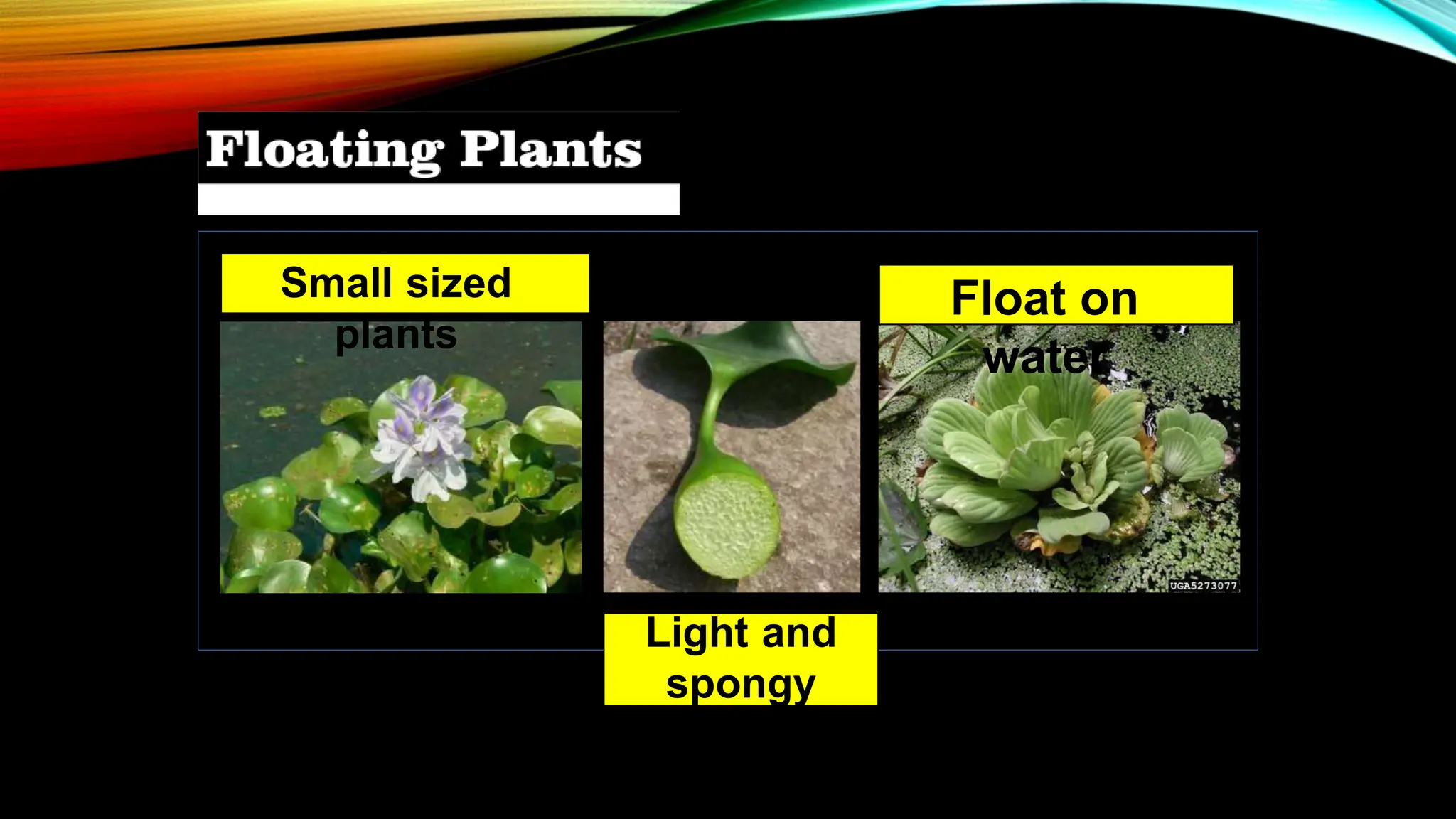
FLOATING PLANTS
Water lettuce
Water hyacinth
Some plants float on water and called as
‘floating plants’.
Duckweed
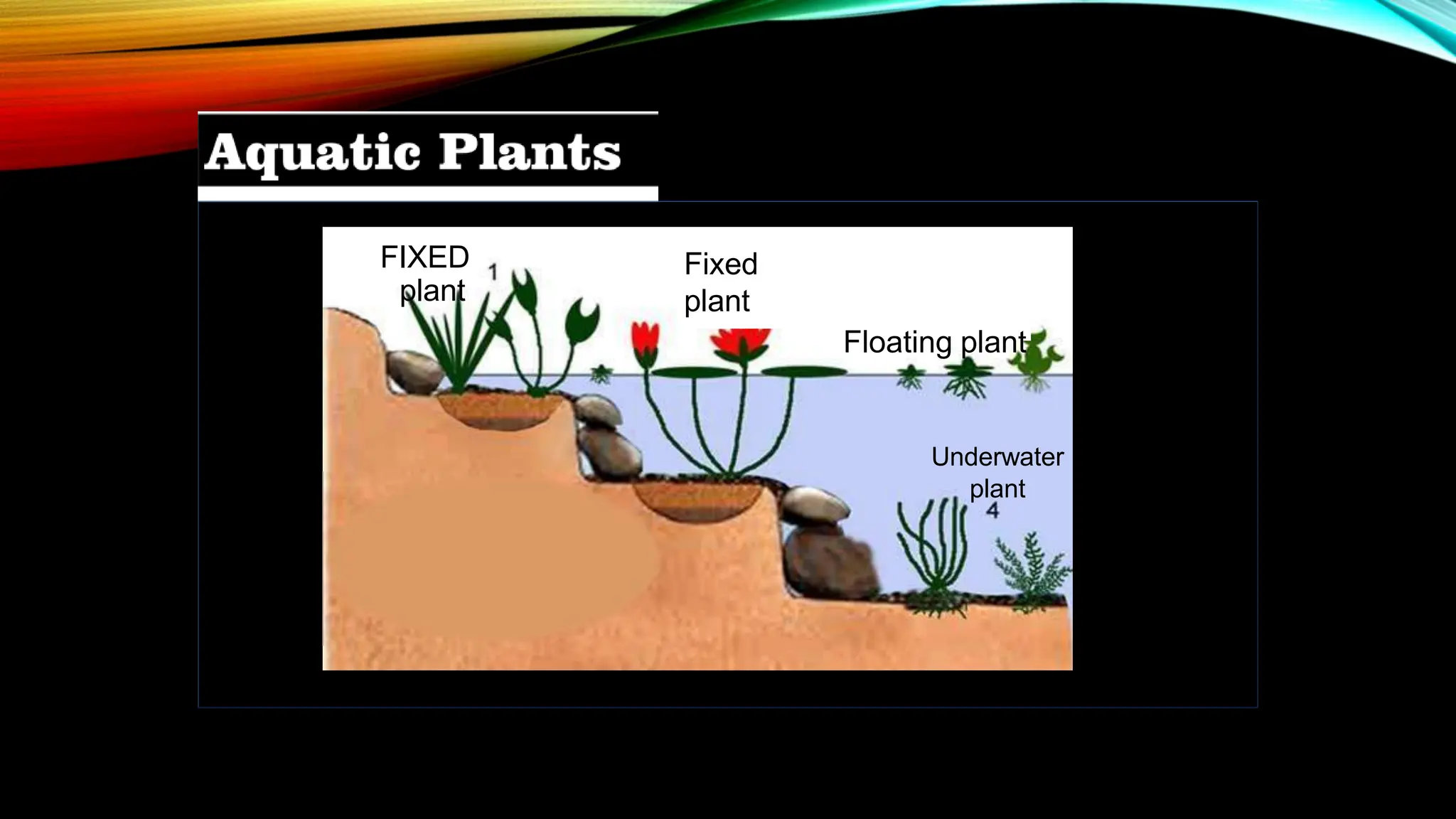
FIXED
plant
Fixed
plant
Floating plant
Underwater
plant
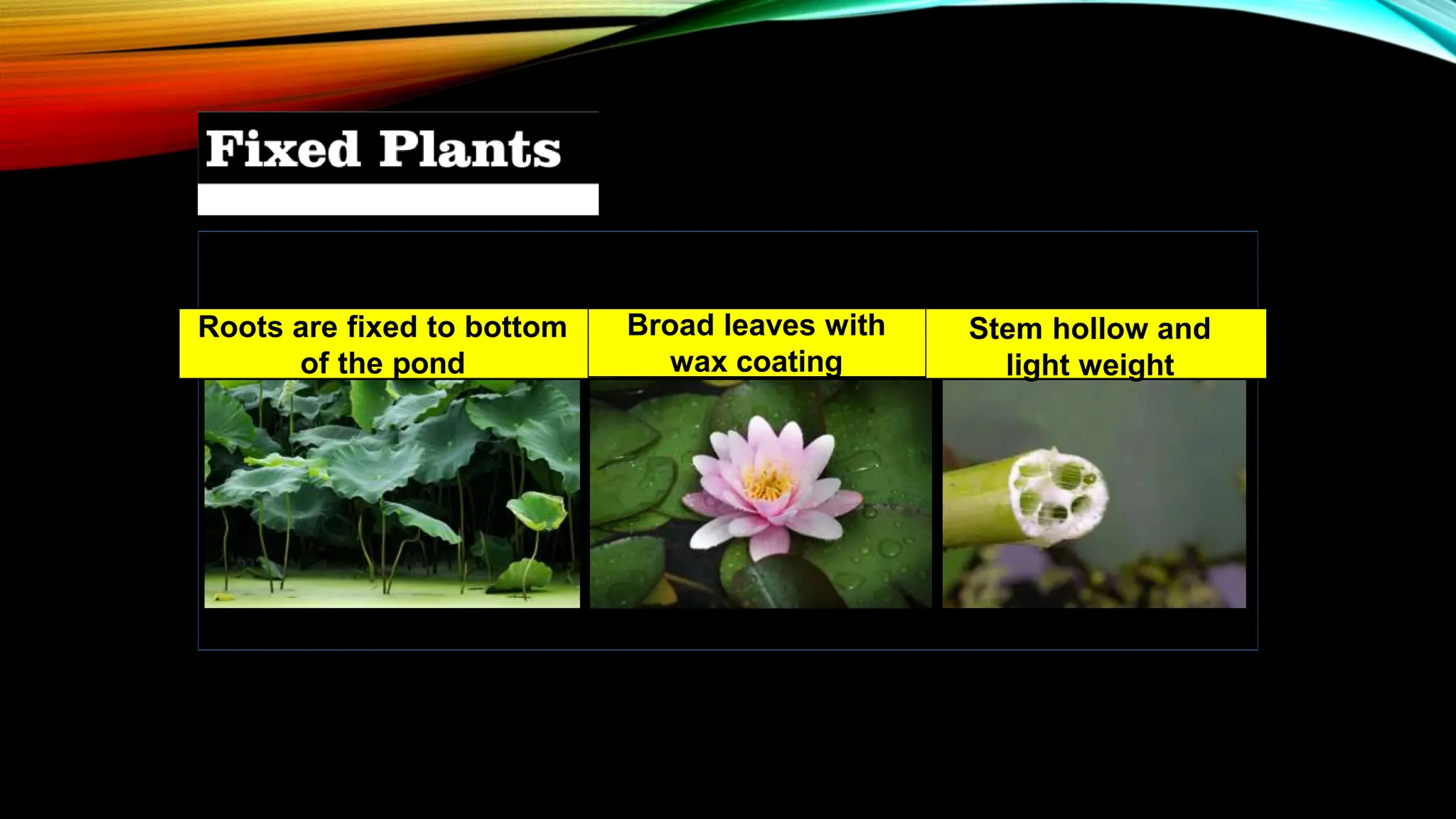
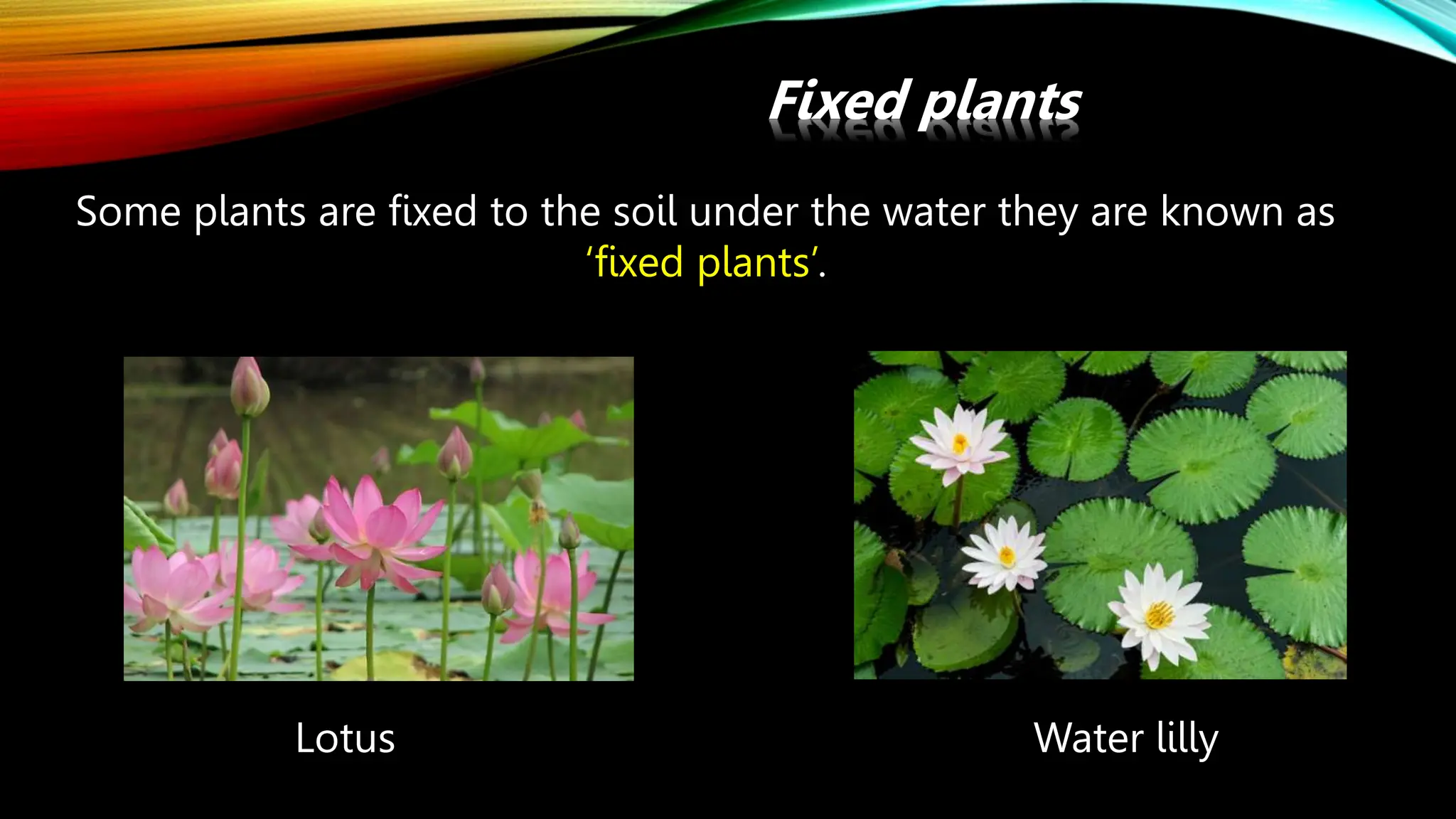
Roots are fixed to bottom
of the pond
Broad leaves with
wax coating
Stem hollow and
light weight
Light and
spongy
stem
Small sized
plants
Float on
water
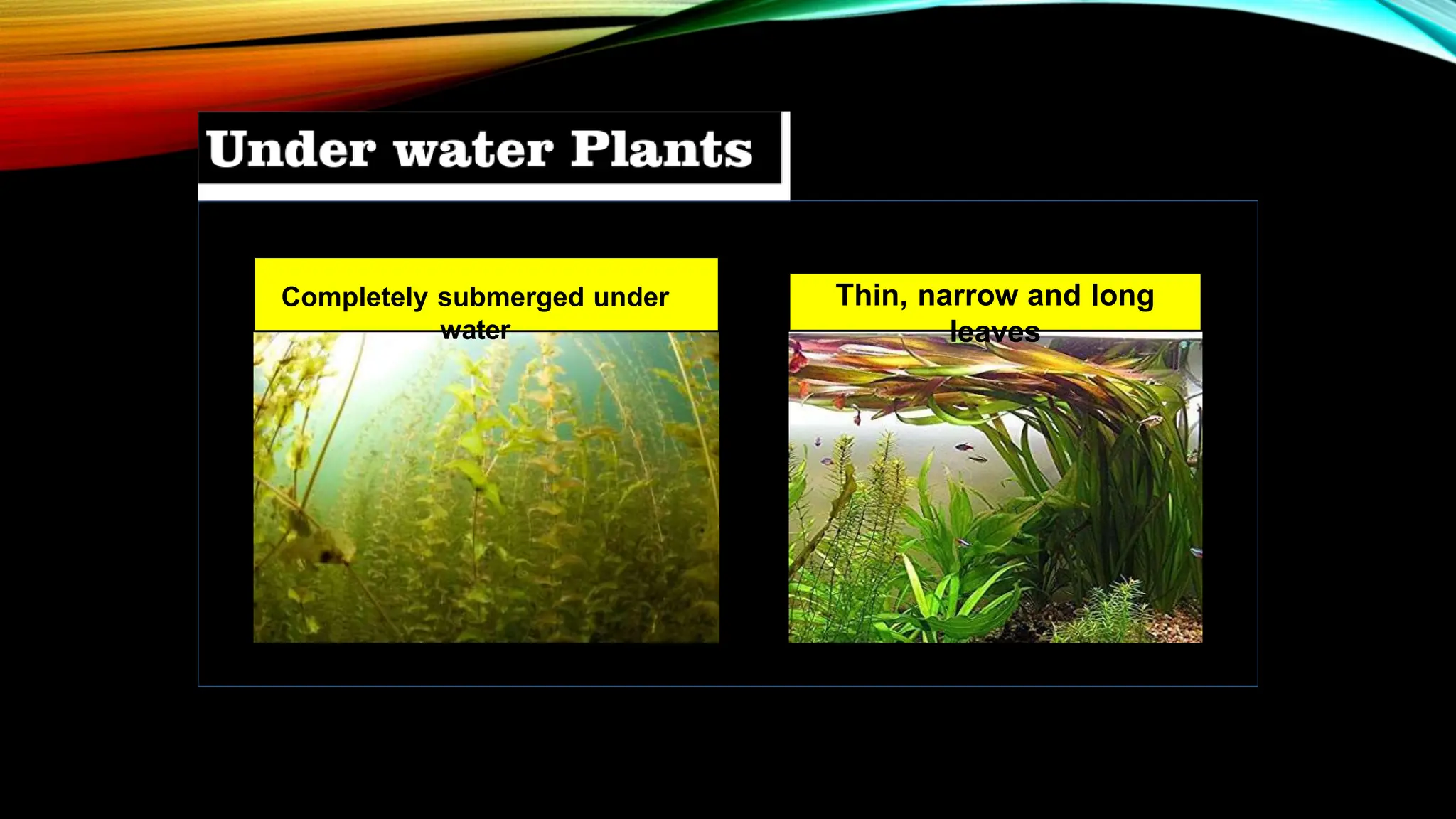
Completely submerged under
water
Thin, narrow and long
leaves
• Stems are light and filled with air.
• Leaves are filled with air to help them float.
• Stomata are on the upper side on the leaves.
• Long roots hang free in the water to take in nutrients.
Adaptations in floating plants
Fixed plants
Some plants are fixed to the soil under the water they are known as
‘fixed plants’.
Lotus Water lilly
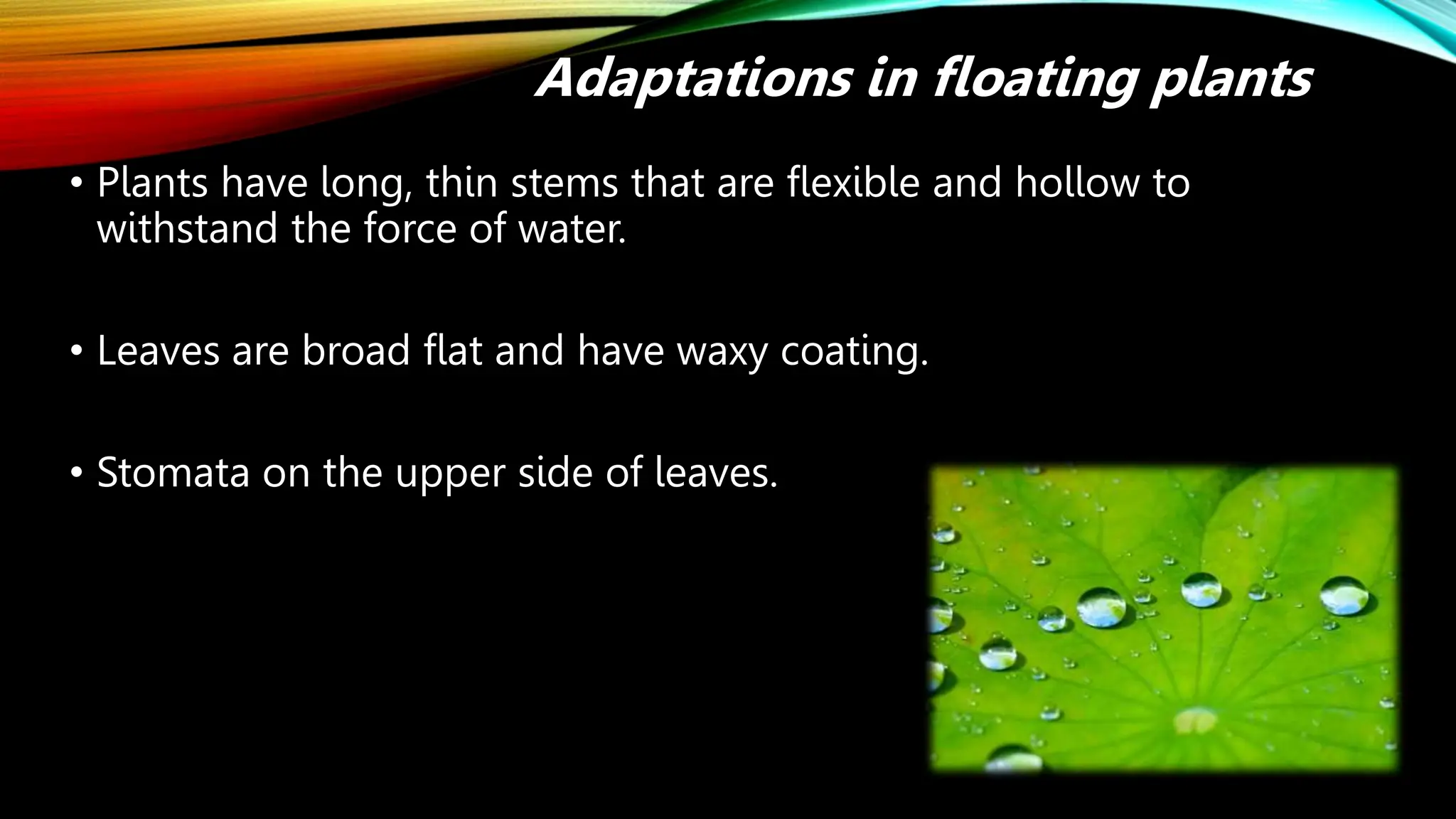
• Plants have long, thin stems that are flexible and hollow to
withstand the force of water.
• Leaves are broad flat and have waxy coating.
• Stomata on the upper side of leaves.
Adaptations in floating plants
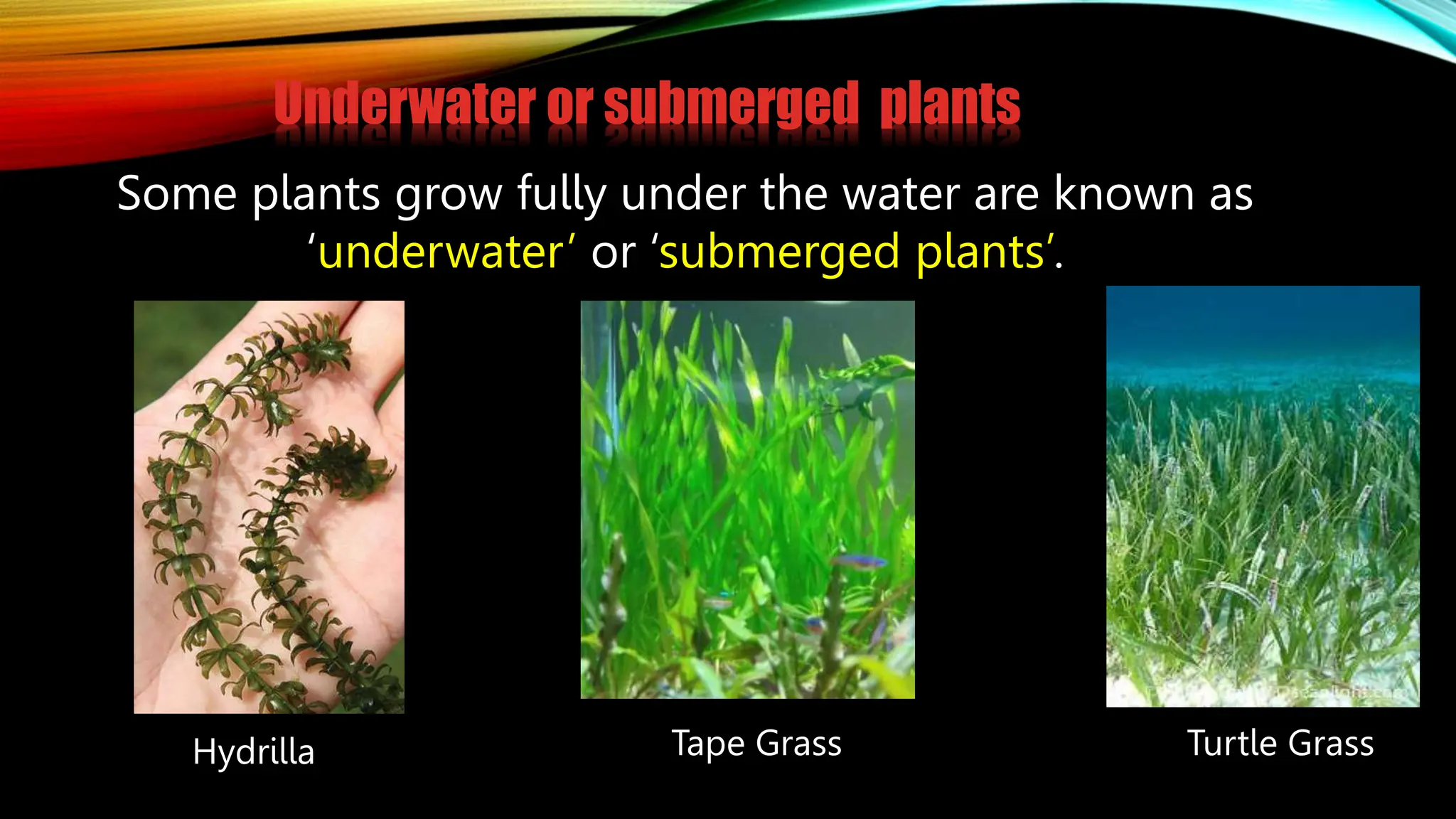
Underwater or submerged plants
Some plants grow fully under the water are known as
‘underwater’ or ‘submerged plants’.
Hydrilla Tape Grass Turtle Grass
ADAPTATIONS IN UNDERWATER PLANTS
• Plants have flexible stems.
• Roots are not well developed since they do not
have to search for water.
• Leaves are thin, narrow and pointed. It helps free
flow of water.
• Most of them do not have stomata.
( do not carry out transpiration )
Adaptations of plants of different habitat GRADE 4 science

Adaptations of plants of different habitat GRADE 4 science

  • 2.
    People from U.SPeople from Africa People from Philippines People from China
  • 3.
    As we knowthat people from different region of world shows different characteristics such as physical appearance , language , height etc. It’s similar with plants as well Let’s find out “Plants grow in most places on the earth”
  • 4.
    Plants in plains Plantson hills Plants on snow- clad mountains Plants in oceans Plants in deserts
  • 5.
    Find out whatis the difference between group ‘A’ plants and group ‘B’ plants
  • 6.
  • 7.
    WE CAN BROADLYDIVIDE PLANTS INTO TWO GROUPS 1) TERRESTRIAL PLANTS – PLANTS THAT GROW ON LAND 2) AQUATIC PLANTS- PLANTS THAT GROW IN WATER Lets take an example and understand “what is Habitat”
  • 8.
    Conclusion : Camelcan not live in Iceland region’s, but can easily thrive in desert region.
  • 9.
    The natural homeof an organism, where it lives and grows, is called “Habitat”. Conclusion : fish can not live on land, but can easily thrive in aquatic environment.
  • 10.
    SOME EXAMPLES OFHABITAT’S Desert Iceland Coastal Hills
  • 11.
    EACH HABITAT HASDIFFERENT LIVING CONDITIONS Habitat Temperature Type of soil Availability of sunlight Rain fall
  • 12.
    LIVING THINGS HAVESPECIAL CHARACTERISTICS OR FEATURES CALLED “ADAPTATIONS” ADAPTATION
  • 13.
    POLAR BEAR LIVESIN ARCTIC REGION TEMPERATURE IN ARCTIC REGION RANGES FROM -2°C TO -35°C TO SURVIVE POLAR BEAR HAVE DEVELOPED THICK LAYER OF BODY FAT WHICH PROTECT FROM SUCH LOW TEMPERATURES. Thick layer of skin Living things have special characteristics or features called “Adaptations”
  • 14.
    WHAT WILL HAPPENIF I PLACE POLAR BEAR IN DESERT ? WHERE THE TEMPERATURE IS 38°C DURING DAY Without adaptations , a plant or animal may not be able to survive in that habitat
  • 15.
  • 16.
    ADAPTATION IN TERRESTRIALPLANTS ( PLANTS ON LAND ) Plants in different habitats on land show different adaptations. Plants in deserts Plants in mountains Plants in the plains
  • 17.
    Plants in coastalareas Plants in Marshlands
  • 18.
    PLANTS IN DESERTS Aplace that receives very little rainfall is called a “desert”. • Very little rainfall a year • During the day, desert temperatures rise to an average of 38°C • During night, desert temperatures fall to an average of -3.9°C
  • 19.
    WHAT FEATURES ORCHARACTERISTICS PLANTS HAVE DEVELOPED TO LIVE IS SUCH DRY HABITAT Water is stored in the stem of the plant , Hence stems are fleshy and have a thick waxy skin. Leaves have been converted into spines , which helps to reduce water loss as well as to protect the plant from being eaten.
  • 20.
     Process Photosynthesisis carried out by Green stem.  Roots may grow deep into soil in search of water or may form network of roots to intake water before it evaporates.
  • 21.
    OTHER PLANTS THATGROW IN DESERT Brittlebush Date palm Mesquite bush
  • 22.
    PLANTS IN THEMOUNTAINS • Climate can be very cold on mountains. • In winters , there may be heavy snowfall.
  • 23.
    What features orcharacteristics plants have developed to live is such cold and snowy habitat Trees grow tall and have conical shape to enable snow to slide off easily. Leaves are needle shaped with a waxy coating to prevent loss of water.
  • 24.
     Many treesin such region do not have flowers. Instead they have cones which contains seeds. Deciduous trees Some trees shed their leaves to protect themselves from cold or heat they are known as ‘Deciduous trees’. Evergreen trees Trees which do not shed all their leaves at the same time are called ‘evergreen trees’.
  • 25.
    Deciduous trees Oak Tree Inwinter In winter Maple Tree
  • 26.
  • 27.
    Plants in theplains Areas on the earth which are flat and which are warmer than the mountains such regions are known as plains. Plains with low rainfall Plains with heavy rainfall
  • 28.
    Deciduous trees Some treesshed their leaves to protect themselves from cold or heat they are known as ‘Deciduous trees’. Evergreen trees Trees which do not shed all their leaves at the same time are called ‘evergreen trees’.
  • 29.
    ADAPTATIONS IN PLANTSTHAT GROW IN THE PLAINS WITH LOW RAINFALL • Trees have many branches with broad leaves. • In hotter plains, some trees loose their leaves in summer to protect themselves from the heat. Eg. Indian almond tree ( Deciduous tree ).
  • 30.
    SOME OF THETREES GROW IN THE PLAINS Neem Tree Sandalwood Tree Teak Tree
  • 31.
    In such environmentalconditions plants compete for Light, food and space. Adaptations in plants that grow in the plains with heavy rainfall Bamboo plant Rubber Tree
  • 32.
     Trees aremostly evergreen. They are tall with branches and leaves near the top.  The leaves are broad to catch the sunlight that penetrates. The leaves have pointed tips and a waxy coating. This enables rainwater to run off.  The bark of these trees is thick and smooth. This allows water to run down easily. What features or characteristics plants have developed to live is such conditions Jackfruit plant leaves Rubber tree bark
  • 33.
  • 34.
    QUICK CHECK 1)A neemtree is a terrestrial / Aquatic plant. 2)A desert is a / an adaptation / habitat where a cactus grows. 3)Cactus have spines is the adaptation / habitat. 4)Pine trees have Flowers / Cones which contain seeds. 5)The Indian almond tree is a deciduous / evergreen tree.
  • 35.
     Wet andwindy climate  Soil is sandy  Water is salty Plants in coastal areas
  • 36.
    What features orcharacteristics plants have developed to live is such conditions Trees are tall with hard, round trunks. Entire leaf is cut into strips. This helps the wind to rush through it without tearing it. The leaves are waterproof.
  • 37.
    The roots arelong and spread wide. The seeds are dispersed by water.
  • 38.
    Plants in Marshlands Someareas are waterlogged and are called ‘marshlands’.  Wet and muddy region  Less oxygen Most plants found in marshlands are called ‘Mangroves’.
  • 39.
    • Plants havelarge air spaces in the stem to store air in case of need. What features or characteristics plants have developed to live is such conditions  Plants also have roots that grow up and out of the water to breathe. These roots take in air and carry it to the stems, roots and leaves. Such roots are called as ‘breathing roots’.
  • 40.
    SOME EXAMPLES OFMANGROVES Sundari Tree Reed plant
  • 41.
    1) Which habitatdo coconut trees grow in ? 2) In which habitat does a sundari tree grows ? 3) What are breathing roots ? Coastal areas Marshlands Exposed part of the roots that grows above the water filled soil and allows exchanges of gases are called breathing roots.
  • 43.
    INTERESTING ADAPTATIONS OF INSECTIVOROUSPLANTS Some plants grow in soil that does not contain enough nutrients. To get the required nutrients, these plants trap and eat insects. Such plants are called ‘insectivorous plants’.
  • 44.
    It has atrap at the end of its leaf. Trap consist of two halves of the leaf joined at the midrib. When an insect sits on it, the two halves close. The trapped insect is then digested.
  • 45.
    It has aleaves that look like containers with lids. This container has a liquid inside which helps to digest insect. Insects that fall into the container are trapped and digested.
  • 46.
    1. They Havea waxy Cuticle • The leaves and stems of land plants, especially the young shoots, are covered with waxy cuticles to minimize the escape of water. • A plant cuticle is a protective film that consist of lipids and wax. • This waxy layer repels water, forcing it to remain inside the plant body. • Plant cuticles are also describe as Hydrophobic or “water-hating.”
  • 47.
    2. They havestomata that respond to temperature changes. • The stomata is a pore found in the outer layer of plants. • It controls the exchange of gases with in the plant body. • The stomata is bordered by a pair of special cells, called guard cells, that regulate the size of the opening.
  • 48.
    3. They havexylem and phloem that allow to transport of materials. • Vascular tissue are plant tissues that allow water and other dissolved substances to be distributed to the different plant parts. • The xylem is the water transport tissue while the phloem is the nutrients transport tissue.
  • 49.
  • 50.
    AQUATIC PLANTS Do youknow more than ¾ of our planet is covered by water. Hence plants growing in different region shows different adaptations in them.
  • 51.
    Aquatic plants Floating plantsFixed plants Underwater plants
  • 52.
    FLOATING PLANTS Water lettuce Waterhyacinth Some plants float on water and called as ‘floating plants’. Duckweed
  • 53.
  • 54.
    Roots are fixedto bottom of the pond Broad leaves with wax coating Stem hollow and light weight
  • 55.
  • 56.
  • 57.
    • Stems arelight and filled with air. • Leaves are filled with air to help them float. • Stomata are on the upper side on the leaves. • Long roots hang free in the water to take in nutrients. Adaptations in floating plants
  • 58.
    Fixed plants Some plantsare fixed to the soil under the water they are known as ‘fixed plants’. Lotus Water lilly
  • 59.
    • Plants havelong, thin stems that are flexible and hollow to withstand the force of water. • Leaves are broad flat and have waxy coating. • Stomata on the upper side of leaves. Adaptations in floating plants
  • 60.
    Underwater or submergedplants Some plants grow fully under the water are known as ‘underwater’ or ‘submerged plants’. Hydrilla Tape Grass Turtle Grass
  • 61.
    ADAPTATIONS IN UNDERWATERPLANTS • Plants have flexible stems. • Roots are not well developed since they do not have to search for water. • Leaves are thin, narrow and pointed. It helps free flow of water. • Most of them do not have stomata. ( do not carry out transpiration )