Learning to Trade with Q-Reinforcement Learning
(A tensorflow and Python focus)
Ben Ball & David Samuel
www.prediction-machines.com
Special thanks to -
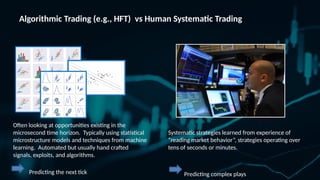
Algorithmic Trading (e.g., HFT) vs Human Systematic Trading
Often looking at opportunities existing in the
microsecond time horizon. Typically using statistical
microstructure models and techniques from machine
learning. Automated but usually hand crafted
signals, exploits, and algorithms.
Predicting the next tick
Systematic strategies learned from experience of
“reading market behavior”, strategies operating over
tens of seconds or minutes.
Predicting complex plays
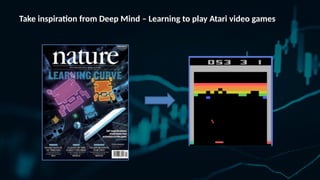
Take inspiration from Deep Mind – Learning to play Atari video games
+
Input
FC ReLU
FC ReLU
Functional
pass-though
Output
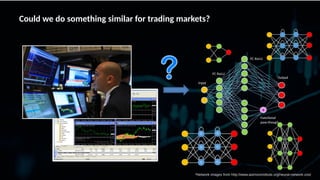
Could we do something similar for trading markets?
O
O
O
O
O
O
*Network images from http://www.asimovinstitute.org/neural-network-zoo/
Introduction to Reinforcement Learning
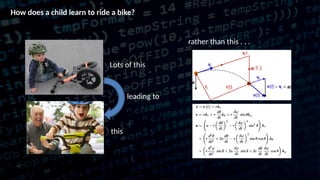
How does a child learn to ride a bike?
Lots of this
leading to
this
rather than this . . .
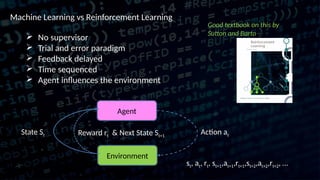
Machine Learning vs Reinforcement Learning
 No supervisor
 Trial and error paradigm
 Feedback delayed
 Time sequenced
 Agent influences the environment
Agent
Environment
Action atState St Reward rt & Next State St+1
Good textbook on this by
Sutton and Barto -
st, at, rt, st+1,at+1,rt+1,st+2,at+2,rt+2, …
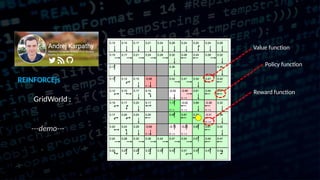
REINFORCEjs
GridWorld :
---demo---
Value function
Policy function
Reward function
Application to Trading
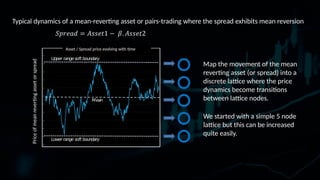
Typical dynamics of a mean-reverting asset or pairs-trading where the spread exhibits mean reversion
Upper rangesoft boundary
Lower range soft boundary
Mean
Priceofmeanrevertingassetorspread
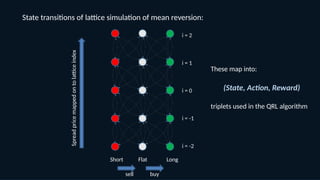
Map the movement of the mean
reverting asset (or spread) into a
discrete lattice where the price
dynamics become transitions
between lattice nodes.
We started with a simple 5 node
lattice but this can be increased
quite easily.
Asset / Spread price evolving with time
State transitions of lattice simulation of mean reversion:
Short LongFlat
Spreadpricemappedontolatticeindex
i = 0
i = -1
i = -2
i = 1
i = 2
sell buy
These map into:
(State, Action, Reward)
triplets used in the QRL algorithm
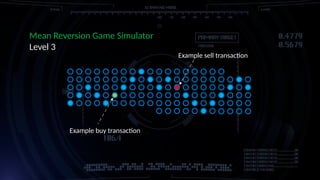
Mean Reversion Game Simulator
Level 3
Example buy transaction
Example sell transaction
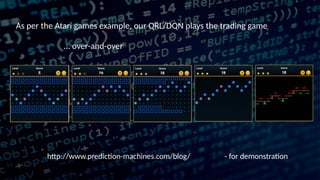
http://www.prediction-machines.com/blog/ - for demonstration
As per the Atari games example, our QRL/DQN plays the trading game
… over-and-over
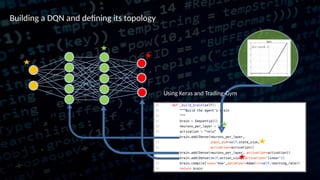
Building a DQN and defining its topology
Using Keras and Trading-Gym
+
Input
FC ReLU
FC ReLU
Functional
pass-though
Output
+
Input
FC ReLU
FC ReLU
Functional
pass-though
Output
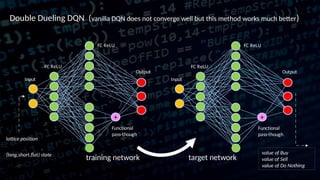
Double Dueling DQN (vanilla DQN does not converge well but this method works much better)
target networktraining network
lattice position
(long,short,flat) state value of Buy
value of Sell
value of Do Nothing
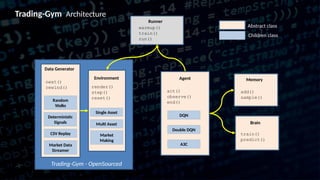
Trading-Gym Architecture
Runner
warmup()
train()
run()
Children class
Agent
act()
observe()
end()
DQN
Double DQN
A3C
Abstract class
Memory
add()
sample()
Brain
train()
predict()
Data Generator
Random
Walks
Deterministic
Signals
CSV Replay
Market Data
Streamer
Single Asset
Multi Asset
Market
Making
Environment
render()
step()
reset()
next()
rewind()
Trading-Gym - OpenSourced
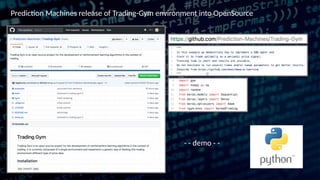
Prediction Machines release of Trading-Gym environment into OpenSource
- - demo - -
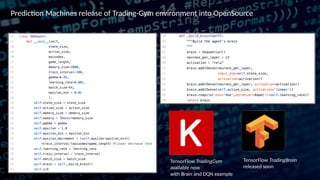
TensorFlow TradingBrain
released soon
TensorFlow TradingGym
available now
with Brain and DQN example
Prediction Machines release of Trading-Gym environment into OpenSource
References:
Insights In Reinforcement Learning (PhD thesis) by Hado van Hasselt
Human-level control though deep reinforcement learning
V Mnih, K Kavukcuoglu, D Silver, AA Rusu, J Veness, MG Bellemare, ...
Nature 518 (7540), 529-533
Deep Reinforcement Learning with Double Q-Learning
H Van Hasselt, A Guez, D Silver
AAAI, 2094-2100
Prioritized experience replay
T Schaul, J Quan, I Antonoglou, D Silver
arXiv preprint arXiv:1511.05952
Dueling Network Architectures for Deep Reinforcement Learning
Z Wang, T Schaul, M Hessel, H van Hasselt, M Lanctot, N de Freitas
The 33rd International Conference on Machine Learning, 1995–2003
DDDQN and
Tensorflow
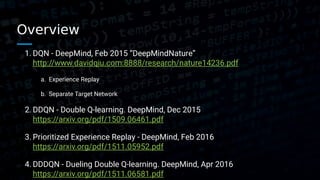
Overview
1. DQN - DeepMind, Feb 2015 “DeepMindNature”
http://www.davidqiu.com:8888/research/nature14236.pdf
a. Experience Replay
b. Separate Target Network
2. DDQN - Double Q-learning. DeepMind, Dec 2015
https://arxiv.org/pdf/1509.06461.pdf
3. Prioritized Experience Replay - DeepMind, Feb 2016
https://arxiv.org/pdf/1511.05952.pdf
4. DDDQN - Dueling Double Q-learning. DeepMind, Apr 2016
https://arxiv.org/pdf/1511.06581.pdf
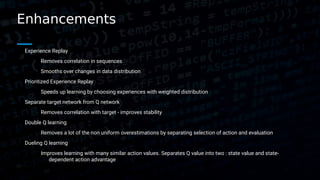
Enhancements
Experience Replay
Removes correlation in sequences
Smooths over changes in data distribution
Prioritized Experience Replay
Speeds up learning by choosing experiences with weighted distribution
Separate target network from Q network
Removes correlation with target - improves stability
Double Q learning
Removes a lot of the non uniform overestimations by separating selection of action and evaluation
Dueling Q learning
Improves learning with many similar action values. Separates Q value into two : state value and state-
dependent action advantage
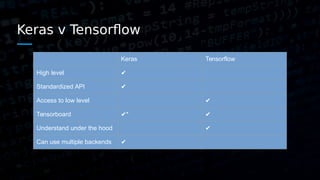
Keras v Tensorflow
Keras Tensorflow
High level ✔
Standardized API ✔
Access to low level ✔
Tensorboard ✔* ✔
Understand under the hood ✔
Can use multiple backends ✔
Install Tensorflow
My installation was on CentOS in docker with GPU*, but also did locally on
Ubuntu 16 for this demo. *Built from source for maximum speed.
CentOS instructions were adapted from:
https://blog.abysm.org/2016/06/building-tensorflow-centos-6/
Ubuntu install was from:
https://www.tensorflow.org/install/install_sources
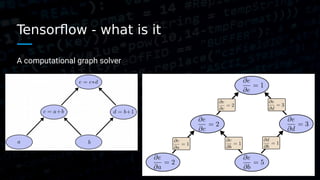
Tensorflow - what is it
A computational graph solver
Tensorflow key API
Namespaces for organizing the graph and showing in tensorboard
with tf.variable_scope('prediction'):
Sessions
with tf.Session() as sess:
Create variables and placeholders
var = tf.placeholder('int32', [None, 2, 3], name='varname’)
self.global_step = tf.Variable(0, trainable=False)
Session.run or variable.eval to run parts of the graph and retrieve values
pred_action = self.q_action.eval({self.s_t['p']: s_t_plus_1})
q_t, loss= self.sess.run([q['p'], loss], {target_q_t: target_q_t, action: action})
Trading-Gym
https://github.com/Prediction-Machines/Trading-Gym
Open sourced
Modelled after OpenAI Gym. Compatible with it.
Contains example of DQN with Keras
Contains pair trading example simulator and visualizer
Trading-Brain
https://github.com/Prediction-Machines/Trading-Brain
Two rich examples
Contains the Trading-Gym Keras example with suggested structuring
examples/keras_example.py
Contains example of Dueling Double DQN for single stock trading game
examples/tf_example.py
References
Much of the Brain and config code in this example is adapted from devsisters github:
https://github.com/devsisters/DQN-tensorflow
Our github:
https://github.com/Prediction-Machines
Our blog:
http://prediction-machines.com/blog/
Our job openings:
http://prediction-machines.com/jobopenings/
Video of this presentation:
https://www.youtube.com/watch?v=xvm-M-R2fZY
Deep Learning in Python with Tensorflow for Finance

Deep Learning in Python with Tensorflow for Finance

  • 1.
    Learning to Tradewith Q-Reinforcement Learning (A tensorflow and Python focus) Ben Ball & David Samuel www.prediction-machines.com
  • 2.
  • 3.
    Algorithmic Trading (e.g.,HFT) vs Human Systematic Trading Often looking at opportunities existing in the microsecond time horizon. Typically using statistical microstructure models and techniques from machine learning. Automated but usually hand crafted signals, exploits, and algorithms. Predicting the next tick Systematic strategies learned from experience of “reading market behavior”, strategies operating over tens of seconds or minutes. Predicting complex plays
  • 4.
    Take inspiration fromDeep Mind – Learning to play Atari video games
  • 5.
    + Input FC ReLU FC ReLU Functional pass-though Output Couldwe do something similar for trading markets? O O O O O O *Network images from http://www.asimovinstitute.org/neural-network-zoo/
  • 6.
  • 7.
    How does achild learn to ride a bike? Lots of this leading to this rather than this . . .
  • 8.
    Machine Learning vsReinforcement Learning  No supervisor  Trial and error paradigm  Feedback delayed  Time sequenced  Agent influences the environment Agent Environment Action atState St Reward rt & Next State St+1 Good textbook on this by Sutton and Barto - st, at, rt, st+1,at+1,rt+1,st+2,at+2,rt+2, …
  • 9.
  • 10.
  • 11.
    Typical dynamics ofa mean-reverting asset or pairs-trading where the spread exhibits mean reversion Upper rangesoft boundary Lower range soft boundary Mean Priceofmeanrevertingassetorspread Map the movement of the mean reverting asset (or spread) into a discrete lattice where the price dynamics become transitions between lattice nodes. We started with a simple 5 node lattice but this can be increased quite easily. Asset / Spread price evolving with time
  • 12.
    State transitions oflattice simulation of mean reversion: Short LongFlat Spreadpricemappedontolatticeindex i = 0 i = -1 i = -2 i = 1 i = 2 sell buy These map into: (State, Action, Reward) triplets used in the QRL algorithm
  • 13.
    Mean Reversion GameSimulator Level 3 Example buy transaction Example sell transaction
  • 14.
    http://www.prediction-machines.com/blog/ - fordemonstration As per the Atari games example, our QRL/DQN plays the trading game … over-and-over
  • 15.
    Building a DQNand defining its topology Using Keras and Trading-Gym
  • 16.
    + Input FC ReLU FC ReLU Functional pass-though Output + Input FCReLU FC ReLU Functional pass-though Output Double Dueling DQN (vanilla DQN does not converge well but this method works much better) target networktraining network lattice position (long,short,flat) state value of Buy value of Sell value of Do Nothing
  • 17.
    Trading-Gym Architecture Runner warmup() train() run() Children class Agent act() observe() end() DQN DoubleDQN A3C Abstract class Memory add() sample() Brain train() predict() Data Generator Random Walks Deterministic Signals CSV Replay Market Data Streamer Single Asset Multi Asset Market Making Environment render() step() reset() next() rewind() Trading-Gym - OpenSourced
  • 18.
    Prediction Machines releaseof Trading-Gym environment into OpenSource - - demo - -
  • 19.
    TensorFlow TradingBrain released soon TensorFlowTradingGym available now with Brain and DQN example Prediction Machines release of Trading-Gym environment into OpenSource
  • 20.
    References: Insights In ReinforcementLearning (PhD thesis) by Hado van Hasselt Human-level control though deep reinforcement learning V Mnih, K Kavukcuoglu, D Silver, AA Rusu, J Veness, MG Bellemare, ... Nature 518 (7540), 529-533 Deep Reinforcement Learning with Double Q-Learning H Van Hasselt, A Guez, D Silver AAAI, 2094-2100 Prioritized experience replay T Schaul, J Quan, I Antonoglou, D Silver arXiv preprint arXiv:1511.05952 Dueling Network Architectures for Deep Reinforcement Learning Z Wang, T Schaul, M Hessel, H van Hasselt, M Lanctot, N de Freitas The 33rd International Conference on Machine Learning, 1995–2003
  • 21.
  • 22.
    Overview 1. DQN -DeepMind, Feb 2015 “DeepMindNature” http://www.davidqiu.com:8888/research/nature14236.pdf a. Experience Replay b. Separate Target Network 2. DDQN - Double Q-learning. DeepMind, Dec 2015 https://arxiv.org/pdf/1509.06461.pdf 3. Prioritized Experience Replay - DeepMind, Feb 2016 https://arxiv.org/pdf/1511.05952.pdf 4. DDDQN - Dueling Double Q-learning. DeepMind, Apr 2016 https://arxiv.org/pdf/1511.06581.pdf
  • 23.
    Enhancements Experience Replay Removes correlationin sequences Smooths over changes in data distribution Prioritized Experience Replay Speeds up learning by choosing experiences with weighted distribution Separate target network from Q network Removes correlation with target - improves stability Double Q learning Removes a lot of the non uniform overestimations by separating selection of action and evaluation Dueling Q learning Improves learning with many similar action values. Separates Q value into two : state value and state- dependent action advantage
  • 24.
    Keras v Tensorflow KerasTensorflow High level ✔ Standardized API ✔ Access to low level ✔ Tensorboard ✔* ✔ Understand under the hood ✔ Can use multiple backends ✔
  • 25.
    Install Tensorflow My installationwas on CentOS in docker with GPU*, but also did locally on Ubuntu 16 for this demo. *Built from source for maximum speed. CentOS instructions were adapted from: https://blog.abysm.org/2016/06/building-tensorflow-centos-6/ Ubuntu install was from: https://www.tensorflow.org/install/install_sources
  • 26.
    Tensorflow - whatis it A computational graph solver
  • 27.
    Tensorflow key API Namespacesfor organizing the graph and showing in tensorboard with tf.variable_scope('prediction'): Sessions with tf.Session() as sess: Create variables and placeholders var = tf.placeholder('int32', [None, 2, 3], name='varname’) self.global_step = tf.Variable(0, trainable=False) Session.run or variable.eval to run parts of the graph and retrieve values pred_action = self.q_action.eval({self.s_t['p']: s_t_plus_1}) q_t, loss= self.sess.run([q['p'], loss], {target_q_t: target_q_t, action: action})
  • 28.
    Trading-Gym https://github.com/Prediction-Machines/Trading-Gym Open sourced Modelled afterOpenAI Gym. Compatible with it. Contains example of DQN with Keras Contains pair trading example simulator and visualizer
  • 29.
    Trading-Brain https://github.com/Prediction-Machines/Trading-Brain Two rich examples Containsthe Trading-Gym Keras example with suggested structuring examples/keras_example.py Contains example of Dueling Double DQN for single stock trading game examples/tf_example.py
  • 30.
    References Much of theBrain and config code in this example is adapted from devsisters github: https://github.com/devsisters/DQN-tensorflow Our github: https://github.com/Prediction-Machines Our blog: http://prediction-machines.com/blog/ Our job openings: http://prediction-machines.com/jobopenings/ Video of this presentation: https://www.youtube.com/watch?v=xvm-M-R2fZY