TERADATA DBA
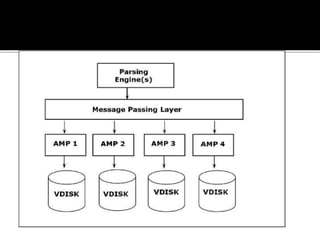
 Teradata architecture is based on Massively
Parallel Processing (MPP) architecture.The
major components ofTeradata are Parsing
Engine, BYNET andAccess Module
Processors (AMPs).The following diagram
shows the high level architecture of a
Teradata Node.
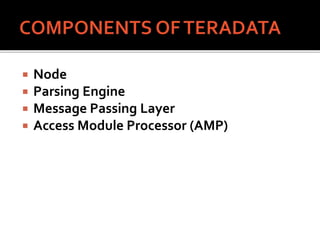
 Node
 Parsing Engine
 Message Passing Layer
 Access Module Processor (AMP)
 It is the basic unit inTeradata System. Each
individual server in aTeradata system is
referred as a Node. A node consists of its own
operating system, CPU, memory, own copy
ofTeradata RDBMS software and disk space.
A cabinet consists of one or more Nodes.
 Receive the SQL query from the client
 Parse the SQL query check for syntax errors
 Check if the user has required privilege
against the objects used in the SQL query
 Check if the objects used in the SQL actually
exists
 Prepare the execution plan to execute the
SQL query and pass it to BYNET
 Receives the results from the AMPs and send
to the client
 Message Passing Layer called as BYNET, is
the networking layer inTeradata system. It
allows the communication between PE and
AMP and also between the nodes. It receives
the execution plan from Parsing Engine and
sends to AMP. Similarly, it receives the results
from the AMPs and sends to Parsing Engine.
 AMPs, called asVirtual Processors (vprocs) are
the one that actually stores and retrieves the
data. AMPs receive the data and execution plan
from Parsing Engine, performs any data type
conversion, aggregation, filter, sorting and
stores the data in the disks associated with
them. Records from the tables are evenly
distributed among the AMPs in the system. Each
AMP is associated with a set of disks on which
data is stored. Only that AMP can read/write
data from the disks.
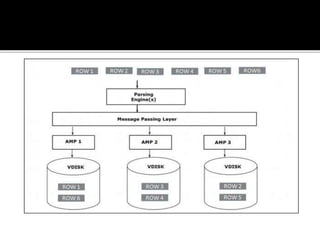
 When the client runs queries to insert
records, Parsing engine sends the records to
BYNET. BYNET retrieves the records and
sends the row to the targetAMP. AMP stores
these records on its disks. Following diagram
shows the storage architecture ofTeradata
 Oracle training in marathahalli
 http://www.traininginmarathahalli.in

Teradata

  • 1.
  • 2.
     Teradata architectureis based on Massively Parallel Processing (MPP) architecture.The major components ofTeradata are Parsing Engine, BYNET andAccess Module Processors (AMPs).The following diagram shows the high level architecture of a Teradata Node.
  • 4.
     Node  ParsingEngine  Message Passing Layer  Access Module Processor (AMP)
  • 5.
     It isthe basic unit inTeradata System. Each individual server in aTeradata system is referred as a Node. A node consists of its own operating system, CPU, memory, own copy ofTeradata RDBMS software and disk space. A cabinet consists of one or more Nodes.
  • 6.
     Receive theSQL query from the client  Parse the SQL query check for syntax errors  Check if the user has required privilege against the objects used in the SQL query  Check if the objects used in the SQL actually exists  Prepare the execution plan to execute the SQL query and pass it to BYNET  Receives the results from the AMPs and send to the client
  • 7.
     Message PassingLayer called as BYNET, is the networking layer inTeradata system. It allows the communication between PE and AMP and also between the nodes. It receives the execution plan from Parsing Engine and sends to AMP. Similarly, it receives the results from the AMPs and sends to Parsing Engine.
  • 8.
     AMPs, calledasVirtual Processors (vprocs) are the one that actually stores and retrieves the data. AMPs receive the data and execution plan from Parsing Engine, performs any data type conversion, aggregation, filter, sorting and stores the data in the disks associated with them. Records from the tables are evenly distributed among the AMPs in the system. Each AMP is associated with a set of disks on which data is stored. Only that AMP can read/write data from the disks.
  • 9.
     When theclient runs queries to insert records, Parsing engine sends the records to BYNET. BYNET retrieves the records and sends the row to the targetAMP. AMP stores these records on its disks. Following diagram shows the storage architecture ofTeradata
  • 11.
     Oracle trainingin marathahalli  http://www.traininginmarathahalli.in