Teradata System Architecture
After completing this module, you will be able to:
• Identify characteristics of various components.
• List two non-NCR platforms that support Teradatas
Teradata Version 1 Platforms
Teradata Version 1 was a combination of hardware and software.
For example, if a customer needed additional Parsing Engine capability, the
hardware and software components for a “Parsing Engine” had to be
purchased, installed, and configured.
Platform Year Available Upper Limit CPUs
Teradata DBC/1012 1984 1 TB 286, 386, 486
NCR 3600 1991 4 TB 486
Both platforms have the following common characteristics:
TOS based (Teradata Operating System)
Hardware PE Referred to as IFP or COP on DBC/1012
Hardware AMP Intel 286, 386, or 486 CPUs
Ynet Message Passing Layer
Channel-Attached Hosts Bus and Tag only
LAN Attached Hosts
This course will not discuss Version 1 platforms in any detail.
Teradata Version 2 Architecture
PE vproc
AMP
vproc
Vdisk
PE vproc
AMP
vproc
Vdisk
AMP
vproc
Vdisk
AMP
vproc
Vdisk
AMP
vproc
Vdisk
AMP
vproc
Vdisk
AMP
vproc
Vdisk
AMP
vproc
Vdisk
AMP
vproc
Vdisk
AMP
vproc
Vdisk
PDE and BYNET S/W (Message Passing Layer)
Operating System (UNIX MP-RAS or Windows 2000)
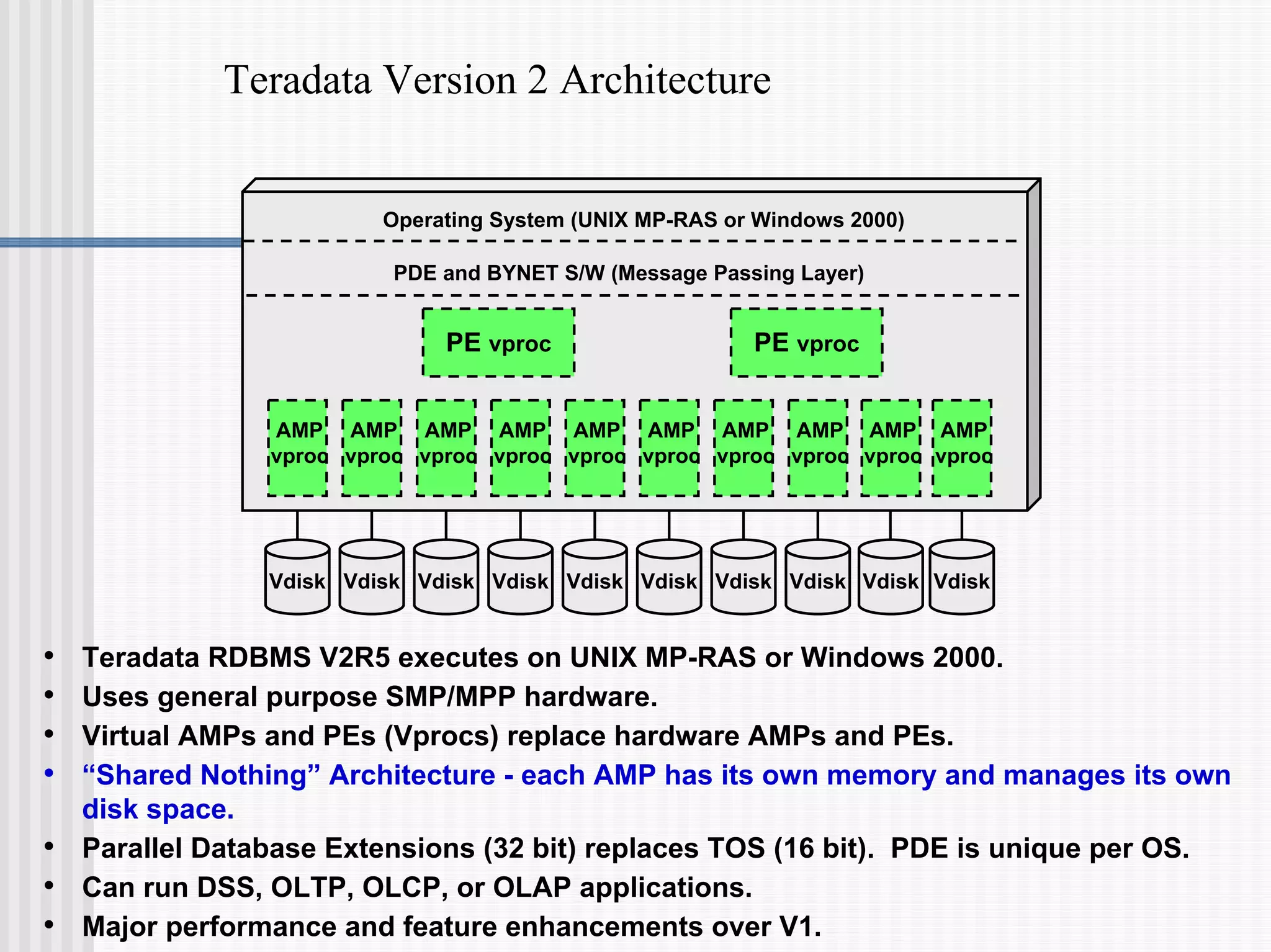
• Teradata RDBMS V2R5 executes on UNIX MP-RAS or Windows 2000.
• Uses general purpose SMP/MPP hardware.
• Virtual AMPs and PEs (Vprocs) replace hardware AMPs and PEs.
• “Shared Nothing” Architecture - each AMP has its own memory and manages its own
disk space.
• Parallel Database Extensions (32 bit) replaces TOS (16 bit). PDE is unique per OS.
• Can run DSS, OLTP, OLCP, or OLAP applications.
• Major performance and feature enhancements over V1.
Comparing Teradata V1 and V2
AMP
TOS
AMP
TOS
AMP
TOS
PE
TOS
AMP
TOS
….
Version 1 Characteristics
PEs and AMPs are physical processors.
AMPs map to physical or logical disks.
Each AMP runs TOS (16-bit OS).
Each PE/AMP only has 16 MB of memory.
Fastest CPU utilized was Intel i486 CPU.
Operating System (e.g., UNIX MP-RAS)
PDE
Vdisk Vdisk Vdisk Vdisk Vdisk Vdisk Vdisk Vdisk Vdisk Vdisk
PE vproc
AMP
vproc
AMP
vproc
AMP
vproc
AMP
vproc
AMP
vproc
AMP
vproc
AMP
vproc
AMP
vproc
AMP
vproc
AMP
vproc
PE vproc
Version 2 Characteristics
PEs and AMPs are virtual processors.
AMPs map to virtual disks (Vdisks).
Each SMP node runs and OS and PDE.
Each SMP can have up to 4 GB of physical
memory.
Utilizes newest CPUs (e.g., Intel Pentium
IV Xeon 3.06 GHz).
Teradata Version 2 Single Node (SMP)
CHANNEL LAN
PC W/S
Channel-Attached Systems
TDP
Applications/
Utilities
Channel Drivers Gateway Software
PE vproc
AMP
vproc
Vdisk
PE vproc
AMP
vproc
Vdisk
AMP
vproc
Vdisk
AMP
vproc
Vdisk
AMP
vproc
Vdisk
AMP
vproc
Vdisk
AMP
vproc
Vdisk
AMP
vproc
Vdisk
AMP
vproc
Vdisk
AMP
vproc
Vdisk
PDE and BYNET S/W (Message Passing Layer)
Operating System (UNIX MP-RAS or Windows 2000)
Notes:
• Applications, channel
drivers, and the LAN
gateway software run as
Operating System
processes.
• AMPs and PEs are virtual
processors (Vprocs) which
run under the Parallel
Database Extensions (PDE).
• AMPs are associated with
virtual disks (Vdisks) within
a disk array subsystem.
• Teradata is called a Trusted
Parallel Application of PDE.
Multi-Node MPP System
BYNET
DAC DAC DAC DAC DAC DAC DAC DAC
SMP SMP SMP SMP
Notes:
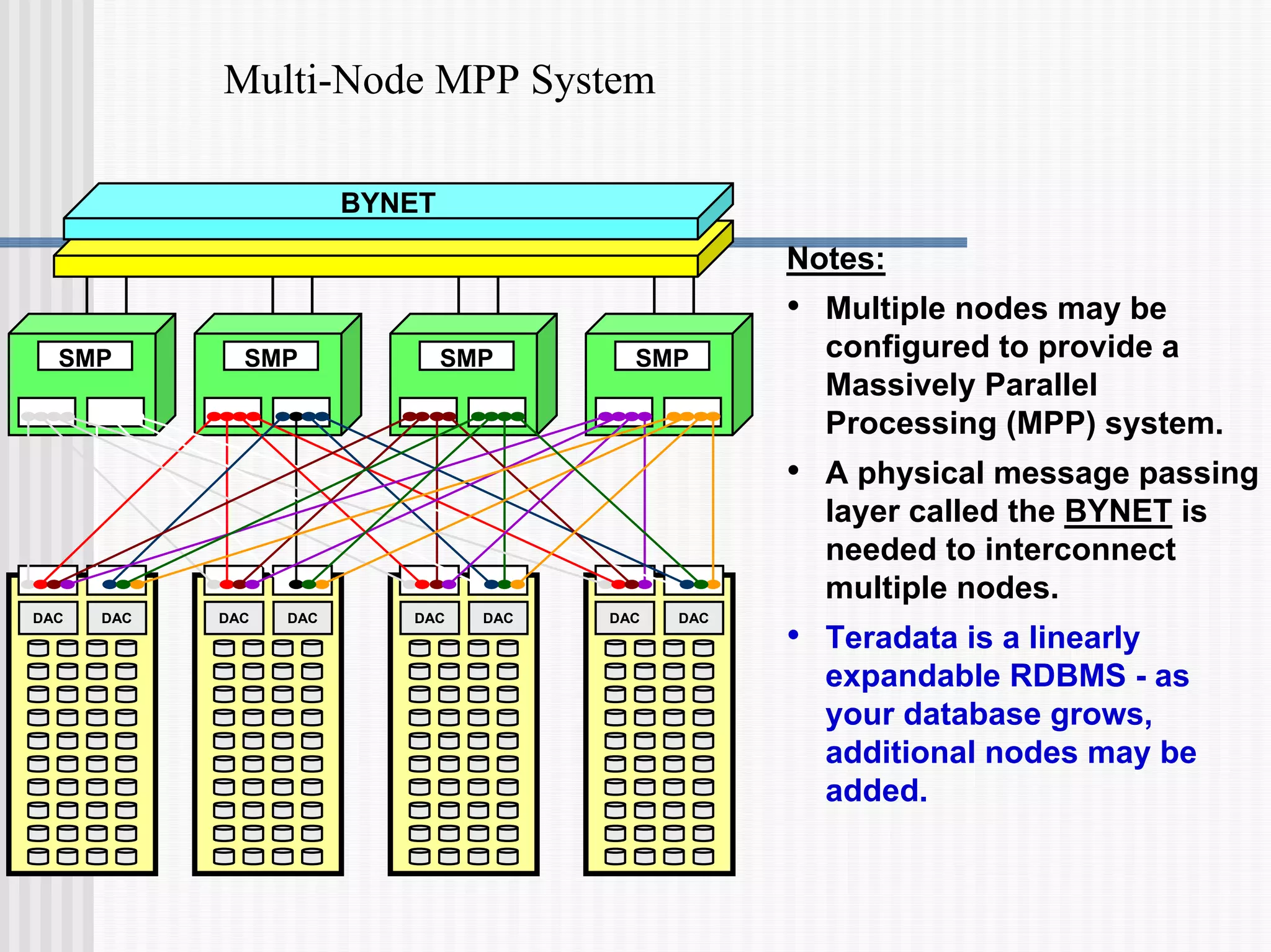
• Multiple nodes may be
configured to provide a
Massively Parallel
Processing (MPP) system.
• A physical message passing
layer called the BYNET is
needed to interconnect
multiple nodes.
• Teradata is a linearly
expandable RDBMS - as
your database grows,
additional nodes may be
added.
Example of 4 Node Teradata System
DAC-A DAC-B
DAC-A DAC-B
DAC-A DAC-B DAC-A DAC-B
0 4 36
…….
SMP001-4 AMPs
1 5 37
…….
SMP001-5 AMPs
2 6 38
…….
SMP002-4 AMPs
3 7 39
…….
SMP002-5 AMPs
BYNET
RAID 1
Vdisk 0
Pdisk 0
Pdisk 1
MaxPerm
72 GB
AMP 0
36 GB
36 GB
36 GB
36 GB
Teradata Cliques
• A clique is a defined set of nodes that share a common set of disk arrays.
• All nodes in a clique must be able to access all Vdisks for all AMPs in the clique.
• A clique provides protection from a node failure.
• If a node fails, all vprocs will migrate to the remaining nodes in the clique (Vproc
Migration).
• A clique can support up to 128 vprocs.
BYNET
SMP SMP SMP SMP SMP SMP SMP SMP
Clique 0 Clique 1
BYNET (for MPP)
BYNET 0 BYNET 1
SMP SMP SMP SMP SMP SMP SMP SMP
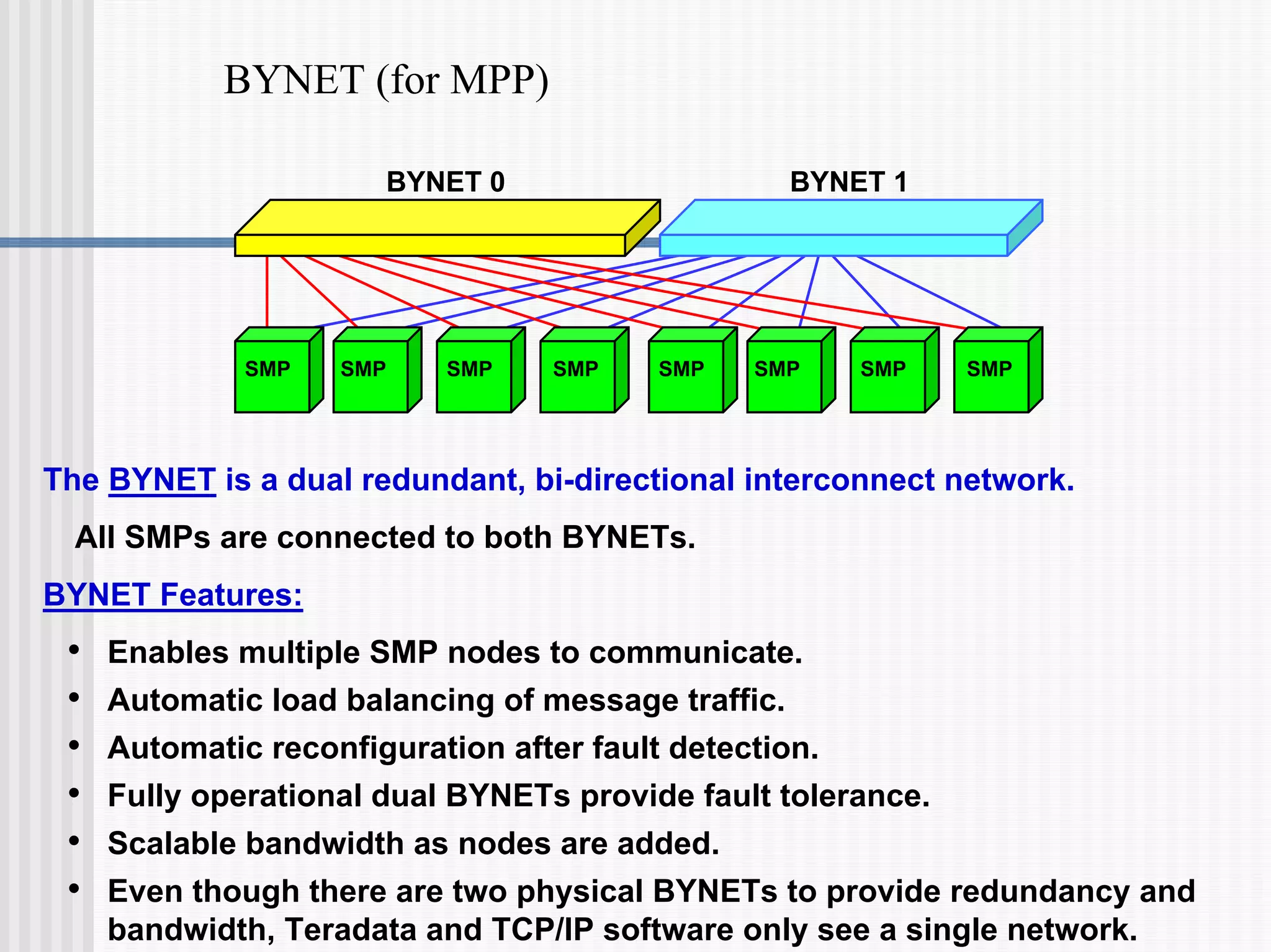
The BYNET is a dual redundant, bi-directional interconnect network.
All SMPs are connected to both BYNETs.
BYNET Features:
• Enables multiple SMP nodes to communicate.
• Automatic load balancing of message traffic.
• Automatic reconfiguration after fault detection.
• Fully operational dual BYNETs provide fault tolerance.
• Scalable bandwidth as nodes are added.
• Even though there are two physical BYNETs to provide redundancy and
bandwidth, Teradata and TCP/IP software only see a single network.
BYNET Communication Protocols
BYNET 0 BYNET 1
PE
AMP ... AMP
PE PE
AMP ... AMP
PE PE
AMP ... AMP
PE PE
AMP ... AMP
PE
Point-to-Point (one-to-one):
Any node communicates with one node. Scalable bandwidth:
BYNET V1 - 10 MB x 2 BYNETs = 20 MB per node
BYNET V2 - 60 MB x 2 BYNETs = 120 MB per node
Multi-Cast (one-to-many):
Any node communicates to a subset of nodes.
Used with Group AMP operations - Teradata release V2R5 and above.
Broadcast (one-to-all):
Any node communicates to all nodes. Not scalable:
BYNET V1 - Fixed at 10 MB per BYNET
BYNET V2 - Fixed at 60 MB per BYNET
Vproc Inter-process Communication
Single-Node or SMP System
Teradata V2R3 and above
Teradata RDBMS
PDE and BYNET s/w
vproc vproc vproc
vproc vproc vproc
BYNET
Node B
Teradata RDBMS
PDE and BYNET s/w
Node A
Teradata RDBMS
PDE and BYNET s/w
vproc vproc
vproc vproc
vproc vproc vproc
vproc vproc vproc
vproc
vproc
MPP Systems
Teradata V2R3 and above
Examples of Teradata Version 2 Systems
Examples of NCR systems that support Teradata include:
SMP Servers 1 – 4 Nodes 2 – 512 Nodes
NCR 4400 NCR 4800/4850 NCR 5200/5250
NCR 4455 NCR 4851/4855 NCR 5251/5255
NCR 4470 NCR 4900 NCR 5300
NCR 4475 NCR 4950 NCR 5350
NCR 4480 NCR 4980 NCR 5380
The basic building block is the SMP (Symmetric Multi-Processing) node.
Common characteristics of these systems:
• MPP systems use the BYNET interconnect
• Support of the Teradata database – Version 2
• Single point of operational control – AWS
• Rack-based systems – each technology is encapsulated in its own chassis
Key differences:
• Speed and capacity of SMP nodes and systems
• Cabinet architecture
• BYNET interface cards, switches and speeds
Examples of other SMP vendors (running Windows 2000) are Dell, HP, and
Compaq.
What Makes NCR’s MPP Platforms Special?
Key features of NCR’s MPP systems include:
• Teradata RDBMS software - allows Teradata to execute on multiple SMPs
and act as a single instance.
• Scalable BYNET Interconnect - as you add nodes, you add bandwidth.
• PUT - Parallel Upgrade Utility - simplifies installation/upgrade of software
across many SMPs
• AWS - single point of operational control and scalable server management.
• SMP operating system software (e.g., UNIX MP-RAS and Windows 2000) is
only aware of the resources within the SMP and only has to manage those
resources.
• Dual AC capability for increased availability.
NCR Rack-Based Cabinets
with door
SMPxxx-4
BYNET V2
BYNET V2
SMC
SMPxxx-5
SMPxxx-6
SMPxxx-7
NCR 5380
SMC - 2U
6841-2456
6841-2456
NCR 6841
NCR uses industry
standard rack-based
cabinets.
Shown are examples
of a Processor rack
and a Storage or disk
array rack.
Summary
• Teradata Version 1 was a combination of hardware and software.
• Teradata RDBMS Version 2 is a software implementation of Teradata.
– Virtual AMPs and PEs (Vprocs) replace hardware AMPs and PEs.
• Teradata utilizes a “Shared Nothing” Architecture - each AMP has its own
memory and manages its own disk space.
• Teradata is called a Trusted Parallel Application.
• Multiple nodes may be configured to provide a Massively Parallel
Processing (MPP) system.
• A clique is a defined set of nodes that share a common set of disk arrays.
• Teradata is a linearly expandable RDBMS - as your database grows,
additional nodes may be added.
Review Questions
Complete the following.
1. Each AMP has its own memory and manages its own disk space and executes independently of
other AMPs. This is referred to as a ___________ __________ architecture.
2. The software component that allows Teradata to execute in different operating system
environments is the __________.
3. A physical message passing interconnect is called the _____________.
4. A clique provides protection from a _________ failure.
5. If a node fails, all vprocs will migrate to the remaining nodes in the clique. This feature is referred
to as ___________ _____________.
6. The ____________ provides a single point of operational control for NCR MPP systems.
7. List two non-NCR platforms that Teradata is supported on. _____________ ____________
Review Question Answers
Complete the following.
1. Each AMP has its own memory and manages its own disk space and executes independently of
other AMPs. This is referred to as a shared nothing architecture.
2. The software component that allows Teradata to execute in different operating system
environments is the PDE.
3. A physical message passing interconnect is called the BYNET.
4. A clique provides protection from a node failure.
5. If a node fails, all vprocs will migrate to the remaining nodes in the clique. This feature is referred
to as vproc migration.
6. The AWS provides a single point of operational control for NCR MPP systems.
7. List two non-NCR platforms that Teradata is supported on. Dell HP Compaq

1.4 System Arch.pdf

  • 1.
    Teradata System Architecture Aftercompleting this module, you will be able to: • Identify characteristics of various components. • List two non-NCR platforms that support Teradatas
  • 2.
    Teradata Version 1Platforms Teradata Version 1 was a combination of hardware and software. For example, if a customer needed additional Parsing Engine capability, the hardware and software components for a “Parsing Engine” had to be purchased, installed, and configured. Platform Year Available Upper Limit CPUs Teradata DBC/1012 1984 1 TB 286, 386, 486 NCR 3600 1991 4 TB 486 Both platforms have the following common characteristics: TOS based (Teradata Operating System) Hardware PE Referred to as IFP or COP on DBC/1012 Hardware AMP Intel 286, 386, or 486 CPUs Ynet Message Passing Layer Channel-Attached Hosts Bus and Tag only LAN Attached Hosts This course will not discuss Version 1 platforms in any detail.
  • 3.
    Teradata Version 2Architecture PE vproc AMP vproc Vdisk PE vproc AMP vproc Vdisk AMP vproc Vdisk AMP vproc Vdisk AMP vproc Vdisk AMP vproc Vdisk AMP vproc Vdisk AMP vproc Vdisk AMP vproc Vdisk AMP vproc Vdisk PDE and BYNET S/W (Message Passing Layer) Operating System (UNIX MP-RAS or Windows 2000) • Teradata RDBMS V2R5 executes on UNIX MP-RAS or Windows 2000. • Uses general purpose SMP/MPP hardware. • Virtual AMPs and PEs (Vprocs) replace hardware AMPs and PEs. • “Shared Nothing” Architecture - each AMP has its own memory and manages its own disk space. • Parallel Database Extensions (32 bit) replaces TOS (16 bit). PDE is unique per OS. • Can run DSS, OLTP, OLCP, or OLAP applications. • Major performance and feature enhancements over V1.
  • 4.
    Comparing Teradata V1and V2 AMP TOS AMP TOS AMP TOS PE TOS AMP TOS …. Version 1 Characteristics PEs and AMPs are physical processors. AMPs map to physical or logical disks. Each AMP runs TOS (16-bit OS). Each PE/AMP only has 16 MB of memory. Fastest CPU utilized was Intel i486 CPU. Operating System (e.g., UNIX MP-RAS) PDE Vdisk Vdisk Vdisk Vdisk Vdisk Vdisk Vdisk Vdisk Vdisk Vdisk PE vproc AMP vproc AMP vproc AMP vproc AMP vproc AMP vproc AMP vproc AMP vproc AMP vproc AMP vproc AMP vproc PE vproc Version 2 Characteristics PEs and AMPs are virtual processors. AMPs map to virtual disks (Vdisks). Each SMP node runs and OS and PDE. Each SMP can have up to 4 GB of physical memory. Utilizes newest CPUs (e.g., Intel Pentium IV Xeon 3.06 GHz).
  • 5.
    Teradata Version 2Single Node (SMP) CHANNEL LAN PC W/S Channel-Attached Systems TDP Applications/ Utilities Channel Drivers Gateway Software PE vproc AMP vproc Vdisk PE vproc AMP vproc Vdisk AMP vproc Vdisk AMP vproc Vdisk AMP vproc Vdisk AMP vproc Vdisk AMP vproc Vdisk AMP vproc Vdisk AMP vproc Vdisk AMP vproc Vdisk PDE and BYNET S/W (Message Passing Layer) Operating System (UNIX MP-RAS or Windows 2000) Notes: • Applications, channel drivers, and the LAN gateway software run as Operating System processes. • AMPs and PEs are virtual processors (Vprocs) which run under the Parallel Database Extensions (PDE). • AMPs are associated with virtual disks (Vdisks) within a disk array subsystem. • Teradata is called a Trusted Parallel Application of PDE.
  • 6.
    Multi-Node MPP System BYNET DACDAC DAC DAC DAC DAC DAC DAC SMP SMP SMP SMP Notes: • Multiple nodes may be configured to provide a Massively Parallel Processing (MPP) system. • A physical message passing layer called the BYNET is needed to interconnect multiple nodes. • Teradata is a linearly expandable RDBMS - as your database grows, additional nodes may be added.
  • 7.
    Example of 4Node Teradata System DAC-A DAC-B DAC-A DAC-B DAC-A DAC-B DAC-A DAC-B 0 4 36 ……. SMP001-4 AMPs 1 5 37 ……. SMP001-5 AMPs 2 6 38 ……. SMP002-4 AMPs 3 7 39 ……. SMP002-5 AMPs BYNET RAID 1 Vdisk 0 Pdisk 0 Pdisk 1 MaxPerm 72 GB AMP 0 36 GB 36 GB 36 GB 36 GB
  • 8.
    Teradata Cliques • Aclique is a defined set of nodes that share a common set of disk arrays. • All nodes in a clique must be able to access all Vdisks for all AMPs in the clique. • A clique provides protection from a node failure. • If a node fails, all vprocs will migrate to the remaining nodes in the clique (Vproc Migration). • A clique can support up to 128 vprocs. BYNET SMP SMP SMP SMP SMP SMP SMP SMP Clique 0 Clique 1
  • 9.
    BYNET (for MPP) BYNET0 BYNET 1 SMP SMP SMP SMP SMP SMP SMP SMP The BYNET is a dual redundant, bi-directional interconnect network. All SMPs are connected to both BYNETs. BYNET Features: • Enables multiple SMP nodes to communicate. • Automatic load balancing of message traffic. • Automatic reconfiguration after fault detection. • Fully operational dual BYNETs provide fault tolerance. • Scalable bandwidth as nodes are added. • Even though there are two physical BYNETs to provide redundancy and bandwidth, Teradata and TCP/IP software only see a single network.
  • 10.
    BYNET Communication Protocols BYNET0 BYNET 1 PE AMP ... AMP PE PE AMP ... AMP PE PE AMP ... AMP PE PE AMP ... AMP PE Point-to-Point (one-to-one): Any node communicates with one node. Scalable bandwidth: BYNET V1 - 10 MB x 2 BYNETs = 20 MB per node BYNET V2 - 60 MB x 2 BYNETs = 120 MB per node Multi-Cast (one-to-many): Any node communicates to a subset of nodes. Used with Group AMP operations - Teradata release V2R5 and above. Broadcast (one-to-all): Any node communicates to all nodes. Not scalable: BYNET V1 - Fixed at 10 MB per BYNET BYNET V2 - Fixed at 60 MB per BYNET
  • 11.
    Vproc Inter-process Communication Single-Nodeor SMP System Teradata V2R3 and above Teradata RDBMS PDE and BYNET s/w vproc vproc vproc vproc vproc vproc BYNET Node B Teradata RDBMS PDE and BYNET s/w Node A Teradata RDBMS PDE and BYNET s/w vproc vproc vproc vproc vproc vproc vproc vproc vproc vproc vproc vproc MPP Systems Teradata V2R3 and above
  • 12.
    Examples of TeradataVersion 2 Systems Examples of NCR systems that support Teradata include: SMP Servers 1 – 4 Nodes 2 – 512 Nodes NCR 4400 NCR 4800/4850 NCR 5200/5250 NCR 4455 NCR 4851/4855 NCR 5251/5255 NCR 4470 NCR 4900 NCR 5300 NCR 4475 NCR 4950 NCR 5350 NCR 4480 NCR 4980 NCR 5380 The basic building block is the SMP (Symmetric Multi-Processing) node. Common characteristics of these systems: • MPP systems use the BYNET interconnect • Support of the Teradata database – Version 2 • Single point of operational control – AWS • Rack-based systems – each technology is encapsulated in its own chassis Key differences: • Speed and capacity of SMP nodes and systems • Cabinet architecture • BYNET interface cards, switches and speeds Examples of other SMP vendors (running Windows 2000) are Dell, HP, and Compaq.
  • 13.
    What Makes NCR’sMPP Platforms Special? Key features of NCR’s MPP systems include: • Teradata RDBMS software - allows Teradata to execute on multiple SMPs and act as a single instance. • Scalable BYNET Interconnect - as you add nodes, you add bandwidth. • PUT - Parallel Upgrade Utility - simplifies installation/upgrade of software across many SMPs • AWS - single point of operational control and scalable server management. • SMP operating system software (e.g., UNIX MP-RAS and Windows 2000) is only aware of the resources within the SMP and only has to manage those resources. • Dual AC capability for increased availability.
  • 14.
    NCR Rack-Based Cabinets withdoor SMPxxx-4 BYNET V2 BYNET V2 SMC SMPxxx-5 SMPxxx-6 SMPxxx-7 NCR 5380 SMC - 2U 6841-2456 6841-2456 NCR 6841 NCR uses industry standard rack-based cabinets. Shown are examples of a Processor rack and a Storage or disk array rack.
  • 15.
    Summary • Teradata Version1 was a combination of hardware and software. • Teradata RDBMS Version 2 is a software implementation of Teradata. – Virtual AMPs and PEs (Vprocs) replace hardware AMPs and PEs. • Teradata utilizes a “Shared Nothing” Architecture - each AMP has its own memory and manages its own disk space. • Teradata is called a Trusted Parallel Application. • Multiple nodes may be configured to provide a Massively Parallel Processing (MPP) system. • A clique is a defined set of nodes that share a common set of disk arrays. • Teradata is a linearly expandable RDBMS - as your database grows, additional nodes may be added.
  • 16.
    Review Questions Complete thefollowing. 1. Each AMP has its own memory and manages its own disk space and executes independently of other AMPs. This is referred to as a ___________ __________ architecture. 2. The software component that allows Teradata to execute in different operating system environments is the __________. 3. A physical message passing interconnect is called the _____________. 4. A clique provides protection from a _________ failure. 5. If a node fails, all vprocs will migrate to the remaining nodes in the clique. This feature is referred to as ___________ _____________. 6. The ____________ provides a single point of operational control for NCR MPP systems. 7. List two non-NCR platforms that Teradata is supported on. _____________ ____________
  • 17.
    Review Question Answers Completethe following. 1. Each AMP has its own memory and manages its own disk space and executes independently of other AMPs. This is referred to as a shared nothing architecture. 2. The software component that allows Teradata to execute in different operating system environments is the PDE. 3. A physical message passing interconnect is called the BYNET. 4. A clique provides protection from a node failure. 5. If a node fails, all vprocs will migrate to the remaining nodes in the clique. This feature is referred to as vproc migration. 6. The AWS provides a single point of operational control for NCR MPP systems. 7. List two non-NCR platforms that Teradata is supported on. Dell HP Compaq