www.basestructures.com
Many clients approach us to build their designs, sometimes from detailed
drawings, usually from a rough outline.
Others ask us to design and build something they have in their heads from
scratch.
But everyone is now recognising the massive potential that this technology
offers… not just to enhance their designs but to have unique benefits in
terms of cost and environmental performance.
For that to happen, more people need to know what’s possible and how it
works.
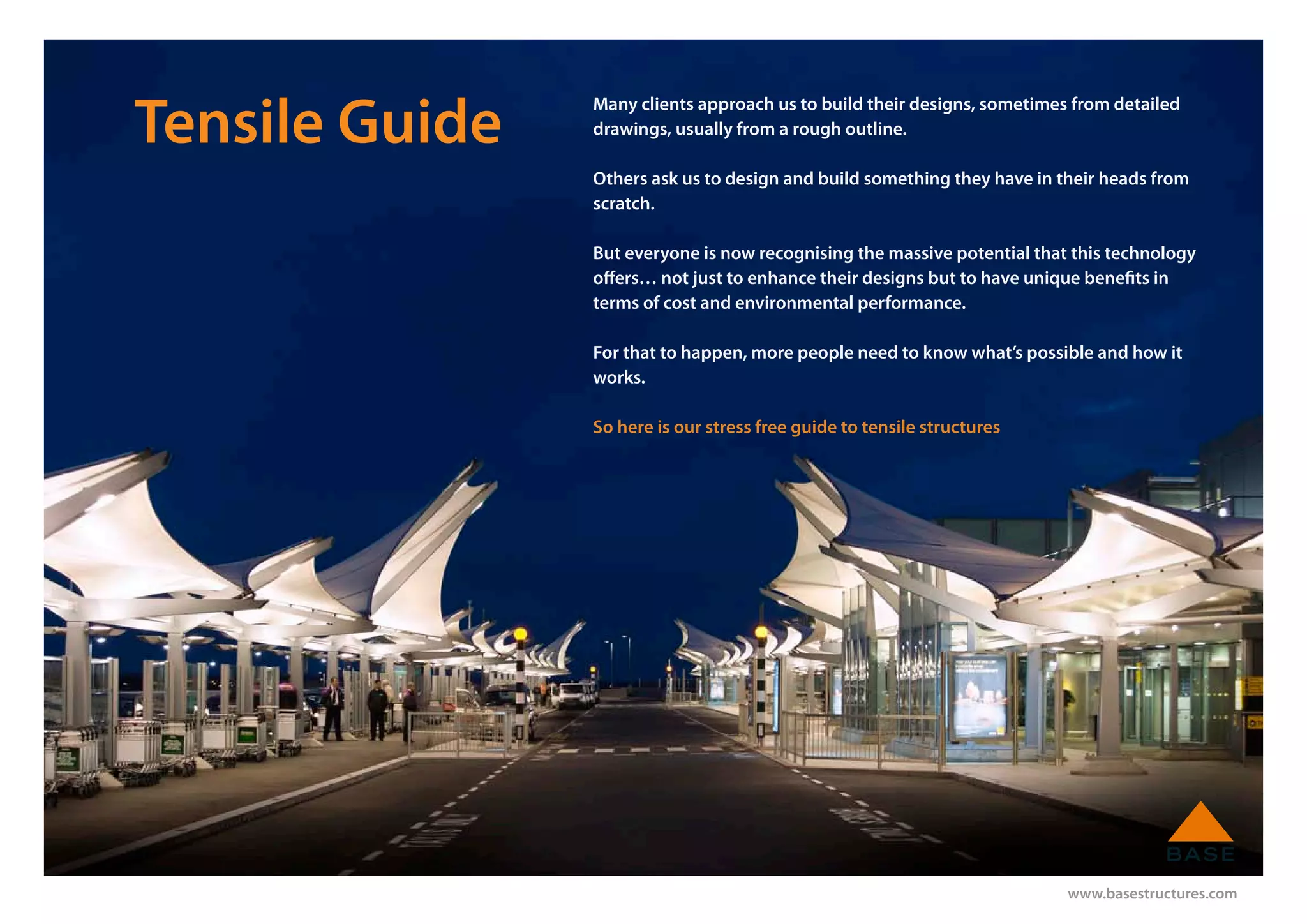
So here is our stress free guide to tensile structures
Tensile Guide
www.basestructures.com
The briefest of histories
Tensile fabric structures have been with us since the
Mongolians swept down from the plains, with their
yurts as their transportable overnight accommodation.
The Bedouins have done the same for untold years.
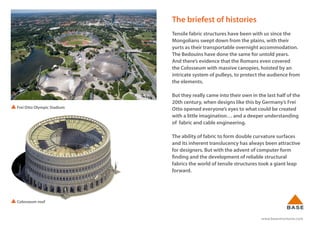
And there’s evidence that the Romans even covered
the Colosseum with massive canopies, hoisted by an
intricate system of pulleys, to protect the audience from
the elements.
But they really came into their own in the last half of the
20th century, when designs like this by Germany’s Frei
Otto opened everyone’s eyes to what could be created
with a little imagination… and a deeper understanding
of fabric and cable engineering.
The ability of fabric to form double curvature surfaces
and its inherent translucency has always been attractive
for designers. But with the advent of computer form
finding and the development of reliable structural
fabrics the world of tensile structures took a giant leap
forward.
Colosseum roof
Frei Otto Olympic Stadium
www.basestructures.com
Why tensiles are the shape they are
Large flat pieces of fabric are very poor at resisting
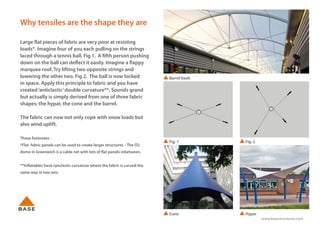
loads*. Imagine four of you each pulling on the strings
laced through a tennis ball. Fig 1. A fifth person pushing
down on the ball can deflect it easily. Imagine a flappy
marquee roof. Try lifting two opposite strings and
lowering the other two. Fig 2. The ball is now locked
in space. Apply this principle to fabric and you have
created‘anticlastic’double curvature**. Sounds grand
but actually is simply derived from one of three fabric
shapes; the hypar, the cone and the barrel.
The fabric can now not only cope with snow loads but
also wind uplift.
Those footnotes -
*Flat fabric panels can be used to create larger structures – The O2
dome in Greenwich is a cable net with lots of flat panels inbetween.
**Inflatables have synclastic curvature where the fabric is curved the
same way in two axis.
Barrel Vault
Cone Hypar
Fig. 1 Fig. 2
www.basestructures.com
Where do the loads go?
Good question.
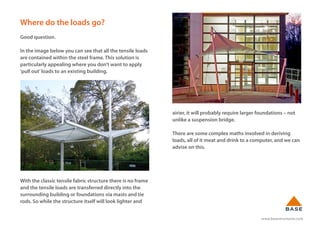
In the image below you can see that all the tensile loads
are contained within the steel frame. This solution is
particularly appealing where you don’t want to apply
‘pull out’loads to an existing building.

With the classic tensile fabric structure there is no frame
and the tensile loads are transferred directly into the
surrounding building or foundations via masts and tie
rods. So while the structure itself will look lighter and
airier, it will probably require larger foundations – not
unlike a suspension bridge.

There are some complex maths involved in deriving
loads, all of it meat and drink to a computer, and we can
advise on this.
www.basestructures.com
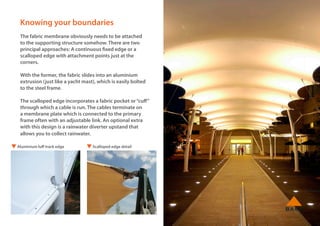
Knowing your boundaries
The fabric membrane obviously needs to be attached
to the supporting structure somehow. There are two
principal approaches: A continuous fixed edge or a
scalloped edge with attachment points just at the
corners.
With the former, the fabric slides into an aluminium
extrusion (just like a yacht mast), which is easily bolted
to the steel frame.
The scalloped edge incorporates a fabric pocket or“cuff”
through which a cable is run. The cables terminate on
a membrane plate which is connected to the primary
frame often with an adjustable link. An optional extra
with this design is a rainwater diverter upstand that
allows you to collect rainwater.
Scalloped edge detail
Aluminium luff track edge
www.basestructures.com
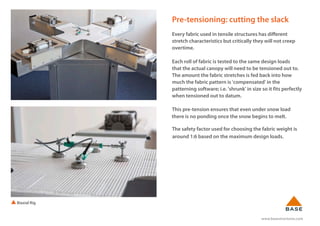
Pre-tensioning: cutting the slack
Every fabric used in tensile structures has different
stretch characteristics but critically they will not creep
overtime.
Each roll of fabric is tested to the same design loads
that the actual canopy will need to be tensioned out to.
The amount the fabric stretches is fed back into how
much the fabric pattern is 'compensated' in the
patterning software; i.e. 'shrunk' in size so it fits perfectly
when tensioned out to datum.
This pre-tension ensures that even under snow load
there is no ponding once the snow begins to melt.
The safety factor used for choosing the fabric weight is
around 1:6 based on the maximum design loads.
Biaxial Rig
www.basestructures.com
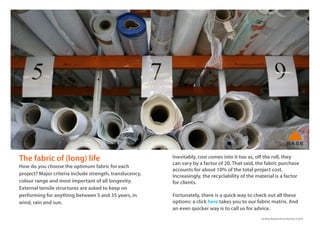
The fabric of (long) life
How do you choose the optimum fabric for each
project? Major criteria include strength, translucency,
colour range and most important of all longevity.
External tensile structures are asked to keep on
performing for anything between 5 and 35 years, in
wind, rain and sun.
Inevitably, cost comes into it too as, off the roll, they
can vary by a factor of 20. That said, the fabric purchase
accounts for about 10% of the total project cost.
Increasingly, the recyclability of the material is a factor
for clients.
Fortunately, there is a quick way to check out all these
options: a click here takes you to our fabric matrix. And
an even quicker way is to call us for advice.
www.basestructures.com
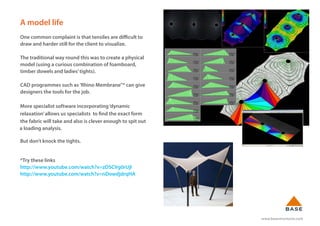
A model life
One common complaint is that tensiles are difficult to
draw and harder still for the client to visualize.
The traditional way round this was to create a physical
model (using a curious combination of foamboard,
timber dowels and ladies’tights).
CAD programmes such as 'Rhino Membrane"* can give
designers the tools for the job.
More specialist software incorporating‘dynamic
relaxation’allows us specialists to find the exact form
the fabric will take and also is clever enough to spit out
a loading analysis.
But don’t knock the tights.
*Try these links
http://www.youtube.com/watch?v=zDSCVg0rUjl
http://www.youtube.com/watch?v=nDowdjdrqHA
www.basestructures.com
Things you should know
Insulation: Although fabric structures are generally
used to cover unheated spaces it is possible to have
a multi layer construction consisting of an inner and
outer fabric skin with an interlayer of insulation. One
disadvantage is the loss of translucency, although
there are now translucent products such as Nanogel
that could be used if the budget permits. A double
skin construction can be used to reduce the risk of
condensation if this cannot be designed out by other
means.
Fire safety: All structural fabrics are fire rated although
some behave differently than others in a fire. Pvc coated
polyesters will melt back from a heat source which is
useful for venting the flames & smoke. Coated glass
fibre based fabrics will tend to produce less smoke
and stay intact longer until the seams fail at very high
temperatures. Any fabric producing burning droplets
is totally unsuitable. The European fire coding system
measures flammability, smoke production and burning
droplets. A typical PVC coated polyester Euro Class fire
rating would be B-s2,d0.
Acoustics: To achieve an effective sound absorption
you need plenty of mass, which is not one of fabric’s
strong points. What fabric is useful for is reducing
reverberation times in interiors with a lot of hard
surfaces. The best combination is a mesh fabric with an
acoustic quilt behind. One technical fabric by Mermet
has been engineered to reduce mid to high frequency
sound whilst still being translucent to light.
Environmental: Many (but not all) of the fabrics
now in popular use can be recycled. If this is a major
concern for you or your client, the fabric matrix gives an
indication of this and we can give more detailed advice.
The amount of embodied carbon can also be calculated
for your project.
www.basestructures.com
Appearance is all
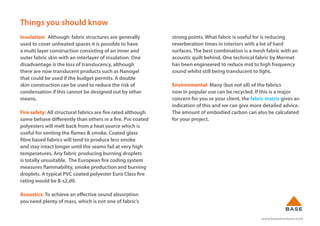
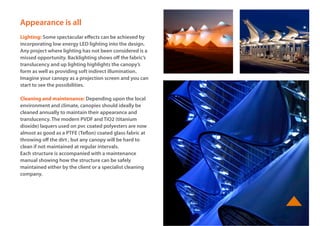
Lighting: Some spectacular effects can be achieved by
incorporating low energy LED lighting into the design.
Any project where lighting has not been considered is a
missed opportunity. Backlighting shows off the fabric’s
translucency and up lighting highlights the canopy’s
form as well as providing soft indirect illumination.
Imagine your canopy as a projection screen and you can
start to see the possibilities.
Cleaning and maintenance: Depending upon the local
environment and climate, canopies should ideally be
cleaned annually to maintain their appearance and
translucency. The modern PVDF and TiO2 (titanium
dioxide) laquers used on pvc coated polyesters are now
almost as good as a PTFE (Teflon) coated glass fabric at
throwing off the dirt , but any canopy will be hard to
clean if not maintained at regular intervals.
Each structure is accompanied with a maintenance
manual showing how the structure can be safely
maintained either by the client or a specialist cleaning
company.
www.basestructures.com
adaptability is still quickening as architects let their
imagination flow and new materials come to the fore.
And for sheer architectural variety within one project,
look no further than the astonishing array of different
designs at the 2012 Olympics – where many of the
structures will be relocated or the parts recycled for new
projects.
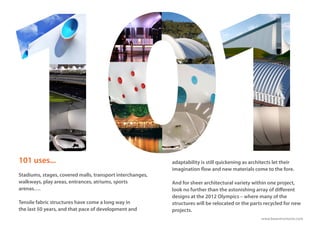
101 uses...
Stadiums, stages, covered malls, transport interchanges,
walkways, play areas, entrances, atriums, sports
arenas….
Tensile fabric structures have come a long way in
the last 50 years, and that pace of development and
www.basestructures.com
Going indoors
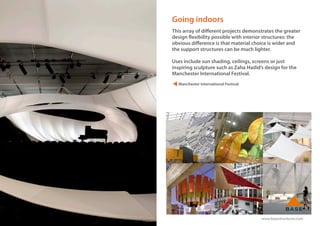
This array of different projects demonstrates the greater
design flexibility possible with interior structures: the
obvious difference is that material choice is wider and
the support structures can be much lighter.
Uses include sun shading, ceilings, screens or just
inspiring sculpture such as Zaha Hadid’s design for the
Manchester International Festival.
Manchester International Festival
www.basestructures.com
Off the peg to suit you
Inevitably budgets are often tight. If you are after a free
standing external canopy it sometimes pays to look into
pre-designed alternatives.
Significant cost and time savings can be achieved using
an‘off-the-peg’design – and Base Structures can offer a
wide choice.
Every pre-designed product is engineered to current
British Standards, making them suitable for year-
round use, even in wind and snow. They also come
with maintenance guidelines and a 5 year warranty,
so whichever fabric structure you choose, you can be
certain it’s engineered to last.
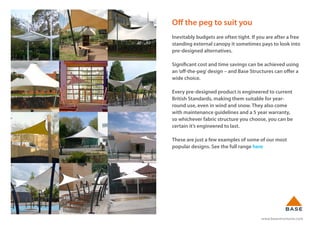
These are just a few examples of some of our most
popular designs. See the full range here
www.basestructures.com
Let there be light
Tensile structures don’t necessarily have to keep out all
the elements.
A wide range of mesh fabrics are available that are
perfect for solar protection, used either as a sunshade
or on a façade.
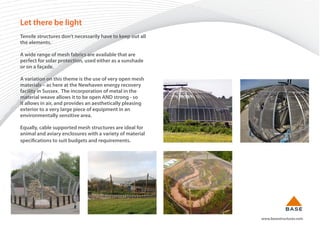
A variation on this theme is the use of very open mesh
materials – as here at the Newhaven energy recovery
facility in Sussex. The incorporation of metal in the
material weave allows it to be open AND strong - so
it allows in air, and provides an aesthetically pleasing
exterior to a very large piece of equipment in an
environmentally sensitive area.
Equally, cable supported mesh structures are ideal for
animal and aviary enclosures with a variety of material
specifications to suit budgets and requirements.
www.basestructures.com
Over to you...
And there you have it. We hope this introductory guide
has been useful to you. If you have some more specific
queries, we’re more than happy to help out – see
overleaf for more details.
In the meantime, thanks for reading. Here’s some more
resources to help you on your way.
Books
Projects & Case studies
• 1,001 projects at a glance
• Breaking new ground – a single skin ETFE roof case
study
• Creating an architectural masterpiece with Zaha
Hadid - case study
• Nottingham University Samworth Academy Case
Study
• MSCP Cardiff Case Study
• Heathrow Terminal 5 Case Study
• Slimbridge WWT Case Study
Otherwise, we’d be grateful if you could take a moment
to let us have your feedback and if you’ve found it useful,
perhaps you’d like to tweet it or share it so that your
friends & colleagues can enjoy it too.
www.basestructures.com
About Base Structures
Base Structures is one of the UK’s most respected and
experienced specialist in tensile fabric structures –
working directly with clients as well as architects to
realise their visions and maximise their budgets.
With over 1400 projects delivered across the globe, we
know a thing or two about getting tensiles right.
Hopefully this guide will help steer you on the right
path but if you would like some support, we are always
happy to work on the conceptual stages of a project on
a speculative basis – providing advice, samples, budget
estimates and hand sketch or rendered images. So
please don’t hesitate to get in touch.
We appoint a single Project Manager to each project so
that it receives the individual attention of a specialist
through from start to finish. Base Structures also offers
an after sales service with a fully staffed maintenance
department offering a 24 hour response.
To find out more, you can get in touch on
+44 (0)117 911 5250, email
mail@basestructures.com or visit our website
www.basestructures.com - where you will
find a wealth of helpful information as well
as some inspirational ideas in our portfolio.

tensile-guide.pdf

  • 1.
    www.basestructures.com Many clients approachus to build their designs, sometimes from detailed drawings, usually from a rough outline. Others ask us to design and build something they have in their heads from scratch. But everyone is now recognising the massive potential that this technology offers… not just to enhance their designs but to have unique benefits in terms of cost and environmental performance. For that to happen, more people need to know what’s possible and how it works. So here is our stress free guide to tensile structures Tensile Guide
  • 2.
    www.basestructures.com The briefest ofhistories Tensile fabric structures have been with us since the Mongolians swept down from the plains, with their yurts as their transportable overnight accommodation. The Bedouins have done the same for untold years. And there’s evidence that the Romans even covered the Colosseum with massive canopies, hoisted by an intricate system of pulleys, to protect the audience from the elements. But they really came into their own in the last half of the 20th century, when designs like this by Germany’s Frei Otto opened everyone’s eyes to what could be created with a little imagination… and a deeper understanding of fabric and cable engineering. The ability of fabric to form double curvature surfaces and its inherent translucency has always been attractive for designers. But with the advent of computer form finding and the development of reliable structural fabrics the world of tensile structures took a giant leap forward. Colosseum roof Frei Otto Olympic Stadium
  • 3.
    www.basestructures.com Why tensiles arethe shape they are Large flat pieces of fabric are very poor at resisting loads*. Imagine four of you each pulling on the strings laced through a tennis ball. Fig 1. A fifth person pushing down on the ball can deflect it easily. Imagine a flappy marquee roof. Try lifting two opposite strings and lowering the other two. Fig 2. The ball is now locked in space. Apply this principle to fabric and you have created‘anticlastic’double curvature**. Sounds grand but actually is simply derived from one of three fabric shapes; the hypar, the cone and the barrel. The fabric can now not only cope with snow loads but also wind uplift. Those footnotes - *Flat fabric panels can be used to create larger structures – The O2 dome in Greenwich is a cable net with lots of flat panels inbetween. **Inflatables have synclastic curvature where the fabric is curved the same way in two axis. Barrel Vault Cone Hypar Fig. 1 Fig. 2
  • 4.
    www.basestructures.com Where do theloads go? Good question. In the image below you can see that all the tensile loads are contained within the steel frame. This solution is particularly appealing where you don’t want to apply ‘pull out’loads to an existing building.  With the classic tensile fabric structure there is no frame and the tensile loads are transferred directly into the surrounding building or foundations via masts and tie rods. So while the structure itself will look lighter and airier, it will probably require larger foundations – not unlike a suspension bridge.  There are some complex maths involved in deriving loads, all of it meat and drink to a computer, and we can advise on this.
  • 5.
    www.basestructures.com Knowing your boundaries Thefabric membrane obviously needs to be attached to the supporting structure somehow. There are two principal approaches: A continuous fixed edge or a scalloped edge with attachment points just at the corners. With the former, the fabric slides into an aluminium extrusion (just like a yacht mast), which is easily bolted to the steel frame. The scalloped edge incorporates a fabric pocket or“cuff” through which a cable is run. The cables terminate on a membrane plate which is connected to the primary frame often with an adjustable link. An optional extra with this design is a rainwater diverter upstand that allows you to collect rainwater. Scalloped edge detail Aluminium luff track edge
  • 6.
    www.basestructures.com Pre-tensioning: cutting theslack Every fabric used in tensile structures has different stretch characteristics but critically they will not creep overtime. Each roll of fabric is tested to the same design loads that the actual canopy will need to be tensioned out to. The amount the fabric stretches is fed back into how much the fabric pattern is 'compensated' in the patterning software; i.e. 'shrunk' in size so it fits perfectly when tensioned out to datum. This pre-tension ensures that even under snow load there is no ponding once the snow begins to melt. The safety factor used for choosing the fabric weight is around 1:6 based on the maximum design loads. Biaxial Rig
  • 7.
    www.basestructures.com The fabric of(long) life How do you choose the optimum fabric for each project? Major criteria include strength, translucency, colour range and most important of all longevity. External tensile structures are asked to keep on performing for anything between 5 and 35 years, in wind, rain and sun. Inevitably, cost comes into it too as, off the roll, they can vary by a factor of 20. That said, the fabric purchase accounts for about 10% of the total project cost. Increasingly, the recyclability of the material is a factor for clients. Fortunately, there is a quick way to check out all these options: a click here takes you to our fabric matrix. And an even quicker way is to call us for advice.
  • 8.
    www.basestructures.com A model life Onecommon complaint is that tensiles are difficult to draw and harder still for the client to visualize. The traditional way round this was to create a physical model (using a curious combination of foamboard, timber dowels and ladies’tights). CAD programmes such as 'Rhino Membrane"* can give designers the tools for the job. More specialist software incorporating‘dynamic relaxation’allows us specialists to find the exact form the fabric will take and also is clever enough to spit out a loading analysis. But don’t knock the tights. *Try these links http://www.youtube.com/watch?v=zDSCVg0rUjl http://www.youtube.com/watch?v=nDowdjdrqHA
  • 9.
    www.basestructures.com Things you shouldknow Insulation: Although fabric structures are generally used to cover unheated spaces it is possible to have a multi layer construction consisting of an inner and outer fabric skin with an interlayer of insulation. One disadvantage is the loss of translucency, although there are now translucent products such as Nanogel that could be used if the budget permits. A double skin construction can be used to reduce the risk of condensation if this cannot be designed out by other means. Fire safety: All structural fabrics are fire rated although some behave differently than others in a fire. Pvc coated polyesters will melt back from a heat source which is useful for venting the flames & smoke. Coated glass fibre based fabrics will tend to produce less smoke and stay intact longer until the seams fail at very high temperatures. Any fabric producing burning droplets is totally unsuitable. The European fire coding system measures flammability, smoke production and burning droplets. A typical PVC coated polyester Euro Class fire rating would be B-s2,d0. Acoustics: To achieve an effective sound absorption you need plenty of mass, which is not one of fabric’s strong points. What fabric is useful for is reducing reverberation times in interiors with a lot of hard surfaces. The best combination is a mesh fabric with an acoustic quilt behind. One technical fabric by Mermet has been engineered to reduce mid to high frequency sound whilst still being translucent to light. Environmental: Many (but not all) of the fabrics now in popular use can be recycled. If this is a major concern for you or your client, the fabric matrix gives an indication of this and we can give more detailed advice. The amount of embodied carbon can also be calculated for your project.
  • 10.
    www.basestructures.com Appearance is all Lighting:Some spectacular effects can be achieved by incorporating low energy LED lighting into the design. Any project where lighting has not been considered is a missed opportunity. Backlighting shows off the fabric’s translucency and up lighting highlights the canopy’s form as well as providing soft indirect illumination. Imagine your canopy as a projection screen and you can start to see the possibilities. Cleaning and maintenance: Depending upon the local environment and climate, canopies should ideally be cleaned annually to maintain their appearance and translucency. The modern PVDF and TiO2 (titanium dioxide) laquers used on pvc coated polyesters are now almost as good as a PTFE (Teflon) coated glass fabric at throwing off the dirt , but any canopy will be hard to clean if not maintained at regular intervals. Each structure is accompanied with a maintenance manual showing how the structure can be safely maintained either by the client or a specialist cleaning company.
  • 11.
    www.basestructures.com adaptability is stillquickening as architects let their imagination flow and new materials come to the fore. And for sheer architectural variety within one project, look no further than the astonishing array of different designs at the 2012 Olympics – where many of the structures will be relocated or the parts recycled for new projects. 101 uses... Stadiums, stages, covered malls, transport interchanges, walkways, play areas, entrances, atriums, sports arenas…. Tensile fabric structures have come a long way in the last 50 years, and that pace of development and
  • 12.
    www.basestructures.com Going indoors This arrayof different projects demonstrates the greater design flexibility possible with interior structures: the obvious difference is that material choice is wider and the support structures can be much lighter. Uses include sun shading, ceilings, screens or just inspiring sculpture such as Zaha Hadid’s design for the Manchester International Festival. Manchester International Festival
  • 13.
    www.basestructures.com Off the pegto suit you Inevitably budgets are often tight. If you are after a free standing external canopy it sometimes pays to look into pre-designed alternatives. Significant cost and time savings can be achieved using an‘off-the-peg’design – and Base Structures can offer a wide choice. Every pre-designed product is engineered to current British Standards, making them suitable for year- round use, even in wind and snow. They also come with maintenance guidelines and a 5 year warranty, so whichever fabric structure you choose, you can be certain it’s engineered to last. These are just a few examples of some of our most popular designs. See the full range here
  • 14.
    www.basestructures.com Let there belight Tensile structures don’t necessarily have to keep out all the elements. A wide range of mesh fabrics are available that are perfect for solar protection, used either as a sunshade or on a façade. A variation on this theme is the use of very open mesh materials – as here at the Newhaven energy recovery facility in Sussex. The incorporation of metal in the material weave allows it to be open AND strong - so it allows in air, and provides an aesthetically pleasing exterior to a very large piece of equipment in an environmentally sensitive area. Equally, cable supported mesh structures are ideal for animal and aviary enclosures with a variety of material specifications to suit budgets and requirements.
  • 15.
    www.basestructures.com Over to you... Andthere you have it. We hope this introductory guide has been useful to you. If you have some more specific queries, we’re more than happy to help out – see overleaf for more details. In the meantime, thanks for reading. Here’s some more resources to help you on your way. Books Projects & Case studies • 1,001 projects at a glance • Breaking new ground – a single skin ETFE roof case study • Creating an architectural masterpiece with Zaha Hadid - case study • Nottingham University Samworth Academy Case Study • MSCP Cardiff Case Study • Heathrow Terminal 5 Case Study • Slimbridge WWT Case Study Otherwise, we’d be grateful if you could take a moment to let us have your feedback and if you’ve found it useful, perhaps you’d like to tweet it or share it so that your friends & colleagues can enjoy it too.
  • 16.
    www.basestructures.com About Base Structures BaseStructures is one of the UK’s most respected and experienced specialist in tensile fabric structures – working directly with clients as well as architects to realise their visions and maximise their budgets. With over 1400 projects delivered across the globe, we know a thing or two about getting tensiles right. Hopefully this guide will help steer you on the right path but if you would like some support, we are always happy to work on the conceptual stages of a project on a speculative basis – providing advice, samples, budget estimates and hand sketch or rendered images. So please don’t hesitate to get in touch. We appoint a single Project Manager to each project so that it receives the individual attention of a specialist through from start to finish. Base Structures also offers an after sales service with a fully staffed maintenance department offering a 24 hour response. To find out more, you can get in touch on +44 (0)117 911 5250, email mail@basestructures.com or visit our website www.basestructures.com - where you will find a wealth of helpful information as well as some inspirational ideas in our portfolio.