Ten Types of
Innovation
Designing Game-Changing
Innovations
How to deliver breakthrough results by
understanding the Ten Types of Innovation.
Learning Objectives
1. Understand the origins of the Ten Types framework.
2. Become familiar with the Ten Types of Innovation.
3. How to use the Ten Types to define where you’re going
with innovation and to expand opportunities beyond
products alone.
4. Become familiar with tools for turning the Ten Types
into building blocks for Innovation.
Material for this presentation was adapted from Ten Types of Innovation:
The Discipline of Building Breakthroughs, Larry Keeley, Ryan Pikkel, Brian
Quinn, Helen Walters (New Jersey: John Wiley & Sons, Inc.) 2013.
Origin of the Ten Types
Framework
A seminal discovery.
A periodic table for innovation…
developed by Doblin…
that applies to all organizations…
and uses a disciplined approach.
• All impactful innovations use some combination of ten
basic types.
• The Ten Types can be used to help innovation efforts in
several ways.
• There are over 100 innovation tactics or specific known
ways the framework can be used.
Overview of the Ten Types
A simple and intuitive framework.
• Useful to diagnose and improve a current innovation or
to analyze the competition.
• Structured into three color-coded categories.
How to Use the 10 Types
Shift your focus.
Use the Ten Types strategically…
to shift value creation because…
product performance isn’t enough.
Diagnostics
help.
CustomerExperience
Brand
Channel
Service
ProductSystems
ProductPerformance
CoreProcesses
EnablingProcesses
Networking
BusinessModels
1988
1989
1990
1991
1992
1993
1994
1995
1996
1997
1998
Emerging standards,
specialization
e.g. PowerPC (IBM, Motorola, Apple),
Zero inventory assembly
Flexible financing
e.g. FreePC, Gateway Your:
)ware, Compaq leasing
Networked organizations
e.g. Dell paperless purchasing,
Intra/Extranets
Low-cost home PC’s
e.g. Windows 95, Intel Celeron
Technology-drive
multimedia enhancements
e.g. Intel 486, Windows 3.0,
Adobe Postscript
Going direct
e.g. Dell, Gateway Country
Stores
Data says: go beyond products to win.
Many innovators use multiple types.
Integrating office tools.
Types Used:
• Profit Model
• Process
• Product System
• Channel
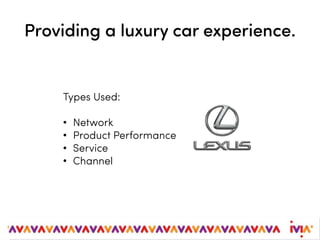
Providing a luxury car experience.
Types Used:
• Network
• Product Performance
• Service
• Channel
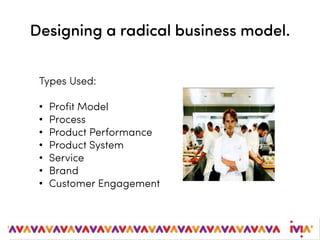
Designing a radical business model.
Types Used:
• Profit Model
• Process
• Product Performance
• Product System
• Service
• Brand
• Customer Engagement
Finding a new way to reach kids.
Reimagining an entire industry.
Its Time for…
Innovation Tactics
Tools for turning the Ten Types into
the building blocks for innovation.
Ad-Supported Float Microtransactions
Auction Forced Scarcity Premium
Bundled Pricing Freemium Risk Sharing
Cost Leadership Installed Base Scaled Transactions
Disaggregated
Pricing
Licensing Subscription
Financing Membership Switchboard
Flexible Pricing Metered Use User-Defined
Alliances Open Innovation
Collaboration Secondary Markets
Complementary
Partnering
Supply Chain Integration
Consolidation
Coopetition
Franchising
Merger/Acquisition
Asset Standardization Organizational Design
Competency Center Outsourcing
Corporate University
Decentralized
Management
Incentive System
IT Integration
Knowledge Management
Crowdsourcing Predictive Analytics
Flexible Manufacturing Process Automation
Intellectual Property Process Efficiency
Lean Production Process Standardization
Localization Strategic Design
Logistics Systems User-Generated
On-Demand Production
Added Functionality Performance Simplification
Conservation Safety
Ease of Use Styling
Engaging Functionality Superior Product
Environmental Sensitivity
Feature Aggregation
Focus
Complements
Extensions/Plug-ins
Integrated Offering
Modular Systems
Product Bundling
Product/Service Platforms
Added Value Superior Service
Concierge Supplementary Service
Guarantee Total Experience Management
Lease or Loan Try Before You Buy
Loyalty Program User Communities/Support Systems
Personalized Service
Self-Service
Context Specific Multi-Level Marketing
Cross-Selling Non-Traditional Channels
Diversification On-Demand
Experience Center Pop-Up Presence
Flagship Store
Go Direct
Indirect Distribution
Brand Extension Values Alignment
Brand Leverage
Certification
Co-Branding
Component Branding
Private Label
Transparency
Autonomy and Authority Personalization
Community and Belonging Status and Recognition
Curation Whimsy and Personality
Experience Automation
Experience Enabling
Experience Simplification
Mastery
How to use the tactics.
1. Anchor & Extend
2. Add & Substitute
3. Array at Random
Ad-
Supported
Alliances Incentive
Systems
Styling Guarante
e
Values
Alignment
Alliances Incentive
Systems
Focus Concierge Go Direct
+ +
Metered
Use
Private
Label
Mastery
Reflection
Successful Initiatives
A X X X X X X
B X X X X X X
C X X X X X X X
D X X X X X X X X
Unsuccessful Initiatives
1 X X
2 X X X
3 X X X X
4 X X X X
What are you doing in your organization?
What could you do?
• Be disciplined.
• Go beyond products.
• Use many types.
• Diagnostics help.
Debrief

Ten types innovation