Chapter4
Threat and Error Management (TEM)
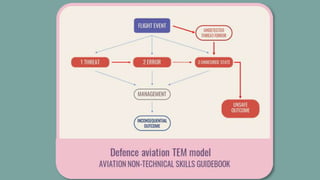
is a framework that recogniseserror as a normal and expected
part of human behaviour. In the course of their duties,
individuals and crews will encounter a number of threats
(external influences) and/ or errors (internal influences)
that could lead to an unsafe outcome. Being able to
anticipate, recognize and manage threats, errors and unsafe
outcomes is a key principle of the TEM framework.
Threat is defined as an external influence that occurs
outside the influence of the crew, but has the potential to
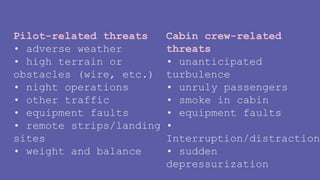
Pilot-related threats
• adverse weather
• high terrain or
obstacles (wire, etc.)
• night operations
• other traffic
• equipment faults
• remote strips/landing
sites
• weight and balance
Cabin crew-related
threats
• unanticipated
turbulence
• unruly passengers
• smoke in cabin
• equipment faults
•
Interruption/distraction
• sudden
depressurization
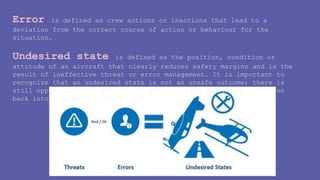
Error is defined as crew actions or inactions that lead to a
deviation from the correct course of action or behaviour for the
situation.
Undesired state is defined as the position, condition or
attitude of an aircraft that clearly reduces safety margins and is the
result of ineffective threat or error management. It is important to
recognize that an undesired state is not an unsafe outcome; there is
still opportunity for the crew to recognize and manage the situation
back into a normal state.
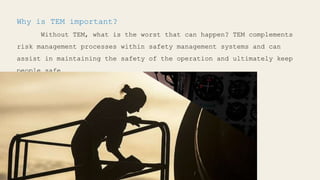
Why is TEM important?
Without TEM, what is the worst that can happen? TEM complements
risk management processes within safety management systems and can
assist in maintaining the safety of the operation and ultimately keep
people safe.
TEM countermeasures
Planning—it is impossible to predict every threat or error that may
occur during the course of a flight, but by effectively planning and
preparing for a flight, and briefing anticipated threats and strategies
to manage them, crews will be better able to manage the unexpected.
This includes understanding potential threats such as fatigue and
stress and effectively managing their impact on performance.
Execution—a crew that work well as a team, communicate and make
sound decisions will have better situational awareness, and therefore
be able to prevent errors, or, detect and effectively manage threats,
errors or Unmanned Aerial Systems** (UAS).
Review—effective threat and error management requires constant
vigilance, and that requires crews to constantly review their
environment and adapt accordingly. Again, NTS skills such as teamwork,
communication, decision-making and situation awareness support
effective identification and management of threats and evolving
situations.
THANK
YOU
Case Study

TEM.pptx

  • 1.
  • 2.
    Threat and ErrorManagement (TEM) is a framework that recogniseserror as a normal and expected part of human behaviour. In the course of their duties, individuals and crews will encounter a number of threats (external influences) and/ or errors (internal influences) that could lead to an unsafe outcome. Being able to anticipate, recognize and manage threats, errors and unsafe outcomes is a key principle of the TEM framework. Threat is defined as an external influence that occurs outside the influence of the crew, but has the potential to
  • 3.
    Pilot-related threats • adverseweather • high terrain or obstacles (wire, etc.) • night operations • other traffic • equipment faults • remote strips/landing sites • weight and balance Cabin crew-related threats • unanticipated turbulence • unruly passengers • smoke in cabin • equipment faults • Interruption/distraction • sudden depressurization
  • 4.
    Error is definedas crew actions or inactions that lead to a deviation from the correct course of action or behaviour for the situation. Undesired state is defined as the position, condition or attitude of an aircraft that clearly reduces safety margins and is the result of ineffective threat or error management. It is important to recognize that an undesired state is not an unsafe outcome; there is still opportunity for the crew to recognize and manage the situation back into a normal state.
  • 6.
    Why is TEMimportant? Without TEM, what is the worst that can happen? TEM complements risk management processes within safety management systems and can assist in maintaining the safety of the operation and ultimately keep people safe.
  • 8.
    TEM countermeasures Planning—it isimpossible to predict every threat or error that may occur during the course of a flight, but by effectively planning and preparing for a flight, and briefing anticipated threats and strategies to manage them, crews will be better able to manage the unexpected. This includes understanding potential threats such as fatigue and stress and effectively managing their impact on performance. Execution—a crew that work well as a team, communicate and make sound decisions will have better situational awareness, and therefore be able to prevent errors, or, detect and effectively manage threats, errors or Unmanned Aerial Systems** (UAS). Review—effective threat and error management requires constant vigilance, and that requires crews to constantly review their environment and adapt accordingly. Again, NTS skills such as teamwork, communication, decision-making and situation awareness support effective identification and management of threats and evolving situations.
  • 9.