Lesson3 How Human
Factors Relate to
C R M
Introduction to Human Factor
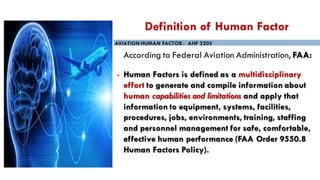
What is Human Factor ?
is the discipline that studies this “man-machine” interface.
Human factors applies “what we know about people, their
abilities, characteristics, and limitations to the design of
equipment they use, environments in which they function, and
jobs they perform.” Human factors specialists help reduce error
and maximize productivity, performance, and safety.
There is opportunity for human factors in all of this. Human
factors contributions allow us to be more productive, to be
more efficient and, perhaps most important, to stay safe.
Humans make errors and those errors have consequences.
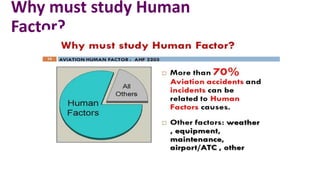
Consider the aviation industry, where error rates have been
extensively studied. According to Boeing, “Human error has
been documented as a primary contributor to more than 70
percent of commercial airplane hull-loss accidents.”
Human Factor
Why must study Human
Factor?
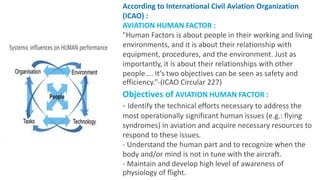
According to International Civil Aviation Organization
(ICAO) :
AVIATION HUMAN FACTOR :
"Human Factors is about people in their working and living
environments, and it is about their relationship with
equipment, procedures, and the environment. Just as
importantly, it is about their relationships with other
people.... It’s two objectives can be seen as safety and
efficiency.”-(ICAO Circular 227)
Objectives of AVIATION HUMAN FACTOR :
- Identify the technical efforts necessary to address the
most operationally significant human issues (e.g.: flying
syndromes) in aviation and acquire necessary resources to
respond to these issues.
- Understand the human part and to recognize when the
body and/or mind is not in tune with the aircraft.
- Maintain and develop high level of awareness of
physiology of flight.
Human Performance
Human performance is defined as the human capabilities and limitations which
have an impact on the safety and efficiency of aeronautical operations.
Human performance training focuses on relationships between people and
equipment, systems, procedures and the environment as well as personal
relationships between individuals and groups. It encompasses the overall
performance of cabin crew members while they carry out their duties.
The goal of this training is to optimize human performance and manage human
error. It encompasses Human Factors principles, crew resource management and
the development and application of skills, such as decision-making. Human
performance training should be oriented towards solving practical problems in
the real world.
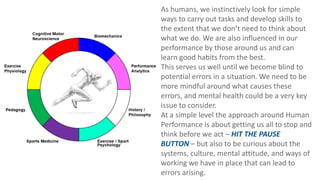
As humans, we instinctively look for simple
ways to carry out tasks and develop skills to
the extent that we don’t need to think about
what we do. We are also influenced in our
performance by those around us and can
learn good habits from the best.
This serves us well until we become blind to
potential errors in a situation. We need to be
more mindful around what causes these
errors, and mental health could be a very key
issue to consider.
At a simple level the approach around Human
Performance is about getting us all to stop and
think before we act – HIT THE PAUSE
BUTTON – but also to be curious about the
systems, culture, mental attitude, and ways of
working we have in place that can lead to
errors arising.
We all make mistakes (around seven per hour if we take the statistics from
Goldberg (The Blunder Book), and for good performance we need to be
aware that errors happen.
However, research has proven that 80% of human errors happen as a result
of latent failings and errors in our organizations (INPO database 2008). In
other words, on a certain day given certain conditions where a person is
prone to making an error there are often a string of weaknesses already in
the organization that can create conditions for that error to happen. Consider
supervision, design, procedures, culture, and mental attitude.
What a lot of organizations don’t consider enough of, is the mental health
and stress issues that employees might be faced with, and how this could
impact on them delivering good performance at work.
Human Factors
Human
Performance
Human Errors
Human
Limitations
Human
Limitations
Human Errors
?
?
?
?
?
?
SHELL
Model
AVIATION HUMAN FACTOR : AHF 2203
Most of aircraft accident were because of
human error. Aircraft mechanical failures greatly
decrease and rarely happen due to high and
modern technology used in aviation.
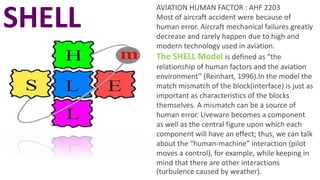
The SHELL Model is defined as “the
relationship of human factors and the aviation
environment” (Reinhart, 1996).In the model the
match mismatch of the block(interface) is just as
important as characteristics of the blocks
themselves. A mismatch can be a source of
human error. Liveware becomes a component
as well as the central figure upon which each
component will have an effect; thus, we can talk
about the “human-machine” interaction (pilot
moves a control), for example, while keeping in
mind that there are other interactions
(turbulence caused by weather).
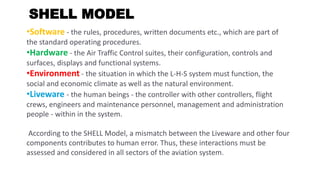
•Software - the rules, procedures, written documents etc., which are part of
the standard operating procedures.
•Hardware - the Air Traffic Control suites, their configuration, controls and
surfaces, displays and functional systems.
•Environment - the situation in which the L-H-S system must function, the
social and economic climate as well as the natural environment.
•Liveware - the human beings - the controller with other controllers, flight
crews, engineers and maintenance personnel, management and administration
people - within in the system.
According to the SHELL Model, a mismatch between the Liveware and other four
components contributes to human error. Thus, these interactions must be
assessed and considered in all sectors of the aviation system.
SHELL MODEL
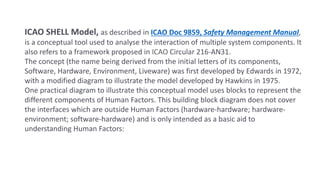
ICAO SHELL Model, as described in ICAO Doc 9859, Safety Management Manual,
is a conceptual tool used to analyse the interaction of multiple system components. It
also refers to a framework proposed in ICAO Circular 216-AN31.
The concept (the name being derived from the initial letters of its components,
Software, Hardware, Environment, Liveware) was first developed by Edwards in 1972,
with a modified diagram to illustrate the model developed by Hawkins in 1975.
One practical diagram to illustrate this conceptual model uses blocks to represent the
different components of Human Factors. This building block diagram does not cover
the interfaces which are outside Human Factors (hardware-hardware; hardware-
environment; software-hardware) and is only intended as a basic aid to
understanding Human Factors:
SHELL Model
•Software;
rules,
regulations,
laws, orders,
standard operating
procedures, etc.
•Hardware;
building,
vehicles,
equipments,
materials, technology and
tools.
•Environment
•The surroundings
of Context of
interaction such as
temperature, weather, light, noise etc.
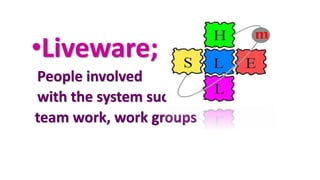
•Liveware;
People involved
with the system such as
team work, work groups
Human Error
Errors are (in)actions,
which fail to achieve
their intended
outcomes.
Violations are
intentional (in)actions,
which violate known
Human Error
is commonly defined as a failure of a planned action to achieve a desired
outcome. ... Plans can be adequate or inadequate, and actions (behavior)
can be intentional or unintentional.
Human error refers to something having been done that was "not intended
by the actor; not desired by a set of rules or an external observer; or that led
the task or system outside its acceptable limits".
Human error has been cited as a primary cause contributing factor in
disasters and accidents in industries as diverse as nuclear power (e.g.,
the Three Mile Island accident), aviation (see pilot error), space exploration
(e.g., the Space Shuttle Challenger Disaster and Space Shuttle Columbia
disaster), and medicine (medical error). Prevention of human error is
generally seen as a major contributor to reliability and safety of (complex)
systems. Human error is one of the many contributing causes of risk events.
Human Errors Basis
1.Anyone can and will make mistakes
2.Origins of error can be different.
3.Consequences of similar errors
can also be different
Human Errors Basis
The origins of errors can be
fundamentally different.
Ohh!!
Human Errors Basis
Anyone can and will make
Human Errors Basis
Consequences of similar errors can also be
Unintentional
- Plan is correct
- Attention failure
SLIPS
- Routine
- Situational
- Exceptional
LAPSES
Intentional MISTAKES
VIOLATIONS
- Plan is correct
- Memory failure
- Plan is incorrect
- Rule / Knowledge-based
“ Human errors
can be minimized,
but they cannot be
eliminated “
LAPSES
VIOLATIONS
Human Factors.pdf

Human Factors.pdf

  • 1.
  • 2.
  • 5.
    What is HumanFactor ?
  • 6.
    is the disciplinethat studies this “man-machine” interface. Human factors applies “what we know about people, their abilities, characteristics, and limitations to the design of equipment they use, environments in which they function, and jobs they perform.” Human factors specialists help reduce error and maximize productivity, performance, and safety. There is opportunity for human factors in all of this. Human factors contributions allow us to be more productive, to be more efficient and, perhaps most important, to stay safe. Humans make errors and those errors have consequences. Consider the aviation industry, where error rates have been extensively studied. According to Boeing, “Human error has been documented as a primary contributor to more than 70 percent of commercial airplane hull-loss accidents.” Human Factor
  • 7.
    Why must studyHuman Factor?
  • 8.
    According to InternationalCivil Aviation Organization (ICAO) : AVIATION HUMAN FACTOR : "Human Factors is about people in their working and living environments, and it is about their relationship with equipment, procedures, and the environment. Just as importantly, it is about their relationships with other people.... It’s two objectives can be seen as safety and efficiency.”-(ICAO Circular 227) Objectives of AVIATION HUMAN FACTOR : - Identify the technical efforts necessary to address the most operationally significant human issues (e.g.: flying syndromes) in aviation and acquire necessary resources to respond to these issues. - Understand the human part and to recognize when the body and/or mind is not in tune with the aircraft. - Maintain and develop high level of awareness of physiology of flight.
  • 9.
    Human Performance Human performanceis defined as the human capabilities and limitations which have an impact on the safety and efficiency of aeronautical operations. Human performance training focuses on relationships between people and equipment, systems, procedures and the environment as well as personal relationships between individuals and groups. It encompasses the overall performance of cabin crew members while they carry out their duties. The goal of this training is to optimize human performance and manage human error. It encompasses Human Factors principles, crew resource management and the development and application of skills, such as decision-making. Human performance training should be oriented towards solving practical problems in the real world.
  • 10.
    As humans, weinstinctively look for simple ways to carry out tasks and develop skills to the extent that we don’t need to think about what we do. We are also influenced in our performance by those around us and can learn good habits from the best. This serves us well until we become blind to potential errors in a situation. We need to be more mindful around what causes these errors, and mental health could be a very key issue to consider. At a simple level the approach around Human Performance is about getting us all to stop and think before we act – HIT THE PAUSE BUTTON – but also to be curious about the systems, culture, mental attitude, and ways of working we have in place that can lead to errors arising.
  • 11.
    We all makemistakes (around seven per hour if we take the statistics from Goldberg (The Blunder Book), and for good performance we need to be aware that errors happen. However, research has proven that 80% of human errors happen as a result of latent failings and errors in our organizations (INPO database 2008). In other words, on a certain day given certain conditions where a person is prone to making an error there are often a string of weaknesses already in the organization that can create conditions for that error to happen. Consider supervision, design, procedures, culture, and mental attitude. What a lot of organizations don’t consider enough of, is the mental health and stress issues that employees might be faced with, and how this could impact on them delivering good performance at work.
  • 12.
  • 13.
    SHELL Model AVIATION HUMAN FACTOR: AHF 2203 Most of aircraft accident were because of human error. Aircraft mechanical failures greatly decrease and rarely happen due to high and modern technology used in aviation. The SHELL Model is defined as “the relationship of human factors and the aviation environment” (Reinhart, 1996).In the model the match mismatch of the block(interface) is just as important as characteristics of the blocks themselves. A mismatch can be a source of human error. Liveware becomes a component as well as the central figure upon which each component will have an effect; thus, we can talk about the “human-machine” interaction (pilot moves a control), for example, while keeping in mind that there are other interactions (turbulence caused by weather).
  • 14.
    •Software - therules, procedures, written documents etc., which are part of the standard operating procedures. •Hardware - the Air Traffic Control suites, their configuration, controls and surfaces, displays and functional systems. •Environment - the situation in which the L-H-S system must function, the social and economic climate as well as the natural environment. •Liveware - the human beings - the controller with other controllers, flight crews, engineers and maintenance personnel, management and administration people - within in the system. According to the SHELL Model, a mismatch between the Liveware and other four components contributes to human error. Thus, these interactions must be assessed and considered in all sectors of the aviation system. SHELL MODEL
  • 15.
    ICAO SHELL Model,as described in ICAO Doc 9859, Safety Management Manual, is a conceptual tool used to analyse the interaction of multiple system components. It also refers to a framework proposed in ICAO Circular 216-AN31. The concept (the name being derived from the initial letters of its components, Software, Hardware, Environment, Liveware) was first developed by Edwards in 1972, with a modified diagram to illustrate the model developed by Hawkins in 1975. One practical diagram to illustrate this conceptual model uses blocks to represent the different components of Human Factors. This building block diagram does not cover the interfaces which are outside Human Factors (hardware-hardware; hardware- environment; software-hardware) and is only intended as a basic aid to understanding Human Factors:
  • 16.
  • 17.
  • 18.
  • 19.
    •Environment •The surroundings of Contextof interaction such as temperature, weather, light, noise etc.
  • 20.
    •Liveware; People involved with thesystem such as team work, work groups
  • 22.
  • 24.
    Errors are (in)actions, whichfail to achieve their intended outcomes. Violations are intentional (in)actions, which violate known
  • 25.
    Human Error is commonlydefined as a failure of a planned action to achieve a desired outcome. ... Plans can be adequate or inadequate, and actions (behavior) can be intentional or unintentional. Human error refers to something having been done that was "not intended by the actor; not desired by a set of rules or an external observer; or that led the task or system outside its acceptable limits". Human error has been cited as a primary cause contributing factor in disasters and accidents in industries as diverse as nuclear power (e.g., the Three Mile Island accident), aviation (see pilot error), space exploration (e.g., the Space Shuttle Challenger Disaster and Space Shuttle Columbia disaster), and medicine (medical error). Prevention of human error is generally seen as a major contributor to reliability and safety of (complex) systems. Human error is one of the many contributing causes of risk events.
  • 26.
    Human Errors Basis 1.Anyonecan and will make mistakes 2.Origins of error can be different. 3.Consequences of similar errors can also be different
  • 27.
    Human Errors Basis Theorigins of errors can be fundamentally different. Ohh!!
  • 28.
    Human Errors Basis Anyonecan and will make
  • 29.
    Human Errors Basis Consequencesof similar errors can also be
  • 30.
    Unintentional - Plan iscorrect - Attention failure SLIPS - Routine - Situational - Exceptional LAPSES Intentional MISTAKES VIOLATIONS - Plan is correct - Memory failure - Plan is incorrect - Rule / Knowledge-based
  • 32.
    “ Human errors canbe minimized, but they cannot be eliminated “
  • 33.