Download as PDF, PPTX

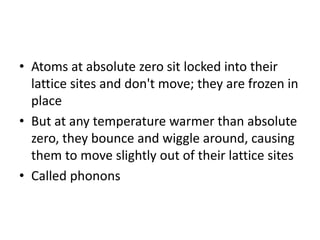
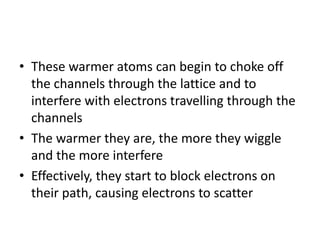
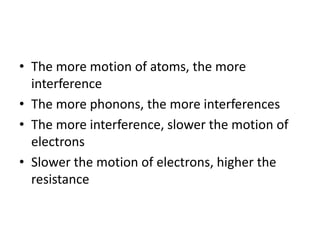

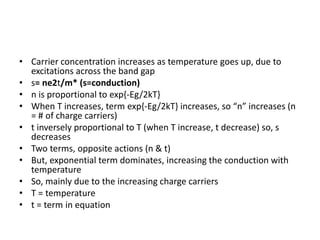


The electrical resistivity of metals increases with temperature due to phonons interfering with electron movement through the metal lattice. Phonons describe the vibrational motion of atoms in the lattice which increases with temperature, causing more scattering of electrons. The electrical resistivity of semiconductors decreases with temperature because the number of charge carriers increases exponentially with temperature due to excitations across the band gap, overcoming the decrease in carrier mobility.


