LESSON 20

Asking permissions
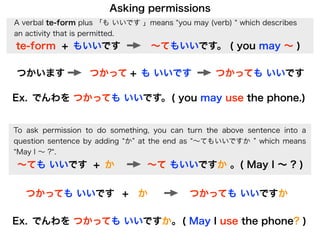
Asking permissions
A verbal te-form plus 「も いいです 」means you may (verb)     which describes
an activity that is permitted.
te-form + もいいです                   ∼てもいいです。 ( you may ∼ )

つかいます             つかって + も いいです                   つかっても いいです

Ex. でんわを つかっても いいです。 ( you may use the phone.)


To ask permission to do something, you can turn the above sentence into a
question sentence by adding か at the end as ∼てもいいですか which means
 May I ∼ ? .
∼ても いいです + か                     ∼て もいいですか 。( May I ∼ ? )


   つかっても いいです + か                          つかっても いいですか

Ex. でんわを つかっても いいですか。 ( May I use the phone? )
Asking permissions
          To grant permission, you may repeat ∼てもいいです as :
           はい、∼ても いいです。 ( Yes, you may ∼ .)

Ex. Q: でんわを つかっても いいですか。 ( May I use the phone? )
 A-1: はい、つかっても いいです。 ( Yes, you may use the phone. )
        However, sometimes it sounds a bit bureaucratic or authoritative.
        Then it much sounds friendly as :

 A-2: はい、どうぞ。 ( Yes, please do [so]. )                           or

 A-3: ええ、どうぞ。 ( Yes, go ahead [to do so]. )

  To refuse permission, it sounds social by not using a direct denial No as :

 A-4: すみませんが、ちょっと・・・。 ( I m sorry, but ・・・ )
   that would be a little difficult or inconvenient may followed by ちょっと (I m
  sorry, but) , on the other hand, Japanese listeners shall instantly understand
  that that would be not permitted even this voiceless part is omitted.
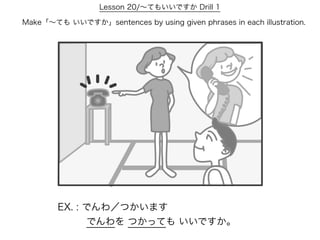
Lesson 20/∼てもいいですか Drill 1

Make「∼ても いいですか」sentences by using given phrases in each illustration.


        EX. : でんわ/つかいます
           でんわを つかっても いいですか。
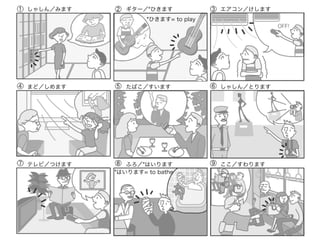
しゃしん/みます      ギター/*ひきます             エアコン/けします
                   *ひきます= to play


まど/しめます       たばこ/すいます              しゃしん/とります


テレビ/つけます      ふろ/*はいります             ここ/すわります
           *はいります= to bathe
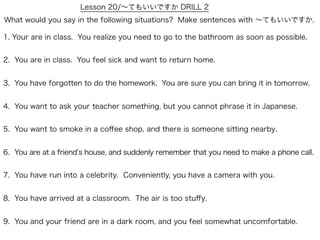
Lesson 20/∼てもいいですか DRILL 2
What would you say in the following situations? Make sentences with ∼てもいいですか.

1. Your are in class. You realize you need to go to the bathroom as soon as possible.


2. You are in class. You feel sick and want to return home.


3. You have forgotten to do the homework. You are sure you can bring it in tomorrow.


4. You want to ask your teacher something, but you cannot phrase it in Japanese.


5. You want to smoke in a coffee shop, and there is someone sitting nearby.


6. You are at a friend s house, and suddenly remember that you need to make a phone call.


7. You have run into a celebrity. Conveniently, you have a camera with you.


8. You have arrived at a classroom. The air is too stuffy.


9. You and your friend are in a dark room, and you feel somewhat uncomfortable.

JBP-1/ Lesson 20/Temoiidesuka

  • 1.
  • 2.
    Asking permissions A verbalte-form plus 「も いいです 」means you may (verb) which describes an activity that is permitted. te-form + もいいです ∼てもいいです。 ( you may ∼ ) つかいます つかって + も いいです つかっても いいです Ex. でんわを つかっても いいです。 ( you may use the phone.) To ask permission to do something, you can turn the above sentence into a question sentence by adding か at the end as ∼てもいいですか which means May I ∼ ? . ∼ても いいです + か ∼て もいいですか 。( May I ∼ ? ) つかっても いいです + か つかっても いいですか Ex. でんわを つかっても いいですか。 ( May I use the phone? )
  • 3.
    Asking permissions To grant permission, you may repeat ∼てもいいです as : はい、∼ても いいです。 ( Yes, you may ∼ .) Ex. Q: でんわを つかっても いいですか。 ( May I use the phone? ) A-1: はい、つかっても いいです。 ( Yes, you may use the phone. ) However, sometimes it sounds a bit bureaucratic or authoritative. Then it much sounds friendly as : A-2: はい、どうぞ。 ( Yes, please do [so]. ) or A-3: ええ、どうぞ。 ( Yes, go ahead [to do so]. ) To refuse permission, it sounds social by not using a direct denial No as : A-4: すみませんが、ちょっと・・・。 ( I m sorry, but ・・・ ) that would be a little difficult or inconvenient may followed by ちょっと (I m sorry, but) , on the other hand, Japanese listeners shall instantly understand that that would be not permitted even this voiceless part is omitted.
  • 4.
    Lesson 20/∼てもいいですか Drill1 Make「∼ても いいですか」sentences by using given phrases in each illustration. EX. : でんわ/つかいます    でんわを つかっても いいですか。
  • 5.
    しゃしん/みます ギター/*ひきます エアコン/けします *ひきます= to play まど/しめます たばこ/すいます しゃしん/とります テレビ/つけます ふろ/*はいります ここ/すわります *はいります= to bathe
  • 6.
    Lesson 20/∼てもいいですか DRILL2 What would you say in the following situations? Make sentences with ∼てもいいですか. 1. Your are in class. You realize you need to go to the bathroom as soon as possible. 2. You are in class. You feel sick and want to return home. 3. You have forgotten to do the homework. You are sure you can bring it in tomorrow. 4. You want to ask your teacher something, but you cannot phrase it in Japanese. 5. You want to smoke in a coffee shop, and there is someone sitting nearby. 6. You are at a friend s house, and suddenly remember that you need to make a phone call. 7. You have run into a celebrity. Conveniently, you have a camera with you. 8. You have arrived at a classroom. The air is too stuffy. 9. You and your friend are in a dark room, and you feel somewhat uncomfortable.