Japanese for Busy People 1
Lesson 14
Grammar Notes of Japanese Adjectives 2
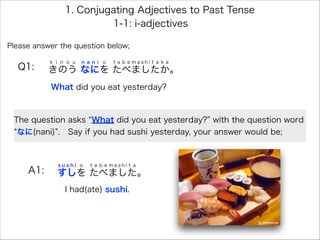
Please answer the question below;
Q1: きのう なにを たべましたか。
k i n o u n a n i o t a b e m a s h i t a k a
1. Conjugating Adjectives to Past Tense
A1: すしを たべました。
s u s h i o t a b e m a s h i t a
The question asks What did you eat yesterday? with the question word
なに(nani) . Say if you had sushi yesterday, your answer would be;
I had(ate) sushi.
What did you eat yesterday?
1-1: i-adjectives
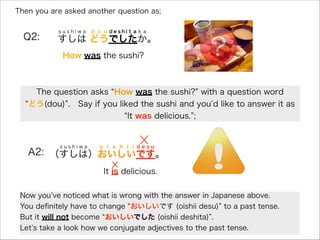
Then you are asked another question as;
Q2: すしは どうでしたか。
s u s h i w a d o u d e s h i t a k a
How was the sushi?
The question asks How was the sushi? with a question word
どう(dou) . Say if you liked the sushi and you d like to answer it as
It was delicious. ;
A2: (すしは)おいしいです。
s u s h i w a o i s h i i d e s u
It is delicious.
Now you ve noticed what is wrong with the answer in Japanese above.
You definitely have to change おいしいです (oishii desu) to a past tense.
But it will not become おいしいでした (oishii deshita) .
Let s take a look how we conjugate adjectives to the past tense.
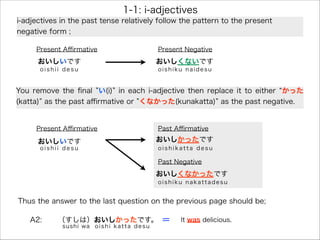
i-adjectives in the past tense relatively follow the pattern to the present
negative form ;
1-1: i-adjectives
A2: (すしは)おいしかったです。
sushi wa oishi katta desu
It was delicious.=
You remove the final い(i) in each i-adjective then replace it to either かった
(katta) as the past affirmative or くなかった(kunakatta) as the past negative.
おいしいです
おいしくないです
Present Affirmative
Present Negative
o i s h i i d e s u
oishiku naidesu
おいしかったです
Past Affirmative
o i s h i k a t t a d e s u
おいしくなかったです
Past Negative
oishiku nakattadesu
おいしいです
Present Affirmative
o i s h i i d e s u
Thus the answer to the last question on the previous page should be;
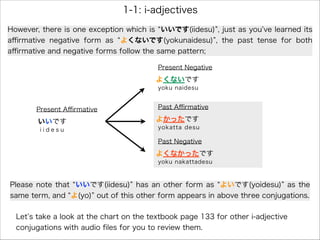
However, there is one exception which is いいです(iidesu) , just as you ve learned its
affirmative negative form as よくないです(yokunaidesu) , the past tense for both
affirmative and negative forms follow the same pattern;
1-1: i-adjectives
いいです
よくないです
Present Affirmative
Present Negative
i i d e s u
yoku naidesu
よかったです
Past Affirmative
yokatta desu
よくなかったです
Past Negative
yoku nakattadesu
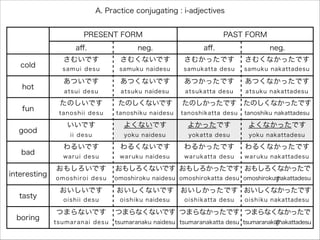
Let s take a look at the chart on the textbook page 133 for other i-adjective
conjugations with audio files for you to review them.
Please note that いいです(iidesu) has an other form as よいです(yoidesu) as the
same term, and よ(yo) out of this other form appears in above three conjugations.
PRESENT FORM PAST FORM
aff. neg. aff. neg.
cold
さむいです さむくないです さむかったです さむくなかったです
hot
あついです あつくないです あつかったです あつくなかったです
fun
たのしいです たのしくないです たのしかったです たのしくなかったです
good
いいです よくないです よかったです よくなかったです
bad
わるいです わるくないです わるかったです わるくなかったです
interesting
おもしろいです おもしろくないです おもしろかったです おもしろくなかったで
す
tasty
おいしいです おいしくないです おいしかったです おいしくなかったです
boring
つまらないです つまらなくないです つまらなかったです つまらなくなかったで
す
A. Practice conjugating : i-adjectives
samui desu samuku naidesu samukatta desu samuku nakattadesu
atsui desu atsuku naidesu atsukatta desu atsuku nakattadesu
tanoshii desu tanoshiku naidesu tanoshikatta desu tanoshiku nakattadesu
ii desu yoku naidesu yokatta desu yoku nakattadesu
warui desu waruku naidesu warukatta desu waruku nakattadesu
omoshiroi desu omoshiroku naidesu omoshirokatta desu omoshiroku nakattadesu
oishii desu oishiku naidesu oishikatta desu oishiku nakattadesu
tsumaranai desu tsumaranaku naidesu tsumaranakatta desu tsumaranaku nakattadesu
Please answer the question below;
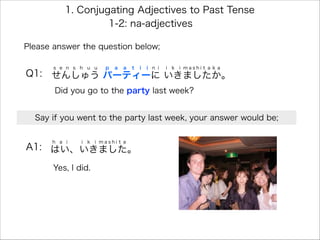
Q1: せんしゅう パーティーに いきましたか。
s e n s h u u p a a t i i n i i k i m a s h i t a k a
1. Conjugating Adjectives to Past Tense
A1: はい、いきました。
h a i i k i m a s h i t a
Yes, I did.
Did you go to the party last week?
1-2: na-adjectives
Say if you went to the party last week, your answer would be;
1. Conjugating Adjectives to Past Tense
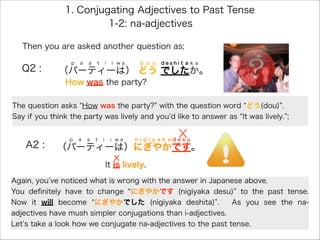
Q2 : (パーティーは) どう でしたか。
p a a t i i w a d o u d e s h i t a k a
How was the party?
A2 : (パーティーは)にぎやかです。
p a a t i i w a n i g i y a k a d e s u
It is lively.
1-2: na-adjectives
Then you are asked another question as;
The question asks How was the party? with the question word どう(dou) .
Say if you think the party was lively and you d like to answer as It was lively. ;
Again, you ve noticed what is wrong with the answer in Japanese above.
You definitely have to change にぎやかです (nigiyaka desu) to the past tense.
Now it will become にぎやかでした (nigiyaka deshita) . As you see the na-
adjectives have mush simpler conjugations than i-adjectives.
Let s take a look how we conjugate na-adjectives to the past tense.
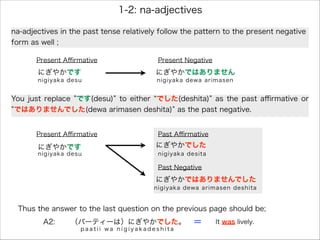
na-adjectives in the past tense relatively follow the pattern to the present negative
form as well ;
1-2: na-adjectives
You just replace です(desu) to either でした(deshita) as the past affirmative or
ではありませんでした(dewa arimasen deshita) as the past negative.
にぎやかです
にぎやかではありません
Present Affirmative
Present Negative
nigiyaka desu
nigiyaka dewa arimasen
にぎやかでした
Past Affirmative
nigiyaka desita
にぎやかではありませんでした
Past Negative
nigiyaka dewa arimasen deshita
にぎやかです
Present Affirmative
nigiyaka desu
Thus the answer to the last question on the previous page should be;
A2: (パーティーは)にぎやかでした。 It was lively.=
p a a t i i w a n i g i y a k a d e s h i t a
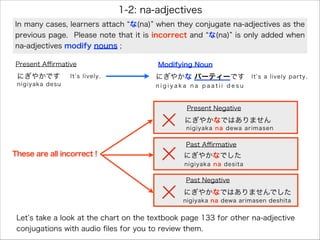
In many cases, learners attach な(na) when they conjugate na-adjectives as the
previous page. Please note that it is incorrect and な(na) is only added when
na-adjectives modify nouns ;
Let s take a look at the chart on the textbook page 133 for other na-adjective
conjugations with audio files for you to review them.
1-2: na-adjectives
にぎやかな パーティーです
Modifying Noun
n i g i y a k a n a p a a t i i d e s u
にぎやかです
Present Affirmative
nigiyaka desu
にぎやかなではありません
Present Negative
nigiyaka na dewa arimasen
にぎやかなでした
Past Affirmative
nigiyaka na desita
にぎやかなではありませんでした
Past Negative
nigiyaka na dewa arimasen deshita
It s lively. It s a lively party.
These are all incorrect !
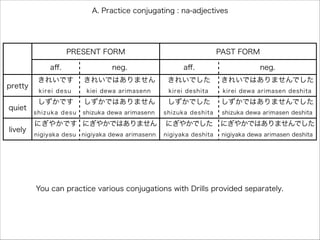
PRESENT FORM PAST FORM
aff. neg. aff. neg.
pretty
きれいです きれいではありません きれいでした きれいではありませんでした
quiet
しずかです しずかではありません しずかでした しずかではありませんでした
lively
にぎやかです にぎやかではありません にぎやかでした にぎやかではありませんでした
A. Practice conjugating : na-adjectives
kirei desu kiei dewa arimasenn kirei deshita kirei dewa arimasen deshita
shizuka desu shizuka dewa arimasenn shizuka deshita shizuka dewa arimasen deshita
nigiyaka desu nigiyaka dewa arimasenn nigiyaka deshita nigiyaka dewa arimasen deshita
You can practice various conjugations with Drills provided separately.
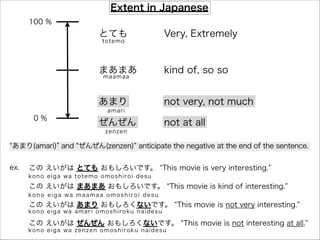
Extent in Japanese
100 %
0 %
とても
まあまあ
あまり
ぜんぜん
Very, Extremely
kind of, so so
not very, not much
not at all
ex. この えいがは とても おもしろいです。 This movie is very interesting.
この えいがは まあまあ おもしろいです。 This movie is kind of interesting.
この えいがは あまり おもしろくないです。 This movie is not very interesting.
この えいがは ぜんぜん おもしろくないです。 This movie is not interesting at all.
あまり(amari) and ぜんぜん(zenzen) anticipate the negative at the end of the sentence.
totemo
maamaa
amari
zenzen
kono eiga wa totemo omoshiroi desu
kono eiga wa maamaa omoshiroi desu
kono eiga wa amari omoshiroku naidesu
kono eiga wa zenzen omoshiroku naidesu
Japanese Adjectives 2

  • 1.
    Japanese for BusyPeople 1 Lesson 14 Grammar Notes of Japanese Adjectives 2
  • 2.
    Please answer thequestion below; Q1: きのう なにを たべましたか。 k i n o u n a n i o t a b e m a s h i t a k a 1. Conjugating Adjectives to Past Tense A1: すしを たべました。 s u s h i o t a b e m a s h i t a The question asks What did you eat yesterday? with the question word なに(nani) . Say if you had sushi yesterday, your answer would be; I had(ate) sushi. What did you eat yesterday? 1-1: i-adjectives
  • 3.
    Then you areasked another question as; Q2: すしは どうでしたか。 s u s h i w a d o u d e s h i t a k a How was the sushi? The question asks How was the sushi? with a question word どう(dou) . Say if you liked the sushi and you d like to answer it as It was delicious. ; A2: (すしは)おいしいです。 s u s h i w a o i s h i i d e s u It is delicious. Now you ve noticed what is wrong with the answer in Japanese above. You definitely have to change おいしいです (oishii desu) to a past tense. But it will not become おいしいでした (oishii deshita) . Let s take a look how we conjugate adjectives to the past tense.
  • 4.
    i-adjectives in thepast tense relatively follow the pattern to the present negative form ; 1-1: i-adjectives A2: (すしは)おいしかったです。 sushi wa oishi katta desu It was delicious.= You remove the final い(i) in each i-adjective then replace it to either かった (katta) as the past affirmative or くなかった(kunakatta) as the past negative. おいしいです おいしくないです Present Affirmative Present Negative o i s h i i d e s u oishiku naidesu おいしかったです Past Affirmative o i s h i k a t t a d e s u おいしくなかったです Past Negative oishiku nakattadesu おいしいです Present Affirmative o i s h i i d e s u Thus the answer to the last question on the previous page should be;
  • 5.
    However, there isone exception which is いいです(iidesu) , just as you ve learned its affirmative negative form as よくないです(yokunaidesu) , the past tense for both affirmative and negative forms follow the same pattern; 1-1: i-adjectives いいです よくないです Present Affirmative Present Negative i i d e s u yoku naidesu よかったです Past Affirmative yokatta desu よくなかったです Past Negative yoku nakattadesu Let s take a look at the chart on the textbook page 133 for other i-adjective conjugations with audio files for you to review them. Please note that いいです(iidesu) has an other form as よいです(yoidesu) as the same term, and よ(yo) out of this other form appears in above three conjugations.
  • 6.
    PRESENT FORM PASTFORM aff. neg. aff. neg. cold さむいです さむくないです さむかったです さむくなかったです hot あついです あつくないです あつかったです あつくなかったです fun たのしいです たのしくないです たのしかったです たのしくなかったです good いいです よくないです よかったです よくなかったです bad わるいです わるくないです わるかったです わるくなかったです interesting おもしろいです おもしろくないです おもしろかったです おもしろくなかったで す tasty おいしいです おいしくないです おいしかったです おいしくなかったです boring つまらないです つまらなくないです つまらなかったです つまらなくなかったで す A. Practice conjugating : i-adjectives samui desu samuku naidesu samukatta desu samuku nakattadesu atsui desu atsuku naidesu atsukatta desu atsuku nakattadesu tanoshii desu tanoshiku naidesu tanoshikatta desu tanoshiku nakattadesu ii desu yoku naidesu yokatta desu yoku nakattadesu warui desu waruku naidesu warukatta desu waruku nakattadesu omoshiroi desu omoshiroku naidesu omoshirokatta desu omoshiroku nakattadesu oishii desu oishiku naidesu oishikatta desu oishiku nakattadesu tsumaranai desu tsumaranaku naidesu tsumaranakatta desu tsumaranaku nakattadesu
  • 7.
    Please answer thequestion below; Q1: せんしゅう パーティーに いきましたか。 s e n s h u u p a a t i i n i i k i m a s h i t a k a 1. Conjugating Adjectives to Past Tense A1: はい、いきました。 h a i i k i m a s h i t a Yes, I did. Did you go to the party last week? 1-2: na-adjectives Say if you went to the party last week, your answer would be;
  • 8.
    1. Conjugating Adjectivesto Past Tense Q2 : (パーティーは) どう でしたか。 p a a t i i w a d o u d e s h i t a k a How was the party? A2 : (パーティーは)にぎやかです。 p a a t i i w a n i g i y a k a d e s u It is lively. 1-2: na-adjectives Then you are asked another question as; The question asks How was the party? with the question word どう(dou) . Say if you think the party was lively and you d like to answer as It was lively. ; Again, you ve noticed what is wrong with the answer in Japanese above. You definitely have to change にぎやかです (nigiyaka desu) to the past tense. Now it will become にぎやかでした (nigiyaka deshita) . As you see the na- adjectives have mush simpler conjugations than i-adjectives. Let s take a look how we conjugate na-adjectives to the past tense.
  • 9.
    na-adjectives in thepast tense relatively follow the pattern to the present negative form as well ; 1-2: na-adjectives You just replace です(desu) to either でした(deshita) as the past affirmative or ではありませんでした(dewa arimasen deshita) as the past negative. にぎやかです にぎやかではありません Present Affirmative Present Negative nigiyaka desu nigiyaka dewa arimasen にぎやかでした Past Affirmative nigiyaka desita にぎやかではありませんでした Past Negative nigiyaka dewa arimasen deshita にぎやかです Present Affirmative nigiyaka desu Thus the answer to the last question on the previous page should be; A2: (パーティーは)にぎやかでした。 It was lively.= p a a t i i w a n i g i y a k a d e s h i t a
  • 10.
    In many cases,learners attach な(na) when they conjugate na-adjectives as the previous page. Please note that it is incorrect and な(na) is only added when na-adjectives modify nouns ; Let s take a look at the chart on the textbook page 133 for other na-adjective conjugations with audio files for you to review them. 1-2: na-adjectives にぎやかな パーティーです Modifying Noun n i g i y a k a n a p a a t i i d e s u にぎやかです Present Affirmative nigiyaka desu にぎやかなではありません Present Negative nigiyaka na dewa arimasen にぎやかなでした Past Affirmative nigiyaka na desita にぎやかなではありませんでした Past Negative nigiyaka na dewa arimasen deshita It s lively. It s a lively party. These are all incorrect !
  • 11.
    PRESENT FORM PASTFORM aff. neg. aff. neg. pretty きれいです きれいではありません きれいでした きれいではありませんでした quiet しずかです しずかではありません しずかでした しずかではありませんでした lively にぎやかです にぎやかではありません にぎやかでした にぎやかではありませんでした A. Practice conjugating : na-adjectives kirei desu kiei dewa arimasenn kirei deshita kirei dewa arimasen deshita shizuka desu shizuka dewa arimasenn shizuka deshita shizuka dewa arimasen deshita nigiyaka desu nigiyaka dewa arimasenn nigiyaka deshita nigiyaka dewa arimasen deshita You can practice various conjugations with Drills provided separately.
  • 12.
    Extent in Japanese 100% 0 % とても まあまあ あまり ぜんぜん Very, Extremely kind of, so so not very, not much not at all ex. この えいがは とても おもしろいです。 This movie is very interesting. この えいがは まあまあ おもしろいです。 This movie is kind of interesting. この えいがは あまり おもしろくないです。 This movie is not very interesting. この えいがは ぜんぜん おもしろくないです。 This movie is not interesting at all. あまり(amari) and ぜんぜん(zenzen) anticipate the negative at the end of the sentence. totemo maamaa amari zenzen kono eiga wa totemo omoshiroi desu kono eiga wa maamaa omoshiroi desu kono eiga wa amari omoshiroku naidesu kono eiga wa zenzen omoshiroku naidesu