BMS227 Career Development Skills 
Using Google Sites to teach web design skills 
to Science students 
Neil Everill 
Information and Learning Technology Officer – Biomedical Science.
This semester 2 six week (practical) module provides an 
opportunity for level 2 science students to develop and practice a 
variety of communication and transferable skills. 
The main aims are to: 
• Boost graduate development portfolio; 
• Enhance employability skills.
Split into two assessed components: 
1. CV and job application skills (6 weeks): 
• CV and covering letters; 
• Mock job applications; 
• Oral and presentation skills. 
Careers service – BMS representative Alison Clay. 
Module coordinator: Gordon Cooper (BMS).
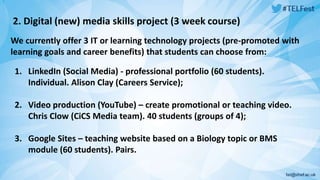
2. Digital (new) media skills project (3 week course) 
We currently offer 3 IT or learning technology projects (pre-promoted with 
learning goals and career benefits) that students can choose from: 
1. LinkedIn (Social Media) - professional portfolio (60 students). 
Individual. Alison Clay (Careers Service); 
2. Video production (YouTube) – create promotional or teaching video. 
Chris Clow (CiCS Media team). 40 students (groups of 4); 
3. Google Sites – teaching website based on a Biology topic or BMS 
module (60 students). Pairs.
BMS227 is a core module. 150 students (240 for 2015). The new 
format allows students to choose 1 of three projects (possibly 4 
for 2015). 
The IT projects have proved very popular over the last few years 
due to the boom in new media (Web 2.0) technologies, an 
excellent University infrastructure and student enthusiasm to 
develop new skills. Also add to CV. 
We’re also finding that IT literacy is much higher which certainly 
helps teaching the projects (net generation).
Brief overview of projects: 
LinkedIn – Social Media - Alison Clay (Careers Service): 
Alison’s workshop and course: 
• Building an online profile (LinkedIn) as a BMS student; professional 
networking; researching occupational and employer information; 
prepping for job applications and interviews. 
• The best of the rest: using Facebook, Twitter and other up-and-coming 
social networks to progress career plans. 
• How to generate a positive ‘digital footprint’: online privacy; managing 
the content of your social media accounts; creating the right impression 
with potential employers (Social Media awareness).
Brief overview of projects: 
Video production (YouTube): Chris Clow (CiCS Media Team): 
Create a short and engaging video presentation that lasts between 3 
and 5 minutes. Team-based project - groups of four. Choice of topic: 
• A biology-based teaching video (i.e. a training guide, case study or 
e-learning package etc.); 
• A student profile (or story) portraying University experiences so 
far; 
• A promotional video for the department.
The workshop teaches students the basic techniques on 
• film-making; 
• video editing; 
• copyright and legal considerations when using video online. 
Up to each group how to plan the workload (i.e. one pair writes the script; 
one pair films and edits etc.) 
Selected videos are hosted on the department websites and Faculty of 
Science YouTube channel; possibility for inclusion on iTunes U. 
As well as enhancing a student’s portfolio, the video project also generates 
useful material for the department, Faculty and the University.
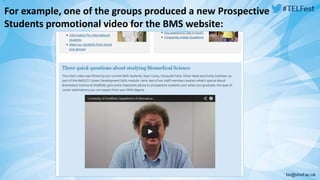
For example, one of the groups produced a new Prospective 
Students promotional video for the BMS website:
Google Sites -Website Design and Publishing Skills 
Work in pairs. Aims to provide students with the skills to create a teaching-based 
(educational) website. 
• The course focuses on how to effectively communicate and 
present content to a wider online audience (the basic principles of 
writing for the web) rather than the more technical aspects of 
website design. 
• Also covers current web issues, such as accessibility and copyright 
when publishing online content. 
• Students learn how to construct a site using a popular Content 
Management System
Why Google Sites? 
• Part of the educational Google Apps suite installed on the Sheffield University 
network. User-friendly, ideal for beginners, few technical skills required; 
• All UoS student users already have a GS account; 
• Private to all users – option to restrict the project internally; 
• Collaboration and teamwork is made simple by using the Google Apps sharing 
tools. Working in pairs, students can: 
• design together in real time (through a browser) or , 
• update a co-authored website independently 
• On completion, the project can be shared (submitted) with the BMS227 
account for marking.
Workshop 
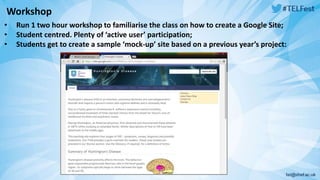
• Run 1 two hour workshop to familiarise the class on how to create a Google Site; 
• Student centred. Plenty of ‘active user’ participation; 
• Students get to create a sample ‘mock-up’ site based on a previous year’s project:
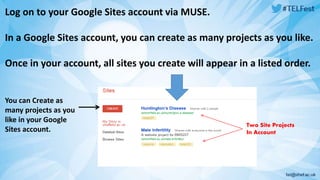
Log on to your Google Sites account via MUSE. 
In a Google Sites account, you can create as many projects as you like. 
Once in your account, all sites you create will appear in a listed order. 
You can Create as 
many projects as you 
like in your Google 
Sites account. 
Two Site Projects 
In Account
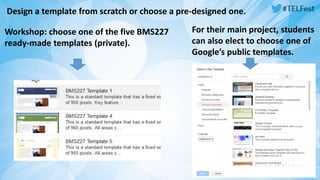
Design a template from scratch or choose a pre-designed one. 
Workshop: choose one of the five BMS227 
ready-made templates (private). 
For their main project, students 
can also elect to choose one of 
Google’s public templates.
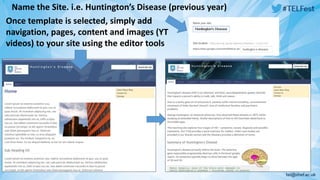
Name the Site. i.e. Huntington’s Disease (previous year) 
Once template is selected, simply add 
navigation, pages, content and images (YT 
videos) to your site using the editor tools
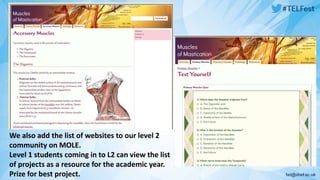
We also add the list of websites to our level 2 
community on MOLE. 
Level 1 students coming in to L2 can view the list 
of projects as a resource for the academic year. 
Prize for best project.
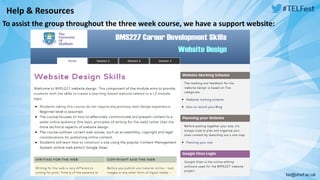
Help & Resources 
To assist the group throughout the three week course, we have a support website:
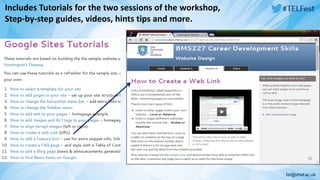
Includes Tutorials for the two sessions of the workshop, 
Step-by-step guides, videos, hints tips and more.
Summary 
Students submit (share) their joint project to the BMS227 Google account at the 
end. 
Since we re-organised the course in 2012, the 
Google Sites project has proved very popular. In 
particular we’ve seen: 
• improved student engagement and knowledge 
development; 
• a high level of creative skills; 
• a responsibility to participate in student directed 
activities and gain alternate career skills. 
Marking scheme: 
• Design and Planning 
• Writing for the web 
• Accessibility 
• Copyright awareness 
• Academic content
A high number of students build and expand on the web design 
project; often produce more than what is required. For example, 
one group developed their own Apps script to include a scored 
Quiz complete with feedback. 
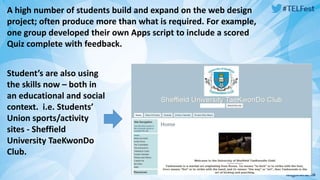
Student’s are also using 
the skills now – both in 
an educational and social 
context. i.e. Students’ 
Union sports/activity 
sites - Sheffield 
University TaeKwonDo 
Club.
Final thoughts: 
While new media technologies like Google Sites present few 
technical barriers to students taking generic skills projects, don’t 
underestimate the amount of time, preparation and resources 
required to support the student experience.
Session Feedback 
We would welcome your feedback on this session, via this URL 
http://goo.gl/ReRYkH 
Thank you

BMS Career development skills using Google sites

  • 1.
    BMS227 Career DevelopmentSkills Using Google Sites to teach web design skills to Science students Neil Everill Information and Learning Technology Officer – Biomedical Science.
  • 2.
    This semester 2six week (practical) module provides an opportunity for level 2 science students to develop and practice a variety of communication and transferable skills. The main aims are to: • Boost graduate development portfolio; • Enhance employability skills.
  • 3.
    Split into twoassessed components: 1. CV and job application skills (6 weeks): • CV and covering letters; • Mock job applications; • Oral and presentation skills. Careers service – BMS representative Alison Clay. Module coordinator: Gordon Cooper (BMS).
  • 4.
    2. Digital (new)media skills project (3 week course) We currently offer 3 IT or learning technology projects (pre-promoted with learning goals and career benefits) that students can choose from: 1. LinkedIn (Social Media) - professional portfolio (60 students). Individual. Alison Clay (Careers Service); 2. Video production (YouTube) – create promotional or teaching video. Chris Clow (CiCS Media team). 40 students (groups of 4); 3. Google Sites – teaching website based on a Biology topic or BMS module (60 students). Pairs.
  • 5.
    BMS227 is acore module. 150 students (240 for 2015). The new format allows students to choose 1 of three projects (possibly 4 for 2015). The IT projects have proved very popular over the last few years due to the boom in new media (Web 2.0) technologies, an excellent University infrastructure and student enthusiasm to develop new skills. Also add to CV. We’re also finding that IT literacy is much higher which certainly helps teaching the projects (net generation).
  • 6.
    Brief overview ofprojects: LinkedIn – Social Media - Alison Clay (Careers Service): Alison’s workshop and course: • Building an online profile (LinkedIn) as a BMS student; professional networking; researching occupational and employer information; prepping for job applications and interviews. • The best of the rest: using Facebook, Twitter and other up-and-coming social networks to progress career plans. • How to generate a positive ‘digital footprint’: online privacy; managing the content of your social media accounts; creating the right impression with potential employers (Social Media awareness).
  • 7.
    Brief overview ofprojects: Video production (YouTube): Chris Clow (CiCS Media Team): Create a short and engaging video presentation that lasts between 3 and 5 minutes. Team-based project - groups of four. Choice of topic: • A biology-based teaching video (i.e. a training guide, case study or e-learning package etc.); • A student profile (or story) portraying University experiences so far; • A promotional video for the department.
  • 8.
    The workshop teachesstudents the basic techniques on • film-making; • video editing; • copyright and legal considerations when using video online. Up to each group how to plan the workload (i.e. one pair writes the script; one pair films and edits etc.) Selected videos are hosted on the department websites and Faculty of Science YouTube channel; possibility for inclusion on iTunes U. As well as enhancing a student’s portfolio, the video project also generates useful material for the department, Faculty and the University.
  • 9.
    For example, oneof the groups produced a new Prospective Students promotional video for the BMS website:
  • 10.
    Google Sites -WebsiteDesign and Publishing Skills Work in pairs. Aims to provide students with the skills to create a teaching-based (educational) website. • The course focuses on how to effectively communicate and present content to a wider online audience (the basic principles of writing for the web) rather than the more technical aspects of website design. • Also covers current web issues, such as accessibility and copyright when publishing online content. • Students learn how to construct a site using a popular Content Management System
  • 11.
    Why Google Sites? • Part of the educational Google Apps suite installed on the Sheffield University network. User-friendly, ideal for beginners, few technical skills required; • All UoS student users already have a GS account; • Private to all users – option to restrict the project internally; • Collaboration and teamwork is made simple by using the Google Apps sharing tools. Working in pairs, students can: • design together in real time (through a browser) or , • update a co-authored website independently • On completion, the project can be shared (submitted) with the BMS227 account for marking.
  • 12.
    Workshop • Run1 two hour workshop to familiarise the class on how to create a Google Site; • Student centred. Plenty of ‘active user’ participation; • Students get to create a sample ‘mock-up’ site based on a previous year’s project:
  • 13.
    Log on toyour Google Sites account via MUSE. In a Google Sites account, you can create as many projects as you like. Once in your account, all sites you create will appear in a listed order. You can Create as many projects as you like in your Google Sites account. Two Site Projects In Account
  • 14.
    Design a templatefrom scratch or choose a pre-designed one. Workshop: choose one of the five BMS227 ready-made templates (private). For their main project, students can also elect to choose one of Google’s public templates.
  • 15.
    Name the Site.i.e. Huntington’s Disease (previous year) Once template is selected, simply add navigation, pages, content and images (YT videos) to your site using the editor tools
  • 16.
    We also addthe list of websites to our level 2 community on MOLE. Level 1 students coming in to L2 can view the list of projects as a resource for the academic year. Prize for best project.
  • 17.
    Help & Resources To assist the group throughout the three week course, we have a support website:
  • 18.
    Includes Tutorials forthe two sessions of the workshop, Step-by-step guides, videos, hints tips and more.
  • 19.
    Summary Students submit(share) their joint project to the BMS227 Google account at the end. Since we re-organised the course in 2012, the Google Sites project has proved very popular. In particular we’ve seen: • improved student engagement and knowledge development; • a high level of creative skills; • a responsibility to participate in student directed activities and gain alternate career skills. Marking scheme: • Design and Planning • Writing for the web • Accessibility • Copyright awareness • Academic content
  • 20.
    A high numberof students build and expand on the web design project; often produce more than what is required. For example, one group developed their own Apps script to include a scored Quiz complete with feedback. Student’s are also using the skills now – both in an educational and social context. i.e. Students’ Union sports/activity sites - Sheffield University TaeKwonDo Club.
  • 21.
    Final thoughts: Whilenew media technologies like Google Sites present few technical barriers to students taking generic skills projects, don’t underestimate the amount of time, preparation and resources required to support the student experience.
  • 22.
    Session Feedback Wewould welcome your feedback on this session, via this URL http://goo.gl/ReRYkH Thank you