Non surgical management
of Carcinoma Cervix
Dr Naresh Jakhotia
Radiation Oncologist
BMCHRC
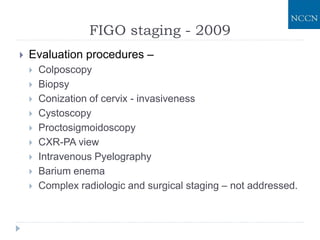
FIGO staging - 2009
 Evaluation procedures –
 Colposcopy
 Biopsy
 Conization of cervix - invasiveness
 Cystoscopy
 Proctosigmoidoscopy
 CXR-PA view
 Intravenous Pyelography
 Barium enema
 Complex radiologic and surgical staging – not addressed.
 Directly aligns with AJCC staging
 No Stage 0 in FIGO
 Regional LN mets not included
 Not altered by LVSI
 FIGO Staging –
 intended for comparison purposes only
 Not as a guide for therapy
FIGO staging - 2009
• In United States, modalities used to guide treatment
options and design –
 CT
 MRI
 PET-CT
 Surgical staging
WORK-UP
 History
 Physical Examination
 CBC
 RFT/LFT
 CXR-PA view
 CT
 PET-CT
 MRI
 Imaging – optional for stage ≤ IB 1
 Cystoscopy & Proctoscopy – if bladder or rectal extension
is suspected
 May aid in treatment
planning
 Not accepted for formal
staging purposes
 NCCN panel
 Uses FIGO definitions as stratification system for
guidelines
 Imaging studies (CT & MRI) - used to guide treatment
options and design
 MRI –
 To rule out disease high in endocervix
 To guide b/w fertility-sparing v/s non-fertility-sparing
treatment approaches.
 To determine soft tissue and Parametrial involvement in
advanced tumors
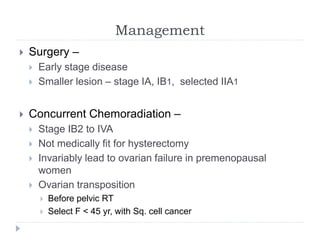
Management
 Surgery –
 Early stage disease
 Smaller lesion – stage IA, IB1, selected IIA1
 Concurrent Chemoradiation –
 Stage IB2 to IVA
 Not medically fit for hysterectomy
 Invariably lead to ovarian failure in premenopausal
women
 Ovarian transposition
 Before pelvic RT
 Select F < 45 yr, with Sq. cell cancer
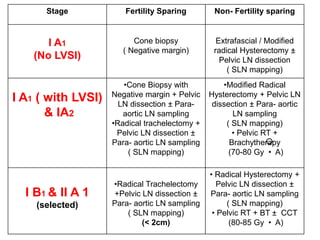
Stage Fertility Sparing Non- Fertility sparing
I A1
(No LVSI)
Cone biopsy
( Negative margin)
Extrafascial / Modified
radical Hysterectomy ±
Pelvic LN dissection
( SLN mapping)
I A1 ( with LVSI)
& IA2
•Cone Biopsy with
Negative margin + Pelvic
LN dissection ± Para-
aortic LN sampling
•Radical trachelectomy +
Pelvic LN dissection ±
Para- aortic LN sampling
( SLN mapping)
•Modified Radical
Hysterectomy + Pelvic LN
dissection ± Para- aortic
LN sampling
( SLN mapping)
• Pelvic RT +
Brachytherapy
(70-80 Gy • A)
I B1 & II A 1
(selected)
•Radical Trachelectomy
+Pelvic LN dissection ±
Para- aortic LN sampling
( SLN mapping)
(< 2cm)
• Radical Hysterectomy +
Pelvic LN dissection ±
Para- aortic LN sampling
( SLN mapping)
• Pelvic RT + BT ± CCT
(80-85 Gy • A)
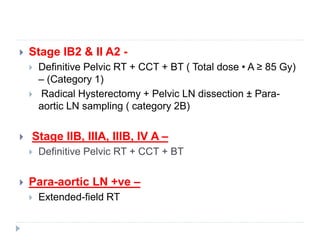
 Stage IB2 & II A2 -
 Definitive Pelvic RT + CCT + BT ( Total dose • A ≥ 85 Gy)
– (Category 1)
 Radical Hysterectomy + Pelvic LN dissection ± Para-
aortic LN sampling ( category 2B)
 Stage IIB, IIIA, IIIB, IV A –
 Definitive Pelvic RT + CCT + BT
 Para-aortic LN +ve –
 Extended-field RT
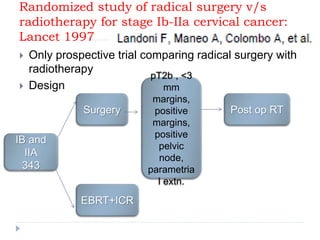
Randomized study of radical surgery v/s
radiotherapy for stage Ib-IIa cervical cancer:
Lancet 1997
 Only prospective trial comparing radical surgery with
radiotherapy
 Design
Surgery
EBRT+ICR
pT2b , <3
mm
margins,
positive
margins,
positive
pelvic
node,
parametria
l extn.
Post op RT
IB and
IIA
343
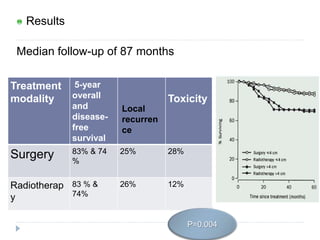
Results
Median follow-up of 87 months
Worse morbidity seen in combined modality
Treatment
modality
5-year
overall
and
disease-
free
survival
Toxicity
Surgery 83% & 74
%
25% 28%
Radiotherap
y
83 % &
74%
26% 12%
Local
recurren
ce
P=0.004
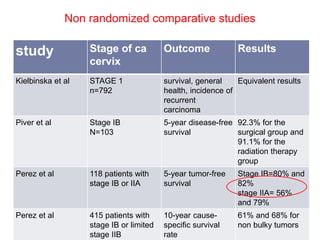
Non randomized comparative studies
study Stage of ca
cervix
Outcome Results
Kielbinska et al STAGE 1
n=792
survival, general
health, incidence of
recurrent
carcinoma
Equivalent results
Piver et al Stage IB
N=103
5-year disease-free
survival
92.3% for the
surgical group and
91.1% for the
radiation therapy
group
Perez et al 118 patients with
stage IB or IIA
5-year tumor-free
survival
Stage IB=80% and
82%
stage IIA= 56%
and 79%
Perez et al 415 patients with
stage IB or limited
stage IIB
10-year cause-
specific survival
rate
61% and 68% for
non bulky tumors
 N = 10,933 - Largest patterns-of-care analysis to
date evaluating patients with local EOD IB-IIB
cervical cancer
 Use of different treatment modalities over a 26-year
time period - from 1983 to 2009
 AIM - To reduce treatment related morbidity without
compromising outcomes.
 For Stage IB-IIA cancers, definitive radiation has 5-year
overall & disease specific-survival rates equivalent to
surgery with radiation given for risk factors, with a
reduction in grade 2 or 3 morbidity of greater than 50%
for patients undergoing RT alone.
 Careful selection of patients for radical hysterectomy
should be done to prevent increased toxicity of multiple
therapies.
 Improved imaging technology –better pretreatment
evaluation.
 Preoperative nodal assessment - most challenging
pretreatment evaluation.
 High sensitivity and specificity of PET for pelvic LN
detection compared to other imaging modalities.
 Algorithm for LN positivity –
 Age < 50 yrs
 Tumor size
 Grade 2 and 3 disease
 Local extent of disease IB2, IIA, and IIB
 Depth of invasion
 LVI
 Parametrial extension
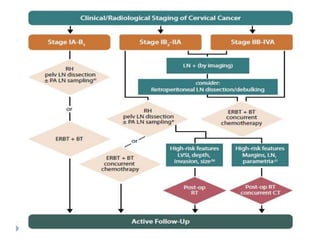
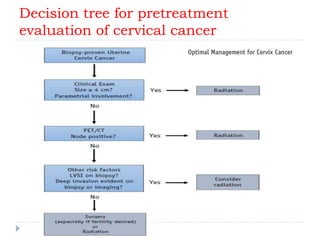
Decision tree for pretreatment
evaluation of cervical cancer
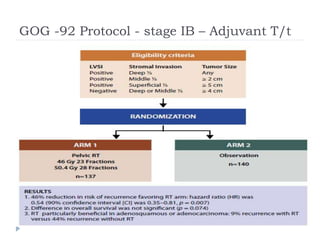
GOG -92 Protocol - stage IB – Adjuvant T/t
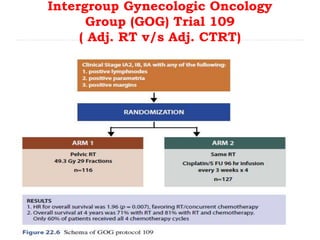
Intergroup Gynecologic Oncology
Group (GOG) Trial 109
( Adj. RT v/s Adj. CTRT)
American Brachytherapy Society –
 Recommends
 primary therapy should avoid routine use of
both Radical surgery and RT
 to minimize morbidity related to multimodality
therapy.
 Overall treatment time should be ≤ 8 weeks.
Treatment of Stage IIB–IVA Cervical
Cancer
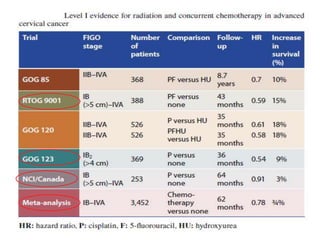
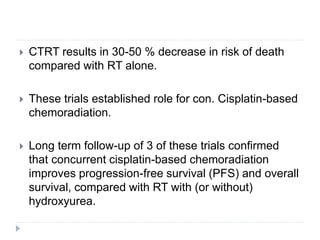
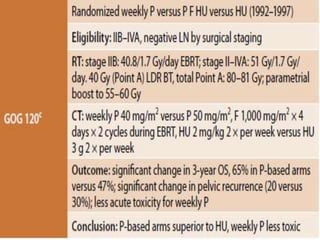
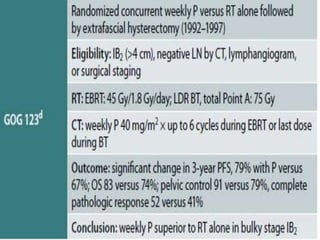
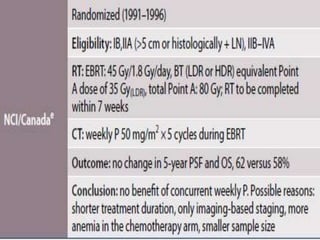
 CTRT results in 30-50 % decrease in risk of death
compared with RT alone.
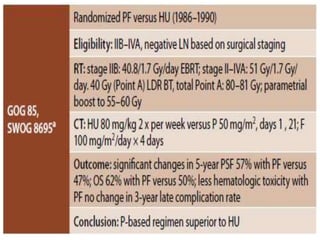
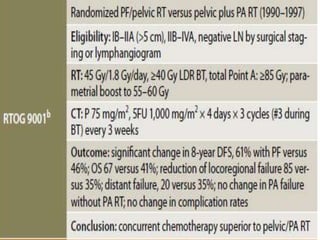
 These trials established role for con. Cisplatin-based
chemoradiation.
 Long term follow-up of 3 of these trials confirmed
that concurrent cisplatin-based chemoradiation
improves progression-free survival (PFS) and overall
survival, compared with RT with (or without)
hydroxyurea.
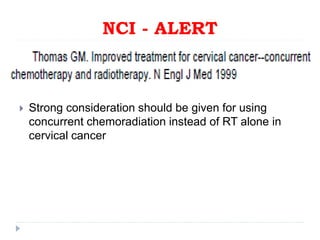
NCI - ALERT
 Strong consideration should be given for using
concurrent chemoradiation instead of RT alone in
cervical cancer
 Chemoradiotherapy leads to 6% improvement in 5-
year survival
 Hazard ratio – 0.81
 P<0.001
 N= 4069
 Confirmed that chemoradiotherapy improved
outcomes when compared with RT alone
Radiation Treatment Planning
 CT-based treatment planning with conformal
blocking and dosimetry – standard of care for EBRT
 CBCT – helpful in defining daily internal soft tissue
positioning.
 Extending overall treatment time beyond 6 to 8
weeks can result in approximately 0.5 – 1 %
decrease in pelvic control and cause specific survival
for each extra day of overall treatment time.
 Entire RT course – should be completed within 8
weeks.
Brachytherapy
 Critical component of definitive / adjuvant therapy
 Special shape of zone to be treated –
 Not symmetrical around the sources
 Considerable variation in size & shape of organs concerned
 Typically combined with EBRT in an integrated
treatment plan
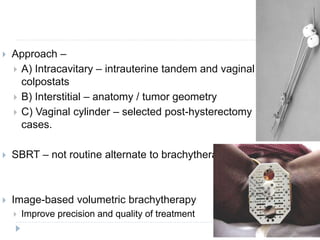
 Approach –
 A) Intracavitary – intrauterine tandem and vaginal
colpostats
 B) Interstitial – anatomy / tumor geometry
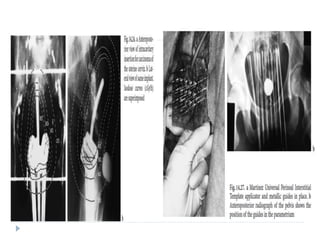
 C) Vaginal cylinder – selected post-hysterectomy
cases.
 SBRT – not routine alternate to brachytherapy.
 Image-based volumetric brachytherapy
 Improve precision and quality of treatment
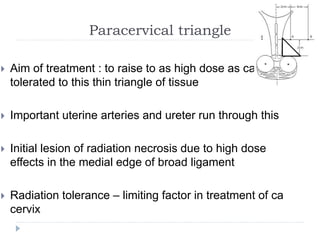
Paracervical triangle
 Aim of treatment : to raise to as high dose as can be
tolerated to this thin triangle of tissue
 Important uterine arteries and ureter run through this
 Initial lesion of radiation necrosis due to high dose
effects in the medial edge of broad ligament
 Radiation tolerance – limiting factor in treatment of ca
cervix
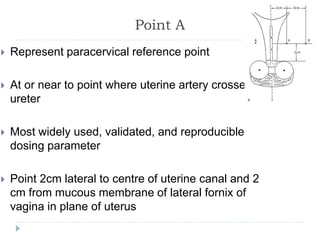
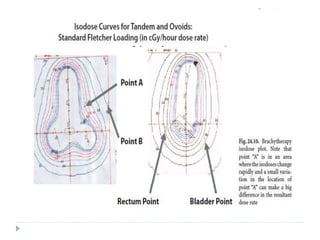
Point A
 Represent paracervical reference point
 At or near to point where uterine artery crosses
ureter
 Most widely used, validated, and reproducible
dosing parameter
 Point 2cm lateral to centre of uterine canal and 2
cm from mucous membrane of lateral fornix of
vagina in plane of uterus
 Recommended total dose to point A-
 Small tumors – at least 80 Gy
 Larger tumors - ≥ 85 Gy
 Limitation – it does not take into account -
 3-D shape of tumors,
 Individual tumor to normal tissue structure correlations.
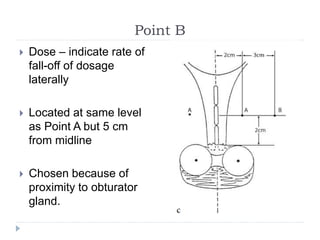
Point B
 Dose – indicate rate of
fall-off of dosage
laterally
 Located at same level
as Point A but 5 cm
from midline
 Chosen because of
proximity to obturator
gland.
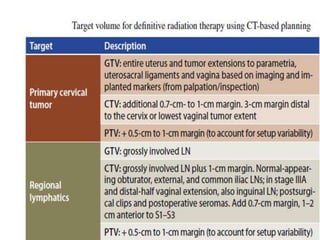
EBRT volume
 Gross disease
 Parametria
 Uterosacral ligaments
 Sufficient vaginal margins from gross disease (3 cm)
 Presacral LN
 Other LN at risk
 Neg LN on surgical/radiologic staging –
 Obturator, Ext. & Int. iliac LN
 Higher risk of LN involvement ( bulky tumor,
suspected/confirmed LN confined to true pelvis)
 Volume increased to cover common iliac LN also
 For lower one third vaginal lesion –
 Inguinal LN – must be treated
 Para-aortic LN (occult or macroscopic) –
 45 Gy
 Bowel, spinal cord, renal tolerances
 Gross disease in parametria or unresected LN –
boosted to 60-65 Gy
 SBRT – not considered routine alternate to
brachytherapy
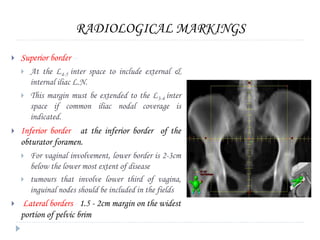
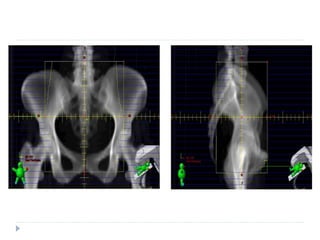
RADIOLOGICAL MARKINGS
 Superior border –
 At the L4-5 inter space to include external &
internal iliac L.N.
 This margin must be extended to the L3-4 inter
space if common iliac nodal coverage is
indicated.
 Inferior border - at the inferior border of the
obturator foramen.
 For vaginal involvement, lower border is 2-3cm
below the lower most extent of disease
 tumours that involve lower third of vagina,
inguinal nodes should be included in the fields
 Lateral borders - 1.5 - 2cm margin on the widest
portion of pelvic brim
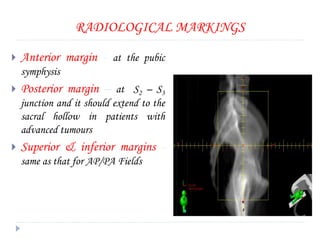
RADIOLOGICAL MARKINGS
 Anterior margin - at the pubic
symphysis
 Posterior margin – at S2 – S3
junction and it should extend to the
sacral hollow in patients with
advanced tumours
 Superior & inferior margins -
same as that for AP/PA Fields
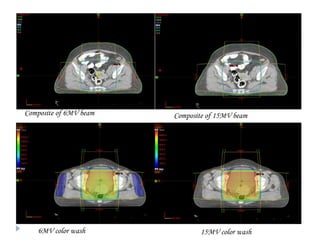
Composite of 6MV beam
6MV color wash
Composite of 15MV beam
15MV color wash
 Documented common iliac and/or para-aortic LN –
 Extended –field pelvic or para-aortic RT, upto level of
renal vessels.
 EBRT dose to LN –
 Microscopic – 45 Gy
 Gross unresected – 10-15 Gy (Boost)
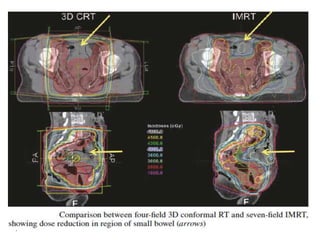
IMRT
 Minimize dose to bowel and other critical structures in
 post-op cases
 PALN
 Useful when high doses are required to treat gross
disease in regional LN
 Not alternative to brachytherapy for treatment of central
disease in intact cervix
 Very careful attention to detail and reproducibility
required
Intraoperative Radiation Therapy
 Single, highly focused dose of radiation to –
 Tumor bed at risk
 Isolated unresectable residual disease, during surgery
 Esp. useful – recurrent disease within previously
radiated volume
 Overlying normal tissue are displaced
 Delivered with pre-formed applicators – variable
sizes.
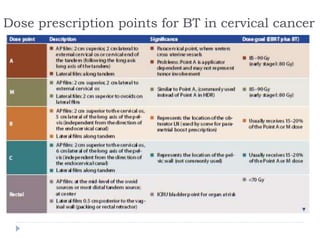
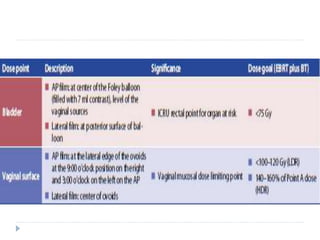
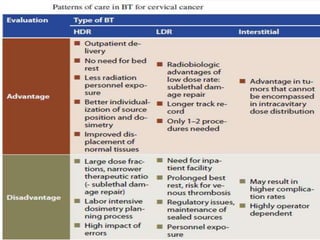
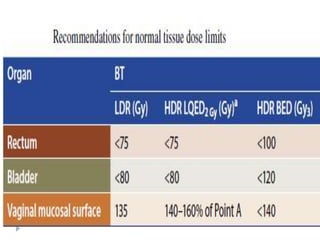
Dose prescription points for BT in cervical cancer
CONCLUSION
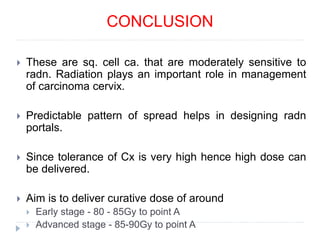
 These are sq. cell ca. that are moderately sensitive to
radn. Radiation plays an important role in management
of carcinoma cervix.
 Predictable pattern of spread helps in designing radn
portals.
 Since tolerance of Cx is very high hence high dose can
be delivered.
 Aim is to deliver curative dose of around
 Early stage - 80 - 85Gy to point A
 Advanced stage - 85-90Gy to point A
 But this dose can’t be delivered by EBRT alone
because of presence of dose limiting structures
like bladder & rectum in the beam path.
 To achieve tumor control – radiation is delivered
by combined technique of EBRT &
Brachytherapy.
 The cervical cancer has two components
 Central component - Disease confined to cervix , vagina
& medial parametria- best treated by brachytherapy
 Peripheral component - Disease involving lateral
parametria & lymph nodes-best treated by EBRT&
brachytherapy as boost
CONCLUSION
 Patients with stage IA ca cx are managed by radical
hysterectomy alone.
 If inoperable, then dose of approx.80 Gy is delivered by
brachytherapy alone
 Patients with stage IB may be managed by a
radical hysterectomy alone if the tumor is <4 cm in
size with no other adverse features.
 Stage IB with tumor > 4 cm, and all patients with
stage IIA, IIB, IIIA, IIIB, and IVA are managed with
EBRT with concurrent chemotherapy and
Brachytherapy.
CONCLUSION
Thank you

Ca Cervix Dr Naresh Jakhotia

  • 1.
    Non surgical management ofCarcinoma Cervix Dr Naresh Jakhotia Radiation Oncologist BMCHRC
  • 4.
    FIGO staging -2009  Evaluation procedures –  Colposcopy  Biopsy  Conization of cervix - invasiveness  Cystoscopy  Proctosigmoidoscopy  CXR-PA view  Intravenous Pyelography  Barium enema  Complex radiologic and surgical staging – not addressed.
  • 5.
     Directly alignswith AJCC staging  No Stage 0 in FIGO  Regional LN mets not included  Not altered by LVSI  FIGO Staging –  intended for comparison purposes only  Not as a guide for therapy FIGO staging - 2009
  • 6.
    • In UnitedStates, modalities used to guide treatment options and design –  CT  MRI  PET-CT  Surgical staging
  • 7.
    WORK-UP  History  PhysicalExamination  CBC  RFT/LFT  CXR-PA view  CT  PET-CT  MRI  Imaging – optional for stage ≤ IB 1  Cystoscopy & Proctoscopy – if bladder or rectal extension is suspected  May aid in treatment planning  Not accepted for formal staging purposes
  • 8.
     NCCN panel Uses FIGO definitions as stratification system for guidelines  Imaging studies (CT & MRI) - used to guide treatment options and design  MRI –  To rule out disease high in endocervix  To guide b/w fertility-sparing v/s non-fertility-sparing treatment approaches.  To determine soft tissue and Parametrial involvement in advanced tumors
  • 9.
    Management  Surgery – Early stage disease  Smaller lesion – stage IA, IB1, selected IIA1  Concurrent Chemoradiation –  Stage IB2 to IVA  Not medically fit for hysterectomy  Invariably lead to ovarian failure in premenopausal women  Ovarian transposition  Before pelvic RT  Select F < 45 yr, with Sq. cell cancer
  • 10.
    Stage Fertility SparingNon- Fertility sparing I A1 (No LVSI) Cone biopsy ( Negative margin) Extrafascial / Modified radical Hysterectomy ± Pelvic LN dissection ( SLN mapping) I A1 ( with LVSI) & IA2 •Cone Biopsy with Negative margin + Pelvic LN dissection ± Para- aortic LN sampling •Radical trachelectomy + Pelvic LN dissection ± Para- aortic LN sampling ( SLN mapping) •Modified Radical Hysterectomy + Pelvic LN dissection ± Para- aortic LN sampling ( SLN mapping) • Pelvic RT + Brachytherapy (70-80 Gy • A) I B1 & II A 1 (selected) •Radical Trachelectomy +Pelvic LN dissection ± Para- aortic LN sampling ( SLN mapping) (< 2cm) • Radical Hysterectomy + Pelvic LN dissection ± Para- aortic LN sampling ( SLN mapping) • Pelvic RT + BT ± CCT (80-85 Gy • A)
  • 11.
     Stage IB2& II A2 -  Definitive Pelvic RT + CCT + BT ( Total dose • A ≥ 85 Gy) – (Category 1)  Radical Hysterectomy + Pelvic LN dissection ± Para- aortic LN sampling ( category 2B)  Stage IIB, IIIA, IIIB, IV A –  Definitive Pelvic RT + CCT + BT  Para-aortic LN +ve –  Extended-field RT
  • 13.
    Randomized study ofradical surgery v/s radiotherapy for stage Ib-IIa cervical cancer: Lancet 1997  Only prospective trial comparing radical surgery with radiotherapy  Design Surgery EBRT+ICR pT2b , <3 mm margins, positive margins, positive pelvic node, parametria l extn. Post op RT IB and IIA 343
  • 14.
    Results Median follow-up of87 months Worse morbidity seen in combined modality Treatment modality 5-year overall and disease- free survival Toxicity Surgery 83% & 74 % 25% 28% Radiotherap y 83 % & 74% 26% 12% Local recurren ce P=0.004
  • 15.
    Non randomized comparativestudies study Stage of ca cervix Outcome Results Kielbinska et al STAGE 1 n=792 survival, general health, incidence of recurrent carcinoma Equivalent results Piver et al Stage IB N=103 5-year disease-free survival 92.3% for the surgical group and 91.1% for the radiation therapy group Perez et al 118 patients with stage IB or IIA 5-year tumor-free survival Stage IB=80% and 82% stage IIA= 56% and 79% Perez et al 415 patients with stage IB or limited stage IIB 10-year cause- specific survival rate 61% and 68% for non bulky tumors
  • 17.
     N =10,933 - Largest patterns-of-care analysis to date evaluating patients with local EOD IB-IIB cervical cancer  Use of different treatment modalities over a 26-year time period - from 1983 to 2009  AIM - To reduce treatment related morbidity without compromising outcomes.
  • 18.
     For StageIB-IIA cancers, definitive radiation has 5-year overall & disease specific-survival rates equivalent to surgery with radiation given for risk factors, with a reduction in grade 2 or 3 morbidity of greater than 50% for patients undergoing RT alone.  Careful selection of patients for radical hysterectomy should be done to prevent increased toxicity of multiple therapies.  Improved imaging technology –better pretreatment evaluation.
  • 19.
     Preoperative nodalassessment - most challenging pretreatment evaluation.  High sensitivity and specificity of PET for pelvic LN detection compared to other imaging modalities.  Algorithm for LN positivity –  Age < 50 yrs  Tumor size  Grade 2 and 3 disease  Local extent of disease IB2, IIA, and IIB  Depth of invasion  LVI  Parametrial extension
  • 20.
    Decision tree forpretreatment evaluation of cervical cancer
  • 21.
    GOG -92 Protocol- stage IB – Adjuvant T/t
  • 22.
    Intergroup Gynecologic Oncology Group(GOG) Trial 109 ( Adj. RT v/s Adj. CTRT)
  • 23.
    American Brachytherapy Society–  Recommends  primary therapy should avoid routine use of both Radical surgery and RT  to minimize morbidity related to multimodality therapy.  Overall treatment time should be ≤ 8 weeks.
  • 24.
    Treatment of StageIIB–IVA Cervical Cancer
  • 26.
     CTRT resultsin 30-50 % decrease in risk of death compared with RT alone.  These trials established role for con. Cisplatin-based chemoradiation.  Long term follow-up of 3 of these trials confirmed that concurrent cisplatin-based chemoradiation improves progression-free survival (PFS) and overall survival, compared with RT with (or without) hydroxyurea.
  • 32.
    NCI - ALERT Strong consideration should be given for using concurrent chemoradiation instead of RT alone in cervical cancer
  • 33.
     Chemoradiotherapy leadsto 6% improvement in 5- year survival  Hazard ratio – 0.81  P<0.001
  • 34.
     N= 4069 Confirmed that chemoradiotherapy improved outcomes when compared with RT alone
  • 35.
    Radiation Treatment Planning CT-based treatment planning with conformal blocking and dosimetry – standard of care for EBRT  CBCT – helpful in defining daily internal soft tissue positioning.  Extending overall treatment time beyond 6 to 8 weeks can result in approximately 0.5 – 1 % decrease in pelvic control and cause specific survival for each extra day of overall treatment time.  Entire RT course – should be completed within 8 weeks.
  • 36.
    Brachytherapy  Critical componentof definitive / adjuvant therapy  Special shape of zone to be treated –  Not symmetrical around the sources  Considerable variation in size & shape of organs concerned  Typically combined with EBRT in an integrated treatment plan
  • 37.
     Approach – A) Intracavitary – intrauterine tandem and vaginal colpostats  B) Interstitial – anatomy / tumor geometry  C) Vaginal cylinder – selected post-hysterectomy cases.  SBRT – not routine alternate to brachytherapy.  Image-based volumetric brachytherapy  Improve precision and quality of treatment
  • 39.
    Paracervical triangle  Aimof treatment : to raise to as high dose as can be tolerated to this thin triangle of tissue  Important uterine arteries and ureter run through this  Initial lesion of radiation necrosis due to high dose effects in the medial edge of broad ligament  Radiation tolerance – limiting factor in treatment of ca cervix
  • 40.
    Point A  Representparacervical reference point  At or near to point where uterine artery crosses ureter  Most widely used, validated, and reproducible dosing parameter  Point 2cm lateral to centre of uterine canal and 2 cm from mucous membrane of lateral fornix of vagina in plane of uterus
  • 41.
     Recommended totaldose to point A-  Small tumors – at least 80 Gy  Larger tumors - ≥ 85 Gy  Limitation – it does not take into account -  3-D shape of tumors,  Individual tumor to normal tissue structure correlations.
  • 42.
    Point B  Dose– indicate rate of fall-off of dosage laterally  Located at same level as Point A but 5 cm from midline  Chosen because of proximity to obturator gland.
  • 44.
    EBRT volume  Grossdisease  Parametria  Uterosacral ligaments  Sufficient vaginal margins from gross disease (3 cm)  Presacral LN  Other LN at risk  Neg LN on surgical/radiologic staging –  Obturator, Ext. & Int. iliac LN  Higher risk of LN involvement ( bulky tumor, suspected/confirmed LN confined to true pelvis)  Volume increased to cover common iliac LN also
  • 45.
     For lowerone third vaginal lesion –  Inguinal LN – must be treated  Para-aortic LN (occult or macroscopic) –  45 Gy  Bowel, spinal cord, renal tolerances  Gross disease in parametria or unresected LN – boosted to 60-65 Gy  SBRT – not considered routine alternate to brachytherapy
  • 47.
    RADIOLOGICAL MARKINGS  Superiorborder –  At the L4-5 inter space to include external & internal iliac L.N.  This margin must be extended to the L3-4 inter space if common iliac nodal coverage is indicated.  Inferior border - at the inferior border of the obturator foramen.  For vaginal involvement, lower border is 2-3cm below the lower most extent of disease  tumours that involve lower third of vagina, inguinal nodes should be included in the fields  Lateral borders - 1.5 - 2cm margin on the widest portion of pelvic brim
  • 48.
    RADIOLOGICAL MARKINGS  Anteriormargin - at the pubic symphysis  Posterior margin – at S2 – S3 junction and it should extend to the sacral hollow in patients with advanced tumours  Superior & inferior margins - same as that for AP/PA Fields
  • 50.
    Composite of 6MVbeam 6MV color wash Composite of 15MV beam 15MV color wash
  • 51.
     Documented commoniliac and/or para-aortic LN –  Extended –field pelvic or para-aortic RT, upto level of renal vessels.  EBRT dose to LN –  Microscopic – 45 Gy  Gross unresected – 10-15 Gy (Boost)
  • 52.
    IMRT  Minimize doseto bowel and other critical structures in  post-op cases  PALN  Useful when high doses are required to treat gross disease in regional LN  Not alternative to brachytherapy for treatment of central disease in intact cervix  Very careful attention to detail and reproducibility required
  • 54.
    Intraoperative Radiation Therapy Single, highly focused dose of radiation to –  Tumor bed at risk  Isolated unresectable residual disease, during surgery  Esp. useful – recurrent disease within previously radiated volume  Overlying normal tissue are displaced  Delivered with pre-formed applicators – variable sizes.
  • 55.
    Dose prescription pointsfor BT in cervical cancer
  • 62.
    CONCLUSION  These aresq. cell ca. that are moderately sensitive to radn. Radiation plays an important role in management of carcinoma cervix.  Predictable pattern of spread helps in designing radn portals.  Since tolerance of Cx is very high hence high dose can be delivered.  Aim is to deliver curative dose of around  Early stage - 80 - 85Gy to point A  Advanced stage - 85-90Gy to point A
  • 63.
     But thisdose can’t be delivered by EBRT alone because of presence of dose limiting structures like bladder & rectum in the beam path.  To achieve tumor control – radiation is delivered by combined technique of EBRT & Brachytherapy.
  • 64.
     The cervicalcancer has two components  Central component - Disease confined to cervix , vagina & medial parametria- best treated by brachytherapy  Peripheral component - Disease involving lateral parametria & lymph nodes-best treated by EBRT& brachytherapy as boost CONCLUSION
  • 65.
     Patients withstage IA ca cx are managed by radical hysterectomy alone.  If inoperable, then dose of approx.80 Gy is delivered by brachytherapy alone  Patients with stage IB may be managed by a radical hysterectomy alone if the tumor is <4 cm in size with no other adverse features.  Stage IB with tumor > 4 cm, and all patients with stage IIA, IIB, IIIA, IIIB, and IVA are managed with EBRT with concurrent chemotherapy and Brachytherapy. CONCLUSION
  • 66.