•Lost-Call System
•Objective of simulation will be to process
given number of call to determine
processed, completed, blocked and busy
call.
Simulation of Telephone System
1
2
3
4
5
6
7
8
0
1
0
1
1
0
1
0
LINES
MAX No.
IN USE
3
2
LINK
S
102
7
CLOCK
1 7 20
FRO
M
TO LENGT
H
1057
ARRIVAL TIME
NEX
T
CALL
4 7 1075
2 5 1053
FRO
M
TO END
CALLS IN
PROGRESS
131 98 5 28
PROCESS
ED
COMPLETE
D
BLOCKED BUSY
CALL COUNTERS
Fig (a) : - System State - 1
 Fig (a), records the state of the system at time
1027
 There are two activities causing events:
 New calls can arrive
 Existing calls can finish
 As shown in fig(a), there are 3 future events:
 The call between lines 2 and 5 is due to finish at
time 1053
 The call between lines 4 and 7 is due to finish at
time 1075
 New call is due to arrive at time 1057
 First step= scan the next potential event
 In this case, the next potential event is 1053. The
clock is updated.
 Second step= Select the Activity that is to cause
event
 In this case, the activity is to disconnect the call.
 Third step= Test whether the potential event can
be executed
 Fourth step= Change records to reflect the effects
of the event
 The call is shown to be disconnected by setting 0
for lines 2 and 5, reducing the number of links in
use by 1, and removing the finished call from the
call-in-progress table
 Fifth and final step= Gather statistics of simulation
output
 Counters are set aside to record the number of
processed, completed, blocked and busy calls.
 With the disconnection of a call processed and
completed call counts are increased by 1
 The state of the system then appears as shown in
fig(b)
1
2
3
4
5
6
7
8
0
0
0
1
0
0
1
0
LINES
MAX No.
IN USE
3
1
LINK
S
105
3
CLOCK
1 7 20
FRO
M
TO LENGT
H
1057
ARRIVAL TIME
NEX
T
CALL
4 7 1075
FRO
M
TO END
CALLS IN
PROGRESS
132 99 5 28
PROCESS
ED
COMPLETE
D
BLOCKED BUSY
CALL COUNTERS
Fig (b) : - System State - 2
1
2
3
4
5
6
7
8
0
0
0
1
0
0
1
0
LINES
MAX No.
IN USE
3
1
LINK
S
105
7
CLOCK
3 6 98
FRO
M
TO LENGT
H
1063
ARRIVAL TIME
NEX
T
CALL
4 7 1075
FRO
M
TO END
CALLS IN
PROGRESS
133 99 5 29
PROCESS
ED
COMPLETE
D
BLOCKED BUSY
CALL COUNTERS
Fig (c) : - System State - 3
1
2
3
4
5
6
7
8
0
0
1
1
0
1
1
0
LINES
MAX No.
IN USE
3
2
LINK
S
106
3
CLOCK
1 5 132
FRO
M
TO LENGT
H
1082
ARRIVAL TIME
NEX
T
CALL
3 6 1161
4 7 1075
FRO
M
TO END
CALLS IN
PROGRESS
133 99 5 29
PROCESS
ED
COMPLETE
D
BLOCKED BUSY
CALL COUNTERS
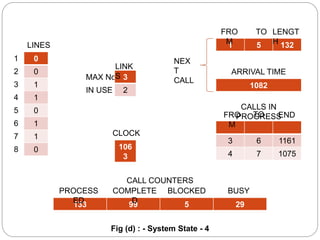
Fig (d) : - System State - 4
 Typically, the simulation will run until a given
number of calls has been processed or certain
time has elapsed
Delayed Calls
 Telephone system modified so that call which is
not connected are not lost
 Instead they wait until they are connected
 Happens to messages in switching system that
has store and forward capability
1
2
3
4
5
6
7
8
0
0
0
1
0
0
1
0
LINES
MAX No.
IN USE
3
1
LINK
S
105
7
CLOCK
3 6 98
FRO
M
TO LENGT
H
1063
ARRIVAL TIME
NEX
T
CALL
4 7 1075
FRO
M
TO END
CALLS IN
PROGRESS
132 99 5 29
PROCESS
ED
COMPLETE
D
BLOCKED BUSY
CALL COUNTERS
Fig (e) : - System State – 3A
1 7 20
FRO
M
TO LENGT
H
DELAYED CALLS
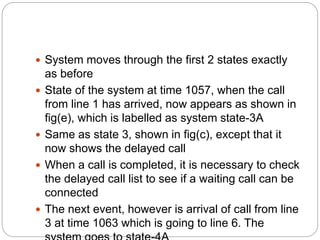
 System moves through the first 2 states exactly
as before
 State of the system at time 1057, when the call
from line 1 has arrived, now appears as shown in
fig(e), which is labelled as system state-3A
 Same as state 3, shown in fig(c), except that it
now shows the delayed call
 When a call is completed, it is necessary to check
the delayed call list to see if a waiting call can be
connected
 The next event, however is arrival of call from line
3 at time 1063 which is going to line 6. The
1
2
3
4
5
6
7
8
0
0
1
1
0
1
1
0
LINES
MAX No.
IN USE
3
2
LINK
S
106
3
CLOCK
1 5 132
FRO
M
TO LENGT
H
1082
ARRIVAL TIME
NEX
T
CALL
3 6 1161
4 7 1075
FRO
M
TO END
CALLS IN
PROGRESS
132 99 5 29
PROCESS
ED
COMPLETE
D
BLOCKED BUSY
CALL COUNTERS
Fig (f) : - System State – 4A
1 7 20
FRO
M
TO LENGT
H
DELAYED CALLS
1
2
3
4
5
6
7
8
1
0
1
0
0
1
1
0
LINES
MAX No.
IN USE
3
2
LINK
S
107
5
CLOCK
1 5 132
FRO
M
TO LENGT
H
1082
ARRIVAL TIME
NEX
T
CALL
3 6 1161
1 7 1097
FRO
M
TO END
CALLS IN
PROGRESS
133 100 5 29
PROCESS
ED
COMPLETE
D
BLOCKED BUSY
CALL COUNTERS
Fig (g) : - System State – 5A
FRO
M
TO LENGT
H
DELAYED CALLS
 Thankyou!

Telephone call-simulation

  • 1.
    •Lost-Call System •Objective ofsimulation will be to process given number of call to determine processed, completed, blocked and busy call. Simulation of Telephone System
  • 2.
    1 2 3 4 5 6 7 8 0 1 0 1 1 0 1 0 LINES MAX No. IN USE 3 2 LINK S 102 7 CLOCK 17 20 FRO M TO LENGT H 1057 ARRIVAL TIME NEX T CALL 4 7 1075 2 5 1053 FRO M TO END CALLS IN PROGRESS 131 98 5 28 PROCESS ED COMPLETE D BLOCKED BUSY CALL COUNTERS Fig (a) : - System State - 1
  • 3.
     Fig (a),records the state of the system at time 1027  There are two activities causing events:  New calls can arrive  Existing calls can finish
  • 4.
     As shownin fig(a), there are 3 future events:  The call between lines 2 and 5 is due to finish at time 1053  The call between lines 4 and 7 is due to finish at time 1075  New call is due to arrive at time 1057
  • 5.
     First step=scan the next potential event  In this case, the next potential event is 1053. The clock is updated.  Second step= Select the Activity that is to cause event  In this case, the activity is to disconnect the call.  Third step= Test whether the potential event can be executed  Fourth step= Change records to reflect the effects of the event  The call is shown to be disconnected by setting 0 for lines 2 and 5, reducing the number of links in use by 1, and removing the finished call from the call-in-progress table
  • 6.
     Fifth andfinal step= Gather statistics of simulation output  Counters are set aside to record the number of processed, completed, blocked and busy calls.  With the disconnection of a call processed and completed call counts are increased by 1  The state of the system then appears as shown in fig(b)
  • 7.
    1 2 3 4 5 6 7 8 0 0 0 1 0 0 1 0 LINES MAX No. IN USE 3 1 LINK S 105 3 CLOCK 17 20 FRO M TO LENGT H 1057 ARRIVAL TIME NEX T CALL 4 7 1075 FRO M TO END CALLS IN PROGRESS 132 99 5 28 PROCESS ED COMPLETE D BLOCKED BUSY CALL COUNTERS Fig (b) : - System State - 2
  • 8.
    1 2 3 4 5 6 7 8 0 0 0 1 0 0 1 0 LINES MAX No. IN USE 3 1 LINK S 105 7 CLOCK 36 98 FRO M TO LENGT H 1063 ARRIVAL TIME NEX T CALL 4 7 1075 FRO M TO END CALLS IN PROGRESS 133 99 5 29 PROCESS ED COMPLETE D BLOCKED BUSY CALL COUNTERS Fig (c) : - System State - 3
  • 9.
    1 2 3 4 5 6 7 8 0 0 1 1 0 1 1 0 LINES MAX No. IN USE 3 2 LINK S 106 3 CLOCK 15 132 FRO M TO LENGT H 1082 ARRIVAL TIME NEX T CALL 3 6 1161 4 7 1075 FRO M TO END CALLS IN PROGRESS 133 99 5 29 PROCESS ED COMPLETE D BLOCKED BUSY CALL COUNTERS Fig (d) : - System State - 4
  • 10.
     Typically, thesimulation will run until a given number of calls has been processed or certain time has elapsed
  • 11.
    Delayed Calls  Telephonesystem modified so that call which is not connected are not lost  Instead they wait until they are connected  Happens to messages in switching system that has store and forward capability
  • 12.
    1 2 3 4 5 6 7 8 0 0 0 1 0 0 1 0 LINES MAX No. IN USE 3 1 LINK S 105 7 CLOCK 36 98 FRO M TO LENGT H 1063 ARRIVAL TIME NEX T CALL 4 7 1075 FRO M TO END CALLS IN PROGRESS 132 99 5 29 PROCESS ED COMPLETE D BLOCKED BUSY CALL COUNTERS Fig (e) : - System State – 3A 1 7 20 FRO M TO LENGT H DELAYED CALLS
  • 13.
     System movesthrough the first 2 states exactly as before  State of the system at time 1057, when the call from line 1 has arrived, now appears as shown in fig(e), which is labelled as system state-3A  Same as state 3, shown in fig(c), except that it now shows the delayed call  When a call is completed, it is necessary to check the delayed call list to see if a waiting call can be connected  The next event, however is arrival of call from line 3 at time 1063 which is going to line 6. The
  • 14.
    1 2 3 4 5 6 7 8 0 0 1 1 0 1 1 0 LINES MAX No. IN USE 3 2 LINK S 106 3 CLOCK 15 132 FRO M TO LENGT H 1082 ARRIVAL TIME NEX T CALL 3 6 1161 4 7 1075 FRO M TO END CALLS IN PROGRESS 132 99 5 29 PROCESS ED COMPLETE D BLOCKED BUSY CALL COUNTERS Fig (f) : - System State – 4A 1 7 20 FRO M TO LENGT H DELAYED CALLS
  • 15.
    1 2 3 4 5 6 7 8 1 0 1 0 0 1 1 0 LINES MAX No. IN USE 3 2 LINK S 107 5 CLOCK 15 132 FRO M TO LENGT H 1082 ARRIVAL TIME NEX T CALL 3 6 1161 1 7 1097 FRO M TO END CALLS IN PROGRESS 133 100 5 29 PROCESS ED COMPLETE D BLOCKED BUSY CALL COUNTERS Fig (g) : - System State – 5A FRO M TO LENGT H DELAYED CALLS
  • 16.