

ARTIFICIAL INTELLIGENCE   IN GAMES NITISHKUMAR KAVISHETTI Dept. of Computer Science & Engineering KLECET – Chikodi Artificial Intelligence In Games
AGENDA Introduction Importance Design Different Game Genres AI in typical FPS Last words about AI References Artificial Intelligence In Games
WHAT THE ARTIFICIAL INTELLIGENCE IS ALL ABOUT? Artificial intelligence is about making computers able to perform the thinking tasks that humans and animals are capable of.  This ‘stuff’  is not about making rules as it was in classical games (Ex: Board games) …… it’s all about obeying them strategically in order to defeat opponent. Artificial Intelligence In Games
INCREASING IMPORTANCE OF AI IN GAMES Smartness and complexity of the game entirely depends on it’s  underlying AI. Modern users are not only demanding  extreme graphics, but also moderate level of opponent intelligence. Hence  Design and Development of AI  is becoming more and more significant. Artificial Intelligence In Games
Building Blocks in Designing Game AI MOVEMENT DECISION MAKING WORLD INTERFACE EXECUTION MANAGEMENT Artificial Intelligence In Games
MOVEMENT Will our characters be represented individually or will we only see their group effects? Will the characters’ motion need to be physically simulated, as in a car game?  How realistic does the physics have to be? Artificial Intelligence In Games
DECISION MAKING What is the full range of different actions that your characters can carry out in the game? Will characters need to look ahead in order to select the best decision? Will your character need to change the decisions it makes depending on how the player acts? Artificial Intelligence In Games
WORLD INTERFACE Characters need to get information on the sights, smells, and sounds of odd occurrences in the game. This should be handled by a sense management simulation Artificial Intelligence In Games
EXECUTION MANAGEMENT  Path finding Sense management Artificial Intelligence In Games
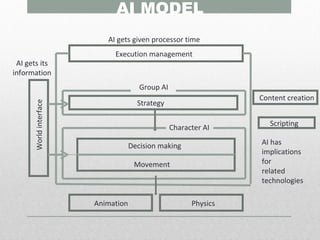
Execution management AI gets given processor time AI gets its information World interface Group AI Strategy Content creation Scripting Character AI Decision making Movement Animation  Physics AI has implications for related technologies AI MODEL
DIFFERENT GAME GENRES First Person Shooter(FPS) Driving  Real-Time Strategy(RTS) Sports Artificial Intelligence In Games
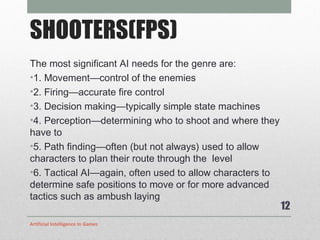
SHOOTERS(FPS) The most significant AI needs for the genre are: 1. Movement—control of the enemies 2. Firing—accurate fire control 3. Decision making—typically simple state machines 4. Perception—determining who to shoot and where they have to 5. Path finding—often (but not always) used to allow characters to plan their route through the  level 6. Tactical AI—again, often used to allow characters to determine safe positions to move or for more advanced tactics such as ambush laying Artificial Intelligence In Games
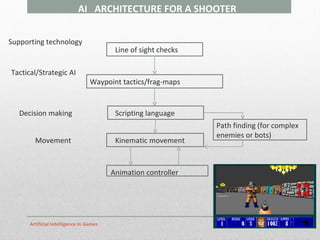
Animation controller Kinematic movement  Scripting language  Waypoint tactics/frag-maps  Artificial Intelligence In Games Line of sight checks Path finding (for complex enemies or bots) Movement Decision making Tactical/Strategic AI Supporting technology AI  ARCHITECTURE FOR A SHOOTER
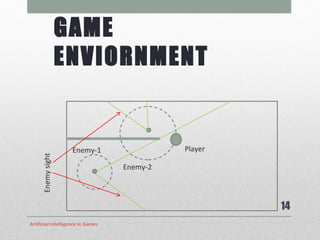
Artificial Intelligence In Games GAME ENVIORNMENT Enemy sight Enemy-1 Enemy-2 Player
CONCLUSION The sea change in academic AI is more than a fashion preference. AI Design is not only complex, but creative.  Hence our hope for new innovation in AI continues….. Artificial Intelligence In Games
REFERENCES   Millington, I. (2007). Game physics engine development. San Francisco: Morgan Kaufmann. 2. E'berly, D. (2004). Game Physics. San Francisco  Morgan. Kaufmann  <http://www.geometrictools.com/Books.html> Accessed 2008 3.  ARTIFICIAL INTELLIGENCE FOR GAMES  Second edition : IAN MILLINGTON  and  JOHN FUNGE Artificial Intelligence In Games
THANK YOU….. Artificial Intelligence In Games

Artificial intelligence In Modern-Games.

  • 1.
    ARTIFICIAL INTELLIGENCE IN GAMES NITISHKUMAR KAVISHETTI Dept. of Computer Science & Engineering KLECET – Chikodi Artificial Intelligence In Games
  • 2.
    AGENDA Introduction ImportanceDesign Different Game Genres AI in typical FPS Last words about AI References Artificial Intelligence In Games
  • 3.
    WHAT THE ARTIFICIALINTELLIGENCE IS ALL ABOUT? Artificial intelligence is about making computers able to perform the thinking tasks that humans and animals are capable of. This ‘stuff’ is not about making rules as it was in classical games (Ex: Board games) …… it’s all about obeying them strategically in order to defeat opponent. Artificial Intelligence In Games
  • 4.
    INCREASING IMPORTANCE OFAI IN GAMES Smartness and complexity of the game entirely depends on it’s underlying AI. Modern users are not only demanding extreme graphics, but also moderate level of opponent intelligence. Hence Design and Development of AI is becoming more and more significant. Artificial Intelligence In Games
  • 5.
    Building Blocks inDesigning Game AI MOVEMENT DECISION MAKING WORLD INTERFACE EXECUTION MANAGEMENT Artificial Intelligence In Games
  • 6.
    MOVEMENT Will ourcharacters be represented individually or will we only see their group effects? Will the characters’ motion need to be physically simulated, as in a car game? How realistic does the physics have to be? Artificial Intelligence In Games
  • 7.
    DECISION MAKING Whatis the full range of different actions that your characters can carry out in the game? Will characters need to look ahead in order to select the best decision? Will your character need to change the decisions it makes depending on how the player acts? Artificial Intelligence In Games
  • 8.
    WORLD INTERFACE Charactersneed to get information on the sights, smells, and sounds of odd occurrences in the game. This should be handled by a sense management simulation Artificial Intelligence In Games
  • 9.
    EXECUTION MANAGEMENT Path finding Sense management Artificial Intelligence In Games
  • 10.
    Execution management AIgets given processor time AI gets its information World interface Group AI Strategy Content creation Scripting Character AI Decision making Movement Animation Physics AI has implications for related technologies AI MODEL
  • 11.
    DIFFERENT GAME GENRESFirst Person Shooter(FPS) Driving Real-Time Strategy(RTS) Sports Artificial Intelligence In Games
  • 12.
    SHOOTERS(FPS) The mostsignificant AI needs for the genre are: 1. Movement—control of the enemies 2. Firing—accurate fire control 3. Decision making—typically simple state machines 4. Perception—determining who to shoot and where they have to 5. Path finding—often (but not always) used to allow characters to plan their route through the level 6. Tactical AI—again, often used to allow characters to determine safe positions to move or for more advanced tactics such as ambush laying Artificial Intelligence In Games
  • 13.
    Animation controller Kinematicmovement Scripting language Waypoint tactics/frag-maps Artificial Intelligence In Games Line of sight checks Path finding (for complex enemies or bots) Movement Decision making Tactical/Strategic AI Supporting technology AI ARCHITECTURE FOR A SHOOTER
  • 14.
    Artificial Intelligence InGames GAME ENVIORNMENT Enemy sight Enemy-1 Enemy-2 Player
  • 15.
    CONCLUSION The seachange in academic AI is more than a fashion preference. AI Design is not only complex, but creative. Hence our hope for new innovation in AI continues….. Artificial Intelligence In Games
  • 16.
    REFERENCES Millington, I. (2007). Game physics engine development. San Francisco: Morgan Kaufmann. 2. E'berly, D. (2004). Game Physics. San Francisco Morgan. Kaufmann <http://www.geometrictools.com/Books.html> Accessed 2008 3. ARTIFICIAL INTELLIGENCE FOR GAMES Second edition : IAN MILLINGTON and JOHN FUNGE Artificial Intelligence In Games
  • 17.
    THANK YOU….. ArtificialIntelligence In Games