Presented by
Abhijat Dhawal
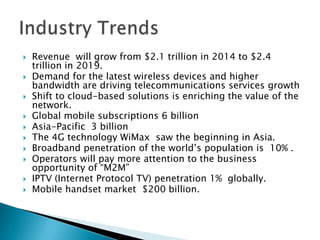
 Revenue will grow from $2.1 trillion in 2014 to $2.4
trillion in 2019.
 Demand for the latest wireless devices and higher
bandwidth are driving telecommunications services growth
 Shift to cloud-based solutions is enriching the value of the
network.
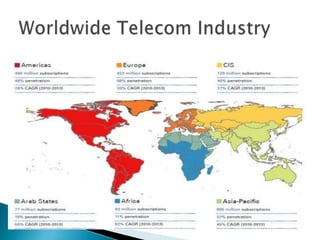
 Global mobile subscriptions 6 billion
 Asia-Pacific 3 billion
 The 4G technology WiMax saw the beginning in Asia.
 Broadband penetration of the world’s population is 10% .
 Operators will pay more attention to the business
opportunity of “M2M”
 IPTV (Internet Protocol TV) penetration 1% globally.
 Mobile handset market $200 billion.
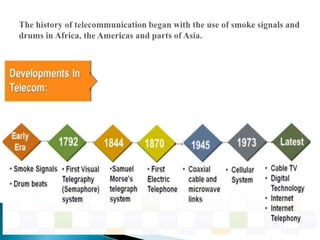
History
Imperatives
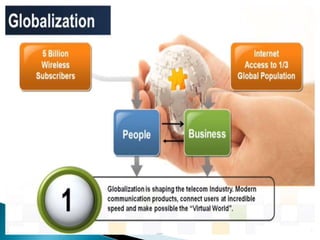
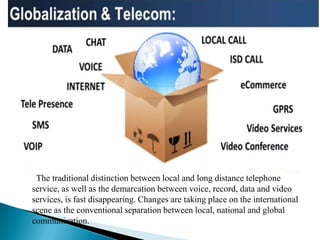
Globalization
The traditional distinction between local and long distance telephone
service, as well as the demarcation between voice, record, data and video
services, is fast disappearing. Changes are taking place on the international
scene as the conventional separation between local, national and global
communication.
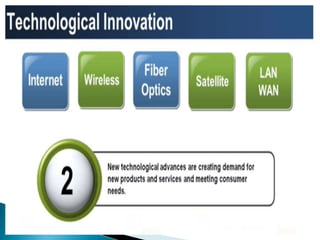
Technological
Innovation
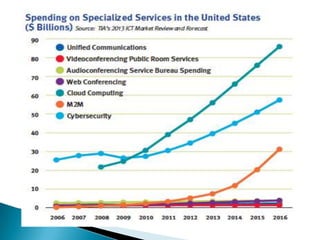
 Dramatically change the dynamics of players.
 Needed to keep pace by creating products
and services meeting these demands.
 In developed countries, future growth will
depend on industrial and political capacity for
institutional and consumer reaction to new
value based services.
Business
Drivers
Develop Sales and Marketing Strategies that
increase operational efficiency and drive
profitability
 Economic Cycles
 Consumer Demand and Changing Mindset
 Technological Innovation & Business
Intelligence
 Regulatory Approach
 Privacy, Security and Resilience
Industry
Profile
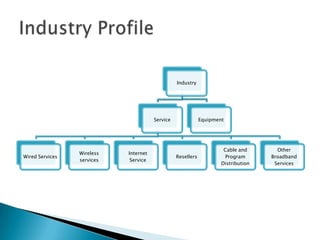
Industry
Service
Wired Services
Wireless
services
Internet
Service
Resellers
Cable and
Program
Distribution
Other
Broadband
Services
Equipment
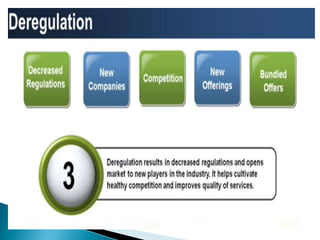
Deregulation
 Process of lowering the level of imposed regulation to promote
liberalization and competition among market players
 logical step to sustain the further development of the industry by
enabling a lasting competitive market environment
 Deregulation has changed the telecommunications industry by
transforming local and long distance
 monopolies into highly competitive suppliers of communications
offerings.
 The Telecommunications Act of 1996 in the United States coincided with
decreased regulations in countries around the world.
Impact of Deregulation
 The role of government would change from regulator to
surveillance, mandating full access or interconnection so that there are
as many suppliers as possible, and preventing collusive behavior.
 A new paradigm is emerging for international trade in
telecommunications
Supply &
Value Chain
Revenue Metric
 ARPU (average revenue per user)
 ARPPU (Average Revenue Per Paying User)
 AMPU (the average profit margin per user)
Cost Model
 heavy capital investments to create
wired, wireless, or broadband infrastructure and
networks.
 Capital-intensive business with high fixed costs
and lower variable or incremental costs
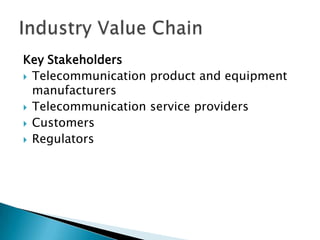
Key Stakeholders
 Telecommunication product and equipment
manufacturers
 Telecommunication service providers
 Customers
 Regulators
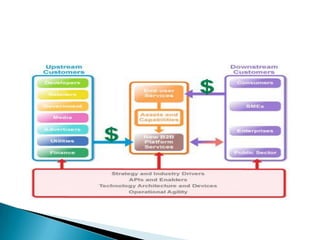
New business
model
 Rise of Cloud Services
 Your Smartphone
 Wireless Network Infrastructure
 Mobile traffic forecasts
 Mobile M2M
 Telco 2.0 New Business Models
 The Telecom Consumer in 2020
 Enterprise Mobility Will Become $140 Billion
Market
 Big Data
 Emphasis of manufacturing base
 http://www.itu.int
 www.bloomberg.com/markets
 http://www.plunkettresearch.com/telecommunic
ations-market-research/industry-statistics
 www.atkearney.com/documents/4011376/4018
136/gsma_asiareport.pdf/1be68139-72fa-
46a3-b7d6-123b962b0ba8?t=1352653946
 http://www.alcatel-
lucent.com/investors/annual-reports
 http://world2013.itu.int/
 http://www.att.com/#fbid=0W8F5BoNLCd
 https://www.vodafone.in/pages/index.aspx

Telecom Presentation

  • 1.
  • 2.
     Revenue willgrow from $2.1 trillion in 2014 to $2.4 trillion in 2019.  Demand for the latest wireless devices and higher bandwidth are driving telecommunications services growth  Shift to cloud-based solutions is enriching the value of the network.  Global mobile subscriptions 6 billion  Asia-Pacific 3 billion  The 4G technology WiMax saw the beginning in Asia.  Broadband penetration of the world’s population is 10% .  Operators will pay more attention to the business opportunity of “M2M”  IPTV (Internet Protocol TV) penetration 1% globally.  Mobile handset market $200 billion.
  • 3.
  • 5.
  • 9.
  • 10.
    The traditional distinctionbetween local and long distance telephone service, as well as the demarcation between voice, record, data and video services, is fast disappearing. Changes are taking place on the international scene as the conventional separation between local, national and global communication.
  • 12.
  • 13.
     Dramatically changethe dynamics of players.  Needed to keep pace by creating products and services meeting these demands.  In developed countries, future growth will depend on industrial and political capacity for institutional and consumer reaction to new value based services.
  • 15.
  • 16.
    Develop Sales andMarketing Strategies that increase operational efficiency and drive profitability  Economic Cycles  Consumer Demand and Changing Mindset  Technological Innovation & Business Intelligence  Regulatory Approach  Privacy, Security and Resilience
  • 17.
  • 19.
  • 20.
  • 21.
     Process oflowering the level of imposed regulation to promote liberalization and competition among market players  logical step to sustain the further development of the industry by enabling a lasting competitive market environment  Deregulation has changed the telecommunications industry by transforming local and long distance  monopolies into highly competitive suppliers of communications offerings.  The Telecommunications Act of 1996 in the United States coincided with decreased regulations in countries around the world. Impact of Deregulation  The role of government would change from regulator to surveillance, mandating full access or interconnection so that there are as many suppliers as possible, and preventing collusive behavior.  A new paradigm is emerging for international trade in telecommunications
  • 22.
  • 23.
    Revenue Metric  ARPU(average revenue per user)  ARPPU (Average Revenue Per Paying User)  AMPU (the average profit margin per user) Cost Model  heavy capital investments to create wired, wireless, or broadband infrastructure and networks.  Capital-intensive business with high fixed costs and lower variable or incremental costs
  • 24.
    Key Stakeholders  Telecommunicationproduct and equipment manufacturers  Telecommunication service providers  Customers  Regulators
  • 25.
  • 28.
     Rise ofCloud Services  Your Smartphone  Wireless Network Infrastructure  Mobile traffic forecasts  Mobile M2M  Telco 2.0 New Business Models  The Telecom Consumer in 2020  Enterprise Mobility Will Become $140 Billion Market  Big Data  Emphasis of manufacturing base
  • 29.
     http://www.itu.int  www.bloomberg.com/markets http://www.plunkettresearch.com/telecommunic ations-market-research/industry-statistics  www.atkearney.com/documents/4011376/4018 136/gsma_asiareport.pdf/1be68139-72fa- 46a3-b7d6-123b962b0ba8?t=1352653946  http://www.alcatel- lucent.com/investors/annual-reports  http://world2013.itu.int/  http://www.att.com/#fbid=0W8F5BoNLCd  https://www.vodafone.in/pages/index.aspx