

Telecom indusTry in india
       since 1991


                         By:
                        umar
               Farooq
                           a 16
              ll oloneumar89@gmail.com
INTRODUCTION
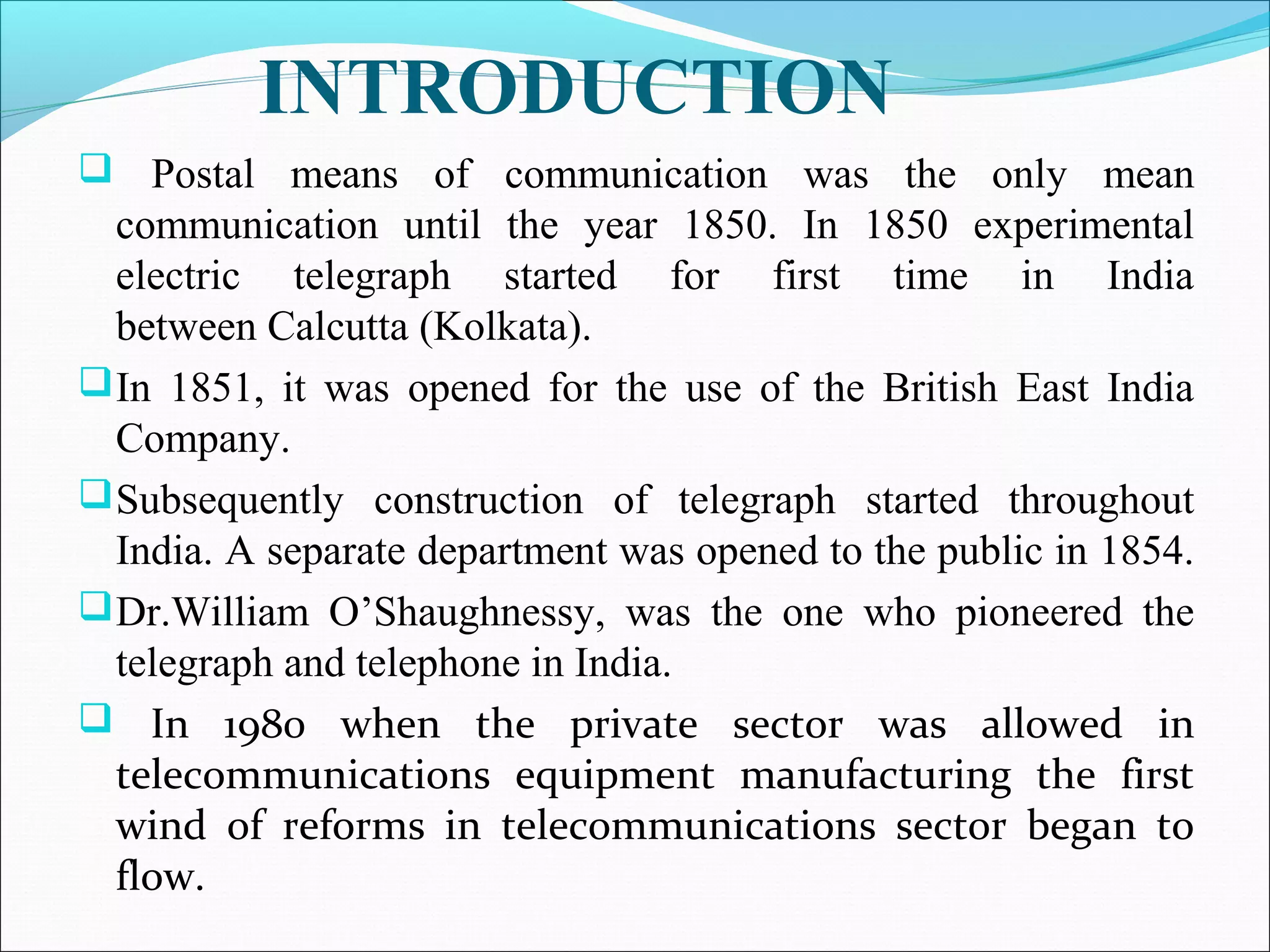
 Postal means of communication was the only mean
  communication until the year 1850. In 1850 experimental
  electric telegraph started for first time in India
  between Calcutta (Kolkata).
 In 1851, it was opened for the use of the British East India
  Company.
 Subsequently construction of telegraph started throughout
  India. A separate department was opened to the public in 1854.
 Dr.William O’Shaughnessy, was the one who pioneered the
  telegraph and telephone in India.
 In 1980 when the private sector was allowed in
  telecommunications equipment manufacturing the first
  wind of reforms in telecommunications sector began to
  flow.
cont…
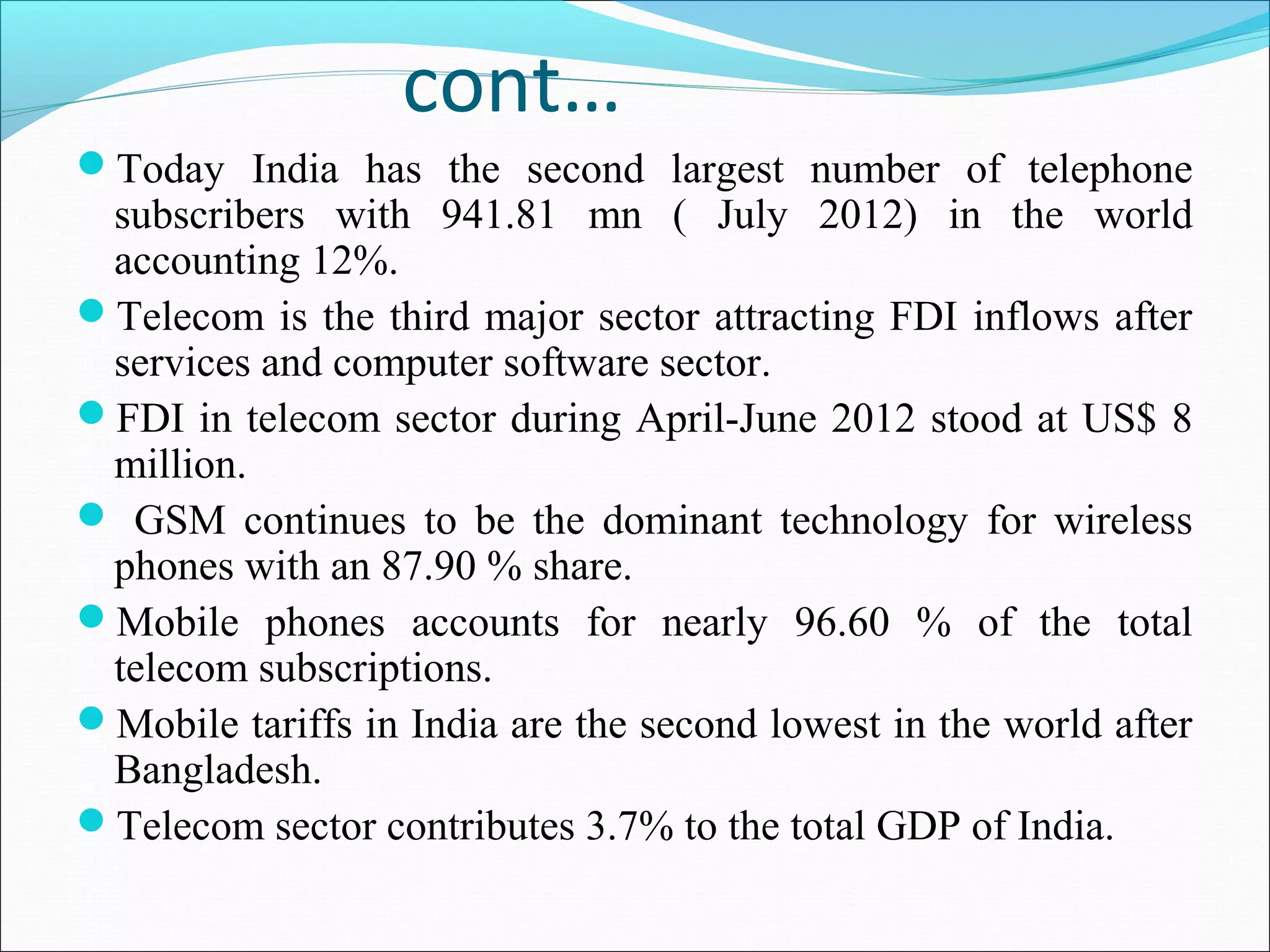
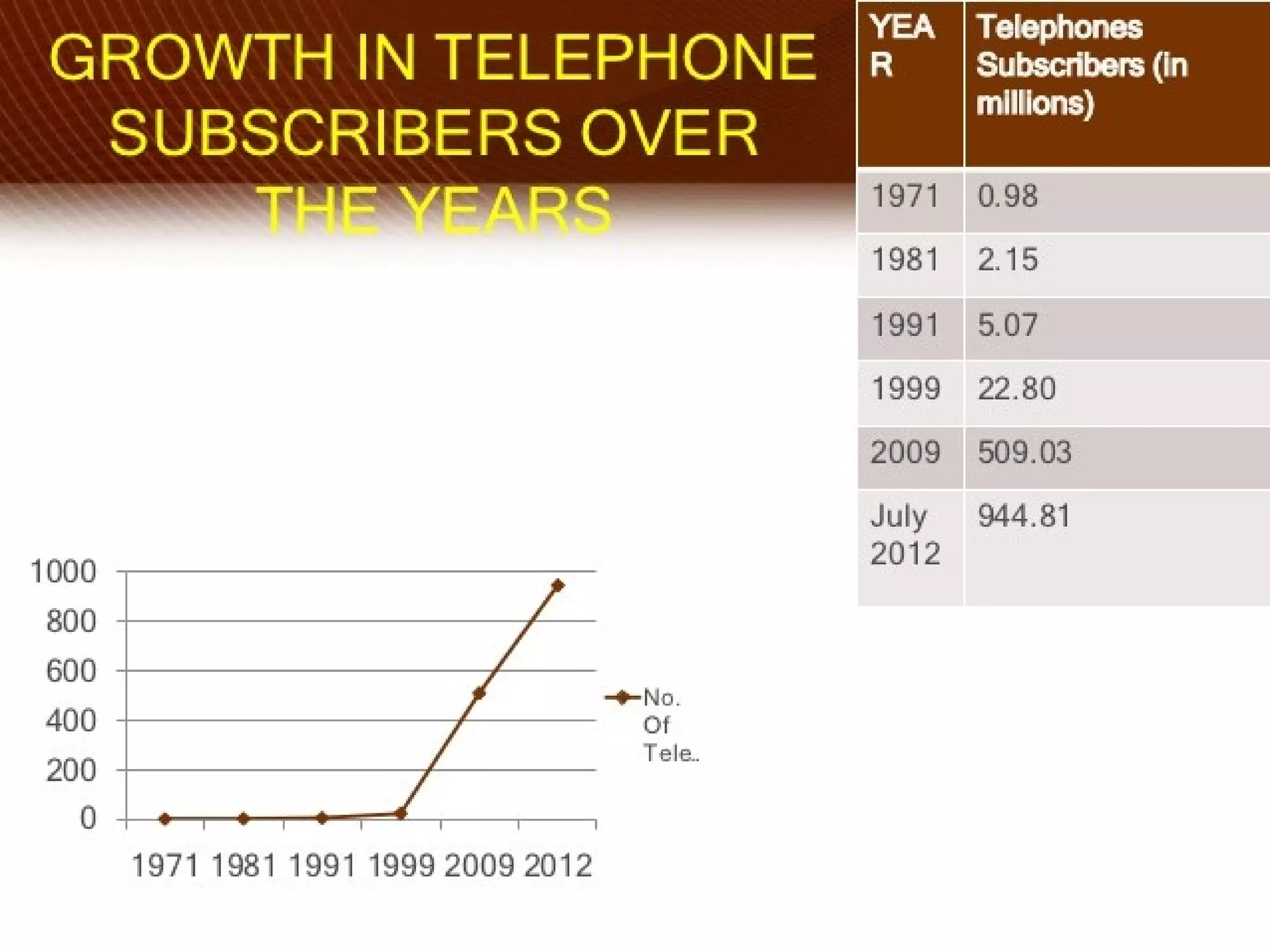
Today India has the second largest number of telephone
 subscribers with 941.81 mn ( July 2012) in the world
 accounting 12%.
Telecom is the third major sector attracting FDI inflows after
 services and computer software sector.
FDI in telecom sector during April-June 2012 stood at US$ 8
 million.
 GSM continues to be the dominant technology for wireless
 phones with an 87.90 % share.
Mobile phones accounts for nearly 96.60 % of the total
 telecom subscriptions.
Mobile tariffs in India are the second lowest in the world after
 Bangladesh.
Telecom sector contributes 3.7% to the total GDP of India.
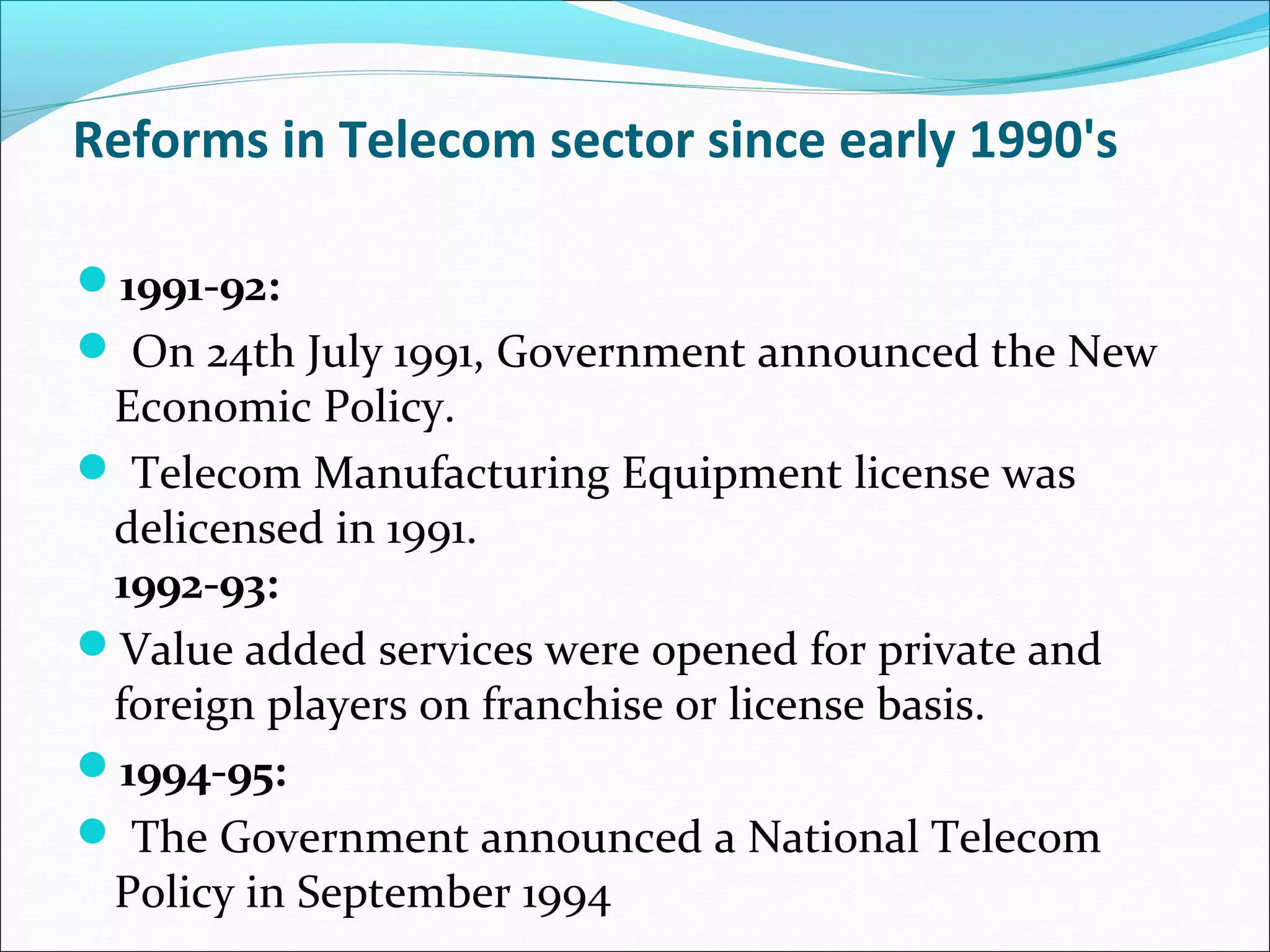
Reforms in Telecom sector since early 1990's

1991-92:
 On 24th July 1991, Government announced the New
 Economic Policy.
 Telecom Manufacturing Equipment license was
 delicensed in 1991.
 1992-93:
Value added services were opened for private and
 foreign players on franchise or license basis.
1994-95:
 The Government announced a National Telecom
 Policy in September 1994
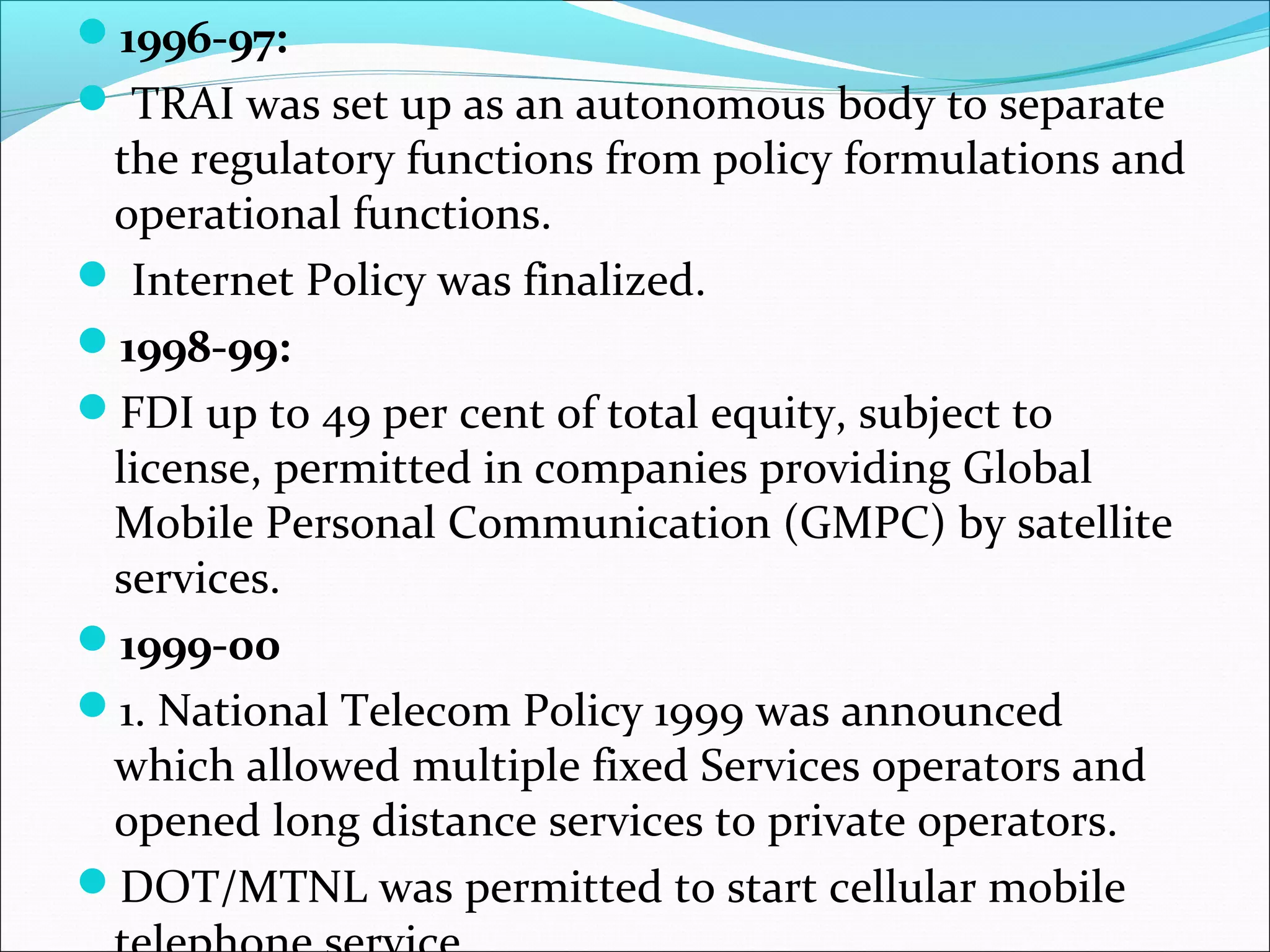
1996-97:
 TRAI was set up as an autonomous body to separate
 the regulatory functions from policy formulations and
 operational functions.
 Internet Policy was finalized.
1998-99:
FDI up to 49 per cent of total equity, subject to
 license, permitted in companies providing Global
 Mobile Personal Communication (GMPC) by satellite
 services.
1999-00
1. National Telecom Policy 1999 was announced
 which allowed multiple fixed Services operators and
 opened long distance services to private operators.
DOT/MTNL was permitted to start cellular mobile
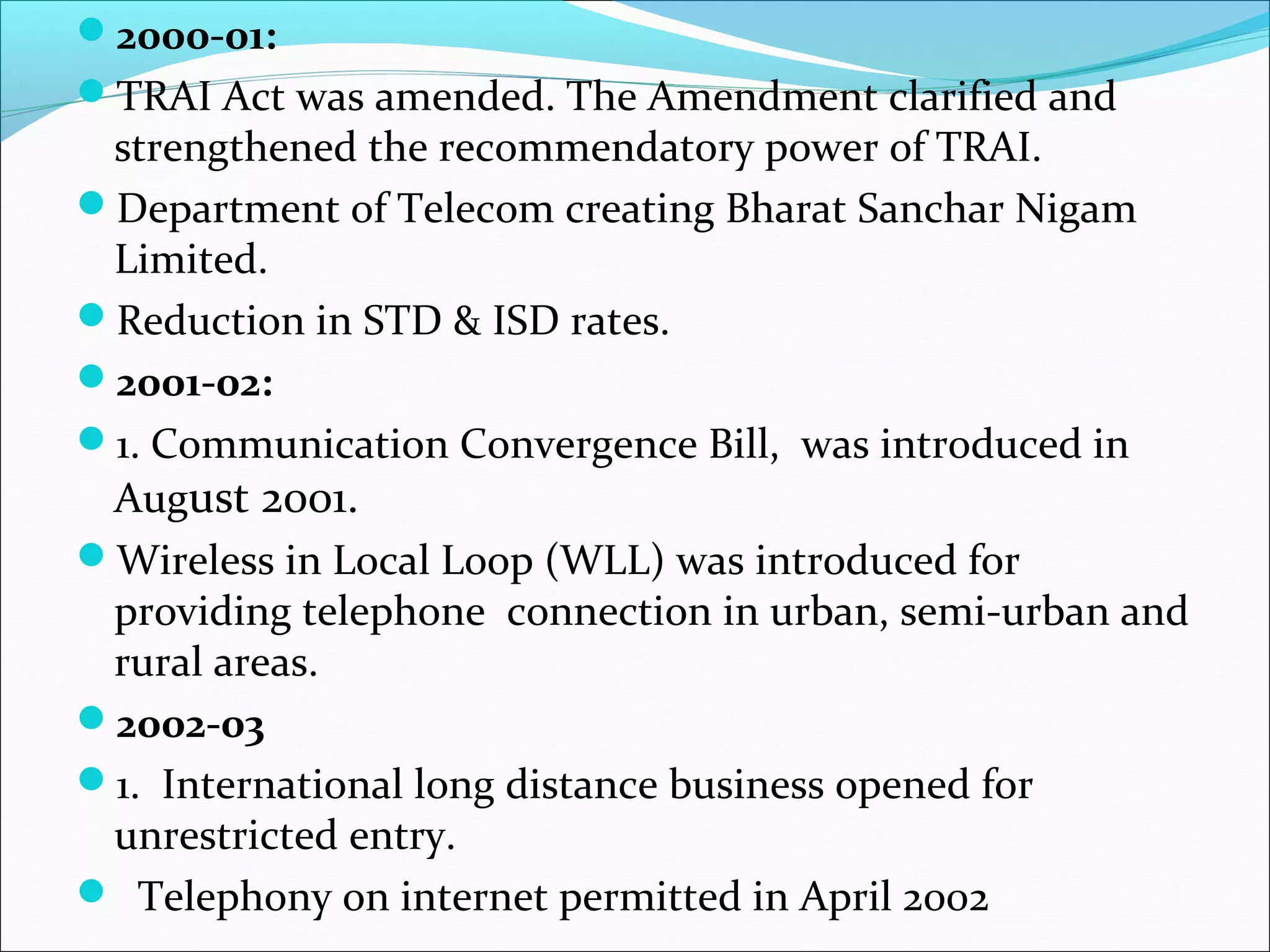
2000-01:
TRAI Act was amended. The Amendment clarified and
 strengthened the recommendatory power of TRAI.
Department of Telecom creating Bharat Sanchar Nigam
 Limited.
Reduction in STD & ISD rates.
2001-02:
1. Communication Convergence Bill, was introduced in
 August 2001.
Wireless in Local Loop (WLL) was introduced for
 providing telephone connection in urban, semi-urban and
 rural areas.
2002-03
1. International long distance business opened for
 unrestricted entry.
 Telephony on internet permitted in April 2002
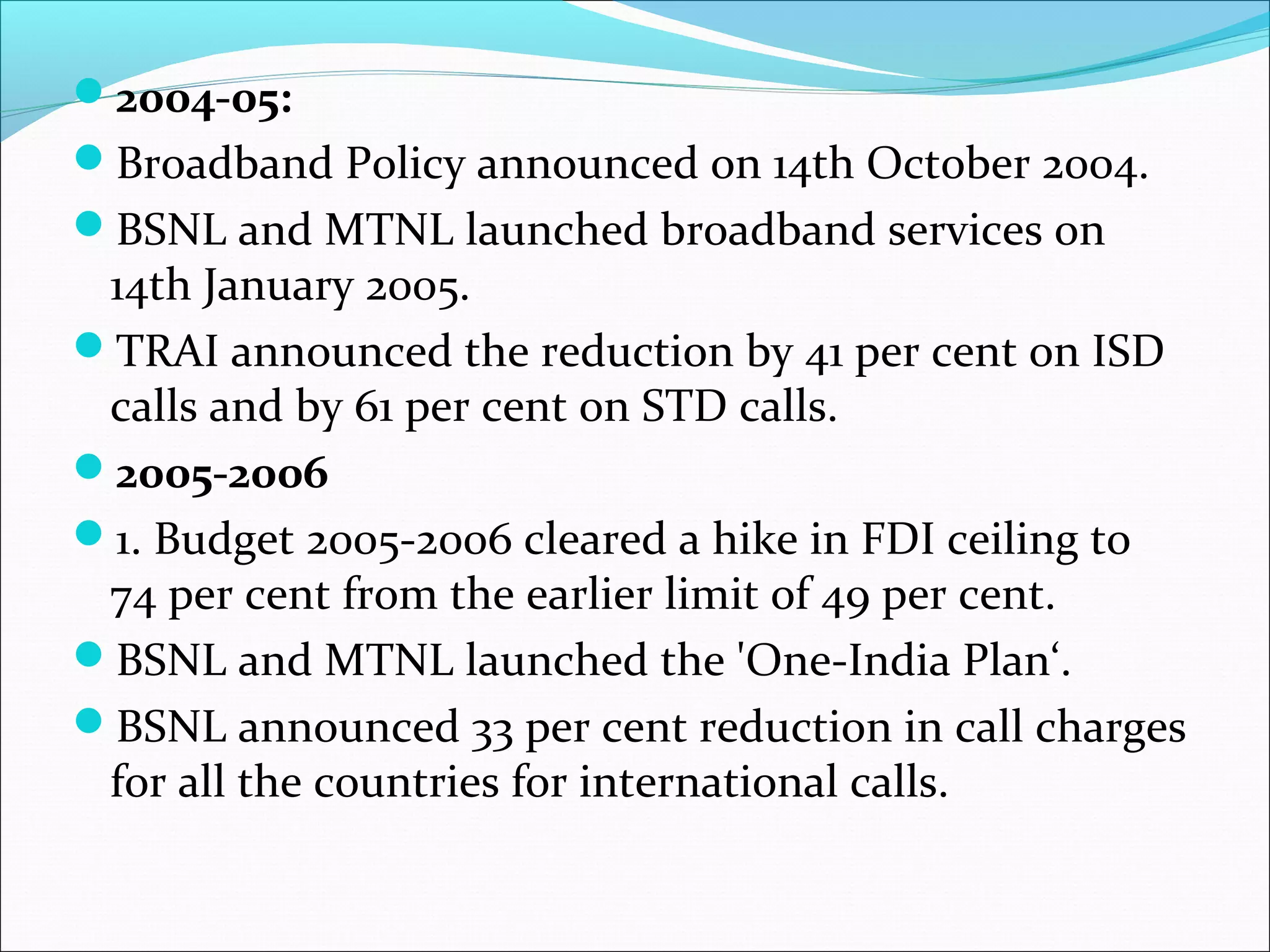
2004-05:
Broadband Policy announced on 14th October 2004.
BSNL and MTNL launched broadband services on
 14th January 2005.
TRAI announced the reduction by 41 per cent on ISD
 calls and by 61 per cent on STD calls.
2005-2006
1. Budget 2005-2006 cleared a hike in FDI ceiling to
 74 per cent from the earlier limit of 49 per cent.
BSNL and MTNL launched the 'One-India Plan‘.
BSNL announced 33 per cent reduction in call charges
 for all the countries for international calls.
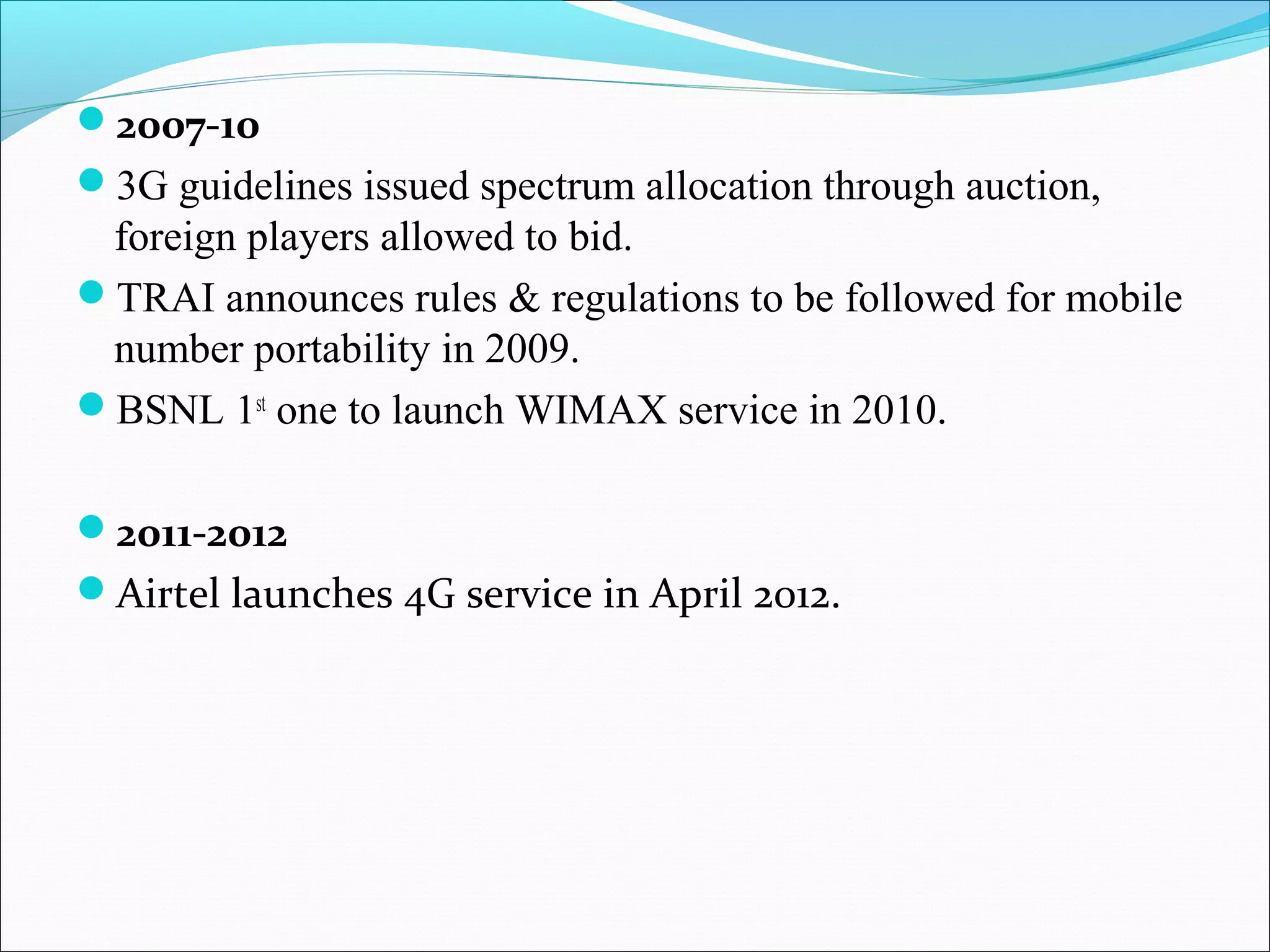
2007-10 
3G guidelines issued spectrum allocation through auction,
 foreign players allowed to bid.
TRAI announces rules & regulations to be followed for mobile
 number portability in 2009.
BSNL 1st one to launch WIMAX service in 2010.


2011-2012
Airtel launches 4G service in April 2012.
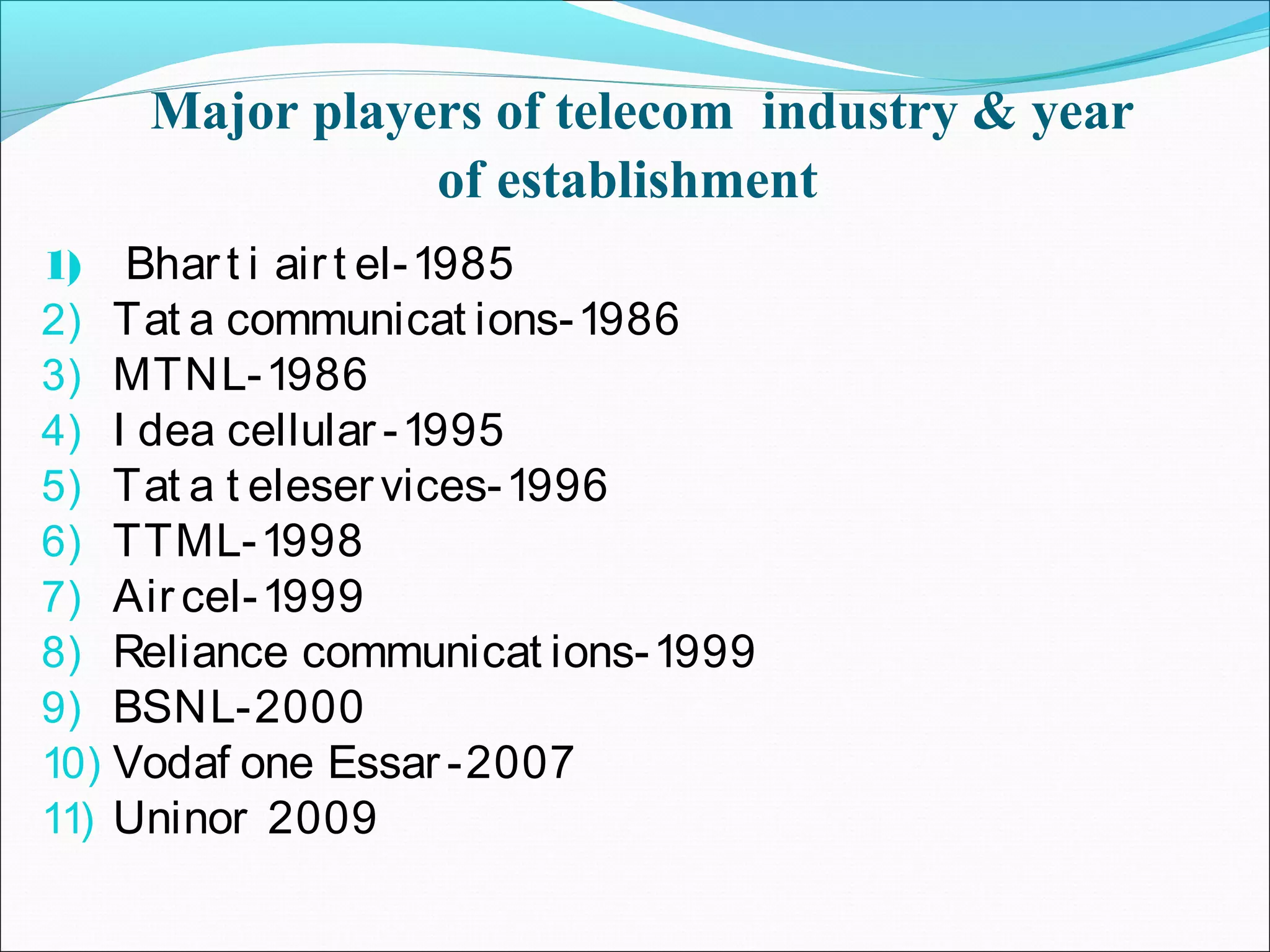
Major players of telecom industry & year
               of establishment
1) Bhar t i air t el-1985
2) Tat a communicat ions-1986
3) MTNL-1986
4) I dea cellular -1995
5) Tat a t eleser vices-1996
6) TTML-1998
7) Air cel-1999
8) Reliance communicat ions-1999
9) BSNL-2000
10) Vodaf one Essar -2007
11) Uninor 2009
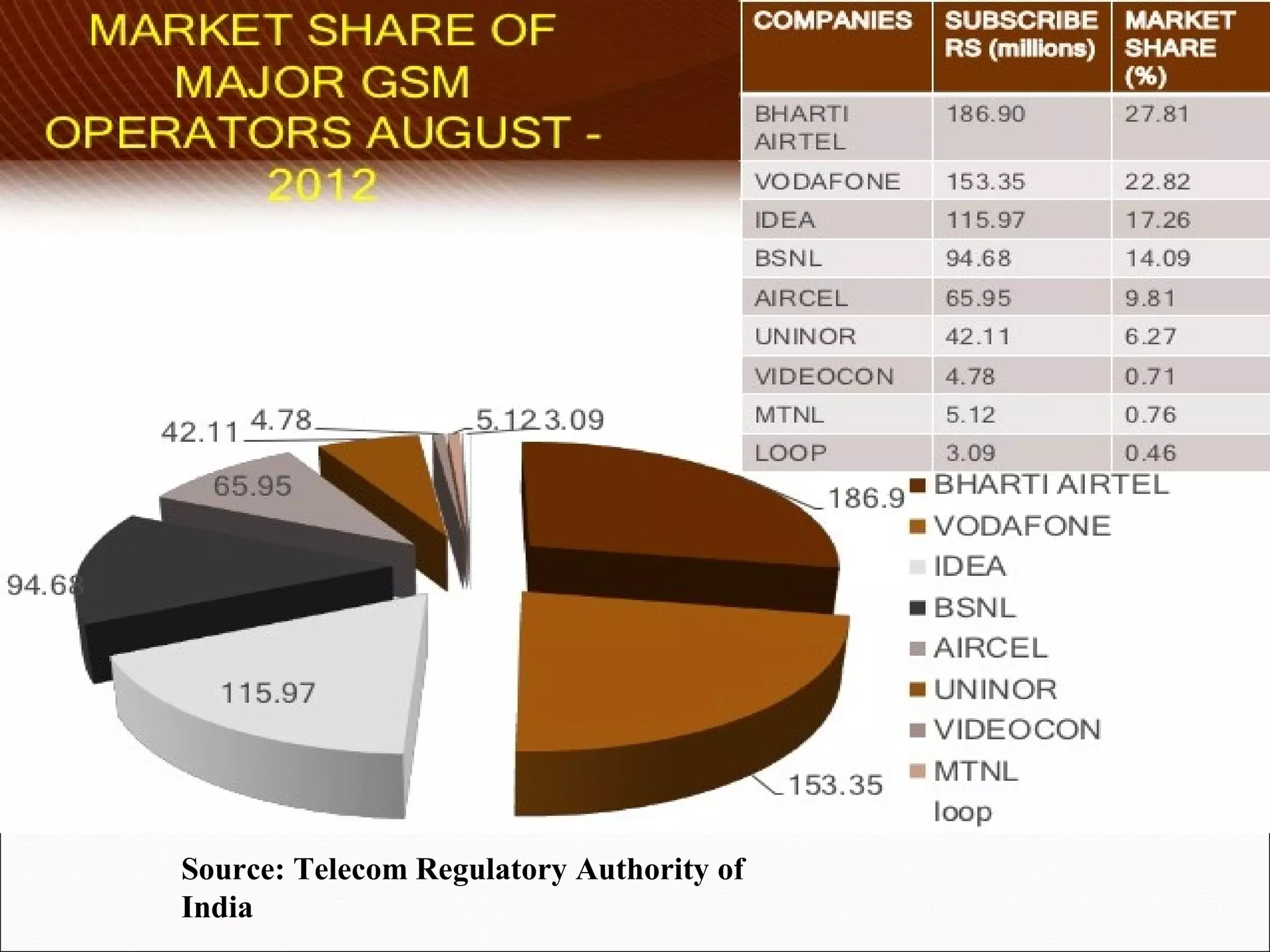
Source: Telecom Regulatory Authority of
India
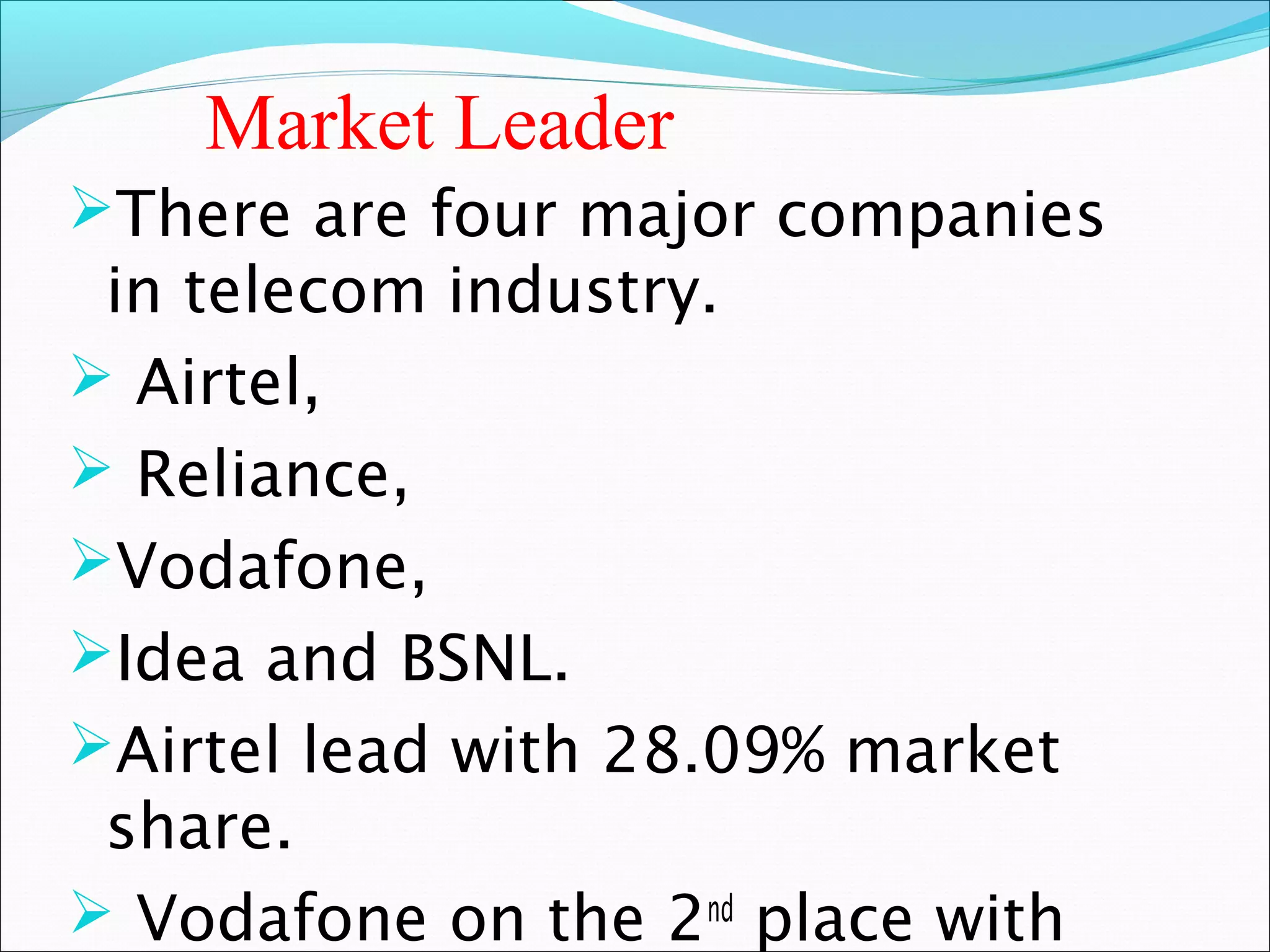
Market Leader
There are four major companies
 in telecom industry.
 Airtel,
 Reliance,
Vodafone,
Idea and BSNL.
Airtel lead with 28.09% market
 share.
 Vodafone on the 2nd place with
Key Drivers
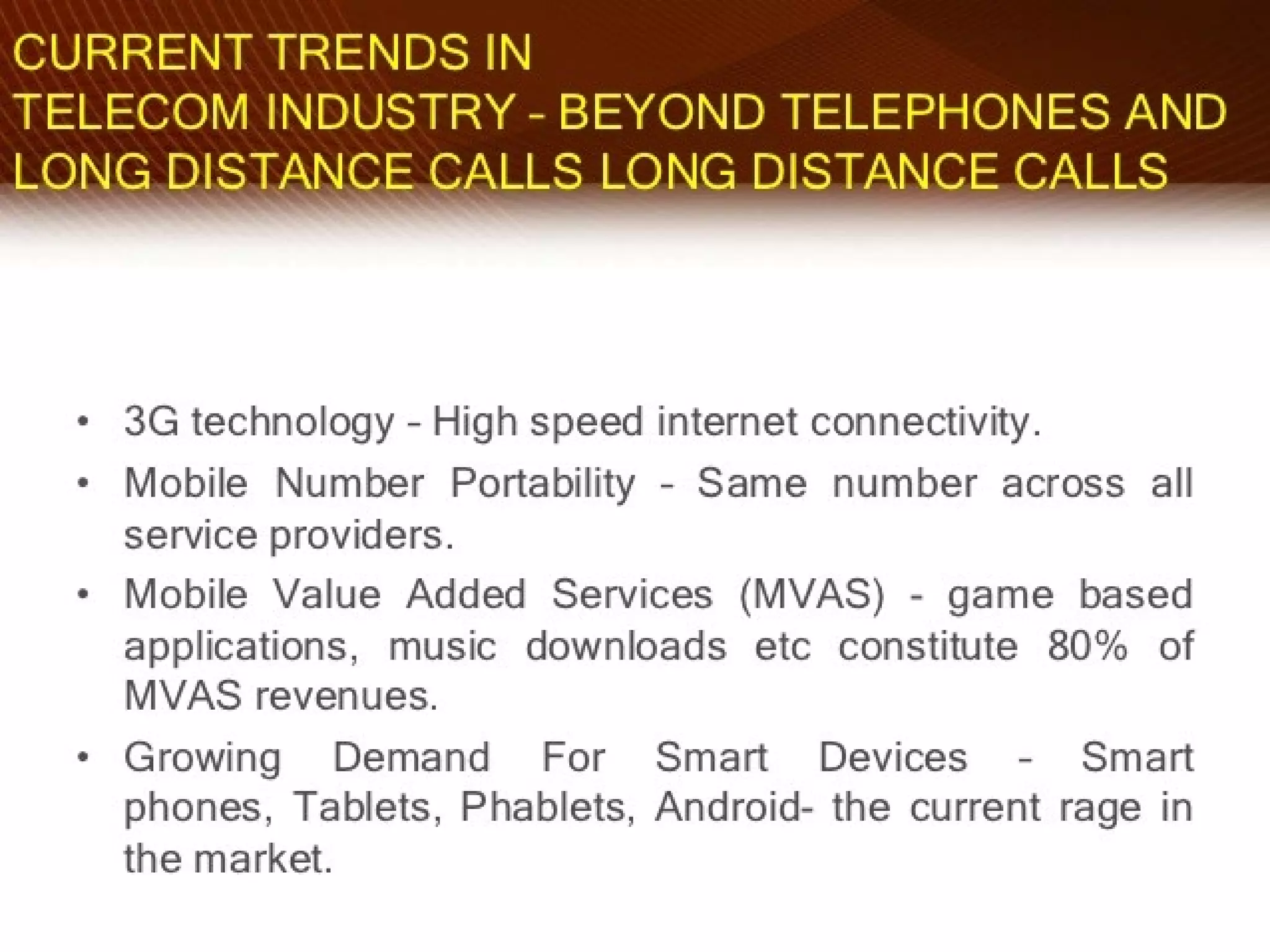
 Mobile value added services like:
 Mobile banking, Mobile education, Health information services, Agriculture
  and Entertainment, Internet services.
 Growth of e-business.
 Low cost hand sets.
 Rural population is the key growth driver of India's telecom industry.
 Market-driven factors such as planned expansion of networks
 Increasing use of 3G, Wimax(wireless network) and 4G
 Increase of Mobile users.(rose to 944.81 million in July 2012)
 Digitization of Television Broadcast Network
 Free Market system . ( e.g. Airtel Rwanda)
 Mergers and Acquisitions (M&A)
 Increase in IT users.
 Growth of Manufacturing and Service Industries.
Challenges FACED BY TELECOM
INDUSTRY
 Limited spectrum availability and interconnection charges between the
  private and state operators.
 Telecom manufacturing in India is not in pace. With only a few
  equipment manufacturers currently operating in the country, most of the
  telecom equipment is imported as the country lags behind in terms of
  telecom R&D.
 Lack of infrastructure in semi-rural and rural areas, which makes it
  difficult to make inroads into this market segment as service providers
  have to incur a huge initial fixed cost.
 One of the major challenge is the absence of a uniform approval process
  across the country for setting up telecom towers and other infrastructure.
 Inadequate utilization of existing towers.
 Multiple levies and high taxes on the set up of mobile towers.
 lack of reliable power for telecom towers and higher tariffs on telecom
  sites. This increases the dependence on diesel- fuelled power sources,
  which is considered expensive and more harmful to the environment.
Impact of global crisis
As we know world economy is fighting with economic slow
 down.
It seems something special about the telecom industry which
 renders it partially immune to the worst effect of the down
 turn.
Total base of connection in world is 3.2 bln.
There was less impact of global crisis on Indian telecom
 industry as India became the 1st country in the world new
 connections in a month.
Conclusions and Recommendations
 A fair and transparent Spectrum Policy should be ensured by the
  Government.
 Equal Access should be ensured to provide support for the
  achievement of Universal Service, an appropriate financing
  mechanism be evolved.
 Provision of right of way could be given by State Governments
  on simple commercial terms without any special conditions
 Tax laws should be amended to permit efficiency with respect to
  consolidation and restructuring of the business of telecom
  operators.
 Foreign Investment Thresholds should be encouraged.
 GOI to increase rural infrastructure (Mainly Power)
Reference:
http://www.dot.gov.in/
http://www.trai.gov.in/
http://timesofindia.indiatimes.com/ Articles,Jul 5, 2012
http://www.businessreviewindia.in/technology/softwar
 e/-telecom-industry--indias- success-story•
 http://voicendata.ciol.com/content/news/110
 112601.asp•
 http://www.coai.com/statistics.php
Stay Connected……

telecom India

  • 1.
    Telecom indusTry inindia since 1991 By: umar Farooq a 16 ll oloneumar89@gmail.com
  • 2.
    INTRODUCTION  Postal meansof communication was the only mean communication until the year 1850. In 1850 experimental electric telegraph started for first time in India between Calcutta (Kolkata).  In 1851, it was opened for the use of the British East India Company.  Subsequently construction of telegraph started throughout India. A separate department was opened to the public in 1854.  Dr.William O’Shaughnessy, was the one who pioneered the telegraph and telephone in India.  In 1980 when the private sector was allowed in telecommunications equipment manufacturing the first wind of reforms in telecommunications sector began to flow.
  • 3.
    cont… Today India hasthe second largest number of telephone subscribers with 941.81 mn ( July 2012) in the world accounting 12%. Telecom is the third major sector attracting FDI inflows after services and computer software sector. FDI in telecom sector during April-June 2012 stood at US$ 8 million.  GSM continues to be the dominant technology for wireless phones with an 87.90 % share. Mobile phones accounts for nearly 96.60 % of the total telecom subscriptions. Mobile tariffs in India are the second lowest in the world after Bangladesh. Telecom sector contributes 3.7% to the total GDP of India.
  • 4.
    Reforms in Telecomsector since early 1990's 1991-92:  On 24th July 1991, Government announced the New Economic Policy.  Telecom Manufacturing Equipment license was delicensed in 1991. 1992-93: Value added services were opened for private and foreign players on franchise or license basis. 1994-95:  The Government announced a National Telecom Policy in September 1994
  • 5.
    1996-97:  TRAI wasset up as an autonomous body to separate the regulatory functions from policy formulations and operational functions.  Internet Policy was finalized. 1998-99: FDI up to 49 per cent of total equity, subject to license, permitted in companies providing Global Mobile Personal Communication (GMPC) by satellite services. 1999-00 1. National Telecom Policy 1999 was announced which allowed multiple fixed Services operators and opened long distance services to private operators. DOT/MTNL was permitted to start cellular mobile
  • 6.
    2000-01: TRAI Act wasamended. The Amendment clarified and strengthened the recommendatory power of TRAI. Department of Telecom creating Bharat Sanchar Nigam Limited. Reduction in STD & ISD rates. 2001-02: 1. Communication Convergence Bill, was introduced in August 2001. Wireless in Local Loop (WLL) was introduced for providing telephone connection in urban, semi-urban and rural areas. 2002-03 1. International long distance business opened for unrestricted entry.  Telephony on internet permitted in April 2002
  • 7.
    2004-05: Broadband Policy announcedon 14th October 2004. BSNL and MTNL launched broadband services on 14th January 2005. TRAI announced the reduction by 41 per cent on ISD calls and by 61 per cent on STD calls. 2005-2006 1. Budget 2005-2006 cleared a hike in FDI ceiling to 74 per cent from the earlier limit of 49 per cent. BSNL and MTNL launched the 'One-India Plan‘. BSNL announced 33 per cent reduction in call charges for all the countries for international calls.
  • 8.
    2007-10  3G guidelines issuedspectrum allocation through auction, foreign players allowed to bid. TRAI announces rules & regulations to be followed for mobile number portability in 2009. BSNL 1st one to launch WIMAX service in 2010. 2011-2012 Airtel launches 4G service in April 2012.
  • 9.
    Major players oftelecom industry & year of establishment 1) Bhar t i air t el-1985 2) Tat a communicat ions-1986 3) MTNL-1986 4) I dea cellular -1995 5) Tat a t eleser vices-1996 6) TTML-1998 7) Air cel-1999 8) Reliance communicat ions-1999 9) BSNL-2000 10) Vodaf one Essar -2007 11) Uninor 2009
  • 10.
    Source: Telecom RegulatoryAuthority of India
  • 11.
    Market Leader There arefour major companies in telecom industry.  Airtel,  Reliance, Vodafone, Idea and BSNL. Airtel lead with 28.09% market share.  Vodafone on the 2nd place with
  • 14.
    Key Drivers  Mobilevalue added services like:  Mobile banking, Mobile education, Health information services, Agriculture and Entertainment, Internet services.  Growth of e-business.  Low cost hand sets.  Rural population is the key growth driver of India's telecom industry.  Market-driven factors such as planned expansion of networks  Increasing use of 3G, Wimax(wireless network) and 4G  Increase of Mobile users.(rose to 944.81 million in July 2012)  Digitization of Television Broadcast Network  Free Market system . ( e.g. Airtel Rwanda)  Mergers and Acquisitions (M&A)  Increase in IT users.  Growth of Manufacturing and Service Industries.
  • 15.
    Challenges FACED BYTELECOM INDUSTRY  Limited spectrum availability and interconnection charges between the private and state operators.  Telecom manufacturing in India is not in pace. With only a few equipment manufacturers currently operating in the country, most of the telecom equipment is imported as the country lags behind in terms of telecom R&D.  Lack of infrastructure in semi-rural and rural areas, which makes it difficult to make inroads into this market segment as service providers have to incur a huge initial fixed cost.  One of the major challenge is the absence of a uniform approval process across the country for setting up telecom towers and other infrastructure.  Inadequate utilization of existing towers.  Multiple levies and high taxes on the set up of mobile towers.  lack of reliable power for telecom towers and higher tariffs on telecom sites. This increases the dependence on diesel- fuelled power sources, which is considered expensive and more harmful to the environment.
  • 16.
    Impact of globalcrisis As we know world economy is fighting with economic slow down. It seems something special about the telecom industry which renders it partially immune to the worst effect of the down turn. Total base of connection in world is 3.2 bln. There was less impact of global crisis on Indian telecom industry as India became the 1st country in the world new connections in a month.
  • 17.
    Conclusions and Recommendations A fair and transparent Spectrum Policy should be ensured by the Government.  Equal Access should be ensured to provide support for the achievement of Universal Service, an appropriate financing mechanism be evolved.  Provision of right of way could be given by State Governments on simple commercial terms without any special conditions  Tax laws should be amended to permit efficiency with respect to consolidation and restructuring of the business of telecom operators.  Foreign Investment Thresholds should be encouraged.  GOI to increase rural infrastructure (Mainly Power)
  • 18.
    Reference: http://www.dot.gov.in/ http://www.trai.gov.in/ http://timesofindia.indiatimes.com/ Articles,Jul 5,2012 http://www.businessreviewindia.in/technology/softwar e/-telecom-industry--indias- success-story•  http://voicendata.ciol.com/content/news/110 112601.asp•  http://www.coai.com/statistics.php
  • 19.