Temporal Variation’s in
Earth’s Magnetic Field
Shivam Shekhar
Geological Technology – 3rd Year
Introduction
Let’s first get to know a bit about earth
1
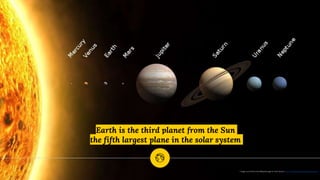
Earth is the third planet from the Sun
the fifth largest plane in the solar system
1 Image sourced from the Wikipedia page for Solar System https://en.wikipedia.org/wiki/Solar_System
Earth’s revolution
1 Image sourced from a SlideShare presentation on “Rotation vs Revolution” https://www.slideshare.net/awboan/rotation-vs-revolution
Equinox
The solar terminator
perpendicular to the
equator
Summer Solstice
(Midsummer)
The solar terminator
perpendicular to the
Tropic of Cancer
Winter Solstice
(Midwinter)
The solar terminator
perpendicular to the
Tropic of Capricorn
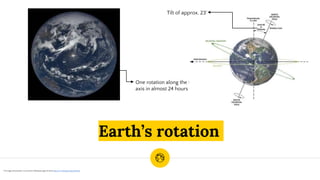
Earth’s rotation
One rotation along the tilted
axis in almost 24 hours
Tilt of approx. 23˚
1 Tilt image and animation sourced from Wikipedia page for Earth https://en.wikipedia.org/wiki/Earth
How did the Sun and the Earth
form?
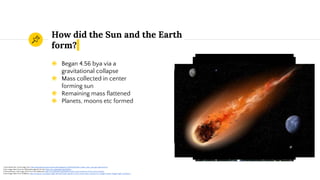
◉ Began 4.56 bya via a
gravitational collapse
◉ Mass collected in center
forming sun
◉ Remaining mass flattened
◉ Planets, moons etc formed
1 Giant Molecular cloud image from http://dearplanetaryastronomermike.blogspot.in/2009/03/dark-matter-stars-and-gas-wheres.html
2 Sun image taken from the Wikipedia page for the Sun https://en.wikipedia.org/wiki/Sun
3 Protoplanetary disk image taken from the Wikipedia https://en.wikipedia.org/wiki/Formation_and_evolution_of_the_Solar_System
4 Last image taken from VUNature http://vunature.com/space-light-asteroid-earth-planets-comet-moon-stars-cosmos-sci-sunlight-nature-images-high-resolution/
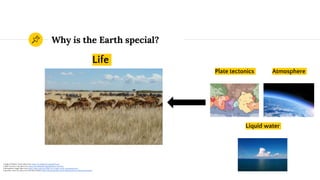
Why is the Earth special?
Liquid water
Plate tectonics Atmosphere
1 Image of Atlantic Ocean taken from https://en.wikipedia.org/wiki/Ocean
2 Plate Tectonics map taken from https://en.wikipedia.org/wiki/Plate_tectonics
3 Atmosphere image taken from https://phys.org/news/2016-05-oxygen-earth-atmosphere.html
4 Question mark icon taken from the Noun Project https://thenounproject.com/marialuisa.iborra/collection/question/
Life
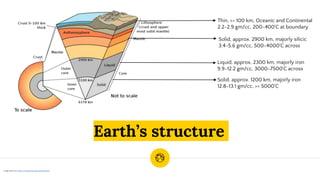
Earth’s structure
1 Image taken from https://en.wikipedia.org/wiki/Lithosphere
Thin, <= 100 km, Oceanic and Continental
2.2-2.9 gm/cc, 200-400˚C at boundary
Solid, approx. 2900 km, majorly silicic
3.4-5.6 gm/cc, 500-4000˚C across
Liquid, approx. 2300 km, majorly iron
9.9-12.2 gm/cc, 3000-7500˚C across
Solid, approx. 1200 km, majorly iron
12.8-13.1 gm/cc, >= 5000˚C
Geomagnetic Field
Earth’s magnetic field and the types of temporal variations in it
2
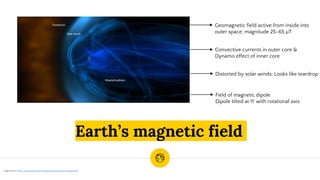
Earth’s magnetic field
1 Image taken from https://www.nasa.gov/mission_pages/sunearth/news/wind-slamswaves.html
Geomagnetic field active from inside into
outer space; magnitude 25-65 μT
Convective currents in outer core &
Dynamo effect of inner core
Distorted by solar winds; Looks like teardrop
Field of magnetic dipole
Dipole tilted at 11˚ with rotational axis
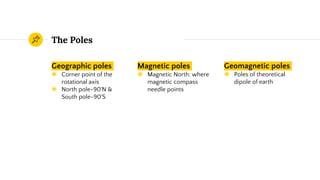
The Poles
Geographic poles
◉ Corner point of the
rotational axis
◉ North pole-90˚N &
South pole-90˚S
Magnetic poles
◉ Magnetic North: where
magnetic compass
needle points
Geomagnetic poles
◉ Poles of theoretical
dipole of earth
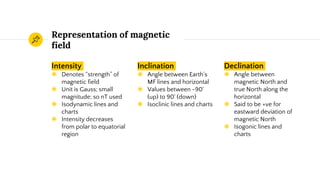
Representation of magnetic
field
Intensity
◉ Denotes “strength” of
magnetic field
◉ Unit is Gauss; small
magnitude; so nT used
◉ Isodynamic lines and
charts
◉ Intensity decreases
from polar to equatorial
region
Inclination
◉ Angle between Earth’s
MF lines and horizontal
◉ Values between -90˚
(up) to 90˚ (down)
◉ Isoclinic lines and charts
Declination
◉ Angle between
magnetic North and
true North along the
horizontal
◉ Said to be +ve for
eastward deviation of
magnetic North
◉ Isogonic lines and
charts
◉ Geomagnetic field varies strongly with
time
◉ Short duration variations  caused by
changes in ionosphere and
magnetosphere
◉ Long duration variations  caused
due to Earth’s iron-rich core
◉ 5 types of temporal variations
Temporal variations in the
geomagnetic field
1. Geomagnetic secular variation
2. Geomagnetic excursion
3. Geomagnetic reversal
4. Geomagnetic storm
5. Apparent polar wander
Geomagnetic
Secular Variation
Changes occurring at a scale of about a year or more
3
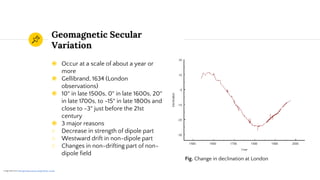
◉ Occur at a scale of about a year or
more
◉ Gellibrand, 1634 (London
observations)
◉ 10° in late 1500s, 0° in late 1600s, 20°
in late 1700s, to -15° in late 1800s and
close to -3° just before the 21st
century
◉ 3 major reasons
○ Decrease in strength of dipole part
○ Westward drift in non-dipole part
○ Changes in non-drifting part of non-
dipole field
Geomagnetic Secular
Variation
Fig. Change in declination at London
1 Image taken from http://geomag.nrcan.gc.ca/mag_fld/sec-en.php
Geomagnetic
Excursion
Significant change in field, both in intensity and orientation
4
Geomagnetic Excursion
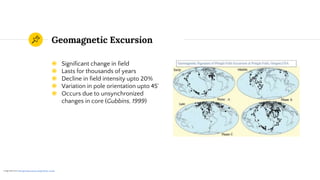
◉ Significant change in field
◉ Lasts for thousands of years
◉ Decline in field intensity upto 20%
◉ Variation in pole orientation upto 45˚
◉ Occurs due to unsynchronized
changes in core (Gubbins, 1999)
1 Image taken from http://geomag.nrcan.gc.ca/mag_fld/sec-en.php
Geomagnetic Excursion
◉ Considered normal behaviour of oscillation in the oscillatory dynamo process
(Busse & Simitev, 2009)
◉ They also proposed that excursion and reversal are of same origin i.e. powered by
the dynamo process only
◉ Very much frequent compared to reversals
◉ Immense effect on climate as it is a phenomenon of weakening of magnetic field
Geomagnetic
Reversal
Interchange of polarity i.e. North becomes South
5
Geomagnetic Reversal
◉ Change in geomagnetic field such that the magnetic poles are interchanged
◉ Current polarity  normal and the reversed one  reverse
◉ Chron: time period in which polarity is reversed
◉ Significantly long process; takes between 1,000 to 10,000 years
Geomagnetic Reversal
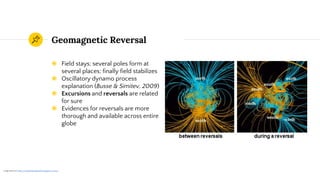
◉ Field stays; several poles form at
several places; finally field stabilizes
◉ Oscillatory dynamo process
explanation (Busse & Simitev, 2009)
◉ Excursions and reversals are related
for sure
◉ Evidences for reversals are more
thorough and available across entire
globe
1 Image taken from https://en.wikipedia.org/wiki/Geomagnetic_reversal
Geomagnetic
Storm
Disturbance of Earth’s magnetosphere by solar winds
6
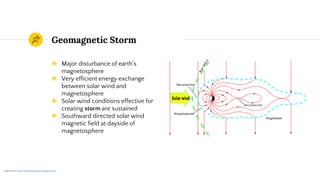
Geomagnetic Storm
◉ Major disturbance of earth’s
magnetosphere
◉ Very efficient energy exchange
between solar wind and
magnetosphere
◉ Solar wind conditions effective for
creating storm are sustained
◉ Southward directed solar wind
magnetic field at dayside of
magnetosphere
1 Image taken from https://en.wikipedia.org/wiki/Geomagnetic_storm
Geomagnetic Storm
◉ G1 (Minor) – 1700 times per solar cycle; slightly affectc the power grid & satellites
◉ G2 (Moderate) – 600 times per solar cycles; cause significant damage to high-
latitude power systems
◉ G3 (Strong) – 200 times per solar cycle; strong affects on power systems & low-
frequency radio navigation systems
◉ G4 (Severe) – 100 times per solar cycle; voltage control problems and degraded
satellite navigation
◉ G5 (Extreme) – 4 times per solar cycle; strongly affect spacecraft, satellite
navigation, power systems and even cause complete blackout on several grids
◉ Also generate auroras, the beautiful natural light display in Northern polar region
Apparent Polar
Wander
Perceived movement of Earth’s paleo-magnetic poles
7
Apparent Polar Wander
◉ Perceived movement of Earth’s paleo-magnetic poles relative to given tectonic
element
◉ Frequently displayed on the present latitude-longitude map as a path connecting
the locations of geomagnetic poles
◉ Relative polar movement can either be polar wandering or continental drift
◉ Concept of apparent polar wander is very useful in plate tectonics
References
◉ Presentation template by SlidesCarnival
◉ Magnetic field icon on first slide created by
anbileru adaleru from the Noun Project
◉ Bouvier, A and Wadhwa, M. 2010. The age of
the Solar System redefined by the oldest Pb-Pb
age of a meteoritic inclusion: Nature Geoscience
3, 637 - 641
◉ Murray, Lori L. 2012. The Construction of
Edmond Halley's 1701 Map of Magnetic
Declination: Electronic Thesis and Dissertation
Repository, 654.
◉ Courtillot V, Le Mouel JL. 1984. Geomagnetic
secular variation impulses: Nature 311, 709 - 716
◉ David Gubbins. 1999. The distinction between
geomagnetic excursions and reversals:
Geophysical Journal International, Volume 137,
Issue 1, 1 April 1999, Pages F1–F3
◉ Busse, F.H. and Simitev R.D. 2009. Toroidal flux
oscillation as possible cause of geomagnetic
excursions and reversals: Physics of the Earth and
Planetary Interiors, 168, (3-4), 237-243, 2008
◉ Online resources
1. Wikipedia website
2. NASA Jet Propulsion Laboratory website
3. Geomagnetism Canada website
4. National Geographic website
5. Geophysical Research Letters website by Andrew P. Roberts
Any questions ?
Thanks!

Temporal Variations in Earth's Magnetic Field

  • 1.
    Temporal Variation’s in Earth’sMagnetic Field Shivam Shekhar Geological Technology – 3rd Year
  • 2.
    Introduction Let’s first getto know a bit about earth 1
  • 3.
    Earth is thethird planet from the Sun the fifth largest plane in the solar system 1 Image sourced from the Wikipedia page for Solar System https://en.wikipedia.org/wiki/Solar_System
  • 4.
    Earth’s revolution 1 Imagesourced from a SlideShare presentation on “Rotation vs Revolution” https://www.slideshare.net/awboan/rotation-vs-revolution Equinox The solar terminator perpendicular to the equator Summer Solstice (Midsummer) The solar terminator perpendicular to the Tropic of Cancer Winter Solstice (Midwinter) The solar terminator perpendicular to the Tropic of Capricorn
  • 5.
    Earth’s rotation One rotationalong the tilted axis in almost 24 hours Tilt of approx. 23˚ 1 Tilt image and animation sourced from Wikipedia page for Earth https://en.wikipedia.org/wiki/Earth
  • 6.
    How did theSun and the Earth form? ◉ Began 4.56 bya via a gravitational collapse ◉ Mass collected in center forming sun ◉ Remaining mass flattened ◉ Planets, moons etc formed 1 Giant Molecular cloud image from http://dearplanetaryastronomermike.blogspot.in/2009/03/dark-matter-stars-and-gas-wheres.html 2 Sun image taken from the Wikipedia page for the Sun https://en.wikipedia.org/wiki/Sun 3 Protoplanetary disk image taken from the Wikipedia https://en.wikipedia.org/wiki/Formation_and_evolution_of_the_Solar_System 4 Last image taken from VUNature http://vunature.com/space-light-asteroid-earth-planets-comet-moon-stars-cosmos-sci-sunlight-nature-images-high-resolution/
  • 7.
    Why is theEarth special? Liquid water Plate tectonics Atmosphere 1 Image of Atlantic Ocean taken from https://en.wikipedia.org/wiki/Ocean 2 Plate Tectonics map taken from https://en.wikipedia.org/wiki/Plate_tectonics 3 Atmosphere image taken from https://phys.org/news/2016-05-oxygen-earth-atmosphere.html 4 Question mark icon taken from the Noun Project https://thenounproject.com/marialuisa.iborra/collection/question/ Life
  • 8.
    Earth’s structure 1 Imagetaken from https://en.wikipedia.org/wiki/Lithosphere Thin, <= 100 km, Oceanic and Continental 2.2-2.9 gm/cc, 200-400˚C at boundary Solid, approx. 2900 km, majorly silicic 3.4-5.6 gm/cc, 500-4000˚C across Liquid, approx. 2300 km, majorly iron 9.9-12.2 gm/cc, 3000-7500˚C across Solid, approx. 1200 km, majorly iron 12.8-13.1 gm/cc, >= 5000˚C
  • 9.
    Geomagnetic Field Earth’s magneticfield and the types of temporal variations in it 2
  • 10.
    Earth’s magnetic field 1Image taken from https://www.nasa.gov/mission_pages/sunearth/news/wind-slamswaves.html Geomagnetic field active from inside into outer space; magnitude 25-65 μT Convective currents in outer core & Dynamo effect of inner core Distorted by solar winds; Looks like teardrop Field of magnetic dipole Dipole tilted at 11˚ with rotational axis
  • 11.
    The Poles Geographic poles ◉Corner point of the rotational axis ◉ North pole-90˚N & South pole-90˚S Magnetic poles ◉ Magnetic North: where magnetic compass needle points Geomagnetic poles ◉ Poles of theoretical dipole of earth
  • 12.
    Representation of magnetic field Intensity ◉Denotes “strength” of magnetic field ◉ Unit is Gauss; small magnitude; so nT used ◉ Isodynamic lines and charts ◉ Intensity decreases from polar to equatorial region Inclination ◉ Angle between Earth’s MF lines and horizontal ◉ Values between -90˚ (up) to 90˚ (down) ◉ Isoclinic lines and charts Declination ◉ Angle between magnetic North and true North along the horizontal ◉ Said to be +ve for eastward deviation of magnetic North ◉ Isogonic lines and charts
  • 13.
    ◉ Geomagnetic fieldvaries strongly with time ◉ Short duration variations  caused by changes in ionosphere and magnetosphere ◉ Long duration variations  caused due to Earth’s iron-rich core ◉ 5 types of temporal variations Temporal variations in the geomagnetic field 1. Geomagnetic secular variation 2. Geomagnetic excursion 3. Geomagnetic reversal 4. Geomagnetic storm 5. Apparent polar wander
  • 14.
    Geomagnetic Secular Variation Changes occurringat a scale of about a year or more 3
  • 15.
    ◉ Occur ata scale of about a year or more ◉ Gellibrand, 1634 (London observations) ◉ 10° in late 1500s, 0° in late 1600s, 20° in late 1700s, to -15° in late 1800s and close to -3° just before the 21st century ◉ 3 major reasons ○ Decrease in strength of dipole part ○ Westward drift in non-dipole part ○ Changes in non-drifting part of non- dipole field Geomagnetic Secular Variation Fig. Change in declination at London 1 Image taken from http://geomag.nrcan.gc.ca/mag_fld/sec-en.php
  • 16.
    Geomagnetic Excursion Significant change infield, both in intensity and orientation 4
  • 17.
    Geomagnetic Excursion ◉ Significantchange in field ◉ Lasts for thousands of years ◉ Decline in field intensity upto 20% ◉ Variation in pole orientation upto 45˚ ◉ Occurs due to unsynchronized changes in core (Gubbins, 1999) 1 Image taken from http://geomag.nrcan.gc.ca/mag_fld/sec-en.php
  • 18.
    Geomagnetic Excursion ◉ Considerednormal behaviour of oscillation in the oscillatory dynamo process (Busse & Simitev, 2009) ◉ They also proposed that excursion and reversal are of same origin i.e. powered by the dynamo process only ◉ Very much frequent compared to reversals ◉ Immense effect on climate as it is a phenomenon of weakening of magnetic field
  • 19.
  • 20.
    Geomagnetic Reversal ◉ Changein geomagnetic field such that the magnetic poles are interchanged ◉ Current polarity  normal and the reversed one  reverse ◉ Chron: time period in which polarity is reversed ◉ Significantly long process; takes between 1,000 to 10,000 years
  • 21.
    Geomagnetic Reversal ◉ Fieldstays; several poles form at several places; finally field stabilizes ◉ Oscillatory dynamo process explanation (Busse & Simitev, 2009) ◉ Excursions and reversals are related for sure ◉ Evidences for reversals are more thorough and available across entire globe 1 Image taken from https://en.wikipedia.org/wiki/Geomagnetic_reversal
  • 22.
    Geomagnetic Storm Disturbance of Earth’smagnetosphere by solar winds 6
  • 23.
    Geomagnetic Storm ◉ Majordisturbance of earth’s magnetosphere ◉ Very efficient energy exchange between solar wind and magnetosphere ◉ Solar wind conditions effective for creating storm are sustained ◉ Southward directed solar wind magnetic field at dayside of magnetosphere 1 Image taken from https://en.wikipedia.org/wiki/Geomagnetic_storm
  • 24.
    Geomagnetic Storm ◉ G1(Minor) – 1700 times per solar cycle; slightly affectc the power grid & satellites ◉ G2 (Moderate) – 600 times per solar cycles; cause significant damage to high- latitude power systems ◉ G3 (Strong) – 200 times per solar cycle; strong affects on power systems & low- frequency radio navigation systems ◉ G4 (Severe) – 100 times per solar cycle; voltage control problems and degraded satellite navigation ◉ G5 (Extreme) – 4 times per solar cycle; strongly affect spacecraft, satellite navigation, power systems and even cause complete blackout on several grids ◉ Also generate auroras, the beautiful natural light display in Northern polar region
  • 25.
    Apparent Polar Wander Perceived movementof Earth’s paleo-magnetic poles 7
  • 26.
    Apparent Polar Wander ◉Perceived movement of Earth’s paleo-magnetic poles relative to given tectonic element ◉ Frequently displayed on the present latitude-longitude map as a path connecting the locations of geomagnetic poles ◉ Relative polar movement can either be polar wandering or continental drift ◉ Concept of apparent polar wander is very useful in plate tectonics
  • 27.
    References ◉ Presentation templateby SlidesCarnival ◉ Magnetic field icon on first slide created by anbileru adaleru from the Noun Project ◉ Bouvier, A and Wadhwa, M. 2010. The age of the Solar System redefined by the oldest Pb-Pb age of a meteoritic inclusion: Nature Geoscience 3, 637 - 641 ◉ Murray, Lori L. 2012. The Construction of Edmond Halley's 1701 Map of Magnetic Declination: Electronic Thesis and Dissertation Repository, 654. ◉ Courtillot V, Le Mouel JL. 1984. Geomagnetic secular variation impulses: Nature 311, 709 - 716 ◉ David Gubbins. 1999. The distinction between geomagnetic excursions and reversals: Geophysical Journal International, Volume 137, Issue 1, 1 April 1999, Pages F1–F3 ◉ Busse, F.H. and Simitev R.D. 2009. Toroidal flux oscillation as possible cause of geomagnetic excursions and reversals: Physics of the Earth and Planetary Interiors, 168, (3-4), 237-243, 2008 ◉ Online resources 1. Wikipedia website 2. NASA Jet Propulsion Laboratory website 3. Geomagnetism Canada website 4. National Geographic website 5. Geophysical Research Letters website by Andrew P. Roberts
  • 28.

Editor's Notes

  • #4 Earth is the third planet from the Sun and the fifth largest planet in the solar system and the only one that gives shelter to the life as we know it. It revolves round the sun bout 150 mn km.
  • #5 Earth revolves around the Sun in an elliptical orbit with an average distance of about 149.60 million km. It takes a little more than 365 days to complete one revolution. The leap year is added to calender every 4 year to account for this. Solar terminator is the edge of the night and day that is it defines what part of earth is having day and what part is having night. There are four major events, the two equinoxes and the two solstices.
  • #6 Besides revolving around the sun, the Earth’ also rotates around itself once in a time period of almost 24 hours, to be precise it takes 23 hours, 56 minutes and 4 seconds. The axis about which it rotates doesn’t pass exactly perpendicular to the direction of the orbit it takes around the sun. But it is tilted at around 23 degrees. Earth’s rotation is slowing slightly with time and thus today is a bit shorter than the yesterday.
  • #7 G collapse of a small part of a giant molecular cloud Major part of the mass; rest flattened into protoplanetary disk Planets, moons, asteroids and other small bodies in SS formed Our earth formed around 4.54 bya
  • #8 Life Widely attributed to 3 things; Complex system where atmosphere isolates and PT and water form a major reason for life’s existence
  • #9 3 layers; Crust+Omantle==Lithosphere; Asthenos==belowLitho+lowResistToPlasticFlow & convection Crust-igneous process; Oceanic/2.9gmcc-basaltic, diabase & gabbro; Continental/2.7gmcc-granitic 40% O; Mantle-3.3gm/cc; highly viscous; high temp  convective material circulation Iron & nickel; Liquid-seismic/P&S waves; low visc.; eddy currents due to FeNiMagField OuterCore coolsinner grows; dynamo action due to growthMagField; Possibility of faster rot due to disconnect b/w mantle
  • #11 Geomagnetic field is the MF; extends from interior into outer space; meets solar wind-charged particles stream from sun; magnitude 25-65uT on surface 2 major reasons; dynamoEffect & motionOuterCoreconvective currents Distorted by solar winds in near space; looks like teardrop; called magnetosphere; contains important parts such as van Allen radiation belts Assumed as field of magDipole that is tilted at 11 deg with rotational axis
  • #12 There are three major kinds of poles that we need to take care of Geographic-RotAxis; NoRelationToMF; Magnetic-CompassNeedlePoints; GeoMagnetic-PolesOfTheoreticalDipole; North Geomagnetic pole is actually the Southern pole of the giant theoretical geomagnet and is located near the Geographic North pole and the Magnetic North pole Our compass exactly point in dirN of magnetic North
  • #13 The GMF can be represented by 3D vector; i.e. 3 parameters at a point Intensity-InAWay it’s the strength of MF; Map of intensity contours-isodynamic chart shows intensity decreases from poles to equator Inclination/Magnetic dip-Straight down at North MP and starts moving up as we move towards equator (0) and South MP ; map of equal inclination lines Declination/Variation-+ve for eastward dev of magNorth rel. to truNorth
  • #14 Variation vary widely on time scales from milliseconds to millions of years We’ll be seeing 5 types of temporal variations
  • #16 First time in 1634 when Gellibrand compared magnetic declination observations he had made at London with earlier observations 10° in late 1500s, 0° in late 1600s, 20° in late 1700s, to -15° in late 1800s and close to -3° just before the 21st century Spherical harmonic models; found that dipole strength decreasing for atleast 2000 years; current rate-6.3% and no dipole after almost 1600 years Edmund Halley-lineOfZeroDeclin moving westward; avrg drift of features is 0.2 deg/year; varies depending on location Some features don’t drift but grow & decay at same place; Total intensity is one such & stayed max iu N.Manitoba, Canada
  • #18 Signif change in field; in intensity & pole orientation Outer core changes its polarity while the inner core does not undergo reversal and the magnetic inertia of the inner core is more and it delays the full field reversal the previous polarity configuration is slowly re-established in the outer core
  • #19 Normal behavior of oscillatory dynamo process that is also a major reason for existence of MF Excursion is a normal behavior and Reversal are extreme cases in which the mean poloidal field is perturbed more strongly that it can recover from its low-amplitude state only with the opposite sign Several excursion events per reversal event Immense effect on climate; weakened fieldallows some harmful radiation
  • #21 2 polarities; chron is 450,000 years but in 0.1 to 1 mn years Some estimated bring it close to 100 years; recent study concluded that GMF is capable of 6 deg per day
  • #22 field stays but it keeps changing during the period of the transition with several poles forming at several different places at different times until the field stabilizes Oscillatory dynamo process; reversals are extreme cases of excursion Every theory on excursion gives an explanation for reversal Evidences across globe in form of locked older polarities in old rocks; ocean floor and seafloor magnetic anomalies Strong magnetic material gets oriented to current MF and after deposition of several layers it cant re-orient itself according to flip AND STAYS AS AN EVIDENCE OF REVERSAL
  • #24 Very efficient exchange of energy from solar wind into the space environment surrounding earth result from variations in the solar wind that produces major changes in the currents, plasmas, and fields in Earth’s magnetosphere Sustained for long time and create storm A Southward directed solar wind magnetic field (opposite the direction of Earth’s field) at the dayside of the magnetosphere This forms the ideal condition for transferring energy from solar wind into the magnetosphere
  • #25 Categorized into 5 types depending on strength
  • #27 a given tectonic element that may be a plate, continent or craton that is assumed to be fixed inferred at distinct times using paleomagnetic techniques (or a combination of both). Data from around the globe are needed in order to isolate or distinguish between the two the magnetic poles rarely stray far from the geographic poles of the planet since it can retrace the relative motion of continents, as well as the formation and break-up of supercontinents