Technology Integration
From Substitution to Redefinition at a Regional English Language Centre
Date: April 2015
Professional learning focus for this session : Developing a digital
pedagogy through SAMR Technology Integration
Essential Questions:
What is a digital pedagogy?
Why do we as TESOL educators need to develop a digital
pedagogy?
What learning theory do our beliefs align with?
Which technology integration model links to the learning theory
our work is based on?
How will we as a team go about developing our digital pedagogy
using the SAMR model?
Professional Learning Team ( PLT) Meeting
AWAKEN (Engage and stimulate discussion)
Slide 6
Do you think the characteristics of your generation influence the type of teacher you are?
Turn and Talk to a partner and discuss
Share with the group and brainstorm beliefs and understandings that arise from the discussion. List
on the Interactive White Board (IWB).
ADD (What will you add to the knowledge and skill set of the participants ?)
1. Slide 7 - Professional Reading: What is a digital pedagogy? And why do we need a digital
pedagogy?
Howell, Jennifer. (2012). one? Teaching with ICT: Digital pedagogies for collaboration and
creativity (pp. 3-17). South Melbourne, Victoria: Oxford University Press.
Read Chapter 1 pages 5 and 6 – use a PMI (plus/ minus/interesting) protocol to take notes. Discuss
as a group and reflect on essential questions above.
2. Slides 8-13 introduce the concept of Technology Integration Model SAMR .SWOT analysis of the
model and how it links to learning theory and our beliefs.
APPLY(What active work will you involve the staff in now to apply this information back in the
classroom?)
Slides 14-18
Using the SAMR model of Technology Integration audit your own TESOL practice and decide at which
level you are placed currently.
Substitution Augmentation Modification Re definition
With a partner choose a task you are currently teaching and place it on a SAMR level based on the
criteria for each level then work together to re define the task and take it to the next level.
What supports and scaffolds will you need as the teacher? What supports and scaffolds will the
students need to complete the task?
Share with the group and discuss the transition of the task and of the expected learning outcomes
AWAY(What will staff do back in the classroom? What evidence collection or reflection will they
commit to for next PLT?)
Slide 19- Over the next week teach the modified task as planned and observe the changes in
teaching and learning for both yourself and the students. Take notes and or video and photos to use
to feed back to this group at the next PLT meeting in a fortnight.
Beliefs and understandings
 Do you think the characteristics of your
generation influence the type of teacher
you are?
 Turn and talk to a partner and discuss
Professional Reading
What is a digital pedagogy? And why do we need a digital
pedagogy?
Howell, Jennifer. (2012). Teaching with ICT: Digital
pedagogies for collaboration and creativity (pp. 3-17).
South Melbourne, Victoria: Oxford University Press.
Read Chapter 1 pages 5 and 6
Use a PMI (plus/ minus/interesting) protocol to take notes.
Discuss as a group and reflect on essential questions above.
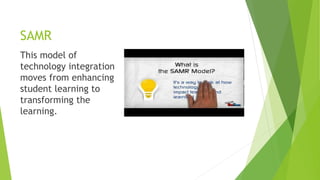
SAMR
This model of
technology integration
moves from enhancing
student learning to
transforming the
learning.
Redefinition
Technology allows for the creation of new tasks, previously inconceivable
Modification
Technology allows for significant task re design
Augmentation
Technology acts as a direct tool substitute, with functional improvement
Substitution
Technology acts as a direct tool, with no functional change
SAMR Technology Integration Model – DR Ruben R. Puentedura , As We May Teach, From
Theory into Practice, ( 2009)
The SAMR model is one approach that can be used by
teachers to plan for the effective use of available
technologies in TESOL.
Used as a whole staff approach to planning, it can provide
a common and consistent language for teachers to use as a
reflective tool for how they use technologies to support
the learning of English.
The SAMR ladder supports teachers to visualise their
planning, identify tasks they are performing at a
substitution level and helps recognise ways that can
further enhance learning tasks.
SAMR Model of Technology Integration
Build on strengths:
• Technology as a tool to transform teaching and learning
• Small steps in changing practice
• Different entry point for teachers
• Moves from teacher centred to student centred
• Collaboration increases
Minimize weaknesses
• Initial introduction integral to engagement and commitment of staff
• Scaffolds needed to support teachers to varying degrees
• Time frame required to ensure transition occurs
• Assessment of transition through the levels required
Seize opportunities
• Development of digital pedagogy
• Collaboration between staff and students
• Focus on life long learning
• Transform the learning through use of digital technology in preparation for mainstream schooling
Counteract threats
• Students’ technology skills and expertise may be more proficient than teachers
• Teachers’ technology skills limited
• Teachers reluctant to change as many consider themselves as ‘ digital immigrants’ (Prensky, 2001)
• Technical problems with hardware and software
• Availability of hardware ad software
Learning Theory to support SAMR
 Constructivism is a theory stating that we generate knowledge and meaning from
interaction between experience and ideas. Thinking back to Piaget’s stages in which
knowledge is internalised by learners, we learn that through the processes of accommodation
and assimilation we construct new knowledge from our experiences.
 Social Constructivism extends constructivism by incorporating the role of other actors
and culture in development. Social interaction plays a key role in the development of
knowledge and according to Vygotsky the more knowledgeable other (MKO) – an individual
who has a better understanding than the learner is important to learning. All learning occurs
within the ‘ zone of proximal development’ ( ZPD) . Teachers scaffold the learning through a
strategy of-
- In front – modelling from the MKO
- Beside- working alongside the student
- Behind- releasing the scaffold and allowing independent learning
Howell, Jennifer. (2012). Teaching with ICT: Digital pedagogies for collaboration and
creativity
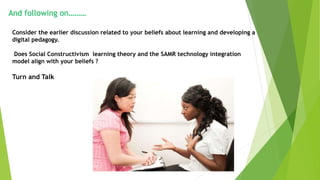
And following on………
Consider the earlier discussion related to your beliefs about learning and developing a
digital pedagogy.
Does Social Constructivism learning theory and the SAMR technology integration
model align with your beliefs ?
Turn and Talk
Apply Task
 Using the SAMR model of Technology Integration audit your own TESOL
practice and decide at which level you are placed currently.
 Substitution Augmentation Modification Re definition
 With a partner choose a task you are currently teaching and place it on a
SAMR level based on the criteria for each level then work together to re
define the task and take it to the next level. (see examples to follow)
 What supports and scaffolds will you need as the teacher? What supports and
scaffolds will the students need to complete the task?
 Share with the group and discuss the transition of the task and its impact on
the expected learning outcomes
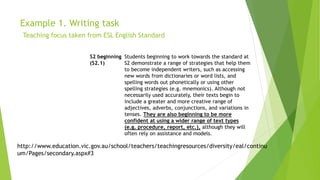
Example 1. Writing task
Teaching focus taken from ESL English Standard
S2 beginning
(S2.1)
Students beginning to work towards the standard at
S2 demonstrate a range of strategies that help them
to become independent writers, such as accessing
new words from dictionaries or word lists, and
spelling words out phonetically or using other
spelling strategies (e.g. mnemonics). Although not
necessarily used accurately, their texts begin to
include a greater and more creative range of
adjectives, adverbs, conjunctions, and variations in
tenses. They are also beginning to be more
confident at using a wider range of text types
(e.g. procedure, report, etc.), although they will
often rely on assistance and models.
http://www.education.vic.gov.au/school/teachers/teachingresources/diversity/eal/continu
um/Pages/secondary.aspx#3
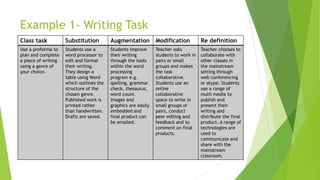
Example 1- Writing Task
Class task Substitution Augmentation Modification Re definition
Use a proforma to
plan and complete
a piece of writing
using a genre of
your choice.
Students use a
word processor to
edit and format
their writing.
They design a
table using Word
which outlines the
structure of the
chosen genre.
Published work is
printed rather
than handwritten.
Drafts are saved.
Students improve
their writing
through the tools
within the word
processing
program e.g.
spelling, grammar
check, thesaurus,
word count.
Images and
graphics are easily
embedded and
final product can
be emailed.
Teacher asks
students to work in
pairs or small
groups and makes
the task
collaborative.
Students use an
online
collaborative
space to write in
small groups or
pairs, conduct
peer editing and
feedback and to
comment on final
products.
Teacher chooses to
collaborate with
other classes in
the mainstream
setting through
web conferencing
or skype. Students
use a range of
multi media to
publish and
present their
writing and
distribute the final
product. A range of
technologies are
used to
communicate and
share with the
mainstream
classroom.
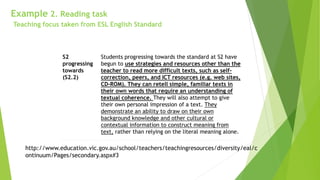
Example 2. Reading task
Teaching focus taken from ESL English Standard
S2
progressing
towards
(S2.2)
Students progressing towards the standard at S2 have
begun to use strategies and resources other than the
teacher to read more difficult texts, such as self-
correction, peers, and ICT resources (e.g. web sites,
CD-ROM). They can retell simple, familiar texts in
their own words that require an understanding of
textual coherence. They will also attempt to give
their own personal impression of a text. They
demonstrate an ability to draw on their own
background knowledge and other cultural or
contextual information to construct meaning from
text, rather than relying on the literal meaning alone.
http://www.education.vic.gov.au/school/teachers/teachingresources/diversity/eal/c
ontinuum/Pages/secondary.aspx#3
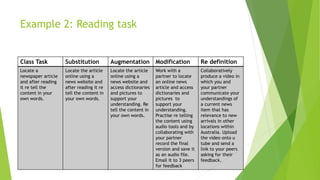
Example 2: Reading task
Class Task Substitution Augmentation Modification Re definition
Locate a
newspaper article
and after reading
it re tell the
content in your
own words.
Locate the article
online using a
news website and
after reading it re
tell the content in
your own words.
Locate the article
online using a
news website and
access dictionaries
and pictures to
support your
understanding. Re
tell the content in
your own words.
Work with a
partner to locate
an online news
article and access
dictionaries and
pictures to
support your
understanding.
Practise re telling
the content using
audio tools and by
collaborating with
your partner
record the final
version and save it
as an audio file.
Email it to 3 peers
for feedback
Collaboratively
produce a video in
which you and
your partner
communicate your
understandings of
a current news
item that has
relevance to new
arrivals in other
locations within
Australia. Upload
the video onto u
tube and send a
link to your peers
asking for their
feedback.
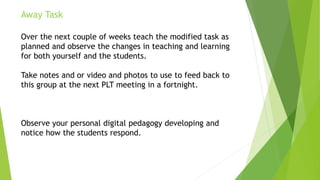
Away Task
Over the next couple of weeks teach the modified task as
planned and observe the changes in teaching and learning
for both yourself and the students.
Take notes and or video and photos to use to feed back to
this group at the next PLT meeting in a fortnight.
Observe your personal digital pedagogy developing and
notice how the students respond.
References
Branham, Mary. (2012). Bringing Technology into the Classroom is a Process, Not an Event
DEECD
http://www.education.vic.gov.au/school/teachers/teachingresources/diversity/eal/continuum/Pages/secondary.asp
x#3
Howell, Jennifer. (2012). What is a digital pedagogy and why do we need one? Teaching with ICT: Digital pedagogies
for collaboration and creativity (pp. 3-17). South Melbourne, Victoria: Oxford University Press
Mascolo, M. (2009) Beyond student-centered and teacher- centered pedagogy: Teaching and learning as guided
participation. Pedagogy and the Human Sciences, 1,No. 1, 2009
Puentedura, R. R. (2003-2014). Ruben R. Puentedura's Weblog: Ongoing thoughts on education and
technology. http://www.hippasus.com/rrpweblog/
Stoerger, S. (2009). The digital melting pot: Bridging the digital native-immigrant divide. First Monday, 14(7)
SAMR http://hippasus.com/resources/tte/part1.html
SAMR Technology Integration Model – DR Ruben R. Puentedura , As We May Teach, From Theory into Practice, ( 2009
TEDxAshburn: A different way to think about technology by Greg Toppo http://youtu.be/D17P3kqB3_0
The Impact of Technology on Constructivist Pedagogies By Kristina Ford and Leslie Lott
https://sites.google.com/a/boisestate.edu/edtechtheories/the-impact-of-technology-on-constructivist-pedagogies-1

Technology integration slide show

  • 1.
    Technology Integration From Substitutionto Redefinition at a Regional English Language Centre
  • 2.
    Date: April 2015 Professionallearning focus for this session : Developing a digital pedagogy through SAMR Technology Integration Essential Questions: What is a digital pedagogy? Why do we as TESOL educators need to develop a digital pedagogy? What learning theory do our beliefs align with? Which technology integration model links to the learning theory our work is based on? How will we as a team go about developing our digital pedagogy using the SAMR model? Professional Learning Team ( PLT) Meeting
  • 3.
    AWAKEN (Engage andstimulate discussion) Slide 6 Do you think the characteristics of your generation influence the type of teacher you are? Turn and Talk to a partner and discuss Share with the group and brainstorm beliefs and understandings that arise from the discussion. List on the Interactive White Board (IWB). ADD (What will you add to the knowledge and skill set of the participants ?) 1. Slide 7 - Professional Reading: What is a digital pedagogy? And why do we need a digital pedagogy? Howell, Jennifer. (2012). one? Teaching with ICT: Digital pedagogies for collaboration and creativity (pp. 3-17). South Melbourne, Victoria: Oxford University Press. Read Chapter 1 pages 5 and 6 – use a PMI (plus/ minus/interesting) protocol to take notes. Discuss as a group and reflect on essential questions above. 2. Slides 8-13 introduce the concept of Technology Integration Model SAMR .SWOT analysis of the model and how it links to learning theory and our beliefs.
  • 4.
    APPLY(What active workwill you involve the staff in now to apply this information back in the classroom?) Slides 14-18 Using the SAMR model of Technology Integration audit your own TESOL practice and decide at which level you are placed currently. Substitution Augmentation Modification Re definition With a partner choose a task you are currently teaching and place it on a SAMR level based on the criteria for each level then work together to re define the task and take it to the next level. What supports and scaffolds will you need as the teacher? What supports and scaffolds will the students need to complete the task? Share with the group and discuss the transition of the task and of the expected learning outcomes AWAY(What will staff do back in the classroom? What evidence collection or reflection will they commit to for next PLT?) Slide 19- Over the next week teach the modified task as planned and observe the changes in teaching and learning for both yourself and the students. Take notes and or video and photos to use to feed back to this group at the next PLT meeting in a fortnight.
  • 5.
    Beliefs and understandings Do you think the characteristics of your generation influence the type of teacher you are?  Turn and talk to a partner and discuss
  • 6.
    Professional Reading What isa digital pedagogy? And why do we need a digital pedagogy? Howell, Jennifer. (2012). Teaching with ICT: Digital pedagogies for collaboration and creativity (pp. 3-17). South Melbourne, Victoria: Oxford University Press. Read Chapter 1 pages 5 and 6 Use a PMI (plus/ minus/interesting) protocol to take notes. Discuss as a group and reflect on essential questions above.
  • 7.
    SAMR This model of technologyintegration moves from enhancing student learning to transforming the learning.
  • 8.
    Redefinition Technology allows forthe creation of new tasks, previously inconceivable Modification Technology allows for significant task re design Augmentation Technology acts as a direct tool substitute, with functional improvement Substitution Technology acts as a direct tool, with no functional change SAMR Technology Integration Model – DR Ruben R. Puentedura , As We May Teach, From Theory into Practice, ( 2009)
  • 9.
    The SAMR modelis one approach that can be used by teachers to plan for the effective use of available technologies in TESOL. Used as a whole staff approach to planning, it can provide a common and consistent language for teachers to use as a reflective tool for how they use technologies to support the learning of English. The SAMR ladder supports teachers to visualise their planning, identify tasks they are performing at a substitution level and helps recognise ways that can further enhance learning tasks.
  • 10.
    SAMR Model ofTechnology Integration Build on strengths: • Technology as a tool to transform teaching and learning • Small steps in changing practice • Different entry point for teachers • Moves from teacher centred to student centred • Collaboration increases Minimize weaknesses • Initial introduction integral to engagement and commitment of staff • Scaffolds needed to support teachers to varying degrees • Time frame required to ensure transition occurs • Assessment of transition through the levels required Seize opportunities • Development of digital pedagogy • Collaboration between staff and students • Focus on life long learning • Transform the learning through use of digital technology in preparation for mainstream schooling Counteract threats • Students’ technology skills and expertise may be more proficient than teachers • Teachers’ technology skills limited • Teachers reluctant to change as many consider themselves as ‘ digital immigrants’ (Prensky, 2001) • Technical problems with hardware and software • Availability of hardware ad software
  • 11.
    Learning Theory tosupport SAMR  Constructivism is a theory stating that we generate knowledge and meaning from interaction between experience and ideas. Thinking back to Piaget’s stages in which knowledge is internalised by learners, we learn that through the processes of accommodation and assimilation we construct new knowledge from our experiences.  Social Constructivism extends constructivism by incorporating the role of other actors and culture in development. Social interaction plays a key role in the development of knowledge and according to Vygotsky the more knowledgeable other (MKO) – an individual who has a better understanding than the learner is important to learning. All learning occurs within the ‘ zone of proximal development’ ( ZPD) . Teachers scaffold the learning through a strategy of- - In front – modelling from the MKO - Beside- working alongside the student - Behind- releasing the scaffold and allowing independent learning Howell, Jennifer. (2012). Teaching with ICT: Digital pedagogies for collaboration and creativity
  • 12.
    And following on……… Considerthe earlier discussion related to your beliefs about learning and developing a digital pedagogy. Does Social Constructivism learning theory and the SAMR technology integration model align with your beliefs ? Turn and Talk
  • 13.
    Apply Task  Usingthe SAMR model of Technology Integration audit your own TESOL practice and decide at which level you are placed currently.  Substitution Augmentation Modification Re definition  With a partner choose a task you are currently teaching and place it on a SAMR level based on the criteria for each level then work together to re define the task and take it to the next level. (see examples to follow)  What supports and scaffolds will you need as the teacher? What supports and scaffolds will the students need to complete the task?  Share with the group and discuss the transition of the task and its impact on the expected learning outcomes
  • 14.
    Example 1. Writingtask Teaching focus taken from ESL English Standard S2 beginning (S2.1) Students beginning to work towards the standard at S2 demonstrate a range of strategies that help them to become independent writers, such as accessing new words from dictionaries or word lists, and spelling words out phonetically or using other spelling strategies (e.g. mnemonics). Although not necessarily used accurately, their texts begin to include a greater and more creative range of adjectives, adverbs, conjunctions, and variations in tenses. They are also beginning to be more confident at using a wider range of text types (e.g. procedure, report, etc.), although they will often rely on assistance and models. http://www.education.vic.gov.au/school/teachers/teachingresources/diversity/eal/continu um/Pages/secondary.aspx#3
  • 15.
    Example 1- WritingTask Class task Substitution Augmentation Modification Re definition Use a proforma to plan and complete a piece of writing using a genre of your choice. Students use a word processor to edit and format their writing. They design a table using Word which outlines the structure of the chosen genre. Published work is printed rather than handwritten. Drafts are saved. Students improve their writing through the tools within the word processing program e.g. spelling, grammar check, thesaurus, word count. Images and graphics are easily embedded and final product can be emailed. Teacher asks students to work in pairs or small groups and makes the task collaborative. Students use an online collaborative space to write in small groups or pairs, conduct peer editing and feedback and to comment on final products. Teacher chooses to collaborate with other classes in the mainstream setting through web conferencing or skype. Students use a range of multi media to publish and present their writing and distribute the final product. A range of technologies are used to communicate and share with the mainstream classroom.
  • 16.
    Example 2. Readingtask Teaching focus taken from ESL English Standard S2 progressing towards (S2.2) Students progressing towards the standard at S2 have begun to use strategies and resources other than the teacher to read more difficult texts, such as self- correction, peers, and ICT resources (e.g. web sites, CD-ROM). They can retell simple, familiar texts in their own words that require an understanding of textual coherence. They will also attempt to give their own personal impression of a text. They demonstrate an ability to draw on their own background knowledge and other cultural or contextual information to construct meaning from text, rather than relying on the literal meaning alone. http://www.education.vic.gov.au/school/teachers/teachingresources/diversity/eal/c ontinuum/Pages/secondary.aspx#3
  • 17.
    Example 2: Readingtask Class Task Substitution Augmentation Modification Re definition Locate a newspaper article and after reading it re tell the content in your own words. Locate the article online using a news website and after reading it re tell the content in your own words. Locate the article online using a news website and access dictionaries and pictures to support your understanding. Re tell the content in your own words. Work with a partner to locate an online news article and access dictionaries and pictures to support your understanding. Practise re telling the content using audio tools and by collaborating with your partner record the final version and save it as an audio file. Email it to 3 peers for feedback Collaboratively produce a video in which you and your partner communicate your understandings of a current news item that has relevance to new arrivals in other locations within Australia. Upload the video onto u tube and send a link to your peers asking for their feedback.
  • 18.
    Away Task Over thenext couple of weeks teach the modified task as planned and observe the changes in teaching and learning for both yourself and the students. Take notes and or video and photos to use to feed back to this group at the next PLT meeting in a fortnight. Observe your personal digital pedagogy developing and notice how the students respond.
  • 19.
    References Branham, Mary. (2012).Bringing Technology into the Classroom is a Process, Not an Event DEECD http://www.education.vic.gov.au/school/teachers/teachingresources/diversity/eal/continuum/Pages/secondary.asp x#3 Howell, Jennifer. (2012). What is a digital pedagogy and why do we need one? Teaching with ICT: Digital pedagogies for collaboration and creativity (pp. 3-17). South Melbourne, Victoria: Oxford University Press Mascolo, M. (2009) Beyond student-centered and teacher- centered pedagogy: Teaching and learning as guided participation. Pedagogy and the Human Sciences, 1,No. 1, 2009 Puentedura, R. R. (2003-2014). Ruben R. Puentedura's Weblog: Ongoing thoughts on education and technology. http://www.hippasus.com/rrpweblog/ Stoerger, S. (2009). The digital melting pot: Bridging the digital native-immigrant divide. First Monday, 14(7) SAMR http://hippasus.com/resources/tte/part1.html SAMR Technology Integration Model – DR Ruben R. Puentedura , As We May Teach, From Theory into Practice, ( 2009 TEDxAshburn: A different way to think about technology by Greg Toppo http://youtu.be/D17P3kqB3_0 The Impact of Technology on Constructivist Pedagogies By Kristina Ford and Leslie Lott https://sites.google.com/a/boisestate.edu/edtechtheories/the-impact-of-technology-on-constructivist-pedagogies-1