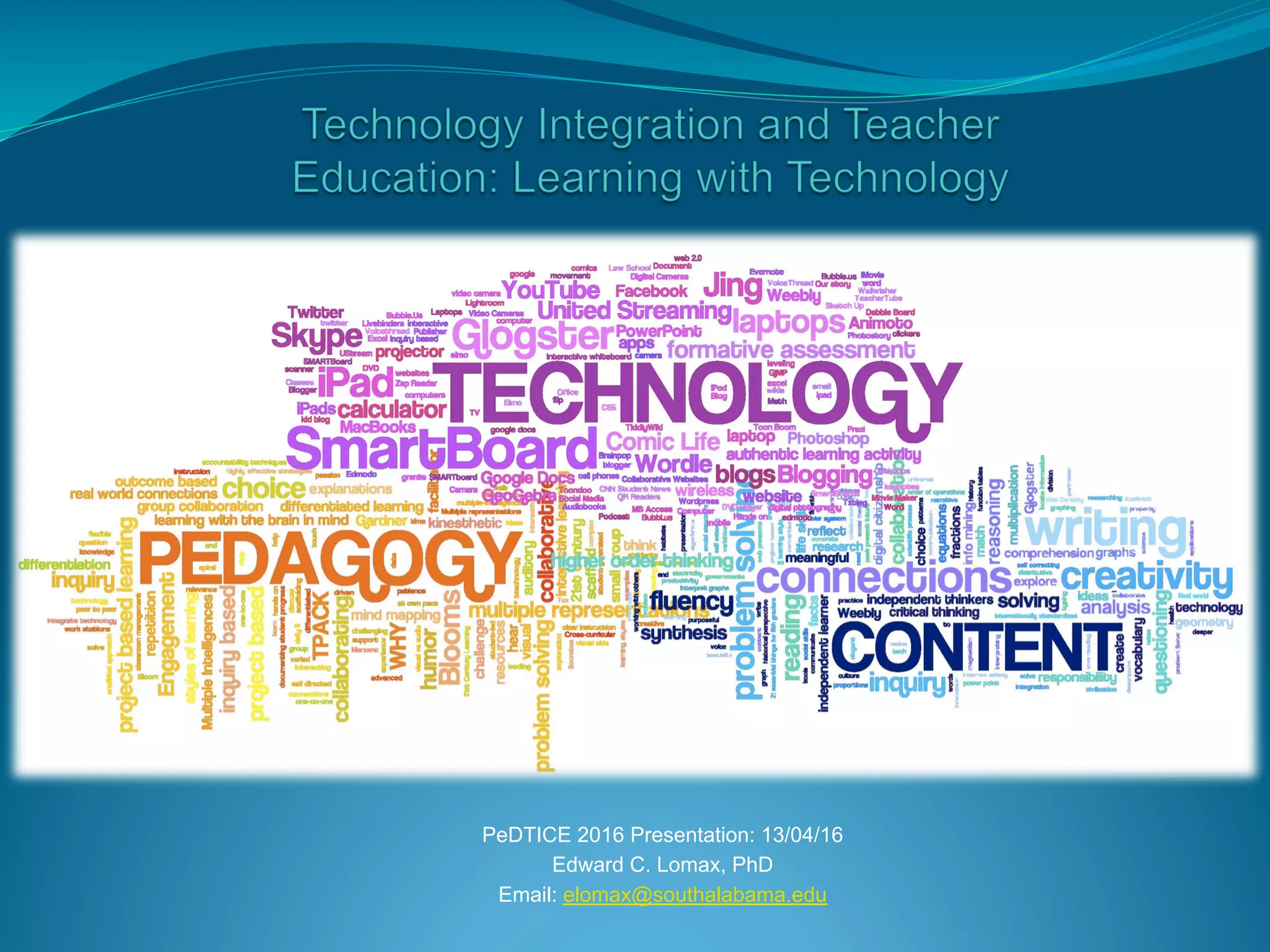
PeDTICE 2016 Presentation: 13/04/16
Edward C. Lomax, PhD
Email: elomax@southalabama.edu
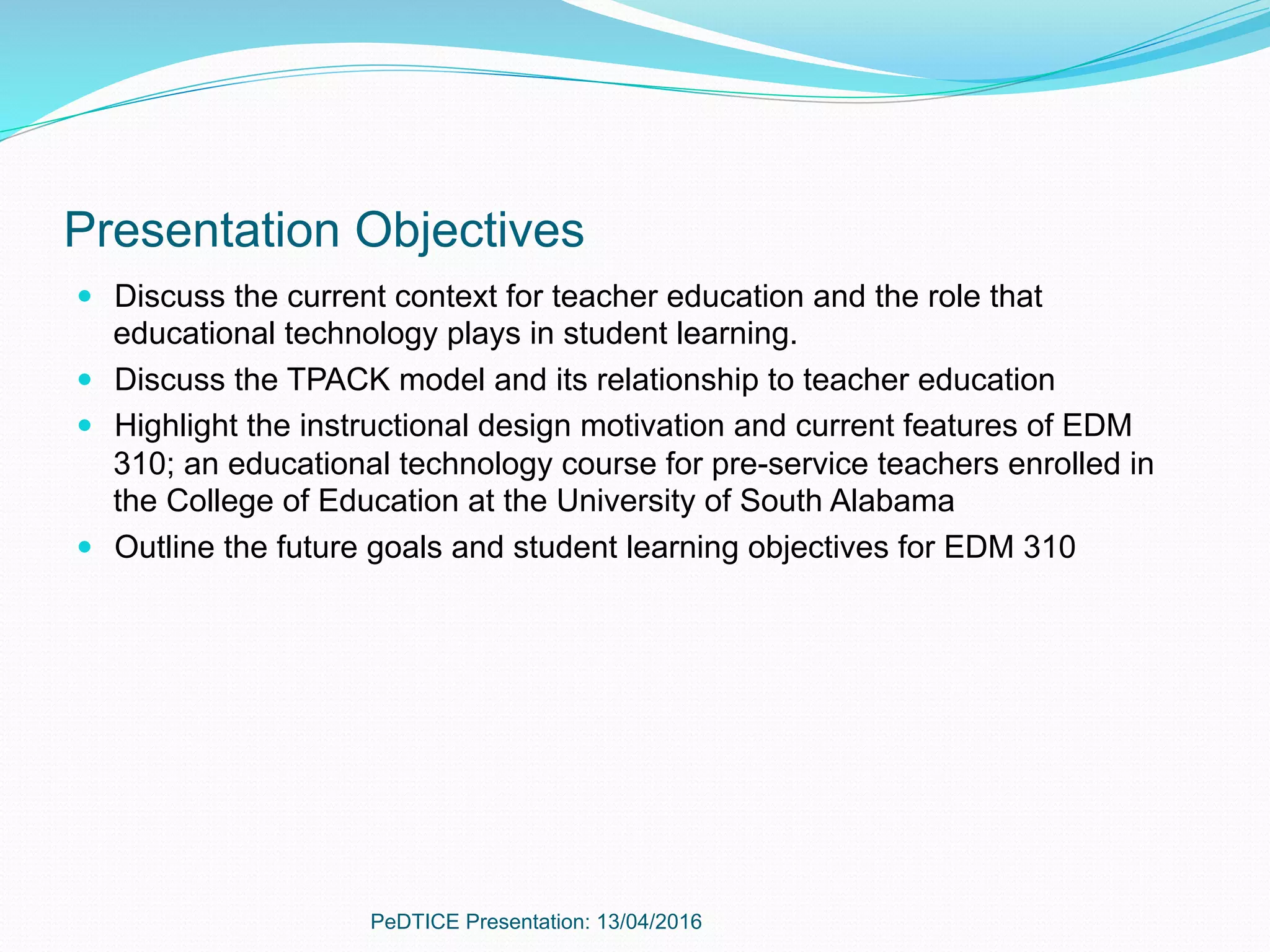
Presentation Objectives
—  Discuss the current context for teacher education and the role that
educational technology plays in student learning.
—  Discuss the TPACK model and its relationship to teacher education
—  Highlight the instructional design motivation and current features of EDM
310; an educational technology course for pre-service teachers enrolled in
the College of Education at the University of South Alabama
—  Outline the future goals and student learning objectives for EDM 310
PeDTICE Presentation: 13/04/2016
Welcome to the future
5 technologies that will change classroom education
PeDTICE Presentation: 13/04/2016
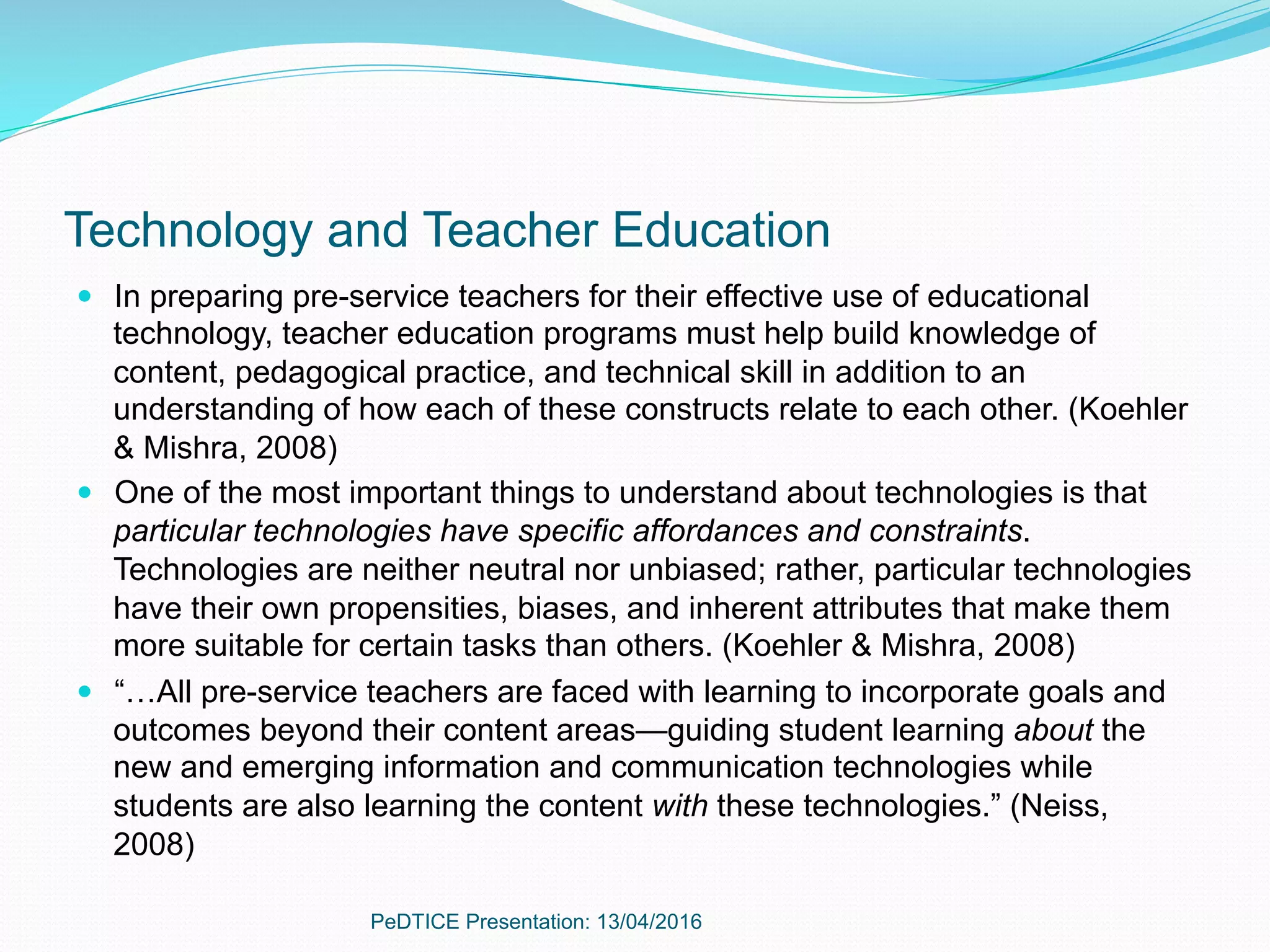
Technology and Teacher Education
—  In preparing pre-service teachers for their effective use of educational
technology, teacher education programs must help build knowledge of
content, pedagogical practice, and technical skill in addition to an
understanding of how each of these constructs relate to each other. (Koehler
& Mishra, 2008)
—  One of the most important things to understand about technologies is that
particular technologies have specific affordances and constraints.
Technologies are neither neutral nor unbiased; rather, particular technologies
have their own propensities, biases, and inherent attributes that make them
more suitable for certain tasks than others. (Koehler & Mishra, 2008)
—  “…All pre-service teachers are faced with learning to incorporate goals and
outcomes beyond their content areas—guiding student learning about the
new and emerging information and communication technologies while
students are also learning the content with these technologies.” (Neiss,
2008)
PeDTICE Presentation: 13/04/2016
Technology, Pedagogy, and Content in Teacher
Education
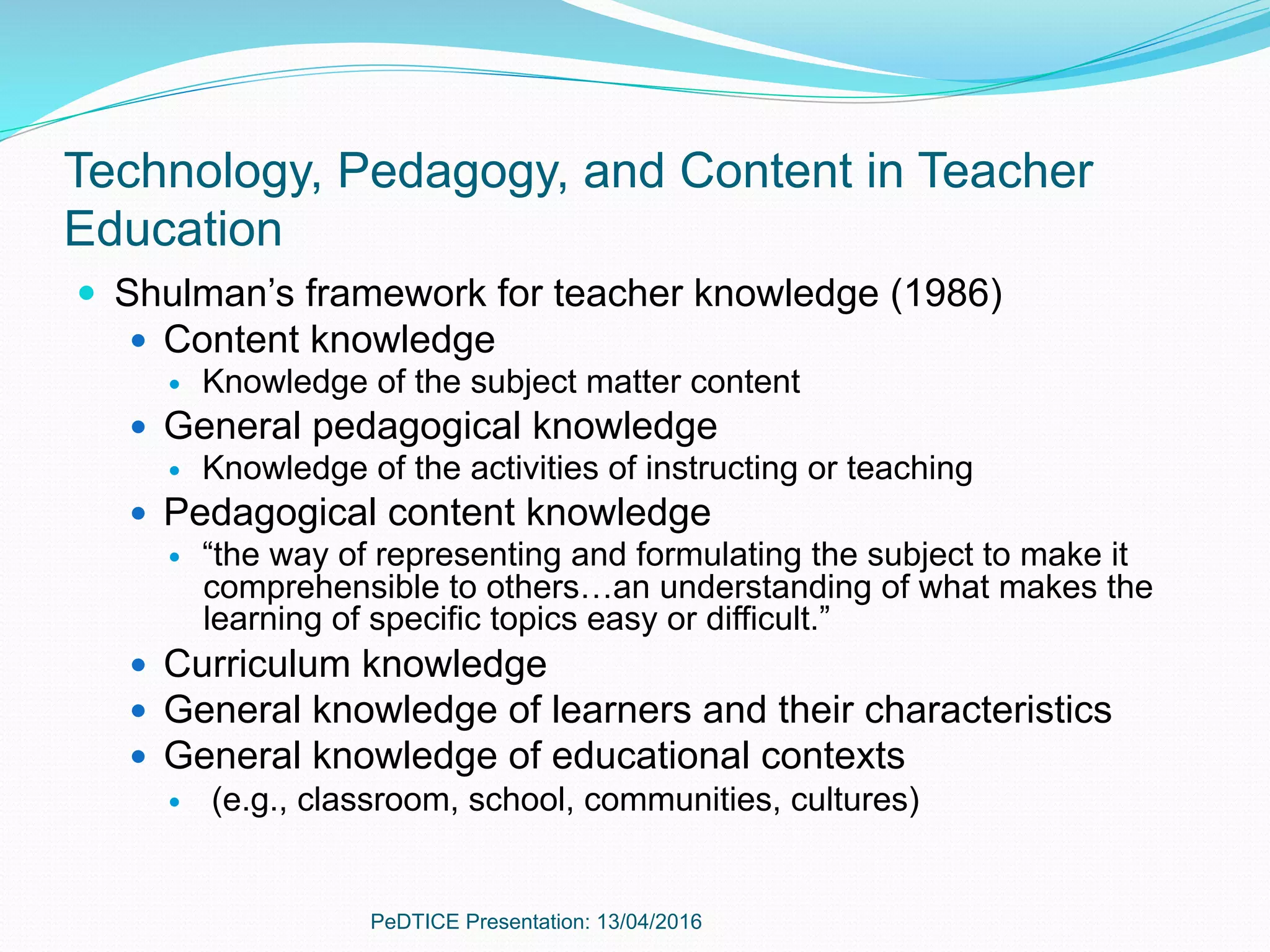
—  Shulman’s framework for teacher knowledge (1986)
—  Content knowledge
—  Knowledge of the subject matter content
—  General pedagogical knowledge
—  Knowledge of the activities of instructing or teaching
—  Pedagogical content knowledge
—  “the way of representing and formulating the subject to make it
comprehensible to others…an understanding of what makes the
learning of specific topics easy or difficult.”
—  Curriculum knowledge
—  General knowledge of learners and their characteristics
—  General knowledge of educational contexts
—  (e.g., classroom, school, communities, cultures)
PeDTICE Presentation: 13/04/2016
Technological pedagogical content knowledge
(TPCK) and its role in teacher education
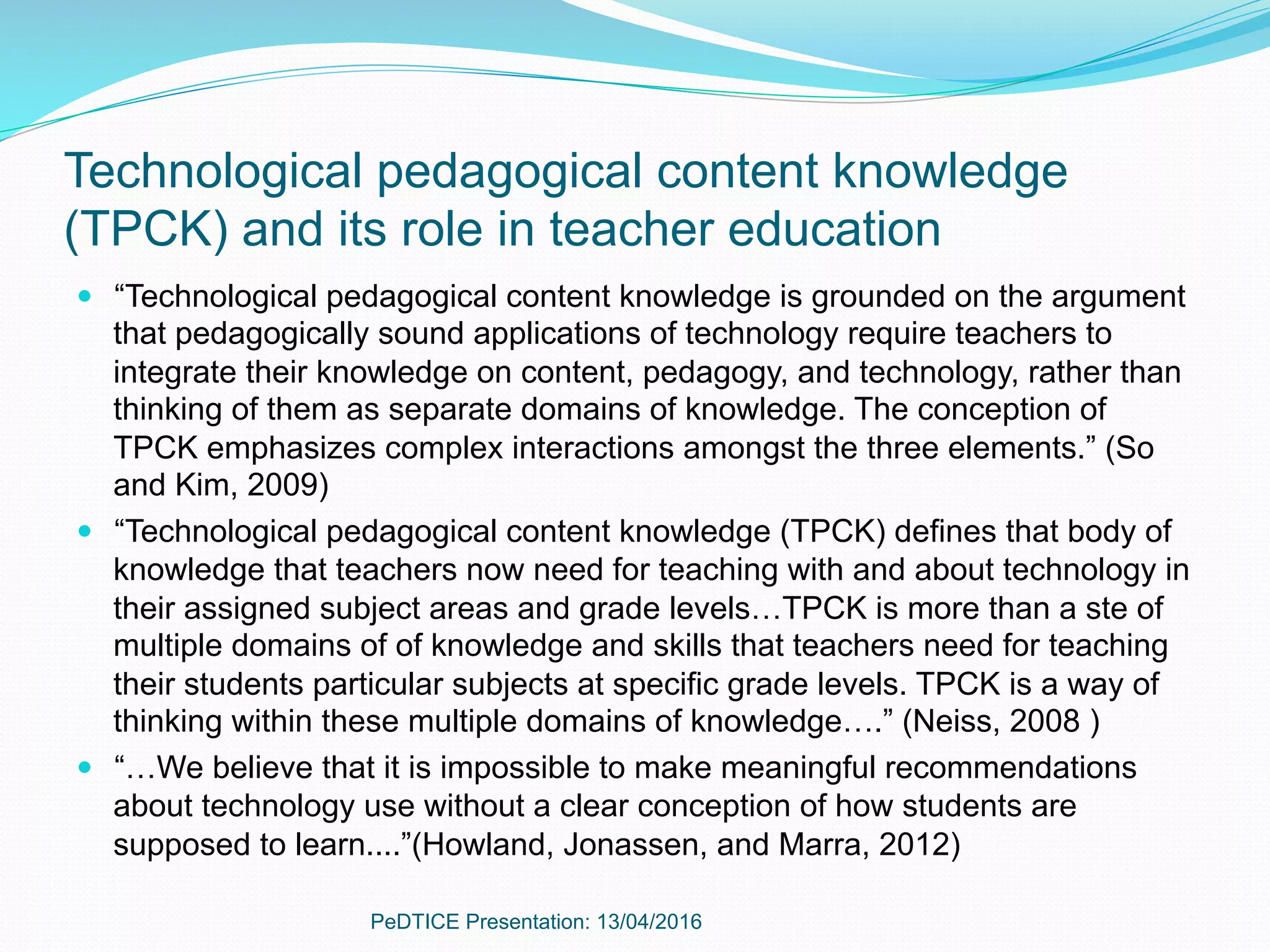
—  “Technological pedagogical content knowledge is grounded on the argument
that pedagogically sound applications of technology require teachers to
integrate their knowledge on content, pedagogy, and technology, rather than
thinking of them as separate domains of knowledge. The conception of
TPCK emphasizes complex interactions amongst the three elements.” (So
and Kim, 2009)
—  “Technological pedagogical content knowledge (TPCK) defines that body of
knowledge that teachers now need for teaching with and about technology in
their assigned subject areas and grade levels…TPCK is more than a ste of
multiple domains of of knowledge and skills that teachers need for teaching
their students particular subjects at specific grade levels. TPCK is a way of
thinking within these multiple domains of knowledge….” (Neiss, 2008 )
—  “…We believe that it is impossible to make meaningful recommendations
about technology use without a clear conception of how students are
supposed to learn....”(Howland, Jonassen, and Marra, 2012)
PeDTICE Presentation: 13/04/2016
Current conceptions of TPACK (Mouza et al., 2014)
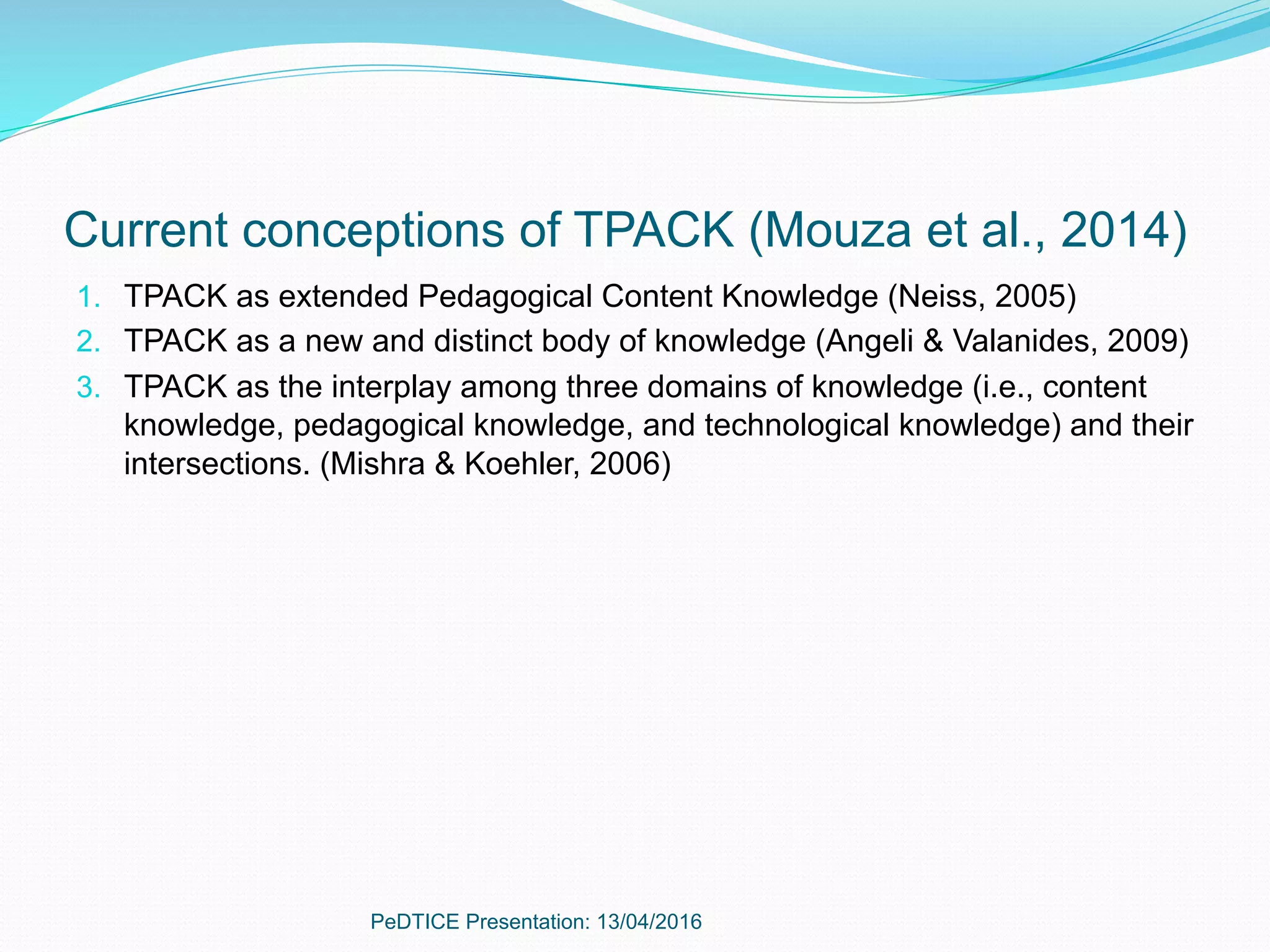
1.  TPACK as extended Pedagogical Content Knowledge (Neiss, 2005)
2.  TPACK as a new and distinct body of knowledge (Angeli & Valanides, 2009)
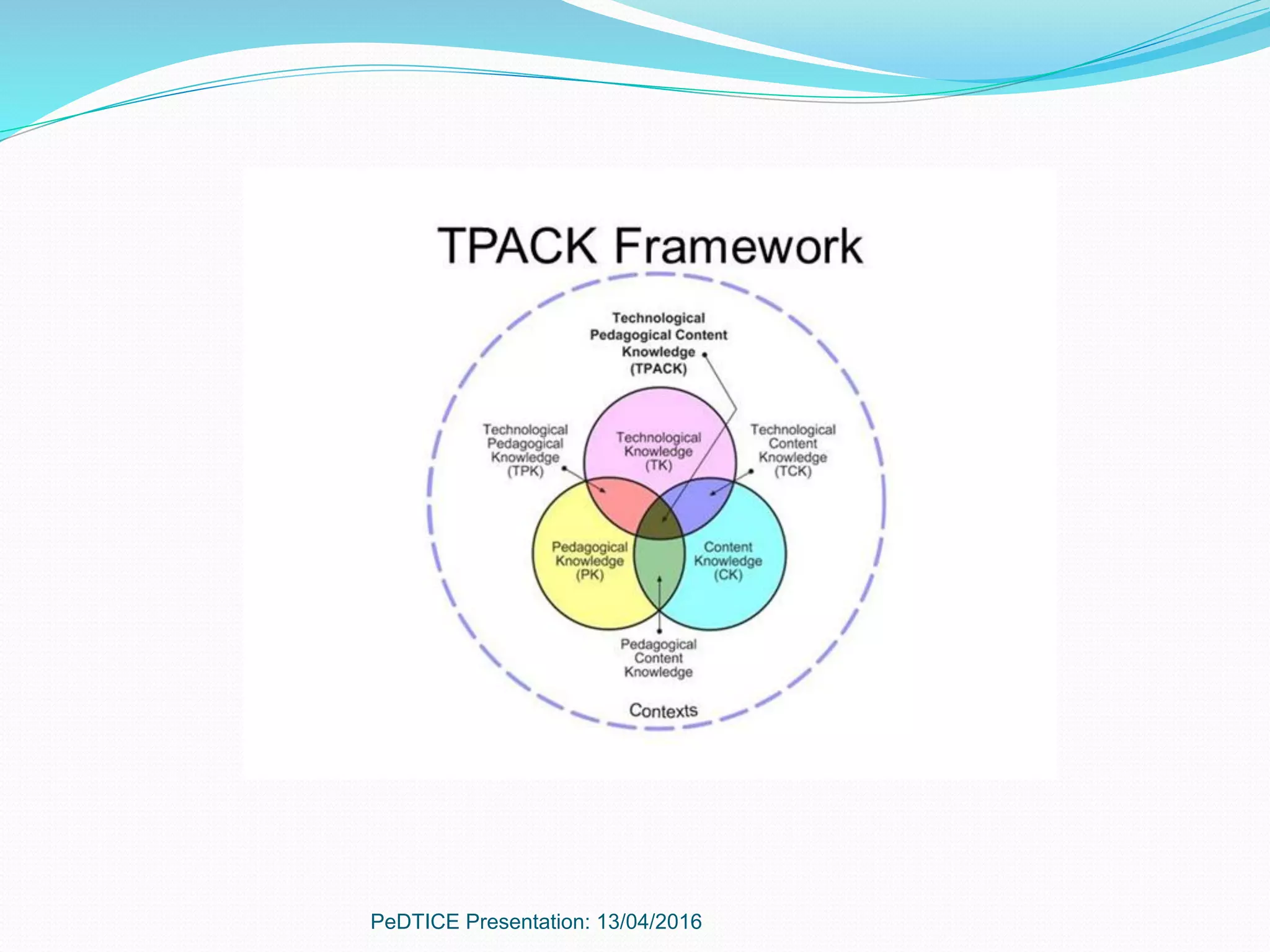
3.  TPACK as the interplay among three domains of knowledge (i.e., content
knowledge, pedagogical knowledge, and technological knowledge) and their
intersections. (Mishra & Koehler, 2006)
PeDTICE Presentation: 13/04/2016
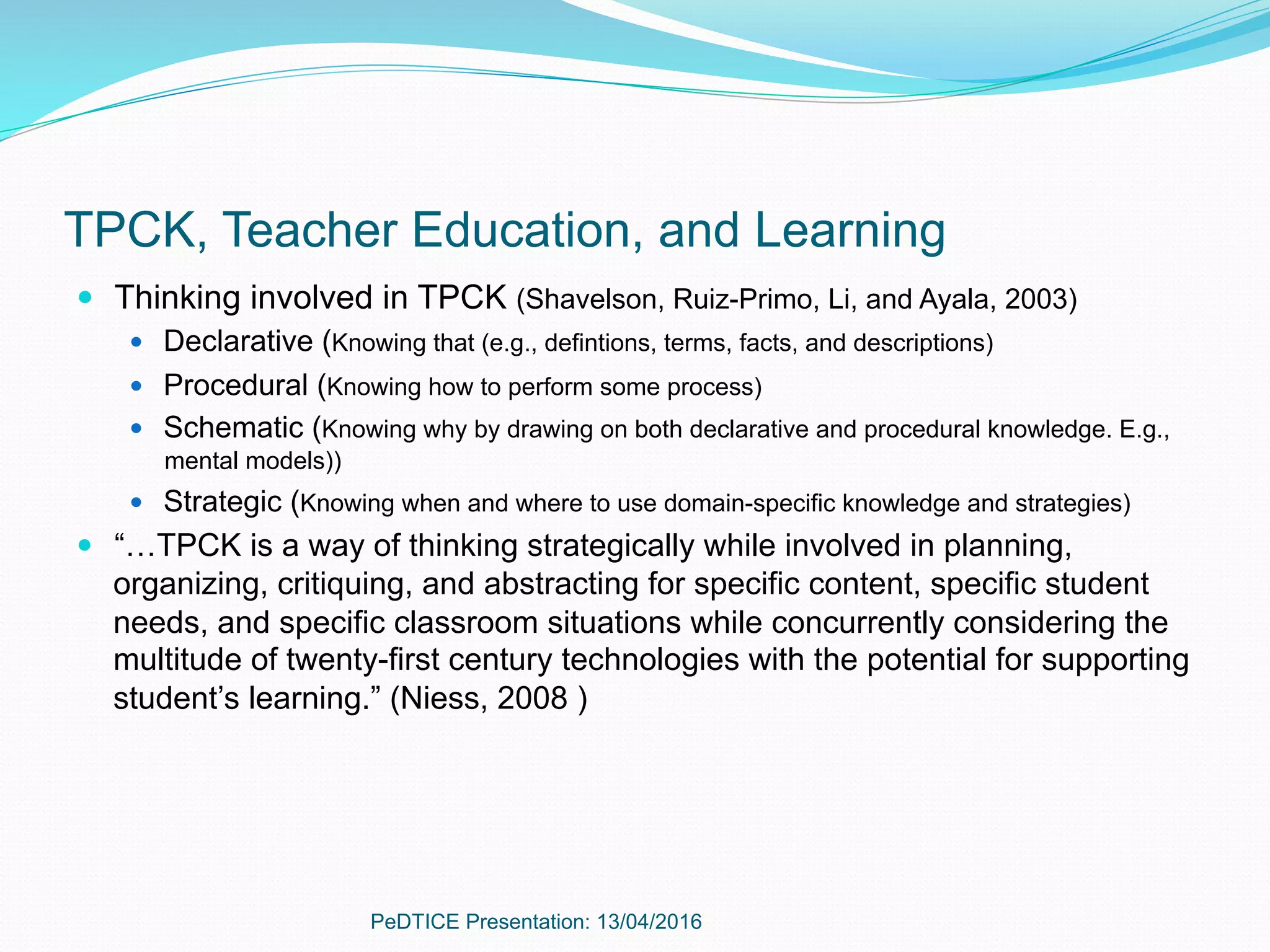
TPCK, Teacher Education, and Learning
—  Thinking involved in TPCK (Shavelson, Ruiz-Primo, Li, and Ayala, 2003)
—  Declarative (Knowing that (e.g., defintions, terms, facts, and descriptions)
—  Procedural (Knowing how to perform some process)
—  Schematic (Knowing why by drawing on both declarative and procedural knowledge. E.g.,
mental models))
—  Strategic (Knowing when and where to use domain-specific knowledge and strategies)
—  “…TPCK is a way of thinking strategically while involved in planning,
organizing, critiquing, and abstracting for specific content, specific student
needs, and specific classroom situations while concurrently considering the
multitude of twenty-first century technologies with the potential for supporting
student’s learning.” (Niess, 2008 )
PeDTICE Presentation: 13/04/2016
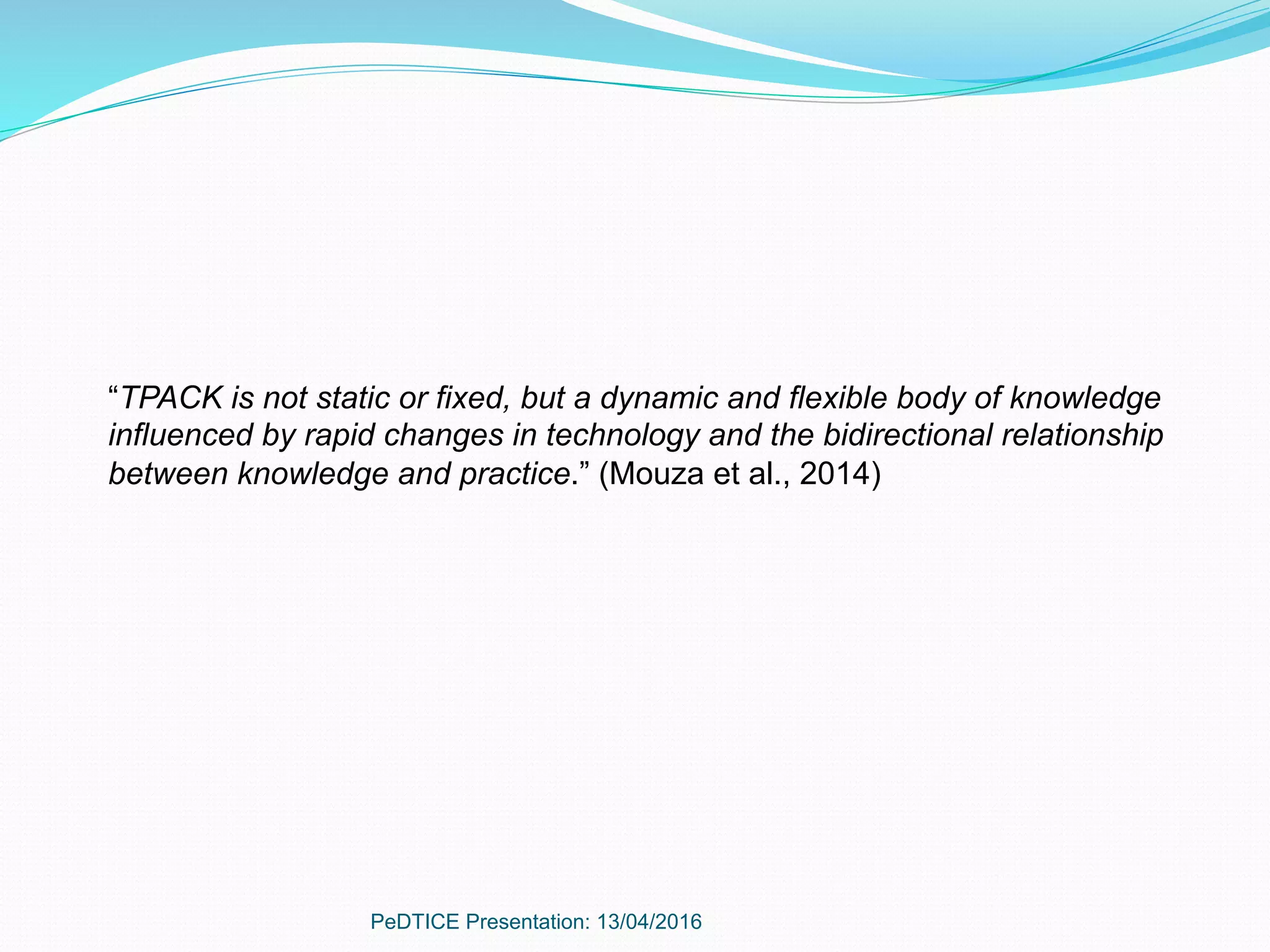
“TPACK is not static or fixed, but a dynamic and flexible body of knowledge
influenced by rapid changes in technology and the bidirectional relationship
between knowledge and practice.” (Mouza et al., 2014)
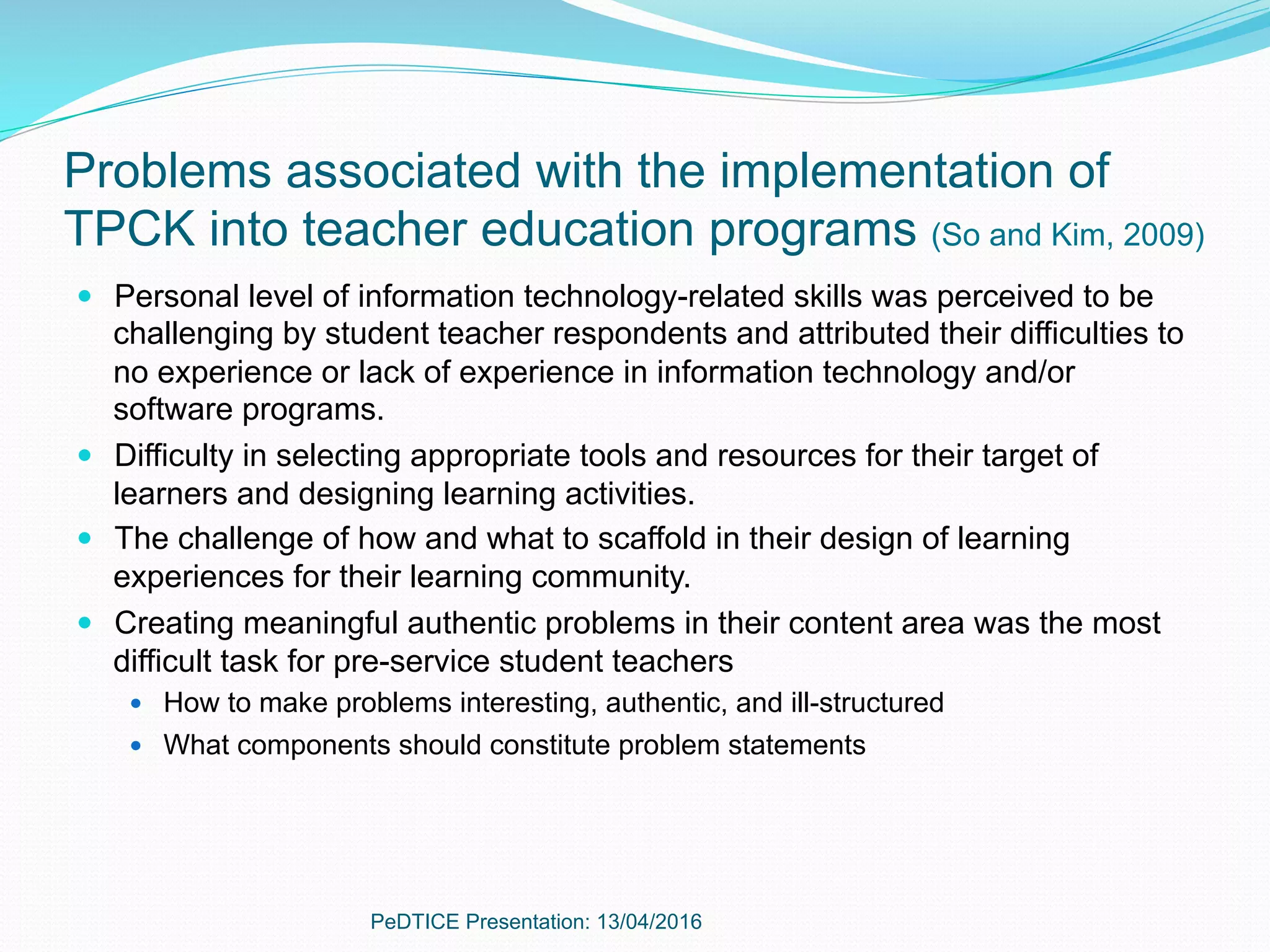
Problems associated with the implementation of
TPCK into teacher education programs (So and Kim, 2009)
—  Personal level of information technology-related skills was perceived to be
challenging by student teacher respondents and attributed their difficulties to
no experience or lack of experience in information technology and/or
software programs.
—  Difficulty in selecting appropriate tools and resources for their target of
learners and designing learning activities.
—  The challenge of how and what to scaffold in their design of learning
experiences for their learning community.
—  Creating meaningful authentic problems in their content area was the most
difficult task for pre-service student teachers
—  How to make problems interesting, authentic, and ill-structured
—  What components should constitute problem statements
PeDTICE Presentation: 13/04/2016
Principles for Effective Teaching and Learning
(Makgato, 2012)
1.  Teaching should begin with content and experiences familiar to students, so
they can make connections to their existing knowledge structures. New
knowledge should be presented in the context of real-life applications, rather
than abstract
2.  Knowledge should be presented in a manner that does not change students
cognitive models drastically.
3.  Teaching should enable students to fill the gaps and extrapolate information
and materials presented by the teacher. The goal should be to empower
learners with skills to be independent, and access/use relevant information
from various sources to answer their problems and challenges.
4.  Teaching should involve students working in small groups dialoging and
arguing to find solutions to the learning activities.
PeDTICE Presentation: 13/04/2016
Teacher Education in a Technological Society
—  Salient features of teacher education for a technological society
—  Promotion of student-centered learning
—  Learning to teach in ways that are innovative
—  Strategic and effective use of educational technology to support curricular goals
—  A commitment to continuous professional learning
—  Development and utilization of collective intelligence (Brown and Lauder, 2001)
—  “…suggests that all are capable rather than a few; that intelligence is multiple rather than a
matter of solving puzzles with only one right answer; and that our human qualities for
imagination and emotional engagement are as important as our ability to become technical
experts.”
—  Building a professional culture that embraces the constancy of change and risk-
taking
PeDTICE Presentation: 13/04/2016
EDM 310:
History and Philosophy
—  A required undergraduate course for pre-service Teacher Education
majors that emphasizes the integration of educational technology into
classroom pedagogy
—  Founding Mission:
—  Increase student competency in the area educational technologies relevant to
their work as a professional teacher in the K-12 classroom teaching environment
—  Aims and Objectives:
—  Collaboration
—  Creativity
—  Learning
—  Engagement
—  Reflection
PeDTICE Presentation: 13/04/2016
Current mission of this course
—  Explore the integration of educational technology into the practice of
teaching as a both an instructional and productivity tool.
—  Combine collaboration, creativity, evaluation, analysis, application, and
comprehension in the pursuit of students’ understanding the role of
educational technology in today’s classroom and how it can assist them in
becoming a successful teacher .
—  Provide a suite of activities, projects, assignments and the use of a variety of
educational technologies that will enable students to gain greater experience
and skills in the integration of educational technology as classroom teachers;
regardless of their eventual grade level, content area, or specialization.
PeDTICE Presentation: 13/04/2016
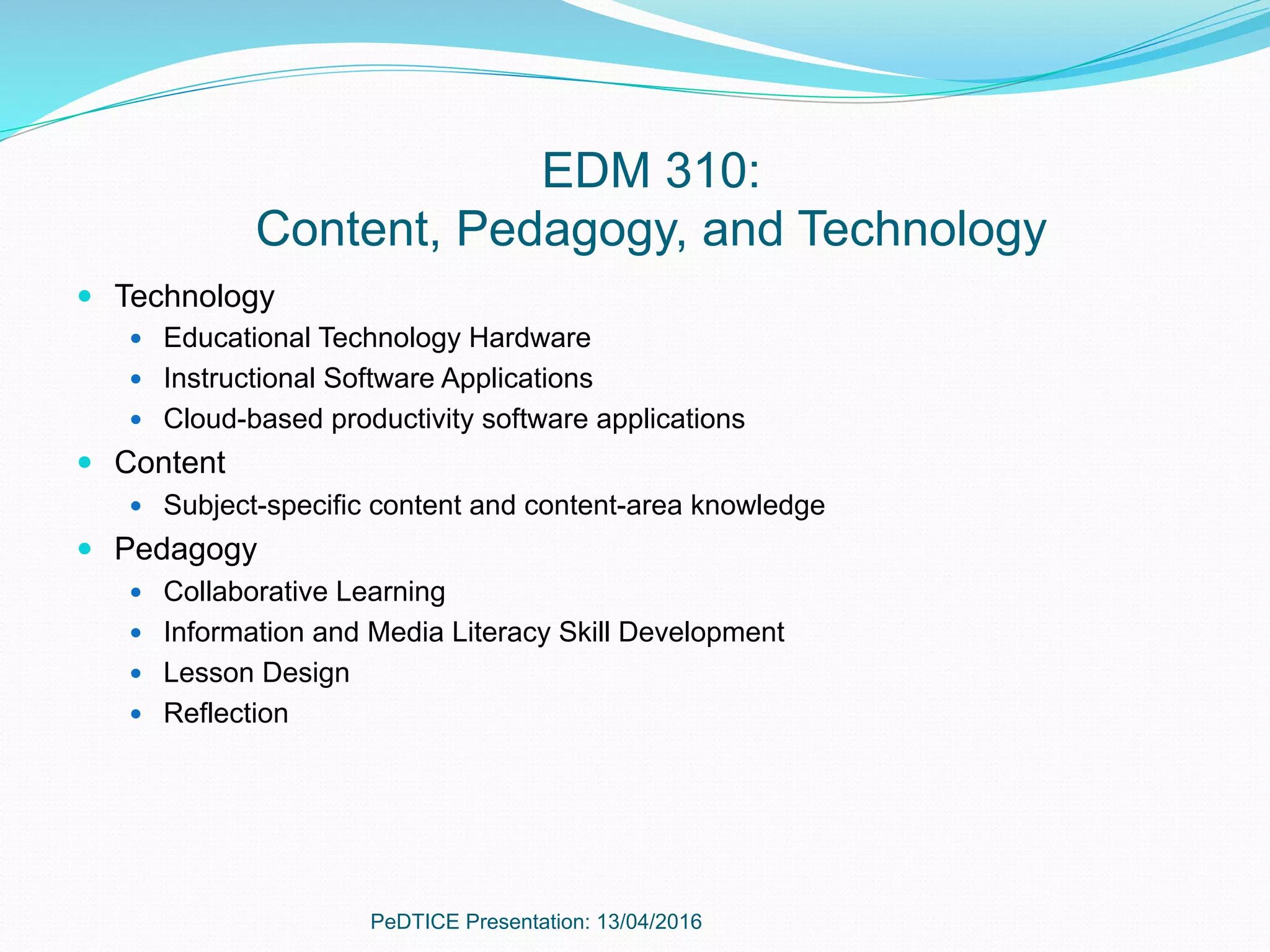
EDM 310:
Content, Pedagogy, and Technology
—  Technology
—  Educational Technology Hardware
—  Instructional Software Applications
—  Cloud-based productivity software applications
—  Content
—  Subject-specific content and content-area knowledge
—  Pedagogy
—  Collaborative Learning
—  Information and Media Literacy Skill Development
—  Lesson Design
—  Reflection
PeDTICE Presentation: 13/04/2016
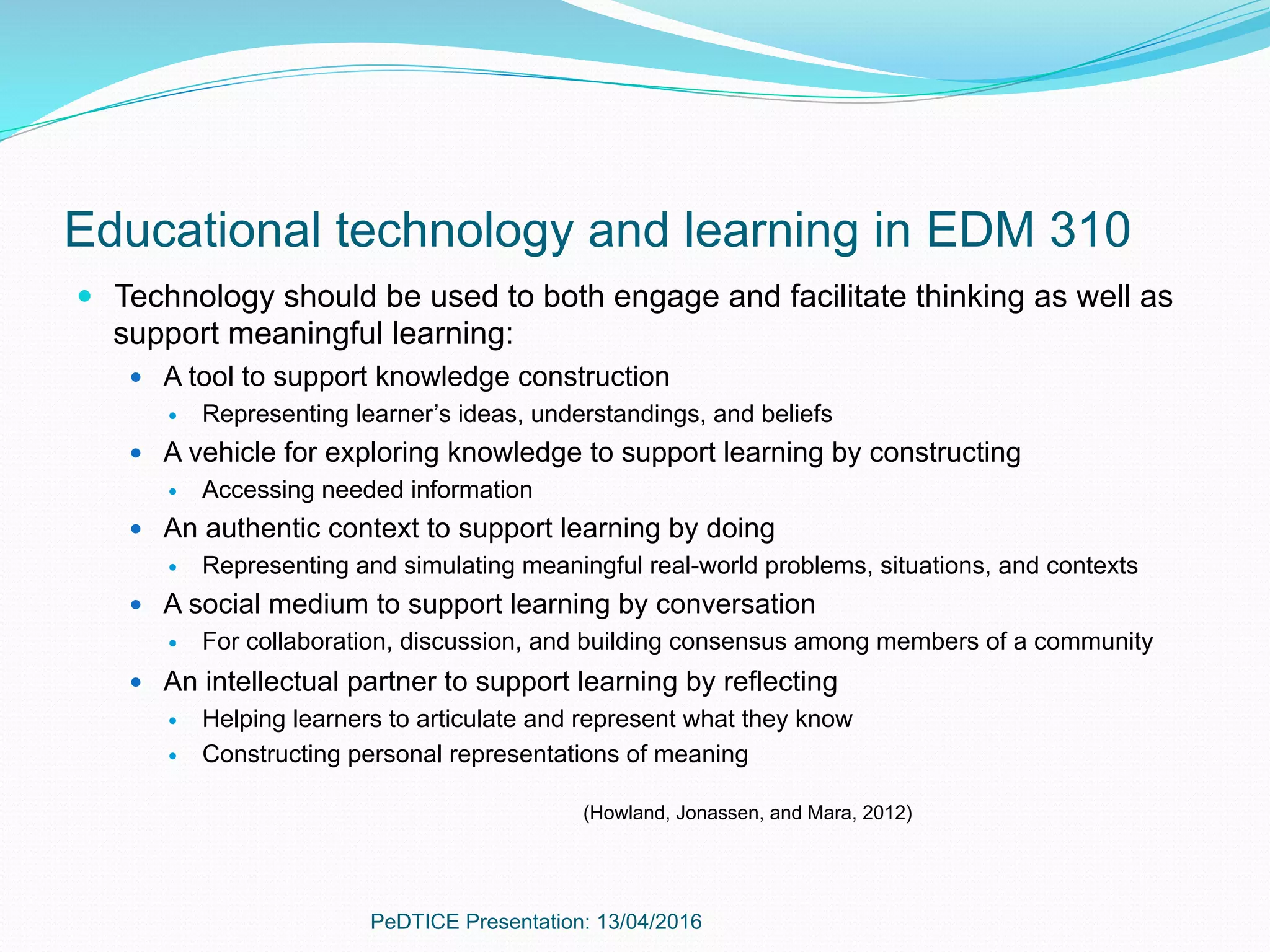
Educational technology and learning in EDM 310
—  Technology should be used to both engage and facilitate thinking as well as
support meaningful learning:
—  A tool to support knowledge construction
—  Representing learner’s ideas, understandings, and beliefs
—  A vehicle for exploring knowledge to support learning by constructing
—  Accessing needed information
—  An authentic context to support learning by doing
—  Representing and simulating meaningful real-world problems, situations, and contexts
—  A social medium to support learning by conversation
—  For collaboration, discussion, and building consensus among members of a community
—  An intellectual partner to support learning by reflecting
—  Helping learners to articulate and represent what they know
—  Constructing personal representations of meaning
(Howland, Jonassen, and Mara, 2012)
PeDTICE Presentation: 13/04/2016
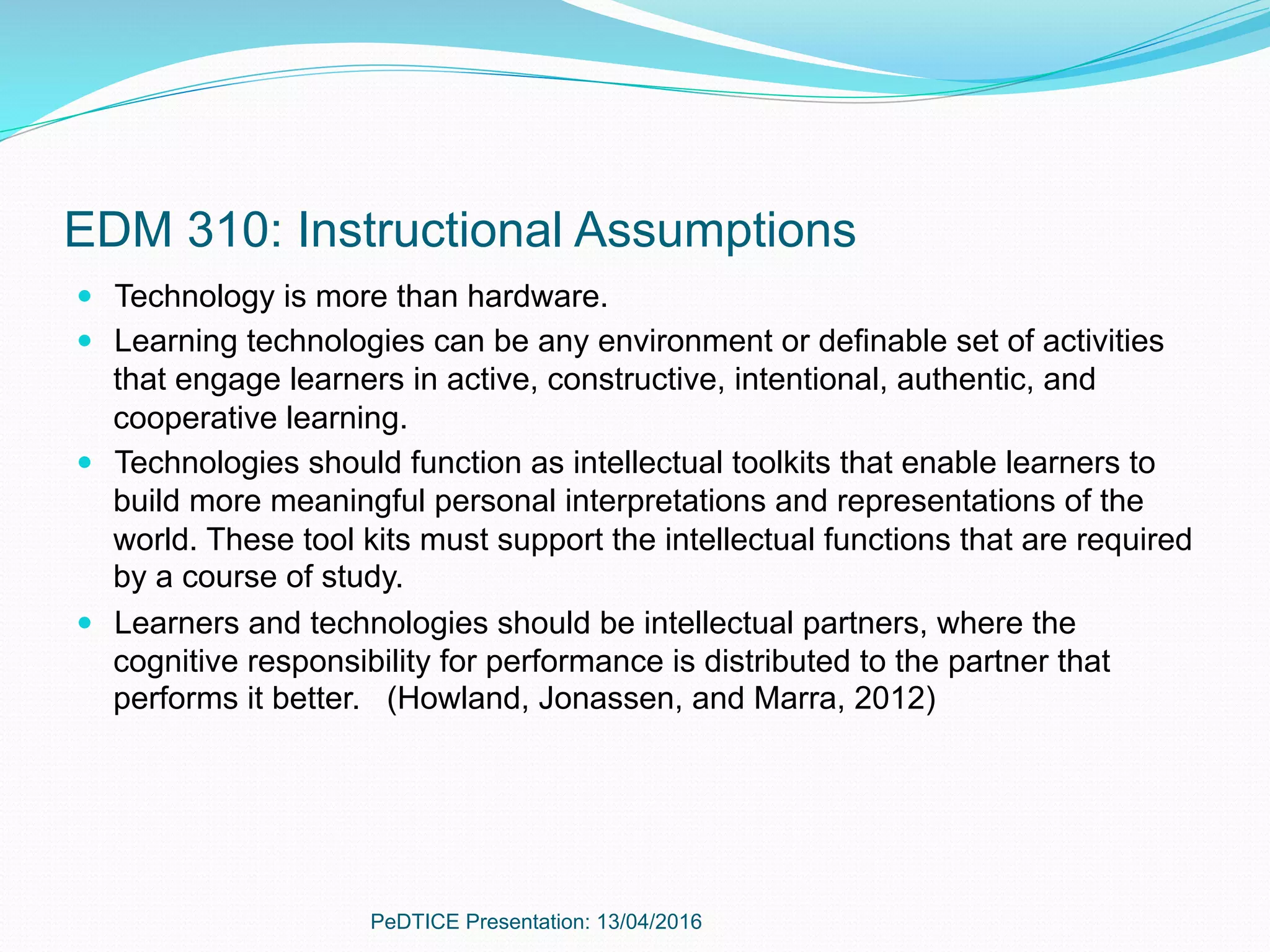
EDM 310: Instructional Assumptions
—  Technology is more than hardware.
—  Learning technologies can be any environment or definable set of activities
that engage learners in active, constructive, intentional, authentic, and
cooperative learning.
—  Technologies should function as intellectual toolkits that enable learners to
build more meaningful personal interpretations and representations of the
world. These tool kits must support the intellectual functions that are required
by a course of study.
—  Learners and technologies should be intellectual partners, where the
cognitive responsibility for performance is distributed to the partner that
performs it better. (Howland, Jonassen, and Marra, 2012)
PeDTICE Presentation: 13/04/2016
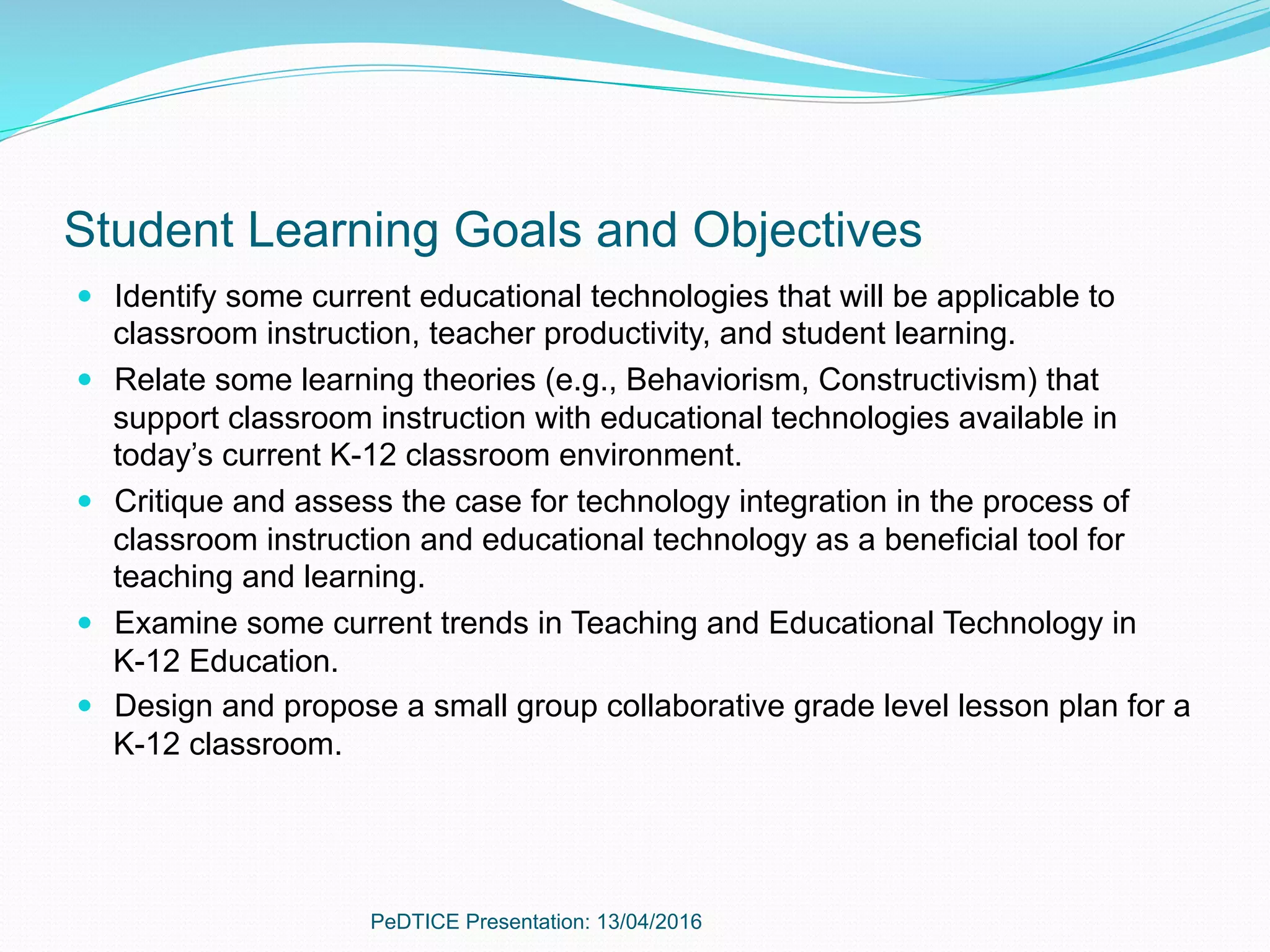
Student Learning Goals and Objectives
—  Identify some current educational technologies that will be applicable to
classroom instruction, teacher productivity, and student learning.
—  Relate some learning theories (e.g., Behaviorism, Constructivism) that
support classroom instruction with educational technologies available in
today’s current K-12 classroom environment.
—  Critique and assess the case for technology integration in the process of
classroom instruction and educational technology as a beneficial tool for
teaching and learning.
—  Examine some current trends in Teaching and Educational Technology in
K-12 Education.
—  Design and propose a small group collaborative grade level lesson plan for a
K-12 classroom.
PeDTICE Presentation: 13/04/2016
EDM 310 Student Assignments
—  Personal Blog Creation
—  Video Design and Production
—  Lesson Planning Database Search and Retrieval
—  Individual and Collaborative Google Apps for Education Activities
—  Technology Application Activities
—  Capstone Technology Integration Exercise (CTIE)
PeDTICE Presentation: 13/04/2016
Capstone Technology Integration Exercise (CTIE)
—  A collaborative and student team-created presentation of a subject-specific
and educational technology-integrated learning exercise.
—  A demonstration of student individual and team skill in the following areas:
—  Evaluating a lesson plan
—  Creating a specific content-area lesson
—  Designing a meaningful learning experience that will result from this lesson.
—  Describing a technology integration strategy to support this lesson
—  Integrating appropriate educational technology into a lesson
—  Creating an appropriate and useful assessment for this lesson
—  A reflective essay from each student’s describing their personal educational
and philosophical journey as part of their involvement in this activity.
PeDTICE Presentation: 13/04/2016
Active Learning Initiative at South Alabama (ALISA)
—  EDM 310 Course Re-Design Goals:
—  a. Compile, categorize and clearly communicate all appropriate state,
program and course-based student learning objectives
—  b. Ensure that assessments clearly and efficiently map to and support
student learning objectives and that the grading scheme is weighted
toward priority competencies
—  c. Design course work according to competency "tracks" where learning
activities and assignments are purposely sequenced and focused to
streamline student work load
—  d. Better integrate individual program interests into the ways that
students engage in and complete course assignments
—  e. Better articulate course delivery and the demands of assignments
with the overall scope, sequence and methods of teacher preparation
curricula
PeDTICE Presentation: 13/04/2016
EDM 310: Future Goals and Objectives
—  Address the challenges involved in an effective interpretation of the TPACK
model in the context of this course and in the context of this teacher
education program.
—  Increase the coordination of relevant course content, current educational
technologies, appropriate instructional software applications for students
enrolled in this course with that of companion courses being offered in their
teacher education program.
—  Integrate new, relevant, and appropriate educational technologies, software
applications, and networked information resources into the content of this
course.
PeDTICE Presentation: 13/04/2016
EDM 310: Future Goals and Objectives
—  Greater infusion of relevant content from and integration with College of
Education (COE) content area courses for pre-service teachers.
—  Address concerns from students, colleagues, our professional learning
community, and outside constituents related to the quality of the education
and training in the area of educational technology and technology integration
received by students in EDM 310 as they prepare to enter into the specific
content area domain, classroom pedagogy, and field experience dimensions
of the teacher education program.
—  Employ evidence-based research and best-practices from the ALISA
initiative and elsewhere to maintain the overall relevancy of EDM 310, its
related instructional activities, and its student learning experiences in light of
the changing requirements of regional and national accreditation bodies, the
Alabama State Department of Education (ALSDE) and local school
administrators.
PeDTICE Presentation: 13/04/2016
References
—  Hargreaves, A. (2003) Teaching in the Knowledge Society: Education in the Age of
Insecurity. New York: Teachers College Press
—  Howland, Jane L, Jonassen, David H, Marra, Rose M. 2012 Meaningful Learning with
Technology. 4th ed. New York: Pearson.
—  Kohler, MJ and Misra, P. 2008. “Introducing TPCK” pp. 1-29 in Handbook of
Technological Pedagogical Content Knowledge (TPCK) for Educators, Edited by the
AACTE Committee on Innovation and Technology. New York: Routledge.
—  Makgato, M. (2012) Identifying constructivist methodologies and pedagogic content
knowledge in the teaching and learning of technology. Procedia – Social and
Behavioral Sciences, 47. 1398-1402.
—  Niess, M. 2008. “Guiding preservice teachers in developing TPCK” pp. 223-250 in
Handbook of Technological Pedagogical Content Knowledge (TPCK) for Educators,
Edited by the AACTE Committee on Innovation and Technology. New York: Routledge.
—  So, H and Kim, B. (2009) Learning about problem based learning: Student teachers
integrating technology, pedagogy and content knowledge. Australasian Journal of
Educational Technology, 25(1), 101-116.
PeDTICE Presentation: 13/04/2016
Edward C. Lomax, PhD
Assistant Professor and Coordinator
Educational Media Online Program
Department of Professional Studies
College of Education
University of South Alabama
UCOM 3800
Mobile, AL 36688-0002
Office: (251) 380-2637
Fax: (251) 380-2713
Email: elomax@southalabama.edu

Technology Integration and Teacher Education: Learning with Technology

  • 1.
    PeDTICE 2016 Presentation:13/04/16 Edward C. Lomax, PhD Email: elomax@southalabama.edu
  • 2.
    Presentation Objectives —  Discussthe current context for teacher education and the role that educational technology plays in student learning. —  Discuss the TPACK model and its relationship to teacher education —  Highlight the instructional design motivation and current features of EDM 310; an educational technology course for pre-service teachers enrolled in the College of Education at the University of South Alabama —  Outline the future goals and student learning objectives for EDM 310 PeDTICE Presentation: 13/04/2016
  • 3.
    Welcome to thefuture 5 technologies that will change classroom education PeDTICE Presentation: 13/04/2016
  • 4.
    Technology and TeacherEducation —  In preparing pre-service teachers for their effective use of educational technology, teacher education programs must help build knowledge of content, pedagogical practice, and technical skill in addition to an understanding of how each of these constructs relate to each other. (Koehler & Mishra, 2008) —  One of the most important things to understand about technologies is that particular technologies have specific affordances and constraints. Technologies are neither neutral nor unbiased; rather, particular technologies have their own propensities, biases, and inherent attributes that make them more suitable for certain tasks than others. (Koehler & Mishra, 2008) —  “…All pre-service teachers are faced with learning to incorporate goals and outcomes beyond their content areas—guiding student learning about the new and emerging information and communication technologies while students are also learning the content with these technologies.” (Neiss, 2008) PeDTICE Presentation: 13/04/2016
  • 5.
    Technology, Pedagogy, andContent in Teacher Education —  Shulman’s framework for teacher knowledge (1986) —  Content knowledge —  Knowledge of the subject matter content —  General pedagogical knowledge —  Knowledge of the activities of instructing or teaching —  Pedagogical content knowledge —  “the way of representing and formulating the subject to make it comprehensible to others…an understanding of what makes the learning of specific topics easy or difficult.” —  Curriculum knowledge —  General knowledge of learners and their characteristics —  General knowledge of educational contexts —  (e.g., classroom, school, communities, cultures) PeDTICE Presentation: 13/04/2016
  • 6.
  • 7.
    Technological pedagogical contentknowledge (TPCK) and its role in teacher education —  “Technological pedagogical content knowledge is grounded on the argument that pedagogically sound applications of technology require teachers to integrate their knowledge on content, pedagogy, and technology, rather than thinking of them as separate domains of knowledge. The conception of TPCK emphasizes complex interactions amongst the three elements.” (So and Kim, 2009) —  “Technological pedagogical content knowledge (TPCK) defines that body of knowledge that teachers now need for teaching with and about technology in their assigned subject areas and grade levels…TPCK is more than a ste of multiple domains of of knowledge and skills that teachers need for teaching their students particular subjects at specific grade levels. TPCK is a way of thinking within these multiple domains of knowledge….” (Neiss, 2008 ) —  “…We believe that it is impossible to make meaningful recommendations about technology use without a clear conception of how students are supposed to learn....”(Howland, Jonassen, and Marra, 2012) PeDTICE Presentation: 13/04/2016
  • 8.
    Current conceptions ofTPACK (Mouza et al., 2014) 1.  TPACK as extended Pedagogical Content Knowledge (Neiss, 2005) 2.  TPACK as a new and distinct body of knowledge (Angeli & Valanides, 2009) 3.  TPACK as the interplay among three domains of knowledge (i.e., content knowledge, pedagogical knowledge, and technological knowledge) and their intersections. (Mishra & Koehler, 2006) PeDTICE Presentation: 13/04/2016
  • 9.
    TPCK, Teacher Education,and Learning —  Thinking involved in TPCK (Shavelson, Ruiz-Primo, Li, and Ayala, 2003) —  Declarative (Knowing that (e.g., defintions, terms, facts, and descriptions) —  Procedural (Knowing how to perform some process) —  Schematic (Knowing why by drawing on both declarative and procedural knowledge. E.g., mental models)) —  Strategic (Knowing when and where to use domain-specific knowledge and strategies) —  “…TPCK is a way of thinking strategically while involved in planning, organizing, critiquing, and abstracting for specific content, specific student needs, and specific classroom situations while concurrently considering the multitude of twenty-first century technologies with the potential for supporting student’s learning.” (Niess, 2008 ) PeDTICE Presentation: 13/04/2016
  • 10.
    PeDTICE Presentation: 13/04/2016 “TPACKis not static or fixed, but a dynamic and flexible body of knowledge influenced by rapid changes in technology and the bidirectional relationship between knowledge and practice.” (Mouza et al., 2014)
  • 11.
    Problems associated withthe implementation of TPCK into teacher education programs (So and Kim, 2009) —  Personal level of information technology-related skills was perceived to be challenging by student teacher respondents and attributed their difficulties to no experience or lack of experience in information technology and/or software programs. —  Difficulty in selecting appropriate tools and resources for their target of learners and designing learning activities. —  The challenge of how and what to scaffold in their design of learning experiences for their learning community. —  Creating meaningful authentic problems in their content area was the most difficult task for pre-service student teachers —  How to make problems interesting, authentic, and ill-structured —  What components should constitute problem statements PeDTICE Presentation: 13/04/2016
  • 12.
  • 13.
    Principles for EffectiveTeaching and Learning (Makgato, 2012) 1.  Teaching should begin with content and experiences familiar to students, so they can make connections to their existing knowledge structures. New knowledge should be presented in the context of real-life applications, rather than abstract 2.  Knowledge should be presented in a manner that does not change students cognitive models drastically. 3.  Teaching should enable students to fill the gaps and extrapolate information and materials presented by the teacher. The goal should be to empower learners with skills to be independent, and access/use relevant information from various sources to answer their problems and challenges. 4.  Teaching should involve students working in small groups dialoging and arguing to find solutions to the learning activities. PeDTICE Presentation: 13/04/2016
  • 14.
    Teacher Education ina Technological Society —  Salient features of teacher education for a technological society —  Promotion of student-centered learning —  Learning to teach in ways that are innovative —  Strategic and effective use of educational technology to support curricular goals —  A commitment to continuous professional learning —  Development and utilization of collective intelligence (Brown and Lauder, 2001) —  “…suggests that all are capable rather than a few; that intelligence is multiple rather than a matter of solving puzzles with only one right answer; and that our human qualities for imagination and emotional engagement are as important as our ability to become technical experts.” —  Building a professional culture that embraces the constancy of change and risk- taking PeDTICE Presentation: 13/04/2016
  • 15.
    EDM 310: History andPhilosophy —  A required undergraduate course for pre-service Teacher Education majors that emphasizes the integration of educational technology into classroom pedagogy —  Founding Mission: —  Increase student competency in the area educational technologies relevant to their work as a professional teacher in the K-12 classroom teaching environment —  Aims and Objectives: —  Collaboration —  Creativity —  Learning —  Engagement —  Reflection PeDTICE Presentation: 13/04/2016
  • 16.
    Current mission ofthis course —  Explore the integration of educational technology into the practice of teaching as a both an instructional and productivity tool. —  Combine collaboration, creativity, evaluation, analysis, application, and comprehension in the pursuit of students’ understanding the role of educational technology in today’s classroom and how it can assist them in becoming a successful teacher . —  Provide a suite of activities, projects, assignments and the use of a variety of educational technologies that will enable students to gain greater experience and skills in the integration of educational technology as classroom teachers; regardless of their eventual grade level, content area, or specialization. PeDTICE Presentation: 13/04/2016
  • 17.
    EDM 310: Content, Pedagogy,and Technology —  Technology —  Educational Technology Hardware —  Instructional Software Applications —  Cloud-based productivity software applications —  Content —  Subject-specific content and content-area knowledge —  Pedagogy —  Collaborative Learning —  Information and Media Literacy Skill Development —  Lesson Design —  Reflection PeDTICE Presentation: 13/04/2016
  • 18.
    Educational technology andlearning in EDM 310 —  Technology should be used to both engage and facilitate thinking as well as support meaningful learning: —  A tool to support knowledge construction —  Representing learner’s ideas, understandings, and beliefs —  A vehicle for exploring knowledge to support learning by constructing —  Accessing needed information —  An authentic context to support learning by doing —  Representing and simulating meaningful real-world problems, situations, and contexts —  A social medium to support learning by conversation —  For collaboration, discussion, and building consensus among members of a community —  An intellectual partner to support learning by reflecting —  Helping learners to articulate and represent what they know —  Constructing personal representations of meaning (Howland, Jonassen, and Mara, 2012) PeDTICE Presentation: 13/04/2016
  • 19.
    EDM 310: InstructionalAssumptions —  Technology is more than hardware. —  Learning technologies can be any environment or definable set of activities that engage learners in active, constructive, intentional, authentic, and cooperative learning. —  Technologies should function as intellectual toolkits that enable learners to build more meaningful personal interpretations and representations of the world. These tool kits must support the intellectual functions that are required by a course of study. —  Learners and technologies should be intellectual partners, where the cognitive responsibility for performance is distributed to the partner that performs it better. (Howland, Jonassen, and Marra, 2012) PeDTICE Presentation: 13/04/2016
  • 20.
    Student Learning Goalsand Objectives —  Identify some current educational technologies that will be applicable to classroom instruction, teacher productivity, and student learning. —  Relate some learning theories (e.g., Behaviorism, Constructivism) that support classroom instruction with educational technologies available in today’s current K-12 classroom environment. —  Critique and assess the case for technology integration in the process of classroom instruction and educational technology as a beneficial tool for teaching and learning. —  Examine some current trends in Teaching and Educational Technology in K-12 Education. —  Design and propose a small group collaborative grade level lesson plan for a K-12 classroom. PeDTICE Presentation: 13/04/2016
  • 21.
    EDM 310 StudentAssignments —  Personal Blog Creation —  Video Design and Production —  Lesson Planning Database Search and Retrieval —  Individual and Collaborative Google Apps for Education Activities —  Technology Application Activities —  Capstone Technology Integration Exercise (CTIE) PeDTICE Presentation: 13/04/2016
  • 22.
    Capstone Technology IntegrationExercise (CTIE) —  A collaborative and student team-created presentation of a subject-specific and educational technology-integrated learning exercise. —  A demonstration of student individual and team skill in the following areas: —  Evaluating a lesson plan —  Creating a specific content-area lesson —  Designing a meaningful learning experience that will result from this lesson. —  Describing a technology integration strategy to support this lesson —  Integrating appropriate educational technology into a lesson —  Creating an appropriate and useful assessment for this lesson —  A reflective essay from each student’s describing their personal educational and philosophical journey as part of their involvement in this activity. PeDTICE Presentation: 13/04/2016
  • 23.
    Active Learning Initiativeat South Alabama (ALISA) —  EDM 310 Course Re-Design Goals: —  a. Compile, categorize and clearly communicate all appropriate state, program and course-based student learning objectives —  b. Ensure that assessments clearly and efficiently map to and support student learning objectives and that the grading scheme is weighted toward priority competencies —  c. Design course work according to competency "tracks" where learning activities and assignments are purposely sequenced and focused to streamline student work load —  d. Better integrate individual program interests into the ways that students engage in and complete course assignments —  e. Better articulate course delivery and the demands of assignments with the overall scope, sequence and methods of teacher preparation curricula PeDTICE Presentation: 13/04/2016
  • 24.
    EDM 310: FutureGoals and Objectives —  Address the challenges involved in an effective interpretation of the TPACK model in the context of this course and in the context of this teacher education program. —  Increase the coordination of relevant course content, current educational technologies, appropriate instructional software applications for students enrolled in this course with that of companion courses being offered in their teacher education program. —  Integrate new, relevant, and appropriate educational technologies, software applications, and networked information resources into the content of this course. PeDTICE Presentation: 13/04/2016
  • 25.
    EDM 310: FutureGoals and Objectives —  Greater infusion of relevant content from and integration with College of Education (COE) content area courses for pre-service teachers. —  Address concerns from students, colleagues, our professional learning community, and outside constituents related to the quality of the education and training in the area of educational technology and technology integration received by students in EDM 310 as they prepare to enter into the specific content area domain, classroom pedagogy, and field experience dimensions of the teacher education program. —  Employ evidence-based research and best-practices from the ALISA initiative and elsewhere to maintain the overall relevancy of EDM 310, its related instructional activities, and its student learning experiences in light of the changing requirements of regional and national accreditation bodies, the Alabama State Department of Education (ALSDE) and local school administrators. PeDTICE Presentation: 13/04/2016
  • 26.
    References —  Hargreaves, A.(2003) Teaching in the Knowledge Society: Education in the Age of Insecurity. New York: Teachers College Press —  Howland, Jane L, Jonassen, David H, Marra, Rose M. 2012 Meaningful Learning with Technology. 4th ed. New York: Pearson. —  Kohler, MJ and Misra, P. 2008. “Introducing TPCK” pp. 1-29 in Handbook of Technological Pedagogical Content Knowledge (TPCK) for Educators, Edited by the AACTE Committee on Innovation and Technology. New York: Routledge. —  Makgato, M. (2012) Identifying constructivist methodologies and pedagogic content knowledge in the teaching and learning of technology. Procedia – Social and Behavioral Sciences, 47. 1398-1402. —  Niess, M. 2008. “Guiding preservice teachers in developing TPCK” pp. 223-250 in Handbook of Technological Pedagogical Content Knowledge (TPCK) for Educators, Edited by the AACTE Committee on Innovation and Technology. New York: Routledge. —  So, H and Kim, B. (2009) Learning about problem based learning: Student teachers integrating technology, pedagogy and content knowledge. Australasian Journal of Educational Technology, 25(1), 101-116. PeDTICE Presentation: 13/04/2016
  • 27.
    Edward C. Lomax,PhD Assistant Professor and Coordinator Educational Media Online Program Department of Professional Studies College of Education University of South Alabama UCOM 3800 Mobile, AL 36688-0002 Office: (251) 380-2637 Fax: (251) 380-2713 Email: elomax@southalabama.edu