Computer mediated communication Presented by: Mohammad Jannatul Ferdous  707241 Pintu Chandra Shill 707775 Cerretti Francesco  711449 Vanoni Davide  707679 Como – October 1, 2007 STUDENT VERSION
contents Course introduction  Communication from an ecological point of view Diffusion of Innovation Theories
people presentation Professor: Lorenzo Cantoni Collaborator: Isabella Rega Email:  [email_address] Class Schedule: Monday   15:00-16:30 30 Minutes Break 17:00-18:30
vision To know Computer Mediated Communication (CMC) main features To be able to design, run and evaluate CMC communication To be aware of the opportunities and peculiarities of CMC
mission & goal Explicit / Declarative Knowledge: “To know that...”  Ex: Rome is the capital of Italy, R ecipe book . Implicit / Procedural Knowledge/ Know-How/ Skill Ex: Cooking, Swimming, Speaking, Driving, etc. Attitude Ex: To be Patient, Collaborative, Positive, Committed, Aware of …, etc.
calendar Day Hours (total: 51) ‏ Notes Group summary 1.10.2007 3 Introduction 8.10.2007   no lesson - 15.10.2007 4 1 22.10.2007 4 projects presentation (on YouTube) ‏ - 29.10.2007 4 2 3 & 4.11.2007 eTour barcamp & eTreasure in Lugano - 5.11.2007 4 3 12.11.2007 4 Tutoring 4 19.11.2007 4 - 26.11.2007 4 5 3.12.2007 4 6 10.12.2007 4 7 17.12.2007 4 Tutoring 8 24.12.2007   Holiday 31.12.2007   Holiday 7.1.2008 4 Presentations 14.1.2008 4 Presentations + fac-simile of written exam 21.1.2008   no lesson 28.1.2008   no lesson
evaluation Note 10% (up to 3) slide preparation & presentation In group; max 10 minutes + 5 minutes comments; between 5 and 10 slides Evaluation: 50% colleagues, 50% IR & LC 30% (up to 9) group work and presentation 60% (up to 18) written exam an example will be presented in class  all marks must be sufficient
communication technology Basic form of human communication is oral communication. In centuries new ways of communication have been developed to facilitate and to enhance communication among humans. Communication technology called-> “technology of the word”
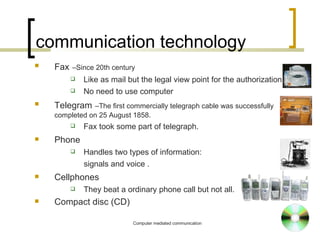
communication technology Fax   –Since 20th century Like as mail but the legal view point for the authorization No need to use computer Telegram   –The first commercially telegraph cable was successfully completed on 25 August 1858. Fax took some part of telegraph. Phone Handles two types of information: signals and voice  . Cellphones They beat a ordinary phone call but not all. Compact disc (CD)‏
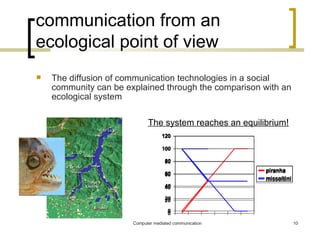
communication from an ecological point of view The system reaches an equilibrium! The diffusion of communication technologies in a social community can be explained through the comparison with an ecological system
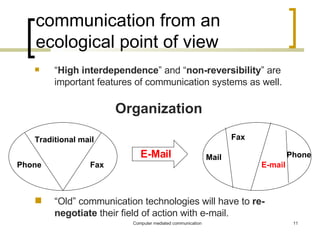
communication from an ecological point of view “ High interdependence ” and “ non-reversibility ” are important features of communication systems as well. Organization E-Mail Traditional mail Phone Fax E-mail Phone Mail Fax “ Old” communication technologies will have to  re-negotiate  their field of action with e-mail.
diffusion of innovation theories In a given social context, an innovation can be:  Adopted  -> “Winner” innovations Not adopted  -> “Loser” innovations Having a better technology  is not enough   for obtaining   social acceptance. How and why do people adopt or reject an innovation? According to diffusion theories an innovation can be adopted if: it has a  better technology ; it is supported by a well defined  business model ; it is compatible with the  legal framework ; it has  social acceptance .  Let’s make some example…
diffusion of innovation theories Radio AM / FM Radio FM was invented in 30’s. It has a better technology than AM radio, nonetheless it had almost no diffusion for three decades. At the beginning of the 60’s it had a great diffusion and it dethroned AM radio in less than 10 years. Why?  FM frequencies was regulated in 1967 by reserving space on the FM dial for new public radio station ->  LEGAL FRAMEWORK ; FM public radio station transmitted Rock’n’roll music ->  SOCIAL   ACCEPTANCE ; The demand for FM technology increased by young people attracting a lot of investors for this technology ->  BUSINESS MODEL .
diffusion of innovation theories I-Pod Example of a successful communication technology It has no battery to change. You can recharge it simply by connecting it to the PC while downloading music on it ->  BETTER TECHNOLOGY THAN OTHER MP3 PLAYERS Very easy to use, it is considered a “must have” gadget by the social community ->  SOCIAL ACCEPTANCE It is supported by a platform (I-Tunes) in which you can legally buy music and services for your I-Pod from Internet ->  BUSINESS MODEL AND LEGAL FRAMEWORK
bibliography Materials published on:  http://corsi.metid.polimi.it/ Articles from prof. Cantoni's blog:  http://newmine.blogspot.com Reference book: Lorenzo Cantoni, Stefano Tardini,  “Internet” , 2006, published by Routledge

Computer mediated communication

  • 1.
    Computer mediated communicationPresented by: Mohammad Jannatul Ferdous 707241 Pintu Chandra Shill 707775 Cerretti Francesco 711449 Vanoni Davide 707679 Como – October 1, 2007 STUDENT VERSION
  • 2.
    contents Course introduction Communication from an ecological point of view Diffusion of Innovation Theories
  • 3.
    people presentation Professor:Lorenzo Cantoni Collaborator: Isabella Rega Email: [email_address] Class Schedule: Monday 15:00-16:30 30 Minutes Break 17:00-18:30
  • 4.
    vision To knowComputer Mediated Communication (CMC) main features To be able to design, run and evaluate CMC communication To be aware of the opportunities and peculiarities of CMC
  • 5.
    mission & goalExplicit / Declarative Knowledge: “To know that...” Ex: Rome is the capital of Italy, R ecipe book . Implicit / Procedural Knowledge/ Know-How/ Skill Ex: Cooking, Swimming, Speaking, Driving, etc. Attitude Ex: To be Patient, Collaborative, Positive, Committed, Aware of …, etc.
  • 6.
    calendar Day Hours(total: 51) ‏ Notes Group summary 1.10.2007 3 Introduction 8.10.2007   no lesson - 15.10.2007 4 1 22.10.2007 4 projects presentation (on YouTube) ‏ - 29.10.2007 4 2 3 & 4.11.2007 eTour barcamp & eTreasure in Lugano - 5.11.2007 4 3 12.11.2007 4 Tutoring 4 19.11.2007 4 - 26.11.2007 4 5 3.12.2007 4 6 10.12.2007 4 7 17.12.2007 4 Tutoring 8 24.12.2007   Holiday 31.12.2007   Holiday 7.1.2008 4 Presentations 14.1.2008 4 Presentations + fac-simile of written exam 21.1.2008   no lesson 28.1.2008   no lesson
  • 7.
    evaluation Note 10%(up to 3) slide preparation & presentation In group; max 10 minutes + 5 minutes comments; between 5 and 10 slides Evaluation: 50% colleagues, 50% IR & LC 30% (up to 9) group work and presentation 60% (up to 18) written exam an example will be presented in class all marks must be sufficient
  • 8.
    communication technology Basicform of human communication is oral communication. In centuries new ways of communication have been developed to facilitate and to enhance communication among humans. Communication technology called-> “technology of the word”
  • 9.
    communication technology Fax –Since 20th century Like as mail but the legal view point for the authorization No need to use computer Telegram –The first commercially telegraph cable was successfully completed on 25 August 1858. Fax took some part of telegraph. Phone Handles two types of information: signals and voice . Cellphones They beat a ordinary phone call but not all. Compact disc (CD)‏
  • 10.
    communication from anecological point of view The system reaches an equilibrium! The diffusion of communication technologies in a social community can be explained through the comparison with an ecological system
  • 11.
    communication from anecological point of view “ High interdependence ” and “ non-reversibility ” are important features of communication systems as well. Organization E-Mail Traditional mail Phone Fax E-mail Phone Mail Fax “ Old” communication technologies will have to re-negotiate their field of action with e-mail.
  • 12.
    diffusion of innovationtheories In a given social context, an innovation can be: Adopted -> “Winner” innovations Not adopted -> “Loser” innovations Having a better technology is not enough for obtaining social acceptance. How and why do people adopt or reject an innovation? According to diffusion theories an innovation can be adopted if: it has a better technology ; it is supported by a well defined business model ; it is compatible with the legal framework ; it has social acceptance . Let’s make some example…
  • 13.
    diffusion of innovationtheories Radio AM / FM Radio FM was invented in 30’s. It has a better technology than AM radio, nonetheless it had almost no diffusion for three decades. At the beginning of the 60’s it had a great diffusion and it dethroned AM radio in less than 10 years. Why? FM frequencies was regulated in 1967 by reserving space on the FM dial for new public radio station -> LEGAL FRAMEWORK ; FM public radio station transmitted Rock’n’roll music -> SOCIAL ACCEPTANCE ; The demand for FM technology increased by young people attracting a lot of investors for this technology -> BUSINESS MODEL .
  • 14.
    diffusion of innovationtheories I-Pod Example of a successful communication technology It has no battery to change. You can recharge it simply by connecting it to the PC while downloading music on it -> BETTER TECHNOLOGY THAN OTHER MP3 PLAYERS Very easy to use, it is considered a “must have” gadget by the social community -> SOCIAL ACCEPTANCE It is supported by a platform (I-Tunes) in which you can legally buy music and services for your I-Pod from Internet -> BUSINESS MODEL AND LEGAL FRAMEWORK
  • 15.
    bibliography Materials publishedon: http://corsi.metid.polimi.it/ Articles from prof. Cantoni's blog: http://newmine.blogspot.com Reference book: Lorenzo Cantoni, Stefano Tardini, “Internet” , 2006, published by Routledge