Technological Innovations for Sustainability
UNDERSTANDING THE CORRELATIONS BETWEEN TECHNOLOGY, INNOVATION
AND SUSTAINABLE DEVELOPMENT

Course-

Management of Technology for
Sustainability
Instructor-

Dr. Balachandra Patil
Technological Innovations for Sustainability

Prepared bySwapnil Soni & Sowmiyan Morri
DoMS, IISc
19 February 2014
Index
 Introduction
 Need of Technological Innovation
 Technology, Sustainability & Development cycle
 Technological Innovations & Sustainability Impact
 Organizations‟ approach to Technological Innovation
 Case Study


Creation and implementation of sustainable technology



Marketing of sustainable technology

 Challenges of sustainable development for innovation policies

 Future recommendation for Technology & Sustainability
 References
Technological Innovations for Sustainability

2

19 February 2014
Introduction - „Technology‟
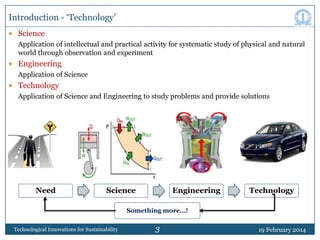
 Science

Application of intellectual and practical activity for systematic study of physical and natural
world through observation and experiment
 Engineering

Application of Science
 Technology

Application of Science and Engineering to study problems and provide solutions

Need

Science

Engineering

Technology

Something more…!
Technological Innovations for Sustainability

3

19 February 2014
Introduction - „Innovation‟


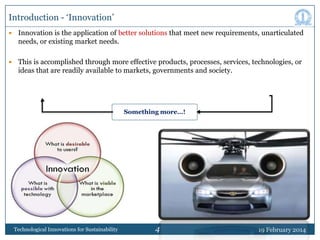
Innovation is the application of better solutions that meet new requirements, unarticulated
needs, or existing market needs.



This is accomplished through more effective products, processes, services, technologies, or
ideas that are readily available to markets, governments and society.

Something more…!

Technological Innovations for Sustainability

4

19 February 2014
Introduction - ‟Sustainability‟
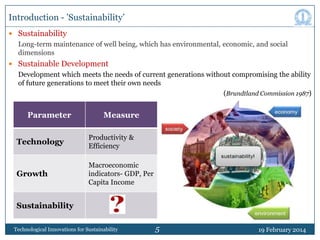
 Sustainability

Long-term maintenance of well being, which has environmental, economic, and social
dimensions
 Sustainable Development

Development which meets the needs of current generations without compromising the ability
of future generations to meet their own needs
(Brundtland Commission 1987)

Parameter

Measure

Technology

Productivity &
Efficiency

Growth

Macroeconomic
indicators- GDP, Per
Capita Income

Sustainability
Technological Innovations for Sustainability

5

19 February 2014
Need of Technological Innovation
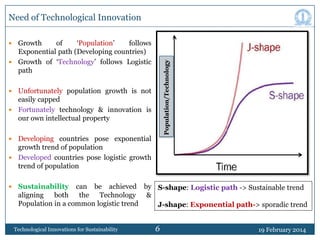
Growth
of
„Population‟
follows
Exponential path (Developing countries)
 Growth of „Technology‟ follows Logistic
path

Population/Technology



Unfortunately population growth is not
easily capped
 Fortunately technology & innovation is
our own intellectual property


Developing countries pose exponential
growth trend of population
 Developed countries pose logistic growth
trend of population




Sustainability can be achieved by S-shape: Logistic path -> Sustainable trend
aligning both the Technology &
Population in a common logistic trend
J-shape: Exponential path-> sporadic trend

Technological Innovations for Sustainability

6

19 February 2014
Need of Technological Innovation

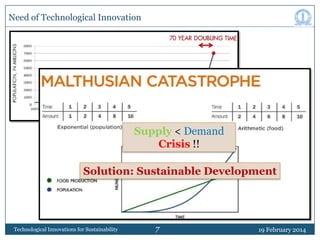
Supply <
World Population Growth

Demand
Crisis !!

Solution: Sustainable Development

Technological Innovations for Sustainability

7

19 February 2014
Technology, Sustainability & Development cycle
Non assimilative

Solution required!

Assimilation by Environment

Resource

Externalities
Equity

Innovation

Technology

Development
Need

Solution

Growth

Feedback

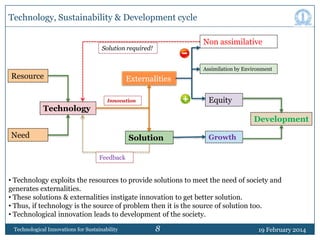
• Technology exploits the resources to provide solutions to meet the need of society and
generates externalities.
• These solutions & externalities instigate innovation to get better solution.
• Thus, if technology is the source of problem then it is the source of solution too.
• Technological innovation leads to development of the society.
Technological Innovations for Sustainability

8

19 February 2014
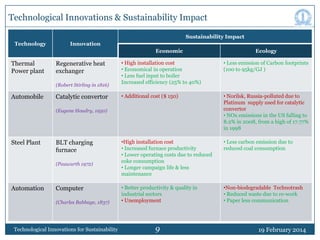
Technological Innovations & Sustainability Impact
Sustainability Impact
Technology

Innovation
Economic

Thermal
Power plant

Regenerative heat
exchanger
(Robert Stirling in 1816)

Automobile

Catalytic convertor

• High installation cost
• Economical in operation
• Less fuel input to boiler
Increased efficiency (25% to 40%)

• Less emission of Carbon footprints
(100 to 95kg/GJ )

• Additional cost ($ 150)

• Norilsk, Russia-polluted due to
Platinum supply used for catalytic
convertor
• NOx emissions in the US falling to
8.2% in 2008, from a high of 17.77%
in 1998

•High installation cost
• Increased furnace productivity
• Lower operating costs due to reduced
coke consumption
• Longer campaign life & less
maintenance

• Less carbon emission due to
reduced coal consumption

• Better productivity & quality in
industrial sectors
• Unemployment

•Non-biodegradable Technotrash
• Reduced waste due to re-work
• Paper less communication

(Eugene Houdry, 1950)

Steel Plant

BLT charging
furnace
(Pauwurth 1972)

Automation

Computer
(Charles Babbage, 1837)

Technological Innovations for Sustainability

Ecology

9

19 February 2014
Organizations‟ approach to Technological Innovation
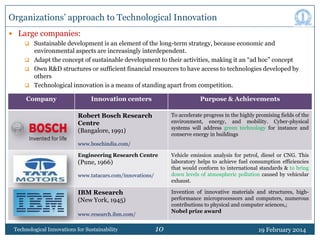
 Large companies:
 Sustainable development is an element of the long-term strategy, because economic and

environmental aspects are increasingly interdependent.
 Adapt the concept of sustainable development to their activities, making it an “ad hoc” concept
 Own R&D structures or sufficient financial resources to have access to technologies developed by
others
 Technological innovation is a means of standing apart from competition.
Company

Innovation centers

Purpose & Achievements
To accelerate progress in the highly promising fields of the
environment, energy, and mobility. Cyber-physical
systems will address green technology for instance and
conserve energy in buildings

Robert Bosch Research
Centre
(Bangalore, 1991)
www.boschindia.com/
Engineering Research Centre

(Pune, 1966)
www.tatacars.com/innovations/

Invention of innovative materials and structures, highperformance microprocessors and computers, numerous
contributions to physical and computer sciences,;
Nobel prize award

IBM Research
(New York, 1945)
www.research.ibm.com/
Technological Innovations for Sustainability

Vehicle emission analysis for petrol, diesel or CNG. This
laboratory helps to achieve fuel consumption efficiencies
that would conform to international standards & to bring
down levels of atmospheric pollution caused by vehicular
exhaust.

10

19 February 2014
Organizations‟ approach to Technological Innovation
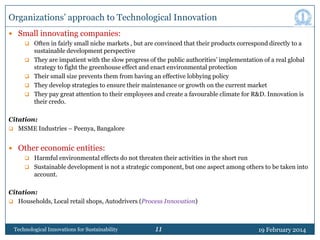
 Small innovating companies:
 Often in fairly small niche markets , but are convinced that their products correspond directly to a






sustainable development perspective
They are impatient with the slow progress of the public authorities‟ implementation of a real global
strategy to fight the greenhouse effect and enact environmental protection
Their small size prevents them from having an effective lobbying policy
They develop strategies to ensure their maintenance or growth on the current market
They pay great attention to their employees and create a favourable climate for R&D. Innovation is
their credo.

Citation:
 MSME Industries – Peenya, Bangalore

 Other economic entities:
 Harmful environmental effects do not threaten their activities in the short run
 Sustainable development is not a strategic component, but one aspect among others to be taken into

account.

Citation:
 Households, Local retail shops, Autodrivers (Process Innovation)

Technological Innovations for Sustainability

11

19 February 2014
Technology –that was unsustainable !!
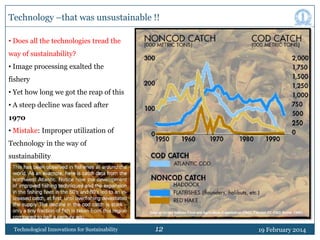
• Does all the technologies tread the
way of sustainability?
• Image processing exalted the
fishery
• Yet how long we got the reap of this
• A steep decline was faced after
1970
• Mistake: Improper utilization of
Technology in the way of
sustainability

Technological Innovations for Sustainability

12

19 February 2014
Case Study-

1

Generating Nuclear Power through Nuclear Waste
Creation and implementation of sustainable technology

Technological Innovations for Sustainability

19 February 2014
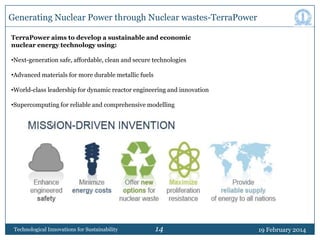
Generating Nuclear Power through Nuclear wastes-TerraPower
TerraPower aims to develop a sustainable and economic
nuclear energy technology using:
•Next-generation safe, affordable, clean and secure technologies
•Advanced materials for more durable metallic fuels
•World-class leadership for dynamic reactor engineering and innovation
•Supercomputing for reliable and comprehensive modelling

Technological Innovations for Sustainability

14

19 February 2014
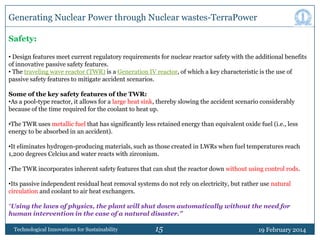
Generating Nuclear Power through Nuclear wastes-TerraPower
Safety:
• Design features meet current regulatory requirements for nuclear reactor safety with the additional benefits
of innovative passive safety features.
• The traveling wave reactor (TWR) is a Generation IV reactor, of which a key characteristic is the use of
passive safety features to mitigate accident scenarios.
Some of the key safety features of the TWR:
•As a pool-type reactor, it allows for a large heat sink, thereby slowing the accident scenario considerably
because of the time required for the coolant to heat up.
•The TWR uses metallic fuel that has significantly less retained energy than equivalent oxide fuel (i.e., less
energy to be absorbed in an accident).
•It eliminates hydrogen-producing materials, such as those created in LWRs when fuel temperatures reach
1,200 degrees Celcius and water reacts with zirconium.
•The TWR incorporates inherent safety features that can shut the reactor down without using control rods.
•Its passive independent residual heat removal systems do not rely on electricity, but rather use natural
circulation and coolant to air heat exchangers.
“Using the laws of physics, the plant will shut down automatically without the need for
human intervention in the case of a natural disaster.”
Technological Innovations for Sustainability

15

19 February 2014
Generating Nuclear Power through Nuclear wastes-TerraPower

Technological Innovations for Sustainability

16

19 February 2014
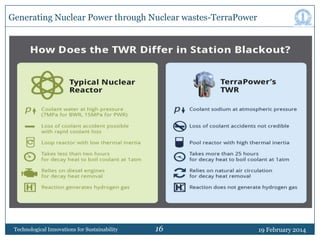
Generating Nuclear Power through Nuclear wastes-TerraPower
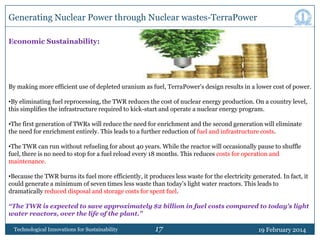
Economic Sustainability:

By making more efficient use of depleted uranium as fuel, TerraPower's design results in a lower cost of power.
•By eliminating fuel reprocessing, the TWR reduces the cost of nuclear energy production. On a country level,
this simplifies the infrastructure required to kick-start and operate a nuclear energy program.
•The first generation of TWRs will reduce the need for enrichment and the second generation will eliminate
the need for enrichment entirely. This leads to a further reduction of fuel and infrastructure costs.
•The TWR can run without refueling for about 40 years. While the reactor will occasionally pause to shuffle
fuel, there is no need to stop for a fuel reload every 18 months. This reduces costs for operation and
maintenance.
•Because the TWR burns its fuel more efficiently, it produces less waste for the electricity generated. In fact, it
could generate a minimum of seven times less waste than today‟s light water reactors. This leads to
dramatically reduced disposal and storage costs for spent fuel.
“The TWR is expected to save approximately $2 billion in fuel costs compared to today's light
water reactors, over the life of the plant.”
Technological Innovations for Sustainability

17

19 February 2014
Generating Nuclear Power through Nuclear wastes-TerraPower
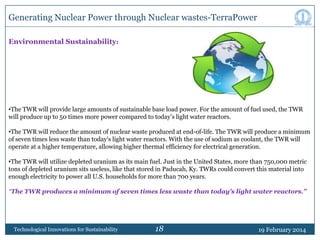
Environmental Sustainability:

•The TWR will provide large amounts of sustainable base load power. For the amount of fuel used, the TWR
will produce up to 50 times more power compared to today‟s light water reactors.
•The TWR will reduce the amount of nuclear waste produced at end-of-life. The TWR will produce a minimum
of seven times less waste than today's light water reactors. With the use of sodium as coolant, the TWR will
operate at a higher temperature, allowing higher thermal efficiency for electrical generation.
•The TWR will utilize depleted uranium as its main fuel. Just in the United States, more than 750,000 metric
tons of depleted uranium sits useless, like that stored in Paducah, Ky. TWRs could convert this material into
enough electricity to power all U.S. households for more than 700 years.
“The TWR produces a minimum of seven times less waste than today's light water reactors.”

Technological Innovations for Sustainability

18

19 February 2014
Generating Nuclear Power through Nuclear wastes-TerraPower
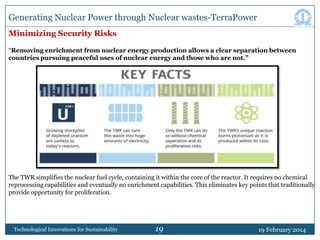
Minimizing Security Risks
“Removing enrichment from nuclear energy production allows a clear separation between
countries pursuing peaceful uses of nuclear energy and those who are not.”

The TWR simplifies the nuclear fuel cycle, containing it within the core of the reactor. It requires no chemical
reprocessing capabilities and eventually no enrichment capabilities. This eliminates key points that traditionally
provide opportunity for proliferation.

Technological Innovations for Sustainability

19

19 February 2014
Case Study-

2

Technological innovation in Horticulture Market
Marketing of sustainable technology

Technological Innovations for Sustainability

19 February 2014
Implementation of Technological Innovation


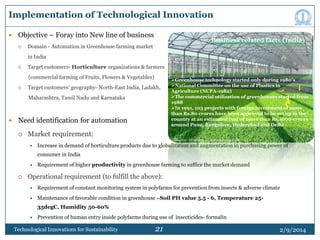
Objective – Foray into New line of business


Business related facts (India)

Installed solar power capacity in India: 1.8GW

Domain - Automation in Greenhouse farming market
in India



Target customers- Horticulture organizations & farmers
(commercial farming of Fruits, Flowers & Vegetables)



Target customers‟ geography- North-East India, Ladakh,
Maharashtra, Tamil Nadu and Karnataka



Need identification for automation


Market requirement:


Greenhouse technology started only during 1980’s
National Committee on the use of Plastics in
Agriculture (NCPA-1982)
The commercial utilization of greenhouses started from
1988
In 1991, 103 projects with foreign investment of more
than Rs.80 crores have been approved to be set up in the
country at an estimated cost of more than Rs.1000 crores
around Pune, Bangalore, Hyderabad and Delhi
Source: Ministry of Agriculture, GOI

Increase in demand of horticulture products due to globalization and augmentation in purchasing power of
consumer in India





Requirement of higher productivity in greenhouse farming to suffice the market demand

Operational requirement (to fulfill the above):


Requirement of constant monitoring system in polyfarms for prevention from insects & adverse climate



Maintenance of favorable condition in greenhouse –Soil PH value 5.5 - 6, Temperature 2535degC, Humidity 50-60%



Prevention of human entry inside polyfarms during use of insecticides- formalin

Technological Innovations for Sustainability

21

2/9/2014
Implementation of Technological Innovation


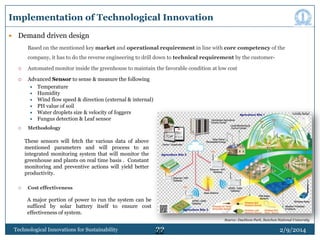
Demand driven design
Based on the mentioned key market and operational requirement in line with core competency of the
company, it has to do the reverse engineering to drill down to technical requirement by the customer

Automated monitor inside the greenhouse to maintain the favorable condition at low cost



Advanced Sensor to sense & measure the following
 Temperature
 Humidity
 Wind flow speed & direction (external & internal)
 PH value of soil
 Water droplets size & velocity of foggers
 Fungus detection & Leaf sensor



Methodology

These sensors will fetch the various data of above
mentioned parameters and will process to an
integrated monitoring system that will monitor the
greenhouse and plants on real time basis . Constant
monitoring and preventive actions will yield better
productivity.


Cost effectiveness

A major portion of power to run the system can be
sufficed by solar battery itself to ensure cost
effectiveness of system.
Source: DaeHeon Park, Sunchon National University

Technological Innovations for Sustainability

22
22

2/9/2014
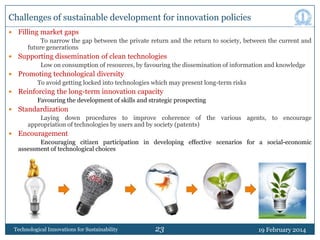
Challenges of sustainable development for innovation policies


Filling market gaps
To narrow the gap between the private return and the return to society, between the current and
future generations



Supporting dissemination of clean technologies
Low on consumption of resources, by favouring the dissemination of information and knowledge



Promoting technological diversity
To avoid getting locked into technologies which may present long-term risks



Reinforcing the long-term innovation capacity
Favouring the development of skills and strategic prospecting



Standardization
Laying down procedures to improve coherence of the various agents, to encourage
appropriation of technologies by users and by society (patents)



Encouragement
Encouraging citizen participation in developing effective scenarios for a social-economic
assessment of technological choices

Technological Innovations for Sustainability

23

19 February 2014
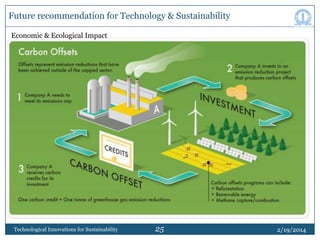
Future recommendation for Technology & Sustainability
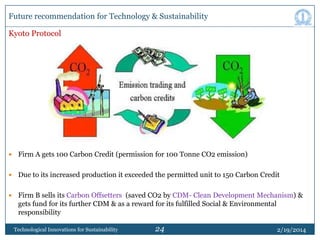
Kyoto Protocol



Firm A gets 100 Carbon Credit (permission for 100 Tonne CO2 emission)



Due to its increased production it exceeded the permitted unit to 150 Carbon Credit



Firm B sells its Carbon Offsetters (saved CO2 by CDM- Clean Development Mechanism) &
gets fund for its further CDM & as a reward for its fulfilled Social & Environmental
responsibility
Technological Innovations for Sustainability

24

2/19/2014
Future recommendation for Technology & Sustainability
Economic & Ecological Impact

Technological Innovations for Sustainability

25

2/19/2014
Future recommendation for Technology & Sustainability
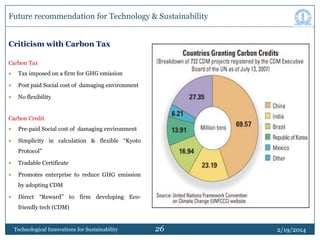
Criticism with Carbon Tax
Carbon Tax


Tax imposed on a firm for GHG emission



Post paid Social cost of damaging environment



No flexibility

Carbon Credit


Pre-paid Social cost of damaging environment



Simplicity in calculation & flexible “Kyoto
Protocol”



Tradable Certificate



Promotes enterprise to reduce GHG emission
by adopting CDM



Direct “Reward” to firm developing Ecofriendly tech (CDM)

Technological Innovations for Sustainability

26

2/19/2014
References
Websites








www.unece.org
en.wikipedia.org
www.sustainability.com
www.innovationcouncil.gov.in
www.coursera.org
www.youtube.com
www.google.com

Research Papers





Technological innovation fostering sustainable development by Cécile Patris, Gérard Valenduc, Françoise
Warrant
How Technology Could Contribute to a Sustainable World by Philip J. Vergragt
Costing the Earth: Equity, Sustainable Development and Environmental Economics by Sharon Beder
The Role of Technology in Sustainable Development by Sharon Beder

Report


Harnessing science, technology and innovation for sustainable development By ICSU-ISTS-TWAS
Consortium ad hoc Advisory Group

Tools used



Microsoft Encarta (Encyclopedia for offline references)
Microsoft Excel (for data analysis & graphs)
Technological Innovations for Sustainability

27

19 February 2014
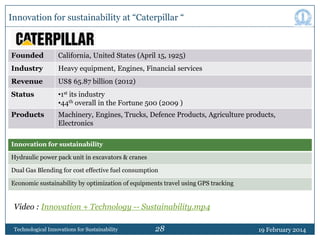
Innovation for sustainability at “Caterpillar “

Founded

California, United States (April 15, 1925)

Industry

Heavy equipment, Engines, Financial services

Revenue

US$ 65.87 billion (2012)

Status

•1st its industry
•44th overall in the Fortune 500 (2009 )

Products

Machinery, Engines, Trucks, Defence Products, Agriculture products,
Electronics

Innovation for sustainability
Hydraulic power pack unit in excavators & cranes
Dual Gas Blending for cost effective fuel consumption
Economic sustainability by optimization of equipments travel using GPS tracking

Video : Innovation + Technology -- Sustainability.mp4
Technological Innovations for Sustainability

28

19 February 2014
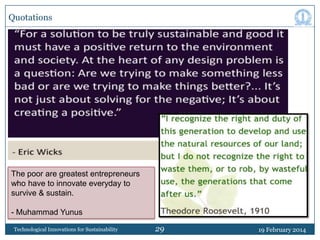
Quotations

The poor are greatest entrepreneurs
who have to innovate everyday to
survive & sustain.
- Muhammad Yunus
Technological Innovations for Sustainability

29

19 February 2014
Thank you!
We realized….
“If Technology has created problem then Technology itself is only the solution for
sustainable development”

Technological Innovations for Sustainability

19 February 2014

Technological innovations for sustainability

  • 1.
    Technological Innovations forSustainability UNDERSTANDING THE CORRELATIONS BETWEEN TECHNOLOGY, INNOVATION AND SUSTAINABLE DEVELOPMENT Course- Management of Technology for Sustainability Instructor- Dr. Balachandra Patil Technological Innovations for Sustainability Prepared bySwapnil Soni & Sowmiyan Morri DoMS, IISc 19 February 2014
  • 2.
    Index  Introduction  Needof Technological Innovation  Technology, Sustainability & Development cycle  Technological Innovations & Sustainability Impact  Organizations‟ approach to Technological Innovation  Case Study  Creation and implementation of sustainable technology  Marketing of sustainable technology  Challenges of sustainable development for innovation policies  Future recommendation for Technology & Sustainability  References Technological Innovations for Sustainability 2 19 February 2014
  • 3.
    Introduction - „Technology‟ Science Application of intellectual and practical activity for systematic study of physical and natural world through observation and experiment  Engineering Application of Science  Technology Application of Science and Engineering to study problems and provide solutions Need Science Engineering Technology Something more…! Technological Innovations for Sustainability 3 19 February 2014
  • 4.
    Introduction - „Innovation‟  Innovationis the application of better solutions that meet new requirements, unarticulated needs, or existing market needs.  This is accomplished through more effective products, processes, services, technologies, or ideas that are readily available to markets, governments and society. Something more…! Technological Innovations for Sustainability 4 19 February 2014
  • 5.
    Introduction - ‟Sustainability‟ Sustainability Long-term maintenance of well being, which has environmental, economic, and social dimensions  Sustainable Development Development which meets the needs of current generations without compromising the ability of future generations to meet their own needs (Brundtland Commission 1987) Parameter Measure Technology Productivity & Efficiency Growth Macroeconomic indicators- GDP, Per Capita Income Sustainability Technological Innovations for Sustainability 5 19 February 2014
  • 6.
    Need of TechnologicalInnovation Growth of „Population‟ follows Exponential path (Developing countries)  Growth of „Technology‟ follows Logistic path Population/Technology  Unfortunately population growth is not easily capped  Fortunately technology & innovation is our own intellectual property  Developing countries pose exponential growth trend of population  Developed countries pose logistic growth trend of population   Sustainability can be achieved by S-shape: Logistic path -> Sustainable trend aligning both the Technology & Population in a common logistic trend J-shape: Exponential path-> sporadic trend Technological Innovations for Sustainability 6 19 February 2014
  • 7.
    Need of TechnologicalInnovation Supply < World Population Growth Demand Crisis !! Solution: Sustainable Development Technological Innovations for Sustainability 7 19 February 2014
  • 8.
    Technology, Sustainability &Development cycle Non assimilative Solution required! Assimilation by Environment Resource Externalities Equity Innovation Technology Development Need Solution Growth Feedback • Technology exploits the resources to provide solutions to meet the need of society and generates externalities. • These solutions & externalities instigate innovation to get better solution. • Thus, if technology is the source of problem then it is the source of solution too. • Technological innovation leads to development of the society. Technological Innovations for Sustainability 8 19 February 2014
  • 9.
    Technological Innovations &Sustainability Impact Sustainability Impact Technology Innovation Economic Thermal Power plant Regenerative heat exchanger (Robert Stirling in 1816) Automobile Catalytic convertor • High installation cost • Economical in operation • Less fuel input to boiler Increased efficiency (25% to 40%) • Less emission of Carbon footprints (100 to 95kg/GJ ) • Additional cost ($ 150) • Norilsk, Russia-polluted due to Platinum supply used for catalytic convertor • NOx emissions in the US falling to 8.2% in 2008, from a high of 17.77% in 1998 •High installation cost • Increased furnace productivity • Lower operating costs due to reduced coke consumption • Longer campaign life & less maintenance • Less carbon emission due to reduced coal consumption • Better productivity & quality in industrial sectors • Unemployment •Non-biodegradable Technotrash • Reduced waste due to re-work • Paper less communication (Eugene Houdry, 1950) Steel Plant BLT charging furnace (Pauwurth 1972) Automation Computer (Charles Babbage, 1837) Technological Innovations for Sustainability Ecology 9 19 February 2014
  • 10.
    Organizations‟ approach toTechnological Innovation  Large companies:  Sustainable development is an element of the long-term strategy, because economic and environmental aspects are increasingly interdependent.  Adapt the concept of sustainable development to their activities, making it an “ad hoc” concept  Own R&D structures or sufficient financial resources to have access to technologies developed by others  Technological innovation is a means of standing apart from competition. Company Innovation centers Purpose & Achievements To accelerate progress in the highly promising fields of the environment, energy, and mobility. Cyber-physical systems will address green technology for instance and conserve energy in buildings Robert Bosch Research Centre (Bangalore, 1991) www.boschindia.com/ Engineering Research Centre (Pune, 1966) www.tatacars.com/innovations/ Invention of innovative materials and structures, highperformance microprocessors and computers, numerous contributions to physical and computer sciences,; Nobel prize award IBM Research (New York, 1945) www.research.ibm.com/ Technological Innovations for Sustainability Vehicle emission analysis for petrol, diesel or CNG. This laboratory helps to achieve fuel consumption efficiencies that would conform to international standards & to bring down levels of atmospheric pollution caused by vehicular exhaust. 10 19 February 2014
  • 11.
    Organizations‟ approach toTechnological Innovation  Small innovating companies:  Often in fairly small niche markets , but are convinced that their products correspond directly to a     sustainable development perspective They are impatient with the slow progress of the public authorities‟ implementation of a real global strategy to fight the greenhouse effect and enact environmental protection Their small size prevents them from having an effective lobbying policy They develop strategies to ensure their maintenance or growth on the current market They pay great attention to their employees and create a favourable climate for R&D. Innovation is their credo. Citation:  MSME Industries – Peenya, Bangalore  Other economic entities:  Harmful environmental effects do not threaten their activities in the short run  Sustainable development is not a strategic component, but one aspect among others to be taken into account. Citation:  Households, Local retail shops, Autodrivers (Process Innovation) Technological Innovations for Sustainability 11 19 February 2014
  • 12.
    Technology –that wasunsustainable !! • Does all the technologies tread the way of sustainability? • Image processing exalted the fishery • Yet how long we got the reap of this • A steep decline was faced after 1970 • Mistake: Improper utilization of Technology in the way of sustainability Technological Innovations for Sustainability 12 19 February 2014
  • 13.
    Case Study- 1 Generating NuclearPower through Nuclear Waste Creation and implementation of sustainable technology Technological Innovations for Sustainability 19 February 2014
  • 14.
    Generating Nuclear Powerthrough Nuclear wastes-TerraPower TerraPower aims to develop a sustainable and economic nuclear energy technology using: •Next-generation safe, affordable, clean and secure technologies •Advanced materials for more durable metallic fuels •World-class leadership for dynamic reactor engineering and innovation •Supercomputing for reliable and comprehensive modelling Technological Innovations for Sustainability 14 19 February 2014
  • 15.
    Generating Nuclear Powerthrough Nuclear wastes-TerraPower Safety: • Design features meet current regulatory requirements for nuclear reactor safety with the additional benefits of innovative passive safety features. • The traveling wave reactor (TWR) is a Generation IV reactor, of which a key characteristic is the use of passive safety features to mitigate accident scenarios. Some of the key safety features of the TWR: •As a pool-type reactor, it allows for a large heat sink, thereby slowing the accident scenario considerably because of the time required for the coolant to heat up. •The TWR uses metallic fuel that has significantly less retained energy than equivalent oxide fuel (i.e., less energy to be absorbed in an accident). •It eliminates hydrogen-producing materials, such as those created in LWRs when fuel temperatures reach 1,200 degrees Celcius and water reacts with zirconium. •The TWR incorporates inherent safety features that can shut the reactor down without using control rods. •Its passive independent residual heat removal systems do not rely on electricity, but rather use natural circulation and coolant to air heat exchangers. “Using the laws of physics, the plant will shut down automatically without the need for human intervention in the case of a natural disaster.” Technological Innovations for Sustainability 15 19 February 2014
  • 16.
    Generating Nuclear Powerthrough Nuclear wastes-TerraPower Technological Innovations for Sustainability 16 19 February 2014
  • 17.
    Generating Nuclear Powerthrough Nuclear wastes-TerraPower Economic Sustainability: By making more efficient use of depleted uranium as fuel, TerraPower's design results in a lower cost of power. •By eliminating fuel reprocessing, the TWR reduces the cost of nuclear energy production. On a country level, this simplifies the infrastructure required to kick-start and operate a nuclear energy program. •The first generation of TWRs will reduce the need for enrichment and the second generation will eliminate the need for enrichment entirely. This leads to a further reduction of fuel and infrastructure costs. •The TWR can run without refueling for about 40 years. While the reactor will occasionally pause to shuffle fuel, there is no need to stop for a fuel reload every 18 months. This reduces costs for operation and maintenance. •Because the TWR burns its fuel more efficiently, it produces less waste for the electricity generated. In fact, it could generate a minimum of seven times less waste than today‟s light water reactors. This leads to dramatically reduced disposal and storage costs for spent fuel. “The TWR is expected to save approximately $2 billion in fuel costs compared to today's light water reactors, over the life of the plant.” Technological Innovations for Sustainability 17 19 February 2014
  • 18.
    Generating Nuclear Powerthrough Nuclear wastes-TerraPower Environmental Sustainability: •The TWR will provide large amounts of sustainable base load power. For the amount of fuel used, the TWR will produce up to 50 times more power compared to today‟s light water reactors. •The TWR will reduce the amount of nuclear waste produced at end-of-life. The TWR will produce a minimum of seven times less waste than today's light water reactors. With the use of sodium as coolant, the TWR will operate at a higher temperature, allowing higher thermal efficiency for electrical generation. •The TWR will utilize depleted uranium as its main fuel. Just in the United States, more than 750,000 metric tons of depleted uranium sits useless, like that stored in Paducah, Ky. TWRs could convert this material into enough electricity to power all U.S. households for more than 700 years. “The TWR produces a minimum of seven times less waste than today's light water reactors.” Technological Innovations for Sustainability 18 19 February 2014
  • 19.
    Generating Nuclear Powerthrough Nuclear wastes-TerraPower Minimizing Security Risks “Removing enrichment from nuclear energy production allows a clear separation between countries pursuing peaceful uses of nuclear energy and those who are not.” The TWR simplifies the nuclear fuel cycle, containing it within the core of the reactor. It requires no chemical reprocessing capabilities and eventually no enrichment capabilities. This eliminates key points that traditionally provide opportunity for proliferation. Technological Innovations for Sustainability 19 19 February 2014
  • 20.
    Case Study- 2 Technological innovationin Horticulture Market Marketing of sustainable technology Technological Innovations for Sustainability 19 February 2014
  • 21.
    Implementation of TechnologicalInnovation  Objective – Foray into New line of business  Business related facts (India) Installed solar power capacity in India: 1.8GW Domain - Automation in Greenhouse farming market in India  Target customers- Horticulture organizations & farmers (commercial farming of Fruits, Flowers & Vegetables)  Target customers‟ geography- North-East India, Ladakh, Maharashtra, Tamil Nadu and Karnataka  Need identification for automation  Market requirement:  Greenhouse technology started only during 1980’s National Committee on the use of Plastics in Agriculture (NCPA-1982) The commercial utilization of greenhouses started from 1988 In 1991, 103 projects with foreign investment of more than Rs.80 crores have been approved to be set up in the country at an estimated cost of more than Rs.1000 crores around Pune, Bangalore, Hyderabad and Delhi Source: Ministry of Agriculture, GOI Increase in demand of horticulture products due to globalization and augmentation in purchasing power of consumer in India   Requirement of higher productivity in greenhouse farming to suffice the market demand Operational requirement (to fulfill the above):  Requirement of constant monitoring system in polyfarms for prevention from insects & adverse climate  Maintenance of favorable condition in greenhouse –Soil PH value 5.5 - 6, Temperature 2535degC, Humidity 50-60%  Prevention of human entry inside polyfarms during use of insecticides- formalin Technological Innovations for Sustainability 21 2/9/2014
  • 22.
    Implementation of TechnologicalInnovation  Demand driven design Based on the mentioned key market and operational requirement in line with core competency of the company, it has to do the reverse engineering to drill down to technical requirement by the customer Automated monitor inside the greenhouse to maintain the favorable condition at low cost  Advanced Sensor to sense & measure the following  Temperature  Humidity  Wind flow speed & direction (external & internal)  PH value of soil  Water droplets size & velocity of foggers  Fungus detection & Leaf sensor  Methodology These sensors will fetch the various data of above mentioned parameters and will process to an integrated monitoring system that will monitor the greenhouse and plants on real time basis . Constant monitoring and preventive actions will yield better productivity.  Cost effectiveness A major portion of power to run the system can be sufficed by solar battery itself to ensure cost effectiveness of system. Source: DaeHeon Park, Sunchon National University Technological Innovations for Sustainability 22 22 2/9/2014
  • 23.
    Challenges of sustainabledevelopment for innovation policies  Filling market gaps To narrow the gap between the private return and the return to society, between the current and future generations  Supporting dissemination of clean technologies Low on consumption of resources, by favouring the dissemination of information and knowledge  Promoting technological diversity To avoid getting locked into technologies which may present long-term risks  Reinforcing the long-term innovation capacity Favouring the development of skills and strategic prospecting  Standardization Laying down procedures to improve coherence of the various agents, to encourage appropriation of technologies by users and by society (patents)  Encouragement Encouraging citizen participation in developing effective scenarios for a social-economic assessment of technological choices Technological Innovations for Sustainability 23 19 February 2014
  • 24.
    Future recommendation forTechnology & Sustainability Kyoto Protocol  Firm A gets 100 Carbon Credit (permission for 100 Tonne CO2 emission)  Due to its increased production it exceeded the permitted unit to 150 Carbon Credit  Firm B sells its Carbon Offsetters (saved CO2 by CDM- Clean Development Mechanism) & gets fund for its further CDM & as a reward for its fulfilled Social & Environmental responsibility Technological Innovations for Sustainability 24 2/19/2014
  • 25.
    Future recommendation forTechnology & Sustainability Economic & Ecological Impact Technological Innovations for Sustainability 25 2/19/2014
  • 26.
    Future recommendation forTechnology & Sustainability Criticism with Carbon Tax Carbon Tax  Tax imposed on a firm for GHG emission  Post paid Social cost of damaging environment  No flexibility Carbon Credit  Pre-paid Social cost of damaging environment  Simplicity in calculation & flexible “Kyoto Protocol”  Tradable Certificate  Promotes enterprise to reduce GHG emission by adopting CDM  Direct “Reward” to firm developing Ecofriendly tech (CDM) Technological Innovations for Sustainability 26 2/19/2014
  • 27.
    References Websites        www.unece.org en.wikipedia.org www.sustainability.com www.innovationcouncil.gov.in www.coursera.org www.youtube.com www.google.com Research Papers     Technological innovationfostering sustainable development by Cécile Patris, Gérard Valenduc, Françoise Warrant How Technology Could Contribute to a Sustainable World by Philip J. Vergragt Costing the Earth: Equity, Sustainable Development and Environmental Economics by Sharon Beder The Role of Technology in Sustainable Development by Sharon Beder Report  Harnessing science, technology and innovation for sustainable development By ICSU-ISTS-TWAS Consortium ad hoc Advisory Group Tools used   Microsoft Encarta (Encyclopedia for offline references) Microsoft Excel (for data analysis & graphs) Technological Innovations for Sustainability 27 19 February 2014
  • 28.
    Innovation for sustainabilityat “Caterpillar “ Founded California, United States (April 15, 1925) Industry Heavy equipment, Engines, Financial services Revenue US$ 65.87 billion (2012) Status •1st its industry •44th overall in the Fortune 500 (2009 ) Products Machinery, Engines, Trucks, Defence Products, Agriculture products, Electronics Innovation for sustainability Hydraulic power pack unit in excavators & cranes Dual Gas Blending for cost effective fuel consumption Economic sustainability by optimization of equipments travel using GPS tracking Video : Innovation + Technology -- Sustainability.mp4 Technological Innovations for Sustainability 28 19 February 2014
  • 29.
    Quotations The poor aregreatest entrepreneurs who have to innovate everyday to survive & sustain. - Muhammad Yunus Technological Innovations for Sustainability 29 19 February 2014
  • 30.
    Thank you! We realized…. “IfTechnology has created problem then Technology itself is only the solution for sustainable development” Technological Innovations for Sustainability 19 February 2014