SUSTAINABLE
INNOVATIONS
By
Anusha Vaddireddy
(1627561)
Anusuya Nandi (1627538)
SUSTAINABLE INNOVATION
Sustainability innovation is about defining economic development as
the creation of private and social wealth to ultimately eliminate
harmful impacts on ecological systems, human health, and
communities.
There is no precise or established definition for sustainable
innovation, reflecting the more general difficulty in defining the
concepts of sustainability and sustainable development.
Sustainable innovation is a process where sustainability
considerations (environmental, social, financial) are integrated into
company systems from idea generation through to research and
development (R&D) and commercialization. This applies to products,
services and technologies, as well as new business and organization
models.
FOUR LEVELS
Sustainable innovation has been defined as covering the spectrum of
levels of innovation from incremental to radical.
Level 1 (incremental): Incremental or small, progressive
improvements to existing products.
Level 2 (re-design or ‘green limits’): Major re-design of existing
products (but limited the level of improvement that is technically
feasible).
Level 3 (functional or ‘product alternatives’): New product or service
concepts to satisfy the same functional need e.g. teleconferencing as
an alternative to travel.
Level 4 (systems): Design for a sustainable society.
WHY COMPANIES MOVING
TOWARDS SUSTAINABILITY?
4 motivating factors which lead the company towards Sustainability:
1. Mitigating business risk from potential disruption of operations,
supplies or reputational damage.
2. Adhering to industry norms of transparency, traceability,
environmental responsibility and other accepted standards.
3. Winning share in current markets and establishing a beachhead
with future customers.
4. Building goodwill with key stakeholders.
SUSTAINABLE INNITIATIVES IN
COMPANIES
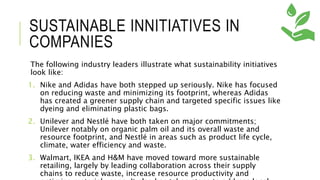
The following industry leaders illustrate what sustainability initiatives
look like:
1. Nike and Adidas have both stepped up seriously. Nike has focused
on reducing waste and minimizing its footprint, whereas Adidas
has created a greener supply chain and targeted specific issues like
dyeing and eliminating plastic bags.
2. Unilever and Nestlé have both taken on major commitments;
Unilever notably on organic palm oil and its overall waste and
resource footprint, and Nestlé in areas such as product life cycle,
climate, water efficiency and waste.
3. Walmart, IKEA and H&M have moved toward more sustainable
retailing, largely by leading collaboration across their supply
chains to reduce waste, increase resource productivity and
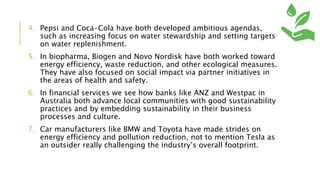
4. Pepsi and Coca-Cola have both developed ambitious agendas,
such as increasing focus on water stewardship and setting targets
on water replenishment.
5. In biopharma, Biogen and Novo Nordisk have both worked toward
energy efficiency, waste reduction, and other ecological measures.
They have also focused on social impact via partner initiatives in
the areas of health and safety.
6. In financial services we see how banks like ANZ and Westpac in
Australia both advance local communities with good sustainability
practices and by embedding sustainability in their business
processes and culture.
7. Car manufacturers like BMW and Toyota have made strides on
energy efficiency and pollution reduction, not to mention Tesla as
an outsider really challenging the industry’s overall footprint.
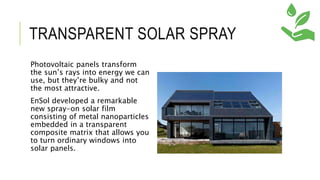
TRANSPARENT SOLAR SPRAY
Photovoltaic panels transform
the sun’s rays into energy we can
use, but they’re bulky and not
the most attractive.
EnSol developed a remarkable
new spray-on solar film
consisting of metal nanoparticles
embedded in a transparent
composite matrix that allows you
to turn ordinary windows into
solar panels.
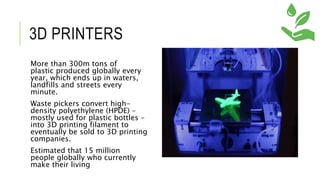
3D PRINTERS
More than 300m tons of
plastic produced globally every
year, which ends up in waters,
landfills and streets every
minute.
Waste pickers convert high-
density polyethylene (HPDE) –
mostly used for plastic bottles –
into 3D printing filament to
eventually be sold to 3D printing
companies.
Estimated that 15 million
people globally who currently
make their living
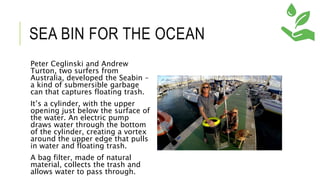
SEA BIN FOR THE OCEAN
Peter Ceglinski and Andrew
Turton, two surfers from
Australia, developed the Seabin –
a kind of submersible garbage
can that captures floating trash.
It’s a cylinder, with the upper
opening just below the surface of
the water. An electric pump
draws water through the bottom
of the cylinder, creating a vortex
around the upper edge that pulls
in water and floating trash.
A bag filter, made of natural
material, collects the trash and
allows water to pass through.
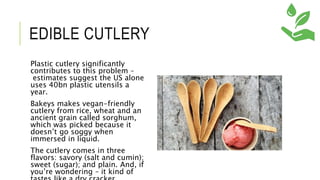
EDIBLE CUTLERY
Plastic cutlery significantly
contributes to this problem –
estimates suggest the US alone
uses 40bn plastic utensils a
year.
Bakeys makes vegan-friendly
cutlery from rice, wheat and an
ancient grain called sorghum,
which was picked because it
doesn’t go soggy when
immersed in liquid.
The cutlery comes in three
flavors: savory (salt and cumin);
sweet (sugar); and plain. And, if
you’re wondering – it kind of
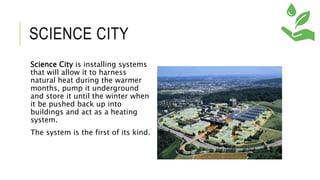
SCIENCE CITY
Science City is installing systems
that will allow it to harness
natural heat during the warmer
months, pump it underground
and store it until the winter when
it be pushed back up into
buildings and act as a heating
system.
The system is the first of its kind.
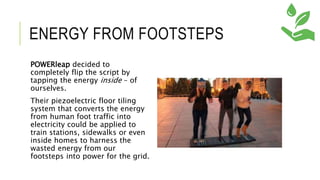
ENERGY FROM FOOTSTEPS
POWERleap decided to
completely flip the script by
tapping the energy inside – of
ourselves.
Their piezoelectric floor tiling
system that converts the energy
from human foot traffic into
electricity could be applied to
train stations, sidewalks or even
inside homes to harness the
wasted energy from our
footsteps into power for the grid.
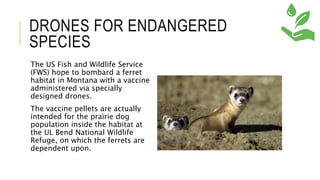
DRONES FOR ENDANGERED
SPECIES
The US Fish and Wildlife Service
(FWS) hope to bombard a ferret
habitat in Montana with a vaccine
administered via specially
designed drones.
The vaccine pellets are actually
intended for the prairie dog
population inside the habitat at
the UL Bend National Wildlife
Refuge, on which the ferrets are
dependent upon.
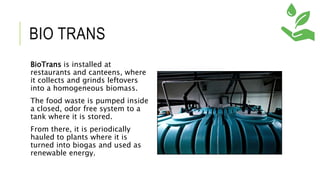
BIO TRANS
BioTrans is installed at
restaurants and canteens, where
it collects and grinds leftovers
into a homogeneous biomass.
The food waste is pumped inside
a closed, odor free system to a
tank where it is stored.
From there, it is periodically
hauled to plants where it is
turned into biogas and used as
renewable energy.
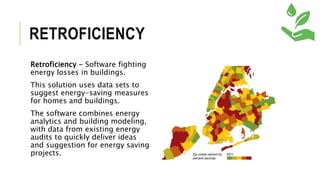
RETROFICIENCY
Retroficiency - Software fighting
energy losses in buildings.
This solution uses data sets to
suggest energy-saving measures
for homes and buildings.
The software combines energy
analytics and building modeling,
with data from existing energy
audits to quickly deliver ideas
and suggestion for energy saving
projects.
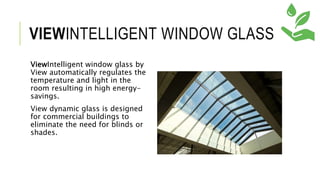
VIEWINTELLIGENT WINDOW GLASS
ViewIntelligent window glass by
View automatically regulates the
temperature and light in the
room resulting in high energy-
savings.
View dynamic glass is designed
for commercial buildings to
eliminate the need for blinds or
shades.
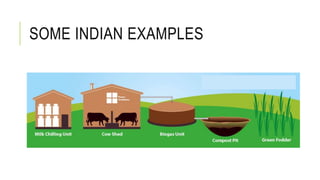
SOME INDIAN EXAMPLES
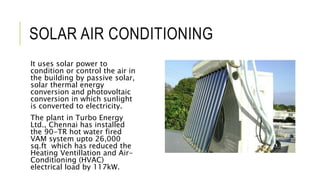
SOLAR AIR CONDITIONING
It uses solar power to
condition or control the air in
the building by passive solar,
solar thermal energy
conversion and photovoltaic
conversion in which sunlight
is converted to electricity.
The plant in Turbo Energy
Ltd., Chennai has installed
the 90-TR hot water fired
VAM system upto 26,000
sq.ft which has reduced the
Heating Ventillation and Air-
Conditioning (HVAC)
electrical load by 117kW.
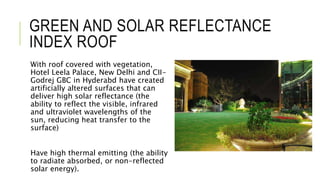
GREEN AND SOLAR REFLECTANCE
INDEX ROOF
With roof covered with vegetation,
Hotel Leela Palace, New Delhi and CII-
Godrej GBC in Hyderabd have created
artificially altered surfaces that can
deliver high solar reflectance (the
ability to reflect the visible, infrared
and ultraviolet wavelengths of the
sun, reducing heat transfer to the
surface)
Have high thermal emitting (the ability
to radiate absorbed, or non-reflected
solar energy).
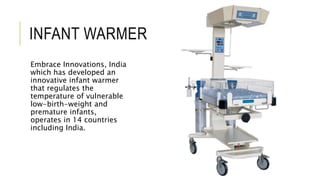
INFANT WARMER
Embrace Innovations, India
which has developed an
innovative infant warmer
that regulates the
temperature of vulnerable
low-birth-weight and
premature infants,
operates in 14 countries
including India.
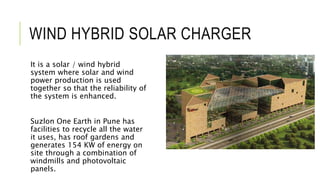
WIND HYBRID SOLAR CHARGER
It is a solar / wind hybrid
system where solar and wind
power production is used
together so that the reliability of
the system is enhanced.
Suzlon One Earth in Pune has
facilities to recycle all the water
it uses, has roof gardens and
generates 154 KW of energy on
site through a combination of
windmills and photovoltaic
panels.
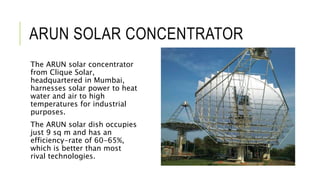
ARUN SOLAR CONCENTRATOR
The ARUN solar concentrator
from Clique Solar,
headquartered in Mumbai,
harnesses solar power to heat
water and air to high
temperatures for industrial
purposes.
The ARUN solar dish occupies
just 9 sq m and has an
efficiency-rate of 60-65%,
which is better than most
rival technologies.
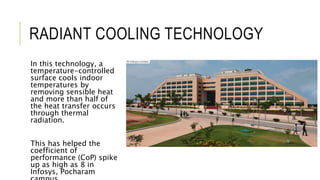
RADIANT COOLING TECHNOLOGY
In this technology, a
temperature-controlled
surface cools indoor
temperatures by
removing sensible heat
and more than half of
the heat transfer occurs
through thermal
radiation.
This has helped the
coefficient of
performance (CoP) spike
up as high as 8 in
Infosys, Pocharam
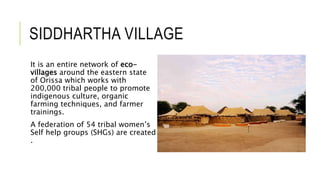
SIDDHARTHA VILLAGE
It is an entire network of eco-
villages around the eastern state
of Orissa which works with
200,000 tribal people to promote
indigenous culture, organic
farming techniques, and farmer
trainings.
A federation of 54 tribal women’s
Self help groups (SHGs) are created
.
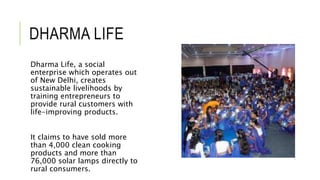
DHARMA LIFE
Dharma Life, a social
enterprise which operates out
of New Delhi, creates
sustainable livelihoods by
training entrepreneurs to
provide rural customers with
life-improving products.
It claims to have sold more
than 4,000 clean cooking
products and more than
76,000 solar lamps directly to
rural consumers.
REFERENCES
https://www.theguardian.com/sustainable-
business/2017/jan/01/sustainable-technology-2016-climate-
change-environment
http://www.dw.com/en/a-trash-can-for-the-ocean/a-38992810
https://inhabitat.com/6-inspiring-examples-of-groundbreaking-
green-technology/
http://www.thealternative.in/lifestyle/10-green-building-
innovations-in-india/
https://www.theguardian.com/sustainable-
business/gallery/2014/jun/16/10-leading-sustainability-innovations
https://yourstory.com/2015/06/sustainable-indian-innovations/
Sustainable innovations

Sustainable innovations

  • 1.
  • 2.
    SUSTAINABLE INNOVATION Sustainability innovationis about defining economic development as the creation of private and social wealth to ultimately eliminate harmful impacts on ecological systems, human health, and communities. There is no precise or established definition for sustainable innovation, reflecting the more general difficulty in defining the concepts of sustainability and sustainable development. Sustainable innovation is a process where sustainability considerations (environmental, social, financial) are integrated into company systems from idea generation through to research and development (R&D) and commercialization. This applies to products, services and technologies, as well as new business and organization models.
  • 3.
    FOUR LEVELS Sustainable innovationhas been defined as covering the spectrum of levels of innovation from incremental to radical. Level 1 (incremental): Incremental or small, progressive improvements to existing products. Level 2 (re-design or ‘green limits’): Major re-design of existing products (but limited the level of improvement that is technically feasible). Level 3 (functional or ‘product alternatives’): New product or service concepts to satisfy the same functional need e.g. teleconferencing as an alternative to travel. Level 4 (systems): Design for a sustainable society.
  • 4.
    WHY COMPANIES MOVING TOWARDSSUSTAINABILITY? 4 motivating factors which lead the company towards Sustainability: 1. Mitigating business risk from potential disruption of operations, supplies or reputational damage. 2. Adhering to industry norms of transparency, traceability, environmental responsibility and other accepted standards. 3. Winning share in current markets and establishing a beachhead with future customers. 4. Building goodwill with key stakeholders.
  • 5.
    SUSTAINABLE INNITIATIVES IN COMPANIES Thefollowing industry leaders illustrate what sustainability initiatives look like: 1. Nike and Adidas have both stepped up seriously. Nike has focused on reducing waste and minimizing its footprint, whereas Adidas has created a greener supply chain and targeted specific issues like dyeing and eliminating plastic bags. 2. Unilever and Nestlé have both taken on major commitments; Unilever notably on organic palm oil and its overall waste and resource footprint, and Nestlé in areas such as product life cycle, climate, water efficiency and waste. 3. Walmart, IKEA and H&M have moved toward more sustainable retailing, largely by leading collaboration across their supply chains to reduce waste, increase resource productivity and
  • 6.
    4. Pepsi andCoca-Cola have both developed ambitious agendas, such as increasing focus on water stewardship and setting targets on water replenishment. 5. In biopharma, Biogen and Novo Nordisk have both worked toward energy efficiency, waste reduction, and other ecological measures. They have also focused on social impact via partner initiatives in the areas of health and safety. 6. In financial services we see how banks like ANZ and Westpac in Australia both advance local communities with good sustainability practices and by embedding sustainability in their business processes and culture. 7. Car manufacturers like BMW and Toyota have made strides on energy efficiency and pollution reduction, not to mention Tesla as an outsider really challenging the industry’s overall footprint.
  • 9.
    TRANSPARENT SOLAR SPRAY Photovoltaicpanels transform the sun’s rays into energy we can use, but they’re bulky and not the most attractive. EnSol developed a remarkable new spray-on solar film consisting of metal nanoparticles embedded in a transparent composite matrix that allows you to turn ordinary windows into solar panels.
  • 10.
    3D PRINTERS More than300m tons of plastic produced globally every year, which ends up in waters, landfills and streets every minute. Waste pickers convert high- density polyethylene (HPDE) – mostly used for plastic bottles – into 3D printing filament to eventually be sold to 3D printing companies. Estimated that 15 million people globally who currently make their living
  • 11.
    SEA BIN FORTHE OCEAN Peter Ceglinski and Andrew Turton, two surfers from Australia, developed the Seabin – a kind of submersible garbage can that captures floating trash. It’s a cylinder, with the upper opening just below the surface of the water. An electric pump draws water through the bottom of the cylinder, creating a vortex around the upper edge that pulls in water and floating trash. A bag filter, made of natural material, collects the trash and allows water to pass through.
  • 12.
    EDIBLE CUTLERY Plastic cutlerysignificantly contributes to this problem – estimates suggest the US alone uses 40bn plastic utensils a year. Bakeys makes vegan-friendly cutlery from rice, wheat and an ancient grain called sorghum, which was picked because it doesn’t go soggy when immersed in liquid. The cutlery comes in three flavors: savory (salt and cumin); sweet (sugar); and plain. And, if you’re wondering – it kind of
  • 13.
    SCIENCE CITY Science Cityis installing systems that will allow it to harness natural heat during the warmer months, pump it underground and store it until the winter when it be pushed back up into buildings and act as a heating system. The system is the first of its kind.
  • 14.
    ENERGY FROM FOOTSTEPS POWERleapdecided to completely flip the script by tapping the energy inside – of ourselves. Their piezoelectric floor tiling system that converts the energy from human foot traffic into electricity could be applied to train stations, sidewalks or even inside homes to harness the wasted energy from our footsteps into power for the grid.
  • 15.
    DRONES FOR ENDANGERED SPECIES TheUS Fish and Wildlife Service (FWS) hope to bombard a ferret habitat in Montana with a vaccine administered via specially designed drones. The vaccine pellets are actually intended for the prairie dog population inside the habitat at the UL Bend National Wildlife Refuge, on which the ferrets are dependent upon.
  • 16.
    BIO TRANS BioTrans isinstalled at restaurants and canteens, where it collects and grinds leftovers into a homogeneous biomass. The food waste is pumped inside a closed, odor free system to a tank where it is stored. From there, it is periodically hauled to plants where it is turned into biogas and used as renewable energy.
  • 17.
    RETROFICIENCY Retroficiency - Softwarefighting energy losses in buildings. This solution uses data sets to suggest energy-saving measures for homes and buildings. The software combines energy analytics and building modeling, with data from existing energy audits to quickly deliver ideas and suggestion for energy saving projects.
  • 18.
    VIEWINTELLIGENT WINDOW GLASS ViewIntelligentwindow glass by View automatically regulates the temperature and light in the room resulting in high energy- savings. View dynamic glass is designed for commercial buildings to eliminate the need for blinds or shades.
  • 19.
  • 20.
    SOLAR AIR CONDITIONING Ituses solar power to condition or control the air in the building by passive solar, solar thermal energy conversion and photovoltaic conversion in which sunlight is converted to electricity. The plant in Turbo Energy Ltd., Chennai has installed the 90-TR hot water fired VAM system upto 26,000 sq.ft which has reduced the Heating Ventillation and Air- Conditioning (HVAC) electrical load by 117kW.
  • 21.
    GREEN AND SOLARREFLECTANCE INDEX ROOF With roof covered with vegetation, Hotel Leela Palace, New Delhi and CII- Godrej GBC in Hyderabd have created artificially altered surfaces that can deliver high solar reflectance (the ability to reflect the visible, infrared and ultraviolet wavelengths of the sun, reducing heat transfer to the surface) Have high thermal emitting (the ability to radiate absorbed, or non-reflected solar energy).
  • 22.
    INFANT WARMER Embrace Innovations,India which has developed an innovative infant warmer that regulates the temperature of vulnerable low-birth-weight and premature infants, operates in 14 countries including India.
  • 23.
    WIND HYBRID SOLARCHARGER It is a solar / wind hybrid system where solar and wind power production is used together so that the reliability of the system is enhanced. Suzlon One Earth in Pune has facilities to recycle all the water it uses, has roof gardens and generates 154 KW of energy on site through a combination of windmills and photovoltaic panels.
  • 24.
    ARUN SOLAR CONCENTRATOR TheARUN solar concentrator from Clique Solar, headquartered in Mumbai, harnesses solar power to heat water and air to high temperatures for industrial purposes. The ARUN solar dish occupies just 9 sq m and has an efficiency-rate of 60-65%, which is better than most rival technologies.
  • 25.
    RADIANT COOLING TECHNOLOGY Inthis technology, a temperature-controlled surface cools indoor temperatures by removing sensible heat and more than half of the heat transfer occurs through thermal radiation. This has helped the coefficient of performance (CoP) spike up as high as 8 in Infosys, Pocharam
  • 26.
    SIDDHARTHA VILLAGE It isan entire network of eco- villages around the eastern state of Orissa which works with 200,000 tribal people to promote indigenous culture, organic farming techniques, and farmer trainings. A federation of 54 tribal women’s Self help groups (SHGs) are created .
  • 27.
    DHARMA LIFE Dharma Life,a social enterprise which operates out of New Delhi, creates sustainable livelihoods by training entrepreneurs to provide rural customers with life-improving products. It claims to have sold more than 4,000 clean cooking products and more than 76,000 solar lamps directly to rural consumers.
  • 28.