Techno - Pedagogic Content Knowledge Analysis - English 
UNIT I 
Techno Pedagogy 
Techno -pedagogy refers to electronically mediated courses that integrate sound pedagogic 
principles of teaching or learning with the use of technology.Technology in the professional 
developmespecific techno- pedagogical competencies allows faculty to make "the work 
practitioners at the centre of professional study in a community of practice. 
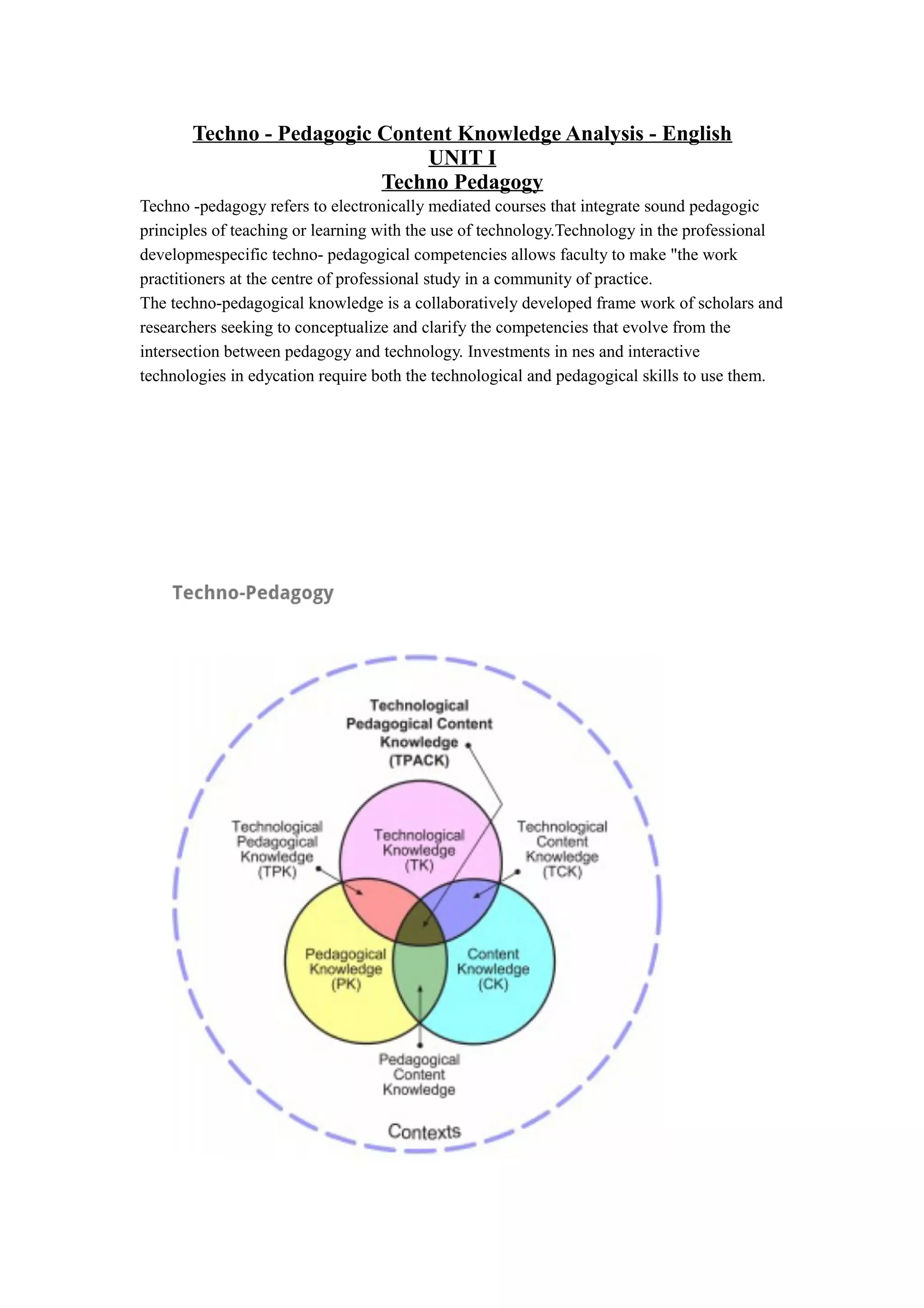
The techno-pedagogical knowledge is a collaboratively developed frame work of scholars and 
researchers seeking to conceptualize and clarify the competencies that evolve from the 
intersection between pedagogy and technology. Investments in nes and interactive 
technologies in edycation require both the technological and pedagogical skills to use them.
Content Knowledge 
Content knowledge is the knowledge about the actual subject matter that is to be learnt or 
taught.The content to be covered in the high school social studies or algebra is cery different from 
the content to bw covered in a graduate course on computer science or art or history.clearly 
teachers must know and understand the subjects they teach including knowledge of central facts, 
concepts, theories, and procedures within a given field. 
Knowledge of explanatory frameworks that organize and connect ideas and knowledge of 
the rules of evidence and proof.Teachers must also understand the nature of knowledge and 
inquiry in different fields.Content knowledge is a term widely used by educators.It refers to the 
body of information that teachers teach and that students are expected to learn in a given subject 
or content area such as English Language , Maths , Science and social studies. It generally refers 
to the facts, concepts, theories and principles that are taught and learned rather than to related 
skills such as reading,writingnir researching that students also learn in academic courses. 
Pedagogical Knowledge 
Pedagogical knowledge is deep knowledge about the procedd and practices or methods of 
teaching and learning and hiw it overall educatiobal purposes, values and aims.This is a generic 
form of knowledge that is involved in all issues of student learning, classroom management, 
lesson plan development and implementation and student evaluation. It includes knowledge about 
techniques or methods to be used in the classroom; the nature of the target audience and strategies 
for evaluating student understanding. A teacher with deep pedagogical knowledge understands 
how students construct knowledge and acquire skills, develops habits of mind and positive 
dispositions towards learning. As such, pedagogical knowledge requires an understanding of 
cognitive , social and developmental theories of learning and how they apply to students in their 
classroom.The inter connection of all the elements of pedagogical knowledge is an exciting 
consideration for teachers with enormous potential for more effective classroom practices.The 
particular element of interest is the pedagogical knowledge of student evaluation or assessment. 
Technology Knowledge 
Technology Knowledge is the knowledge about standard technologies such as books, chalk and 
bkack board as well as more advanced technologies such as the internet and digital video.This 
would involve the skills required to operate technologies.In the case of digital technologies this 
would include knowledge of how to install and remove peripheral devices install and remove 
software programmes, create and archieve documents.Most standard technology workshops and 
tutorials tend to focus on the acquisition of such skills. 
In the Techological - pedagogical content knowledge frame work , Technology knowledge 
can combine with content knowledge (CK) to form Technology Content Knowledge , Pedagogical 
Knowledge to form Technological pedagogical knowledge , Content Knowledge and Pedagogical 
Knowledge to form Technological Pedagogical Content Knowledge (TPACK). 
Content Based web - Resources 
Content based web-resources refers to the informational web sites which provides web resources 
to develop content based materials for the classroom .As the World Wide Web matures multimedia 
and programming technologies are evolving to enable the development of instructional software 
containing significant depth and interactivity. Content based web-resources provides web- based 
tools to support introductory materials , courses and demonstrate how these tools ( Java, Quick
Time, Java Script and Virtual Reality Modelling Language etc.) can be used in an educational 
setting.In the light if the success , we are exploring ways in which content based web resources be 
mire widely distributed such that resources are optimized and development us not duplicated. 
In English Language teaching, using web resources to develop content based materials for 
the classroom emphasized the applied use of web based resources and content based instructional 
practices in English Language Teaching environments.Participants developed practical print based 
material using resources from content - rich web sites. 
Need for content based web-resources 
Teachers and student must be able to navigate the internet to find appropriate materials.With the 
explosion in popularly of the internet in general and the World Wide Web in particular, one is 
bombarded by URL's at every turn.Sources for websites include television, radio, news paper , 
magazines, colleagues, friends and family.Integrating technology into a curriculum requires that 
teachers and students have access to sufficient software and interner resources which fit course 
and curriculum objectives.The internet is a terrific source of materials which can be used in 
content based ciurses.However, there are some needs in using the internet as a source for 
classroom instruction.The needs for content based web resources are; 
# to find appropriate sites related to content. 
# to develop classroom activites which effectively utilize the sites for content and language 
instruction. 
# provide students and other teachers dependable and easy access to the sites and the 
accompanying teaching materials. 
Ways of using web resources 
The internet contains such a vast wealth of information with such a variety of media-text 
graphics, audio, video.It is becoming an ever more important source for content based 
instructions. These Content Based Web-Resources should be useful for the classroom teacher whi 
wants to collect materials fir using in content based teaching There are several ways of using web 
resources. Some of them are; 
# collecting, organizing and making sites available to teachers and students. 
# Itprovides ways to find information on the internet. 
# To integrate the internet into the curriculum. 
# To use online activities targeted at learners. 
# To find and use internet based project for education. 
# Learn how to use website for finding resources to support English language teaching and 
learning. 
# collaborate with langyage teaching colleaguesaround the world with similar pedagogical 
interest.
# Practice adapting and creating culturally abd pedagigically appropriate cintent based English 
Materials. 
#Develop understanding in the content areas of entrepreneurship , civic Education and HIV 
Education and how they might be into English Language Teaching. 
Web resources were selected on the basus of how well they were aligned to participant's 
needs, their pedagogical appropriateness from a teaching and learning perspectives, tge extent to 
which they met accessibility and usability standard and were available at no costt or copyright 
infringement through the internet. (The web/ email) 
~~~~~~~~~~~~~~~~~~~~~~~~~~~~~~~~~~~~~~~~~~~~~~~~~~~~~~~~~~

Techno pedagogic content knowledge-English

  • 1.
    Techno - PedagogicContent Knowledge Analysis - English UNIT I Techno Pedagogy Techno -pedagogy refers to electronically mediated courses that integrate sound pedagogic principles of teaching or learning with the use of technology.Technology in the professional developmespecific techno- pedagogical competencies allows faculty to make "the work practitioners at the centre of professional study in a community of practice. The techno-pedagogical knowledge is a collaboratively developed frame work of scholars and researchers seeking to conceptualize and clarify the competencies that evolve from the intersection between pedagogy and technology. Investments in nes and interactive technologies in edycation require both the technological and pedagogical skills to use them.
  • 2.
    Content Knowledge Contentknowledge is the knowledge about the actual subject matter that is to be learnt or taught.The content to be covered in the high school social studies or algebra is cery different from the content to bw covered in a graduate course on computer science or art or history.clearly teachers must know and understand the subjects they teach including knowledge of central facts, concepts, theories, and procedures within a given field. Knowledge of explanatory frameworks that organize and connect ideas and knowledge of the rules of evidence and proof.Teachers must also understand the nature of knowledge and inquiry in different fields.Content knowledge is a term widely used by educators.It refers to the body of information that teachers teach and that students are expected to learn in a given subject or content area such as English Language , Maths , Science and social studies. It generally refers to the facts, concepts, theories and principles that are taught and learned rather than to related skills such as reading,writingnir researching that students also learn in academic courses. Pedagogical Knowledge Pedagogical knowledge is deep knowledge about the procedd and practices or methods of teaching and learning and hiw it overall educatiobal purposes, values and aims.This is a generic form of knowledge that is involved in all issues of student learning, classroom management, lesson plan development and implementation and student evaluation. It includes knowledge about techniques or methods to be used in the classroom; the nature of the target audience and strategies for evaluating student understanding. A teacher with deep pedagogical knowledge understands how students construct knowledge and acquire skills, develops habits of mind and positive dispositions towards learning. As such, pedagogical knowledge requires an understanding of cognitive , social and developmental theories of learning and how they apply to students in their classroom.The inter connection of all the elements of pedagogical knowledge is an exciting consideration for teachers with enormous potential for more effective classroom practices.The particular element of interest is the pedagogical knowledge of student evaluation or assessment. Technology Knowledge Technology Knowledge is the knowledge about standard technologies such as books, chalk and bkack board as well as more advanced technologies such as the internet and digital video.This would involve the skills required to operate technologies.In the case of digital technologies this would include knowledge of how to install and remove peripheral devices install and remove software programmes, create and archieve documents.Most standard technology workshops and tutorials tend to focus on the acquisition of such skills. In the Techological - pedagogical content knowledge frame work , Technology knowledge can combine with content knowledge (CK) to form Technology Content Knowledge , Pedagogical Knowledge to form Technological pedagogical knowledge , Content Knowledge and Pedagogical Knowledge to form Technological Pedagogical Content Knowledge (TPACK). Content Based web - Resources Content based web-resources refers to the informational web sites which provides web resources to develop content based materials for the classroom .As the World Wide Web matures multimedia and programming technologies are evolving to enable the development of instructional software containing significant depth and interactivity. Content based web-resources provides web- based tools to support introductory materials , courses and demonstrate how these tools ( Java, Quick
  • 3.
    Time, Java Scriptand Virtual Reality Modelling Language etc.) can be used in an educational setting.In the light if the success , we are exploring ways in which content based web resources be mire widely distributed such that resources are optimized and development us not duplicated. In English Language teaching, using web resources to develop content based materials for the classroom emphasized the applied use of web based resources and content based instructional practices in English Language Teaching environments.Participants developed practical print based material using resources from content - rich web sites. Need for content based web-resources Teachers and student must be able to navigate the internet to find appropriate materials.With the explosion in popularly of the internet in general and the World Wide Web in particular, one is bombarded by URL's at every turn.Sources for websites include television, radio, news paper , magazines, colleagues, friends and family.Integrating technology into a curriculum requires that teachers and students have access to sufficient software and interner resources which fit course and curriculum objectives.The internet is a terrific source of materials which can be used in content based ciurses.However, there are some needs in using the internet as a source for classroom instruction.The needs for content based web resources are; # to find appropriate sites related to content. # to develop classroom activites which effectively utilize the sites for content and language instruction. # provide students and other teachers dependable and easy access to the sites and the accompanying teaching materials. Ways of using web resources The internet contains such a vast wealth of information with such a variety of media-text graphics, audio, video.It is becoming an ever more important source for content based instructions. These Content Based Web-Resources should be useful for the classroom teacher whi wants to collect materials fir using in content based teaching There are several ways of using web resources. Some of them are; # collecting, organizing and making sites available to teachers and students. # Itprovides ways to find information on the internet. # To integrate the internet into the curriculum. # To use online activities targeted at learners. # To find and use internet based project for education. # Learn how to use website for finding resources to support English language teaching and learning. # collaborate with langyage teaching colleaguesaround the world with similar pedagogical interest.
  • 4.
    # Practice adaptingand creating culturally abd pedagigically appropriate cintent based English Materials. #Develop understanding in the content areas of entrepreneurship , civic Education and HIV Education and how they might be into English Language Teaching. Web resources were selected on the basus of how well they were aligned to participant's needs, their pedagogical appropriateness from a teaching and learning perspectives, tge extent to which they met accessibility and usability standard and were available at no costt or copyright infringement through the internet. (The web/ email) ~~~~~~~~~~~~~~~~~~~~~~~~~~~~~~~~~~~~~~~~~~~~~~~~~~~~~~~~~~