ONLINE ASSIGNMENT 
“RELEVANCE OF TECHNO-PEDAGOGIC 
ANALYSIS IN 
COMMERCE EDUCATION” 
PRASAD.S.R 
BNV CTE 
B.Ed COMMERCE 
Candidate code:-13357006
Introduction 
he technological revolution has prompted a fundamental 
shift in our understanding of pedagogy and its related 
T 
practices. Traditionally, teaching did not require that the instructor also be 
learner, but only expert. Those who taught could do so in communicative 
non interaction with the learner in a manner of talking at. This is no longer 
adequate. Techno- pedagogy demands that life world experience be 
enmeshed in hyper learning. Neither theory nor practice, singularly, is a 
viable method of instruction-regardless of the discipline and its 
methodological heritage. 
Techno-pedagogy is a key deciding factor in whether an educational 
media product is successful or not. Literally, ‘pedagogy’ refers to the art - 
science of teaching and ‘techno’ refers to the art-skill in handcrafting, 
derived from the Latin word ‘texere’ which means to weave or fabricate. 
Here ‘techno’ is a qualifier; it intersects or crosses the meaning of 
‘pedagogy’ with its own. Techno-pedagogy refers to weaving the 
techniques of the craft of teaching into the learning itself. It requires 
conscious recognition of the mediated learning environment in order to 
maximize the ease and clarity in the transmission of information. It 
attempts to capture some of the essential qualities of teacher knowledge 
required for technology integration in teaching, while addressing the 
complex, multifaceted, and situated nature of this knowledge.
I argue, briefly, that thoughtful pedagogical uses of technology require 
the development of a complex, situated form of knowledge that we call 
Technological Pedagogical Content Knowledge (TPCK). In doing so, we 
posit the complex roles of, and interplay among, three main components of 
learning environments: content, pedagogy, and technology. I argue that this 
model has much to offer to discussions of technology integration at 
multiple levels: theoretical, pedagogical, and methodological. The teaching 
approach based upon the framework, and illustrate the methodological 
contributions that have resulted from this work. Technology has a pivotal 
role to play in the dynamic changing field of commerce, trade and industry. 
It can provide coverage of a growing knowledge base association with the 
information explosion in all areas including commerce. The important 
thing in science is not so much to obtain new facts as to discover new ways 
of thinking about them. Advocates of technology in education often 
envisage similar dramatic changes in the process of teaching 
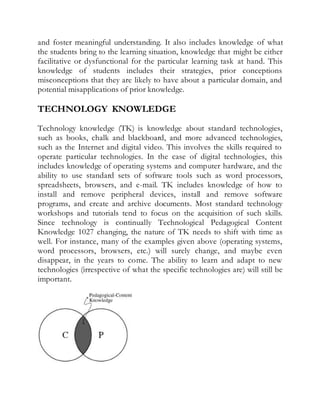
PEDAGOGICAL CONTENT KNOWLEDGE 
This knowledge includes knowing what teaching approaches fit the 
content, and likewise, knowing how elements of the content can be 
arranged for better teaching. This knowledge is different from the 
knowledge of a disciplinary expert and also from the general pedagogical 
knowledge shared by teachers across disciplines. PCK is concerned with 
the representation and formulation of concepts, pedagogical techniques, 
knowledge of what makes concepts difficult or easy to learn, knowledge of 
students’ prior knowledge, and theories of epistemology. It also involves 
knowledge of teaching strategies that incorporate appropriate conceptual 
representations in order to address learner difficulties and misconceptions
and foster meaningful understanding. It also includes knowledge of what 
the students bring to the learning situation, knowledge that might be either 
facilitative or dysfunctional for the particular learning task at hand. This 
knowledge of students includes their strategies, prior conceptions 
misconceptions that they are likely to have about a particular domain, and 
potential misapplications of prior knowledge. 
TECHNOLOGY KNOWLEDGE 
Technology knowledge (TK) is knowledge about standard technologies, 
such as books, chalk and blackboard, and more advanced technologies, 
such as the Internet and digital video. This involves the skills required to 
operate particular technologies. In the case of digital technologies, this 
includes knowledge of operating systems and computer hardware, and the 
ability to use standard sets of software tools such as word processors, 
spreadsheets, browsers, and e-mail. TK includes knowledge of how to 
install and remove peripheral devices, install and remove software 
programs, and create and archive documents. Most standard technology 
workshops and tutorials tend to focus on the acquisition of such skills. 
Since technology is continually Technological Pedagogical Content 
Knowledge 1027 changing, the nature of TK needs to shift with time as 
well. For instance, many of the examples given above (operating systems, 
word processors, browsers, etc.) will surely change, and maybe even 
disappear, in the years to come. The ability to learn and adapt to new 
technologies (irrespective of what the specific technologies are) will still be 
important.
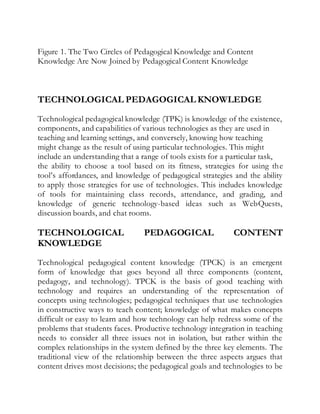
Figure 1. The Two Circles of Pedagogical Knowledge and Content 
Knowledge Are Now Joined by Pedagogical Content Knowledge 
TECHNOLOGICAL PEDAGOGICAL KNOWLEDGE 
Technological pedagogical knowledge (TPK) is knowledge of the existence, 
components, and capabilities of various technologies as they are used in 
teaching and learning settings, and conversely, knowing how teaching 
might change as the result of using particular technologies. This might 
include an understanding that a range of tools exists for a particular task, 
the ability to choose a tool based on its fitness, strategies for using the 
tool’s affordances, and knowledge of pedagogical strategies and the ability 
to apply those strategies for use of technologies. This includes knowledge 
of tools for maintaining class records, attendance, and grading, and 
knowledge of generic technology-based ideas such as WebQuests, 
discussion boards, and chat rooms. 
TECHNOLOGICAL PEDAGOGICAL CONTENT 
KNOWLEDGE 
Technological pedagogical content knowledge (TPCK) is an emergent 
form of knowledge that goes beyond all three components (content, 
pedagogy, and technology). TPCK is the basis of good teaching with 
technology and requires an understanding of the representation of 
concepts using technologies; pedagogical techniques that use technologies 
in constructive ways to teach content; knowledge of what makes concepts 
difficult or easy to learn and how technology can help redress some of the 
problems that students faces. Productive technology integration in teaching 
needs to consider all three issues not in isolation, but rather within the 
complex relationships in the system defined by the three key elements. The 
traditional view of the relationship between the three aspects argues that 
content drives most decisions; the pedagogical goals and technologies to be
used follow from a choice of what to teach. The introduction of the 
Internet can be seen as an example of a technology whose arrival forced 
educators to think about core pedagogical issues. So, in this context, it is 
the technology that drives the kinds of decisions that we make about 
content and pedagogy. 
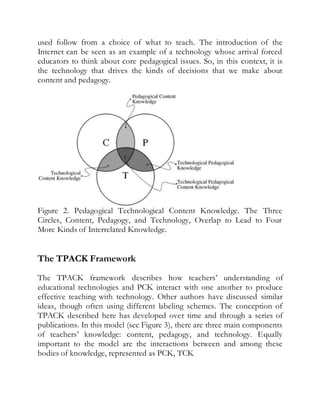
Figure 2. Pedagogical Technological Content Knowledge. The Three 
Circles, Content, Pedagogy, and Technology, Overlap to Lead to Four 
More Kinds of Interrelated Knowledge. 
The TPACK Framework 
The TPACK framework describes how teachers’ understanding of 
educational technologies and PCK interact with one another to produce 
effective teaching with technology. Other authors have discussed similar 
ideas, though often using different labeling schemes. The conception of 
TPACK described here has developed over time and through a series of 
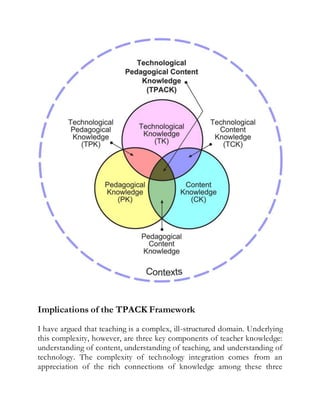
publications. In this model (see Figure 3), there are three main components 
of teachers’ knowledge: content, pedagogy, and technology. Equally 
important to the model are the interactions between and among these 
bodies of knowledge, represented as PCK, TCK
Implications of the TPACK Framework 
I have argued that teaching is a complex, ill-structured domain. Underlying 
this complexity, however, are three key components of teacher knowledge: 
understanding of content, understanding of teaching, and understanding of 
technology. The complexity of technology integration comes from an 
appreciation of the rich connections of knowledge among these three
components and the complex ways in which these are applied in 
multifaceted and dynamic classroom contexts. By better describing the 
types of knowledge teachers need (in the form of content, pedagogy, 
technology, contexts and their interactions), educators are in a better 
position to understand the variance in levels of technology integration 
occurring. In addition, the TPACK framework offers several possibil ities 
for promoting research in teacher education, teacher professional 
development, and teachers’ use of technology. It offers options for looking 
at a complex phenomenon like technology integration in ways that are now 
amenable to analysis and development. Moreover, it allows teachers, 
researchers, and teacher educators to move beyond oversimplified 
approaches that treat technology as an “add-on” instead to focus again, and 
in a more ecological way, upon the connections among technology, 
content, and pedagogy as they play out in classroom contexts. 
TPK analysis becomes particularly important because most popular 
software programs are not designed for educational purposes. Software 
programs such as the Microsoft Office Suite, (Word, PowerPoint, Excel, 
Entourage, and MSN Messenger) are usually designed for business 
environments. Web-based technologies such as blogs or podcasts are 
designed for purposes of entertainment, communication, and social 
networking. Teachers need to reject functional fixedness and develop skills 
to look beyond most common uses for technologies, reconfiguring them 
for customized pedagogical purposes Thus, TPK analysis requires a 
forward-looking, creative, and open-minded seeking of technology use, not 
for its own sake but for the sake of advancing student learning and use. 
The Challenges of Teaching With Technology 
Teaching with technology is complicated further considering the challenges 
newer technologies present to teachers. In our work, the word technology 
applies equally to 
analog and digital, as well as new and old, technologies. As a matter of 
practical significance, however, most of the technologies under 
consideration in current literature are newer and digital and have some
inherent properties that make applying them in straightforward ways 
difficult. Digital technologies—such as computers, handheld devices, and 
software applications. On an academic level, it is easy to argue that a pencil 
and a software simulation are both technologies. The latter, however, is 
qualitatively different in that its functioning is more opaque to teachers and 
offers fundamentally less stability than more traditional technologies. By 
their very nature, newer digital technologies, which are protean, unstable, 
and opaque, present new challenges to teachers who are struggling to use 
more technology in their teaching. 
Using email to communicate, for example, affords (makes possible and 
supports) asynchronous communication and easy storage of exchanges. 
Email does not afford synchronous communication in the way that a 
phone call, a face-to-face conversation, or instant messaging does. Social 
and contextual factors also complicate the relationships between teaching 
and technology. Many teachers earned degrees at a time when educational 
technology was at a very different stage of development than it is today. It 
is, thus, not surprising that they do not consider themselves sufficiently 
prepared to use technology in the classroom and often do not appreciate its 
value or relevance to teaching and learning. Acquiring a new knowledge 
base and skill set can be challenging, particularly if it is a time-intensive 
activity that must fit into a busy schedule. Moreover, this knowledge is 
unlikely to be used unless teachers can conceive of technology uses that are 
consistent with their existing pedagogical beliefs. 
Furthermore, teachers have often been provided with inadequate training 
for this task. Many approaches to teachers’ professional development offer 
a one size- fits-all approach to technology integration when, in fact, 
teachers operate in diverse contexts of teaching and learning. 
An Approach to Thinking About Technology Integration 
An approach is needed that treats teaching as an interaction between 
what teachers know and how they apply what they know in the unique 
circumstances or contexts within their classrooms. There is no “one best 
way” to integrate technology into curriculum. Rather, Honoring the idea 
that teaching with technology is a complex, ill-structured task, we propose 
that understanding approaches to successful technology integration
requires educators to develop new ways of comprehending and 
accommodating this complexity. At the heart of good teaching with 
technology are three core components: content, pedagogy, and technology, 
plus the relationships among and between them. The interactions between 
and among the three components, playing out differently across diverse 
contexts, account for the wide variations seen in the extent and quality of 
educational technology integration. These three knowledge bases (content, 
pedagogy, and technology) form the core of the technology, pedagogy, and 
content knowledge (TPACK) framework. 
PEDAGOGY AND E-LEARNING 
E-Learning and collaborative/co-constructive 
pedagogies go together. The dynamics of classrooms change when e- 
Learning is part of the regular learning environment. Using collaborative, 
interactive pedagogies that also foster co-operation appear to lead to 
effective learning and better teacher/student relationships over time. 
Technology in classrooms becomes an effective tool when teachers 
deliberately use them in relation to appropriate and targeted pedagogical 
practices. 
WHY TECHNO-PEDAGOGIC ANALYSIS IN COMMERCE 
EDUCATION? 
As today’s a learner centered education system, the importance of 
techno –pedagogy has increased very much. Techno-pedagogy aims to 
improve the teaching-learning process. It may be defined as “the 
development, application, and evaluation of systems, techniques and
instructional aids to improve the process of human learning.” As such, the 
scope of educational technology encompasses educational objectives, 
media and their characteristics, criteria for selection of media and 
resources, management of resources, as well as their evaluation. Techno-pedagogy 
increases the output of the entire system of education. It helps in 
optimizing educational outcomes with cost effectiveness through efficient 
use of available resources including men and materials. 
CONCLUSION 
Techno-pedagogic analysis is very much important in a learner centered 
education system. Now-a- days it is an integral part of curriculum in all 
teacher education programmes. Social and contextual factors also 
complicate the relationships between teaching and technology. Social and 
institutional contexts are often unsupportive of teachers’ efforts to 
integrate technology use into their workTechno-pedagogic analysis is a very 
complex process which is to be done with skill and utmost care. Through 
the techno-pedagogy we can make the learning experiences vivid and 
thorough. Techno-pedagogic analysis will be more useful to arts discipline 
like commerce, as it can dramatically improve the learning performance of 
students as well as the teaching productivity and effectiveness of teachers. 
experience with using digital technologies for teaching and learning. Many 
teachers earned degrees at a time when educational technology was at a
very different stage of development than it is today. It is, thus, not 
surprising that they do not consider themselves sufficiently prepared to use 
technology in the classroom and often do not appreciate its value or 
relevance to teaching and learning. Acquiring a new knowledge base and 
skill set can be challenging, particularly if it is a time-intensive activity that 
must fit into a busy schedule. Moreover, this knowledge is unlikely to be 
used unless teachers can conceive of technology uses that are consistent 
with their existing pedagogical beliefs. Furthermore, teachers have often 
been provided with inadequate training for this task. Many approaches to 
teachers’ professional development offer a one size-fits-all approach to 
technology integration when, in fact, teachers operate in diverse contexts 
of teaching and learning.

Online assignment prasad

  • 1.
    ONLINE ASSIGNMENT “RELEVANCEOF TECHNO-PEDAGOGIC ANALYSIS IN COMMERCE EDUCATION” PRASAD.S.R BNV CTE B.Ed COMMERCE Candidate code:-13357006
  • 2.
    Introduction he technologicalrevolution has prompted a fundamental shift in our understanding of pedagogy and its related T practices. Traditionally, teaching did not require that the instructor also be learner, but only expert. Those who taught could do so in communicative non interaction with the learner in a manner of talking at. This is no longer adequate. Techno- pedagogy demands that life world experience be enmeshed in hyper learning. Neither theory nor practice, singularly, is a viable method of instruction-regardless of the discipline and its methodological heritage. Techno-pedagogy is a key deciding factor in whether an educational media product is successful or not. Literally, ‘pedagogy’ refers to the art - science of teaching and ‘techno’ refers to the art-skill in handcrafting, derived from the Latin word ‘texere’ which means to weave or fabricate. Here ‘techno’ is a qualifier; it intersects or crosses the meaning of ‘pedagogy’ with its own. Techno-pedagogy refers to weaving the techniques of the craft of teaching into the learning itself. It requires conscious recognition of the mediated learning environment in order to maximize the ease and clarity in the transmission of information. It attempts to capture some of the essential qualities of teacher knowledge required for technology integration in teaching, while addressing the complex, multifaceted, and situated nature of this knowledge.
  • 3.
    I argue, briefly,that thoughtful pedagogical uses of technology require the development of a complex, situated form of knowledge that we call Technological Pedagogical Content Knowledge (TPCK). In doing so, we posit the complex roles of, and interplay among, three main components of learning environments: content, pedagogy, and technology. I argue that this model has much to offer to discussions of technology integration at multiple levels: theoretical, pedagogical, and methodological. The teaching approach based upon the framework, and illustrate the methodological contributions that have resulted from this work. Technology has a pivotal role to play in the dynamic changing field of commerce, trade and industry. It can provide coverage of a growing knowledge base association with the information explosion in all areas including commerce. The important thing in science is not so much to obtain new facts as to discover new ways of thinking about them. Advocates of technology in education often envisage similar dramatic changes in the process of teaching PEDAGOGICAL CONTENT KNOWLEDGE This knowledge includes knowing what teaching approaches fit the content, and likewise, knowing how elements of the content can be arranged for better teaching. This knowledge is different from the knowledge of a disciplinary expert and also from the general pedagogical knowledge shared by teachers across disciplines. PCK is concerned with the representation and formulation of concepts, pedagogical techniques, knowledge of what makes concepts difficult or easy to learn, knowledge of students’ prior knowledge, and theories of epistemology. It also involves knowledge of teaching strategies that incorporate appropriate conceptual representations in order to address learner difficulties and misconceptions
  • 4.
    and foster meaningfulunderstanding. It also includes knowledge of what the students bring to the learning situation, knowledge that might be either facilitative or dysfunctional for the particular learning task at hand. This knowledge of students includes their strategies, prior conceptions misconceptions that they are likely to have about a particular domain, and potential misapplications of prior knowledge. TECHNOLOGY KNOWLEDGE Technology knowledge (TK) is knowledge about standard technologies, such as books, chalk and blackboard, and more advanced technologies, such as the Internet and digital video. This involves the skills required to operate particular technologies. In the case of digital technologies, this includes knowledge of operating systems and computer hardware, and the ability to use standard sets of software tools such as word processors, spreadsheets, browsers, and e-mail. TK includes knowledge of how to install and remove peripheral devices, install and remove software programs, and create and archive documents. Most standard technology workshops and tutorials tend to focus on the acquisition of such skills. Since technology is continually Technological Pedagogical Content Knowledge 1027 changing, the nature of TK needs to shift with time as well. For instance, many of the examples given above (operating systems, word processors, browsers, etc.) will surely change, and maybe even disappear, in the years to come. The ability to learn and adapt to new technologies (irrespective of what the specific technologies are) will still be important.
  • 5.
    Figure 1. TheTwo Circles of Pedagogical Knowledge and Content Knowledge Are Now Joined by Pedagogical Content Knowledge TECHNOLOGICAL PEDAGOGICAL KNOWLEDGE Technological pedagogical knowledge (TPK) is knowledge of the existence, components, and capabilities of various technologies as they are used in teaching and learning settings, and conversely, knowing how teaching might change as the result of using particular technologies. This might include an understanding that a range of tools exists for a particular task, the ability to choose a tool based on its fitness, strategies for using the tool’s affordances, and knowledge of pedagogical strategies and the ability to apply those strategies for use of technologies. This includes knowledge of tools for maintaining class records, attendance, and grading, and knowledge of generic technology-based ideas such as WebQuests, discussion boards, and chat rooms. TECHNOLOGICAL PEDAGOGICAL CONTENT KNOWLEDGE Technological pedagogical content knowledge (TPCK) is an emergent form of knowledge that goes beyond all three components (content, pedagogy, and technology). TPCK is the basis of good teaching with technology and requires an understanding of the representation of concepts using technologies; pedagogical techniques that use technologies in constructive ways to teach content; knowledge of what makes concepts difficult or easy to learn and how technology can help redress some of the problems that students faces. Productive technology integration in teaching needs to consider all three issues not in isolation, but rather within the complex relationships in the system defined by the three key elements. The traditional view of the relationship between the three aspects argues that content drives most decisions; the pedagogical goals and technologies to be
  • 6.
    used follow froma choice of what to teach. The introduction of the Internet can be seen as an example of a technology whose arrival forced educators to think about core pedagogical issues. So, in this context, it is the technology that drives the kinds of decisions that we make about content and pedagogy. Figure 2. Pedagogical Technological Content Knowledge. The Three Circles, Content, Pedagogy, and Technology, Overlap to Lead to Four More Kinds of Interrelated Knowledge. The TPACK Framework The TPACK framework describes how teachers’ understanding of educational technologies and PCK interact with one another to produce effective teaching with technology. Other authors have discussed similar ideas, though often using different labeling schemes. The conception of TPACK described here has developed over time and through a series of publications. In this model (see Figure 3), there are three main components of teachers’ knowledge: content, pedagogy, and technology. Equally important to the model are the interactions between and among these bodies of knowledge, represented as PCK, TCK
  • 7.
    Implications of theTPACK Framework I have argued that teaching is a complex, ill-structured domain. Underlying this complexity, however, are three key components of teacher knowledge: understanding of content, understanding of teaching, and understanding of technology. The complexity of technology integration comes from an appreciation of the rich connections of knowledge among these three
  • 8.
    components and thecomplex ways in which these are applied in multifaceted and dynamic classroom contexts. By better describing the types of knowledge teachers need (in the form of content, pedagogy, technology, contexts and their interactions), educators are in a better position to understand the variance in levels of technology integration occurring. In addition, the TPACK framework offers several possibil ities for promoting research in teacher education, teacher professional development, and teachers’ use of technology. It offers options for looking at a complex phenomenon like technology integration in ways that are now amenable to analysis and development. Moreover, it allows teachers, researchers, and teacher educators to move beyond oversimplified approaches that treat technology as an “add-on” instead to focus again, and in a more ecological way, upon the connections among technology, content, and pedagogy as they play out in classroom contexts. TPK analysis becomes particularly important because most popular software programs are not designed for educational purposes. Software programs such as the Microsoft Office Suite, (Word, PowerPoint, Excel, Entourage, and MSN Messenger) are usually designed for business environments. Web-based technologies such as blogs or podcasts are designed for purposes of entertainment, communication, and social networking. Teachers need to reject functional fixedness and develop skills to look beyond most common uses for technologies, reconfiguring them for customized pedagogical purposes Thus, TPK analysis requires a forward-looking, creative, and open-minded seeking of technology use, not for its own sake but for the sake of advancing student learning and use. The Challenges of Teaching With Technology Teaching with technology is complicated further considering the challenges newer technologies present to teachers. In our work, the word technology applies equally to analog and digital, as well as new and old, technologies. As a matter of practical significance, however, most of the technologies under consideration in current literature are newer and digital and have some
  • 9.
    inherent properties thatmake applying them in straightforward ways difficult. Digital technologies—such as computers, handheld devices, and software applications. On an academic level, it is easy to argue that a pencil and a software simulation are both technologies. The latter, however, is qualitatively different in that its functioning is more opaque to teachers and offers fundamentally less stability than more traditional technologies. By their very nature, newer digital technologies, which are protean, unstable, and opaque, present new challenges to teachers who are struggling to use more technology in their teaching. Using email to communicate, for example, affords (makes possible and supports) asynchronous communication and easy storage of exchanges. Email does not afford synchronous communication in the way that a phone call, a face-to-face conversation, or instant messaging does. Social and contextual factors also complicate the relationships between teaching and technology. Many teachers earned degrees at a time when educational technology was at a very different stage of development than it is today. It is, thus, not surprising that they do not consider themselves sufficiently prepared to use technology in the classroom and often do not appreciate its value or relevance to teaching and learning. Acquiring a new knowledge base and skill set can be challenging, particularly if it is a time-intensive activity that must fit into a busy schedule. Moreover, this knowledge is unlikely to be used unless teachers can conceive of technology uses that are consistent with their existing pedagogical beliefs. Furthermore, teachers have often been provided with inadequate training for this task. Many approaches to teachers’ professional development offer a one size- fits-all approach to technology integration when, in fact, teachers operate in diverse contexts of teaching and learning. An Approach to Thinking About Technology Integration An approach is needed that treats teaching as an interaction between what teachers know and how they apply what they know in the unique circumstances or contexts within their classrooms. There is no “one best way” to integrate technology into curriculum. Rather, Honoring the idea that teaching with technology is a complex, ill-structured task, we propose that understanding approaches to successful technology integration
  • 10.
    requires educators todevelop new ways of comprehending and accommodating this complexity. At the heart of good teaching with technology are three core components: content, pedagogy, and technology, plus the relationships among and between them. The interactions between and among the three components, playing out differently across diverse contexts, account for the wide variations seen in the extent and quality of educational technology integration. These three knowledge bases (content, pedagogy, and technology) form the core of the technology, pedagogy, and content knowledge (TPACK) framework. PEDAGOGY AND E-LEARNING E-Learning and collaborative/co-constructive pedagogies go together. The dynamics of classrooms change when e- Learning is part of the regular learning environment. Using collaborative, interactive pedagogies that also foster co-operation appear to lead to effective learning and better teacher/student relationships over time. Technology in classrooms becomes an effective tool when teachers deliberately use them in relation to appropriate and targeted pedagogical practices. WHY TECHNO-PEDAGOGIC ANALYSIS IN COMMERCE EDUCATION? As today’s a learner centered education system, the importance of techno –pedagogy has increased very much. Techno-pedagogy aims to improve the teaching-learning process. It may be defined as “the development, application, and evaluation of systems, techniques and
  • 11.
    instructional aids toimprove the process of human learning.” As such, the scope of educational technology encompasses educational objectives, media and their characteristics, criteria for selection of media and resources, management of resources, as well as their evaluation. Techno-pedagogy increases the output of the entire system of education. It helps in optimizing educational outcomes with cost effectiveness through efficient use of available resources including men and materials. CONCLUSION Techno-pedagogic analysis is very much important in a learner centered education system. Now-a- days it is an integral part of curriculum in all teacher education programmes. Social and contextual factors also complicate the relationships between teaching and technology. Social and institutional contexts are often unsupportive of teachers’ efforts to integrate technology use into their workTechno-pedagogic analysis is a very complex process which is to be done with skill and utmost care. Through the techno-pedagogy we can make the learning experiences vivid and thorough. Techno-pedagogic analysis will be more useful to arts discipline like commerce, as it can dramatically improve the learning performance of students as well as the teaching productivity and effectiveness of teachers. experience with using digital technologies for teaching and learning. Many teachers earned degrees at a time when educational technology was at a
  • 12.
    very different stageof development than it is today. It is, thus, not surprising that they do not consider themselves sufficiently prepared to use technology in the classroom and often do not appreciate its value or relevance to teaching and learning. Acquiring a new knowledge base and skill set can be challenging, particularly if it is a time-intensive activity that must fit into a busy schedule. Moreover, this knowledge is unlikely to be used unless teachers can conceive of technology uses that are consistent with their existing pedagogical beliefs. Furthermore, teachers have often been provided with inadequate training for this task. Many approaches to teachers’ professional development offer a one size-fits-all approach to technology integration when, in fact, teachers operate in diverse contexts of teaching and learning.