Strategies for integration of
instructional technology
Kendra Gagnon, PhD, PT
@KendraPedPT
Where in the world is Kan
pollev.com/kendragagnon
What instructional technologie
pollev.com/kendragagnon
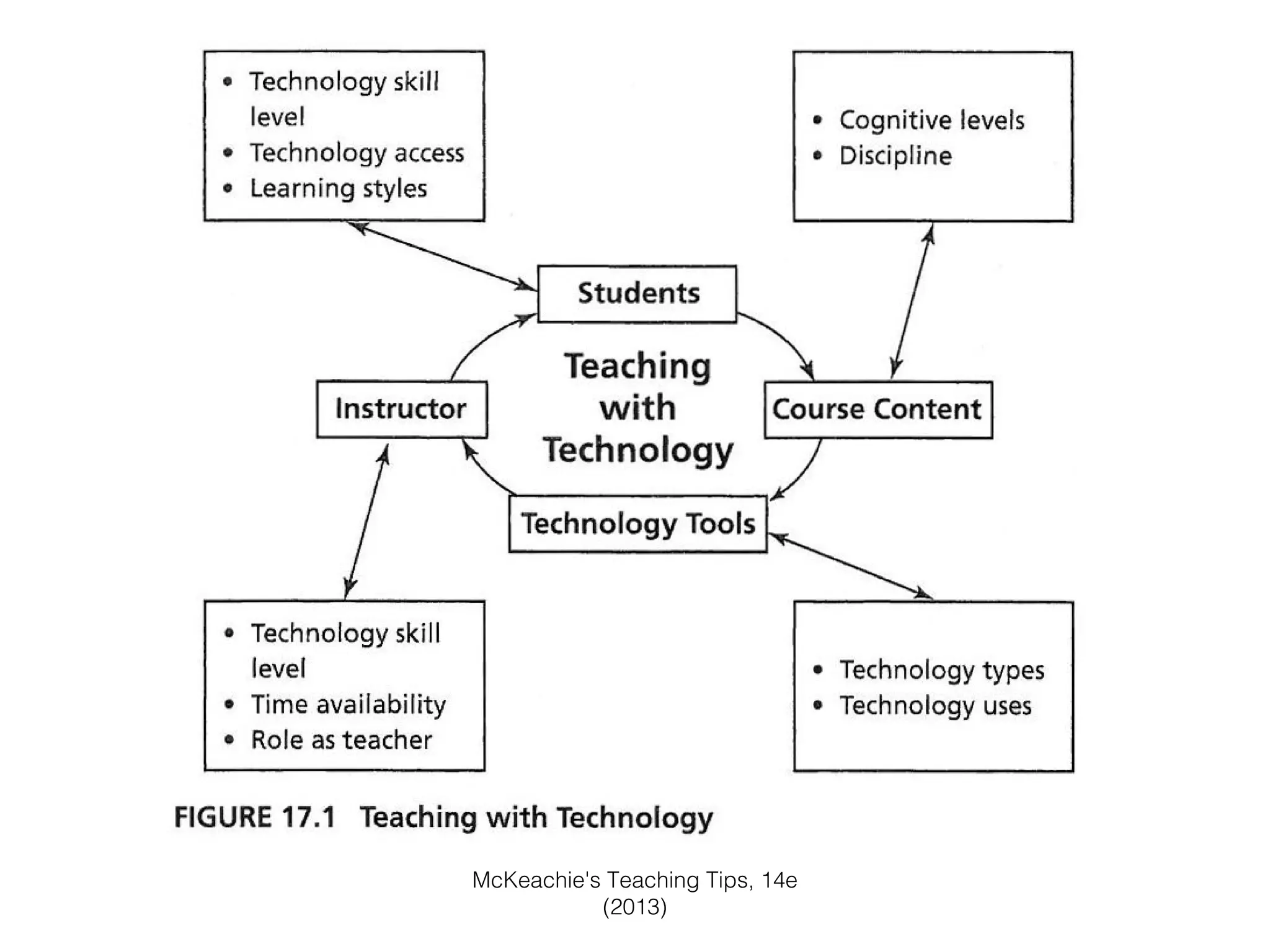
“Technology decisions are...teaching and
learning decisions.”
–McKeachie's Teaching Tips
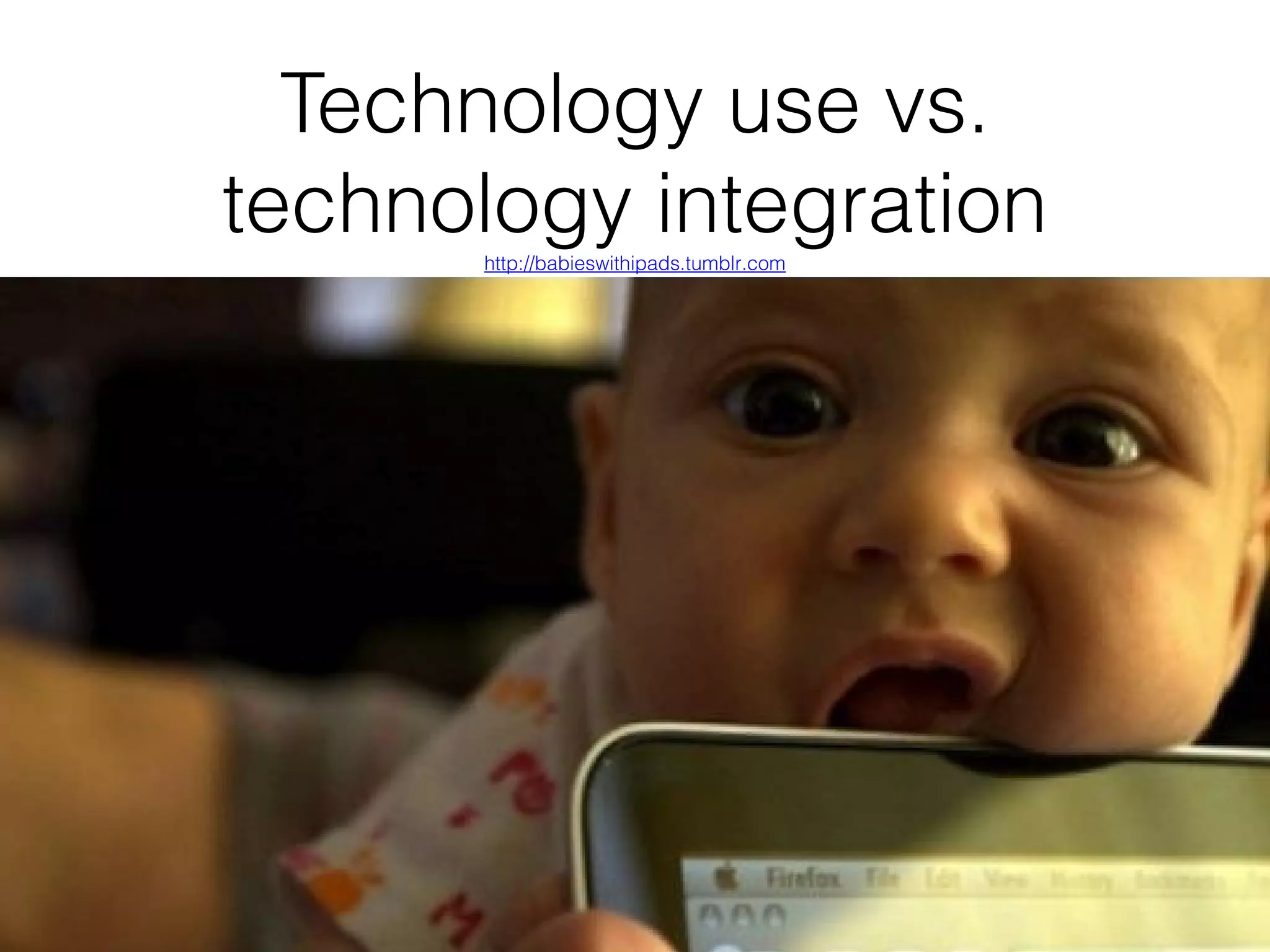
Technology use vs.
technology integration
http://babieswithipads.tumblr.com
Using technology...
http://babieswithipads.tumblr.com

•

Arbitrary

•

Random & sporadic

•

Focused on the technology

•

Used mostly by instructor to deliver content &
information

•

Used individually
Technology integration
http://babieswithipads.tumblr.com

•

Planned and purposeful

•

Part of the culture/environment of the classroom or
program

•

Supports learning objectives

•

Used mostly by the students to create, construct,
and connect knowledge

•

Used to facilitate collaboration
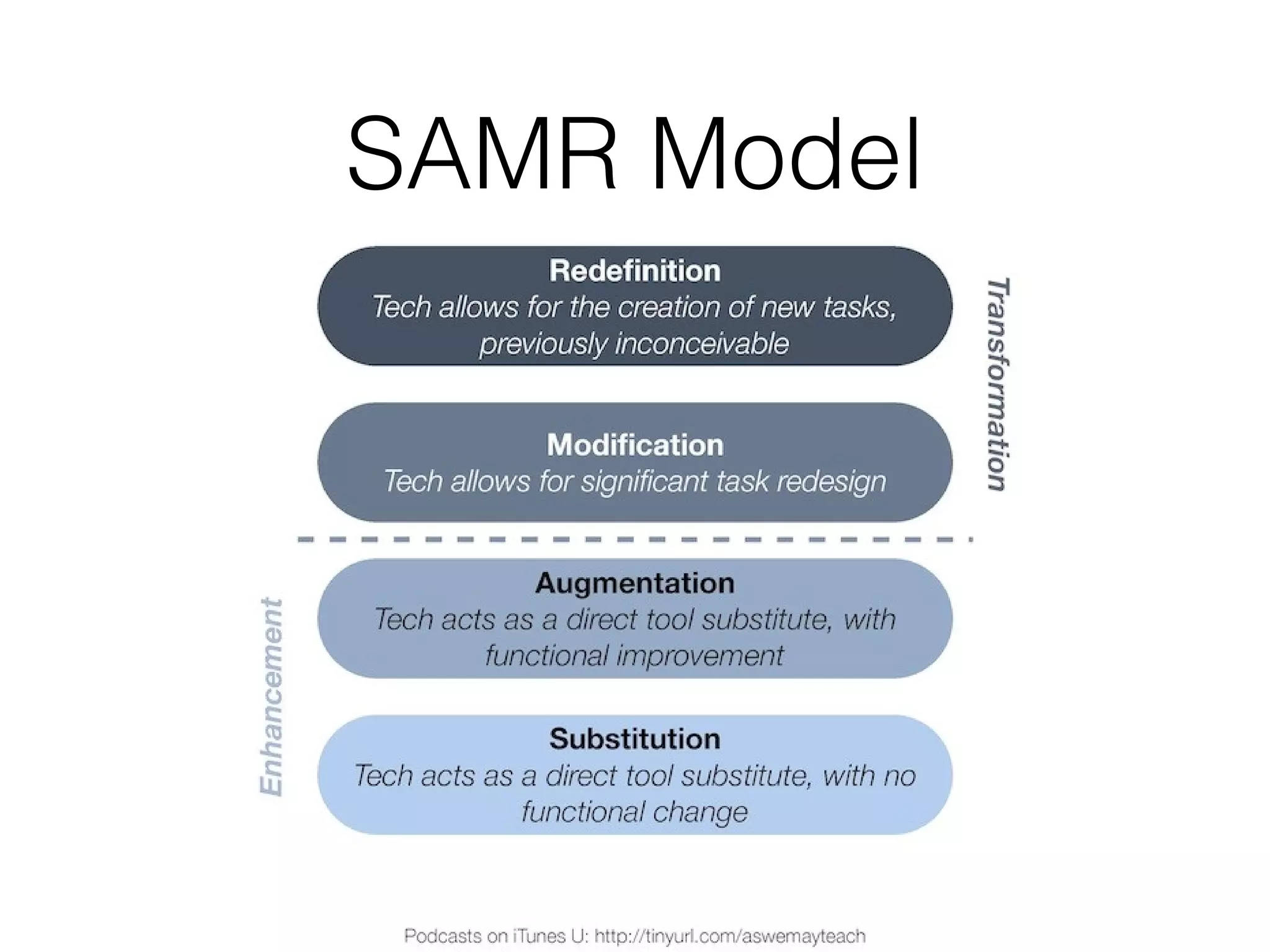
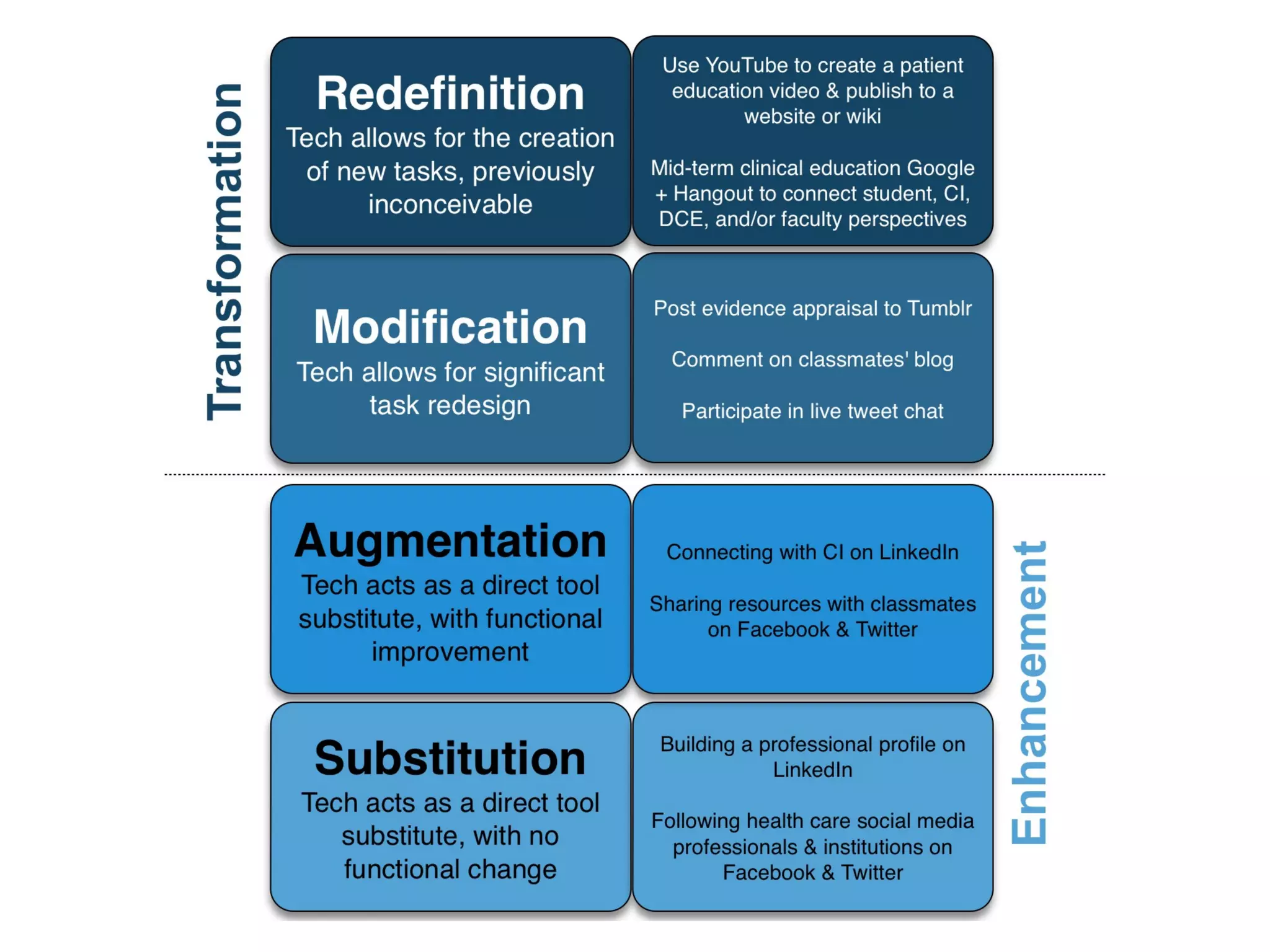
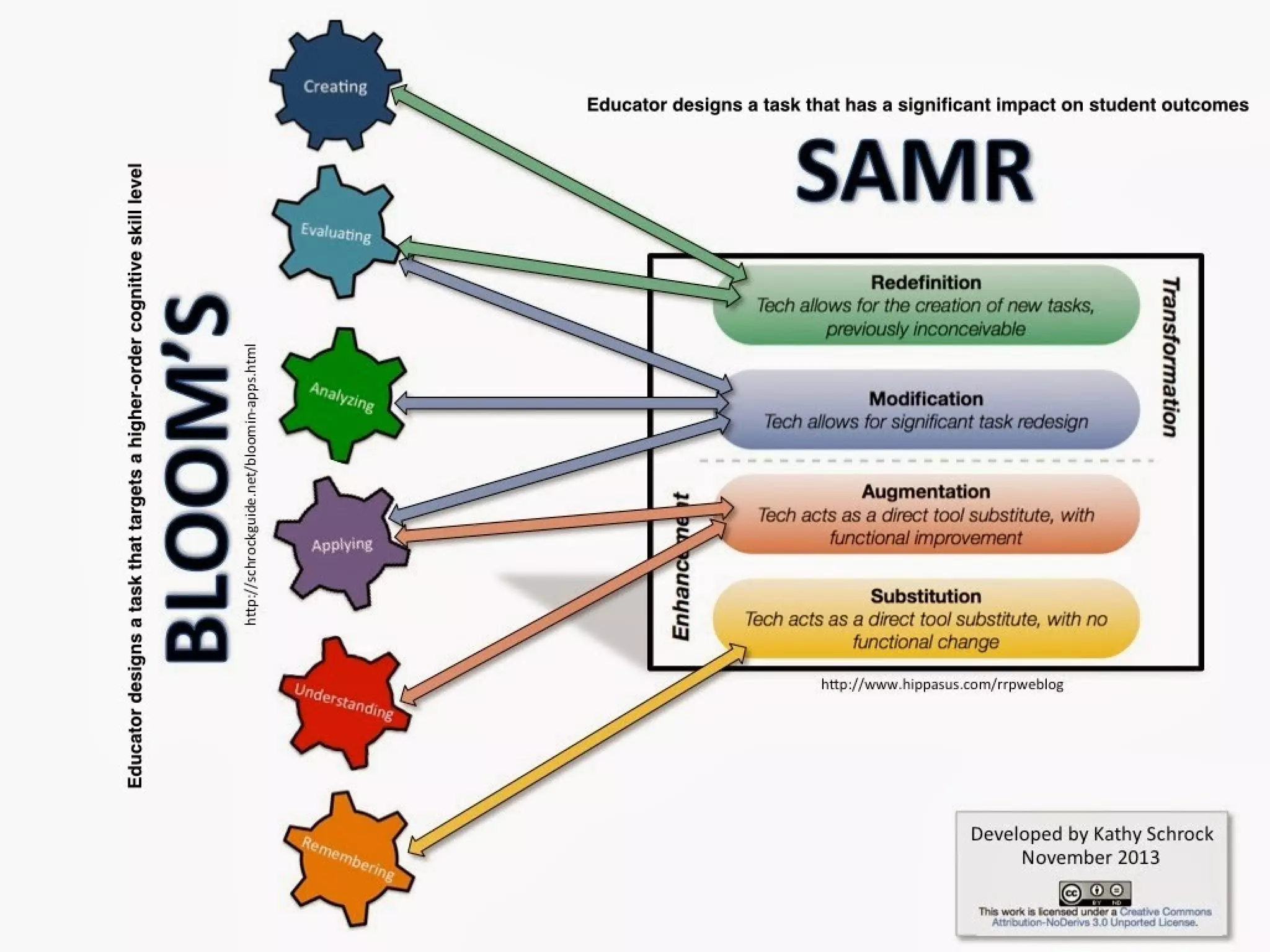
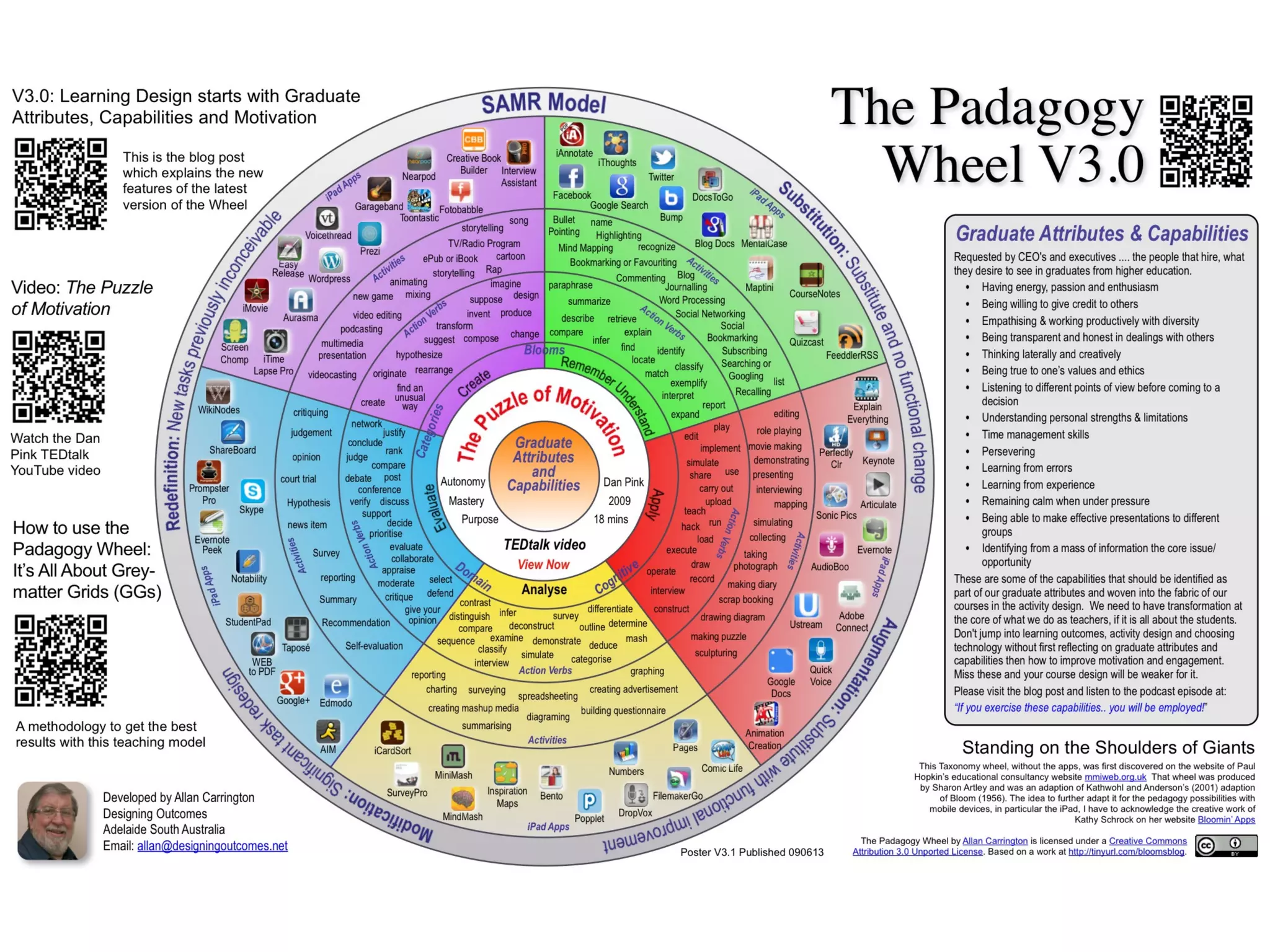
SAMR Model
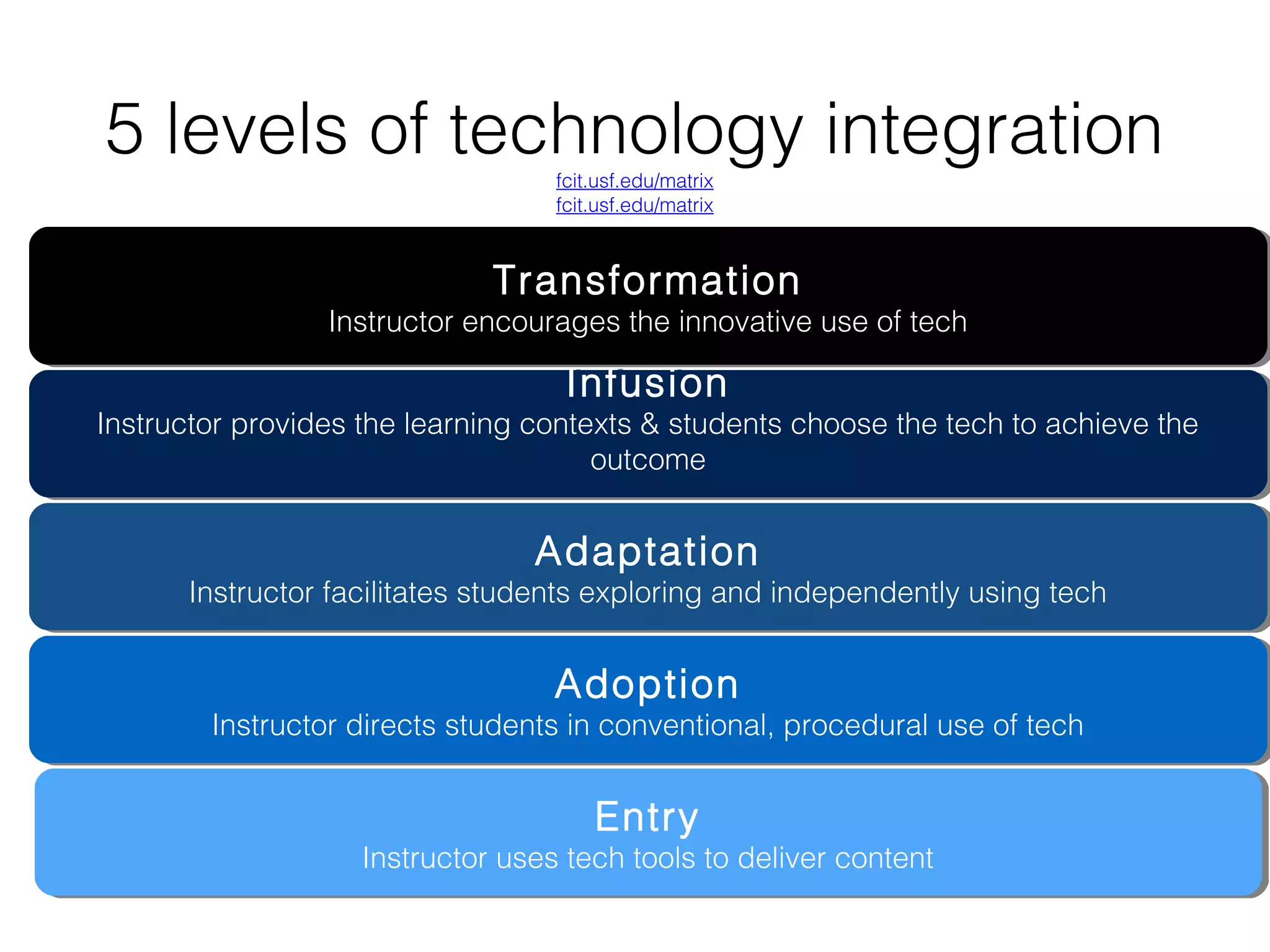
5 levels of technology integration
fcit.usf.edu/matrix
fcit.usf.edu/matrix

Transformation
Transformation

Instructor encourages the innovative use of tech

Infusion
Infusion

Instructor provides the learning contexts & students choose the tech to achieve the
outcome
outcome

Adaptation
Adaptation

Instructor facilitates students exploring and independently using tech

Adoption
Adoption

Instructor directs students in conventional, procedural use of tech

Entry
Entry

Instructor uses tech tools to deliver content
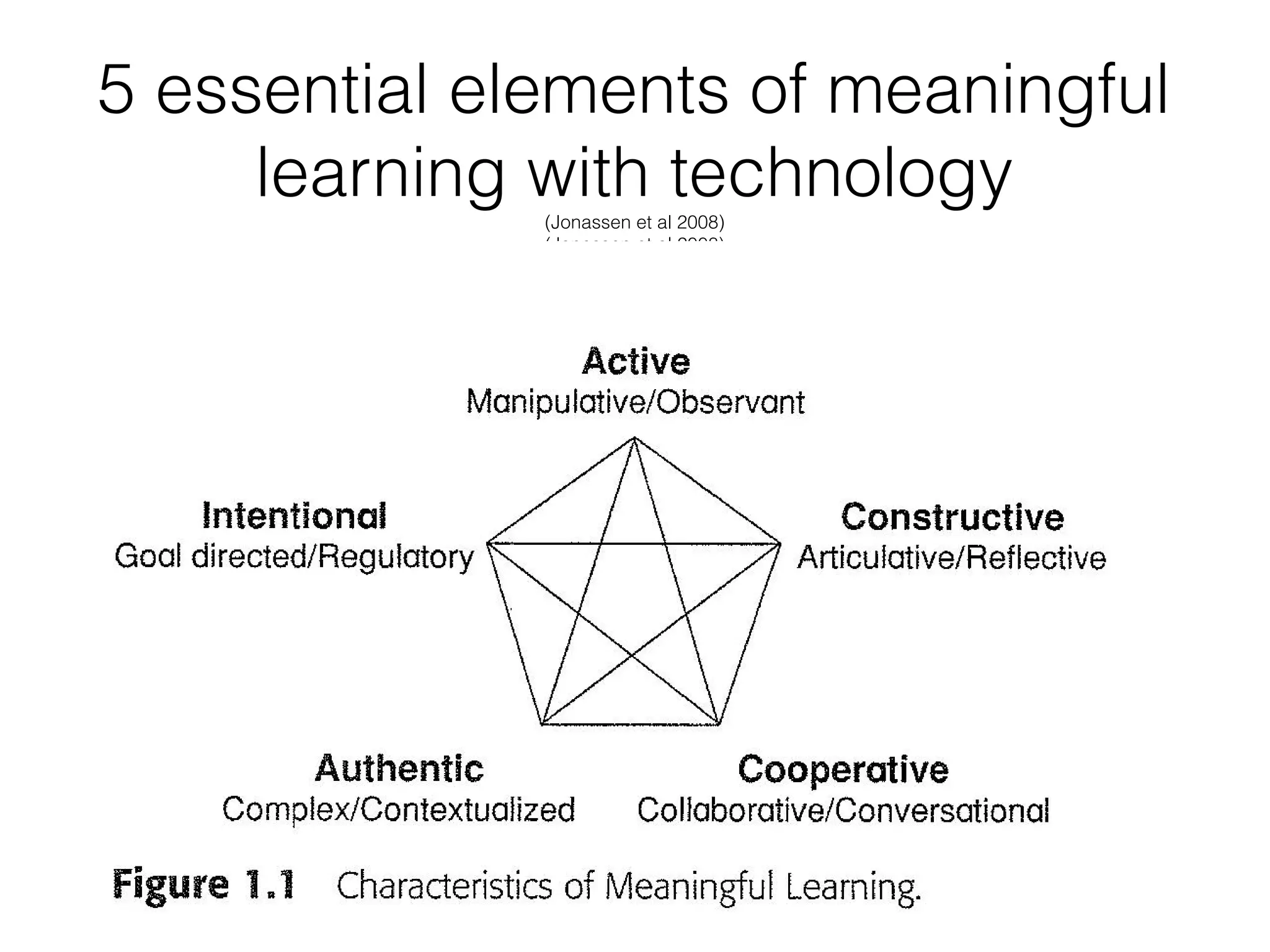
5 essential elements of meaningful
learning with technology
(Jonassen et al 2008)
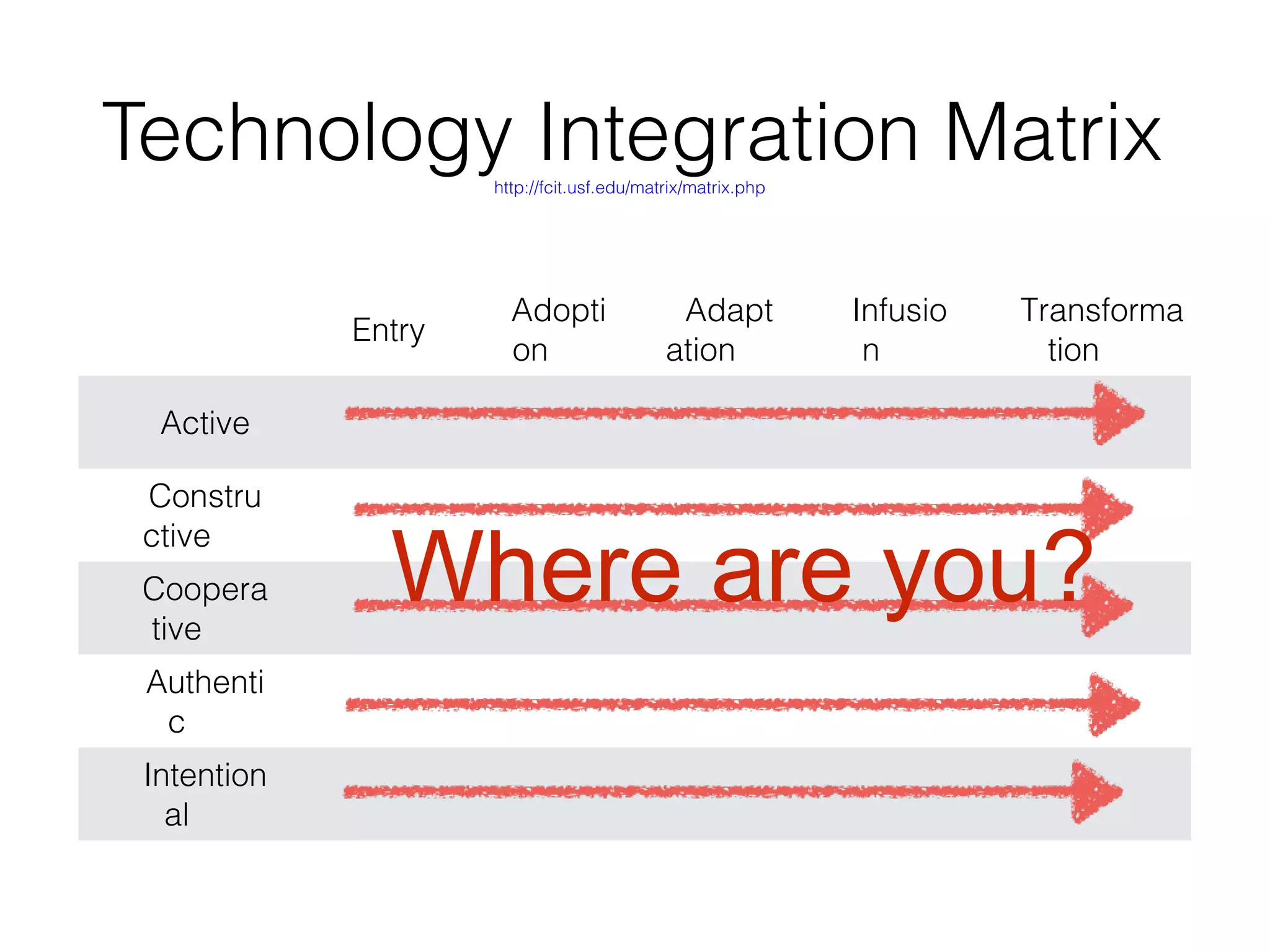
Technology Integration Matrix
http://fcit.usf.edu/matrix/matrix.php

Entry

Adopti
on

Adapt
ation

Infusio
n

Transforma
tion

Active
Constru
ctive
Coopera
tive
Authenti
c
Intention
al

Where are you?
McKeachie's Teaching Tips, 14e
(2013)
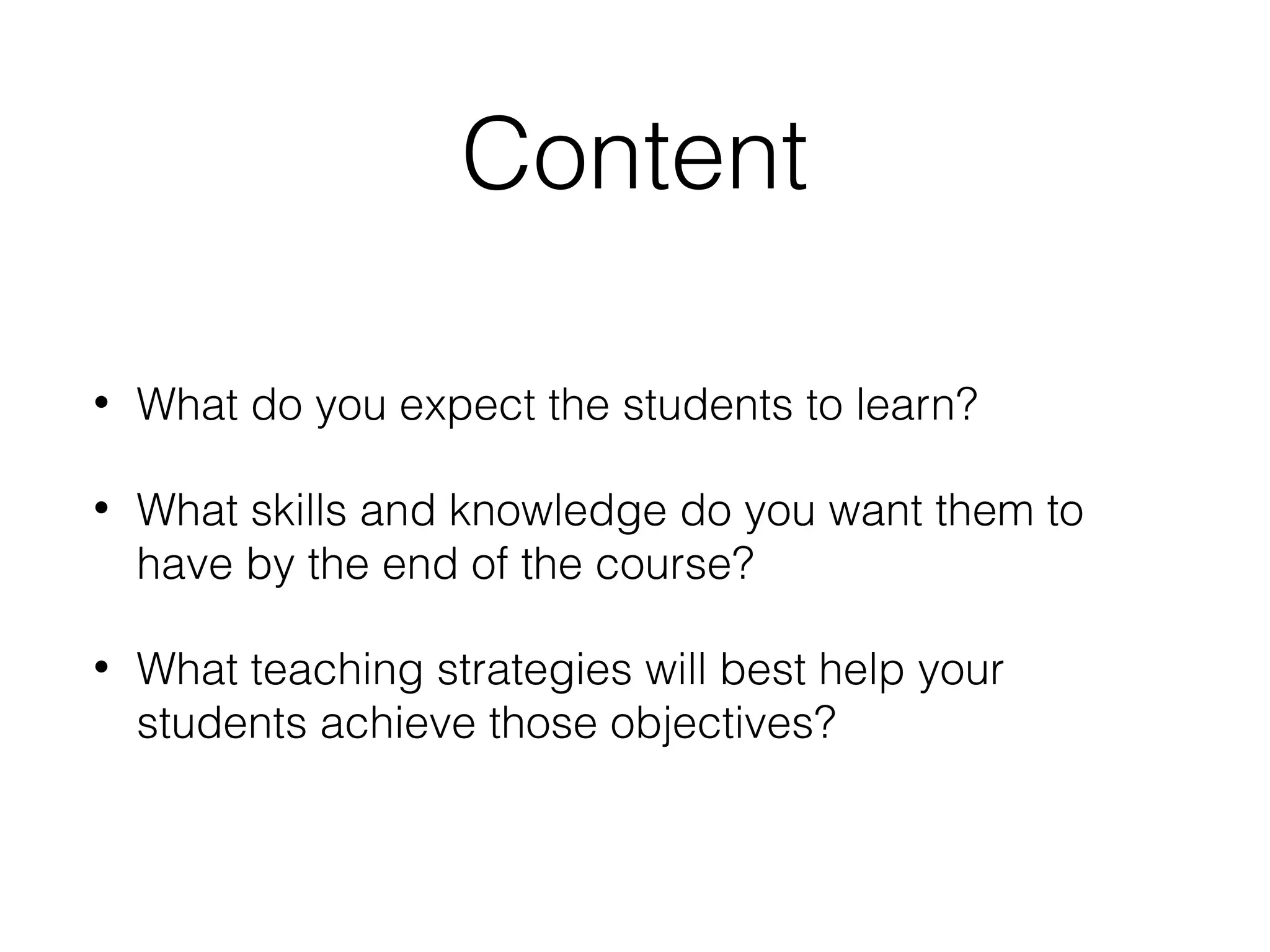
Content
•

What do you expect the students to learn?

•

What skills and knowledge do you want them to
have by the end of the course?

•

What teaching strategies will best help your
students achieve those objectives?
Students
•

What are the students' expectations of technology?

•

What are the students' experience with technology?

•

Can all students access the technology?

•

How will technology affect the roles and
responsibilities of the students?

•

What factors may influence student perception and
use of technology?
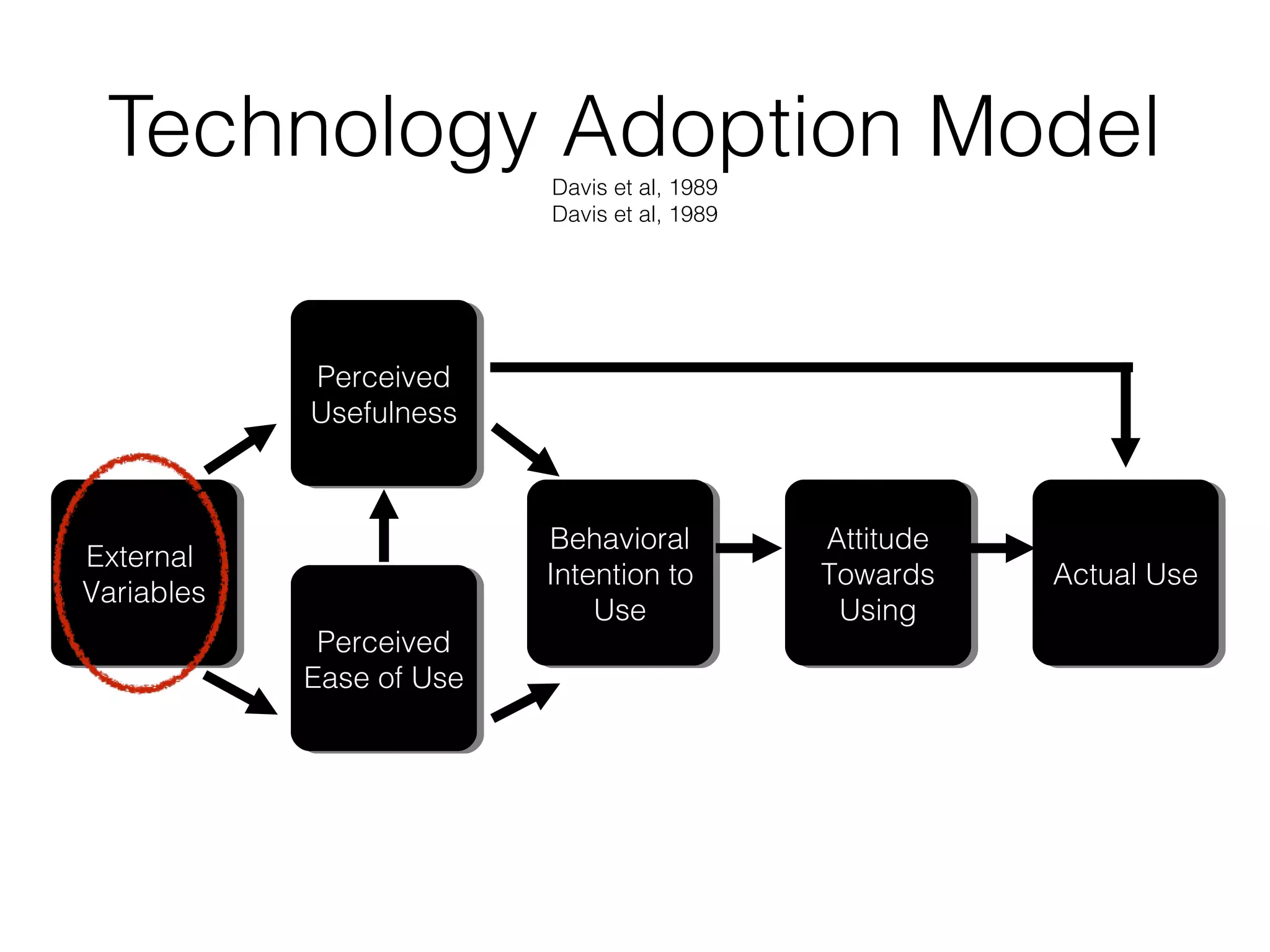
Technology Adoption Model
Davis et al, 1989
Davis et al, 1989

Perceived
Perceived
Usefulness
Usefulness

External
External
Variables
Variables
Perceived
Perceived
Ease of Use
Ease of Use

Behavioral
Behavioral
Intention to
Intention to
Use
Use

Attitude
Attitude
Towards
Towards
Using
Using

Actual Use
Actual Use
Instructor
•

How much skill/experience do you have using
technology?

•

How much time do you have?

•

What is your role as an instructor?

•

What are your expectations of technology?
Institution
•

Is the infrastructure in place for students to use the
technology?

•

What support services are available for the students
and instructor?

•

What is the technology "culture" of the institution?
Technology tools
•

Communication & collaboration

•

Presentation & information sharing

•

Information searching & resource management

•

Learning management systems
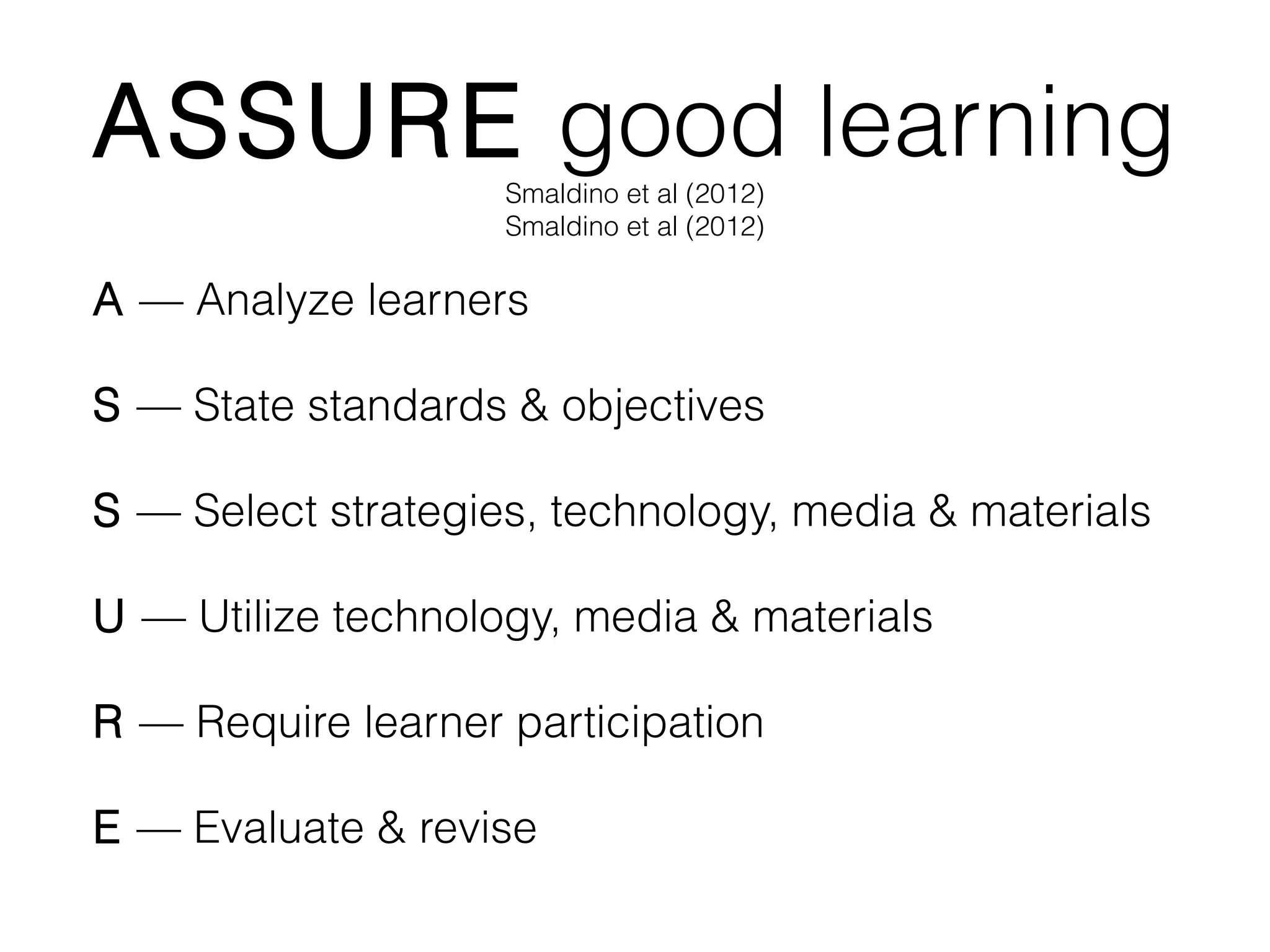
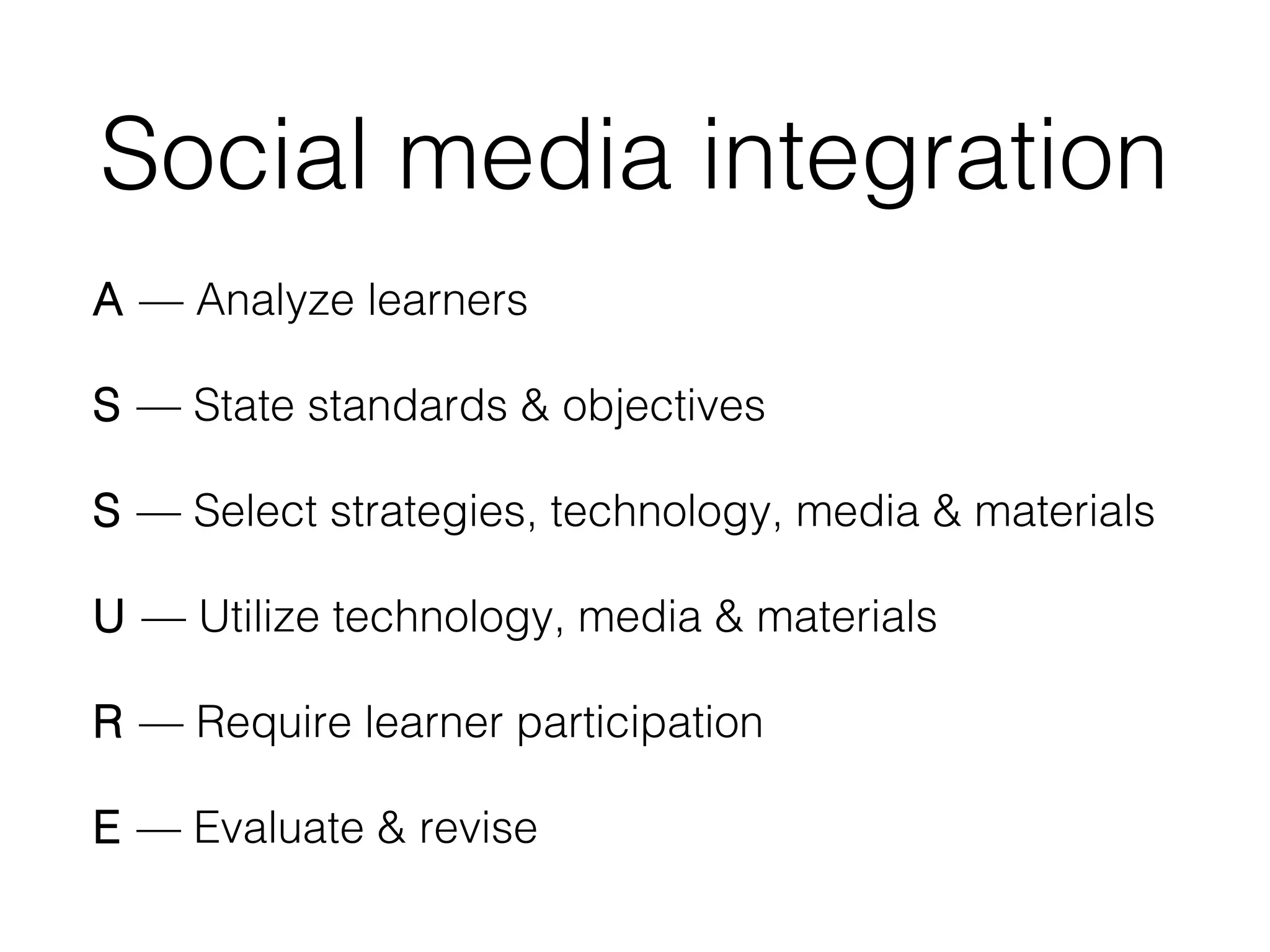
ASSURE good learning
Smaldino et al (2012)

A — Analyze learners
S — State standards & objectives
S — Select strategies, technology, media & materials
U — Utilize technology, media & materials
R — Require learner participation
E — Evaluate & revise
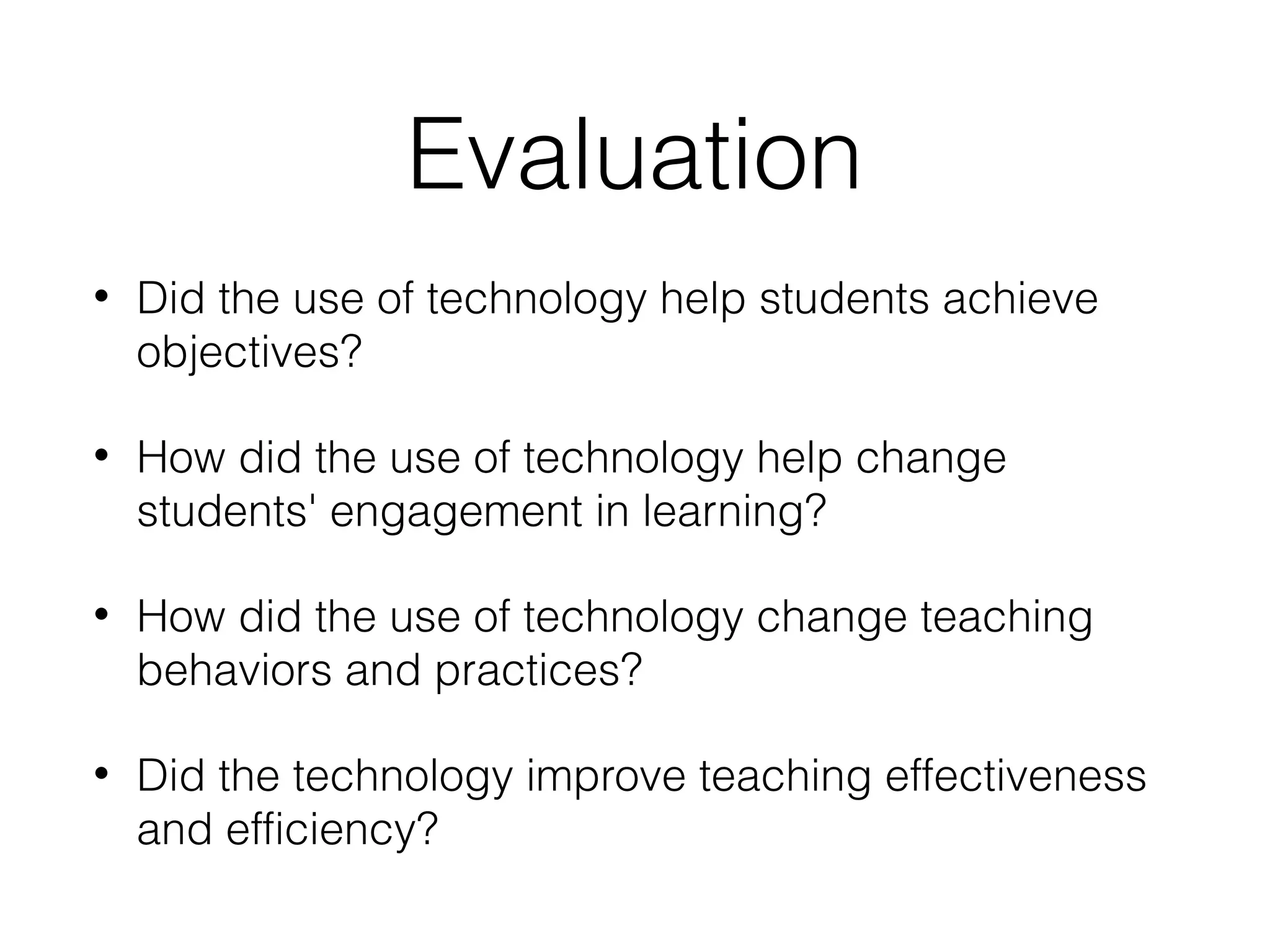
Evaluation
•

Did the use of technology help students achieve
objectives?

•

How did the use of technology help change
students' engagement in learning?

•

How did the use of technology change teaching
behaviors and practices?

•

Did the technology improve teaching effectiveness
and efficiency?
Strategy for
integrating
social media
into DPT
education

LinkedIn

Facebook

Twitter

Evidence du Jour
LHLR
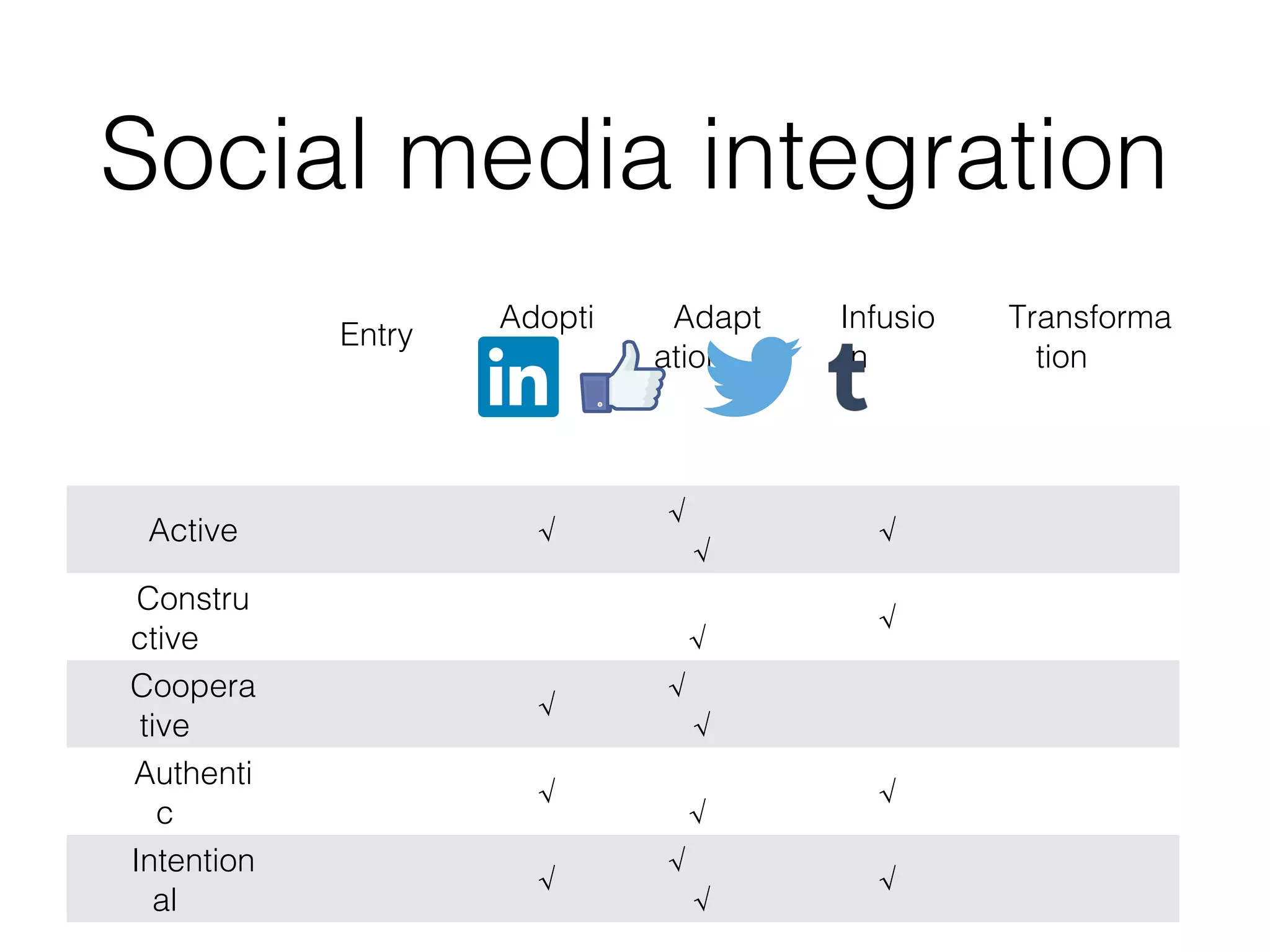
Social media integration
Entry

Active
Constru
ctive
Coopera
tive
Authenti
c
Intention
al

Adopti
on

√

Adapt
ation

√

√
√

√

√

√
√

√
√

√
√

√

Infusio
n

√

√
√

Transforma
tion
Social media integration
A — Analyze learners
S — State standards & objectives
S — Select strategies, technology, media & materials
U — Utilize technology, media & materials
R — Require learner participation
E — Evaluate & revise
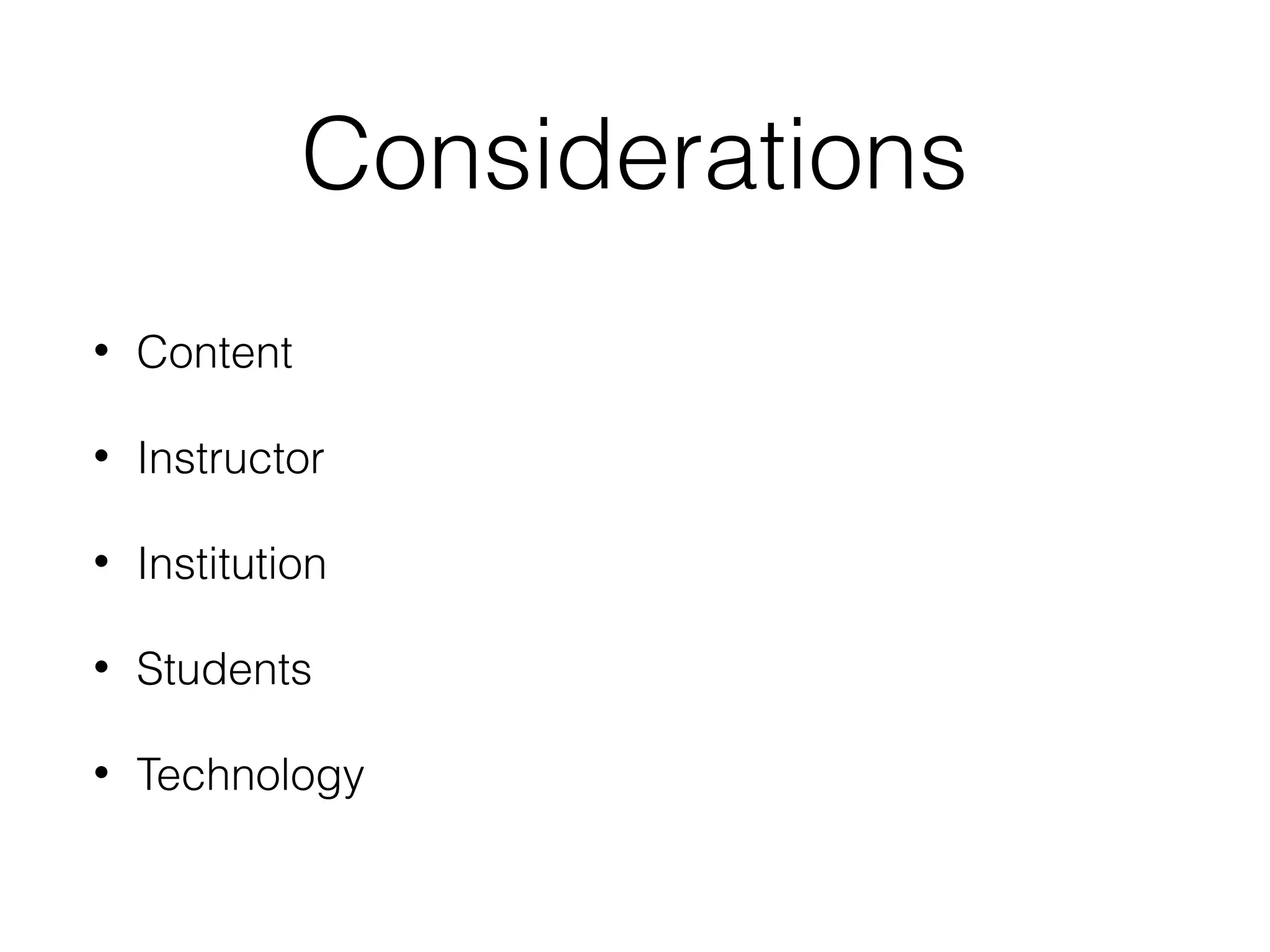
Considerations
•

Content

•

Instructor

•

Institution

•

Students

•

Technology
Integrative pedagogy
Kendra Gagnon, PhD, PT
@KendraPedPT
“Any teacher that can be replaced with a
computer, deserves to be.”
–David Thornburg
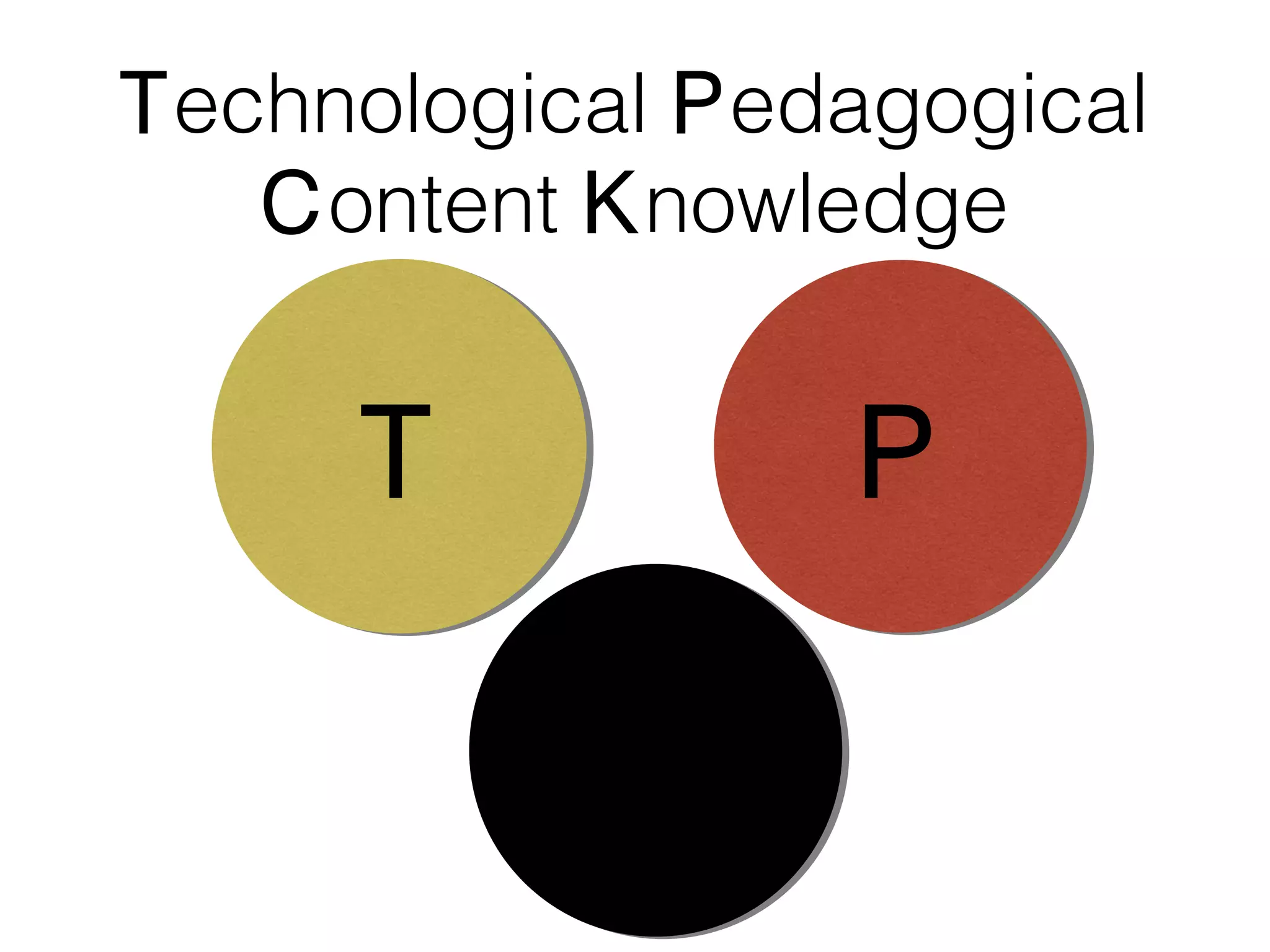
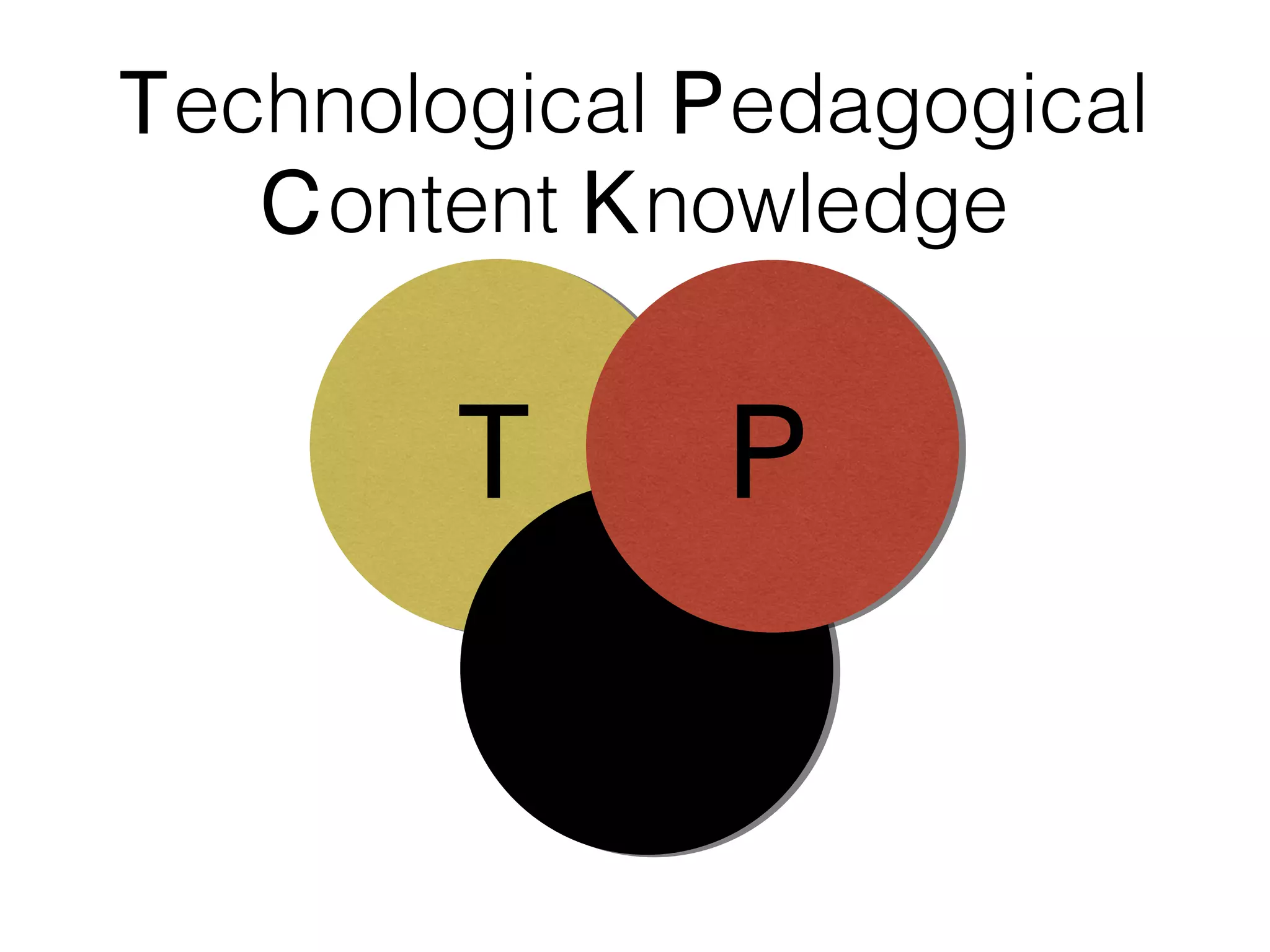
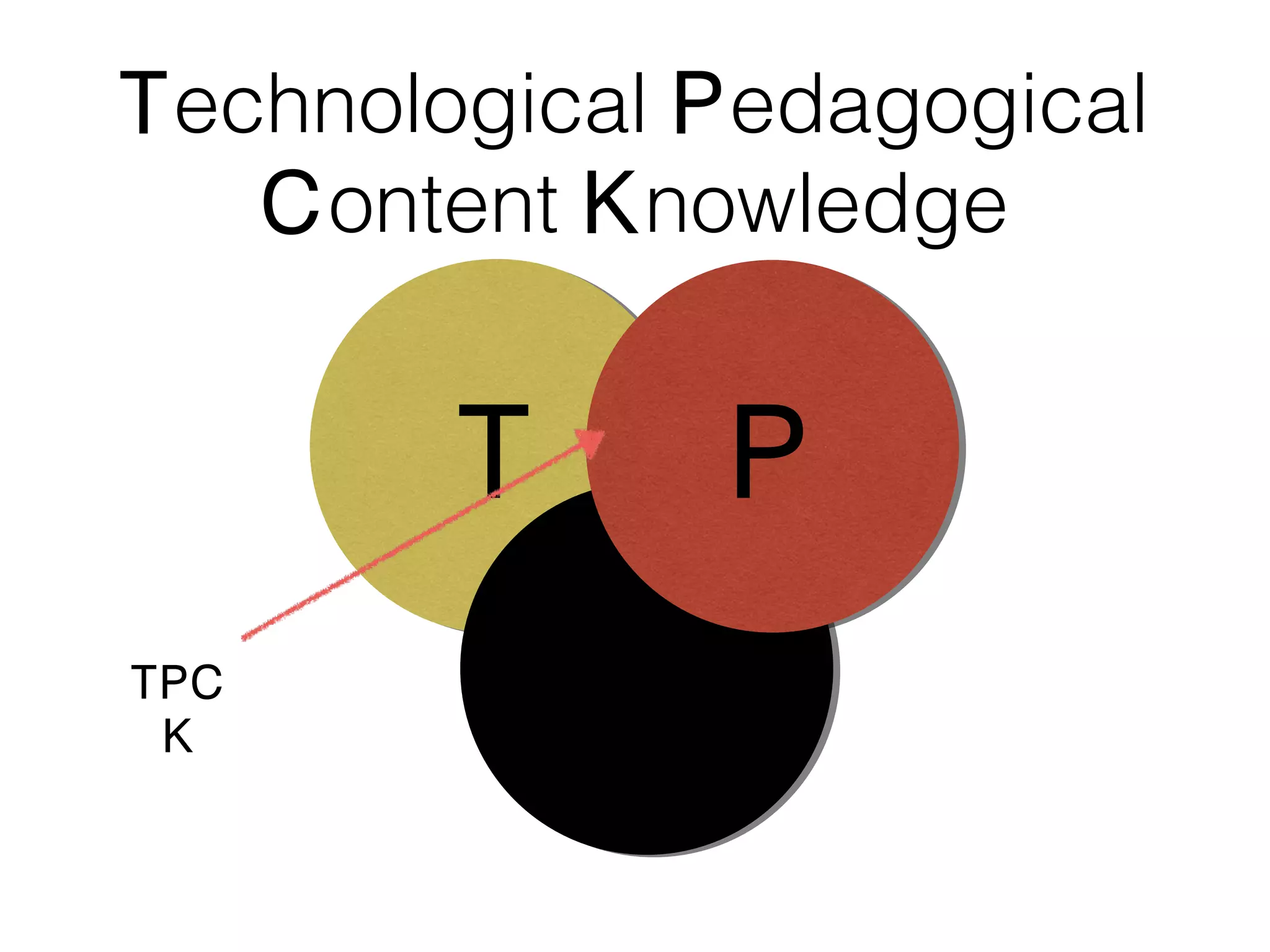
Technological Pedagogical
Content Knowledge

T

P
C
Technological Pedagogical
Content Knowledge

T

P
C
Technological Pedagogical
Content Knowledge

T
TPC
K

P
C
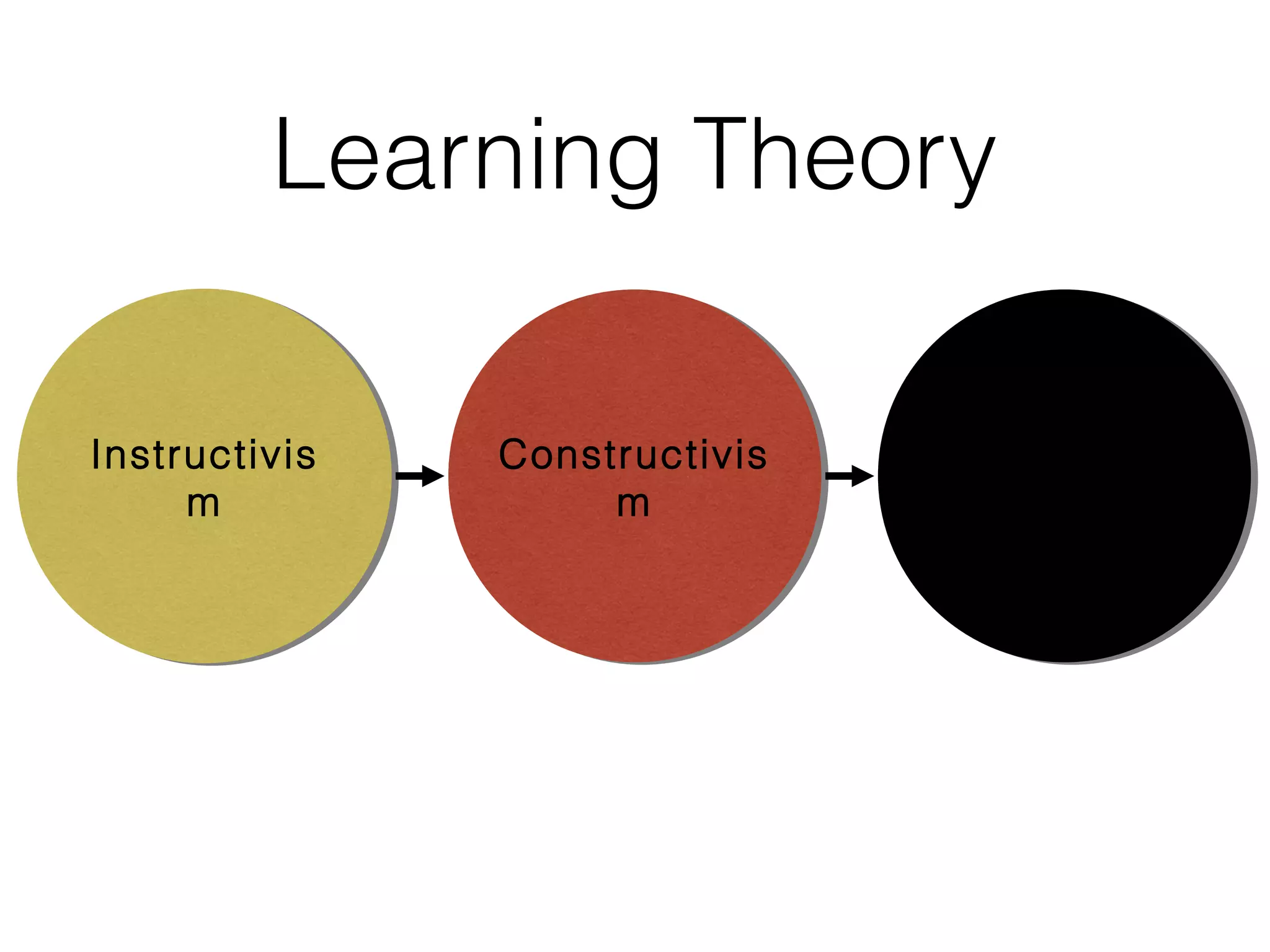
Learning Theory
Instructivis
m

Constructivis
m

Connectivis
m
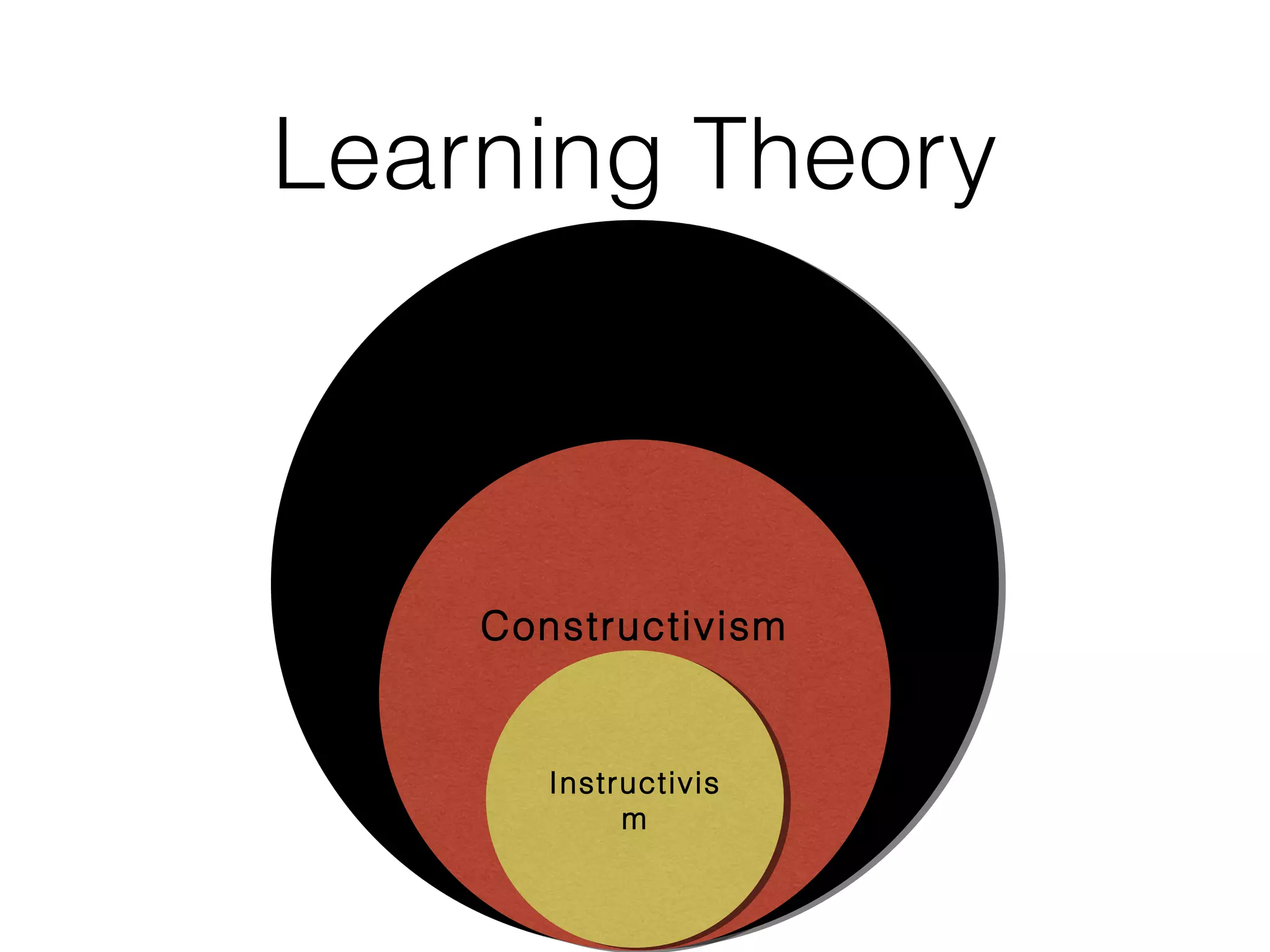
Learning Theory
Connectivism

Constructivism

Instructivis
m
Share 3 things you've learned today that
pollev.com/kendragagnon
Questions & Discussion

@ericrobertson
ekrdpt@gmail.com

@KendraPedPT
kendragagnon@gmail.com

@mpascoe
mike.pascoe@ucdenver.edu
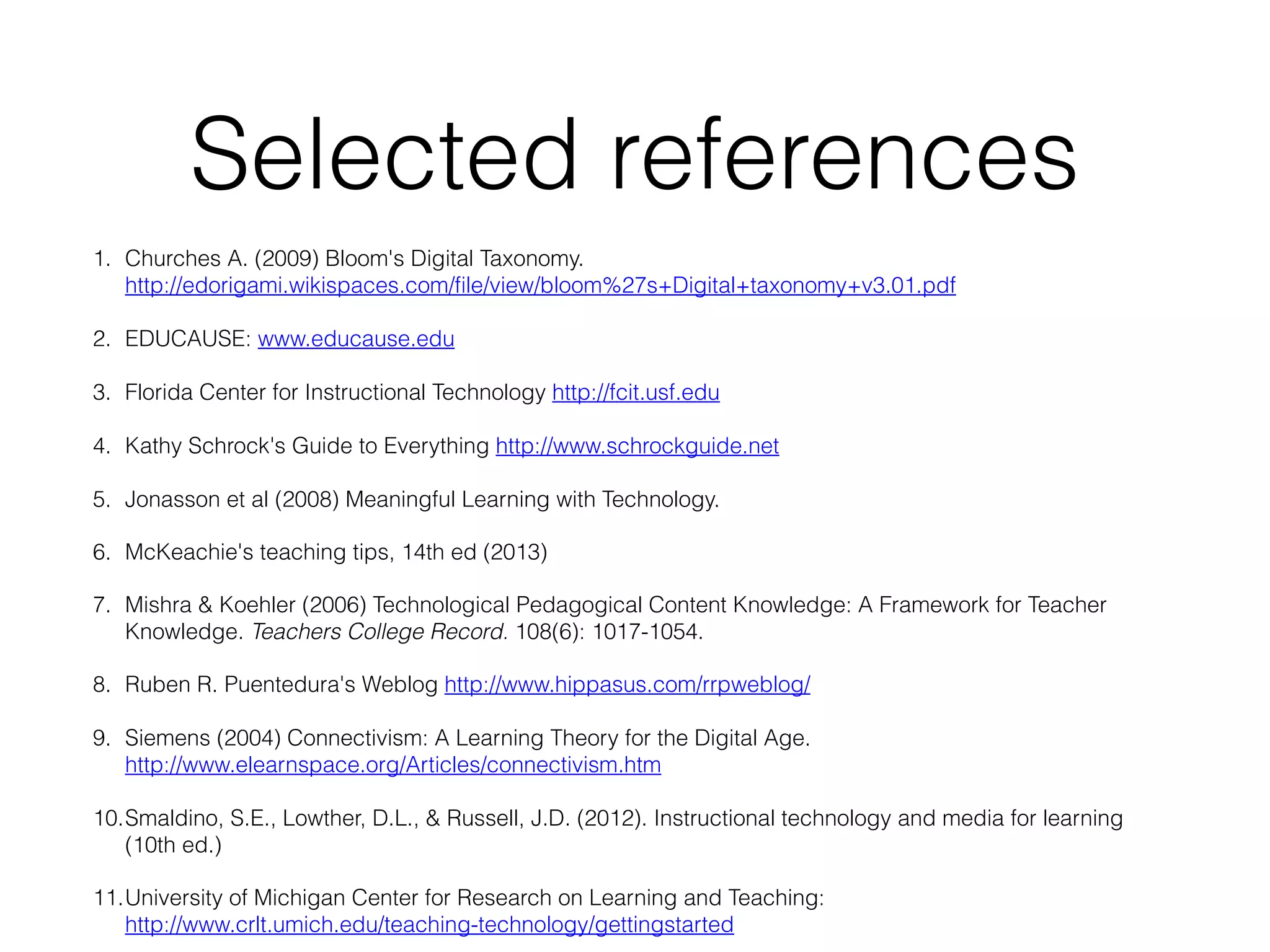
Selected references
1. Churches A. (2009) Bloom's Digital Taxonomy.
http://edorigami.wikispaces.com/file/view/bloom%27s+Digital+taxonomy+v3.01.pdf
2. EDUCAUSE: www.educause.edu
3. Florida Center for Instructional Technology http://fcit.usf.edu
4. Kathy Schrock's Guide to Everything http://www.schrockguide.net
5. Jonasson et al (2008) Meaningful Learning with Technology.
6. McKeachie's teaching tips, 14th ed (2013)
7. Mishra & Koehler (2006) Technological Pedagogical Content Knowledge: A Framework for Teacher
Knowledge. Teachers College Record. 108(6): 1017-1054.
8. Ruben R. Puentedura's Weblog http://www.hippasus.com/rrpweblog/
9. Siemens (2004) Connectivism: A Learning Theory for the Digital Age.
http://www.elearnspace.org/Articles/connectivism.htm
10.Smaldino, S.E., Lowther, D.L., & Russell, J.D. (2012). Instructional technology and media for learning
(10th ed.)
11.University of Michigan Center for Research on Learning and Teaching:
http://www.crlt.umich.edu/teaching-technology/gettingstarted

Strategies and Integrational Pedagogy for Instructional Technology

Editor's Notes

  • #12 Entry - instructor uses tech tools to deliver content, teacher is in control Adoption - instructor directs students in conventional, procedural use of tech, teacher makes decisions about when/how students use the technology, students need a procedural understanding Adaptation - instructor facilitates students exploring and independently using tech, teacher guides the students in using tech, students are able to use the tech independently without procedural instruction and begin to explore the technology Infusion - instructor provides the learning contexts and students choose the tech to achieve the outcome, a range of tech tools are integrated flexibly into the classroom, students make decisions about how to use technology Transformation - instructor encourages innovative use of tech, students are self-directed in using tech to facilitate higher order thinking and to complete learning activities not possible before Developed by Univ of Southern Florida for K-12 education. TIM focuses on pedagogy NOT tech tools. As you move up the levels, there is greater student ownership of learning, and a shift from procedural to conceptual understanding, a move from conventional to complex use, a shift from lower-order to higher-order thinking and skills
  • #13 Active - students are actively engaged in using tech Cooperative - students use tech to collaborate with others Constructive - students use tech to connect new information to their prior knowledge Authentic - students use tech to link learning activities to the "real world" Intentional - students use tech to set goals, plan activities, monitor progress, and evaluate results
  • #17 Big mistake - assuming students are "digital natives" and will just get it. Digital native coined by Marc Prensky in 2001. Although this terminology is thrown about frequently in popular media, it is at best simplified and at worst inaccurate. Studies show that there continues to be a "digital divide" among young people (usually due to access or parental restrictions) and that young people who do use tech use it in a very narrow way (texting, gaming, media consumption such as watching movies).There may not be as vast a difference between old and young generations as we once thought, and students certainly continue to need teachers to guide them in using tech in a relevant way.
  • #20 Available IT resources and support Wireless internet access and capacity on campus How apps will be purchased and distributed (for iPads)
  • #22 ASSURE starts with looking at the learner in detail. Define your audience. Understand their general characteristics Nothing you plan or design is effective unless you have taken the time to look at the learners. Knowing as much as possible about your learners is critical to design and implementation of instruction. Second, the second letter in ASSURE, S, refers to knowing the intended outcomes or expectations. No instruction should begin without everyone having a clear understanding of what is supposed to happen in the instruction. Objectives should be stated in terms of what the learner will do. The second S refers to selecting your media and materials. In steps 1 and 2, you have defined the beginning point (audience characteristics and skills) and end point (outcomes). Now you have to build an instructional bridge to connect those two points. The next step is Using your media and materials. Preview and practice yourself, then roll out the lesson with students. Require learner performance. Students need to actively use the tech, practice, and receive feedback. The final component is to evaluate and revise. Evaluate the entire process. Gather data on outcomes and impressions from the learners. Did the learners meet the objectives? Were the media and materials effective? Did the learners use the materials properly? Identify discrepancies between what you intended and what actually happened, and make revisions.
  • #24 Quickly define: LinkedIn - professional networking Facebook - social network Twitter - microblog Tumblr - blogging site
  • #25 SAMR to guide learning activities
  • #26 Simplification, but illustrates
  • #27 A — Analyze learners: learners are changing. Started with only 3 on Twitter and a handful with smartphones. Now majority on Twitter & almost all with smart phone, tablet, or both. S — State standards & objectives - reviewed with SAMR S — Select strategies, technology, media & materials - discussed U — Utilize technology, media & materials - discussed R — Require learner participation - have done this. Always offer alternatives, never any push back on the front end. E — Evaluate & revise - early objectives to inc engagement and learning outcomes. Did not show inc. Evolved to be about online professionalism communication, and considering one's digital "footprint." We are well-aligned with that goal now. None of these tools can replace an LMS - learning how to integrate these tools with Blackboard

  • #28 Content - prof/Clin Ed was a better fit than ped PT Instructor - I had to know the platforms, difficulty with integration across courses due to diff instructor skill sets, various levels of interest & support from CIs Institution - wireless good on campus, but issues with blocked sites or wifi access at clinical sites Students - students know FB, but need to be taught other sites. Various levels of skill and interest. Access not an issue. Technology - concern with privacy, prof/pers boundaries
  • #35 Pedagogy should drive tech use, not the other way around. If you are using tech well, you should leverage it to increase interaction w/ students
  • #37 Content knowledge (CK) is knowledge about the actual subject matter that is to be learned or taught Pedagogical knowledge (PK) is deep knowledge about the processes and practices or methods of teaching and learning and how it encompasses, among other things, overall educational purposes, values, and aims. Technology knowledge (TK) is knowledge about standard technologies.
  • #38 PCK - knowledge of pedagogy that is applicable to the teaching of specific content. This knowledge includes knowing what teaching approaches fit the content, and likewise, knowing how elements of the content can be arranged for better teaching. This knowledge is different from the knowledge of a disciplinary expert and also from the general pedagogical knowledge shared by teachers across disciplines. Technological content knowledge (TCK) is knowledge about the manner in which technology and content are reciprocally related. Although technology constrains the kinds of representations possible, newer technologies often afford newer and more varied representations and greater flexibility in navigating across these representations. Teachers need to know not just the subject matter they teach but also the manner in which the subject matter can be changed by the application of technology. Technological pedagogical knowledge (TPK) is knowledge of the existence, components, and capabilities of various technologies as they are used in teaching and learning settings, and conversely, knowing how teaching might change as the result of using particular technologies. This might include an understanding that a range of tools exists for a particular task, the ability to choose a tool based on its fitness, strategies for using the tool’s affordances, and knowledge of pedagogical strategies and the ability to apply those strategies for use of technologies.
  • #39 Technological pedagogical content knowledge (TPCK) is an emergent form of knowledge that goes beyond all three components (content, pedagogy, and technology). TPCK is the basis of good teaching with technology and requires an understanding of the representation of concepts using technologies; pedagogical techniques that use technologies in constructive ways to teach content; knowledge of what makes concepts difficult or easy to learn and how technology can help redress some of the problems that students face; knowledge of students’ prior knowledge and theories of epistemology; and knowledge of how technologies can be used to build on existing knowledge and to develop new epistemologies or strengthen old ones.
  • #42 Instructivism Teacher- and institutionally-centered. Knowledge is created by instructors and institutions and is delivered to students. Teachers and institutions create the processes and conditions for success. Constructivism Teacher moves into facilitator role, promoting peer-to-peer learning. Students create and construct their own knowledge, building on foundations of previous learning. Knowledge is socially constructed Knowledge is external to the user and learning is the act of internalizing knowledge Learning is a social process Meaning is created by the learner Connectivism Lots of overlap with constructivism. Relationships and networks are a primary source of learning. Focuses on building a network of knowledge sources to access whenever you need them. Knowledge rests in diversity of opinions Learning is a process of connecting information sources & may reside in non-human devices Capacity to know is more critical than what is known Nurturing and maintaining connections is needed to facilitate continual learning Ability to see connections between fields, ideas, and concepts is a core skill Decision-making itself is a learning process. Choosing what to learn and the meaning of incoming information is seen through the lens of a shifting reality (meta-cognition).
  • #43 Instructivism Teacher- and institutionally-centered. Knowledge is created by instructors and institutions and is delivered to students. Teachers and institutions create the processes and conditions for success. Constructivism Teacher moves into facilitator role, promoting peer-to-peer learning. Students create and construct their own knowledge, building on foundations of previous learning. Knowledge is socially constructed Knowledge is external to the user and learning is the act of internalizing knowledge Learning is a social process Meaning is created by the learner Connectivism Lots of overlap with constructivism. Relationships and networks are a primary source of learning. Focuses on building a network of knowledge sources to access whenever you need them. Knowledge rests in diversity of opinions Learning is a process of connecting information sources & may reside in non-human devices Capacity to know is more critical than what is known Nurturing and maintaining connections is needed to facilitate continual learning Ability to see connections between fields, ideas, and concepts is a core skill Decision-making itself is a learning process. Choosing what to learn and the meaning of incoming information is seen through the lens of a shifting reality (meta-cognition).
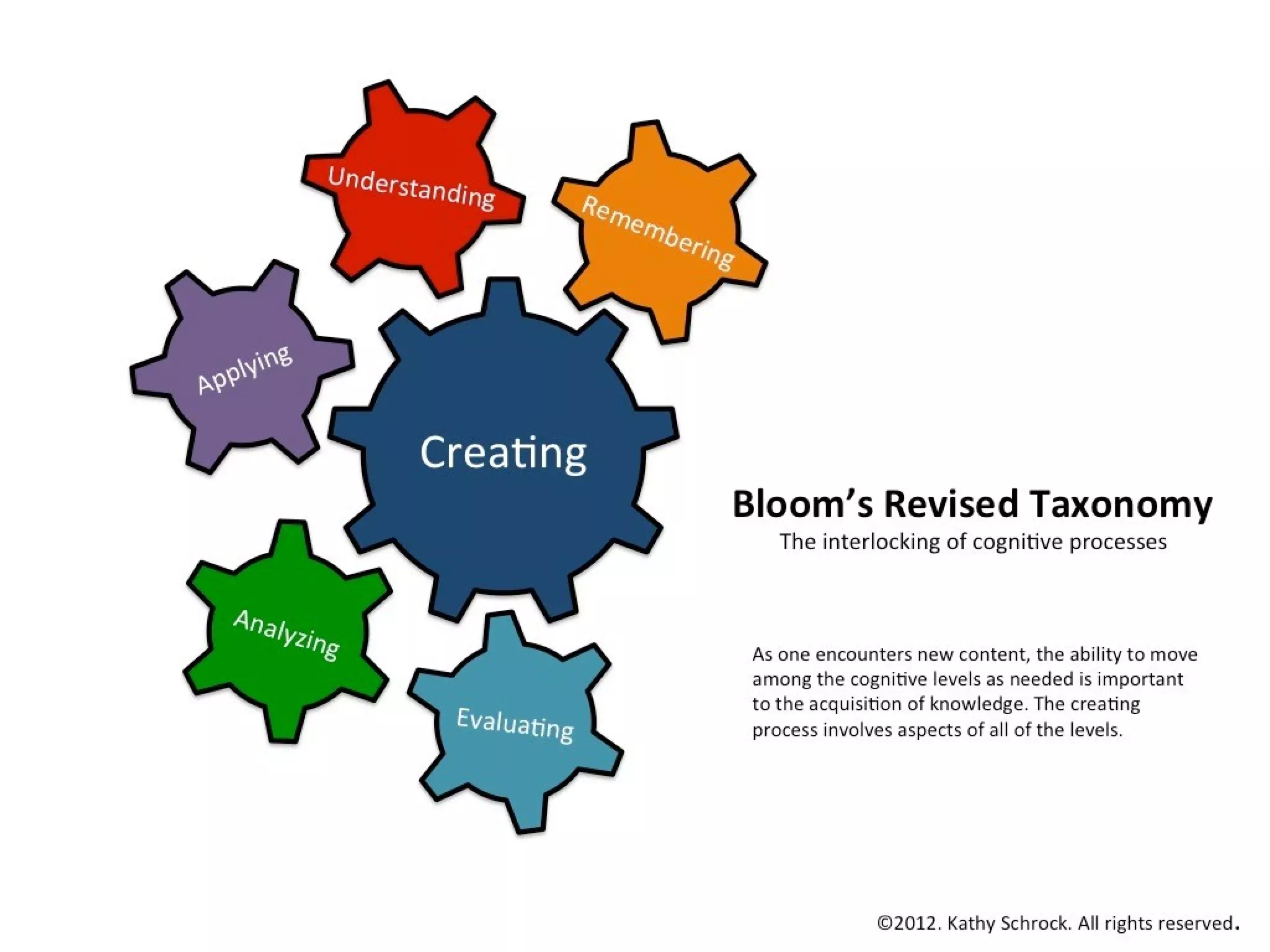
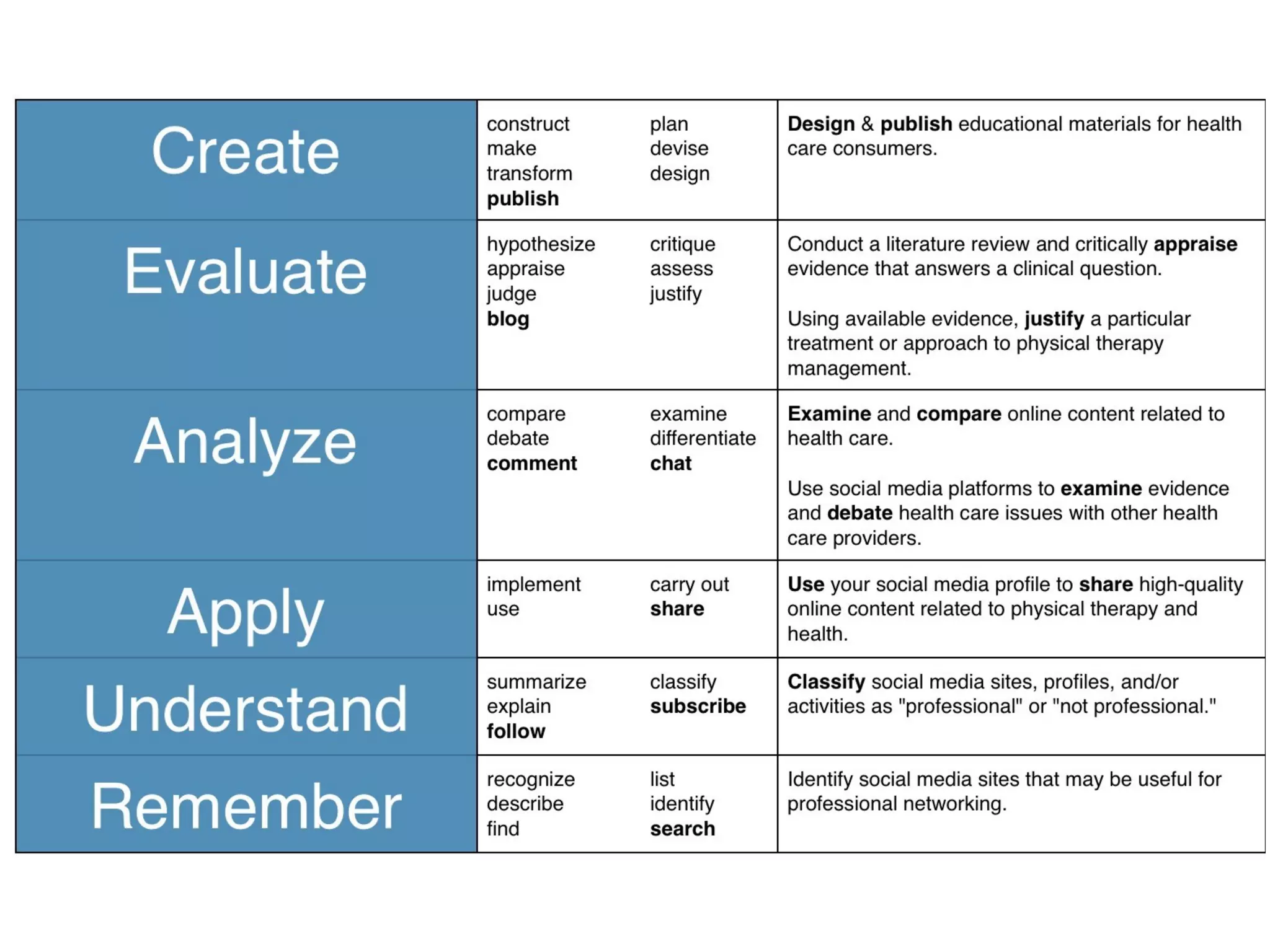
  • #47 Bloom's to guide objectives
  • #50 SAMR to guide learning activities
  • #55 Open and showcase Explain Everything. YouTube channel
  • #57 LinkedIn profile
  • #58 Required,June 2012 3 weekly tweet chats + #FF, 7 total tweets required All 36 students, 9.36 tweets/student (range 7-18) 60 outsiders Optional, April 2013 4 weekly live tweet chats, none required 19.06 tweets/student (range 2-79) 4 additional faculty, 3 alumni, 9 outsiders
  • #61 Future outcomes - rubric for quality of tweets/posts, quality of social media profiles