Mobile Banking
Group-3
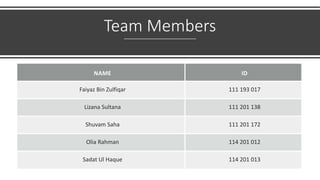
Team Members
NAME ID
Faiyaz Bin Zulfiqar 111 193 017
Lizana Sultana 111 201 138
Shuvam Saha 111 201 172
Olia Rahman 114 201 012
Sadat Ul Haque 114 201 013
Mobile Banking
Mobile banking is a method that allows customers of financial institutions to do a
range of financial transactions using a cell phone or personal digital assistant.
Prior to the launch and activation of mobile web services back in 1999, m - banking
was done mostly through SMS or text which is also referred to as SMS banking.
The Deutsche Bank was the first financial institution to provide Mobile banking.
For the first time in Bangladesh, Dutch Bangla Bank Ltd (DBBL) introduced a mobile
banking service called "Rocket" in May.
The evolution of Mobile
banking in Bangladesh
• Earliest form delivered through SMS
• Then came mobile web-based channels
• Today, it is served through mobile
applications such as bKash and Rocket–
since 2010, rocket was launched by Dutch
Bangla Bank Limited and later bKash by
Brac Bank. Soon, 11 more applications for
mobile banking were launched by several
banks for their clients.
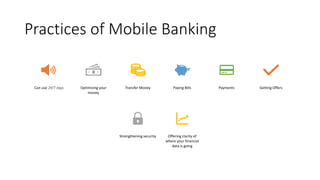
Practices of Mobile Banking
Can use 24/7 days Optimizing your
money
Transfer Money Paying Bills Payments Getting Offers
Strengthening security Offering clarity of
where your financial
data is going
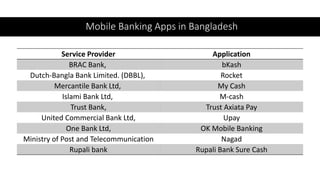
Mobile Banking Apps in Bangladesh
Service Provider Application
BRAC Bank, bKash
Dutch-Bangla Bank Limited. (DBBL), Rocket
Mercantile Bank Ltd, My Cash
Islami Bank Ltd, M-cash
Trust Bank, Trust Axiata Pay
United Commercial Bank Ltd, Upay
One Bank Ltd, OK Mobile Banking
Ministry of Post and Telecommunication Nagad
Rupali bank Rupali Bank Sure Cash
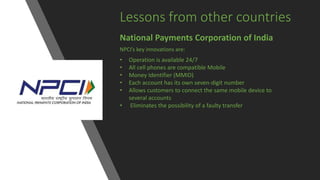
Lessons from other countries
National Payments Corporation of India
NPCI’s key innovations are:
• Operation is available 24/7
• All cell phones are compatible Mobile
• Money Identifier (MMID)
• Each account has its own seven-digit number
• Allows customers to connect the same mobile device to
several accounts
• Eliminates the possibility of a faulty transfer
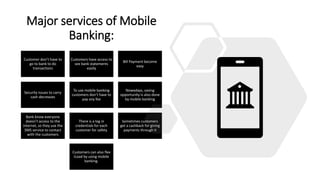
Major services of Mobile
Banking:
Customer don’t have to
go to bank to do
transactions
Customers have access to
see bank statements
easily
Bill Payment become
easy
Security issues to carry
cash decreases
To use mobile banking
customers don’t have to
pay any fee
Nowadays, saving
opportunity is also done
by mobile banking
Bank know everyone
doesn’t access to the
internet, so they use the
SMS service to contact
with the customers
There is a log in
credentials for each
customer for safety
Sometimes customers
get a cashback for giving
payments through it
Customers can also flex
iLoad by using mobile
banking.
Remarkable
Contribution
in The
Pandemic
• Cash-in, Cash-out, P2P transactions are most
used services in the pandemic.
• P2P transaction increased to BDT 19146.25
crore in July 2020
• Utility bill payment and salary disbursement
(B2P) increased to BDT 992.94 and BDT
4586.97 crore
• In 2020-2021, mobile banking also sees
a high remittance transactions.
Challenges
faced for
doing business
Even though mobile banking has given convenience to
the consumer, it comes with its own drawbacks.
•Accessibility through the mediums: The variance in
design of cell phones causes issues.
•The ability to give personalized options: Customer
want more personalized experience
•Distribution of application: The ability to provide
application within time
•Security concerns: Cell Phones can be lost anywhere,
so security breaches are meant to be happened.
•Scalability: Upward trends of adapting to technology
would lead to gaining more customer
•Reliability: The security concerns along with position in
market would challenge the reliability of the banks.
•The ability of synchronizing upgrades: The software
side of the banks need to have the ability to synchronize
the upgrades.
Future
opportunities
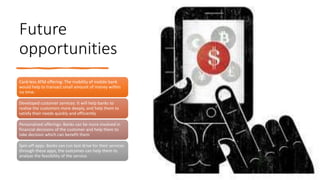
Card-less ATM offering: The mobility of mobile bank
would help to transact small amount of money within
no time.
Developed customer services: It will help banks to
realize the customers more deeply, and help them to
satisfy their needs quickly and efficiently
Personalized offerings: Banks can be more involved in
financial decisions of the customer and help them to
take decision which can benefit them
Spin-off apps: Banks can run test drive for their services
through these apps, the outcomes can help them to
analyze the feasibility of the service.
• Mobile banking is expected to have more than one
billion users by 2024. As of 2020, up to 1.9 billion
people used online banking services globally, with
that figure predicted to climb to 2.5 billion by 2024.
• In January 2020, Bangladesh had 80.92 million
registered M - banking customers, which had
increased dramatically to 92.57 million in July.
• The use of artificial intelligence through chatbots
and voice bots is predicted to reach $7.3 billion by
2023, which can help reduce costs and enhance
profitability by attracting more customers.
Conclusion
The END PLEASE YOU HAVE ANY INQUIRY
PLEASE ASK

Mobile Banking Group-3.pptx

  • 1.
  • 2.
    Team Members NAME ID FaiyazBin Zulfiqar 111 193 017 Lizana Sultana 111 201 138 Shuvam Saha 111 201 172 Olia Rahman 114 201 012 Sadat Ul Haque 114 201 013
  • 3.
    Mobile Banking Mobile bankingis a method that allows customers of financial institutions to do a range of financial transactions using a cell phone or personal digital assistant. Prior to the launch and activation of mobile web services back in 1999, m - banking was done mostly through SMS or text which is also referred to as SMS banking. The Deutsche Bank was the first financial institution to provide Mobile banking. For the first time in Bangladesh, Dutch Bangla Bank Ltd (DBBL) introduced a mobile banking service called "Rocket" in May.
  • 4.
    The evolution ofMobile banking in Bangladesh • Earliest form delivered through SMS • Then came mobile web-based channels • Today, it is served through mobile applications such as bKash and Rocket– since 2010, rocket was launched by Dutch Bangla Bank Limited and later bKash by Brac Bank. Soon, 11 more applications for mobile banking were launched by several banks for their clients.
  • 5.
    Practices of MobileBanking Can use 24/7 days Optimizing your money Transfer Money Paying Bills Payments Getting Offers Strengthening security Offering clarity of where your financial data is going
  • 6.
    Mobile Banking Appsin Bangladesh Service Provider Application BRAC Bank, bKash Dutch-Bangla Bank Limited. (DBBL), Rocket Mercantile Bank Ltd, My Cash Islami Bank Ltd, M-cash Trust Bank, Trust Axiata Pay United Commercial Bank Ltd, Upay One Bank Ltd, OK Mobile Banking Ministry of Post and Telecommunication Nagad Rupali bank Rupali Bank Sure Cash
  • 7.
    Lessons from othercountries National Payments Corporation of India NPCI’s key innovations are: • Operation is available 24/7 • All cell phones are compatible Mobile • Money Identifier (MMID) • Each account has its own seven-digit number • Allows customers to connect the same mobile device to several accounts • Eliminates the possibility of a faulty transfer
  • 8.
    Major services ofMobile Banking: Customer don’t have to go to bank to do transactions Customers have access to see bank statements easily Bill Payment become easy Security issues to carry cash decreases To use mobile banking customers don’t have to pay any fee Nowadays, saving opportunity is also done by mobile banking Bank know everyone doesn’t access to the internet, so they use the SMS service to contact with the customers There is a log in credentials for each customer for safety Sometimes customers get a cashback for giving payments through it Customers can also flex iLoad by using mobile banking.
  • 9.
    Remarkable Contribution in The Pandemic • Cash-in,Cash-out, P2P transactions are most used services in the pandemic. • P2P transaction increased to BDT 19146.25 crore in July 2020 • Utility bill payment and salary disbursement (B2P) increased to BDT 992.94 and BDT 4586.97 crore • In 2020-2021, mobile banking also sees a high remittance transactions.
  • 10.
    Challenges faced for doing business Eventhough mobile banking has given convenience to the consumer, it comes with its own drawbacks. •Accessibility through the mediums: The variance in design of cell phones causes issues. •The ability to give personalized options: Customer want more personalized experience •Distribution of application: The ability to provide application within time •Security concerns: Cell Phones can be lost anywhere, so security breaches are meant to be happened. •Scalability: Upward trends of adapting to technology would lead to gaining more customer •Reliability: The security concerns along with position in market would challenge the reliability of the banks. •The ability of synchronizing upgrades: The software side of the banks need to have the ability to synchronize the upgrades.
  • 11.
    Future opportunities Card-less ATM offering:The mobility of mobile bank would help to transact small amount of money within no time. Developed customer services: It will help banks to realize the customers more deeply, and help them to satisfy their needs quickly and efficiently Personalized offerings: Banks can be more involved in financial decisions of the customer and help them to take decision which can benefit them Spin-off apps: Banks can run test drive for their services through these apps, the outcomes can help them to analyze the feasibility of the service.
  • 12.
    • Mobile bankingis expected to have more than one billion users by 2024. As of 2020, up to 1.9 billion people used online banking services globally, with that figure predicted to climb to 2.5 billion by 2024. • In January 2020, Bangladesh had 80.92 million registered M - banking customers, which had increased dramatically to 92.57 million in July. • The use of artificial intelligence through chatbots and voice bots is predicted to reach $7.3 billion by 2023, which can help reduce costs and enhance profitability by attracting more customers. Conclusion
  • 13.
    The END PLEASEYOU HAVE ANY INQUIRY PLEASE ASK