


Center for Disruptive Technologies
Presented at Business & Financial Times of Ghana
Conference on Mobile Banking & Payment Solutions
22 March 2017
The Tanga Hotel
Accra
Transform
Exponential Africa
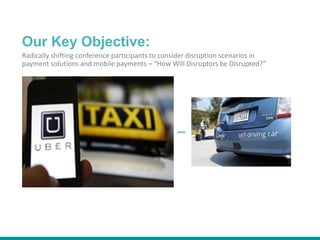
Our Key Objective:
Radically shifting conference participants to consider disruption scenarios in
payment solutions and mobile payments – “How Will Disruptors be Disrupted?”
Thinking Differently to
Think Exponentially
Why every business
leader should know and
care about the impact of
disruptive technologies
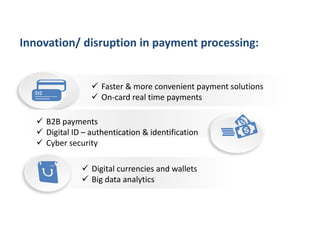
 Faster & more convenient payment solutions
 On-card real time payments
 Digital currencies and wallets
 Big data analytics
 B2B payments
 Digital ID – authentication & identification
 Cyber security
Innovation/ disruption in payment processing:
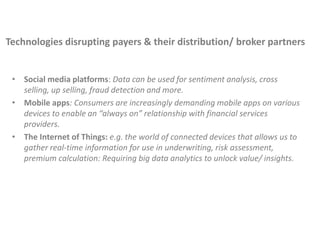
• Social media platforms: Data can be used for sentiment analysis, cross
selling, up selling, fraud detection and more.
• Mobile apps: Consumers are increasingly demanding mobile apps on various
devices to enable an “always on” relationship with financial services
providers.
• The Internet of Things: e.g. the world of connected devices that allows us to
gather real-time information for use in underwriting, risk assessment,
premium calculation: Requiring big data analytics to unlock value/ insights.
Technologies disrupting payers & their distribution/ broker partners
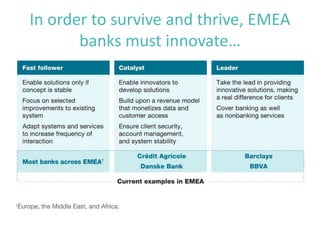
In order to survive and thrive, EMEA
banks must innovate…
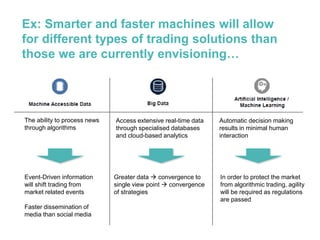
The ability to process news
through algorithms
Event-Driven information
will shift trading from
market related events
Faster dissemination of
media than social media
Access extensive real-time data
through specialised databases
and cloud-based analytics
Greater data  convergence to
single view point  convergence
of strategies
Automatic decision making
results in minimal human
interaction
In order to protect the market
from algorithmic trading, agility
will be required as regulations
are passed
Ex: Smarter and faster machines will allow
for different types of trading solutions than
those we are currently envisioning…
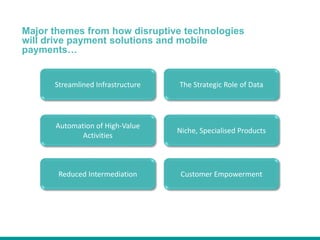
Streamlined Infrastructure
Automation of High-Value
Activities
Reduced Intermediation
The Strategic Role of Data
Niche, Specialised Products
Customer Empowerment
Major themes from how disruptive technologies
will drive payment solutions and mobile
payments…
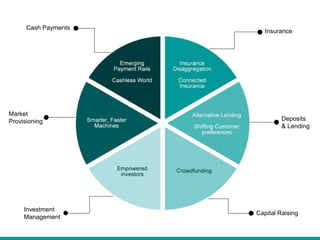
Insurance
Capital Raising
Investment
Management
Cash Payments
Market
Provisioning Deposits
& Lending
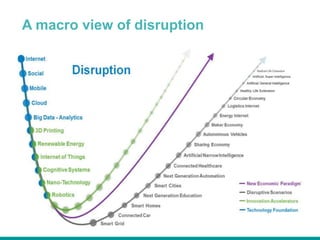
A macro view of disruption
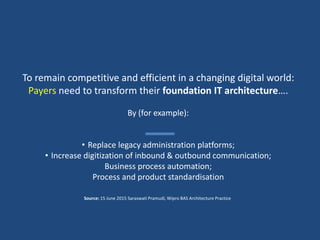
To remain competitive and efficient in a changing digital world:
Payers need to transform their foundation IT architecture….
By (for example):
• Replace legacy administration platforms;
• Increase digitization of inbound & outbound communication;
Business process automation;
Process and product standardisation
Source: 15 June 2015 Saraswati Pramudi, Wipro BAS Architecture Practice
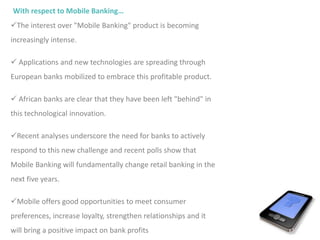
With respect to Mobile Banking…
The interest over "Mobile Banking" product is becoming
increasingly intense.
 Applications and new technologies are spreading through
European banks mobilized to embrace this profitable product.
 African banks are clear that they have been left "behind" in
this technological innovation.
Recent analyses underscore the need for banks to actively
respond to this new challenge and recent polls show that
Mobile Banking will fundamentally change retail banking in the
next five years.
Mobile offers good opportunities to meet consumer
preferences, increase loyalty, strengthen relationships and it
will bring a positive impact on bank profits
Mobile Banking Future
 Money is changing as we become more mobile.
We know that the young of today become banking customers of tomorrow
New brands are emerging that are acting as ‘money vaults’ for consumers. They
are not banks.
A lot of financial services providers are ensuring that they are leading the new way
in shaping the Mobile Money
The demand is growing consumer trust and engagement will rise further beyond
mobile banking into payments and commerce
Now is the time for banks to strengthen their hand in the mobile space and
cement their position in the growing ecosystems in and beyond.
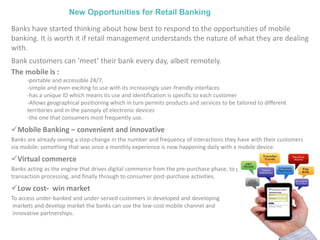
New Opportunities for Retail Banking
Banks have started thinking about how best to respond to the opportunities of mobile
banking. It is worth it if retail management understands the nature of what they are dealing
with.
Bank customers can ‘meet’ their bank every day, albeit remotely.
The mobile is :
-portable and accessible 24/7,
-simple and even exciting to use with its increasingly user-friendly interfaces
-has a unique ID which means its use and identification is specific to each customer
-Allows geographical positioning which in turn permits products and services to be tailored to different
territories and in the panoply of electronic devices
-the one that consumers most frequently use.
Mobile Banking – convenient and innovative
Banks are already seeing a step-change in the number and frequency of interactions they have with their customers
via mobile; something that was once a monthly experience is now happening daily with a mobile device.
Virtual commerce
Banks acting as the engine that drives digital commerce from the pre-purchase phase, to purchase financing, to
transaction processing, and finally through to consumer post-purchase activities.
Low cost- win market
To access under-banked and under-served customers in developed and developing
markets and develop market the banks can use the low-cost mobile channel and
innovative partnerships.
A Successful Mobile Banking Strategy
 Mobile banking has moved quickly to become a point of differentiation and a
potential source of revenue for progressive banks.
Online banking is not simply using a Smartphone but it is at the hub of the
customer relationship.
Peter Wannemacher :analyst for Forrester, says, "The most obvious missed
opportunity among the 15 banks reviewed is that few are making effective use of
context to make information more relevant to customers. Sales is another big missed
opportunity, with many banks not even trying to cross-sell products and services
through the mobile channel.“
In Africa, the stats are even less impressive.
A Successful Mobile Banking Strategy
Increase enrollment and usage of Mobile Banking
 One of the biggest impediments to enrollment today is that many banks still
require mobile banking customers to have an online banking relationship.
 Smartphone providers have found a way to sign up for mobile banking and use
the service.
 It is recommended a consistent sign-in process be used for both the online and
mobile banking relationships if a bank is going to require multifactor authentication.
 It is very important to have a customer service team familiar with the mobile
banking platform and well trained to answer every question from customers.
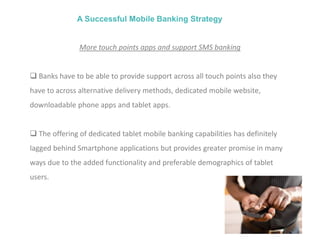
A Successful Mobile Banking Strategy
More touch points apps and support SMS banking
 Banks have to be able to provide support across all touch points also they
have to across alternative delivery methods, dedicated mobile website,
downloadable phone apps and tablet apps.
 The offering of dedicated tablet mobile banking capabilities has definitely
lagged behind Smartphone applications but provides greater promise in many
ways due to the added functionality and preferable demographics of tablet
users.
A Successful Mobile Banking Strategy
Integration of Cross-Channel
 There are other ways for customer's interactions with a bank to be
integrated. While being able to access customer support directly from the
mobile app a great example of cross-channel support.
 It is very important the integration of social media within a bank's mobile
banking application, not only to show live tweets in real time on their mobile
banking platform, but their integration with Facebook and YouTube content is
one of the strongest in the industry.
A Successful Mobile Banking Strategy
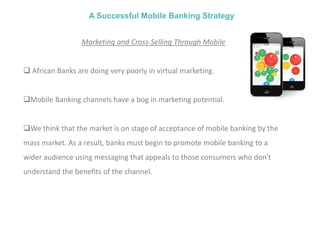
Marketing and Cross-Selling Through Mobile
 African Banks are doing very poorly in virtual marketing.
Mobile Banking channels have a bog in marketing potential.
We think that the market is on stage of acceptance of mobile banking by the
mass market. As a result, banks must begin to promote mobile banking to a
wider audience using messaging that appeals to those consumers who don't
understand the benefits of the channel.
Retail Banking in the next ……….years
Mobile banking is the next big thing in the retail banking industry. Over the next
five to 10 years, expect it to become as routine as using ATMs.
Successful customer experiences will require large technology investments, tricky
collaborations with competitors and a clear "own-the-customer" strategy.
The rewards for banks could be great if they will be open minded about disruptive
technologies, willing to learn marketing and security lessons drawn from trailblazing
developing markets.
Mobile banking opportunities may be looming on the horizon, but these
opportunities can only create worth-while value if banks consider three separate
perspectives:
1. Bank profits.
2. Banking industry.
3. The wider ‘mobile’ industry.
CONCLUSIONS REGARDING MOBILE BANKING TRENDS
With the growth in tablet use, consumers are able to access highly graphic and
sophisticated financial planning tools on the road or while multi-tasking in their
home.
As more innovative Smartphone applications are developed within and outside
the financial services sector, the ability for banks to keep pace becomes both more
difficult and more important.
By building an agile leadership team, banks can realize increased differentiation,
lower cost customer acquisition, improved channel efficiency, enhanced customer
retention, and greater revenues through cross-selling and up-selling of products and
services and through merchant-funded rewards.
By executing and optimizing a successful mobile banking strategy that is
integrated with a wider multi-channel strategy, banks will be better positioned for
the future mobile banking.
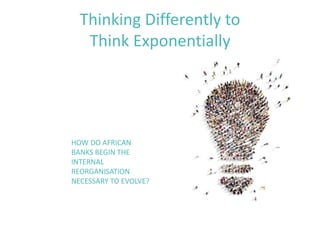
Thinking Differently to
Think Exponentially
HOW DO AFRICAN
BANKS BEGIN THE
INTERNAL
REORGANISATION
NECESSARY TO EVOLVE?
Future trends and predictions:
• The continuing digital transformation of merchant payments
• A shift in power from data accumulation to data insights and applications
• The advent of noncard real-time payments
• Rapid growth and digital transformation in cross-border transaction banking
• Payments will be a cornerstone in the next phase of digital banking
Banks and Financial Services firms across Africa will increasingly invest to explore:
• Emerging technologies that are driving technological breakthroughs in payment
solutions and mobile payments across the African continent
• Partnerships between African and international technology companies at the
forefront of exporting African approaches to payment solutions to other
continents
• The future of payment solutions & mobile payments in light of exponentially
growing technology – Africa’s moonshots in the sector
Center for Disruptive Technologies
Ideation & Innovation for Business Needs. Outsourced
Specialists in Financial Services Solutions
Transform
Exponential Africa
Center for Disruptive Technologies
Contact us:
www.cdtafrica.com
+27 11 325 2008
Dr. Kwame Amuah Dr. Sharron L. McPherson
Co-Founder & Chair Co-Founder & Executive Director
kamuah@cdtafrica.com smcpherson@cdtafrica.com
Transform
Exponential Africa

Centre for Disruptive Technologies Mobile Money & Payments Presentation

  • 1.
    Center for DisruptiveTechnologies Presented at Business & Financial Times of Ghana Conference on Mobile Banking & Payment Solutions 22 March 2017 The Tanga Hotel Accra Transform Exponential Africa
  • 2.
    Our Key Objective: Radicallyshifting conference participants to consider disruption scenarios in payment solutions and mobile payments – “How Will Disruptors be Disrupted?”
  • 4.
    Thinking Differently to ThinkExponentially Why every business leader should know and care about the impact of disruptive technologies
  • 6.
     Faster &more convenient payment solutions  On-card real time payments  Digital currencies and wallets  Big data analytics  B2B payments  Digital ID – authentication & identification  Cyber security Innovation/ disruption in payment processing:
  • 7.
    • Social mediaplatforms: Data can be used for sentiment analysis, cross selling, up selling, fraud detection and more. • Mobile apps: Consumers are increasingly demanding mobile apps on various devices to enable an “always on” relationship with financial services providers. • The Internet of Things: e.g. the world of connected devices that allows us to gather real-time information for use in underwriting, risk assessment, premium calculation: Requiring big data analytics to unlock value/ insights. Technologies disrupting payers & their distribution/ broker partners
  • 8.
    In order tosurvive and thrive, EMEA banks must innovate…
  • 9.
    The ability toprocess news through algorithms Event-Driven information will shift trading from market related events Faster dissemination of media than social media Access extensive real-time data through specialised databases and cloud-based analytics Greater data  convergence to single view point  convergence of strategies Automatic decision making results in minimal human interaction In order to protect the market from algorithmic trading, agility will be required as regulations are passed Ex: Smarter and faster machines will allow for different types of trading solutions than those we are currently envisioning…
  • 10.
    Streamlined Infrastructure Automation ofHigh-Value Activities Reduced Intermediation The Strategic Role of Data Niche, Specialised Products Customer Empowerment Major themes from how disruptive technologies will drive payment solutions and mobile payments…
  • 11.
  • 12.
    A macro viewof disruption
  • 13.
    To remain competitiveand efficient in a changing digital world: Payers need to transform their foundation IT architecture…. By (for example): • Replace legacy administration platforms; • Increase digitization of inbound & outbound communication; Business process automation; Process and product standardisation Source: 15 June 2015 Saraswati Pramudi, Wipro BAS Architecture Practice
  • 14.
    With respect toMobile Banking… The interest over "Mobile Banking" product is becoming increasingly intense.  Applications and new technologies are spreading through European banks mobilized to embrace this profitable product.  African banks are clear that they have been left "behind" in this technological innovation. Recent analyses underscore the need for banks to actively respond to this new challenge and recent polls show that Mobile Banking will fundamentally change retail banking in the next five years. Mobile offers good opportunities to meet consumer preferences, increase loyalty, strengthen relationships and it will bring a positive impact on bank profits
  • 15.
    Mobile Banking Future Money is changing as we become more mobile. We know that the young of today become banking customers of tomorrow New brands are emerging that are acting as ‘money vaults’ for consumers. They are not banks. A lot of financial services providers are ensuring that they are leading the new way in shaping the Mobile Money The demand is growing consumer trust and engagement will rise further beyond mobile banking into payments and commerce Now is the time for banks to strengthen their hand in the mobile space and cement their position in the growing ecosystems in and beyond.
  • 16.
    New Opportunities forRetail Banking Banks have started thinking about how best to respond to the opportunities of mobile banking. It is worth it if retail management understands the nature of what they are dealing with. Bank customers can ‘meet’ their bank every day, albeit remotely. The mobile is : -portable and accessible 24/7, -simple and even exciting to use with its increasingly user-friendly interfaces -has a unique ID which means its use and identification is specific to each customer -Allows geographical positioning which in turn permits products and services to be tailored to different territories and in the panoply of electronic devices -the one that consumers most frequently use. Mobile Banking – convenient and innovative Banks are already seeing a step-change in the number and frequency of interactions they have with their customers via mobile; something that was once a monthly experience is now happening daily with a mobile device. Virtual commerce Banks acting as the engine that drives digital commerce from the pre-purchase phase, to purchase financing, to transaction processing, and finally through to consumer post-purchase activities. Low cost- win market To access under-banked and under-served customers in developed and developing markets and develop market the banks can use the low-cost mobile channel and innovative partnerships.
  • 17.
    A Successful MobileBanking Strategy  Mobile banking has moved quickly to become a point of differentiation and a potential source of revenue for progressive banks. Online banking is not simply using a Smartphone but it is at the hub of the customer relationship. Peter Wannemacher :analyst for Forrester, says, "The most obvious missed opportunity among the 15 banks reviewed is that few are making effective use of context to make information more relevant to customers. Sales is another big missed opportunity, with many banks not even trying to cross-sell products and services through the mobile channel.“ In Africa, the stats are even less impressive.
  • 18.
    A Successful MobileBanking Strategy Increase enrollment and usage of Mobile Banking  One of the biggest impediments to enrollment today is that many banks still require mobile banking customers to have an online banking relationship.  Smartphone providers have found a way to sign up for mobile banking and use the service.  It is recommended a consistent sign-in process be used for both the online and mobile banking relationships if a bank is going to require multifactor authentication.  It is very important to have a customer service team familiar with the mobile banking platform and well trained to answer every question from customers.
  • 19.
    A Successful MobileBanking Strategy More touch points apps and support SMS banking  Banks have to be able to provide support across all touch points also they have to across alternative delivery methods, dedicated mobile website, downloadable phone apps and tablet apps.  The offering of dedicated tablet mobile banking capabilities has definitely lagged behind Smartphone applications but provides greater promise in many ways due to the added functionality and preferable demographics of tablet users.
  • 20.
    A Successful MobileBanking Strategy Integration of Cross-Channel  There are other ways for customer's interactions with a bank to be integrated. While being able to access customer support directly from the mobile app a great example of cross-channel support.  It is very important the integration of social media within a bank's mobile banking application, not only to show live tweets in real time on their mobile banking platform, but their integration with Facebook and YouTube content is one of the strongest in the industry.
  • 21.
    A Successful MobileBanking Strategy Marketing and Cross-Selling Through Mobile  African Banks are doing very poorly in virtual marketing. Mobile Banking channels have a bog in marketing potential. We think that the market is on stage of acceptance of mobile banking by the mass market. As a result, banks must begin to promote mobile banking to a wider audience using messaging that appeals to those consumers who don't understand the benefits of the channel.
  • 22.
    Retail Banking inthe next ……….years Mobile banking is the next big thing in the retail banking industry. Over the next five to 10 years, expect it to become as routine as using ATMs. Successful customer experiences will require large technology investments, tricky collaborations with competitors and a clear "own-the-customer" strategy. The rewards for banks could be great if they will be open minded about disruptive technologies, willing to learn marketing and security lessons drawn from trailblazing developing markets. Mobile banking opportunities may be looming on the horizon, but these opportunities can only create worth-while value if banks consider three separate perspectives: 1. Bank profits. 2. Banking industry. 3. The wider ‘mobile’ industry.
  • 23.
    CONCLUSIONS REGARDING MOBILEBANKING TRENDS With the growth in tablet use, consumers are able to access highly graphic and sophisticated financial planning tools on the road or while multi-tasking in their home. As more innovative Smartphone applications are developed within and outside the financial services sector, the ability for banks to keep pace becomes both more difficult and more important. By building an agile leadership team, banks can realize increased differentiation, lower cost customer acquisition, improved channel efficiency, enhanced customer retention, and greater revenues through cross-selling and up-selling of products and services and through merchant-funded rewards. By executing and optimizing a successful mobile banking strategy that is integrated with a wider multi-channel strategy, banks will be better positioned for the future mobile banking.
  • 24.
    Thinking Differently to ThinkExponentially HOW DO AFRICAN BANKS BEGIN THE INTERNAL REORGANISATION NECESSARY TO EVOLVE?
  • 26.
    Future trends andpredictions: • The continuing digital transformation of merchant payments • A shift in power from data accumulation to data insights and applications • The advent of noncard real-time payments • Rapid growth and digital transformation in cross-border transaction banking • Payments will be a cornerstone in the next phase of digital banking Banks and Financial Services firms across Africa will increasingly invest to explore: • Emerging technologies that are driving technological breakthroughs in payment solutions and mobile payments across the African continent • Partnerships between African and international technology companies at the forefront of exporting African approaches to payment solutions to other continents • The future of payment solutions & mobile payments in light of exponentially growing technology – Africa’s moonshots in the sector
  • 27.
    Center for DisruptiveTechnologies Ideation & Innovation for Business Needs. Outsourced Specialists in Financial Services Solutions Transform Exponential Africa
  • 28.
    Center for DisruptiveTechnologies Contact us: www.cdtafrica.com +27 11 325 2008 Dr. Kwame Amuah Dr. Sharron L. McPherson Co-Founder & Chair Co-Founder & Executive Director kamuah@cdtafrica.com smcpherson@cdtafrica.com Transform Exponential Africa

Editor's Notes

  • #3 But before we go further – let’s revisit our Key Objective for the Day. Radically shifting FNB to become an exponential organisation will require that we go BEYOND THE UBERISATION OF FINANCIAL SERVCIES!
  • #4 PETER DIAMANDIS’ 6 D’S OF EXPONENTIAL GROWTH EXEMPLIFIED: DECEPTIVE - EARLY STAGES OF EXPONENTIAL GROWTH – DECEPTIVELY LINEAR DIGITISED – ALLOWS US TO PUT A LAYER OF ANALYTICS ON TOP OF IT DISRUPTIVE – ONCE THE GROWTH REACHES THE KNEE OF THE CURVE – TOO LATE DEMATERIALISE – THINK ABOUT PHONES IN YOUR CAMERA DEMONITISED – THE COST GOES DOWN AT AN ALARMING RATE DEMOCRATICISED – EVERYONE HAS ONE OR HAS ACCESS
  • #5 The point is to make here is that business is not just private – it’s also public and SOE’s that should also know and care.
  • #10 Theme: The importance/change in the way information is consumed and sourcing new information. More data moves towards efficient markets hypothesis Content: Traditionally, algorthmic trading was based on the ability of computers to process market related information. Recently, the ability for computers process event driven information without human intervention has changed they way information is related back to algorithmic models. These models now have an additional source of info to make trading decision on which provides a competitive advantage as well as changes the way in markets react to information. Efficient markets hypothesis. More data, higher processing capabilities mean real-time adjustments, wider access to information and thus ultimately a convergence of strategies (efficient markets hypothesis – all info priced in, all individuals knowledgeable). The use of algorithms will most likely be regulated as discrepancies in data can have major market impacts, thus, institutions will be required to be agile in the way they react to chanign environments and still keep the competitive edge.
  • #12  http://theearthchild.co.za/revolutionary-3-d-printer-can-build-10-houses-in-24-hours-and-for-only-5000-each/
  • #25 The point is to make here is that business is not just private – it’s also public and SOE’s that should also know and care.
  • #26 Deloitte’s more generalised approach to internal organisation to cope with disruption.