TEAM WORK
Flow
1. Definition of team and group


2. Types of work-related teams


3. Stages of team development


4. Effective teams


5. Group roles


6. Potential team dysfunctions
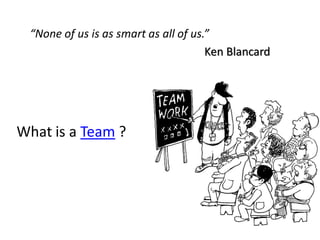
“None of us is as smart as all of us.”
                                      Ken Blancard


What is a Team ?
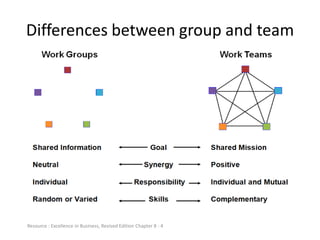
Differences between group and team


Resource : Excellence in Business, Revised Edition Chapter 8 - 4
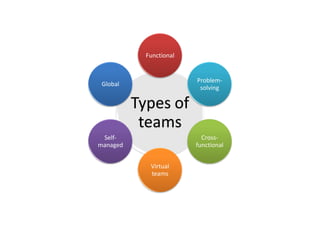
Functional


                         Problem-
 Global
                          solving

          Types of
           teams
 Self-                     Cross-
managed                  functional


             Virtual
             teams
Functional


 Global
                         Problem-
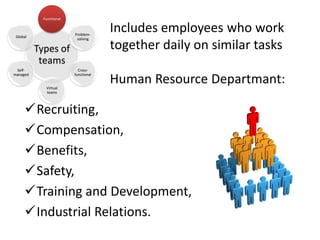
                                      Includes employees who work
                          solving

          Types of                    together daily on similar tasks
           teams
 Self-                     Cross-

                                      Human Resource Departmant:
managed                  functional


             Virtual
             teams


     Recruiting,
     Compensation,
     Benefits,
     Safety,
     Training and Development,
     Industrial Relations.
Functional
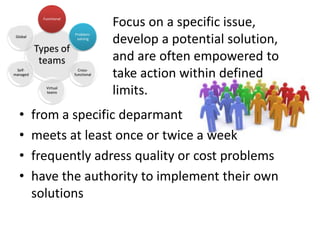
                                      Focus on a specific issue,
                                      develop a potential solution,
                         Problem-
 Global
                          solving

          Types of
           teams                      and are often empowered to
 Self-
managed
                           Cross-
                         functional   take action within defined
             Virtual
             teams                    limits.
  •       from a specific deparmant
  •       meets at least once or twice a week
  •       frequently adress quality or cost problems
  •       have the authority to implement their own
          solutions
Functional


 Global
                         Problem-
                          solving
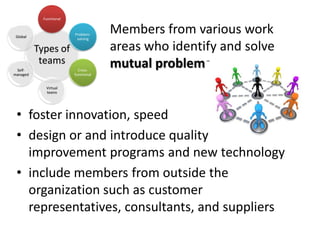
                                      Members from various work
          Types of                    areas who identify and solve
           teams                      mutual problems
 Self-                     Cross-
managed                  functional


             Virtual
             teams


 • foster innovation, speed
 • design or and introduce quality
   improvement programs and new technology
 • include members from outside the
   organization such as customer
   representatives, consultants, and suppliers
Functional


                         Problem-
 Global
                          solving

          Types of
           teams
 Self-                     Cross-
managed                  functional


             Virtual
             teams


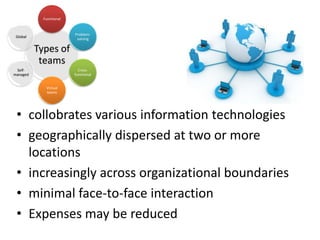
 • collobrates various information technologies
 • geographically dispersed at two or more
   locations
 • increasingly across organizational boundaries
 • minimal face-to-face interaction
 • Expenses may be reduced
Functional


                         Problem-
 Global
                          solving

          Types of
           teams
 Self-                     Cross-
managed                  functional


             Virtual
             teams


 • to highly interdependent
 • work together efficiently on a daily basis to
   manufacture an entire product or can provide
   an entire service to a set of customers
 • can schedule work and vacations, rotate tasks,
   order metarials, decide on leadership, budget,
   hire, evaluate each other’s performance
Functional


                         Problem-
 Global
                          solving

          Types of
           teams
 Self-                     Cross-
managed                  functional


             Virtual
             teams


 • a variety of countries
 • separated significantly by time,
   distance, culture, and language.
 • typically conduct a substantial portion of their
   tasks as virtual teams
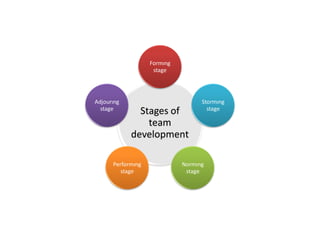
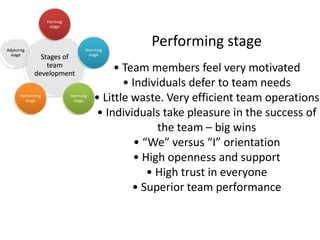
Formıng
                    stage


Adjourıng                          Stormıng
  stage
              Stages of              stage

                team
            development

      Performıng             Normıng
         stage                stage
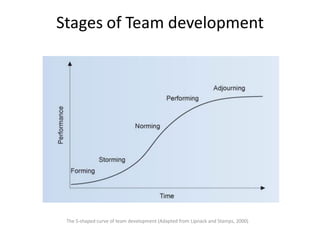
Stages of Team development


 The S-shaped curve of team development (Adapted from Lipnack and Stamps, 2000)
Formıng
                    stage

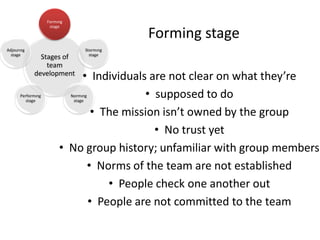
                                              Forming stage
Adjourıng                          Stormıng
  stage                              stage
              Stages of
                team
            development
                            • Individuals are not clear on what they’re
      Performıng
         stage
                             Normıng
                              stage
                                         • supposed to do
                              • The mission isn’t owned by the group
                                           • No trust yet
                        • No group history; unfamiliar with group members
                             • Norms of the team are not established
                                 • People check one another out
                             • People are not committed to the team
Formıng
                    stage


Adjourıng                          Stormıng
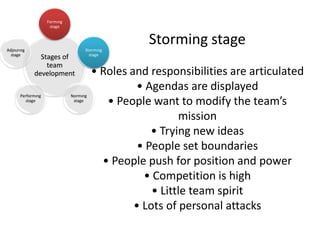
                                                  Storming stage
  stage                              stage
              Stages of
                team
            development                • Roles and responsibilities are articulated
                                                • Agendas are displayed
      Performıng             Normıng
         stage                stage
                                          • People want to modify the team’s
                                                          mission
                                                    • Trying new ideas
                                                 • People set boundaries
                                         • People push for position and power
                                                  • Competition is high
                                                    • Little team spirit
                                                • Lots of personal attacks
Formıng
                    stage

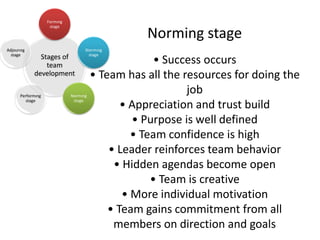
                                                  Norming stage
Adjourıng                          Stormıng
  stage                              stage
              Stages of
                team
                                                     • Success occurs
            development                • Team has all the resources for doing the
      Performıng             Normıng
                                                           job
         stage                stage
                                              • Appreciation and trust build
                                                • Purpose is well defined
                                                • Team confidence is high
                                           • Leader reinforces team behavior
                                            • Hidden agendas become open
                                                    • Team is creative
                                              • More individual motivation
                                           • Team gains commitment from all
                                            members on direction and goals
Formıng
                    stage


Adjourıng                          Stormıng
                                                  Performing stage
  stage                              stage
              Stages of
                team
            development
                                            • Team members feel very motivated
                                              • Individuals defer to team needs
      Performıng
         stage
                             Normıng
                              stage    • Little waste. Very efficient team operations
                                       • Individuals take pleasure in the success of
                                                      the team – big wins
                                                 • “We” versus “I” orientation
                                                • High openness and support
                                                    • High trust in everyone
                                                • Superior team performance
Formıng
                    stage


Adjourıng                          Stormıng
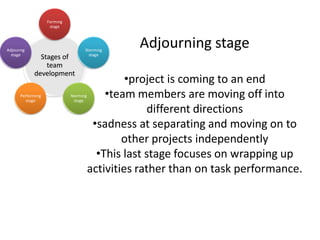
                                                 Adjourning stage
  stage                              stage
              Stages of
                team
            development
                                                •project is coming to an end
      Performıng
         stage
                             Normıng
                              stage
                                           •team members are moving off into
                                                    different directions
                                        •sadness at separating and moving on to
                                               other projects independently
                                         •This last stage focuses on wrapping up
                                       activities rather than on task performance.
Characteristics of Effective Teams
• The team must have a clear goal
• The team must have a results-driven structure
• The team must have competent team members
• The team must have unified commitment
• The team must have a collaborative climate
• The team must have high standards that are
  understood by all
• The team must receive external support and
  encouragement
• The team must have principled leadership
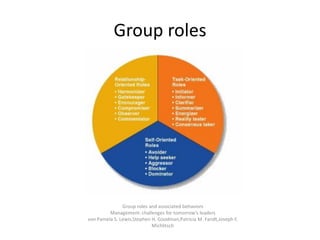
Group roles


               Group roles and associated behaviors
         Management: challenges for tomorrow's leaders
von Pamela S. Lewis,Stephen H. Goodman,Patricia M. Fandt,Joseph F.
                            Michlitsch
Task-oriented
•   Evaluating
•   Coordinating
•   Initiating
•   Seeking information
•   Giving information
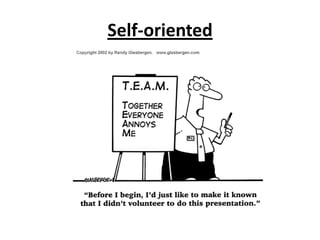
Self-oriented
Self-oriented
•   Expense of the team group
•   Blocking progress
•   Seeking recognition
•   Dominating
•   Avoiding involvement
Relations-oriented
• Warmth and solidarity
• Harmonizing
• Encouraging
• Expressing standards for the team to achieve
  or apply
• Following
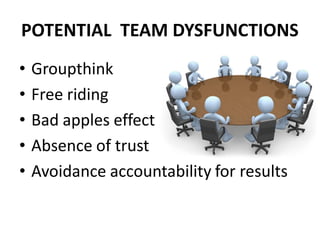
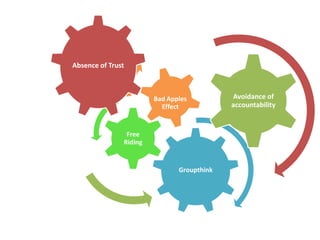
POTENTIAL TEAM DYSFUNCTIONS
•   Groupthink
•   Free riding
•   Bad apples effect
•   Absence of trust
•   Avoidance accountability for results
Groupthink
      Agreement-at-any-cost mentality
• High cohesiveness
• Insulation of the team from outsiders
• Lack of methodical procedures for search and
  appraisal
• Directive leadership
• High stress with a low degree of hope for finding
  a better solution than the one favored by the
  leader or other influential persons
• Complex/changing environment
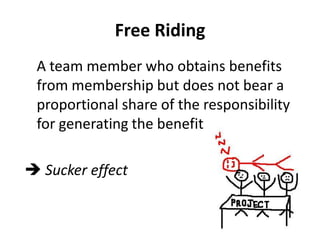
Free Riding
 A team member who obtains benefits
 from membership but does not bear a
 proportional share of the responsibility
 for generating the benefit

 Sucker effect
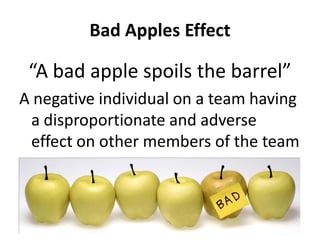
Bad Apples Effect

 “A bad apple spoils the barrel”
A negative individual on a team having
 a disproportionate and adverse
 effect on other members of the team
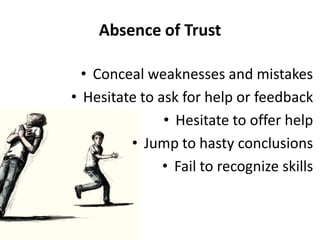
Absence of Trust

  • Conceal weaknesses and mistakes
• Hesitate to ask for help or feedback
               • Hesitate to offer help
         • Jump to hasty conclusions
               • Fail to recognize skills
Avoidance of accountability for Results
• team doesn’t commit to a clear set of
  goals and plan of action
• Team members put their own needs
  ahead of the goals of the team
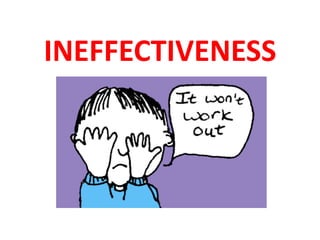
INEFFECTIVENESS
Absence of Trust


                        Bad Apples          Avoidance of
                          Effect            accountability


                Free
               Riding


                               Groupthink
Thank you for attention
Bibliography
•   Principles of Organizational Behavior Slocum, Hellriegel, Chapter 11 –
    p321-350
•   Management: challenges for tomorrow's leaders von Pamela S.
    Lewis,Stephen H. Goodman,Patricia M. Fandt,Joseph F. Michlitsch
•   Excellence in Business, Revised Edition, Prentice Hall, 2005, Chapter 8 -p35
•   http://www.ndt-ed.org/TeachingResources/ClassroomTips/Teamwork.htm
•   http://www.projectsmart.co.uk/the-five-stages-of-team-development-a-
    case-study.html
•   http://www.ginaabudi.com/the-five-stages-of-team-development-part-i/
•   http://openlearn.open.ac.uk/file.php/4393/!via/oucontent/course/3524/
    m891_unit2_f03.jpg

Teamwork

  • 1.
  • 2.
    Flow 1. Definition ofteam and group 2. Types of work-related teams 3. Stages of team development 4. Effective teams 5. Group roles 6. Potential team dysfunctions
  • 3.
    “None of usis as smart as all of us.” Ken Blancard What is a Team ?
  • 4.
    Differences between groupand team Resource : Excellence in Business, Revised Edition Chapter 8 - 4
  • 5.
    Functional Problem- Global solving Types of teams Self- Cross- managed functional Virtual teams
  • 6.
    Functional Global Problem- Includes employees who work solving Types of together daily on similar tasks teams Self- Cross- Human Resource Departmant: managed functional Virtual teams Recruiting, Compensation, Benefits, Safety, Training and Development, Industrial Relations.
  • 7.
    Functional Focus on a specific issue, develop a potential solution, Problem- Global solving Types of teams and are often empowered to Self- managed Cross- functional take action within defined Virtual teams limits. • from a specific deparmant • meets at least once or twice a week • frequently adress quality or cost problems • have the authority to implement their own solutions
  • 8.
    Functional Global Problem- solving Members from various work Types of areas who identify and solve teams mutual problems Self- Cross- managed functional Virtual teams • foster innovation, speed • design or and introduce quality improvement programs and new technology • include members from outside the organization such as customer representatives, consultants, and suppliers
  • 9.
    Functional Problem- Global solving Types of teams Self- Cross- managed functional Virtual teams • collobrates various information technologies • geographically dispersed at two or more locations • increasingly across organizational boundaries • minimal face-to-face interaction • Expenses may be reduced
  • 10.
    Functional Problem- Global solving Types of teams Self- Cross- managed functional Virtual teams • to highly interdependent • work together efficiently on a daily basis to manufacture an entire product or can provide an entire service to a set of customers • can schedule work and vacations, rotate tasks, order metarials, decide on leadership, budget, hire, evaluate each other’s performance
  • 11.
    Functional Problem- Global solving Types of teams Self- Cross- managed functional Virtual teams • a variety of countries • separated significantly by time, distance, culture, and language. • typically conduct a substantial portion of their tasks as virtual teams
  • 12.
    Formıng stage Adjourıng Stormıng stage Stages of stage team development Performıng Normıng stage stage
  • 13.
    Stages of Teamdevelopment The S-shaped curve of team development (Adapted from Lipnack and Stamps, 2000)
  • 14.
    Formıng stage Forming stage Adjourıng Stormıng stage stage Stages of team development • Individuals are not clear on what they’re Performıng stage Normıng stage • supposed to do • The mission isn’t owned by the group • No trust yet • No group history; unfamiliar with group members • Norms of the team are not established • People check one another out • People are not committed to the team
  • 15.
    Formıng stage Adjourıng Stormıng Storming stage stage stage Stages of team development • Roles and responsibilities are articulated • Agendas are displayed Performıng Normıng stage stage • People want to modify the team’s mission • Trying new ideas • People set boundaries • People push for position and power • Competition is high • Little team spirit • Lots of personal attacks
  • 16.
    Formıng stage Norming stage Adjourıng Stormıng stage stage Stages of team • Success occurs development • Team has all the resources for doing the Performıng Normıng job stage stage • Appreciation and trust build • Purpose is well defined • Team confidence is high • Leader reinforces team behavior • Hidden agendas become open • Team is creative • More individual motivation • Team gains commitment from all members on direction and goals
  • 17.
    Formıng stage Adjourıng Stormıng Performing stage stage stage Stages of team development • Team members feel very motivated • Individuals defer to team needs Performıng stage Normıng stage • Little waste. Very efficient team operations • Individuals take pleasure in the success of the team – big wins • “We” versus “I” orientation • High openness and support • High trust in everyone • Superior team performance
  • 18.
    Formıng stage Adjourıng Stormıng Adjourning stage stage stage Stages of team development •project is coming to an end Performıng stage Normıng stage •team members are moving off into different directions •sadness at separating and moving on to other projects independently •This last stage focuses on wrapping up activities rather than on task performance.
  • 19.
    Characteristics of EffectiveTeams • The team must have a clear goal • The team must have a results-driven structure • The team must have competent team members • The team must have unified commitment • The team must have a collaborative climate • The team must have high standards that are understood by all • The team must receive external support and encouragement • The team must have principled leadership
  • 20.
    Group roles Group roles and associated behaviors Management: challenges for tomorrow's leaders von Pamela S. Lewis,Stephen H. Goodman,Patricia M. Fandt,Joseph F. Michlitsch
  • 21.
    Task-oriented • Evaluating • Coordinating • Initiating • Seeking information • Giving information
  • 22.
  • 23.
    Self-oriented • Expense of the team group • Blocking progress • Seeking recognition • Dominating • Avoiding involvement
  • 24.
    Relations-oriented • Warmth andsolidarity • Harmonizing • Encouraging • Expressing standards for the team to achieve or apply • Following
  • 25.
    POTENTIAL TEAM DYSFUNCTIONS • Groupthink • Free riding • Bad apples effect • Absence of trust • Avoidance accountability for results
  • 26.
    Groupthink Agreement-at-any-cost mentality • High cohesiveness • Insulation of the team from outsiders • Lack of methodical procedures for search and appraisal • Directive leadership • High stress with a low degree of hope for finding a better solution than the one favored by the leader or other influential persons • Complex/changing environment
  • 27.
    Free Riding Ateam member who obtains benefits from membership but does not bear a proportional share of the responsibility for generating the benefit  Sucker effect
  • 28.
    Bad Apples Effect “A bad apple spoils the barrel” A negative individual on a team having a disproportionate and adverse effect on other members of the team
  • 29.
    Absence of Trust • Conceal weaknesses and mistakes • Hesitate to ask for help or feedback • Hesitate to offer help • Jump to hasty conclusions • Fail to recognize skills
  • 30.
    Avoidance of accountabilityfor Results • team doesn’t commit to a clear set of goals and plan of action • Team members put their own needs ahead of the goals of the team
  • 31.
  • 32.
    Absence of Trust Bad Apples Avoidance of Effect accountability Free Riding Groupthink
  • 34.
    Thank you forattention
  • 35.
    Bibliography • Principles of Organizational Behavior Slocum, Hellriegel, Chapter 11 – p321-350 • Management: challenges for tomorrow's leaders von Pamela S. Lewis,Stephen H. Goodman,Patricia M. Fandt,Joseph F. Michlitsch • Excellence in Business, Revised Edition, Prentice Hall, 2005, Chapter 8 -p35 • http://www.ndt-ed.org/TeachingResources/ClassroomTips/Teamwork.htm • http://www.projectsmart.co.uk/the-five-stages-of-team-development-a- case-study.html • http://www.ginaabudi.com/the-five-stages-of-team-development-part-i/ • http://openlearn.open.ac.uk/file.php/4393/!via/oucontent/course/3524/ m891_unit2_f03.jpg