TEAM
WORKING
•
•
•
•
•
•
-
T
                                 W
e                                o
a                                r
m                                k
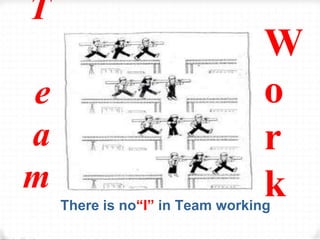
    There is no“I” in Team working
-
                                -


A team is a small number of people with
complementary skills who are committed to a
common purpose, and hold themselves
mutually accountable for its achievement.
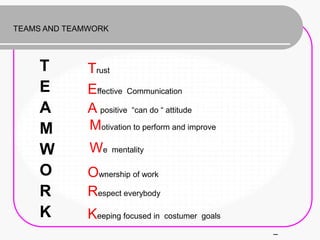
TEAMS AND TEAMWORK


    T         Trust
    E         Effective Communication
    A         A positive “can do “ attitude
    M         Motivation to perform and improve
    W         We     mentality

    O         Ownership of work
    R         Respect everybody
    K         Keeping focused in   costumer goals

                                                    –
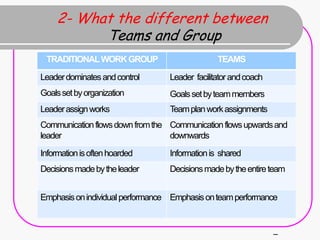
2- What the different between
          Teams and Group
 TRADITIONAL WORK GROUP                         TEAMS

Leader dominates and control      Leader facilitator and coach
Goals set by organization         Goals set by team members
Leader assign works               Team plan work assignments
Communication flows down from the Communication flows upwards and
leader                            downwards
Information is often hoarded      Information is shared
Decisions made by the leader      Decisions made by the entire team


Emphasis on individual performance Emphasis on team performance


                                                                 –
TEAMS AND TEAMWORK

Importance Of Teams

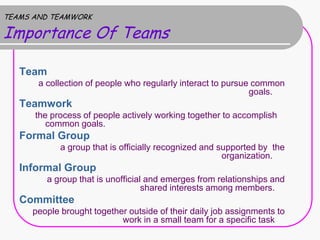
   Team
       a collection of people who regularly interact to pursue common
                                                              goals.
   Teamwork
      the process of people actively working together to accomplish
         common goals.
   Formal Group
            a group that is officially recognized and supported by the
                                                       organization.
   Informal Group
         a group that is unofficial and emerges from relationships and
                                   shared interests among members.
   Committee
     people brought together outside of their daily job assignments to
                           work in a small team for a specific task
-
Team working and individual working


                -                     -
                 -

                       -
-
-
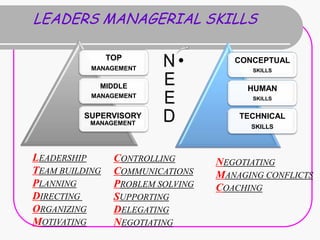
LEADERS MANAGERIAL SKILLS

                TOP                   CONCEPTUAL
           MANAGEMENT                    SKILLS


            MIDDLE                      HUMAN
           MANAGEMENT                    SKILLS


         SUPERVISORY                   TECHNICAL
          MANAGEMENT
                                         SKILLS


LEADERSHIP       CONTROLLING       NEGOTIATING
TEAM BUILDING    COMMUNICATIONS    MANAGING CONFLICTS
PLANNING         PROBLEM SOLVING   COACHING
DIRECTING        SUPPORTING
ORGANIZING       DELEGATING
MOTIVATING       NEGOTIATING
-
-
-   -
-
-   -
    -
-
-       -
    -

    -
-
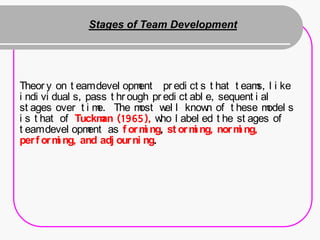
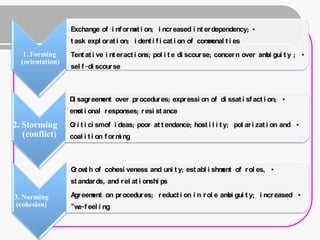
Stages of Team Development


Theor y on t eam devel opm   ent pr edi ct s t hat t eam l i ke
                                                          s,
i ndi vi dual s, pass t hr ough pr edi ct abl e, sequent i al
st ages over t i m The m
                   e.        ost w l know of t hese m
                                   el         n              odel s
i s t hat of Tuckm (1965), w l abel ed t he st ages of
                    an            ho
t eam devel opm  ent as f or m ng, st or m ng, nor m ng,
                              i            i         i
per f or m ng, and adj our ni ng.
          i
Exchange of i nf or m i on; i ncr eased i nt er dependency; •
                                       at
                  t ask expl or at i on; i dent i f i cat i on of com onal t i es
                                                                     m
   1. Forming     Tent at i ve i nt er act i ons; pol i t e di scour se; concer n over am gui t y ; •
                                                                                         bi
  (orientation)
                  sel f -di scour se


                  D sagr eem over pr ocedur es; expr essi on of di ssat i sf act i on; •
                   i        ent
                  em i onal r esponses; r esi st ance
                    ot
2. Storming       C i t i ci smof i deas; poor at t endance; host i l i t y; pol ar i zat i on and •
                   r
   (conflict)     coal i t i on f or m ng
                                      i


                  G ow h of cohesi veness and uni t y; est abl i shm of r ol es, •
                   r t                                              ent
                  st andar ds, and r el at i onshi ps

3. Norming        A eem on pr ocedur es; r educt i on i n r ol e am gui t y; i ncr eased •
                   gr  ent                                         bi
(cohesion)        "w eel i ng
                    e-f
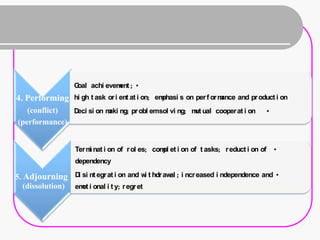
Goal achi evem ; •
                                ent
4. Performing     hi gh t ask or i ent at i on; emphasi s on per f or mance and pr oduct i on
   (conflict) D si on m ng; pr obl emsol vi ng; m ual cooper at i on
               eci     aki                       ut                                   •
(performance)


                  Ter m nat i on of r ol es; com et i on of t asks; r educt i on of
                       i                        pl                                        •
                  dependency

5. Adjourning Di si nt egr at i on and w t hdr aw ; i ncr eased i ndependence and •
                                           i     al
   (dissolution) em i onal i t y; r egr et
                   ot
TEAMS AND TEAMWORK

Importance Of Teams
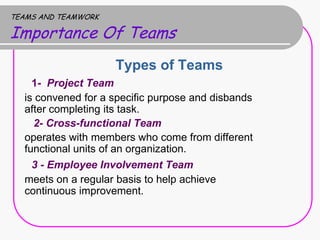
                     Types of Teams
    1- Project Team
  is convened for a specific purpose and disbands
  after completing its task.
    2- Cross-functional Team
  operates with members who come from different
  functional units of an organization.
    3 - Employee Involvement Team
  meets on a regular basis to help achieve
  continuous improvement.
TEAMS AND TEAMWORK

Importance Of Teams

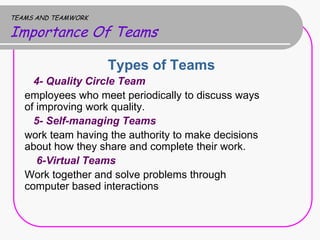
                     Types of Teams
     4- Quality Circle Team
   employees who meet periodically to discuss ways
   of improving work quality.
     5- Self-managing Teams
   work team having the authority to make decisions
   about how they share and complete their work.
      6-Virtual Teams
   Work together and solve problems through
   computer based interactions
MEETING

                  
              -   -   
              -   -   
                  -   
                  -   


          –
MEETING

                      
                      
              -       -   •
                  -   -   •
                          •
                          •
                          •


          –
MEETING

                  
                  
                  
                   •
                   •
                   •
                   •
                   •
                   •
              -    •
              -    •
          –
TEAMS AND TEAMWORK

Meeting
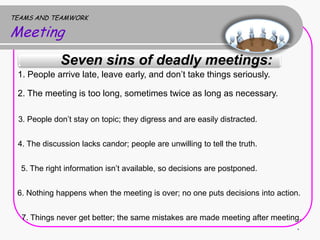
             Seven sins of deadly meetings:
 1. People arrive late, leave early, and don’t take things seriously.

 2. The meeting is too long, sometimes twice as long as necessary.

 3. People don’t stay on topic; they digress and are easily distracted.


 4. The discussion lacks candor; people are unwilling to tell the truth.


  5. The right information isn’t available, so decisions are postponed.


 6. Nothing happens when the meeting is over; no one puts decisions into action.


  7. Things never get better; the same mistakes are made meeting after meeting.
                                                                              .
TEAMS AND TEAMWORK

Importance Of Teams
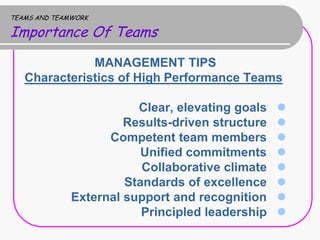
              MANAGEMENT TIPS
   Characteristics of High Performance Teams

                         Clear, elevating goals   
                       Results-driven structure   
                    Competent team members        
                          Unified commitments     
                          Collaborative climate   
                       Standards of excellence    
              External support and recognition    
                          Principled leadership   
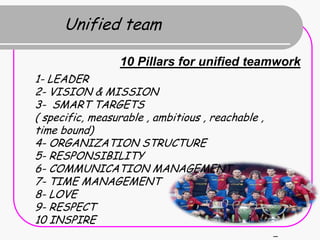
Unified team

                 10 Pillars for unified teamwork
1- LEADER
2- VISION & MISSION
3- SMART TARGETS
( specific, measurable , ambitious , reachable ,
time bound)
4- ORGANIZATION STRUCTURE
5- RESPONSIBILITY
6- COMMUNICATION MANAGEMENT
7- TIME MANAGEMENT
8- LOVE
9- RESPECT
10 INSPIRE
                                                   –
FOUNDATIONS OF TEAMWORK
Effective Teams
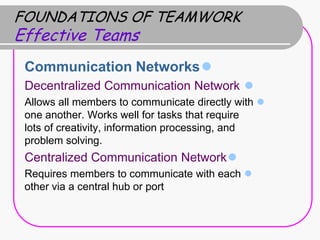
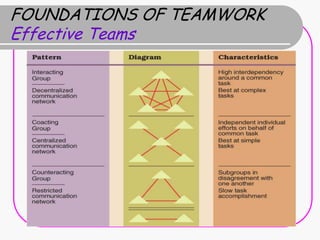
 Communication Networks 
 Decentralized Communication Network 
 Allows all members to communicate directly with 
 one another. Works well for tasks that require
 lots of creativity, information processing, and
 problem solving.
 Centralized Communication Network 
 Requires members to communicate with each 
 other via a central hub or port
FOUNDATIONS OF TEAMWORK
Effective Teams
FOUNDATIONS OF TEAMWORK
Effective Teams
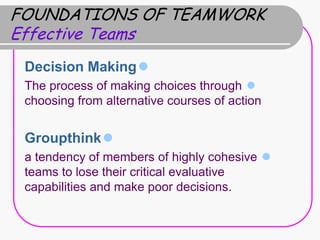
 Decision Making 
 The process of making choices through 
 choosing from alternative courses of action


 Groupthink 
 a tendency of members of highly cohesive 
 teams to lose their critical evaluative
 capabilities and make poor decisions.
THANK YOU

Team work

  • 1.
  • 2.
  • 3.
  • 4.
    T W e o a r m k There is no“I” in Team working
  • 5.
    - - A team is a small number of people with complementary skills who are committed to a common purpose, and hold themselves mutually accountable for its achievement.
  • 6.
    TEAMS AND TEAMWORK T Trust E Effective Communication A A positive “can do “ attitude M Motivation to perform and improve W We mentality O Ownership of work R Respect everybody K Keeping focused in costumer goals –
  • 7.
    2- What thedifferent between Teams and Group TRADITIONAL WORK GROUP TEAMS Leader dominates and control Leader facilitator and coach Goals set by organization Goals set by team members Leader assign works Team plan work assignments Communication flows down from the Communication flows upwards and leader downwards Information is often hoarded Information is shared Decisions made by the leader Decisions made by the entire team Emphasis on individual performance Emphasis on team performance –
  • 8.
    TEAMS AND TEAMWORK ImportanceOf Teams Team a collection of people who regularly interact to pursue common goals. Teamwork the process of people actively working together to accomplish common goals. Formal Group a group that is officially recognized and supported by the organization. Informal Group a group that is unofficial and emerges from relationships and shared interests among members. Committee people brought together outside of their daily job assignments to work in a small team for a specific task
  • 9.
  • 10.
    Team working andindividual working - - - -
  • 11.
  • 12.
  • 13.
    LEADERS MANAGERIAL SKILLS TOP CONCEPTUAL MANAGEMENT SKILLS MIDDLE HUMAN MANAGEMENT SKILLS SUPERVISORY TECHNICAL MANAGEMENT SKILLS LEADERSHIP CONTROLLING NEGOTIATING TEAM BUILDING COMMUNICATIONS MANAGING CONFLICTS PLANNING PROBLEM SOLVING COACHING DIRECTING SUPPORTING ORGANIZING DELEGATING MOTIVATING NEGOTIATING
  • 14.
  • 15.
  • 16.
    - - - -
  • 17.
    - - - - -
  • 18.
  • 19.
    Stages of TeamDevelopment Theor y on t eam devel opm ent pr edi ct s t hat t eam l i ke s, i ndi vi dual s, pass t hr ough pr edi ct abl e, sequent i al st ages over t i m The m e. ost w l know of t hese m el n odel s i s t hat of Tuckm (1965), w l abel ed t he st ages of an ho t eam devel opm ent as f or m ng, st or m ng, nor m ng, i i i per f or m ng, and adj our ni ng. i
  • 20.
    Exchange of inf or m i on; i ncr eased i nt er dependency; • at t ask expl or at i on; i dent i f i cat i on of com onal t i es m 1. Forming Tent at i ve i nt er act i ons; pol i t e di scour se; concer n over am gui t y ; • bi (orientation) sel f -di scour se D sagr eem over pr ocedur es; expr essi on of di ssat i sf act i on; • i ent em i onal r esponses; r esi st ance ot 2. Storming C i t i ci smof i deas; poor at t endance; host i l i t y; pol ar i zat i on and • r (conflict) coal i t i on f or m ng i G ow h of cohesi veness and uni t y; est abl i shm of r ol es, • r t ent st andar ds, and r el at i onshi ps 3. Norming A eem on pr ocedur es; r educt i on i n r ol e am gui t y; i ncr eased • gr ent bi (cohesion) "w eel i ng e-f
  • 21.
    Goal achi evem; • ent 4. Performing hi gh t ask or i ent at i on; emphasi s on per f or mance and pr oduct i on (conflict) D si on m ng; pr obl emsol vi ng; m ual cooper at i on eci aki ut • (performance) Ter m nat i on of r ol es; com et i on of t asks; r educt i on of i pl • dependency 5. Adjourning Di si nt egr at i on and w t hdr aw ; i ncr eased i ndependence and • i al (dissolution) em i onal i t y; r egr et ot
  • 22.
    TEAMS AND TEAMWORK ImportanceOf Teams Types of Teams 1- Project Team is convened for a specific purpose and disbands after completing its task. 2- Cross-functional Team operates with members who come from different functional units of an organization. 3 - Employee Involvement Team meets on a regular basis to help achieve continuous improvement.
  • 23.
    TEAMS AND TEAMWORK ImportanceOf Teams Types of Teams 4- Quality Circle Team employees who meet periodically to discuss ways of improving work quality. 5- Self-managing Teams work team having the authority to make decisions about how they share and complete their work. 6-Virtual Teams Work together and solve problems through computer based interactions
  • 24.
    MEETING  - -  - -  -  -  –
  • 25.
    MEETING   - - • - - • • • • –
  • 26.
    MEETING    • • • • • • - • - • –
  • 27.
    TEAMS AND TEAMWORK Meeting Seven sins of deadly meetings: 1. People arrive late, leave early, and don’t take things seriously. 2. The meeting is too long, sometimes twice as long as necessary. 3. People don’t stay on topic; they digress and are easily distracted. 4. The discussion lacks candor; people are unwilling to tell the truth. 5. The right information isn’t available, so decisions are postponed. 6. Nothing happens when the meeting is over; no one puts decisions into action. 7. Things never get better; the same mistakes are made meeting after meeting. .
  • 28.
    TEAMS AND TEAMWORK ImportanceOf Teams MANAGEMENT TIPS Characteristics of High Performance Teams Clear, elevating goals  Results-driven structure  Competent team members  Unified commitments  Collaborative climate  Standards of excellence  External support and recognition  Principled leadership 
  • 29.
    Unified team 10 Pillars for unified teamwork 1- LEADER 2- VISION & MISSION 3- SMART TARGETS ( specific, measurable , ambitious , reachable , time bound) 4- ORGANIZATION STRUCTURE 5- RESPONSIBILITY 6- COMMUNICATION MANAGEMENT 7- TIME MANAGEMENT 8- LOVE 9- RESPECT 10 INSPIRE –
  • 30.
    FOUNDATIONS OF TEAMWORK EffectiveTeams Communication Networks  Decentralized Communication Network  Allows all members to communicate directly with  one another. Works well for tasks that require lots of creativity, information processing, and problem solving. Centralized Communication Network  Requires members to communicate with each  other via a central hub or port
  • 31.
  • 32.
    FOUNDATIONS OF TEAMWORK EffectiveTeams Decision Making  The process of making choices through  choosing from alternative courses of action Groupthink  a tendency of members of highly cohesive  teams to lose their critical evaluative capabilities and make poor decisions.
  • 33.