THINKING
SKILLS
Lecturer :
SHARIHAN BIN SHAHIDAN PKT, PAP, PBP
INTRODUCTION
Thinking Skill
Thinking skills refer to the cognitive abilities and
processes that individuals use to understand,
analyze, evaluate, and generate ideas, solve
problems, make decisions, and engage in critical and
creative thinking.
Presentation title 2
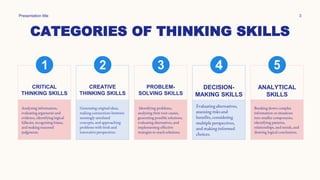
CATEGORIES OF THINKING SKILLS
Presentation title 3
CRITICAL
THINKING SKILLS
Analyzing information,
evaluating arguments and
evidence, identifying logical
fallacies, recognizing biases,
and making reasoned
judgments.
CREATIVE
THINKING SKILLS
Generating original ideas,
making connections between
seemingly unrelated
concepts, and approaching
problems with fresh and
innovative perspectives.
PROBLEM-
SOLVING SKILLS
Identifying problems,
analyzing their root causes,
generating possible solutions,
evaluating alternatives, and
implementing effective
strategies to reach solutions.
DECISION-
MAKING SKILLS
Evaluating alternatives,
assessing risks and
benefits, considering
multiple perspectives,
and making informed
choices.
ANALYTICAL
SKILLS
Breaking down complex
information or situations
into smaller components,
identifying patterns,
relationships, and trends, and
drawing logical conclusions.
TOPIC 1 : CRITICAL
THINKING
COURSE LEARNING OUTCOMES (CLO) :
CLO 1:
Explain the concept of critical and creative thinking (C2,
PLO1)
AGENDA
1.1 Definition​
1.2 Critical thinking theories
1.3 Types of critical thinking
1.4 Characteristics and skills of a critical
thinker​
1.1 CRITICAL
THINKING
6
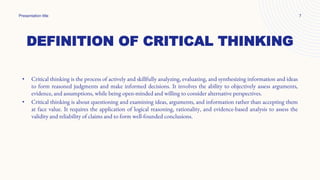
DEFINITION OF CRITICAL THINKING
• Critical thinking is the process of actively and skillfully analyzing, evaluating, and synthesizing information and ideas
to form reasoned judgments and make informed decisions. It involves the ability to objectively assess arguments,
evidence, and assumptions, while being open-minded and willing to consider alternative perspectives.
• Critical thinking is about questioning and examining ideas, arguments, and information rather than accepting them
at face value. It requires the application of logical reasoning, rationality, and evidence-based analysis to assess the
validity and reliability of claims and to form well-founded conclusions.
Presentation title 7
SELF STUDY :
Key elements of critical thinking
1.2 CRITICAL
THINKING THEORIES
9
CRITICAL THINKING THEORIES
Critical thinking is a concept and a skill rather than a set of
theories. However, there are various theoretical
perspectives and models that have been proposed to
understand and explain critical thinking processes.
These models provide frameworks for understanding the
components and stages of critical thinking. Here are a few
examples of theoretical models of critical thinking:
10
Presentation title
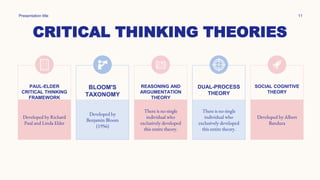
CRITICAL THINKING THEORIES
Presentation title 11
PAUL-ELDER
CRITICAL THINKING
FRAMEWORK
Developed by Richard
Paul and Linda Elder
BLOOM'S
TAXONOMY
Developed by
Benjamin Bloom
(1956)
REASONING AND
ARGUMENTATION
THEORY
There is no single
individual who
exclusively developed
this entire theory.
DUAL-PROCESS
THEORY
There is no single
individual who
exclusively developed
this entire theory.
SOCIAL COGNITIVE
THEORY
Developed by Albert
Bandura
GROUP ACTIVITIES :
1. Make a small group
2. Make a discussion about the
theories of critical thinking
1.3 TYPES OF
CRITICAL THINKING
13
Critical thinking can be
categorized into different
types based on the
cognitive processes
involved and the contexts
in which it is applied.
• Analytical Thinking
• Creative Thinking
• Reflective Thinking
• Problem-solving Thinking
• Decision-making Thinking
• Strategic Thinking
• Scientific Thinking
• Ethical Thinking
Some common types of
critical thinking:
14
GROUP ACTIVITIES :
Give examples :
Types of creative thinking
1.4 Characteristics
and skills of a
critical thinker
CHARACTERISTICS AND SKILLS OF
A CRITICAL THINKER
17
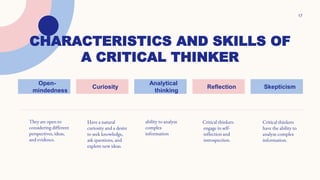
Open-
mindedness
Curiosity
Analytical
thinking
Reflection Skepticism
They are open to
considering different
perspectives, ideas,
and evidence.
Have a natural
curiosity and a desire
to seek knowledge,
ask questions, and
explore new ideas.
ability to analyze
complex
information
Critical thinkers
engage in self-
reflection and
introspection.
Critical thinkers
have the ability to
analyze complex
information.
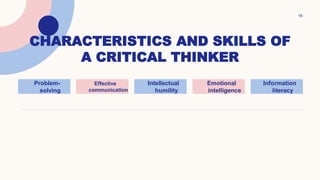
CHARACTERISTICS AND SKILLS OF
A CRITICAL THINKER
18
Problem-
solving
Effective
communication
Intellectual
humility
Emotional
intelligence
Information
literacy
THANK YOU

CHAPTER 1 CRITICAL THINKING.pptx

  • 1.
  • 2.
    INTRODUCTION Thinking Skill Thinking skillsrefer to the cognitive abilities and processes that individuals use to understand, analyze, evaluate, and generate ideas, solve problems, make decisions, and engage in critical and creative thinking. Presentation title 2
  • 3.
    CATEGORIES OF THINKINGSKILLS Presentation title 3 CRITICAL THINKING SKILLS Analyzing information, evaluating arguments and evidence, identifying logical fallacies, recognizing biases, and making reasoned judgments. CREATIVE THINKING SKILLS Generating original ideas, making connections between seemingly unrelated concepts, and approaching problems with fresh and innovative perspectives. PROBLEM- SOLVING SKILLS Identifying problems, analyzing their root causes, generating possible solutions, evaluating alternatives, and implementing effective strategies to reach solutions. DECISION- MAKING SKILLS Evaluating alternatives, assessing risks and benefits, considering multiple perspectives, and making informed choices. ANALYTICAL SKILLS Breaking down complex information or situations into smaller components, identifying patterns, relationships, and trends, and drawing logical conclusions.
  • 4.
    TOPIC 1 :CRITICAL THINKING COURSE LEARNING OUTCOMES (CLO) : CLO 1: Explain the concept of critical and creative thinking (C2, PLO1)
  • 5.
    AGENDA 1.1 Definition​ 1.2 Criticalthinking theories 1.3 Types of critical thinking 1.4 Characteristics and skills of a critical thinker​
  • 6.
  • 7.
    DEFINITION OF CRITICALTHINKING • Critical thinking is the process of actively and skillfully analyzing, evaluating, and synthesizing information and ideas to form reasoned judgments and make informed decisions. It involves the ability to objectively assess arguments, evidence, and assumptions, while being open-minded and willing to consider alternative perspectives. • Critical thinking is about questioning and examining ideas, arguments, and information rather than accepting them at face value. It requires the application of logical reasoning, rationality, and evidence-based analysis to assess the validity and reliability of claims and to form well-founded conclusions. Presentation title 7
  • 8.
    SELF STUDY : Keyelements of critical thinking
  • 9.
  • 10.
    CRITICAL THINKING THEORIES Criticalthinking is a concept and a skill rather than a set of theories. However, there are various theoretical perspectives and models that have been proposed to understand and explain critical thinking processes. These models provide frameworks for understanding the components and stages of critical thinking. Here are a few examples of theoretical models of critical thinking: 10 Presentation title
  • 11.
    CRITICAL THINKING THEORIES Presentationtitle 11 PAUL-ELDER CRITICAL THINKING FRAMEWORK Developed by Richard Paul and Linda Elder BLOOM'S TAXONOMY Developed by Benjamin Bloom (1956) REASONING AND ARGUMENTATION THEORY There is no single individual who exclusively developed this entire theory. DUAL-PROCESS THEORY There is no single individual who exclusively developed this entire theory. SOCIAL COGNITIVE THEORY Developed by Albert Bandura
  • 12.
    GROUP ACTIVITIES : 1.Make a small group 2. Make a discussion about the theories of critical thinking
  • 13.
  • 14.
    Critical thinking canbe categorized into different types based on the cognitive processes involved and the contexts in which it is applied. • Analytical Thinking • Creative Thinking • Reflective Thinking • Problem-solving Thinking • Decision-making Thinking • Strategic Thinking • Scientific Thinking • Ethical Thinking Some common types of critical thinking: 14
  • 15.
    GROUP ACTIVITIES : Giveexamples : Types of creative thinking
  • 16.
    1.4 Characteristics and skillsof a critical thinker
  • 17.
    CHARACTERISTICS AND SKILLSOF A CRITICAL THINKER 17 Open- mindedness Curiosity Analytical thinking Reflection Skepticism They are open to considering different perspectives, ideas, and evidence. Have a natural curiosity and a desire to seek knowledge, ask questions, and explore new ideas. ability to analyze complex information Critical thinkers engage in self- reflection and introspection. Critical thinkers have the ability to analyze complex information.
  • 18.
    CHARACTERISTICS AND SKILLSOF A CRITICAL THINKER 18 Problem- solving Effective communication Intellectual humility Emotional intelligence Information literacy
  • 19.