Step 1 group assignment
LEADERSHIP AND
CHANGE
MANAGEMENT
Team 4:
1. Sree Harsha Pedamallu.
2. Sai Supraja Nanduri
3. Sai Akash Nori
4. Chirag Sharma
5. Yash Pokharna
6. Naresh Sabani
Learning Objectives
1. Theoretical explanation of Complacency from the book Leading Change (TEOC)
2. Theoretical explanation of Urgency level from the book Heart of Change (TEUL)
3. Practical application in the cases where the above were applied (PAIC)
- This is the road map for this PPT
TEOC TEUL PAIC
The presentation serves three purposes:
1. It is believed that Senior management has got only 5 mins (Slides 16,17,18)
2. For stakeholders who wants a clear idea (All slides)
3. Stakeholders who needs only summary of individual section (3,9,10)
Summary
TEOC TEUL PAICTEOC
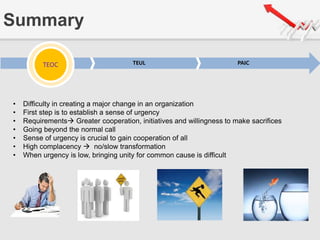
• Difficulty in creating a major change in an organization
• First step is to establish a sense of urgency
• Requirements Greater cooperation, initiatives and willingness to make sacrifices
• Going beyond the normal call
• Sense of urgency is crucial to gain cooperation of all
• High complacency  no/slow transformation
• When urgency is low, bringing unity for common cause is difficult
Pharma Example
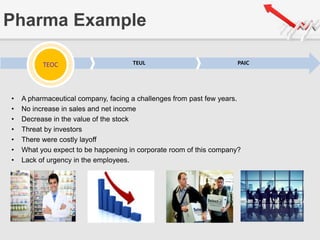
• A pharmaceutical company, facing a challenges from past few years.
• No increase in sales and net income
• Decrease in the value of the stock
• Threat by investors
• There were costly layoff
• What you expect to be happening in corporate room of this company?
• Lack of urgency in the employees.
TEOC TEUL PAICTEOC
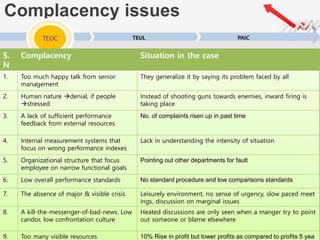
Complacency issues
TEOC TEUL PAICTEOC
S.
N
Complacency Situation in the case
1. Too much happy talk from senior
management
They generalize it by saying its problem faced by all
2. Human nature denial, if people
stressed
Instead of shooting guns towards enemies, inward firing is
taking place
3. A lack of sufficient performance
feedback from external resources
No. of complaints risen up in past time
4. Internal measurement systems that
focus on wrong performance indexes
Lack in understanding the intensity of situation
5. Organizational structure that focus
employee on narrow functional goals
Pointing out other departments for fault
6. Low overall performance standards No standard procedure and low comparisons standards
7. The absence of major & visible crisis Leisurely environment, no sense of urgency, slow paced meet
ings, discussion on marginal issues
8. A kill-the-messenger-of-bad-news. Low
candor, low confrontation culture
Heated discussions are only seen when a manger try to point
out someone or blame elsewhere
9. Too many visible resources 10% Rise in profit but lower profits as compared to profits 5 yea
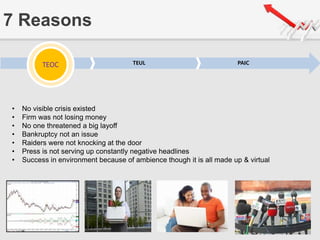
7 Reasons
TEOC TEUL PAICTEOC
• No visible crisis existed
• Firm was not losing money
• No one threatened a big layoff
• Bankruptcy not an issue
• Raiders were not knocking at the door
• Press is not serving up constantly negative headlines
• Success in environment because of ambience though it is all made up & virtual
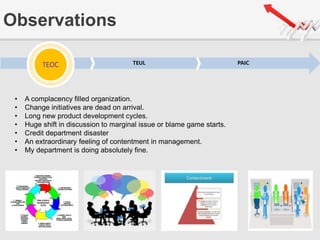
Observations
TEOC TEUL PAICTEOC
• A complacency filled organization.
• Change initiatives are dead on arrival.
• Long new product development cycles.
• Huge shift in discussion to marginal issue or blame game starts.
• Credit department disaster
• An extraordinary feeling of contentment in management.
• My department is doing absolutely fine.
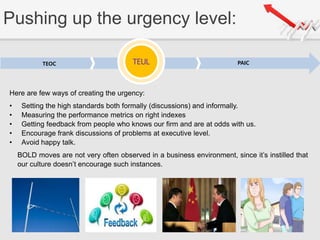
Pushing up the urgency level:
TEOC TEUL PAICTEUL
Here are few ways of creating the urgency:
• Setting the high standards both formally (discussions) and informally.
• Measuring the performance metrics on right indexes
• Getting feedback from people who knows our firm and are at odds with us.
• Encourage frank discussions of problems at executive level.
• Avoid happy talk.
BOLD moves are not very often observed in a business environment, since it’s instilled that
our culture doesn’t encourage such instances.
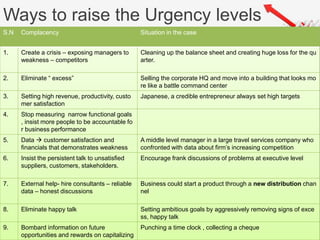
Ways to raise the Urgency levels
TEOC TEUL PAICTEUL
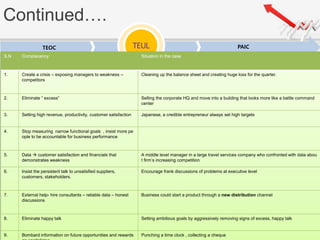
S.N Complacency Situation in the case
1. Create a crisis – exposing managers to
weakness – competitors
Cleaning up the balance sheet and creating huge loss for the qu
arter.
2. Eliminate “ excess” Selling the corporate HQ and move into a building that looks mo
re like a battle command center
3. Setting high revenue, productivity, custo
mer satisfaction
Japanese, a credible entrepreneur always set high targets
4. Stop measuring narrow functional goals
, insist more people to be accountable fo
r business performance
5. Data  customer satisfaction and
financials that demonstrates weakness
A middle level manager in a large travel services company who
confronted with data about firm’s increasing competition
6. Insist the persistent talk to unsatisfied
suppliers, customers, stakeholders.
Encourage frank discussions of problems at executive level
7. External help- hire consultants – reliable
data – honest discussions
Business could start a product through a new distribution chan
nel
8. Eliminate happy talk Setting ambitious goals by aggressively removing signs of exce
ss, happy talk
9. Bombard information on future
opportunities and rewards on capitalizing
Punching a time clock , collecting a cheque
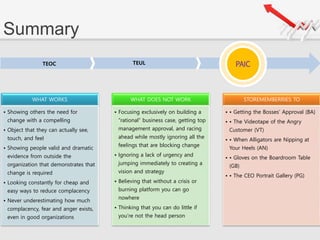
Summary
TEOC TEUL PAICPAIC
WHAT WORKS
• Showing others the need for
change with a compelling
• Object that they can actually see,
touch, and feel
• Showing people valid and dramatic
evidence from outside the
organization that demonstrates that
change is required
• Looking constantly for cheap and
easy ways to reduce complacency
• Never underestimating how much
complacency, fear and anger exists,
even in good organizations
WHAT DOES NOT WORK
• Focusing exclusively on building a
“rational” business case, getting top
management approval, and racing
ahead while mostly ignoring all the
feelings that are blocking change
• Ignoring a lack of urgency and
jumping immediately to creating a
vision and strategy
• Believing that without a crisis or
burning platform you can go
nowhere
• Thinking that you can do little if
you’re not the head person
STOREMEMBERRIES TO
• • Getting the Bosses’ Approval (BA)
• • The Videotape of the Angry
Customer (VT)
• • When Alligators are Nipping at
Your Heels (AN)
• • Gloves on the Boardroom Table
(GB)
• • The CEO Portrait Gallery (PG)
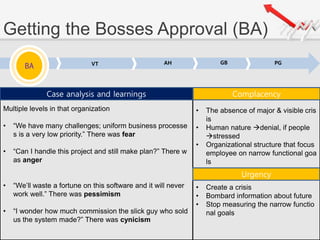
Getting the Bosses Approval (BA)
BA VT AH
BA
GB PG
Multiple levels in that organization
• “We have many challenges; uniform business processe
s is a very low priority.” There was fear
• “Can I handle this project and still make plan?” There w
as anger
• “We’ll waste a fortune on this software and it will never
work well.” There was pessimism
• “I wonder how much commission the slick guy who sold
us the system made?” There was cynicism
• The absence of major & visible cris
is
• Human nature denial, if people
stressed
• Organizational structure that focus
employee on narrow functional goa
ls
• Create a crisis
• Bombard information about future
• Stop measuring the narrow functio
nal goals
Case analysis and learnings Complacency
Urgency
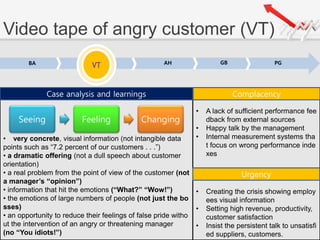
Video tape of angry customer (VT)
BA VT AH
VT GB PG
• very concrete, visual information (not intangible data
points such as “7.2 percent of our customers . . .”)
• a dramatic offering (not a dull speech about customer
orientation)
• a real problem from the point of view of the customer (not
a manager’s “opinion”)
• information that hit the emotions (“What?” “Wow!”)
• the emotions of large numbers of people (not just the bo
sses)
• an opportunity to reduce their feelings of false pride witho
ut the intervention of an angry or threatening manager
(no “You idiots!”)
• A lack of sufficient performance fee
dback from external sources
• Happy talk by the management
• Internal measurement systems tha
t focus on wrong performance inde
xes
• Creating the crisis showing employ
ees visual information
• Setting high revenue, productivity,
customer satisfaction
• Insist the persistent talk to unsatisfi
ed suppliers, customers.
Case analysis and learnings Complacency
Urgency
Seeing Feeling Changing
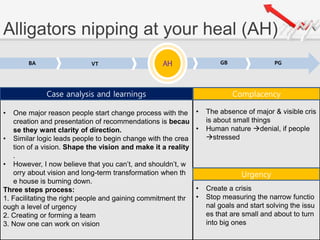
Alligators nipping at your heal (AH)
BA VT AHAH GB PG
• One major reason people start change process with the
creation and presentation of recommendations is becau
se they want clarity of direction.
• Similar logic leads people to begin change with the crea
tion of a vision. Shape the vision and make it a reality
.
• However, I now believe that you can’t, and shouldn’t, w
orry about vision and long-term transformation when th
e house is burning down.
Three steps process:
1. Facilitating the right people and gaining commitment thr
ough a level of urgency
2. Creating or forming a team
3. Now one can work on vision
• The absence of major & visible cris
is about small things
• Human nature denial, if people
stressed
• Create a crisis
• Stop measuring the narrow functio
nal goals and start solving the issu
es that are small and about to turn
into big ones
Case analysis and learnings Complacency
Urgency
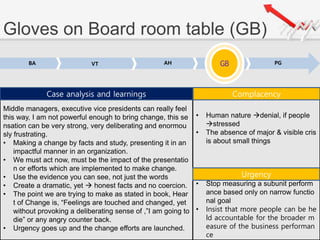
Gloves on Board room table (GB)
BA VT AH GB PG
Middle managers, executive vice presidents can really feel
this way, I am not powerful enough to bring change, this se
nsation can be very strong, very deliberating and enormou
sly frustrating.
• Making a change by facts and study, presenting it in an
impactful manner in an organization.
• We must act now, must be the impact of the presentatio
n or efforts which are implemented to make change.
• Use the evidence you can see, not just the words
• Create a dramatic, yet  honest facts and no coercion.
• The point we are trying to make as stated in book, Hear
t of Change is, “Feelings are touched and changed, yet
without provoking a deliberating sense of ,”I am going to
die” or any angry counter back.
• Urgency goes up and the change efforts are launched.
• Human nature denial, if people
stressed
• The absence of major & visible cris
is about small things
• Stop measuring a subunit perform
ance based only on narrow functio
nal goal
• Insist that more people can be he
ld accountable for the broader m
easure of the business performan
ce
Case analysis and learnings Complacency
Urgency
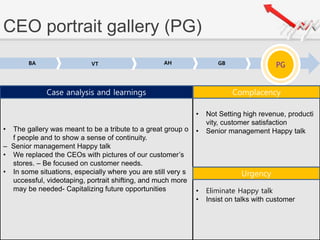
CEO portrait gallery (PG)
BA VT AH
PGGB
• The gallery was meant to be a tribute to a great group o
f people and to show a sense of continuity.
– Senior management Happy talk
• We replaced the CEOs with pictures of our customer’s
stores. – Be focused on customer needs.
• In some situations, especially where you are still very s
uccessful, videotaping, portrait shifting, and much more
may be needed- Capitalizing future opportunities
• Not Setting high revenue, producti
vity, customer satisfaction
• Senior management Happy talk
• Eliminate Happy talk
• Insist on talks with customer
Case analysis and learnings Complacency
Urgency
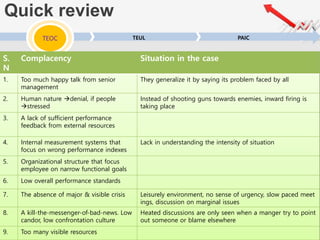
Quick review
TEOC TEUL PAICTEOC
S.
N
Complacency Situation in the case
1. Too much happy talk from senior
management
They generalize it by saying its problem faced by all
2. Human nature denial, if people
stressed
Instead of shooting guns towards enemies, inward firing is
taking place
3. A lack of sufficient performance
feedback from external resources
4. Internal measurement systems that
focus on wrong performance indexes
Lack in understanding the intensity of situation
5. Organizational structure that focus
employee on narrow functional goals
6. Low overall performance standards
7. The absence of major & visible crisis Leisurely environment, no sense of urgency, slow paced meet
ings, discussion on marginal issues
8. A kill-the-messenger-of-bad-news. Low
candor, low confrontation culture
Heated discussions are only seen when a manger try to point
out someone or blame elsewhere
9. Too many visible resources
Continued….
TEOC TEUL PAICTEUL
S.N Complacency Situation in the case
1. Create a crisis – exposing managers to weakness –
competitors
Cleaning up the balance sheet and creating huge loss for the quarter.
2. Eliminate “ excess” Selling the corporate HQ and move into a building that looks more like a battle command
center
3. Setting high revenue, productivity, customer satisfaction Japanese, a credible entrepreneur always set high targets
4. Stop measuring narrow functional goals , insist more pe
ople to be accountable for business performance
5. Data  customer satisfaction and financials that
demonstrates weakness
A middle level manager in a large travel services company who confronted with data abou
t firm’s increasing competition
6. Insist the persistent talk to unsatisfied suppliers,
customers, stakeholders.
Encourage frank discussions of problems at executive level
7. External help- hire consultants – reliable data – honest
discussions
Business could start a product through a new distribution channel
8. Eliminate happy talk Setting ambitious goals by aggressively removing signs of excess, happy talk
9. Bombard information on future opportunities and rewards Punching a time clock , collecting a cheque
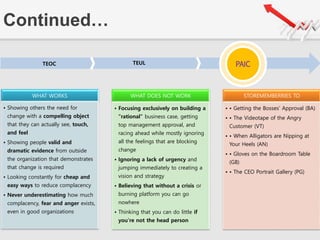
Continued…
TEOC TEUL PAICPAIC
WHAT WORKS
• Showing others the need for
change with a compelling object
that they can actually see, touch,
and feel
• Showing people valid and
dramatic evidence from outside
the organization that demonstrates
that change is required
• Looking constantly for cheap and
easy ways to reduce complacency
• Never underestimating how much
complacency, fear and anger exists,
even in good organizations
WHAT DOES NOT WORK
• Focusing exclusively on building a
“rational” business case, getting
top management approval, and
racing ahead while mostly ignoring
all the feelings that are blocking
change
• Ignoring a lack of urgency and
jumping immediately to creating a
vision and strategy
• Believing that without a crisis or
burning platform you can go
nowhere
• Thinking that you can do little if
you’re not the head person
STOREMEMBERRIES TO
• • Getting the Bosses’ Approval (BA)
• • The Videotape of the Angry
Customer (VT)
• • When Alligators are Nipping at
Your Heels (AN)
• • Gloves on the Boardroom Table
(GB)
• • The CEO Portrait Gallery (PG)
Thank You
Any Questions?

Team 4 (vezetes) final ppt 1st step assignment

  • 1.
    Step 1 groupassignment LEADERSHIP AND CHANGE MANAGEMENT Team 4: 1. Sree Harsha Pedamallu. 2. Sai Supraja Nanduri 3. Sai Akash Nori 4. Chirag Sharma 5. Yash Pokharna 6. Naresh Sabani
  • 2.
    Learning Objectives 1. Theoreticalexplanation of Complacency from the book Leading Change (TEOC) 2. Theoretical explanation of Urgency level from the book Heart of Change (TEUL) 3. Practical application in the cases where the above were applied (PAIC) - This is the road map for this PPT TEOC TEUL PAIC The presentation serves three purposes: 1. It is believed that Senior management has got only 5 mins (Slides 16,17,18) 2. For stakeholders who wants a clear idea (All slides) 3. Stakeholders who needs only summary of individual section (3,9,10)
  • 3.
    Summary TEOC TEUL PAICTEOC •Difficulty in creating a major change in an organization • First step is to establish a sense of urgency • Requirements Greater cooperation, initiatives and willingness to make sacrifices • Going beyond the normal call • Sense of urgency is crucial to gain cooperation of all • High complacency  no/slow transformation • When urgency is low, bringing unity for common cause is difficult
  • 4.
    Pharma Example • Apharmaceutical company, facing a challenges from past few years. • No increase in sales and net income • Decrease in the value of the stock • Threat by investors • There were costly layoff • What you expect to be happening in corporate room of this company? • Lack of urgency in the employees. TEOC TEUL PAICTEOC
  • 5.
    Complacency issues TEOC TEULPAICTEOC S. N Complacency Situation in the case 1. Too much happy talk from senior management They generalize it by saying its problem faced by all 2. Human nature denial, if people stressed Instead of shooting guns towards enemies, inward firing is taking place 3. A lack of sufficient performance feedback from external resources No. of complaints risen up in past time 4. Internal measurement systems that focus on wrong performance indexes Lack in understanding the intensity of situation 5. Organizational structure that focus employee on narrow functional goals Pointing out other departments for fault 6. Low overall performance standards No standard procedure and low comparisons standards 7. The absence of major & visible crisis Leisurely environment, no sense of urgency, slow paced meet ings, discussion on marginal issues 8. A kill-the-messenger-of-bad-news. Low candor, low confrontation culture Heated discussions are only seen when a manger try to point out someone or blame elsewhere 9. Too many visible resources 10% Rise in profit but lower profits as compared to profits 5 yea
  • 6.
    7 Reasons TEOC TEULPAICTEOC • No visible crisis existed • Firm was not losing money • No one threatened a big layoff • Bankruptcy not an issue • Raiders were not knocking at the door • Press is not serving up constantly negative headlines • Success in environment because of ambience though it is all made up & virtual
  • 7.
    Observations TEOC TEUL PAICTEOC •A complacency filled organization. • Change initiatives are dead on arrival. • Long new product development cycles. • Huge shift in discussion to marginal issue or blame game starts. • Credit department disaster • An extraordinary feeling of contentment in management. • My department is doing absolutely fine.
  • 8.
    Pushing up theurgency level: TEOC TEUL PAICTEUL Here are few ways of creating the urgency: • Setting the high standards both formally (discussions) and informally. • Measuring the performance metrics on right indexes • Getting feedback from people who knows our firm and are at odds with us. • Encourage frank discussions of problems at executive level. • Avoid happy talk. BOLD moves are not very often observed in a business environment, since it’s instilled that our culture doesn’t encourage such instances.
  • 9.
    Ways to raisethe Urgency levels TEOC TEUL PAICTEUL S.N Complacency Situation in the case 1. Create a crisis – exposing managers to weakness – competitors Cleaning up the balance sheet and creating huge loss for the qu arter. 2. Eliminate “ excess” Selling the corporate HQ and move into a building that looks mo re like a battle command center 3. Setting high revenue, productivity, custo mer satisfaction Japanese, a credible entrepreneur always set high targets 4. Stop measuring narrow functional goals , insist more people to be accountable fo r business performance 5. Data  customer satisfaction and financials that demonstrates weakness A middle level manager in a large travel services company who confronted with data about firm’s increasing competition 6. Insist the persistent talk to unsatisfied suppliers, customers, stakeholders. Encourage frank discussions of problems at executive level 7. External help- hire consultants – reliable data – honest discussions Business could start a product through a new distribution chan nel 8. Eliminate happy talk Setting ambitious goals by aggressively removing signs of exce ss, happy talk 9. Bombard information on future opportunities and rewards on capitalizing Punching a time clock , collecting a cheque
  • 10.
    Summary TEOC TEUL PAICPAIC WHATWORKS • Showing others the need for change with a compelling • Object that they can actually see, touch, and feel • Showing people valid and dramatic evidence from outside the organization that demonstrates that change is required • Looking constantly for cheap and easy ways to reduce complacency • Never underestimating how much complacency, fear and anger exists, even in good organizations WHAT DOES NOT WORK • Focusing exclusively on building a “rational” business case, getting top management approval, and racing ahead while mostly ignoring all the feelings that are blocking change • Ignoring a lack of urgency and jumping immediately to creating a vision and strategy • Believing that without a crisis or burning platform you can go nowhere • Thinking that you can do little if you’re not the head person STOREMEMBERRIES TO • • Getting the Bosses’ Approval (BA) • • The Videotape of the Angry Customer (VT) • • When Alligators are Nipping at Your Heels (AN) • • Gloves on the Boardroom Table (GB) • • The CEO Portrait Gallery (PG)
  • 11.
    Getting the BossesApproval (BA) BA VT AH BA GB PG Multiple levels in that organization • “We have many challenges; uniform business processe s is a very low priority.” There was fear • “Can I handle this project and still make plan?” There w as anger • “We’ll waste a fortune on this software and it will never work well.” There was pessimism • “I wonder how much commission the slick guy who sold us the system made?” There was cynicism • The absence of major & visible cris is • Human nature denial, if people stressed • Organizational structure that focus employee on narrow functional goa ls • Create a crisis • Bombard information about future • Stop measuring the narrow functio nal goals Case analysis and learnings Complacency Urgency
  • 12.
    Video tape ofangry customer (VT) BA VT AH VT GB PG • very concrete, visual information (not intangible data points such as “7.2 percent of our customers . . .”) • a dramatic offering (not a dull speech about customer orientation) • a real problem from the point of view of the customer (not a manager’s “opinion”) • information that hit the emotions (“What?” “Wow!”) • the emotions of large numbers of people (not just the bo sses) • an opportunity to reduce their feelings of false pride witho ut the intervention of an angry or threatening manager (no “You idiots!”) • A lack of sufficient performance fee dback from external sources • Happy talk by the management • Internal measurement systems tha t focus on wrong performance inde xes • Creating the crisis showing employ ees visual information • Setting high revenue, productivity, customer satisfaction • Insist the persistent talk to unsatisfi ed suppliers, customers. Case analysis and learnings Complacency Urgency Seeing Feeling Changing
  • 13.
    Alligators nipping atyour heal (AH) BA VT AHAH GB PG • One major reason people start change process with the creation and presentation of recommendations is becau se they want clarity of direction. • Similar logic leads people to begin change with the crea tion of a vision. Shape the vision and make it a reality . • However, I now believe that you can’t, and shouldn’t, w orry about vision and long-term transformation when th e house is burning down. Three steps process: 1. Facilitating the right people and gaining commitment thr ough a level of urgency 2. Creating or forming a team 3. Now one can work on vision • The absence of major & visible cris is about small things • Human nature denial, if people stressed • Create a crisis • Stop measuring the narrow functio nal goals and start solving the issu es that are small and about to turn into big ones Case analysis and learnings Complacency Urgency
  • 14.
    Gloves on Boardroom table (GB) BA VT AH GB PG Middle managers, executive vice presidents can really feel this way, I am not powerful enough to bring change, this se nsation can be very strong, very deliberating and enormou sly frustrating. • Making a change by facts and study, presenting it in an impactful manner in an organization. • We must act now, must be the impact of the presentatio n or efforts which are implemented to make change. • Use the evidence you can see, not just the words • Create a dramatic, yet  honest facts and no coercion. • The point we are trying to make as stated in book, Hear t of Change is, “Feelings are touched and changed, yet without provoking a deliberating sense of ,”I am going to die” or any angry counter back. • Urgency goes up and the change efforts are launched. • Human nature denial, if people stressed • The absence of major & visible cris is about small things • Stop measuring a subunit perform ance based only on narrow functio nal goal • Insist that more people can be he ld accountable for the broader m easure of the business performan ce Case analysis and learnings Complacency Urgency
  • 15.
    CEO portrait gallery(PG) BA VT AH PGGB • The gallery was meant to be a tribute to a great group o f people and to show a sense of continuity. – Senior management Happy talk • We replaced the CEOs with pictures of our customer’s stores. – Be focused on customer needs. • In some situations, especially where you are still very s uccessful, videotaping, portrait shifting, and much more may be needed- Capitalizing future opportunities • Not Setting high revenue, producti vity, customer satisfaction • Senior management Happy talk • Eliminate Happy talk • Insist on talks with customer Case analysis and learnings Complacency Urgency
  • 16.
    Quick review TEOC TEULPAICTEOC S. N Complacency Situation in the case 1. Too much happy talk from senior management They generalize it by saying its problem faced by all 2. Human nature denial, if people stressed Instead of shooting guns towards enemies, inward firing is taking place 3. A lack of sufficient performance feedback from external resources 4. Internal measurement systems that focus on wrong performance indexes Lack in understanding the intensity of situation 5. Organizational structure that focus employee on narrow functional goals 6. Low overall performance standards 7. The absence of major & visible crisis Leisurely environment, no sense of urgency, slow paced meet ings, discussion on marginal issues 8. A kill-the-messenger-of-bad-news. Low candor, low confrontation culture Heated discussions are only seen when a manger try to point out someone or blame elsewhere 9. Too many visible resources
  • 17.
    Continued…. TEOC TEUL PAICTEUL S.NComplacency Situation in the case 1. Create a crisis – exposing managers to weakness – competitors Cleaning up the balance sheet and creating huge loss for the quarter. 2. Eliminate “ excess” Selling the corporate HQ and move into a building that looks more like a battle command center 3. Setting high revenue, productivity, customer satisfaction Japanese, a credible entrepreneur always set high targets 4. Stop measuring narrow functional goals , insist more pe ople to be accountable for business performance 5. Data  customer satisfaction and financials that demonstrates weakness A middle level manager in a large travel services company who confronted with data abou t firm’s increasing competition 6. Insist the persistent talk to unsatisfied suppliers, customers, stakeholders. Encourage frank discussions of problems at executive level 7. External help- hire consultants – reliable data – honest discussions Business could start a product through a new distribution channel 8. Eliminate happy talk Setting ambitious goals by aggressively removing signs of excess, happy talk 9. Bombard information on future opportunities and rewards Punching a time clock , collecting a cheque
  • 18.
    Continued… TEOC TEUL PAICPAIC WHATWORKS • Showing others the need for change with a compelling object that they can actually see, touch, and feel • Showing people valid and dramatic evidence from outside the organization that demonstrates that change is required • Looking constantly for cheap and easy ways to reduce complacency • Never underestimating how much complacency, fear and anger exists, even in good organizations WHAT DOES NOT WORK • Focusing exclusively on building a “rational” business case, getting top management approval, and racing ahead while mostly ignoring all the feelings that are blocking change • Ignoring a lack of urgency and jumping immediately to creating a vision and strategy • Believing that without a crisis or burning platform you can go nowhere • Thinking that you can do little if you’re not the head person STOREMEMBERRIES TO • • Getting the Bosses’ Approval (BA) • • The Videotape of the Angry Customer (VT) • • When Alligators are Nipping at Your Heels (AN) • • Gloves on the Boardroom Table (GB) • • The CEO Portrait Gallery (PG)
  • 19.
  • 20.