5 KEYS TO LEAD WITH
INTENT
“Lead with Intent” resides at the center of
most modern leadership philosophy.
It is in recognition and response to a
complicated and ever-changing business
environment, where independent action
is necessary to achieve results.
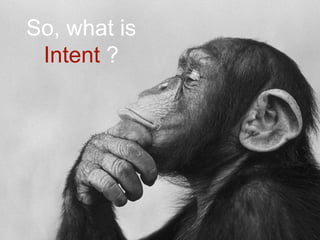
So, what is
Intent ?
– Bungay, Stephen
The Art of Action (p. 110)
“An intent is the decision to do something now (a
task) in order to achieve an outcome (a purpose).”
Intent
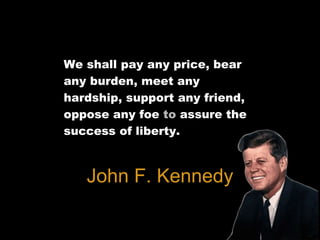
We shall pay any price, bear
any burden, meet any
hardship, support any friend,
oppose any foe to assure the
success of liberty.
John F. Kennedy
So, communicating intent is to relate two
things:
What and Why
Simple Right?
Not so fast…
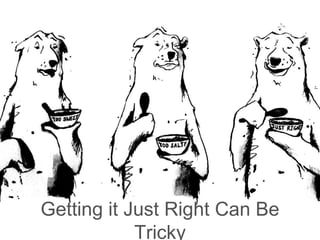
Getting it Just Right is an Art not a Science
Too Little
Too little will leave the audience confused
and poorly aligned.The result will be
inefficient action, or worse, paralysis.
Too Much
Too much and the result will be
low morale, upward delegation,
and inefficient ineffective action.
There are 5 Keys to Leading with Intent
Thats what this presentation is about
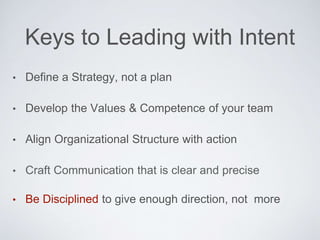
• Define a Strategy, not a plan
• Develop the Values & Competence of your team
• Align Organizational Structure with action
• Craft Communication that is clear and precise
• Be Disciplined to give enough direction, not more
Keys to Leading with Intent
First, you need to answer the
question:
“How are we going to Compete?”
Strategy is at the Heart of Leading with Intent
– Bungay, Stephen
The Art of Action (p. 110)
“An intent is the decision to do something now (a
task) in order to achieve an outcome (a purpose).”
This strategy forms the intent
– Bungay, Stephen
The Art of Action (p. 95)
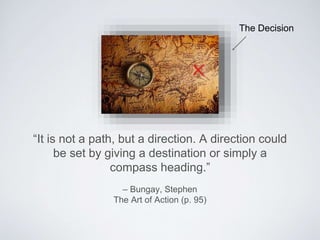
“It is not a path, but a direction.A direction could be
set by giving a destination or simply a compass
heading.”
The Decision
–Richard P. Rumelt
Good Strategy Bad Strategy
“Good strategy works by focusing energy and
resources on one, or a very few, pivotal objectives
whose accomplishment will lead to a cascade of
favorable outcomes.”
Strategy is the input.
People drive activity.
Measurable results are the output.
In an organization led with Intent
– Bungay, Stephen
The Art of Action (p. 90)
“Strategy is a framework for decision making, a guide
to thoughtful, purposive action.”
So, good Strategy is all about
helping people make good decisions
Good Strategy
• Provides direction (destination +/or compass heading)
which inform decisions (particularly in trade-off situations)
• Includes “just enough” information as necessary so as
not to confuse the intent or inhibit independent action
• Drives measurable results, reflecting that the strategy is
informing important decisions (the most important to the
organization)
• Define a Strategy, not a plan
• Align Organizational Structure with action
• Craft Communication that is clear and precise
• Be Disciplined to give enough direction, not more
Keys to Leading with Intent
• Develop the Values & Competence of your team
– Bungay, Stephen
The Art of Action (p. 88)
“Such a model will only work if people are competent
and share basic values.”
Competence andValues fill in
where specifics leave off
Since Strategy is purposely limited
Competence
• Context Specific
• Often a function of Knowledge & Experience
• Quantitative, it can be measured to some extent
Values
• Underlying Principles
• May not always exist (particularly in weaker orgs)
• Often a function of organizational culture
• Qualitative, it is difficult to measure
Assessing Competence
• Start with Standard Industry Guidelines
• Accept less based on organization’s ability and
willingness to invest in training
AssessingValues
• Observe, identify leaders
• Risk takers
• Influencers
• Observe, identify followers
• Risk avoiders
• Upward delegators
We want to cultivate these
(Some) Good leadership
Characteristics
• Courageous
• “Independent thinking”
• Clear reasoning
• Decisive
– Bungay, Stephen
The Art of Action (p. 185)
“Authoritarians micro-manage under all circumstances
because it is the only approach they are comfortable
with.An autocrat only does so if the circumstances
render such behavior appropriate.”
Watch out for Authoritarians
(i.e. bullies)
Take Action: DeployYourTeam
• Remove Authoritarians (bullies, g-bye)
• Hire NewTeam Members (if needed)
• StartTraining, if a lot of training is needed dig in
(this is the longest part of the road and a topic
that deserves a presentation in itself)
• Define a Strategy, not a plan
• Develop the Values & Competence of your team
• Craft Communication that is clear and precise
• Be Disciplined to give enough direction, not more
Keys to Leading with Intent
• Align Organizational Structure with action
– Bungay, Stephen
The Art of Action (p. 143)
“unless the structure of the organization broadly
reflects the structure of the tasks implied by executing
the strategy, the strategy will not be executed.”
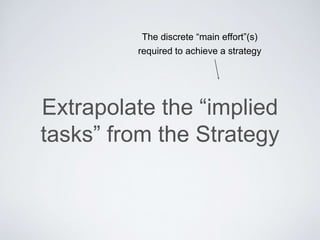
Extrapolate the “implied tasks”
from the Strategy
The discrete “main effort”(s)
required to achieve a strategy
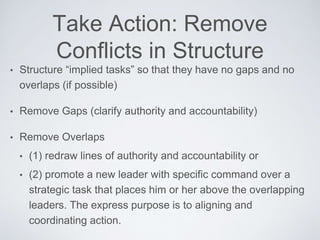
Take Action: Remove Conflicts in
Structure
• Structure “implied tasks” so that they have no gaps and no overlaps
(if possible)
• Remove Gaps (clarify authority and accountability)
• Remove Overlaps
• (1) redraw lines of authority and accountability or
• (2) promote a new leader with specific command over a strategic
task that places him or her above the overlapping leaders.The
express purpose is to aligning and coordinating action.
• Be Disciplined to give enough direction, not more
• Define a Strategy, not a plan
• Develop the Values & Competence of your team
• Align Organizational Structure with action
Keys to Leading with Intent
• Craft Communication that is clear and precise
People don’t just know the strategy.You
have to tell them.And they need to
understand it. In other words,
communication unites strategy and
people
– Bungay, Stephen
The Art of Action (p. 167)
“What matters about creating alignment around a
strategy is not the volume of communication, but its
quality and precision.”
a process worth trying:
Strategy Brief
&
Back Brief
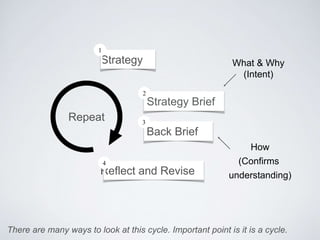
Strategy
Strategy Brief
Back Brief
Reflect and Revise
There are many ways to look at this cycle. Important point is it is a cycle.
1
2
3
4
Repeat
What & Why
(Intent)
How
(Confirms
understanding)
– Bungay, Stephen
The Art of Action (p. 164)
The Strategy Briefing “is a way of structuring thought
so as to concentrate the mind on what matters now,
and leave out what does not matter.”
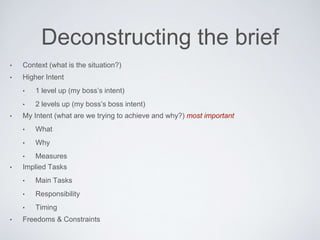
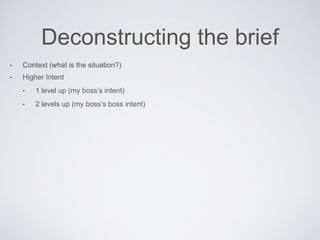
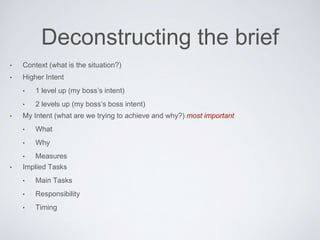
Deconstructing the brief
• Context (what is the situation?)
• Higher Intent
• 1 level up (my boss’s intent)
• 2 levels up (my boss’s boss intent)
• My Intent (what are we trying to achieve and why?) most important
• What
• Why
• Measures
• Implied Tasks
• MainTasks
• Responsibility
• Timing
• Freedoms & Constraints
Deconstructing the brief
• Context (what is the situation?)
– Bungay, Stephen
The Art of Action (p. 62)
“Understanding the context and the overall intention
is what enables junior officers to take independent
decisions if the specific orders issued to them become
invalid because of a change in the situation.”
Deconstructing the brief
• Higher Intent
• 1 level up (my boss’s intent)
• 2 levels up (my boss’s boss intent)
• Context (what is the situation?)• Context (what is the situation?)
Expressing the higher intent
unifies action across the
organization. It also resolves issues
that arise in a matrix environment.
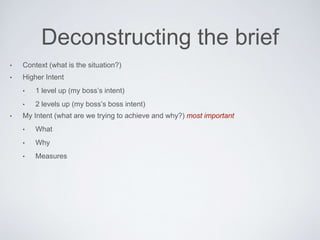
Deconstructing the brief
• Context (what is the situation?)
• Higher Intent
• 1 level up (my boss’s intent)
• 2 levels up (my boss’s boss intent)
• My Intent (what are we trying to achieve and why?) most important
• What
• Why
• Measures
What and Why
-
Decision and Outcome
measures help clarify this
Deconstructing the brief
• Context (what is the situation?)
• Higher Intent
• 1 level up (my boss’s intent)
• 2 levels up (my boss’s boss intent)
• My Intent (what are we trying to achieve and why?) most important
• What
• Why
• Measures
• Implied Tasks
• MainTasks
• Responsibility
• Timing
State the intent as simply as
possible.
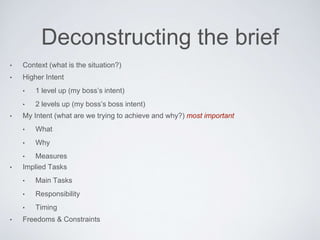
Deconstructing the brief
• Context (what is the situation?)
• Higher Intent
• 1 level up (my boss’s intent)
• 2 levels up (my boss’s boss intent)
• My Intent (what are we trying to achieve and why?) most important
• What
• Why
• Measures
• Implied Tasks
• MainTasks
• Responsibility
• Timing
• Freedoms & Constraints
If it is not already clear, state the
bounds of their autonomy (e.g.
what situations they should
escalate)
• Be Disciplined to give enough direction, not more
• Define a Strategy, not a plan
• Develop the Values & Competence of your team
• Align Organizational Structure with action
• Craft Communication that is clear and precise
Keys to Leading with Intent
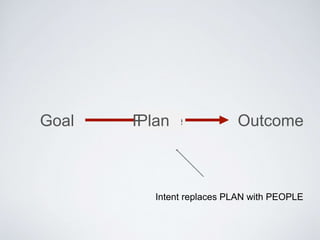
Goal OutcomePeoplePlan
Intent replaces PLAN with PEOPLE
Goal OutcomePeople
Intent replaces PLAN with PEOPLE
No. Not quite.
When Leading with Intent you’re
attempting to guide Independent Action
by diagnosing and communicating the
key to competitive advantage
–General Feldmarshall Graf von Moltke
“The rule to follow is that an order should contain all,
but also only, what subordinates cannot
determine for themselves to achieve a particular
purpose.”
Be disciplined, or else you
erode the culture of
independent thinking, and
condition upward delegation
– Bungay, Stephen
The Art of Action (p. 182)
“People only show independent thinking obedience if
they have the means to do so, and are operating
within a network of trust.”
AvoidTheseTraps
• Avoid unclear ownership of a task (especially when its you).
Make it clear to everyone who owns responsibility for a task.
When its you, make it clear its is their job to assist you in
achieving, but that you will be dictating specifics in this case.The
worst thing you can do is appear to delegate then take it back.
• Avoid criticizing mistakes of commission:“a failure to act
or a delay is a more serious fault than making a mistake in the
choice of means.” - The Art of Action (p. 71)
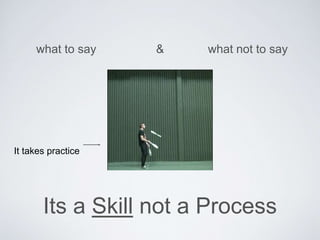
Its a Skill not a Process
&what to say what not to say
It takes practice
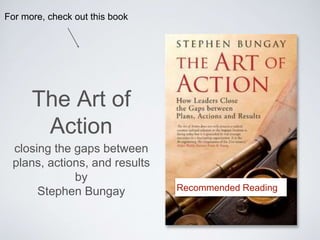
The Art of
Action
closing the gaps between
plans, actions, and results
by
Stephen Bungay
For more, check out this book
Recommended Reading

5 Keys to Lead with Intent

  • 1.
    5 KEYS TOLEAD WITH INTENT
  • 2.
    “Lead with Intent”resides at the center of most modern leadership philosophy.
  • 3.
    It is inrecognition and response to a complicated and ever-changing business environment, where independent action is necessary to achieve results.
  • 4.
  • 5.
    – Bungay, Stephen TheArt of Action (p. 110) “An intent is the decision to do something now (a task) in order to achieve an outcome (a purpose).” Intent
  • 6.
    We shall payany price, bear any burden, meet any hardship, support any friend, oppose any foe to assure the success of liberty. John F. Kennedy
  • 7.
    So, communicating intentis to relate two things: What and Why
  • 8.
  • 9.
  • 10.
    Getting it JustRight is an Art not a Science
  • 11.
  • 12.
    Too little willleave the audience confused and poorly aligned.The result will be inefficient action, or worse, paralysis.
  • 13.
  • 14.
    Too much andthe result will be low morale, upward delegation, and inefficient ineffective action.
  • 15.
    There are 5Keys to Leading with Intent Thats what this presentation is about
  • 16.
    • Define aStrategy, not a plan • Develop the Values & Competence of your team • Align Organizational Structure with action • Craft Communication that is clear and precise • Be Disciplined to give enough direction, not more Keys to Leading with Intent
  • 17.
    First, you needto answer the question: “How are we going to Compete?” Strategy is at the Heart of Leading with Intent
  • 18.
    – Bungay, Stephen TheArt of Action (p. 110) “An intent is the decision to do something now (a task) in order to achieve an outcome (a purpose).” This strategy forms the intent
  • 19.
    – Bungay, Stephen TheArt of Action (p. 95) “It is not a path, but a direction.A direction could be set by giving a destination or simply a compass heading.” The Decision
  • 20.
    –Richard P. Rumelt GoodStrategy Bad Strategy “Good strategy works by focusing energy and resources on one, or a very few, pivotal objectives whose accomplishment will lead to a cascade of favorable outcomes.”
  • 21.
    Strategy is theinput. People drive activity. Measurable results are the output. In an organization led with Intent
  • 22.
    – Bungay, Stephen TheArt of Action (p. 90) “Strategy is a framework for decision making, a guide to thoughtful, purposive action.” So, good Strategy is all about helping people make good decisions
  • 23.
    Good Strategy • Providesdirection (destination +/or compass heading) which inform decisions (particularly in trade-off situations) • Includes “just enough” information as necessary so as not to confuse the intent or inhibit independent action • Drives measurable results, reflecting that the strategy is informing important decisions (the most important to the organization)
  • 24.
    • Define aStrategy, not a plan • Align Organizational Structure with action • Craft Communication that is clear and precise • Be Disciplined to give enough direction, not more Keys to Leading with Intent • Develop the Values & Competence of your team
  • 25.
    – Bungay, Stephen TheArt of Action (p. 88) “Such a model will only work if people are competent and share basic values.”
  • 26.
    Competence andValues fillin where specifics leave off Since Strategy is purposely limited
  • 27.
    Competence • Context Specific •Often a function of Knowledge & Experience • Quantitative, it can be measured to some extent
  • 28.
    Values • Underlying Principles •May not always exist (particularly in weaker orgs) • Often a function of organizational culture • Qualitative, it is difficult to measure
  • 29.
    Assessing Competence • Startwith Standard Industry Guidelines • Accept less based on organization’s ability and willingness to invest in training
  • 30.
    AssessingValues • Observe, identifyleaders • Risk takers • Influencers • Observe, identify followers • Risk avoiders • Upward delegators We want to cultivate these
  • 31.
    (Some) Good leadership Characteristics •Courageous • “Independent thinking” • Clear reasoning • Decisive
  • 32.
    – Bungay, Stephen TheArt of Action (p. 185) “Authoritarians micro-manage under all circumstances because it is the only approach they are comfortable with.An autocrat only does so if the circumstances render such behavior appropriate.” Watch out for Authoritarians (i.e. bullies)
  • 33.
    Take Action: DeployYourTeam •Remove Authoritarians (bullies, g-bye) • Hire NewTeam Members (if needed) • StartTraining, if a lot of training is needed dig in (this is the longest part of the road and a topic that deserves a presentation in itself)
  • 34.
    • Define aStrategy, not a plan • Develop the Values & Competence of your team • Craft Communication that is clear and precise • Be Disciplined to give enough direction, not more Keys to Leading with Intent • Align Organizational Structure with action
  • 35.
    – Bungay, Stephen TheArt of Action (p. 143) “unless the structure of the organization broadly reflects the structure of the tasks implied by executing the strategy, the strategy will not be executed.”
  • 36.
    Extrapolate the “impliedtasks” from the Strategy The discrete “main effort”(s) required to achieve a strategy
  • 37.
    Take Action: RemoveConflicts in Structure • Structure “implied tasks” so that they have no gaps and no overlaps (if possible) • Remove Gaps (clarify authority and accountability) • Remove Overlaps • (1) redraw lines of authority and accountability or • (2) promote a new leader with specific command over a strategic task that places him or her above the overlapping leaders.The express purpose is to aligning and coordinating action.
  • 38.
    • Be Disciplinedto give enough direction, not more • Define a Strategy, not a plan • Develop the Values & Competence of your team • Align Organizational Structure with action Keys to Leading with Intent • Craft Communication that is clear and precise
  • 39.
    People don’t justknow the strategy.You have to tell them.And they need to understand it. In other words, communication unites strategy and people
  • 40.
    – Bungay, Stephen TheArt of Action (p. 167) “What matters about creating alignment around a strategy is not the volume of communication, but its quality and precision.”
  • 41.
    a process worthtrying: Strategy Brief & Back Brief
  • 42.
    Strategy Strategy Brief Back Brief Reflectand Revise There are many ways to look at this cycle. Important point is it is a cycle. 1 2 3 4 Repeat What & Why (Intent) How (Confirms understanding)
  • 43.
    – Bungay, Stephen TheArt of Action (p. 164) The Strategy Briefing “is a way of structuring thought so as to concentrate the mind on what matters now, and leave out what does not matter.”
  • 44.
    Deconstructing the brief •Context (what is the situation?) • Higher Intent • 1 level up (my boss’s intent) • 2 levels up (my boss’s boss intent) • My Intent (what are we trying to achieve and why?) most important • What • Why • Measures • Implied Tasks • MainTasks • Responsibility • Timing • Freedoms & Constraints
  • 45.
    Deconstructing the brief •Context (what is the situation?)
  • 46.
    – Bungay, Stephen TheArt of Action (p. 62) “Understanding the context and the overall intention is what enables junior officers to take independent decisions if the specific orders issued to them become invalid because of a change in the situation.”
  • 47.
    Deconstructing the brief •Higher Intent • 1 level up (my boss’s intent) • 2 levels up (my boss’s boss intent) • Context (what is the situation?)• Context (what is the situation?)
  • 48.
    Expressing the higherintent unifies action across the organization. It also resolves issues that arise in a matrix environment.
  • 49.
    Deconstructing the brief •Context (what is the situation?) • Higher Intent • 1 level up (my boss’s intent) • 2 levels up (my boss’s boss intent) • My Intent (what are we trying to achieve and why?) most important • What • Why • Measures
  • 50.
    What and Why - Decisionand Outcome measures help clarify this
  • 51.
    Deconstructing the brief •Context (what is the situation?) • Higher Intent • 1 level up (my boss’s intent) • 2 levels up (my boss’s boss intent) • My Intent (what are we trying to achieve and why?) most important • What • Why • Measures • Implied Tasks • MainTasks • Responsibility • Timing
  • 52.
    State the intentas simply as possible.
  • 53.
    Deconstructing the brief •Context (what is the situation?) • Higher Intent • 1 level up (my boss’s intent) • 2 levels up (my boss’s boss intent) • My Intent (what are we trying to achieve and why?) most important • What • Why • Measures • Implied Tasks • MainTasks • Responsibility • Timing • Freedoms & Constraints
  • 54.
    If it isnot already clear, state the bounds of their autonomy (e.g. what situations they should escalate)
  • 55.
    • Be Disciplinedto give enough direction, not more • Define a Strategy, not a plan • Develop the Values & Competence of your team • Align Organizational Structure with action • Craft Communication that is clear and precise Keys to Leading with Intent
  • 56.
  • 57.
  • 58.
  • 59.
    When Leading withIntent you’re attempting to guide Independent Action by diagnosing and communicating the key to competitive advantage
  • 60.
    –General Feldmarshall Grafvon Moltke “The rule to follow is that an order should contain all, but also only, what subordinates cannot determine for themselves to achieve a particular purpose.”
  • 61.
    Be disciplined, orelse you erode the culture of independent thinking, and condition upward delegation
  • 62.
    – Bungay, Stephen TheArt of Action (p. 182) “People only show independent thinking obedience if they have the means to do so, and are operating within a network of trust.”
  • 63.
    AvoidTheseTraps • Avoid unclearownership of a task (especially when its you). Make it clear to everyone who owns responsibility for a task. When its you, make it clear its is their job to assist you in achieving, but that you will be dictating specifics in this case.The worst thing you can do is appear to delegate then take it back. • Avoid criticizing mistakes of commission:“a failure to act or a delay is a more serious fault than making a mistake in the choice of means.” - The Art of Action (p. 71)
  • 64.
    Its a Skillnot a Process &what to say what not to say It takes practice
  • 65.
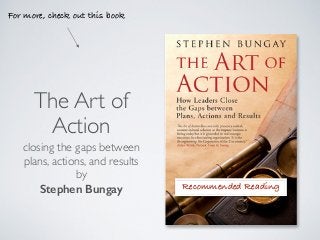
    The Art of Action closingthe gaps between plans, actions, and results by Stephen Bungay For more, check out this book Recommended Reading