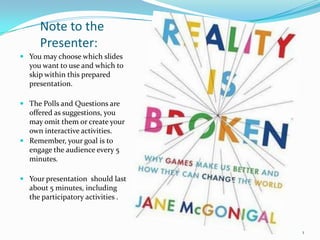
Note to the Presenter:You may choose which slides you want to use and which to skip within this prepared presentation.The Polls and Questions are offered as suggestions, you may omit them or create your own interactive activities.  Remember, your goal is to engage the audience every 5 minutes.Your presentation  should last about 5 minutes, including the participatory activities .1
Presentation for Moderator/Presenter Team 1ID: Andrea HildrethClient: Walden University, Capstone ProjectItem: Book Review, Reality is Broken by Jane McGonigal
Book Review Part ICovering pages 1-51
The Book“Reality is Broken: Why games make us better and how they can change the world”By Jane McGonigal2011, Pengiun Press4
Inclusion of an Outside Resource:About the book:Tinyurl: http://tinyurl.com/3clen5n5
The AuthorJane McGonigal, Ph.D.Director of Game Research and Development at the Institute for the future.In 2009 Business Week called her one of the most important innovators to watch.6
4 Traits of Games as defined by McGonigal“When you strip away the genre differences and the technological competition, all games share four defining traits:GoalRulesFeedback SystemVoluntary Participation”	(p. 12)7
Let’s ChatDo you agree with McGonigal’s “4 Traits of Games”?Do you think that any Trait is more relevant than the others?8
Obstacles“Playing a game is the voluntary attempt to overcome unnecessary obstacles.” Bernard Suits The illustration offered by McGonigal is the game of golf where she notes that if you weren’t playing a game you would just walk over and put the ball into the hole; thus efficiently achieving the ball-into-hole objective.(as cited by McGonigal, p. 22)9
“Fixes” For RealityMcGonigal suggests “Fixes” for “Reality”  We will discuss each of them over this series of presentations.10
Fix #1“Compared with games. Reality is too easy.  Games challenge us with voluntary obstacles and help us put our personal strengths to better use.” (p. 22)11
Example: TetrisTetris is “often dubbed the greatest computer game of all time” It is a game you cannot winIt is addictive(p. 23)12
Why Tetris is AddictiveIntense FeedbackVisual: you see rows of pieces disappearQuantitative: constantly ticking score is prominently displayedQualitative: steady increase in level of challenge13
Fix #2: Emotional Activation“Compared with games, reality is depressing.  Games focus our energy, with relentless optimism, on something we’re good at and enjoy.”(p. 38)14
Poll: How do you feel about Tetris? Never heard of TetrisPlayed a few timesIt’s fun, but I am not addictedI would play for 24 hours straight if I could (just a bit addicted   )15
Let’s ChatDo you think that it is possible to design educational experiences that are addictive?16
Winning is not a game ‘Trait’“Many gamers would rather keep playing than win - thereby ending the gameIn high-feedback games, the state of being intensely engaged may ultimately be more pleasurable than even the satisfaction of winning.” (p. 25)17
Let's ChatCould we create assessment that incorporates “high-feedback”?What would it look like?18
The End of Part IFinal comments and questions?19

Team 1 Presentation

  • 1.
    Note to thePresenter:You may choose which slides you want to use and which to skip within this prepared presentation.The Polls and Questions are offered as suggestions, you may omit them or create your own interactive activities. Remember, your goal is to engage the audience every 5 minutes.Your presentation should last about 5 minutes, including the participatory activities .1
  • 2.
    Presentation for Moderator/PresenterTeam 1ID: Andrea HildrethClient: Walden University, Capstone ProjectItem: Book Review, Reality is Broken by Jane McGonigal
  • 3.
    Book Review PartICovering pages 1-51
  • 4.
    The Book“Reality isBroken: Why games make us better and how they can change the world”By Jane McGonigal2011, Pengiun Press4
  • 5.
    Inclusion of anOutside Resource:About the book:Tinyurl: http://tinyurl.com/3clen5n5
  • 6.
    The AuthorJane McGonigal,Ph.D.Director of Game Research and Development at the Institute for the future.In 2009 Business Week called her one of the most important innovators to watch.6
  • 7.
    4 Traits ofGames as defined by McGonigal“When you strip away the genre differences and the technological competition, all games share four defining traits:GoalRulesFeedback SystemVoluntary Participation” (p. 12)7
  • 8.
    Let’s ChatDo youagree with McGonigal’s “4 Traits of Games”?Do you think that any Trait is more relevant than the others?8
  • 9.
    Obstacles“Playing a gameis the voluntary attempt to overcome unnecessary obstacles.” Bernard Suits The illustration offered by McGonigal is the game of golf where she notes that if you weren’t playing a game you would just walk over and put the ball into the hole; thus efficiently achieving the ball-into-hole objective.(as cited by McGonigal, p. 22)9
  • 10.
    “Fixes” For RealityMcGonigalsuggests “Fixes” for “Reality” We will discuss each of them over this series of presentations.10
  • 11.
    Fix #1“Compared withgames. Reality is too easy. Games challenge us with voluntary obstacles and help us put our personal strengths to better use.” (p. 22)11
  • 12.
    Example: TetrisTetris is“often dubbed the greatest computer game of all time” It is a game you cannot winIt is addictive(p. 23)12
  • 13.
    Why Tetris isAddictiveIntense FeedbackVisual: you see rows of pieces disappearQuantitative: constantly ticking score is prominently displayedQualitative: steady increase in level of challenge13
  • 14.
    Fix #2: EmotionalActivation“Compared with games, reality is depressing. Games focus our energy, with relentless optimism, on something we’re good at and enjoy.”(p. 38)14
  • 15.
    Poll: How doyou feel about Tetris? Never heard of TetrisPlayed a few timesIt’s fun, but I am not addictedI would play for 24 hours straight if I could (just a bit addicted  )15
  • 16.
    Let’s ChatDo youthink that it is possible to design educational experiences that are addictive?16
  • 17.
    Winning is nota game ‘Trait’“Many gamers would rather keep playing than win - thereby ending the gameIn high-feedback games, the state of being intensely engaged may ultimately be more pleasurable than even the satisfaction of winning.” (p. 25)17
  • 18.
    Let's ChatCould wecreate assessment that incorporates “high-feedback”?What would it look like?18
  • 19.
    The End ofPart IFinal comments and questions?19