
Social Gaming
  for Events


  in partnership with
                        An

                             Production
V
Playing that game made me
       feel _________.
Co-creation
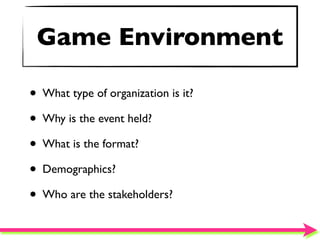
Game Environment

• What type of organization is it?
• Why is the event held?
• What is the format?
• Demographics?
• Who are the stakeholders?
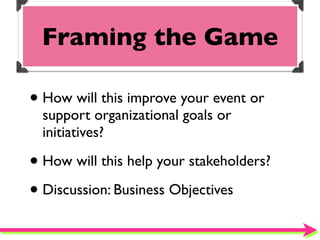
Framing the Game

• How will this improve your event or
  support organizational goals or
  initiatives?

• How will this help your stakeholders?
• Discussion: Business Objectives
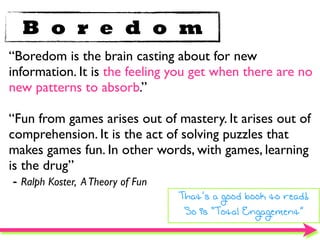
B o r e d o m
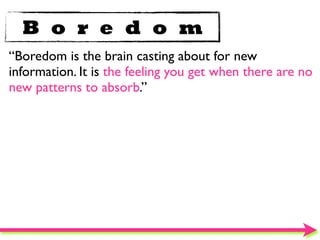
B o r e d o m
“Boredom is the brain casting about for new
information. It is the feeling you get when there are no
new patterns to absorb.”
B o r e d o m
“Boredom is the brain casting about for new
information. It is the feeling you get when there are no
new patterns to absorb.”

“Fun from games arises out of mastery. It arises out of
comprehension. It is the act of solving puzzles that
makes games fun. In other words, with games, learning
is the drug”
 - Ralph Koster, A Theory of Fun
                               That’s a good book to read!
                                So is “Total Engagement”
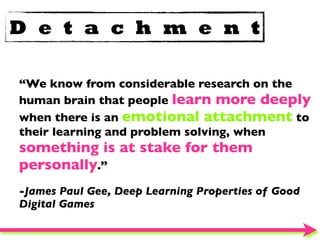
D e t a c h m e n t

“We know from considerable research on the
human brain that people learn more deeply
when there is an emotional attachment to
their learning and problem solving, when
something is at stake for them
personally.”
-James Paul Gee, Deep Learning Properties of Good
Digital Games
Boredom Busters
Boredom Busters
Play/Fun - Role in Learning and Problem Solving
Boredom Busters
Play/Fun - Role in Learning and Problem Solving

  While playing, we enter a state of flow


                               (“flow”: Mihaly Csikzentmihalyi)
Boredom Busters
Play/Fun - Role in Learning and Problem Solving

  While playing, we enter a state of flow
  It’s SAFE!


                               (“flow”: Mihaly Csikzentmihalyi)
Boredom Busters
Play/Fun - Role in Learning and Problem Solving

  While playing, we enter a state of flow
  It’s SAFE!
  Emotional Engagement = Total Commitment


                               (“flow”: Mihaly Csikzentmihalyi)
Boredom Busters
Play/Fun - Role in Learning and Problem Solving

  While playing, we enter a state of flow
  It’s SAFE!
  Emotional Engagement = Total Commitment
  Competition = Engagement

                               (“flow”: Mihaly Csikzentmihalyi)
Boredom Busters
  Play/Fun - Role in Learning and Problem Solving

       While playing, we enter a state of flow
       It’s SAFE!
       Emotional Engagement = Total Commitment
       Competition = Engagement
       Pedagogy
                                             (“flow”: Mihaly Csikzentmihalyi)
(Pedagogy: Malcom Knowles, Alexander Kapp)
I s o l a t i o n
I s o l a t i o n
“Even a small taste of communitas can be enough to
bring us back to the social world if we feel isolated
from it, or to renew our commitment to participating
actively and positively...”
I s o l a t i o n
“Even a small taste of communitas can be enough to
bring us back to the social world if we feel isolated
from it, or to renew our commitment to participating
actively and positively...”

“Experiencing a short burst of community in a space
that previously felt uninviting or simply
uninteresting...becomes a space for us to act and to be
of service, not just to pass through or observe.”
I s o l a t i o n
“Even a small taste of communitas can be enough to
bring us back to the social world if we feel isolated
from it, or to renew our commitment to participating
actively and positively...”

“Experiencing a short burst of community in a space
that previously felt uninviting or simply
uninteresting...becomes a space for us to act and to be
of service, not just to pass through or observe.”
 - Jane McGonigal, Reality is Broken
Communitas
Communitas

Eliminates Exclusivity
Communitas

Eliminates Exclusivity
Emotional Connections
Communitas

Eliminates Exclusivity
Emotional Connections
Trust
Communitas

Eliminates Exclusivity
Emotional Connections
Trust
Fosters innovation
Communitas

Eliminates Exclusivity
Emotional Connections
Trust
Fosters innovation
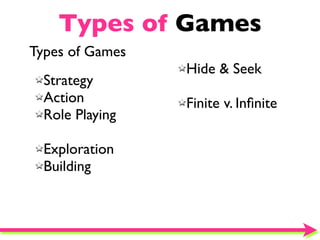
Types of Games
Types of Games
Types of Games
                 Hide & Seek
  Strategy
  Action         Finite v. Infinite
  Role Playing

  Exploration
  Building
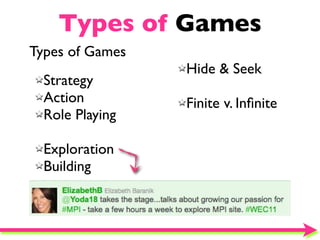
Types of Games
Types of Games
                 Hide & Seek
  Strategy
  Action         Finite v. Infinite
  Role Playing

  Exploration
  Building
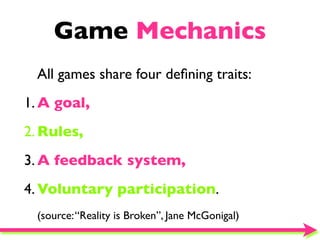
Game Mechanics
 All games share four defining traits:
1. A goal,
2. Rules,
3. A feedback system,
4. Voluntary participation.
 (source: “Reality is Broken”, Jane McGonigal)
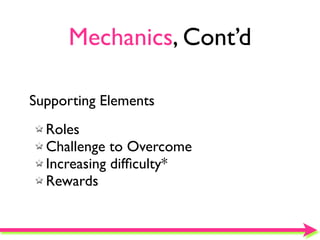
Mechanics, Cont’d

Supporting Elements
  Roles
  Challenge to Overcome
  Increasing difficulty*
  Rewards
Co-creation
 Continued
Let’s Build It!
• Goal
• Rules
• Roles
• Feedback system
• Increasing Difficulty*
• Reward
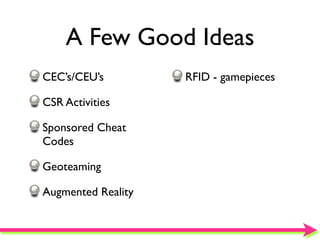
A Few Good Ideas
A Few Good Ideas
CEC’s/CEU’s
A Few Good Ideas
CEC’s/CEU’s

CSR Activities
A Few Good Ideas
CEC’s/CEU’s

CSR Activities

Sponsored Cheat
Codes
A Few Good Ideas
CEC’s/CEU’s

CSR Activities

Sponsored Cheat
Codes

Geoteaming
A Few Good Ideas
CEC’s/CEU’s

CSR Activities

Sponsored Cheat
Codes

Geoteaming

Augmented Reality
A Few Good Ideas
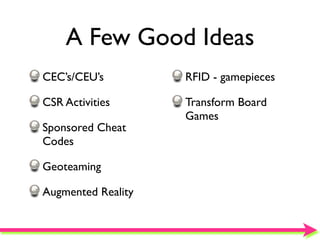
CEC’s/CEU’s         RFID - gamepieces

CSR Activities

Sponsored Cheat
Codes

Geoteaming

Augmented Reality
A Few Good Ideas
CEC’s/CEU’s         RFID - gamepieces

CSR Activities      Transform Board
                    Games
Sponsored Cheat
Codes

Geoteaming

Augmented Reality
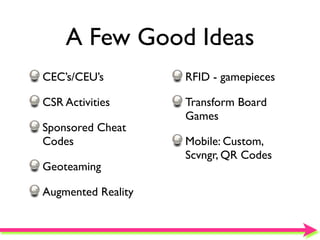
A Few Good Ideas
CEC’s/CEU’s         RFID - gamepieces

CSR Activities      Transform Board
                    Games
Sponsored Cheat
Codes               Mobile: Custom,
                    Scvngr, QR Codes
Geoteaming

Augmented Reality
The session is never over!

Jessica Levin,                          Midori
MBA, CMP                                Connolly
Seven Degrees                           AVGirl
Communications                          midori@pulsestaging.com
engage@sevendegreescommunications.com
                                        @GreenA_V
@JessicaLevin                           gplus.to/midoric
gplus.to/jessicalevin


   http://bit.ly/wec11gaming
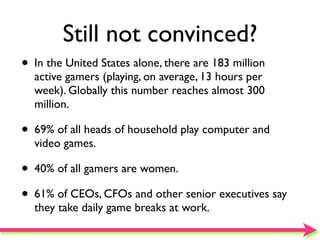
Still not convinced?
• In the United States alone, there are 183 million
  active gamers (playing, on average, 13 hours per
  week). Globally this number reaches almost 300
  million.

• 69% of all heads of household play computer and
  video games.

• 40% of all gamers are women.
• 61% of CEOs, CFOs and other senior executives say
  they take daily game breaks at work.

Social Gaming for Events

  • 1.
    Social Gaming for Events in partnership with An Production
  • 2.
  • 4.
    Playing that gamemade me feel _________.
  • 5.
  • 6.
    Game Environment • Whattype of organization is it? • Why is the event held? • What is the format? • Demographics? • Who are the stakeholders?
  • 7.
    Framing the Game •How will this improve your event or support organizational goals or initiatives? • How will this help your stakeholders? • Discussion: Business Objectives
  • 8.
    B o re d o m
  • 9.
    B o re d o m “Boredom is the brain casting about for new information. It is the feeling you get when there are no new patterns to absorb.”
  • 10.
    B o re d o m “Boredom is the brain casting about for new information. It is the feeling you get when there are no new patterns to absorb.” “Fun from games arises out of mastery. It arises out of comprehension. It is the act of solving puzzles that makes games fun. In other words, with games, learning is the drug” - Ralph Koster, A Theory of Fun That’s a good book to read! So is “Total Engagement”
  • 11.
    D e ta c h m e n t “We know from considerable research on the human brain that people learn more deeply when there is an emotional attachment to their learning and problem solving, when something is at stake for them personally.” -James Paul Gee, Deep Learning Properties of Good Digital Games
  • 12.
  • 13.
    Boredom Busters Play/Fun -Role in Learning and Problem Solving
  • 14.
    Boredom Busters Play/Fun -Role in Learning and Problem Solving While playing, we enter a state of flow (“flow”: Mihaly Csikzentmihalyi)
  • 15.
    Boredom Busters Play/Fun -Role in Learning and Problem Solving While playing, we enter a state of flow It’s SAFE! (“flow”: Mihaly Csikzentmihalyi)
  • 16.
    Boredom Busters Play/Fun -Role in Learning and Problem Solving While playing, we enter a state of flow It’s SAFE! Emotional Engagement = Total Commitment (“flow”: Mihaly Csikzentmihalyi)
  • 17.
    Boredom Busters Play/Fun -Role in Learning and Problem Solving While playing, we enter a state of flow It’s SAFE! Emotional Engagement = Total Commitment Competition = Engagement (“flow”: Mihaly Csikzentmihalyi)
  • 18.
    Boredom Busters Play/Fun - Role in Learning and Problem Solving While playing, we enter a state of flow It’s SAFE! Emotional Engagement = Total Commitment Competition = Engagement Pedagogy (“flow”: Mihaly Csikzentmihalyi) (Pedagogy: Malcom Knowles, Alexander Kapp)
  • 19.
    I s ol a t i o n
  • 20.
    I s ol a t i o n “Even a small taste of communitas can be enough to bring us back to the social world if we feel isolated from it, or to renew our commitment to participating actively and positively...”
  • 21.
    I s ol a t i o n “Even a small taste of communitas can be enough to bring us back to the social world if we feel isolated from it, or to renew our commitment to participating actively and positively...” “Experiencing a short burst of community in a space that previously felt uninviting or simply uninteresting...becomes a space for us to act and to be of service, not just to pass through or observe.”
  • 22.
    I s ol a t i o n “Even a small taste of communitas can be enough to bring us back to the social world if we feel isolated from it, or to renew our commitment to participating actively and positively...” “Experiencing a short burst of community in a space that previously felt uninviting or simply uninteresting...becomes a space for us to act and to be of service, not just to pass through or observe.” - Jane McGonigal, Reality is Broken
  • 23.
  • 24.
  • 25.
  • 26.
  • 27.
  • 28.
  • 29.
  • 30.
    Types of Games Typesof Games Hide & Seek Strategy Action Finite v. Infinite Role Playing Exploration Building
  • 31.
    Types of Games Typesof Games Hide & Seek Strategy Action Finite v. Infinite Role Playing Exploration Building
  • 32.
    Game Mechanics Allgames share four defining traits: 1. A goal, 2. Rules, 3. A feedback system, 4. Voluntary participation. (source: “Reality is Broken”, Jane McGonigal)
  • 33.
    Mechanics, Cont’d Supporting Elements Roles Challenge to Overcome Increasing difficulty* Rewards
  • 34.
  • 35.
    Let’s Build It! •Goal • Rules • Roles • Feedback system • Increasing Difficulty* • Reward
  • 36.
  • 37.
    A Few GoodIdeas CEC’s/CEU’s
  • 38.
    A Few GoodIdeas CEC’s/CEU’s CSR Activities
  • 39.
    A Few GoodIdeas CEC’s/CEU’s CSR Activities Sponsored Cheat Codes
  • 40.
    A Few GoodIdeas CEC’s/CEU’s CSR Activities Sponsored Cheat Codes Geoteaming
  • 41.
    A Few GoodIdeas CEC’s/CEU’s CSR Activities Sponsored Cheat Codes Geoteaming Augmented Reality
  • 42.
    A Few GoodIdeas CEC’s/CEU’s RFID - gamepieces CSR Activities Sponsored Cheat Codes Geoteaming Augmented Reality
  • 43.
    A Few GoodIdeas CEC’s/CEU’s RFID - gamepieces CSR Activities Transform Board Games Sponsored Cheat Codes Geoteaming Augmented Reality
  • 44.
    A Few GoodIdeas CEC’s/CEU’s RFID - gamepieces CSR Activities Transform Board Games Sponsored Cheat Codes Mobile: Custom, Scvngr, QR Codes Geoteaming Augmented Reality
  • 45.
    The session isnever over! Jessica Levin, Midori MBA, CMP Connolly Seven Degrees AVGirl Communications midori@pulsestaging.com engage@sevendegreescommunications.com @GreenA_V @JessicaLevin gplus.to/midoric gplus.to/jessicalevin http://bit.ly/wec11gaming
  • 46.
  • 47.
    Still not convinced? •In the United States alone, there are 183 million active gamers (playing, on average, 13 hours per week). Globally this number reaches almost 300 million. • 69% of all heads of household play computer and video games. • 40% of all gamers are women. • 61% of CEOs, CFOs and other senior executives say they take daily game breaks at work.

Editor's Notes

  • #2 \n
  • #3 \n
  • #4 \n
  • #5 \n
  • #6 \n
  • #7 \n
  • #8 2 minute discussion in groups of 2.\n
  • #9 Ralph Koster, A Theory of Fun\n
  • #10 Ralph Koster, A Theory of Fun\n
  • #11 Ralph Koster, A Theory of Fun\n
  • #12 Ralph Koster, A Theory of Fun\n
  • #13 \n
  • #14 Our best moments (the ones we claim to enjoy the most) occur when we’re voluntarily trying to accomplish something difficult for which we have the right skills.\nadults want to use what they know and be acknowledged for having that knowledge\nadults must experience a need to learn something in order to solve real-life tasks or problems \nencourage learners’ readiness to learn by designing situations where the student will encounter a need for their knowledge or skill\n\n
  • #15 Our best moments (the ones we claim to enjoy the most) occur when we’re voluntarily trying to accomplish something difficult for which we have the right skills.\nadults want to use what they know and be acknowledged for having that knowledge\nadults must experience a need to learn something in order to solve real-life tasks or problems \nencourage learners’ readiness to learn by designing situations where the student will encounter a need for their knowledge or skill\n\n
  • #16 Our best moments (the ones we claim to enjoy the most) occur when we’re voluntarily trying to accomplish something difficult for which we have the right skills.\nadults want to use what they know and be acknowledged for having that knowledge\nadults must experience a need to learn something in order to solve real-life tasks or problems \nencourage learners’ readiness to learn by designing situations where the student will encounter a need for their knowledge or skill\n\n
  • #17 Our best moments (the ones we claim to enjoy the most) occur when we’re voluntarily trying to accomplish something difficult for which we have the right skills.\nadults want to use what they know and be acknowledged for having that knowledge\nadults must experience a need to learn something in order to solve real-life tasks or problems \nencourage learners’ readiness to learn by designing situations where the student will encounter a need for their knowledge or skill\n\n
  • #18 Our best moments (the ones we claim to enjoy the most) occur when we’re voluntarily trying to accomplish something difficult for which we have the right skills.\nadults want to use what they know and be acknowledged for having that knowledge\nadults must experience a need to learn something in order to solve real-life tasks or problems \nencourage learners’ readiness to learn by designing situations where the student will encounter a need for their knowledge or skill\n\n
  • #19 Our best moments (the ones we claim to enjoy the most) occur when we’re voluntarily trying to accomplish something difficult for which we have the right skills.\nadults want to use what they know and be acknowledged for having that knowledge\nadults must experience a need to learn something in order to solve real-life tasks or problems \nencourage learners’ readiness to learn by designing situations where the student will encounter a need for their knowledge or skill\n\n
  • #20 Our best moments (the ones we claim to enjoy the most) occur when we’re voluntarily trying to accomplish something difficult for which we have the right skills.\nadults want to use what they know and be acknowledged for having that knowledge\nadults must experience a need to learn something in order to solve real-life tasks or problems \nencourage learners’ readiness to learn by designing situations where the student will encounter a need for their knowledge or skill\n\n
  • #21 Our best moments (the ones we claim to enjoy the most) occur when we’re voluntarily trying to accomplish something difficult for which we have the right skills.\nadults want to use what they know and be acknowledged for having that knowledge\nadults must experience a need to learn something in order to solve real-life tasks or problems \nencourage learners’ readiness to learn by designing situations where the student will encounter a need for their knowledge or skill\n\n
  • #22 Communitas is an anthropoligical term for the spirit of community. a powerful sense of togetherness, solidarity and social connection. Protects againt loneliness and isolation.\n
  • #23 Communitas is an anthropoligical term for the spirit of community. a powerful sense of togetherness, solidarity and social connection. Protects againt loneliness and isolation.\n
  • #24 Communitas is an anthropoligical term for the spirit of community. a powerful sense of togetherness, solidarity and social connection. Protects againt loneliness and isolation.\n
  • #25 We have social media - most people have the food table.\n\nWe develop identity with a community\nSense of belonging at all times\nAchieving goals gives a sense of shared, common interests.\nAlso, fosters innovation.\n
  • #26 We have social media - most people have the food table.\n\nWe develop identity with a community\nSense of belonging at all times\nAchieving goals gives a sense of shared, common interests.\nAlso, fosters innovation.\n
  • #27 We have social media - most people have the food table.\n\nWe develop identity with a community\nSense of belonging at all times\nAchieving goals gives a sense of shared, common interests.\nAlso, fosters innovation.\n
  • #28 We have social media - most people have the food table.\n\nWe develop identity with a community\nSense of belonging at all times\nAchieving goals gives a sense of shared, common interests.\nAlso, fosters innovation.\n
  • #29 We have social media - most people have the food table.\n\nWe develop identity with a community\nSense of belonging at all times\nAchieving goals gives a sense of shared, common interests.\nAlso, fosters innovation.\n
  • #30 Risk, Strategico. \nFootball, sports-oriented. \nRole Playing - problem solving. All three allow conflict to be practiced.\nExploration - learn about an environment, physical product or space. Scvng, Foursquare or association exploring new website.\nBuilding, much the same.\nHide and Seek combines strategy, exploration of an environment and action\n\n
  • #31 Risk, Strategico. \nFootball, sports-oriented. \nRole Playing - problem solving. All three allow conflict to be practiced.\nExploration - learn about an environment, physical product or space. Scvng, Foursquare or association exploring new website.\nBuilding, much the same.\nHide and Seek combines strategy, exploration of an environment and action\n\n
  • #32 Risk, Strategico. \nFootball, sports-oriented. \nRole Playing - problem solving. All three allow conflict to be practiced.\nExploration - learn about an environment, physical product or space. Scvng, Foursquare or association exploring new website.\nBuilding, much the same.\nHide and Seek combines strategy, exploration of an environment and action\n\n
  • #33 \n
  • #34 \n
  • #35 \n
  • #36 \n
  • #37 \n
  • #38 \n
  • #39 \n
  • #40 \n
  • #41 \n
  • #42 \n
  • #43 \n
  • #44 \n
  • #45 \n
  • #46 \n