The Role of the Librarian In Developing Children’s Libraries Philippine Board on Books for Young People PBBY Workshop Series
Outline I. Tradition vs. Innovation Roles to Play II. Developing a Library for Kids Needs of the Learning Child Reading Skills Stages of Reading Development Stages of Information Processing III. The Children’s Library Sugar! Spice! And everything nice at the library! IV. Resources for Librarians
 
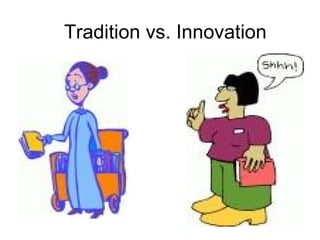
Tradition vs. Innovation
The  school library  provides  information and ideas  that are fundamental to  functioning successfully  in today's information and knowledge-based society. The  school library  equips students with  life-long learning skills  and  develops the imagination , enabling them  to live as responsible citizens.   - UNESCO School Library Manifesto – http://www.ifla.org/VII/s11/pubs/manifest.htm
Roles to Play Teacher - one who designs instruction; one who collaborates with teachers in the planning and implementation of lessons;  Consultant – one who has a grasp of the curriculum able to match and fill the needs of clients; Instructional Technologist – a provider of different technology for teaching and learning processes;
Manager of computing services – a creator of databases and knowledge resources; Manager of learning resources collection – content managers of information systems that facilitate the efficient and effective storage, retrieval, use and communication of learning resources and instructional media.  (Christophers, 2004)
The librarian is teacher, advisor, consultant and information provider; The librarian is an identifier of relevant resources and; (In the academe) Librarians can assist with research products and the evaluation of its results.  ( Thomas, 1999)
The school librarian is the  professionally qualified staff  member responsible for planning and managing the school library,  supported by as adequate staffing  as possible,  working together  with all members of the school community, and  liaising with  the public library and others. In an increasingly networked environment, school librarians  must be competent in planning and teaching different information-handling skills  to both  teachers  and  students .  - UNESCO School Library Manifesto -
LIBRARIAN’S ROLE TEACHER’S ROLE
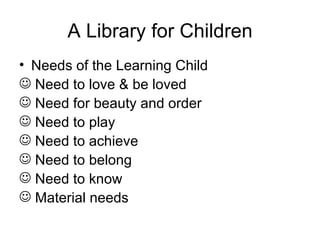
A Library for Children Needs of the Learning Child Need to love & be loved Need for beauty and order Need to play Need to achieve Need to belong Need to know Material needs
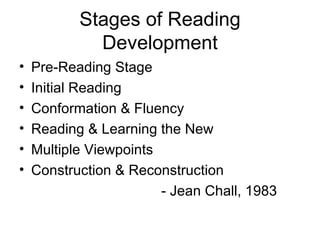
Stages of Reading Development Pre-Reading Stage Initial Reading Conformation & Fluency Reading & Learning the New Multiple Viewpoints Construction & Reconstruction - Jean Chall, 1983
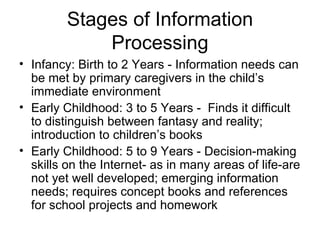
Stages of Information Processing Infancy: Birth to 2 Years  -  Information needs can be met by primary caregivers in the child’s immediate environment Early Childhood: 3 to 5 Years -  Finds it difficult to distinguish between fantasy and reality; introduction to children’s books Early Childhood: 5 to 9 Years  -  Decision-making skills on the Internet- as in many areas of life-are not yet well developed; emerging information needs; requires concept books and references for school projects and homework
Preadolescence: 10-12 Years  -  much better able to distinguish between fantasy and reality ;  information needs are expanding; decision-making skills are developing in more abstract ways   Early Adolescence 13-15 Years  -  Information needs are broader and relate to the world at large, so the availability of some external information source is important Late Adolescence: 16-18 Years - Information needs are extensive in scope and depth and often require access to wide range of resources beyond the immediate environment.
Resources     School Librarian In Action http://lovealibrarian.blogspot.com/ KUTING – Kwentista ng Mga Tskiting http://lagalagnakuting.blogspot.com/ PBBY – Philippine Board On Books for the Young http://www.liza.ph/pbby/index.html    Alitaptap Storytellers Philippines http://www.storytellersphilippines.com/  Ang INK http://.ink.org.ph/angink/angink.html Pinoy Teachers Network http://pinoyteachersnetwork.blog-city.com
Sugar! Spice! And everything nice @ the library   Physical Facilities  Bulletin Boards & Displays Programs & Services Regular Storytelling Program Author & Illustrator Visits Puppet Shows Literary Trivia Book Talks Film Viewing Library Reviews by students, parents, teachers and members of the community Use of resource people (integration with other content disciplines) Online Activities
   Zarah Gagatiga   School Librarian Xavier School 723.0481 loc 225 628. 2620 [email_address] http://lovealibrarian.blogspot.com 09208099214 / 09182293587 / 09209602884

Developing a Children's Library

  • 1.
    The Role ofthe Librarian In Developing Children’s Libraries Philippine Board on Books for Young People PBBY Workshop Series
  • 2.
    Outline I. Traditionvs. Innovation Roles to Play II. Developing a Library for Kids Needs of the Learning Child Reading Skills Stages of Reading Development Stages of Information Processing III. The Children’s Library Sugar! Spice! And everything nice at the library! IV. Resources for Librarians
  • 3.
  • 4.
  • 5.
    The schoollibrary provides information and ideas that are fundamental to functioning successfully in today's information and knowledge-based society. The school library equips students with life-long learning skills and develops the imagination , enabling them to live as responsible citizens. - UNESCO School Library Manifesto – http://www.ifla.org/VII/s11/pubs/manifest.htm
  • 6.
    Roles to PlayTeacher - one who designs instruction; one who collaborates with teachers in the planning and implementation of lessons; Consultant – one who has a grasp of the curriculum able to match and fill the needs of clients; Instructional Technologist – a provider of different technology for teaching and learning processes;
  • 7.
    Manager of computingservices – a creator of databases and knowledge resources; Manager of learning resources collection – content managers of information systems that facilitate the efficient and effective storage, retrieval, use and communication of learning resources and instructional media. (Christophers, 2004)
  • 8.
    The librarian isteacher, advisor, consultant and information provider; The librarian is an identifier of relevant resources and; (In the academe) Librarians can assist with research products and the evaluation of its results. ( Thomas, 1999)
  • 9.
    The school librarianis the professionally qualified staff member responsible for planning and managing the school library, supported by as adequate staffing as possible, working together with all members of the school community, and liaising with the public library and others. In an increasingly networked environment, school librarians must be competent in planning and teaching different information-handling skills to both teachers and students . - UNESCO School Library Manifesto -
  • 10.
  • 11.
    A Library forChildren Needs of the Learning Child Need to love & be loved Need for beauty and order Need to play Need to achieve Need to belong Need to know Material needs
  • 12.
    Stages of ReadingDevelopment Pre-Reading Stage Initial Reading Conformation & Fluency Reading & Learning the New Multiple Viewpoints Construction & Reconstruction - Jean Chall, 1983
  • 13.
    Stages of InformationProcessing Infancy: Birth to 2 Years - Information needs can be met by primary caregivers in the child’s immediate environment Early Childhood: 3 to 5 Years - Finds it difficult to distinguish between fantasy and reality; introduction to children’s books Early Childhood: 5 to 9 Years - Decision-making skills on the Internet- as in many areas of life-are not yet well developed; emerging information needs; requires concept books and references for school projects and homework
  • 14.
    Preadolescence: 10-12 Years - much better able to distinguish between fantasy and reality ; information needs are expanding; decision-making skills are developing in more abstract ways Early Adolescence 13-15 Years - Information needs are broader and relate to the world at large, so the availability of some external information source is important Late Adolescence: 16-18 Years - Information needs are extensive in scope and depth and often require access to wide range of resources beyond the immediate environment.
  • 15.
    Resources  School Librarian In Action http://lovealibrarian.blogspot.com/ KUTING – Kwentista ng Mga Tskiting http://lagalagnakuting.blogspot.com/ PBBY – Philippine Board On Books for the Young http://www.liza.ph/pbby/index.html  Alitaptap Storytellers Philippines http://www.storytellersphilippines.com/  Ang INK http://.ink.org.ph/angink/angink.html Pinoy Teachers Network http://pinoyteachersnetwork.blog-city.com
  • 16.
    Sugar! Spice! Andeverything nice @ the library  Physical Facilities Bulletin Boards & Displays Programs & Services Regular Storytelling Program Author & Illustrator Visits Puppet Shows Literary Trivia Book Talks Film Viewing Library Reviews by students, parents, teachers and members of the community Use of resource people (integration with other content disciplines) Online Activities
  • 17.
    Zarah Gagatiga  School Librarian Xavier School 723.0481 loc 225 628. 2620 [email_address] http://lovealibrarian.blogspot.com 09208099214 / 09182293587 / 09209602884