REGINA MUNDI: IN SERVICE JANUARY 2011YOUNGLEARNERS
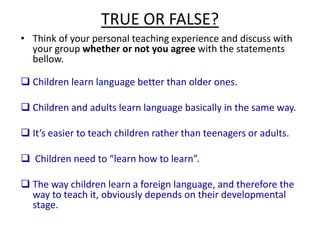
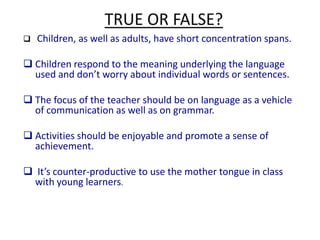
TRUE OR FALSE?Think of your personal teaching experience and discuss with your group whether or not you agreewith the statements bellow. Children learn language better than older ones. Children and adults learn language basically in the same way. It’s easier to teach children rather than teenagers or adults.  Children need to “learn how to learn”. The way children learn a foreign language, and therefore the way to teach it, obviously depends on their developmental stage.TRUE OR FALSE? Children, as well as adults, have short concentration spans. Children respond to the meaning underlying the language used and don’t worry about individual words or sentences.  The focus of the teacher should be on language as a vehicle of communication as well as on grammar. Activities should be enjoyable and promote a sense of achievement.  It’s counter-productive to use the mother tongue in class with young learners.Young Learners’ CharacteristicsTASK -Talkto yourpeersabout Young Learnersandtry and identify the key characteristics of learners you've encountered.If you have no experience of YL classrooms yet, describe children you've got experience of (your own, cousins, friends, etc) - try to think of them in situations where they are learning something new.	What are they like?What do they like?What makes them different from adult learners?
Young Learners’ CharacteristicsSarah Phillips (1993:5) in the introduction to her book 'Young Learners' describes YLs as… … children from the first year of formal schooling (five or six years old) to eleven or twelve years of age. However, as any children's teacher will know, it is not so much the children's age that counts in the classroom as how mature they are. There are many factors that influence children's maturity: for example, their culture, their environment (city or rural), their sex, the expectations of their peers and parents.
Young Learners’ CharacteristicsYoung children do not come to the language classroom empty-handed. They bring with them an already well-established set of instincts, skills and characteristics which will help them to learn another language. We need to identify those and make the most of them. For example, children:
Are already very good at interpreting meaning without necessarily understanding the individual words;
Already have great skill in using limited language creatively;

Young learners

  • 1.
    REGINA MUNDI: INSERVICE JANUARY 2011YOUNGLEARNERS
  • 2.
    TRUE OR FALSE?Thinkof your personal teaching experience and discuss with your group whether or not you agreewith the statements bellow. Children learn language better than older ones. Children and adults learn language basically in the same way. It’s easier to teach children rather than teenagers or adults.  Children need to “learn how to learn”. The way children learn a foreign language, and therefore the way to teach it, obviously depends on their developmental stage.TRUE OR FALSE? Children, as well as adults, have short concentration spans. Children respond to the meaning underlying the language used and don’t worry about individual words or sentences.  The focus of the teacher should be on language as a vehicle of communication as well as on grammar. Activities should be enjoyable and promote a sense of achievement.  It’s counter-productive to use the mother tongue in class with young learners.Young Learners’ CharacteristicsTASK -Talkto yourpeersabout Young Learnersandtry and identify the key characteristics of learners you've encountered.If you have no experience of YL classrooms yet, describe children you've got experience of (your own, cousins, friends, etc) - try to think of them in situations where they are learning something new. What are they like?What do they like?What makes them different from adult learners?
  • 3.
    Young Learners’ CharacteristicsSarahPhillips (1993:5) in the introduction to her book 'Young Learners' describes YLs as… … children from the first year of formal schooling (five or six years old) to eleven or twelve years of age. However, as any children's teacher will know, it is not so much the children's age that counts in the classroom as how mature they are. There are many factors that influence children's maturity: for example, their culture, their environment (city or rural), their sex, the expectations of their peers and parents.
  • 4.
    Young Learners’ CharacteristicsYoungchildren do not come to the language classroom empty-handed. They bring with them an already well-established set of instincts, skills and characteristics which will help them to learn another language. We need to identify those and make the most of them. For example, children:
  • 5.
    Are already verygood at interpreting meaning without necessarily understanding the individual words;
  • 6.
    Already have greatskill in using limited language creatively;