TEACHING TOOLS


          Xon Vilahur i Godoy
          Abril 2012
TEACHING STRATEGIES
Which learning strategies best contribute to students
becoming engaged and active citizens involved in
achieving environmental, social and economic
sustainability?
The Seven Strategies
Learning Locally - Community as Classroom
Integrated Learning
Acting on Learning
Real-World Connections
Considering Alternative Perspectives
Inquiry
Sharing Responsibility for Learning with Students
 http://www.sac.sa.edu.au/Library/Library/Topics/thinking_skills/thinking.html
 http://www.sac.sa.edu.au/Library/Library/Topics/thinking_skills/thinking.html
TEACHING STRATEGIES

1. Journals and logs . Math journals and logs can be particularly helpful for
helping students understand challenging procedures and formulas.

2. Demonstrations The student might show others how to do a process.

3. Products The student might make products or objects that are the end
result or product outcome connected to a learning unit that is happening at
school.

4. Problem-solving processes Problem solving is the starting point. and is
the basic tool for all students.

5. Graphic organizers The student might be asked to use visual formats to
gather, analyze, and evaluate information.


 http://www.innovative-tutoring.com/curriculum.html
TEACHING STRATEGIES

6. Projects The student might construct and create meaningful long-term
projects that incorporate several intelligences. The student is taught how to
organize a project and will engage the students in a variety of individual and
projects focused on improving different skill sets.


7. Exhibits The student might research a topic and prepare an exhibit to
display what he or she has learned.


8. Performances The student might develop a show of visual arts products
for their peers, parents, or their classroom, or for audiences such as senior
citizens and school neighbors.
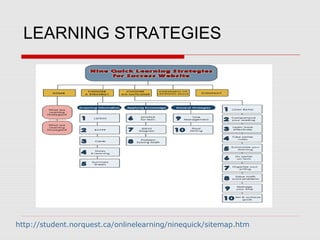
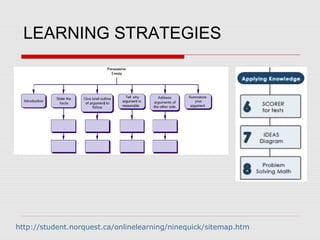
LEARNING STRATEGIES


http://student.norquest.ca/onlinelearning/ninequick/sitemap.htm
LEARNING STRATEGIES
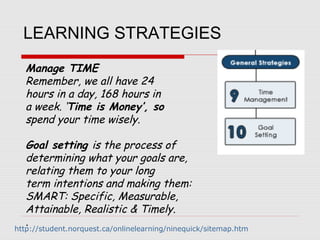
  Manage TIME
  Remember, we all have 24
  hours in a day, 168 hours in
  a week. ‘Time is Money’, so
  spend your time wisely.

  Goal setting is the process of
  determining what your goals are,
  relating them to your long
  term intentions and making them:
  SMART: Specific, Measurable,
  Attainable, Realistic & Timely.
  .
http://student.norquest.ca/onlinelearning/ninequick/sitemap.htm
LEARNING STRATEGIES
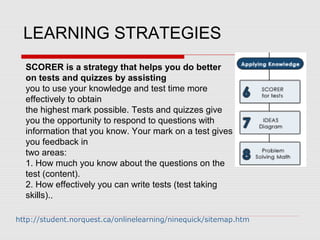
  SCORER is a strategy that helps you do better
  on tests and quizzes by assisting
  you to use your knowledge and test time more
  effectively to obtain
  the highest mark possible. Tests and quizzes give
  you the opportunity to respond to questions with
  information that you know. Your mark on a test gives
  you feedback in
  two areas:
  1. How much you know about the questions on the
  test (content).
  2. How effectively you can write tests (test taking
  skills)..

http://student.norquest.ca/onlinelearning/ninequick/sitemap.htm
LEARNING STRATEGIES


http://student.norquest.ca/onlinelearning/ninequick/sitemap.htm
LEARNING STRATEGIES

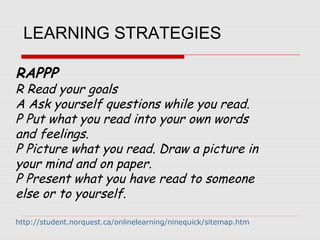
RAPPP
R Read your goals
A Ask yourself questions while you read.
P Put what you read into your own words
and feelings.
P Picture what you read. Draw a picture in
your mind and on paper.
P Present what you have read to someone
else or to yourself.

http://student.norquest.ca/onlinelearning/ninequick/sitemap.htm
GENRE TYPES
   Genre types are text types which learners meet in the
    school curriculum and which have specific purposes,
    structures and language features.
   Every genre has a number of characteristics which
    make it different from other genres.
   Types of genre include: discussion; explanation;
    instruction; proposal; letter; narrative; persuasion;
    recount (to retell events, usually in chronological order,
    e.g. autobiography, setting up an experiment); report;
    review.


http://www.teachingenglish.org.uk/articles/six-types-task-tbl
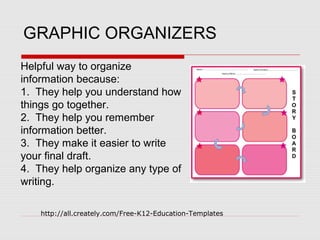
GRAPHIC ORGANIZERS
Helpful way to organize
information because:
1. They help you understand how
things go together.
2. They help you remember
information better.
3. They make it easier to write
your final draft.
4. They help organize any type of
writing.

    http://all.creately.com/Free-K12-Education-Templates
GRAPHIC ORGANIZERS


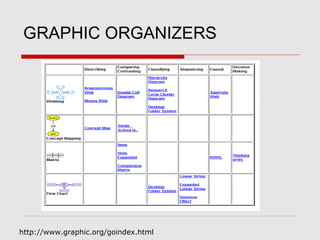
http://www.graphic.org/goindex.html
GRAPHIC ORGANIZERS

Cluster Diagrams – good for descriptive writing, especially when
you have a lot of different ideas.
Charts – good for writing directions of how to do something, or for
keeping a lot of different ideas in categories.
Venn Diagrams – good for comparing things that are the same
and different.
Story Maps – good for retelling books, plays or stories.
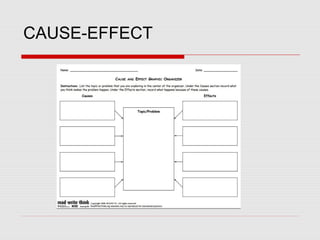
Cause and Effect Diagrams – good for explaining how something
happened.
Outlines – good for big topics with lots of main ideas and details.
Outlines are also good for persuasive writing.
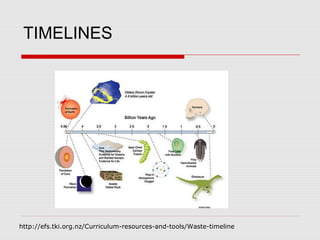
Timelines - good for telling the order of how things happen in
time.

http://library.thinkquest.org/J001156/writing%20process/sl_graphic_organizers.htm?
     tqskip=1
CAUSE-EFFECT
TIMELINES


http://efs.tki.org.nz/Curriculum-resources-and-tools/Waste-timeline
GAMES
Bingo
http://www.bingocardcreator.com/bingo-cards/science

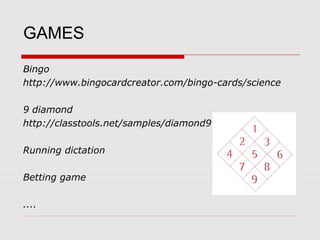
9 diamond
http://classtools.net/samples/diamond9

Running dictation

Betting game

....
SONGS, FILMS,
CARTOONS,DRAMA
“Music, art, drama and sports – there
  are what kept me involved when I
  was at school. And these very things,
  that make a teacher’s and a student’s
  job easier and more rewarding, are
  what’s been cut from curriculum
  across the country.” Tom Chapin.

So, let’s song!

Teaching tools

  • 1.
    TEACHING TOOLS Xon Vilahur i Godoy Abril 2012
  • 2.
    TEACHING STRATEGIES Which learningstrategies best contribute to students becoming engaged and active citizens involved in achieving environmental, social and economic sustainability? The Seven Strategies Learning Locally - Community as Classroom Integrated Learning Acting on Learning Real-World Connections Considering Alternative Perspectives Inquiry Sharing Responsibility for Learning with Students http://www.sac.sa.edu.au/Library/Library/Topics/thinking_skills/thinking.html http://www.sac.sa.edu.au/Library/Library/Topics/thinking_skills/thinking.html
  • 3.
    TEACHING STRATEGIES 1. Journalsand logs . Math journals and logs can be particularly helpful for helping students understand challenging procedures and formulas. 2. Demonstrations The student might show others how to do a process. 3. Products The student might make products or objects that are the end result or product outcome connected to a learning unit that is happening at school. 4. Problem-solving processes Problem solving is the starting point. and is the basic tool for all students. 5. Graphic organizers The student might be asked to use visual formats to gather, analyze, and evaluate information. http://www.innovative-tutoring.com/curriculum.html
  • 4.
    TEACHING STRATEGIES 6. ProjectsThe student might construct and create meaningful long-term projects that incorporate several intelligences. The student is taught how to organize a project and will engage the students in a variety of individual and projects focused on improving different skill sets. 7. Exhibits The student might research a topic and prepare an exhibit to display what he or she has learned. 8. Performances The student might develop a show of visual arts products for their peers, parents, or their classroom, or for audiences such as senior citizens and school neighbors.
  • 5.
  • 6.
    LEARNING STRATEGIES Manage TIME Remember, we all have 24 hours in a day, 168 hours in a week. ‘Time is Money’, so spend your time wisely. Goal setting is the process of determining what your goals are, relating them to your long term intentions and making them: SMART: Specific, Measurable, Attainable, Realistic & Timely. . http://student.norquest.ca/onlinelearning/ninequick/sitemap.htm
  • 7.
    LEARNING STRATEGIES SCORER is a strategy that helps you do better on tests and quizzes by assisting you to use your knowledge and test time more effectively to obtain the highest mark possible. Tests and quizzes give you the opportunity to respond to questions with information that you know. Your mark on a test gives you feedback in two areas: 1. How much you know about the questions on the test (content). 2. How effectively you can write tests (test taking skills).. http://student.norquest.ca/onlinelearning/ninequick/sitemap.htm
  • 8.
  • 9.
    LEARNING STRATEGIES RAPPP R Readyour goals A Ask yourself questions while you read. P Put what you read into your own words and feelings. P Picture what you read. Draw a picture in your mind and on paper. P Present what you have read to someone else or to yourself. http://student.norquest.ca/onlinelearning/ninequick/sitemap.htm
  • 10.
    GENRE TYPES  Genre types are text types which learners meet in the school curriculum and which have specific purposes, structures and language features.  Every genre has a number of characteristics which make it different from other genres.  Types of genre include: discussion; explanation; instruction; proposal; letter; narrative; persuasion; recount (to retell events, usually in chronological order, e.g. autobiography, setting up an experiment); report; review. http://www.teachingenglish.org.uk/articles/six-types-task-tbl
  • 11.
    GRAPHIC ORGANIZERS Helpful wayto organize information because: 1. They help you understand how things go together. 2. They help you remember information better. 3. They make it easier to write your final draft. 4. They help organize any type of writing. http://all.creately.com/Free-K12-Education-Templates
  • 12.
  • 13.
    GRAPHIC ORGANIZERS Cluster Diagrams– good for descriptive writing, especially when you have a lot of different ideas. Charts – good for writing directions of how to do something, or for keeping a lot of different ideas in categories. Venn Diagrams – good for comparing things that are the same and different. Story Maps – good for retelling books, plays or stories. Cause and Effect Diagrams – good for explaining how something happened. Outlines – good for big topics with lots of main ideas and details. Outlines are also good for persuasive writing. Timelines - good for telling the order of how things happen in time. http://library.thinkquest.org/J001156/writing%20process/sl_graphic_organizers.htm? tqskip=1
  • 14.
  • 15.
  • 16.
  • 17.
    SONGS, FILMS, CARTOONS,DRAMA “Music, art,drama and sports – there are what kept me involved when I was at school. And these very things, that make a teacher’s and a student’s job easier and more rewarding, are what’s been cut from curriculum across the country.” Tom Chapin. So, let’s song!