ACCELERATED
  LEARNING
 How can you learn most effectively?

                ~Or

       Learning how to learn
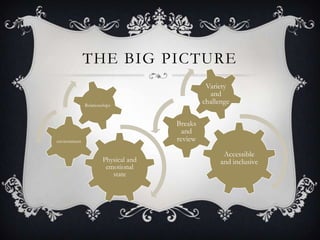
THE BIG PICTURE
                                                Variety
                                                 and
              Relationships
                                               challenge

                                      Breaks
                                        and
environment                           review

                                                     Accessible
                       Physical and                 and inclusive
                        emotional
                          state
PREPARE TO LEARN

             Relax
        The correct diet
            Hydrate
         Temperature
     Oxygen and light levels
         Reduce stress
           Motivate
             Sleep
RELAXATION
Basic meditation techniques can be learned. A simple focus on breathing,
in through the nose out through the mouth is good. A visualisation of an
activity or environment that makes you happy, that can be recalled prior to
                         learning or assessment,
DIET

Vitamins A/B/C/E help to make you alert, improve vision, improve
          memory and help support proper brain function.
                 Avoid starch, sugar and caffeine.
                      Never miss breakfast.
                Eat regularly throughout the day.
HYDRATION
  Hydration helps to maintain optimum brain functioning.

            Always explain the benefits of water.

Allow/encourage use of water bottles. This will also minimise
                       interruptions.
TEMPERATURE
Have a thermometer in your room, this will allow you to maintain an optimum temperature
                          that is not too hot and not too cold.
OXYGEN AND LIGHT
          LEVELS
                            Open your windows.
Keep plants in your room, they also filter out harmful gasses from computers.
Allow as much natural light as possible, avoid fluorescent lighting if at all
                                  possible.
REDUCE STRESS
Acknowledge the presence and importance of stress to your students.

                 Use music to relax your students.

                 Use basic meditation techniques.

                    Have plants in your room.
MOTIVATION
         The most effective motivation is intrinsic not extrinsic.

Establish “what’s in it for me”. Allow students to set their own learning
                      goals. Use SMART targets.
SLEEP
 Sleep helps you to remember what you have learnt during the day.
Remember, the hours before midnight are more important than after!
ROOM TO LEARN

 Your class room should be a multisensory environment.
 Displays are an essential part of this.
 They should include :
 Students work, including examples of different abilities.
 Work to illustrate assessment objectives.
 Motivational posters.
 Key words of the topics.
MUSIC TO AID
              LEARNING
               Its not just baroque music that helps.

Remember, most students will listen to music at home while studying.

                 Some even find silence unsettling!
MUSIC TO AID
    LEARNING-PLAN IT,
    DON’T JUST PLAY IT!
           Upbeat positive music at the start of the class.

                 Music linked to the topic of study.

Use relaxing background music (60 beats per minute) to aid learning.

              Use dramatic music to conclude a lesson.
CREATE A SUPPORTIVE
LEARNING ENVIRONMENT.
Ensure there are clear class room rules, and clear sanctions negotiated by
  the students. Focus on helping others to learn. Allow students to express
 what they expect from their teacher. Keep expectations high and linked with
ability. Allow, even encourage mistakes. Listen to everyone's views and do not
allow personal put downs. Give frequent praise and don’t always try and be
                                    right.
TEACHING STRATEGIES.
 Starting a lesson
 Structuring a lesson
 Questioning
 Use variation in your teaching style
 Explaining and introducing tasks
 Setting tasks
 Show them what they have learned.
 Review
 Homework
STARTING A LESSON

 Arrive before the students.

 Greet each student

 Insist students enter quietly and settle quickly

 Consider using music to set the tone of the lesson.

 Ensure equipment and hand-outs are already on desks.

 Engage students interests with a starter or warm up activity.
STRUCTURING A LESSON

  Part 1: put the learning in          Part 2: Starter
            context.              A short activity that engages
 Review learning from               the students interest – a
previous lesson.                  prop/story/exciting stimulus.
 Relate learning to syllabus
                                  Try to put prior knowledge in
 Make learning outcomes                     context.
clear.
                                     Prepare for main task.
STRUCTURING A LESSON
     Part 3: Main teaching and
               learning.                        Part 4: Plenary
 Students should be engaged for
                                            An opportunity to review
75% of the lesson.
 Act as facilitator, don’t talk for too            learning.
long.                                       A chance to reflect on the
 Learning should be multi-sensory
                                                  main learning.
and engage different learning styles.
 Works should be                             Careful questioning.
differentiated, challenging and broken
into achievable chunks.
QUESTIONING

 Pitch language and content at an appropriate level
 Ask open and closed questions
 Prompt and give clues
 Allow thinking time
 Invite answers
 Wait before commenting
 Allow students to devise their own questions
USE
           VA R I AT I O N I N YO U R
            T E AC H I N G S T Y L E

  A greater variety in teaching styles is more effective for learning
and stimulates interest and motivation, Use the check list provided to
                   reflect on your teaching styles.
EXPLAINING AND
       INTRODUCING TASKS
 Give the tasks verbally and in writing.

 Make sure everyone understands the assessment criteria.

 Carefully differentiate all tasks.

 Break up all new information into chunks

 Give a time frame.
SETTING AND MANAGING
          TASKS
 Offer a choice in the task or the way the results are presented.

 Include a variety of task to appeal to different types of learner.

 Allow plenty of opportunity for individual/group/pair work.

 Circulate widely.

 Do not insist on silence as long as they are focused on the task.

 Maximise the time spent on carrying out and reflecting on the task.
SHOW THEM WHAT
THEY HAVE LEARNED
        Checking answers.

      Reading out responses.

     Presentations to the class.

           Completion.
REVIEW

   Students need plenty of opportunities to review what they have
            learned. This could take place in the plenary.

 Writing out summary points

 Drawing a mind map of a lesson

 Naming the most important thing they learned.

 Preparing flash cards or summary diagrams.
HOMEWORK

Effective:                         Ineffective:
 Used to extend learning            Finishing of work done in
 Builds on what is learnt in the   lessons.
lesson                               Optional
 Takes advantage of students        Give to specific students, eg
home lives                          those who did not complete work
 Is enjoyable                      in class.
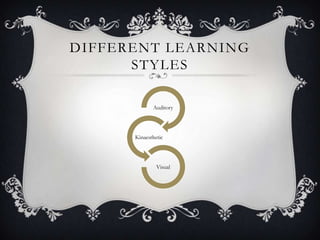
DIFFERENT LEARNING
      STYLES

             Auditory


      Kinaesthetic


               Visual
AUDITORY

 Characteristics                    Learning Activities
 Listen to music when relaxing      Hearing a presentation

 Prefer to talk on the phone        Reading aloud

 Eager to talk                      Making a tape to listen to
                                     Verbal summaries
 Forget faces but remember names
                                     Explaining to another student
 Talk when inactive
                                     Internal verbalisations
 Outburst when angry
                                     Practice saying words before writing
 Don’t like reading books or
manuals
KINAESTHETIC

 Characteristics                       Learning Activities
 Play games or sport to relax          Copy demonstrations

 Prefer to talk while doing            Make models
something else                          Record information as they hear
                                       it, preferably as a mind map
 Slow talkers, using gestures and
expressions                             Walk around as they read
                                        Underline/highlight new information
 Fidget when inactive
                                        Use index cards for key points
 When angry they clench fists, grit
teeth and storm off.
VISUAL

 Characteristics                             Learning Activities
 Prefer to watch a film or TV or read a
                                              Write down key facts or draw a
book to relax
 Prefer to talk face-to-face
                                             mind map

 Fast talkers, don’t enjoy listening         Visualise
 Forget names but remember faces             Create pictures or diagrams
 When inactive they doodle or watch
                                              Use time lines for remembering
something or someone
                                             dates
 When angry they remain silent and seethe
                                              Create strong visual links

Accelerated learning

  • 1.
    ACCELERATED LEARNING How can you learn most effectively? ~Or Learning how to learn
  • 2.
    THE BIG PICTURE Variety and Relationships challenge Breaks and environment review Accessible Physical and and inclusive emotional state
  • 3.
    PREPARE TO LEARN  Relax  The correct diet  Hydrate  Temperature  Oxygen and light levels  Reduce stress  Motivate  Sleep
  • 4.
    RELAXATION Basic meditation techniquescan be learned. A simple focus on breathing, in through the nose out through the mouth is good. A visualisation of an activity or environment that makes you happy, that can be recalled prior to learning or assessment,
  • 5.
    DIET Vitamins A/B/C/E helpto make you alert, improve vision, improve memory and help support proper brain function. Avoid starch, sugar and caffeine. Never miss breakfast. Eat regularly throughout the day.
  • 6.
    HYDRATION Hydrationhelps to maintain optimum brain functioning. Always explain the benefits of water. Allow/encourage use of water bottles. This will also minimise interruptions.
  • 7.
    TEMPERATURE Have a thermometerin your room, this will allow you to maintain an optimum temperature that is not too hot and not too cold.
  • 8.
    OXYGEN AND LIGHT LEVELS Open your windows. Keep plants in your room, they also filter out harmful gasses from computers. Allow as much natural light as possible, avoid fluorescent lighting if at all possible.
  • 9.
    REDUCE STRESS Acknowledge thepresence and importance of stress to your students. Use music to relax your students. Use basic meditation techniques. Have plants in your room.
  • 10.
    MOTIVATION The most effective motivation is intrinsic not extrinsic. Establish “what’s in it for me”. Allow students to set their own learning goals. Use SMART targets.
  • 11.
    SLEEP Sleep helpsyou to remember what you have learnt during the day. Remember, the hours before midnight are more important than after!
  • 12.
    ROOM TO LEARN Your class room should be a multisensory environment.  Displays are an essential part of this.  They should include :  Students work, including examples of different abilities.  Work to illustrate assessment objectives.  Motivational posters.  Key words of the topics.
  • 13.
    MUSIC TO AID LEARNING Its not just baroque music that helps. Remember, most students will listen to music at home while studying. Some even find silence unsettling!
  • 14.
    MUSIC TO AID LEARNING-PLAN IT, DON’T JUST PLAY IT! Upbeat positive music at the start of the class. Music linked to the topic of study. Use relaxing background music (60 beats per minute) to aid learning. Use dramatic music to conclude a lesson.
  • 15.
    CREATE A SUPPORTIVE LEARNINGENVIRONMENT. Ensure there are clear class room rules, and clear sanctions negotiated by the students. Focus on helping others to learn. Allow students to express what they expect from their teacher. Keep expectations high and linked with ability. Allow, even encourage mistakes. Listen to everyone's views and do not allow personal put downs. Give frequent praise and don’t always try and be right.
  • 16.
    TEACHING STRATEGIES.  Startinga lesson  Structuring a lesson  Questioning  Use variation in your teaching style  Explaining and introducing tasks  Setting tasks  Show them what they have learned.  Review  Homework
  • 17.
    STARTING A LESSON Arrive before the students.  Greet each student  Insist students enter quietly and settle quickly  Consider using music to set the tone of the lesson.  Ensure equipment and hand-outs are already on desks.  Engage students interests with a starter or warm up activity.
  • 18.
    STRUCTURING A LESSON  Part 1: put the learning in  Part 2: Starter context.  A short activity that engages  Review learning from the students interest – a previous lesson. prop/story/exciting stimulus.  Relate learning to syllabus  Try to put prior knowledge in  Make learning outcomes context. clear.  Prepare for main task.
  • 19.
    STRUCTURING A LESSON  Part 3: Main teaching and learning.  Part 4: Plenary  Students should be engaged for  An opportunity to review 75% of the lesson.  Act as facilitator, don’t talk for too learning. long.  A chance to reflect on the  Learning should be multi-sensory main learning. and engage different learning styles.  Works should be  Careful questioning. differentiated, challenging and broken into achievable chunks.
  • 20.
    QUESTIONING  Pitch languageand content at an appropriate level  Ask open and closed questions  Prompt and give clues  Allow thinking time  Invite answers  Wait before commenting  Allow students to devise their own questions
  • 21.
    USE VA R I AT I O N I N YO U R T E AC H I N G S T Y L E  A greater variety in teaching styles is more effective for learning and stimulates interest and motivation, Use the check list provided to reflect on your teaching styles.
  • 22.
    EXPLAINING AND INTRODUCING TASKS  Give the tasks verbally and in writing.  Make sure everyone understands the assessment criteria.  Carefully differentiate all tasks.  Break up all new information into chunks  Give a time frame.
  • 23.
    SETTING AND MANAGING TASKS  Offer a choice in the task or the way the results are presented.  Include a variety of task to appeal to different types of learner.  Allow plenty of opportunity for individual/group/pair work.  Circulate widely.  Do not insist on silence as long as they are focused on the task.  Maximise the time spent on carrying out and reflecting on the task.
  • 24.
    SHOW THEM WHAT THEYHAVE LEARNED  Checking answers.  Reading out responses.  Presentations to the class.  Completion.
  • 25.
    REVIEW Students need plenty of opportunities to review what they have learned. This could take place in the plenary.  Writing out summary points  Drawing a mind map of a lesson  Naming the most important thing they learned.  Preparing flash cards or summary diagrams.
  • 26.
    HOMEWORK Effective: Ineffective:  Used to extend learning  Finishing of work done in  Builds on what is learnt in the lessons. lesson  Optional  Takes advantage of students  Give to specific students, eg home lives those who did not complete work  Is enjoyable in class.
  • 27.
    DIFFERENT LEARNING STYLES Auditory Kinaesthetic Visual
  • 28.
    AUDITORY  Characteristics  Learning Activities  Listen to music when relaxing  Hearing a presentation  Prefer to talk on the phone  Reading aloud  Eager to talk  Making a tape to listen to  Verbal summaries  Forget faces but remember names  Explaining to another student  Talk when inactive  Internal verbalisations  Outburst when angry  Practice saying words before writing  Don’t like reading books or manuals
  • 29.
    KINAESTHETIC  Characteristics  Learning Activities  Play games or sport to relax  Copy demonstrations  Prefer to talk while doing  Make models something else  Record information as they hear it, preferably as a mind map  Slow talkers, using gestures and expressions  Walk around as they read  Underline/highlight new information  Fidget when inactive  Use index cards for key points  When angry they clench fists, grit teeth and storm off.
  • 30.
    VISUAL  Characteristics  Learning Activities  Prefer to watch a film or TV or read a  Write down key facts or draw a book to relax  Prefer to talk face-to-face mind map  Fast talkers, don’t enjoy listening  Visualise  Forget names but remember faces  Create pictures or diagrams  When inactive they doodle or watch  Use time lines for remembering something or someone dates  When angry they remain silent and seethe  Create strong visual links